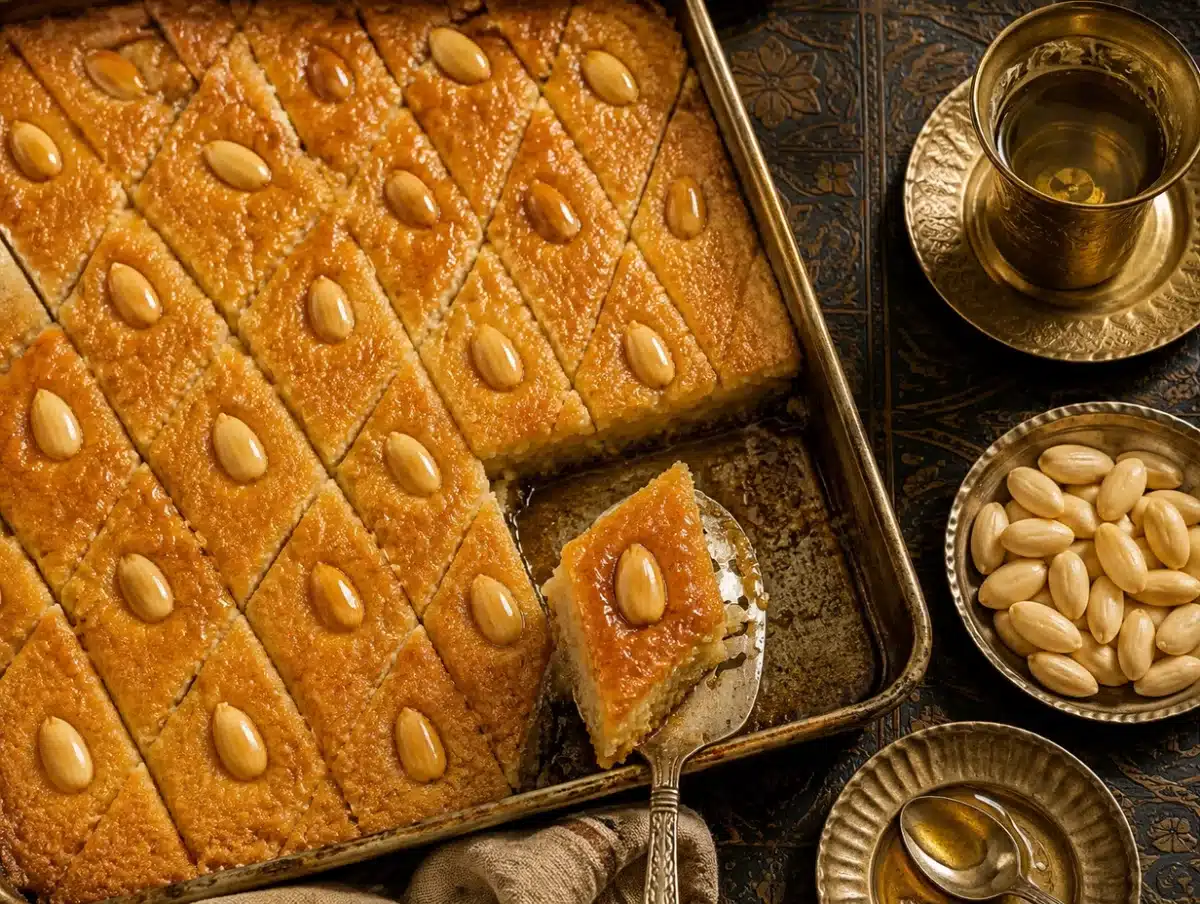
March 14th, 2021. My friend Dina — a Cairo-born food writer who has opinions about semolina that border on spiritual — invited eight of us over for what she called a ‘simple dessert night.’ She made her grandmother’s Egyptian basbousa: a golden, syrup-drenched semolina cake (Basbousa Revani) that smelled of orange blossom and warm butter. I had three pieces. Three. I went home and immediately tried to replicate it and produced something that could generously be described as grainy, dry, and vaguely sad.
It took me eleven attempts over six months — I kept a notes document titled ‘semolina disasters’ — before I nailed the texture, the syrup ratio, and the exact moment to pour the syrup. These are those eleven batches, distilled into seven secrets.
Table of Contents
Semolina Cake (Basbousa Revani)
Ingredients
Method
- 1. Preheat oven to 350°F (180°C). Brush a 9×13 inch baking pan with tahini paste.
- 2. In a large bowl, combine both semolinas, sugar, baking powder, and coconut (if using). Stir together.
- 3. Add yogurt and melted ghee. Mix with a spatula until a thick, uniform batter forms. Do not over-mix.
- 4. IMPORTANT: Cover batter and rest 20–30 minutes. This allows semolina to fully hydrate.
- 5. Pour batter into prepared pan. Smooth the top with a wet spatula. Score diamond or square portions with a sharp knife. Press one almond into the center of each portion.
- 6. Bake 35–40 minutes until deep golden brown. If needed, broil 2–3 minutes for color — watch carefully.
- 7. While cake bakes, make syrup: combine sugar, water, and lemon juice in saucepan. Bring to boil, reduce, simmer 5–7 minutes until slightly thickened. Stir in orange blossom water. Cool to room temperature.
- 8. Remove hot cake from oven. Re-score the lines. Pour ALL the cooled syrup evenly over the hot cake.
- 9. Rest uncovered at least 60 minutes (overnight for best results). Serve at room temperature.
Notes
Why This Semolina Cake Recipe Works
The Science of Semolina: Why It Drinks Syrup So Beautifully
The thing that makes semolina cake (basbousa/revani) unlike any other baked dessert is the granule structure of semolina itself. Coarse durum wheat semolina — um, as opposed to fine semolina, which is a different animal entirely — has a starch matrix that gelatinizes during baking but remains slightly open at a microscopic level.
This is why, as Harold McGee explains in On Food and Cooking, starch-based baked goods with a coarser grind absorb liquid more readily than fine-flour cakes. Basically: the semolina is built to soak. Pouring hot syrup over a hot cake would create a soggy mess; pouring cool syrup over a hot cake creates the perfect tension — the cake pulls the syrup inward like a sponge. That’s the whole trick.
A Dessert That Crosses Borders
Few desserts have traveled as widely as semolina cake with syrup. In Egypt it’s called basbousa (or harissa in Upper Egypt). In Turkey and Greece it’s revani (or ravani). In Lebanon and Syria, it’s namoura. In Jordan and Palestine, it’s hareesa. Each version uses the same syrup-soaking principle but varies the aromatic — lemon zest in the Turkish revani, orange blossom water in the Lebanese namoura, rose water in the Egyptian basbousa. Honestly, the variations make this Mediterranean semolina dessert one of the most adaptable in the world. Much like our Greek yogurt panna cotta, the beauty is in how a small change to aromatic creates an entirely different experience.
Essential Basbousa Ingredients
What You Need and Why Each Item Matters
Let me be direct: basbousa ingredients are simple. But ‘simple’ does not mean ‘interchangeable.’ The choice between fine and coarse semolina, between butter and ghee, between plain yogurt and Greek yogurt — these decisions completely change your final cake. Here’s the full breakdown with my (strongly held) preferences:
- Coarse semolina (250g): The backbone. Coarse gives you that signature slightly grainy, nutty bite. Fine semolina alone makes it too smooth — loses the character. I prefer a 3:1 coarse-to-fine ratio. See below.
- Fine semolina (80g): A minority addition that helps bind and softens the crumb slightly without killing the texture.
- Plain yogurt (150g): NOT Greek yogurt — the thickness of Greek yogurt creates too-dense a batter. Full-fat plain yogurt is the move.
- Ghee (80g, melted): More authentic than butter, ghee’s clarified fat creates a richer, nuttier crumb. Substitute with melted unsalted butter if needed.
- Sugar (120g): For the cake only — the syrup adds most of the sweetness.
- Baking powder (1 tsp): Just enough lift so it’s not a brick.
- Desiccated coconut (50g, optional): Traditional in Egyptian basbousa, omit for Turkish revani style.
- Blanched almonds: For garnish, pressed into each diamond portion before baking.
Semolina Grain Size Comparison — Why It Matters
| Semolina Type | Texture Result | Best For | USA Brand Example |
| All coarse | Grainy, nutty, authentic | Traditional Egyptian basbousa | Bob’s Red Mill Semolina |
| 3:1 coarse to fine | Soft but textured — the sweet spot | Versatile basbousa/revani | Mix Bob’s + fine durum |
| All fine semolina | Smooth, almost cakey | Turkish revani | Hodgson Mill Fine Semolina |
| Farina (Cream of Wheat) | Very smooth, velvety | Ultra-soft modern basbousa | Cream of Wheat Original |
| All-purpose flour only | Standard cake texture | Greek ravani style | Any brand |
The game-changing secret? Tahini the pan. Instead of butter-and-flour, brush your baking dish with a thin layer of tahini paste before pouring the batter. It creates an incredible nutty crust on the bottom layer that most people assume is from the semolina itself. It also prevents sticking better than anything else I’ve tried. (I know, I was skeptical too.) For more Middle Eastern-inspired flavor pairings, our Mediterranean chickpea power bowl uses tahini in a similar base-building way.
USA substitutions: Can’t find ghee? Brown the butter first before melting — you get the same nutty Maillard compounds. No orange blossom water? A combination of orange zest and a few drops of vanilla achieves similar floral depth. And for the full Mediterranean desserts collection, many of these substitution principles apply across multiple recipes.
The Foolproof Method
Preparation: Mixing the Batter and the Syrup
Step 1 (10 minutes): Preheat your oven to 350°F (180°C). Brush a 9×13 inch baking pan generously with tahini (or melted ghee as a backup). Set aside.
Step 2 (5 minutes): In a large bowl, whisk together the basbousa ingredients — coarse semolina, fine semolina, sugar, desiccated coconut, and baking powder. Make a well in the center.
Step 3 (3 minutes): Add the plain yogurt and melted ghee to the well. Mix with a wooden spoon or rubber spatula until a thick, uniform batter forms. Do not over-mix — you’re not developing gluten here, just combining.
Step 4 (REST — this is the secret most skip): Cover the batter and let it rest for 20–30 minutes before baking. This allows the semolina to hydrate fully. Skip this step and your cake will be gritty rather than tender. Kenji Lopez-Alt talks about this hydration rest for semolina-based batters — the grains absorb liquid and swell, which transforms the crumb dramatically.
Step 5 (2 minutes): Pour the rested batter into the prepared pan. Smooth the top with a wet spatula. Using a sharp knife, score diamond or square portions before baking — this is critical for syrup absorption later. Press one blanched almond into the center of each portion.
Baking and Syruping: The Steps Everyone Gets Wrong
Step 6 (35–40 minutes): Bake at 350°F until deep golden brown on top. It should be genuinely golden, not just set — pale semolina cake (basbousa/revani) doesn’t absorb syrup as well because the surface hasn’t formed the right crust. If needed, finish under the broiler for 2–3 minutes but watch it closely. My second attempt burned under the broiler because I got distracted watching a documentary about competitive cheese-making. Don’t be me.
Step 7 — THE SYRUP (make while cake bakes): Combine 250g sugar, 200ml water, 1 tbsp lemon juice, and optionally 1 tbsp orange blossom water in a saucepan. Bring to a boil, reduce heat, and simmer for 5–7 minutes until slightly thickened and coats the back of a spoon. Allow to cool to room temperature — same principle as loukoumades. The thermal contrast between hot cake and cool syrup is what drives absorption rather than pooling. This is, in my extremely strong opinion, the single most important step in this entire recipe.
Step 8: Remove hot cake from oven. Immediately re-score the lines deeply with a sharp knife. Pour cool syrup slowly and evenly across the entire surface, starting from the edges. You’ll hear a satisfying hiss. Pour ALL of it. Do not be timid. Let the cake rest, uncovered, for at least 60 minutes (or up to overnight — it genuinely improves). This is similar to the resting technique in our classic Greek lemon rice pilafi, where patience after cooking transforms the final texture.
Step 9: Serve at room temperature or slightly warm. Cut along the score lines. Each piece of this syrup soaked cake should be glossy, tender, and hold its shape. A well-made semolina cake with syrup that’s rested overnight will be far superior to one served immediately — Dina told me this on attempt eight, and it genuinely changed everything. For a complete dessert spread, this pairs beautifully after our gemista Greek stuffed peppers as part of a full Mediterranean feast.
Creative Variations
Regional Versions and Modern Twists
This is where things get genuinely fun, because semolina cake (basbousa/revani) has perhaps more legitimate regional variations than almost any dessert I know. Each one is authentic. Each one is delicious. Each one will cause a minor argument at a dinner table if you claim one is ‘the original.’ (I’ve seen it happen. I’ve caused it to happen.)
| Variation | Key Difference | Syrup Flavor | Best For | Dietary Note |
| Egyptian Basbousa | Coconut in batter, yogurt base | Rose water or plain sugar | Traditionalists, large batches | Egg-free naturally |
| Turkish Revani | Eggs included, citrus-forward | Lemon or orange syrup | Lighter texture lovers | Contains eggs |
| Lebanese Namoura | Extra tahini, dense texture | Orange blossom water | Rich dessert fans | Egg-free naturally |
| Greek Ravani | Coconut flakes, egg whites only | Plain lemon syrup | Lighter coconut cake style | Egg whites only |
| Vegan Version | Flax egg (1 tbsp + 3 tbsp water), plant yogurt | Agave + orange syrup | Vegan guests | Fully vegan |
| Gluten-Free | Certified GF semolina/polenta blend | Any syrup variation | Celiac/GF diet | GF if using GF semolina |
Kid-friendly version: skip the orange blossom water (some kids find it ‘soapy’ — their word, not mine) and use a plain vanilla syrup instead. Make mini portions in a muffin tin for 18 minutes. They become like little honey-sweet semolina cakes individual enough for a kids’ party. Pair these with our frozen Greek yogurt bars for the ultimate Mediterranean-inspired children’s dessert spread.
Budget-friendly note: The basic basbousa recipe costs under $3 total in ingredients for a 9×13 pan that feeds 20+. It genuinely might be the most economical impressive dessert in existence. The more exotic versions (cardamom, pistachio, rose water) add maybe $1.50. Compare this to our amazing sweet potato brownies — equally budget-conscious but a different flavor direction.
Storage & Serving
How Semolina Cake Gets Better With Time
Here’s something most recipes don’t tell you: semolina cake (basbousa/revani) genuinely improves for 24–48 hours after baking. The syrup continues to redistribute and equalize throughout the cake as it rests. Day-one basbousa is good. Day-two basbousa is better. Day-three (if there’s any left, which there won’t be) is peak.
Room temperature: Covered with plastic wrap or in an airtight container, this syrup soaked cake keeps perfectly at room temperature for 3 days. Refrigerate after that.
Refrigerator: Up to 1 week. Remove 30 minutes before serving — cold semolina dessert loses some of its textural magic. A quick 15 seconds in the microwave restores warmth and softness.
Freezer: Up to 3 months. Freeze individual portions on a baking sheet first (uncovered, 2 hours), then transfer to zip-lock bags. Thaw at room temperature for 2 hours or overnight in the fridge. Do not re-syrup after freezing — the original syrup reactivates on thawing.
Serving Pairings That Elevate the Experience
| Pairing | Why It Works | Occasion | Beverage |
| Clotted cream or ashta | Rich creaminess against sweet, grainy cake | Special occasion | Arabic coffee (no cardamom) |
| Vanilla ice cream | Temperature + texture contrast | Everyday dessert | Mint tea |
| Fresh berries | Tartness cuts through sweetness | Summer gatherings | Sparkling lemon water |
| Thick Greek yogurt | Tangy foil to sweet syrup | Brunch setting | Iced hibiscus tea |
| Pistachio dust | Nutty depth, color contrast | Party presentation | Rose lemonade |
For a complete Mediterranean dessert table, this Egyptian basbousa sits beautifully alongside our Greek yogurt panna cotta — the contrasting textures (grainy-and-sticky versus smooth-and-cool) make them a genuinely stunning duo. And for a full dinner leading into dessert, our grilled chicken Mediterranean bowl provides the perfect savory foundation before the sweetness hits.
Nutritional Benefits
Disclaimer upfront: I’m not a dietitian, and basbousa is unambiguously a dessert with real sugar in it — I won’t pretend otherwise. That said, this Middle Eastern semolina cake has a more nuanced nutritional profile than most Western cakes, particularly due to the semolina base and the absence of eggs in the traditional version.
Macronutrient Profile (Per Serving, 1 piece of a 20-piece batch)
| Macronutrient | Amount | % Daily Value | Notes |
| Calories | 210 kcal | 11% | Moderate for a dessert portion |
| Total Fat | 8g | 10% | Primarily from ghee/butter |
| Saturated Fat | 4.5g | 23% | From ghee — use in moderation |
| Carbohydrates | 32g | 12% | From semolina + syrup sugar |
| Protein | 4g | 8% | Semolina is surprisingly protein-rich |
| Sugar | 18g | — | From syrup; reduce syrup for lower sugar |
Micronutrient Profile (Per Serving)
| Micronutrient | Amount | Source | Health Benefit |
| Sodium | 110mg | Salt + baking powder | Low sodium profile |
| Fiber | 2g | Semolina (whole grain) | Digestive support |
| Cholesterol | 15mg | Ghee only | Lower than egg-based cakes |
| Trans Fat | 0g | — | No trans fats in traditional recipe |
| Iron | 1.8mg | Durum wheat semolina | 10% DV — good source |
| B Vitamins | Trace | Semolina | Thiamine, niacin, folate |
Semolina is made from durum wheat — a harder wheat with a higher protein content (12–14%) than standard all-purpose flour (10–12%). This higher protein content also means a slightly lower glycemic spike per gram than refined-flour cakes. The semolina cake recipe here has an estimated GI of 55–62, moderate on the scale. For more nutrient-dense Mediterranean ideas, our harissa chickpea roasted cauliflower makes an excellent high-fiber savory course before a small dessert portion.
Frequently Asked Questions
What is basbousa made of?
Basbousa (semolina cake) is traditionally made from coarse semolina, sugar, plain yogurt, ghee or butter, desiccated coconut, and a small amount of baking powder — then soaked in sugar syrup flavored with rose water or orange blossom water. It’s notably egg-free in the traditional Egyptian version.
What is the difference between basbousa and revani?
Both are syrup soaked cake varieties made with semolina. The main differences: Egyptian basbousa is egg-free, uses coconut, and is typically syruped with rose water. Turkish revani includes eggs and all-purpose flour alongside semolina, and uses lemon or orange syrup. Greek ravani leans on coconut flakes and uses egg whites only.
Why is my basbousa dry?
Usually one of three reasons: (1) you didn’t use enough syrup — pour all of it; (2) you didn’t let the cake rest long enough after syruping — minimum 60 minutes, ideally overnight; (3) you overbaked it, creating a crust too thick for syrup to penetrate. Pale gold is not done enough for semolina cake with syrup — go for deep golden brown.
Can you make semolina cake gluten-free?
Semolina is wheat-based, so not naturally gluten-free. However, certified gluten-free polenta (corn-based) makes a surprisingly close substitute, or a GF flour blend works for the Turkish revani style. The texture changes somewhat but the syrup-soaking magic remains.
What does orange blossom water do in basbousa?
Orange blossom water adds a delicate, floral-citrus aromatic that’s signature to Lebanese namoura cake and many Egyptian versions. It’s potent — use sparingly. Too much and it tastes like perfume. One tablespoon is usually enough for a full batch.
How long does semolina cake keep?
Room temperature up to 3 days (covered), refrigerator up to 1 week, freezer up to 3 months. This Mediterranean semolina dessert is one of the best make-ahead options — it genuinely improves over 24–48 hours.
Do you pour syrup over hot or cold basbousa?
Hot cake, cool syrup. This is the non-negotiable rule. Pouring hot syrup over hot cake creates a gummy, over-saturated mess. The thermal contrast between the steaming cake and the room-temperature syrup is what drives the syrup deep into the crumb cleanly.
Pairing & Serving Ideas
Building a Mediterranean Dessert Experience
In Egypt, basbousa is cut into diamonds and served at every celebration — weddings, Eid, family gatherings after Friday prayers. In Turkey, revani appears at tea houses alongside tulumba and baklava. There’s a reason this semolina cake (basbousa/revani) has persisted for centuries: it’s inherently social. You can’t really eat one piece. Something about the diamond-cut portions sitting on a tray just makes everyone reach for a second. And honestly — at 210 calories a portion — they can.
| Occasion | Serving Style | Accompaniment | Beverage (Non-Alcoholic) |
| Eid or holiday table | Diamond cuts, full tray | Clotted cream or ashta | Arabic coffee |
| Weeknight dessert | Single warm piece | Vanilla ice cream | Mint tea |
| Brunch party | Mini muffin tin version | Thick Greek yogurt | Rose lemonade |
| Dinner party finale | Plated with berry coulis | Pistachio dust | Sparkling lemon water |
| Make-ahead gift | Whole pan, sliced | Honey drizzle | Iced hibiscus tea |
Beverage Pairings
Arabic coffee (qahwa) — bitter, cardamom-free — is the traditional companion that cuts the sweetness of basbousa with yogurt perfectly. Mint tea creates a cooling contrast. For a summer outdoor gathering, rose lemonade is unexpectedly great. Before the basbousa appears, set the stage with our Mediterranean white bean salad as a light appetizer — the clean, herbal flavors prime the palate beautifully. And for a second dessert option alongside, our sweet potato cake Mediterranean recipe offers warm spiced contrast.
Conclusion
Make It Your Own
After eleven batches — some catastrophic, some merely mediocre, and eventually some genuinely wonderful — what I love most about semolina cake (basbousa/revani) is that it has no single correct version. Every culture that adopted it made it their own, and every home cook who makes it develops their own preferences. Do you prefer it deeply sweet and coconut-fragrant in the Egyptian style? Or bright and lemon-forward like a Turkish revani? Or the floral, orange blossom-perfumed Lebanese namoura? The base technique is identical. The personality is yours.
My personal preference, for what it’s worth, is the cold-syrup-on-hot-cake Egyptian version, rested overnight, served at room temperature with no accompaniment. Just this cake. Dina would approve. Probably.
Share Your Basbousa
I want to know your version — what region, what syrup flavor, what’s the weird family variation that nobody else does? Leave a comment below. And while you’re building your Mediterranean dessert repertoire, don’t miss our amazing sweet potato soufflé recipe — another dish where the resting time post-bake makes or breaks the final result. Finally, the full collection of Mediterranean dessert recipes on this site has everything from quick weeknight sweets to full celebration showstoppers — because life is too short for boring desserts.