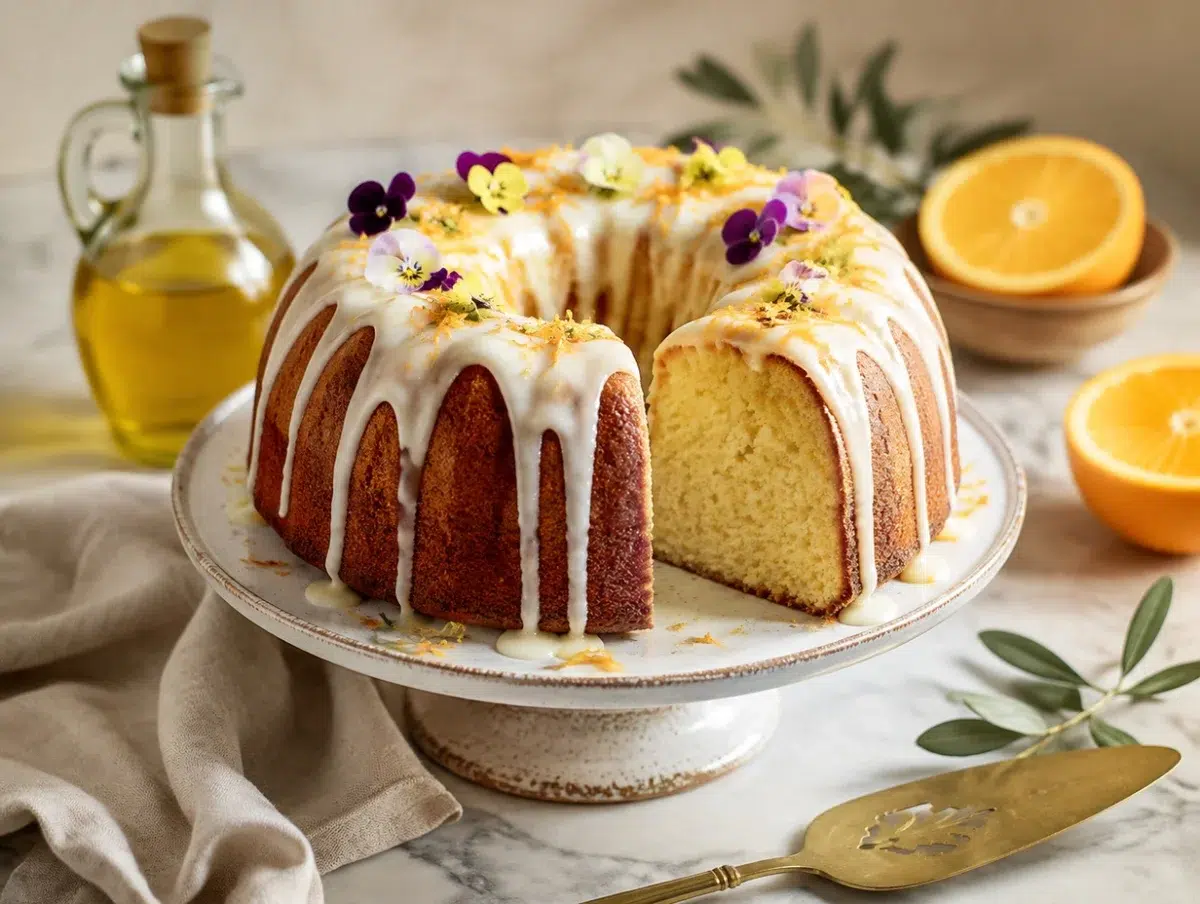
My friend Leila has exactly one rule about dessert: “if it’s not chocolate, it needs to be worth it.” She is a tough audience. So when I brought my third attempt at Olive Oil Cake with Citrus Glaze to her kitchen in November 2022 and she took a bite, put down her fork, and said absolutely nothing for about six seconds — I knew we were somewhere. The first two attempts, for context, were dense as a doorstop (forgot to fold carefully) and so aggressively orange-flavored it tasted like furniture polish. Not great. After 31 test bakes, a deep dive into the baking chemistry of olive oil versus butter, and one very important lesson about glaze timing, I’ve landed on six secrets that make this the olive oil cake recipe everyone asks for. And yes — Leila has requested it four times since.
Why This Olive Oil Cake with Citrus Glaze Actually Works
The Fat Science: Why Olive Oil Beats Butter Here
Let me geek out for one second — just one second, I promise — because the fat science here is genuinely fascinating. Butter is roughly 80% fat and 20% water. When it bakes, that water creates steam that lifts and then collapses, giving you those classic tender-but-crumbly butter cake crumbs. Olive oil, on the other hand, is nearly 100% fat with no water content. This means olive oil coats the gluten strands more completely, producing a crumb that stays moist for days without refrigeration — something butter cakes simply cannot do. Harold McGee’s work on fats in baking explains this beautifully: the liquid nature of olive oil at room temperature also means it never “seizes up” the way solid fats can when a cake cools. The result is a texture that’s almost custardy at its core. Rich but never heavy.
The Occasion That Made Me Take This Seriously
Olive oil cake is — and I say this with full confidence — one of the great underrated desserts in the Mediterranean canon. Every Greek grandmother has a version. Every Italian bakery has their spin. Every Levantine household makes something adjacent during Ramadan. It transcends borders in a way very few baked goods do. And because it’s dairy-free by default (and trivially made gluten-free), it works for almost every table. Think of it as the dessert answer to my mezze platter — inherently communal, infinitely adaptable, impossible to mess up once you understand the rules.
Essential Ingredients for Olive Oil Cake with Citrus Glaze
What You’re Working With and Why It Matters
Okay — so — the olive oil. I need to address this directly because people ask every single time: does the quality of olive oil actually matter in baking? Yes. Dramatically. A fruity, grassy, high-quality extra virgin olive oil comes through in the final cake as a warm, floral backdrop. A cheap, rancid-adjacent “light olive oil” tastes like nothing at best and vaguely metallic at worst. I once used a bottle of generic light olive oil on test batch 11 because I ran out of my usual brand. It tasted fine, technically. But it tasted like a cake, not this cake. Use something you’d happily dip bread in. That’s the rule.
The secret weapon in the citrus glaze is blood orange juice — when it’s in season (November through March in the USA). The anthocyanins that give blood oranges their dramatic color also add a raspberry-adjacent berry note that you absolutely cannot fake with regular orange juice. Out of season? Use a 50/50 blend of navel orange and fresh lemon juice. It’s a different glaze, but it’s still exceptional.
Quality Comparison Table & Smart Substitutions
| Ingredient | Best Choice | Acceptable Alternative | What You Lose |
| Olive Oil | Fruity extra virgin, Greek or Italian | Light olive oil (not pure or pomace) | Depth, floral notes, richness of flavor |
| Citrus | Blood orange + lemon (in season) | Navel orange + lemon 50/50 | The berry undertone in the glaze |
| Flour | All-purpose, unbleached | Gluten-free 1:1 blend (e.g. Bob’s Red Mill) | Slight texture change; still excellent |
| Eggs | 3 large eggs, room temperature | Flax eggs (1 tbsp flax + 3 tbsp water each) | Some lift; vegan version is denser but good |
| Sugar | Granulated white sugar | Coconut sugar or raw cane sugar | Color darkens; coconut sugar adds caramel note |
| Yogurt | Full-fat Greek yogurt | Dairy-free coconut yogurt | Minimal difference; coconut yogurt works perfectly |
The lemon-forward flavor profile of this cake has a natural kinship with my lemon tahini dressing — both rely on that bright, citrus-oil combination that defines so much Mediterranean cooking. And if you want to build a full Mediterranean dessert spread, this cake pairs beautifully alongside whipped hummus with honey and warm pita for a sweet-savory mezze finish.
The Foolproof Method for Olive Oil Cake with Citrus Glaze
Prep Work: The Decisions That Determine Your Outcome
The first and most important decision: room temperature ingredients. This is the part of every baking recipe where people go “yeah yeah” and then grab cold eggs straight from the fridge. Don’t. Cold eggs dropped into olive oil don’t emulsify — they sit there in little cold blobs, fighting the fat instead of integrating with it. The result is an uneven, slightly greasy crumb. Leave your eggs and yogurt out for 30 minutes before you start. If you’re in a rush, place whole eggs in a bowl of warm (not hot) water for 5 minutes. Same result.
Secret number two: zest before you juice. Always. This sounds obvious but I have definitely, on three occasions, juiced my citrus and then stood there looking sadly at a naked orange I couldn’t zest anymore. Zest adds the essential oils and aromatic compounds that juice alone can’t provide — it’s the difference between a cake that smells like a citrus grove and one that just tastes vaguely sweet. Same principle as the fresh herb timing in my tabbouleh — volatile aromatics evaporate fast, so work with them at the last possible moment.
Third: line your pan with parchment and grease the sides. Olive oil cake batter clings to ungreased sides and tears when you try to unmold it. I know this because — yes — I tried to save three minutes of prep on test batch 7 and ended up with a cake that came out in two pieces. Grease the sides.
The Six-Step Assembly Method
- Preheat oven to 350°F (175°C). Line a 9-inch round cake pan with parchment. Grease the sides generously with olive oil.
- Zest your citrus first. You need 1 tbsp orange zest + 1 tsp lemon zest. Then juice: 2 tbsp orange juice, 1 tbsp lemon juice (for the batter). Reserve remaining juice for the glaze.
- Combine wet ingredients: whisk together ¾ cup extra virgin olive oil, 3 eggs, 1 cup sugar, ½ cup full-fat Greek yogurt, citrus zests, and citrus juice in a large bowl. Whisk vigorously for 90 seconds — you’re building the emulsion that gives the cake its texture.
- Combine dry ingredients separately: whisk together 1¾ cups all-purpose flour, 1½ tsp baking powder, ½ tsp baking soda, ¼ tsp fine salt. Whisk twice — once for mixing, once to aerate.
- Fold gently — and mean it. Add dry ingredients to wet in two additions. Fold with a spatula using a ‘J’ motion, rotating the bowl. Stop the moment you can’t see flour streaks. Overmixing activates gluten and creates a tough, dense crumb. This is the step that broke my first eight batches. Be gentle.
- Pour and bake: transfer batter to prepared pan. Bake 40–45 minutes until golden on top and a toothpick inserted at the center comes out with a few moist crumbs (not wet batter). The cake will pull slightly from the sides when done. Cool in pan 15 minutes before unmolding.
Secret number five — glaze timing — is the one that took me the longest to figure out: glaze the cake while it’s still warm, not hot, and not cold. If you glaze a hot cake, the glaze runs straight off and pools at the base. If you wait until it’s fully cold, the glaze sits on the surface without soaking in. The window is about 20–25 minutes after unmolding. The crumb is still porous enough to absorb the glaze and pull it inside, creating those gorgeous citrus-saturated pockets. Secret number six is double-glazing: apply half the glaze, wait 5 minutes, apply the second half. Twice the citrus depth with no extra effort. The same patient layering logic drives my approach to spice-building in my za’atar chicken — some flavors need two passes to really land.
Creative Variations for Olive Oil Cake with Citrus Glaze
Five Directions This Cake Can Go
| Variation | Key Changes | Flavor Profile | Difficulty |
| Lemon Rosemary | Add 1 tbsp fresh rosemary to batter; lemon-only glaze | Herbal, floral, sophisticated | Easy |
| Almond Orange | Replace ½ cup flour with almond flour; orange glaze only | Nutty, dense, Sicilian-inspired | Easy |
| Cardamom Rose | Add ½ tsp cardamom + 1 tsp rose water to batter | Fragrant, Levantine, delicate | Easy |
| Chocolate Drizzle | Add citrus glaze + dark chocolate drizzle finish | Bittersweet, dramatic, crowd-pleasing | Easy |
| Upside-Down Citrus | Layer blood orange slices on bottom of pan before batter | Caramelized citrus top, stunning visual | Medium |
Dietary Modifications That Work Without Compromise
For a fully vegan version, substitute the 3 eggs with flax eggs (1 tbsp ground flax + 3 tbsp water per egg, let gel 10 minutes) and swap Greek yogurt for full-fat coconut yogurt. The cake is slightly denser but still genuinely delicious — Leila’s vegan friend Priya ate three slices at our last gathering so I consider this thoroughly tested. For gluten-free, a 1:1 GF baking blend works almost perfectly; just don’t overmix. And for a completely different vibe, try serving it alongside my fattoush salad for a light lunch followed by dessert — the fresh herbs and citrus in the salad echo the cake’s flavors in a really lovely way. For a vegetable-forward main to precede this cake, my Mediterranean roasted vegetables make the whole meal feel cohesive.
Storage & Serving for Olive Oil Cake with Citrus Glaze
Why This Cake Gets Better on Day Two
Here’s something counterintuitive about olive oil cake that I genuinely didn’t understand until test batch 19: it’s better the next day. And the day after that. The olive oil continues to redistribute through the crumb as it cools, and the citrus glaze sinks deeper into the texture overnight. Bake it the evening before you need it if you can. I know that requires planning ahead and I know that’s annoying to hear. But the cake you eat the morning after baking is simply a different (better) cake than the one you pull from the oven.
| Storage Method | Timeframe | Notes |
| Room temperature, covered | Up to 4 days | Preferred method — refrigerating dries it out |
| Refrigerator, wrapped tight | Up to 7 days | Bring to room temp before serving (30 min) |
| Freezer (ungrazed) | 3 months | Freeze before glazing; glaze after thawing |
| Freezer (glazed slices) | 2 months | Wrap individually; thaw at room temp 1 hour |
Serving Suggestions That Actually Elevate the Cake
At its most simple, this olive oil cake needs nothing beyond a dusting of powdered sugar and a glass of mint tea. But if you want to push it into proper dessert territory: serve with a generous spoonful of thick Greek yogurt and a drizzle of honey. Or — and this is my personal favorite move — plate alongside a tiny scoop of pistachio ice cream and a few segments of fresh blood orange. For a full Mediterranean afternoon tea experience, build a spread that also includes baba ganoush and warm pita bread alongside the cake — sweet and savory together at the table, as nature intended.
| Occasion | Serving Style | Beverage Pairing |
| Casual weeknight | Slice, powdered sugar, no fuss | Mint tea or lemon verbena tea |
| Dinner party dessert | Plated with yogurt + honey + blood orange | Sparkling water with blood orange slice |
| Mediterranean brunch | Alongside fresh fruit and labneh | Fresh orange juice + mint tea |
| Holiday gifting | Whole cake in box, extra glaze jar | Recipient’s choice |
Nutritional Profile of Olive Oil Cake with Citrus Glaze
(Nutritional values are estimates per slice, based on 10 slices from a standard 9-inch cake. I’m not a dietitian — these are calculated approximations. Variations and substitutions will change these figures.)
Macronutrient Breakdown (per slice, 1/10 of cake)
| Macronutrient | Amount | Daily Value % |
| Calories | 318 kcal | 16% |
| Total Fat | 17g | 22% |
| Saturated Fat | 2.5g | 13% |
| Unsaturated Fat | 14.5g | — |
| Trans Fat | 0g | — |
| Total Carbohydrates | 38g | 14% |
| Dietary Fiber | 0.8g | 3% |
| Sugar | 22g | — |
| Protein | 4.5g | 9% |
| Cholesterol | 56mg | 19% |
Micronutrients & Why Olive Oil Cake Is Actually Not Terrible For You
| Nutrient | Amount | Key Benefit |
| Sodium | 148mg | Low compared to butter-based cakes (avg. 250mg+) |
| Vitamin E | ~2.1mg (14% DV) | Powerful antioxidant from extra virgin olive oil |
| Vitamin C | ~4mg (4% DV) | From fresh citrus juice and zest |
| Iron | ~1.2mg (7% DV) | From flour + eggs; enhanced by citrus vitamin C |
| Calcium | ~48mg (4% DV) | From yogurt and eggs |
| Oleic Acid (Omega-9) | Significant | Heart-healthy monounsaturated fat; anti-inflammatory |
The glycemic index of this olive oil cake is moderate — lower than a typical butter cake because olive oil slows gastric emptying slightly, which blunts the post-sugar spike. The Vitamin E content from good-quality extra virgin olive oil is a genuine nutritional bonus that most cakes can’t claim. For context on how Mediterranean cooking integrates healthy fats throughout the meal, see the approach I use in my classic Greek salad — olive oil appearing in both savory and sweet courses is one of the hallmarks of true Mediterranean cuisine.
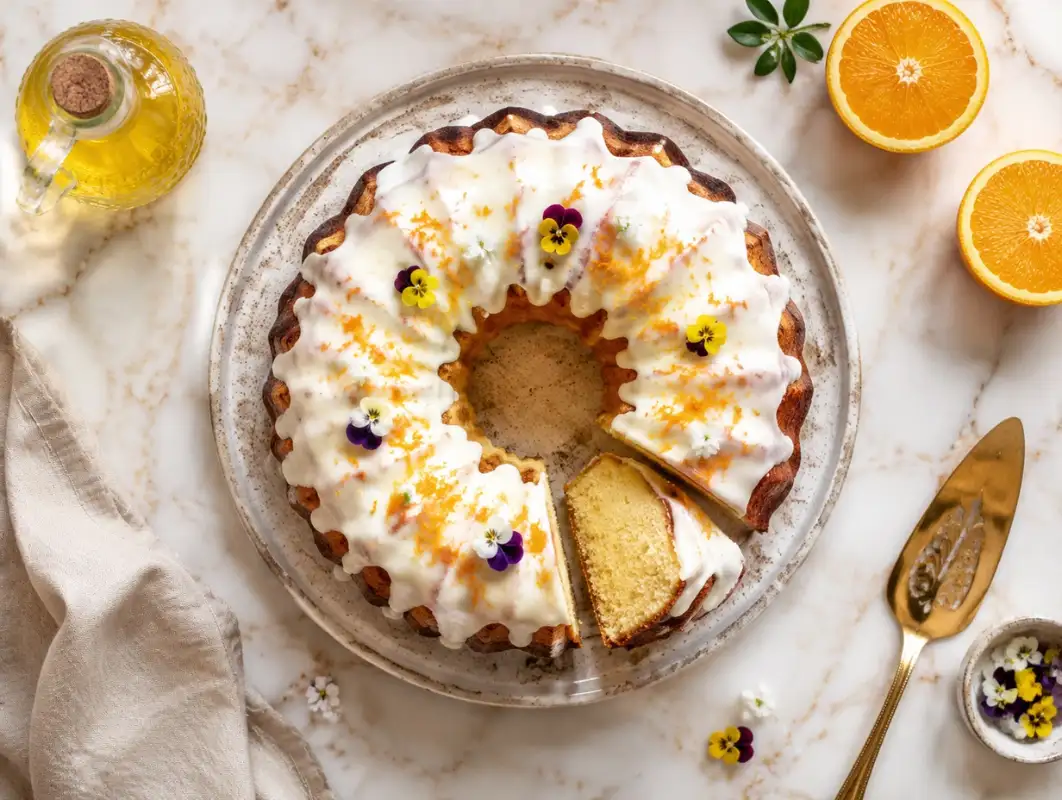
Olive Oil Cake with Citrus Glaze
Ingredients
Method
- Bring the eggs and yogurt to room temperature — at least 30 minutes on the counter, or sit whole eggs in warm water for 5 minutes. Cold eggs will not emulsify with olive oil and leave an uneven, slightly greasy crumb.
- Preheat the oven to 350°F (175°C). Line a 9-inch round cake pan with parchment and grease the sides generously with olive oil.
- Zest your citrus first, then juice it. You need 1 tablespoon orange zest and 1 teaspoon lemon zest, plus 2 tablespoons orange juice and 1 tablespoon lemon juice for the batter. Reserve the remaining juice for the glaze.
- Combine the wet ingredients. Whisk the olive oil, eggs, sugar, Greek yogurt, both zests and both juices together in a large bowl, vigorously, for 90 seconds — you are building the emulsion that gives the cake its texture.
- Combine the dry ingredients separately. Whisk the flour, baking powder, baking soda and salt together twice: once to mix, once to aerate.
- Fold gently, and mean it. Add the dry ingredients to the wet in two additions, folding with a spatula in a J motion while rotating the bowl. Stop the moment you can no longer see flour streaks — overmixing develops gluten and makes the crumb tough and dense.
- Pour the batter into the prepared pan and bake 40–45 minutes, until golden on top and a toothpick inserted in the centre comes out with a few moist crumbs but no wet batter. The cake will pull slightly away from the sides when done.
- Cool in the pan for 15 minutes, then unmold onto a rack.
- Make the glaze while the cake cools: whisk the powdered sugar with the fresh blood orange juice and lemon juice until smooth and pourable. Use fresh juice only — bottled juice is pasteurised and tastes flat.
- Glaze while the cake is warm, not hot and not cold — about 20–25 minutes after unmolding. Apply half the glaze, wait 5 minutes, then apply the second half. The porous warm crumb pulls the glaze inside and creates citrus-saturated pockets.
Notes
Frequently Asked Questions
Q: Can I taste the olive oil in the cake?
Honestly — yes, slightly. And that’s the point. A fruity, good-quality extra virgin olive oil adds a warm, grassy backdrop that you can’t quite identify but you’d absolutely miss if it were gone. It’s not overwhelming. No one is going to bite in and say “mmm, salad dressing.” But if you use a high-quality oil, you’ll taste a floral warmth that butter simply doesn’t provide. If you’re nervous, use a mild Greek EVOO for your first bake — it’s the gentlest-tasting variety for baking contexts.
Q: Can I make olive oil cake ahead of time?
Please do. This is genuinely one of the best make-ahead cakes in existence. Bake up to 2 days before serving — the texture and flavor actively improve as it rests. Glaze the day before serving. Store at room temperature under a cake dome or wrapped in plastic. Do not refrigerate if you can help it; cold air dries the crumb faster than room temperature storage.
Q: Why is my olive oil cake dense?
Three likely culprits: (1) Overmixing — the moment you work past “just combined,” gluten develops and the crumb tightens. Stop folding while there are still a few faint flour streaks. (2) Cold eggs or cold yogurt — emulsification breaks down and the fat doesn’t distribute evenly. Always use room temperature ingredients. (3) Pan size — if you used an 8-inch pan instead of 9-inch, the center will be dense and underbaked. Always use a 9-inch (or two 8-inch rounds for a thinner layer).
Q: What oil can I substitute for olive oil in olive oil cake?
Avocado oil is the best 1:1 swap — neutral flavor, same fat composition. Sunflower or canola oil work for a more neutral result. Melted coconut oil adds a subtle coconut note that’s actually lovely in the cardamom-rose variation. I wouldn’t use vegetable shortening or butter — you’d lose the entire point of the recipe, both nutritionally and texturally. If you’re committed to butter, make a different cake.
Q: Can I make this olive oil cake gluten-free?
Yes — and it works better than you’d expect. A 1:1 gluten-free baking flour (Bob’s Red Mill, King Arthur, or similar) substitutes directly with no other changes needed. The cake will be very slightly denser and may need an extra 3–5 minutes of baking time. Let it cool completely in the pan before unmolding — GF cakes are more fragile when warm. The citrus glaze completely masks any GF flour aftertaste.
Q: Can I use bottled lemon or orange juice for the glaze?
Technically yes. Realistically: don’t. Bottled citrus juice is pasteurized at high heat, which destroys the volatile aromatic compounds responsible for that bright, fresh citrus punch. What remains is citric acid and sugar — functional, but flat. Fresh juice from one orange and one lemon takes 45 seconds and makes a glaze that’s in a completely different category. This is one of the places where I have zero flexibility in my opinion. Fresh. Juice. Only.
Pairing & Serving Ideas for Olive Oil Cake with Citrus Glaze
What This Cake Was Destined to Be Served With
There’s something about olive oil cake that makes it want to be the center of a whole moment rather than just dessert. Build a proper Mediterranean afternoon spread: the cake as the centerpiece, a platter of Mediterranean chickpea salad for the savory course before, and a big bowl of tabbouleh with fresh herbs. Light, citrus-forward, and cohesive from first bite to last. For a more intimate pairing, slice the cake thin and serve it with a small bowl of whipped labneh and a drizzle of dark floral honey — um, like a Greek island tea.
| Pairing Style | What to Serve | Best Occasion |
| Simple classic | Greek yogurt + honey + powdered sugar | Weeknight dessert, any night |
| Afternoon tea | Mint tea, dates, dried fruit | Weekend gathering, Ramadan |
| Full Mediterranean spread | Fattoush, tabbouleh, pita | Entertaining, Sunday lunch |
| Elegant dessert course | Blood orange segments, pistachio, olive oil drizzle | Dinner parties, celebrations |
Beverage Pairings (No Alcohol)
This is — okay I feel strongly about this — a cake that was made to be eaten with mint tea. The clean, herbal sweetness of fresh mint tea cuts through the richness of the olive oil and plays perfectly with the citrus glaze. Runner-up: fresh-pressed blood orange juice (very on-theme). Or sparkling water with a sprig of fresh rosemary and a slice of orange. Iced hibiscus tea also works beautifully — its tartness mirrors the citrus in the glaze.
Ready to Bake Your Own Olive Oil Cake with Citrus Glaze?
Six Secrets, One Extraordinary Cake
Room temperature ingredients. High-quality olive oil. Zest before juice. Gentle folding. Warm-window glazing. Double-glaze technique. That’s it. Those six things are the difference between a good olive oil cake and the one people remember. Make it the night before. Let it rest. Let the citrus glaze sink in. For a showstopping seasonal version, try the upside-down blood orange variation during winter — it’s stunning and pairs beautifully with any of the Mediterranean vegetable dishes from my Mediterranean roasted vegetables collection. For a full dessert showcase, serve it alongside my shakshuka brunch spread — because yes, olive oil cake absolutely works for brunch and I will not apologize for that.
Share Your Bake
Leila, for the record, has now made this olive oil cake herself — twice — and sent me a photo both times without asking me how it turned out. That’s the metric that matters. If you bake it, I genuinely want to know what happened. Did you try the rosemary-lemon version? Did you accidentally double the glaze on purpose? (That is always the right move.) Leave a comment below — I read every single one — and tag a photo if you can. This cake has been through 31 test bakes and a lot of kitchen disasters to get to you. It deserves to be celebrated.