Written by Ines Zahraoui — Tunisian home cook and co-founder of The Mediterranean Recipe, developing and testing recipes in her own kitchen since 2020. More about Ines →
I am going to tell you to buy the shells, which is not the sort of thing a recipe site is supposed to say.
Making ghost cannoli shells properly requires a specific dough acidified with vinegar, a rolling method that gets it thin enough to blister, metal dowels to wrap it around, and a pan of hot oil. It is a genuinely satisfying afternoon and it produces something better than anything you can buy. It is also a skill you will use once a year, and nobody at your Halloween party will know or ask.
What they will notice is the filling — because the filling is where almost every cannoli goes wrong, and it goes wrong for one reason: the ricotta was not drained.
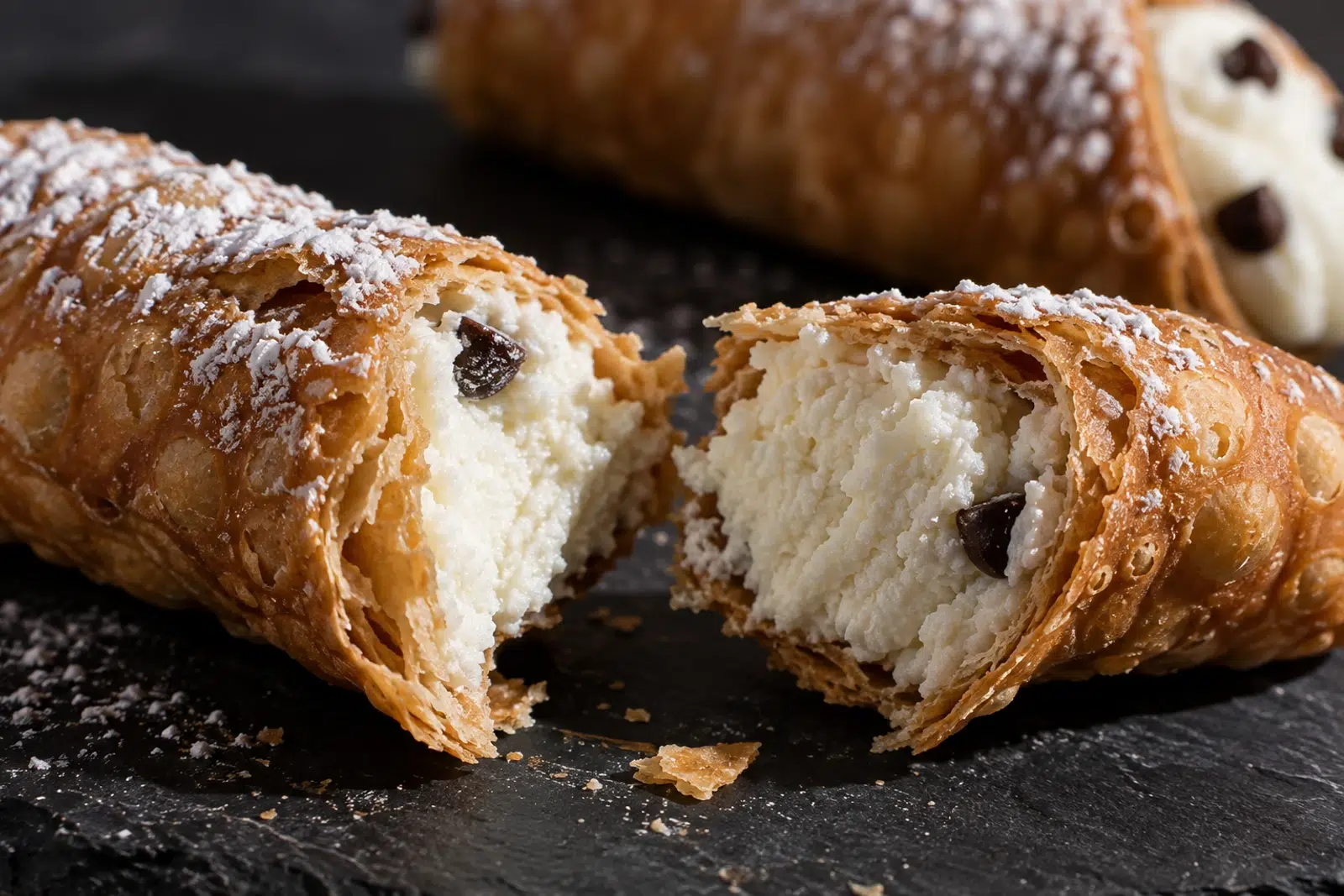
The ghost is barely a technique. Pipe the filling so it peaks slightly at each open end, press in two mini chocolate chips as eyes, and the shape does the rest. Twenty minutes, no oven, no heat.
The texture is what makes it work — a shell that shatters into flakes around a cold, thick, faintly grainy ricotta. Which brings us to the one thing you cannot ignore: a filled cannoli is on a short clock; forty-five minutes is a conservative house limit.
Table of Contents
Table of Contents
Ghost Cannoli Recipe Card

Ghost Cannoli
Ingredients
Method
- The night before: line a sieve with two layers of cheesecloth or a clean thin tea towel, set it over a bowl, tip in the ricotta and fold the cloth over the top. Refrigerate overnight, or at least 8 hours. You will be surprised how much liquid comes out.
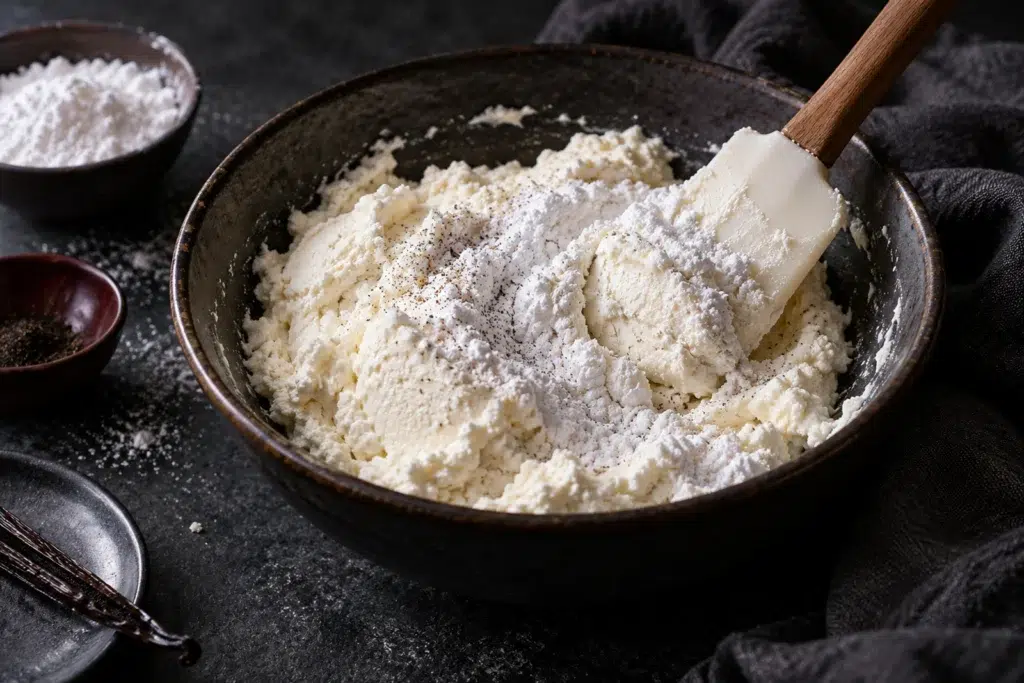
- Discard the drained liquid. Tip the ricotta into a bowl — it should now be thick, dense and hold a shape.
- Beat in the powdered sugar, vanilla powder, orange zest, cinnamon and salt until completely smooth. Do not over-beat. Thirty seconds by hand is enough; a mixer run too long makes it loose again.
- Chill the filling at least 30 minutes. Transfer to a piping bag fitted with a plain round tip, or a zip bag with a corner cut.
- Fill within an hour of serving. Pipe from each end toward the middle so the shell fills completely, then pipe a small extra peak proud of each opening.
- Press two mini chocolate chips, points inward, into the filling at one end as eyes.
- Dust lightly with powdered sugar and serve.
Notes
Why This Recipe Actually Works
- The draining step is stated as mandatory, which almost no ghost cannoli recipe does.
- Twenty minutes and no heat, once the ricotta has drained overnight.
- The ghost is the shape, not a decoration applied to it.
- Shop-bought shells are the plan, not the fallback.
- The filling is genuinely good and works in March in a bowl with fruit.
Why the Ghost Shape Works Here
A cannoli is a tube with white filling protruding from each end. Pipe the filling so it peaks slightly proud of the opening, press in two dark eyes, and you have a shape that reads instantly without a single piece of fondant.
It is one of the very few Halloween styling ideas that makes the dessert look more like what it already is rather than disguising it.
Essential Ingredients
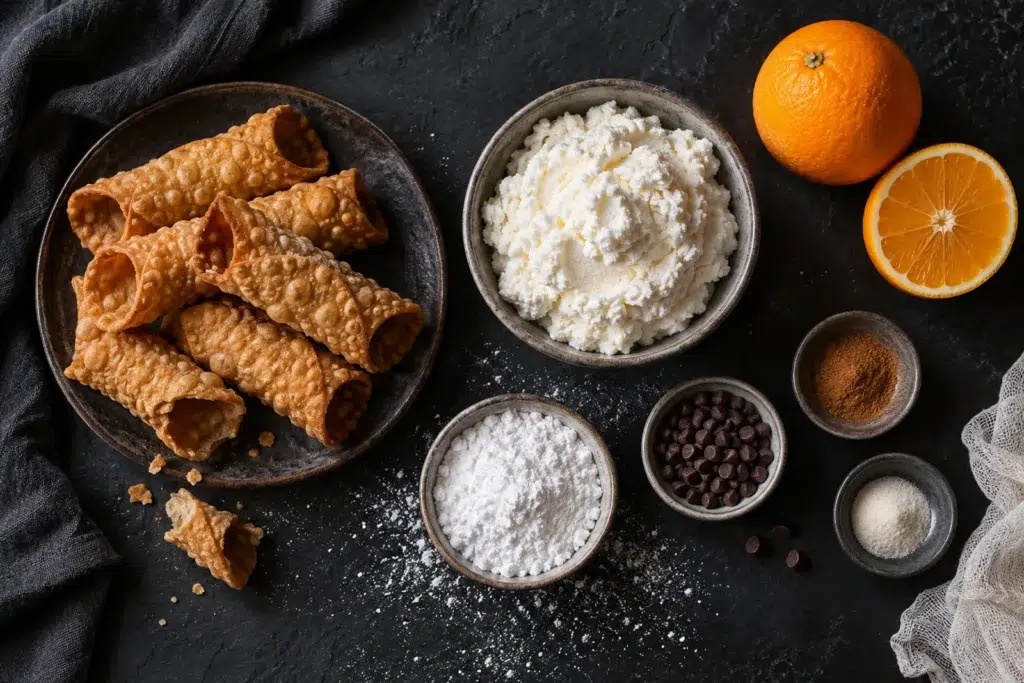
Cannoli shells. Shop-bought, from an Italian deli if you have one and from a supermarket if you do not. Buy a few more than you need — they break in the packet.
Whole-milk ricotta. Not part-skim, which is wetter and blander. If your shop has fresh ricotta from an Italian grocer rather than the tub kind, buy that — it drains less and tastes considerably better.
Powdered sugar, sifted. Granulated sugar will not dissolve in cold ricotta and leaves it gritty.
Vanilla, orange zest, cinnamon. The classic Sicilian trio. Orange zest in particular lifts ricotta out of blandness.
Mini chocolate chips. For the eyes, and optionally folded through the filling, which is entirely traditional.
Salt. A pinch. Ricotta without salt tastes of very little.
The Foolproof Method
- Drain the ricotta overnight in cloth.
- Beat in the sugar and flavourings briefly.
- Chill 30 minutes.
- Pipe from both ends inward, with a peak proud of each opening.
- Two chocolate chips as eyes.
- Dust and serve within the hour.
Buy the Shells
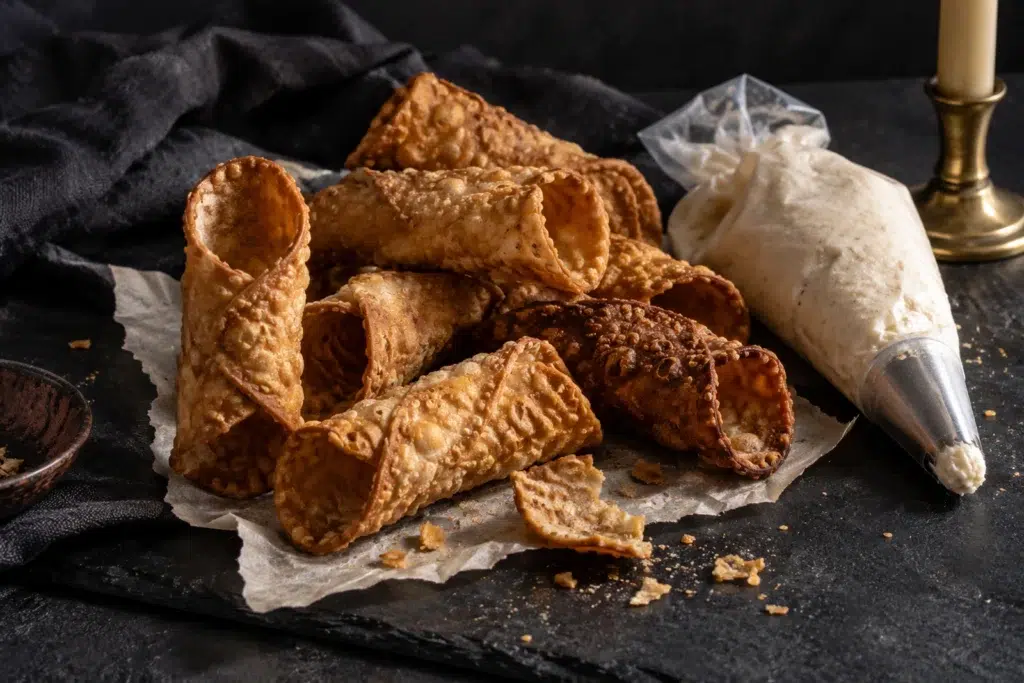
Here is the argument, made properly rather than as a shrug.
Making cannoli shells from scratch requires: a dough enriched with vinegar and butter or vegetable shortening, rolled thin enough to see through, cut into ovals, wrapped around metal dowels, sealed with egg white, deep-fried at a specific temperature, then slid off the dowels while hot without shattering them. It takes an afternoon, it requires equipment you own for this purpose alone, and the failure rate on a first attempt is high.
What it gets you: a genuinely better shell. Blistered, lighter, more delicate, fresher. It is a real difference and I am not going to pretend otherwise.
What it costs you at a Halloween party: the entire afternoon of the day you are also making everything else, and a skill you use once a year and forget in between.
Shop-bought shells are good. Italian delis sell excellent ones and even supermarket versions are perfectly crisp. They are a fried pastry with a long shelf life, which is a category that survives commercial production far better than most. Check the ingredient list and choose shells made with butter or vegetable shortening.
The part that genuinely cannot be bought is the filling. Pre-filled cannoli are always disappointing, because they were filled hours or days before you bought them and the shell went soft immediately. That is precisely where your effort should go.
So: buy the shells, make the filling, and fill them yourself in the last ten minutes. That division of labour gets you 90% of the result for 10% of the work, and the 10% you are doing is the part that actually shows.
If you do want to make shells, make them on a different day for their own sake, not on Halloween.
Drain the Ricotta Overnight

This is the one that decides everything.
Tub ricotta contains a great deal of whey, and it is not obvious until you take it out. Straight from the tub it looks thick enough. Beaten with sugar it loosens noticeably, because the sugar draws yet more moisture out of the curd. By the time it is in a piping bag it is a loose, weeping mixture that will not hold a peak, will not stay in the shell, and will start soaking the pastry the moment it goes in.
Drained overnight, the same ricotta becomes dense and almost spreadable — thick enough to hold a piped peak, sweet without being loose, and slow to release moisture into the shell.
The method: two layers of cheesecloth, muslin or a clean thin tea towel in a sieve over a bowl. Tip the ricotta in, fold the cloth over the top, and refrigerate for at least 8 hours. Do not press or squeeze it — gravity does the work and pressing forces curd through the cloth.
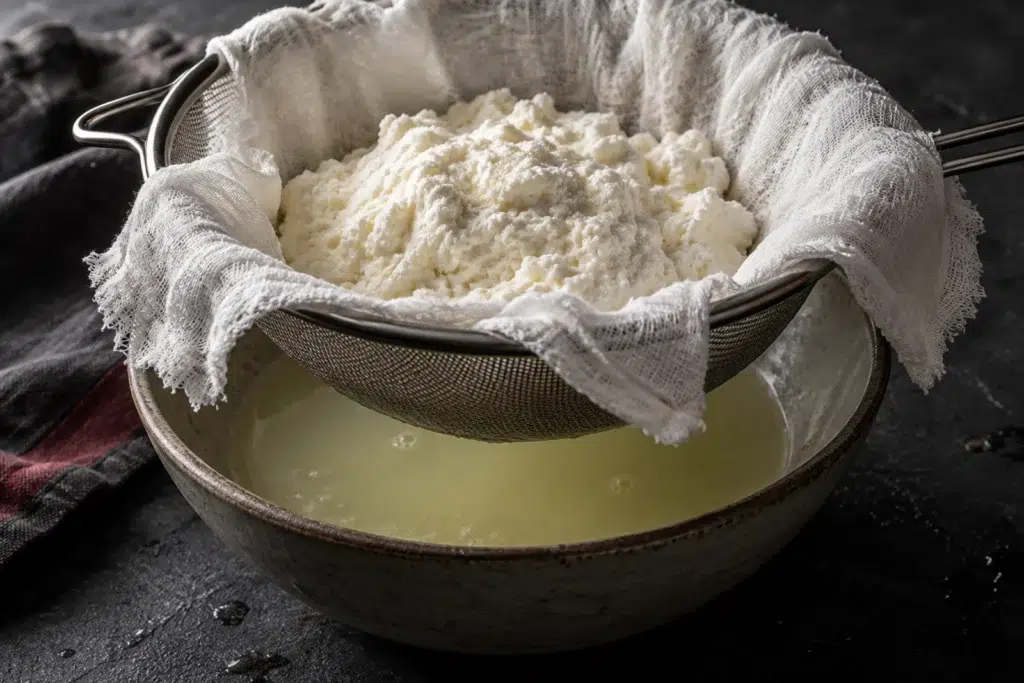
How much liquid to expect: anywhere from a quarter to a half cup from two cups of ricotta, depending on brand. If almost nothing comes out, you have bought good fresh ricotta and you can proceed straight away.
The other half of the rule: do not over-beat. Every second in a mixer breaks the curd down further and releases more moisture. Thirty seconds by hand with a spatula or a whisk is enough to combine the sugar. A stand mixer left running for two minutes will undo the entire overnight drain.
If you have forgotten to drain and have an hour, set it in cloth in a sieve and put a small plate with a can on top. It is not as good but it is a great deal better than nothing.
Fill Them Close to Serving
As a conservative house rule, a filled cannoli has about forty-five minutes before the shell may start to go.
That is the constraint the entire serving plan has to work around, and it is why every disappointing cannoli you have eaten was disappointing.
The mechanism is simple: the shell is a fried pastry whose crispness depends on being dry, and the filling is a wet dairy product pressed directly against its inside surface. Moisture migrates outward. Within about forty-five minutes the inner surface has softened, within two hours the whole shell is leathery, and there is no reversing it.
What to do about it:
Fill as guests arrive, or as dessert is served. Twelve cannoli take about four minutes to pipe once the bag is ready.
Keep the piping bag in the fridge, never the filled shells. The bag is the make-ahead item.
Set up a filling station if you want the theatre — shells in a jar, bag of filling, bowl of chocolate chips — and let people fill their own. It solves the timing problem completely and it is genuinely fun.
Never buy pre-filled cannoli, for exactly this reason.
Making the Ghost
Barely a technique, and that is its appeal.
Pipe from both ends inward so the shell fills all the way through with no air pocket in the middle. Then push a little extra out at each opening so the filling stands slightly proud — that small dome is the ghost’s head.

Two mini chocolate chips, points inward, pressed into the filling at one end. Points inward matters: the flat face outward reads as an eye, the point outward reads as a spike.
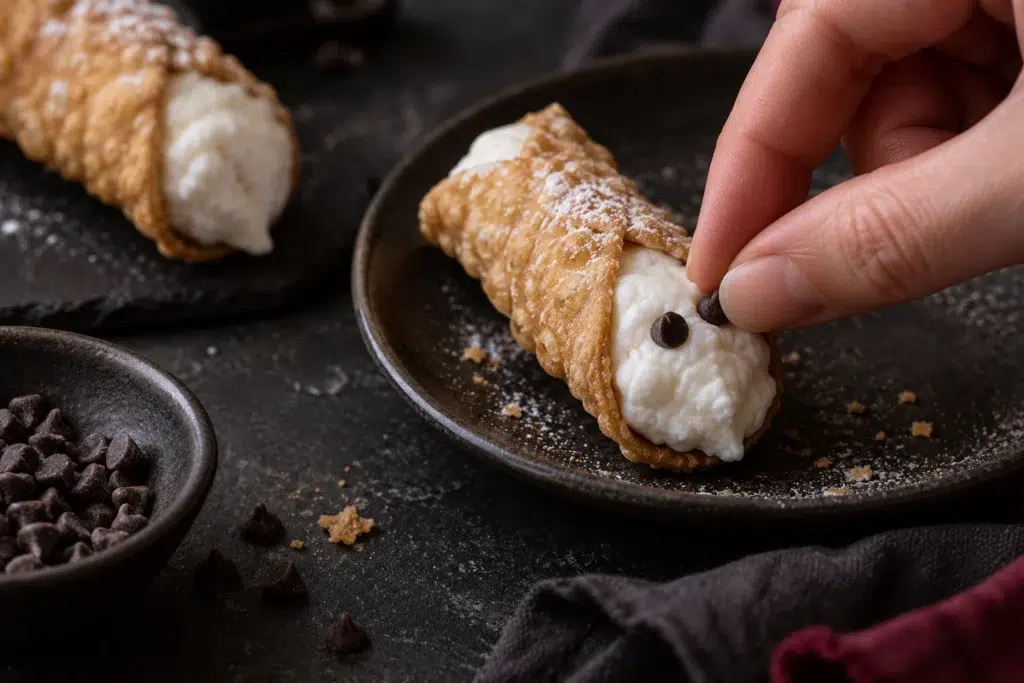
Dust with powdered sugar from a height, lightly. Heavy dusting fills the chocolate chip eyes and they disappear.
One optional addition: a very small dot of melted dark chocolate as a mouth, applied with a toothpick. I usually leave it off — two eyes and nothing else is more unsettling than a face.

Creative Variations
Chocolate chip through the filling. Traditional Sicilian, and it adds texture the plain version lacks.
Pistachio ends. Dip both open ends in finely chopped pistachios before adding the eyes. Green against white is very good and it is what a Sicilian bakery would do.
Orange and cinnamon. Double the orange zest and add a proper quarter teaspoon of cinnamon. Warmer and more autumnal.
Ricotta and mascarpone. Replace a quarter of the ricotta with mascarpone for a richer, smoother filling that holds even better.
Phyllo ghost cups. If you cannot find shells at all, press buttered phyllo squares into a muffin tin, bake 8 minutes at 375°F, and pipe the same filling into them. All of the effect, none of the sourcing problem. [LIVE — /mediterranean-halloween-desserts/]
Storage and Serving Suggestions
Unfilled shells: 2 weeks in a sealed container at room temperature. Never the fridge.
Filling: 3 days in the fridge, ideally already in the piping bag. It firms further as it sits, which is fine.
Filled cannoli: use 45 minutes as a conservative house limit, then adjust only if your tested shell stays crisp.
Do not refrigerate filled cannoli thinking it will help. Fridge humidity softens the shell faster than room temperature does.
Serving: on a dark plate, dusted, with the eyes facing the room. Twelve serves eight to twelve as part of a dessert table.
Nutritional Benefits
Ricotta is a genuinely good source of protein and calcium and is lower in fat than most soft cheeses, particularly the whole-milk version drained of its whey. Draining also concentrates the protein.
The shell is fried pastry and the filling has sugar in it, so this is a dessert. But it is one of the higher-protein desserts you can put on a table, and at around 220 calories each they are a reasonable single portion.
Five Rules to Keep Beside the Recipe
Check the shell ingredient list
Drain ricotta 8–12 hours
Mix briefly to keep it dense
Pipe from both ends
Fill close to serving
Scaling line: 6 cannoli: half filling · 12 cannoli: standard batch · 24 cannoli: double filling, pipe in two rounds
Frequently Asked Questions
Why is my cannoli filling runny?
The ricotta was not drained, or it was over-beaten. Tub ricotta holds a lot of whey, and adding sugar draws out more. Drain it overnight in cheesecloth in a sieve, then mix the sugar in by hand for about thirty seconds rather than running a mixer.
Can I fill cannoli ahead of time?
No. As a conservative house rule, allow a filled shell roughly forty-five minutes before moisture from the filling starts softening the pastry, and no method reverses it. Keep the filling in a piping bag in the fridge and pipe as you serve.
Should I make or buy cannoli shells?
Buy them. Making them requires metal dowels, deep frying and an afternoon, for a skill used once a year. Shop-bought shells are genuinely good because fried pastry survives commercial production well. Put the effort into the filling, which is where quality actually shows.
How long do unfilled cannoli shells keep?
About two weeks in a sealed container at room temperature. Never refrigerate them — fridge humidity softens them. Buy a few more than you need, as they break easily in transit.
Can I use part-skim ricotta?
You can, but whole-milk is noticeably better here — creamier, less watery and more flavourful. Part-skim also needs longer draining. If it is what you have, drain it a full twelve hours.
What can I use instead of cannoli shells?
Phyllo cups are the best substitute: press buttered phyllo squares into a muffin tin and bake eight minutes at 375°F. Crisp wafer baskets also work. Both hold the same filling and the same two chocolate chip eyes.
Pairing and Serving Ideas

On a dessert table, these are the pale element among darker things. Next to near-black pan dei morti or dark chocolate bark, a plate of white ghosts reads strongly. [LIVE — /pan-dei-morti-bread-of-the-dead/] · [LIVE — /halloween-halva-bark/]
As a filling station, with shells in a jar and a bag of filling, which removes the forty-five-minute problem and gives guests something to do.
With coffee. Espresso, or a Sicilian-style coffee with a strip of lemon peel.
Not next to another ricotta dessert. One creamy Italian sweet per table.
For a full Italian November table alongside the three Day of the Dead bakes, these are the modern addition that makes the plate feel less austere. [LIVE — /italian-day-of-the-dead-recipes/]
Watch: Drained, Piped, Eyed
[VIDEO EMBED — 15 seconds, vertical 9:16]
Ricotta tipped into cloth in a sieve, a hard cut to whey collected in the bowl beneath, the thickened ricotta beaten briefly with powdered sugar, piped into a shell from both ends until it peaks, two chocolate chips pressed in as eyes, then a light dusting of powdered sugar from above.
Ready to Make the Easiest Thing on the Dessert Table?
Drain the ricotta the night before. Buy the shells without guilt. Beat the filling for thirty seconds, not two minutes. Then fill them ten minutes before you serve them, and not a moment earlier.