The smell hit me before I reached the top of the stairs. It was a September Sunday in Chania — I was perhaps nine — and my yiayia was making pistachio halva in the kitchen. Not the pressed sesame kind you find wrapped in foil at the supermarket checkout. Her halva: semolina-based, golden from caramelized butter and roasted flour, studded with bright green Aegina pistachios, fragrant with a few drops of rose water that she added at the very last moment before the mixture set. The smell coming up the stairs was warm and nutty and faintly floral all at once — the smell, I would later understand, of the Maillard reaction and caramelization happening simultaneously in a single hot pan.
She made it in the shallow tapsi that lived on the second shelf, and she pressed the surface smooth with the back of a wet spoon — a technique she said her own mother had shown her. ‘Το χαλβά δεν συγχωρεί βιασύνη,’ she told me. The halva does not forgive hurry. I tested that warning thirty-two times developing this recipe, and I can confirm: she was absolutely right about the hurry, and completely correct about everything else.
What follows is the authentic pistachio halva of the Greek and Eastern Mediterranean tradition — the 1:2:3 ratio that is its structural foundation, the toasting that cannot be rushed, the syrup that must hit the flour at exactly the right moment, and the pistachio and rose water that make it unmistakably Aegean rather than simply Middle Eastern. Seven secrets, all of them earned.
Table of Contents

Pistachio Halva
Ingredients
Method
- 1. Make syrup: Combine sugar, water, and cinnamon in a saucepan. Stir until dissolved, then bring to a rolling boil without stirring. Boil for 3 minutes (220°F / 105°C). Remove from heat. Add rose water. Cover and set aside.
- 2. Warm pistachios: Place pistachios in a dry pan over medium heat for 2 minutes, stirring once. Set aside (keep warm).
- 3. Toast semolina: Heat olive oil or butter in a wide heavy-bottomed 3-litre pot over medium heat. Add semolina and salt. Stir continuously, reaching bottom and corners, for 12–15 minutes until the mixture reaches a deep amber colour — nutty-smelling, honey-gold. Do not stop stirring.
- 4. Add warm syrup: Remove semolina from heat. Stand back slightly and pour warm syrup in a slow steady stream while stirring vigorously. Mixture will steam and spit — this is normal. Do not stop stirring.
- 5. Cook to pull-away stage: Return pot to medium-low heat. Stir continuously for 3–5 minutes until mixture pulls away from pot sides and gathers toward centre. Remove from heat immediately.
- 6. Add pistachios: Fold in warm pistachios off heat using 8–10 strokes. Do not over-fold.
- 7. Pour into mould: Transfer immediately to a lightly oiled 20×30 cm (8×12 in) baking dish. Spread to corners with an offset spatula — 2–3 strokes only.
- 8. Press and score: Press surface with the back of a cold-water-dipped spoon (or parchment paper, 5 minutes). Dust with cinnamon. Score into diamonds while still warm (within 15 minutes).
- 9. Cool and refrigerate: Cool at room temperature for 1 hour, then refrigerate for 2 hours before slicing along scored lines. Serve at room temperature with fresh cinnamon dusting.
Notes
Why This Pistachio Halva Recipe Is Special
The 1:2:3 Ratio and Why It Is Non-Negotiable
Most halva recipes you find online are approximations. Some use a 1:1:2 ratio; some add butter at the beginning; some skip the dry-toasting phase entirely and wonder why the result is pale and lacking depth.
The authentic Greek halva — halvás in Greek, from the Arabic halawa, meaning sweetness — is built on a foundation ratio of 1 part fat : 2 parts semolina : 3 parts liquid (sugar syrup). This ratio is documented in Greek culinary tradition going back centuries, and it is not arbitrary: the 2:3 ratio of semolina to liquid produces a halva that sets firmly enough to slice cleanly but remains fudgy and moist at the centre, not dry or sandy. Too much liquid and it won’t set; too little and it cracks when you cut it.
As Harold McGee explains in On Food and Cooking, the gelatinization of semolina starch requires sufficient water at sufficient temperature — and the 1:2:3 ratio delivers both precisely.
The pistachio halva distinction beyond the ratio is the dry-toast of the semolina in fat before the syrup is added. This is the step that transforms halva from a pale, starchy dessert into something with genuine depth: the semolina granules undergo the Maillard reaction in the hot oil, developing hundreds of new flavour compounds that no amount of sugar or rose water can replicate if you skip it. Toast to golden amber. Not pale gold. Not light brown. Amber.
A Flavor Profile That Carries the Mediterranean in Every Bite
A properly made pistachio halva has four distinct flavour layers that arrive in sequence. First: the sweetness of the warm sugar syrup, which hits immediately. Second: the roasted, slightly nutty depth of the caramelized semolina — not sweet, slightly savory, like warm pastry. Third: the bright, buttery crunch of the Aegina pistachios, which resist slightly before giving way. Fourth: the floral whisper of rose water, which arrives last and lingers longest. At the workshops I run in Athens, I ask students to identify the number of flavour layers before I tell them there are four. The average guess is two. There are always four.
The Story Behind Pistachio Halva
From the Silk Road to the Greek Easter Table
Halva in its dozens of forms — sesame, semolina, flour, nut-butter — has been eaten from Central Asia to the Iberian Peninsula for over a thousand years, travelling along trade routes as both a preserved sweet and a cultural marker.
The semolina halva tradition entered Greek cooking through Byzantine and Ottoman culinary exchange, and by the nineteenth century it had become embedded in Greek religious life: halvás is the traditional sweet served after Orthodox memorial services (mnimósyno), made in the 40 days of Lent (it is naturally dairy-free when made with olive oil), and prepared at Easter and Epiphany. It is simultaneously a dessert of mourning and of celebration — perhaps the most Greek thing about it.
The Middle Eastern halva tradition, including the tahini-based pressed halva more common in Lebanese, Israeli, and Turkish versions, shares the same Arabic root word but is a structurally different sweet. This recipe is for the Greek semolina tradition.
My Yiayia’s Tapsi and the September Ritual
My yiayia made pistachio halva every September without fail — she called it the end-of-summer sweet, made when the new-season Aegina pistachios arrived at the Chania market in their shell, pale green and slightly waxy, smelling of nothing until you cracked them and then smelling of everything.
She shelled them herself at the kitchen table while the semolina toasted in the pan — a fifteen-minute ritual of cracking and sorting that she refused to do with pre-shelled nuts.
‘The shell keeps the flavour inside,’ she said. She was, as food science later confirmed to me, completely correct: the lipids in pistachios oxidize more slowly in-shell, preserving the bright, buttery flavour that distinguishes fresh Aegina pistachios from the flat, papery taste of nuts that have been shelled and sitting in a bag for three months.
Essential Ingredients for Pistachio Halva
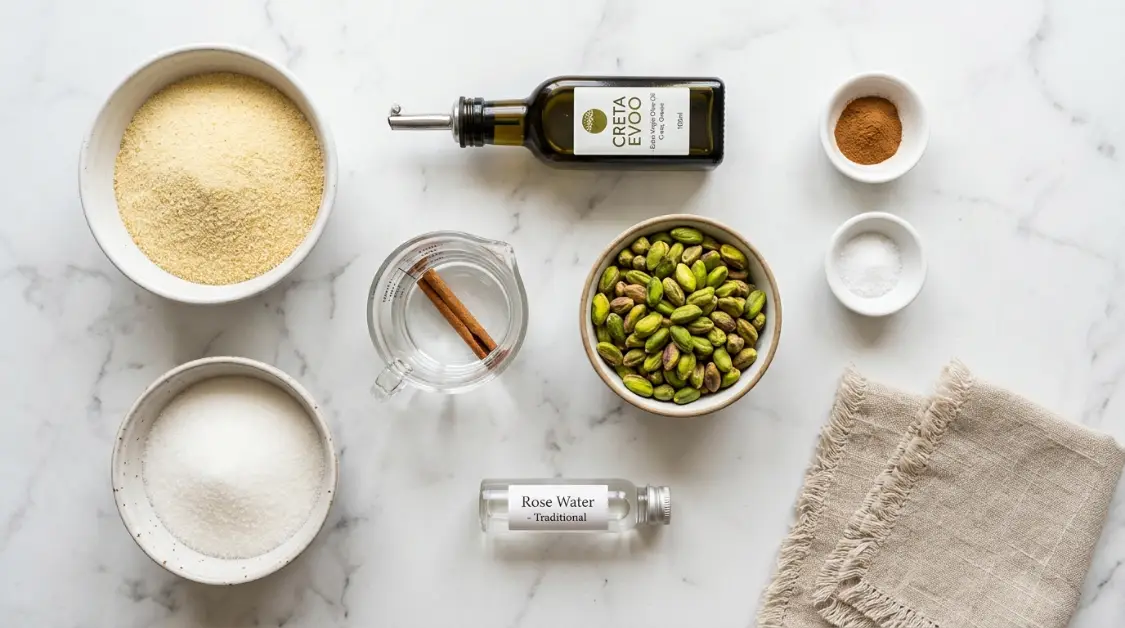
Complete Ingredients List
FOR THE SUGAR SYRUP:
600g (3 cups) white granulated sugar
900ml (3¾ cups) water
1 tsp ground cinnamon
1½ tsp pure rose water (added OFF HEAT after syrup is made)
FOR THE SEMOLINA BASE:
150ml (⅔ cup) extra-virgin olive oil OR 150g unsalted butter
300g (1¾ cups) coarse semolina
¼ tsp fine sea salt
FOR FINISHING:
200g (1½ cups) raw unsalted pistachios, briefly warmed in a dry pan
Ground cinnamon for dusting (2–3 tsp)
Thyme honey for drizzling — optional
Extra crushed pistachios for garnish — optional
Core Ingredients: The Semolina Grade Determines the Texture
Before we go into the table: coarse semolina and fine semolina produce different results, and you need to know which you want. Coarse semolina (simigdali in Greek) produces a halva with a slightly granular, rustic texture — each grain is distinct and the result has a pleasant bite. Fine semolina produces a smoother, more uniform texture closer to a dense fudge. My recipe uses coarse semolina — this is the traditional Cretan preference and the one my yiayia used — but I’ll note in the table where to adjust if you prefer fine. Both are correct. They’re different pistachio halvas.
| Ingredient | Amount | Why It Matters | Authentic Pick | Substitution |
| Coarse semolina | 300g (1¾ cups) | The structural base; starch gelatinization creates the fudgy set; coarse = rustic texture, fine = smoother | Greek simigdali or Italian semola rimacinata (coarse) | Fine semolina (same weight; smoother result; reduce cook time by 2 min) |
| Extra-virgin olive oil (or unsalted butter) | 150ml (⅔ cup) / 150g | Fat medium for Maillard toasting of semolina; olive oil = fruitier, Lenten-suitable; butter = richer, more indulgent | Cretan EVOO for Lenten version; unsalted butter for festive version | Coconut oil (vegan; slight tropical note) |
| Granulated white sugar | 600g (3 cups) | Dissolves into syrup that hydrates and sweetens the semolina; ratio is 3 parts liquid to 2 parts semolina | Fine white sugar — dissolves cleanly, no flavour interference | Honey (250g replacing 200g sugar — more floral, slightly softer set) |
| Water (for syrup) | 900ml (3¾ cups) | Combines with sugar to make the 3-parts liquid of the 1:2:3 ratio | Cold tap water — temperature doesn’t matter at syrup stage | Add 1 tbsp lemon juice to syrup for slight tartness that cuts richness |
| Unsalted pistachios (Aegina or Bronte) | 200g (1½ cups) | Crunchy contrast; bright flavour against the sweet toasted semolina; visual signature of the dish | Aegina PDO pistachios (Greece) or Bronte DOP (Sicily) — freshest possible, in-shell if available | Any good unsalted raw pistachios; avoid roasted/salted |
| Rose water | 1½ tsp, added off heat | Floral top note that defines the Aegean character; must be off-heat or it evaporates entirely | Pure rose water — check ingredients list for real vs synthetic | Orange blossom water (equally traditional; different floral note) |
| Ground cinnamon | 1 tsp (in syrup) + extra for dusting | Warm spice that bridges sweet syrup and nutty semolina; in the syrup it infuses throughout | Ceylon cinnamon — softer, more floral than Cassia; the Greek preference | ½ tsp allspice + ½ tsp cinnamon (Cypriot variation) |
| Fine sea salt | ¼ tsp (in semolina) | Sharpens all flavours; suppresses bitterness from semolina caramelization | Aegean fine sea salt | Any fine salt — essential; don’t omit |
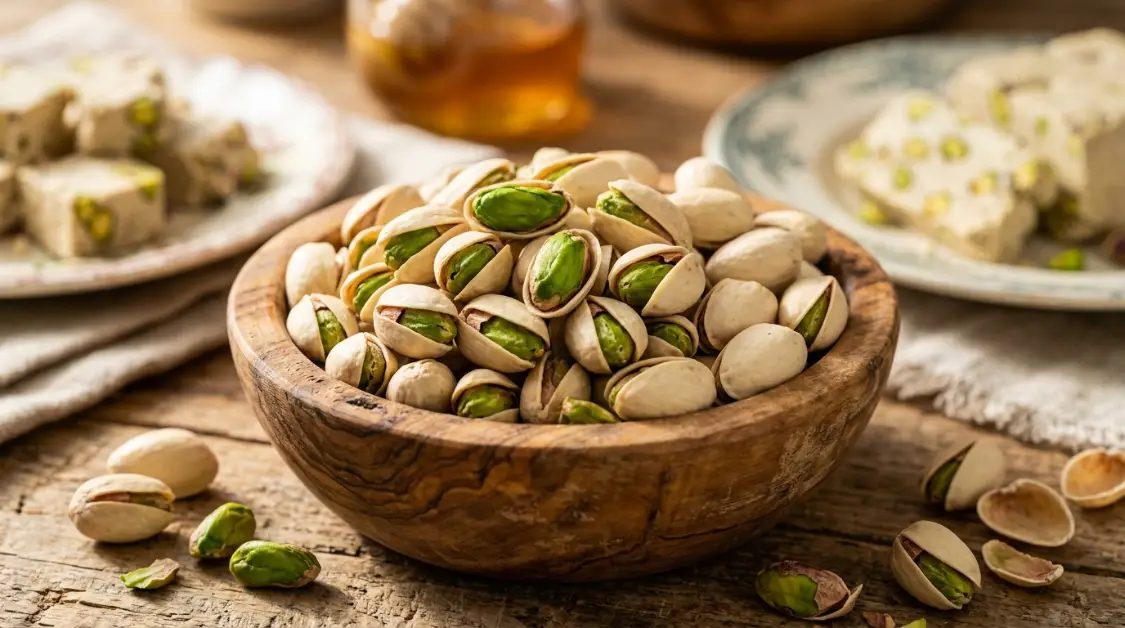
The pistachios: I want to say something directly about sourcing. Aegina pistachios are the finest pistachios in the world — small, intensely flavoured, protected by Greek PDO designation and harvested once a year from the island of Aegina in the Saronic Gulf. They are more expensive than Iranian or American pistachios, and they are worth every euro. If you cannot find them, Bronte pistachios from Sicily are the second choice. The difference between a pistachio halva made with fresh Aegina pistachios and one made with supermarket-bag pistachios is not subtle. Use the best nuts you can access.
⭐ Yiayia’s Tip: My yiayia warmed the pistachios briefly in the pan before adding them to the halva — 2 minutes over medium heat, no fat, just enough to wake up the oils. She said cold nuts from the bag ‘shock the halva.’ She was right about the temperature change affecting the set, but also, warm pistachios smell extraordinary and that fragrance carries into the finished dessert.
Dietary Substitutions and Variations That Work
| Dietary Need | Replace | With | Notes & Tested Results |
| Vegan / Lenten | Butter | Olive oil (same volume, 150ml) | Traditional — the olive oil version is the authentic Lenten halva. Slightly less rich but equally delicious. |
| Lower sugar | 600g white sugar | 400g sugar + 2 tbsp honey | Set is slightly softer; taste is more complex. Reduce water by 50ml to compensate for honey’s moisture. |
| Nut-free | 200g pistachios | 200g dried cranberries or raisins + 50g toasted sesame seeds | Completely different flavour profile but structurally sound. Not pistachio halva — a different halva. |
| Gluten-free | Semolina (contains gluten) | Coarse polenta (cornmeal) — same weight | Texture is slightly coarser and less fudgy; the set is slightly looser. Add 1 extra tbsp fat to compensate. |
| Orange blossom variation | Rose water (1½ tsp) | Orange blossom water (1 tsp — more potent, use less) | Equally authentic; more citrus-floral. My mother’s preferred version for Easter. |
| Honey halva | White sugar (all) | 300g sugar + 150g strong thyme honey from Crete | Deeper, more complex flavour; darker colour; slightly looser set. Extraordinary version. |
🌿 Pro Tip: The 1:2:3 ratio (fat:semolina:liquid syrup) is sacred. When experimenting with substitutions, always maintain this ratio by weight. Any deviation — more liquid, less fat, different semolina — will affect the set. Calculate substitution volumes against this ratio before you start.
Equipment & Technique for Pistachio Halva
Traditional Tools and Their Modern Alternatives
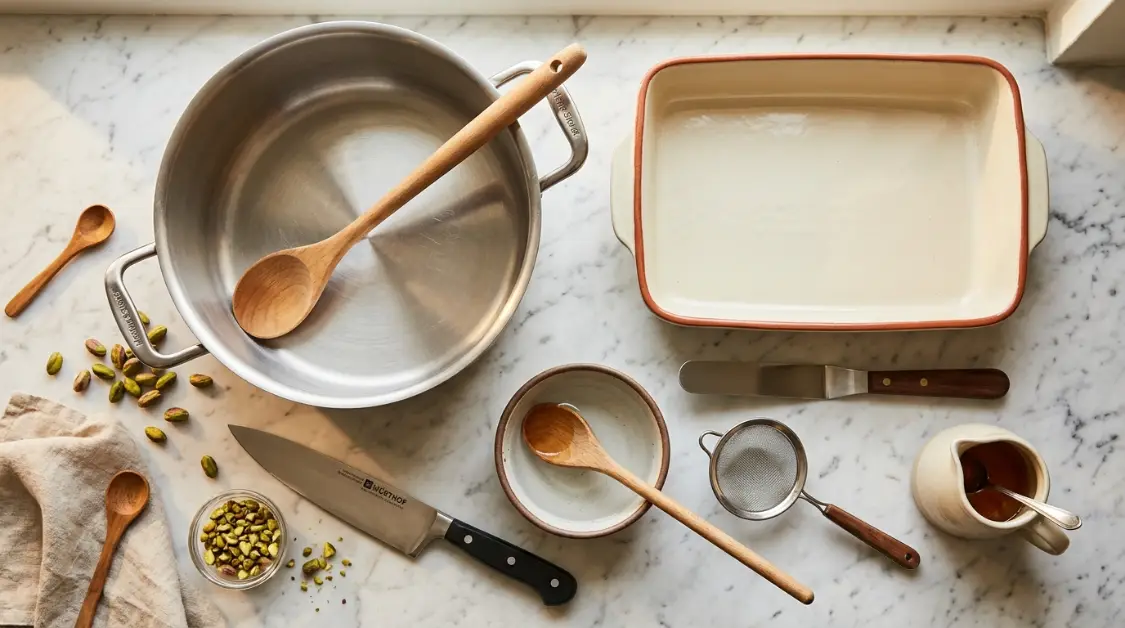
| Traditional Tool | Modern Alternative | Why It Matters |
| Wide, heavy copper saucepan | Heavy-bottomed stainless steel or enamelled cast-iron pot (3-litre) | Even heat distribution is critical — hot spots cause uneven Maillard browning and local burning |
| Long wooden stirring spoon | Silicone spatula or wooden spoon | You will stir continuously for 15–20 minutes; a long handle protects your hand from steam |
| Shallow terracotta tapsi (baking dish) | 20×30 cm (8×12 in) glass or ceramic baking dish | Width determines layer depth; 2–3 cm is ideal for clean slicing and correct set |
| Wet back of a spoon (surface pressing) | Offset spatula dipped in cold water | Prevents the halva sticking to the tool while creating the smooth, pressed surface |
| Fine-mesh strainer (for syrup) | Standard strainer | Removes any undissolved sugar or cinnamon pieces from syrup before adding to semolina |
| Kitchen thermometer | Visual/sound cues (see Step 3) | Syrup should reach 220°F / 105°C — a rolling boil for 3 minutes; thermometer is more reliable |
Mise en Place: The Setup That Makes 15 Minutes of Stirring Manageable
Pistachio halva moves fast once the syrup hits the semolina. Have everything ready before you start the fat: measure your semolina into a bowl, measure your syrup ingredients into a separate pot, have your pistachios toasted and standing by (warm), your rose water measured, your tapsi lightly oiled and ready.
The three-stage process — toast semolina, make syrup, combine — happens with precise timing, and the syrup must be added to the semolina immediately when both are at the right temperature. Cold syrup into hot semolina creates lumping; hot semolina sitting too long before the syrup arrives burns and over-darkens. The mise en place here is not optional preparation — it is the technique. I set up my Athens kitchen like a mise en place diagram before every pistachio halva session, and I’ve made this thirty-two times.
Step-by-Step Pistachio Halva Instructions
Preparation Steps 1–4: Syrup, Toasting, and the Critical Moment
Step 1: Make the sugar syrup (10 minutes). Combine 600g sugar, 900ml water, and 1 tsp ground cinnamon in a medium saucepan over medium-high heat. Stir until sugar dissolves — stop stirring once it comes to a boil. Bring to a rolling boil and maintain for 3 minutes. The syrup should reach approximately 220°F / 105°C — you can use a thermometer, or simply time the rolling boil. Remove from heat. Add 1½ tsp rose water off heat only — rose water’s aromatic compounds (primarily geraniol and citronellol) volatilize rapidly above 160°F / 71°C with sustained heat. Stir once, cover with a lid to keep warm, and set aside.
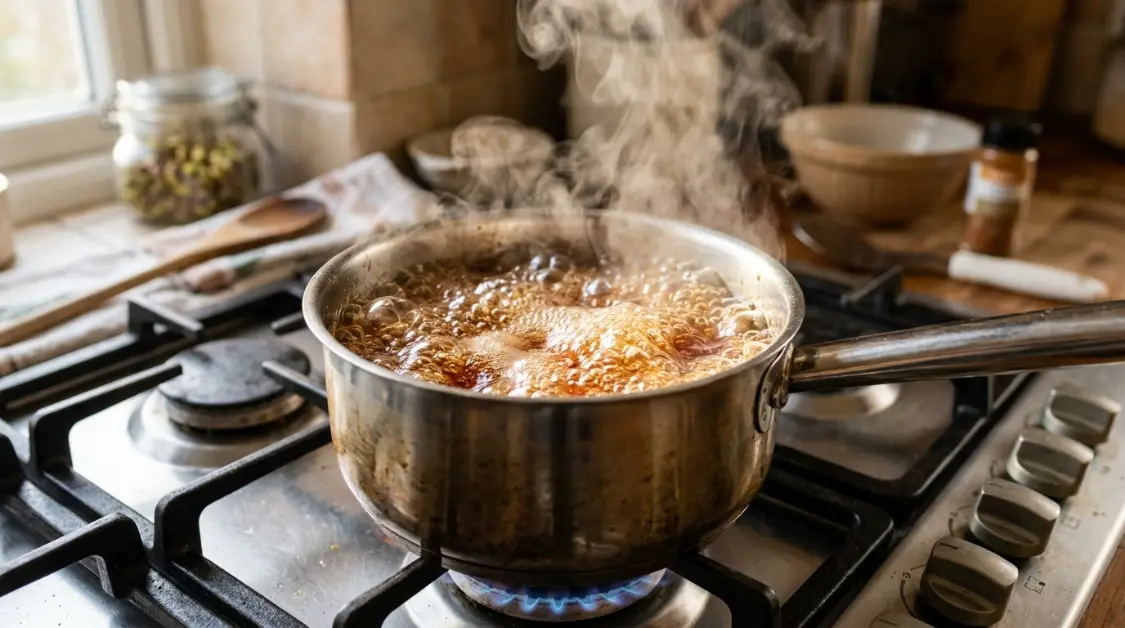
⭐ Yiayia’s Tip: My yiayia always made the syrup first and let it sit covered while she toasted the semolina — she called it ‘resting the sweetness.’ The covered syrup stays warm for 15 minutes without losing temperature, which is exactly how long the semolina toasting takes. Perfect timing that I thought was coincidental until I understood the chemistry.
Step 2: Toast the semolina in fat — the most important 15 minutes of the recipe. Heat 150ml olive oil (or 150g butter) in a wide, heavy-bottomed 3-litre pot over medium heat until shimmering. Add 300g coarse semolina and ¼ tsp fine salt all at once. Stir immediately and continuously with a wooden spoon or silicone spatula, reaching the bottom and corners of the pot at every stroke.
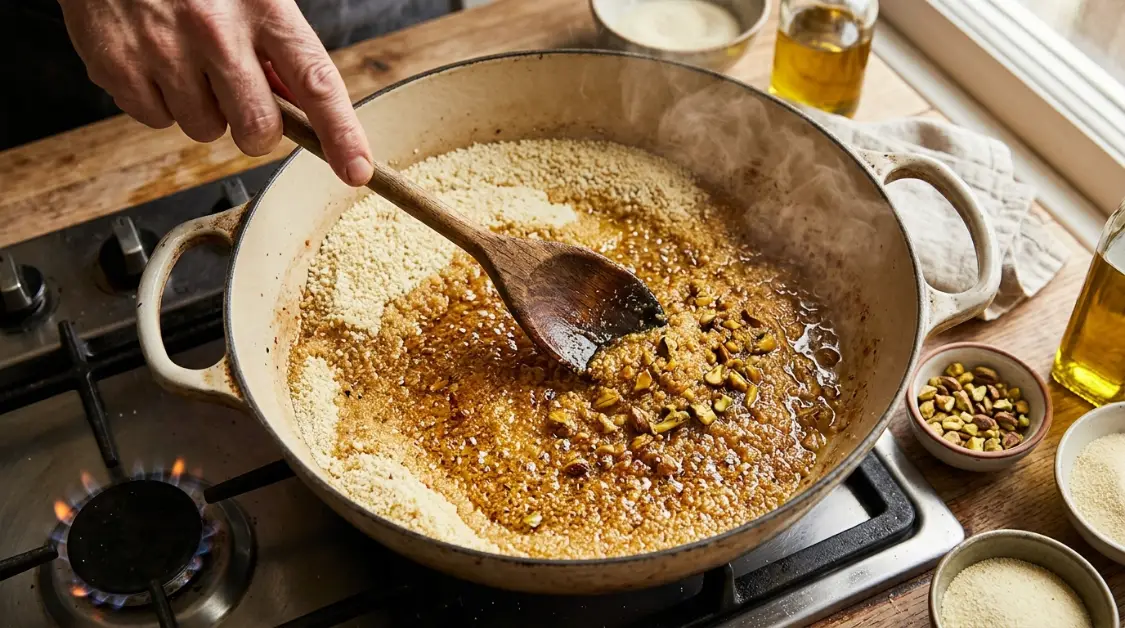
The semolina will first look pale and sandy (minutes 1–5), then begin to turn golden (minutes 6–10), then deepen toward amber (minutes 11–15). You want amber. Not pale gold — that is undercooked and will produce a flat, starchy halva. Not dark brown — that is burned and bitter. Amber. The colour of good Greek honey.
What is happening: the Maillard reaction between the amino acids and reducing sugars in the semolina, accelerated by the fat medium. Kenji López-Alt discusses in The Food Lab how fat-cooking (as opposed to water-cooking) allows surface temperatures to exceed 212°F / 100°C, reaching the 280°F / 140°C threshold where Maillard reactions accelerate exponentially. This is why toasting semolina in oil or butter produces flavours that dry-toasting alone cannot — the fat elevates the surface temperature of each grain far beyond what steam would allow.
Step 3: Add the warm syrup — stand back, stir fast. This is the most dramatic moment of pistachio halva making, and the one that ends most beginners’ first attempts in disaster. When the semolina is amber and the syrup is warm (not cold — if it has cooled, rewarm it briefly), remove the semolina pot from heat, stand back slightly, and add the syrup in a slow, steady stream while stirring vigorously.
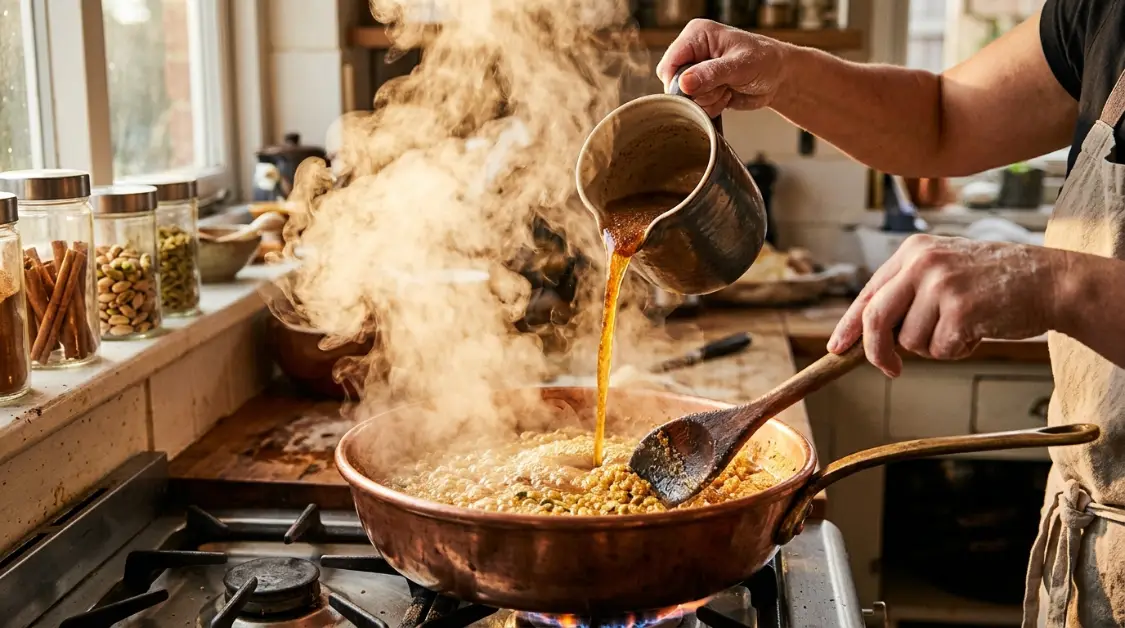
The mixture will erupt in violent steam and spitting as the hot fat meets the water-based syrup — this is normal and expected, and it will subside within 30 seconds. Do not stop stirring during this phase. The starch gelatinization happens almost immediately as the hot liquid hits the roasted semolina, and any area that is not stirred will lump and set before being incorporated.
🌿 Pro Tip: If your syrup has cooled completely while the semolina was toasting, don’t add cold syrup — rewarm it for 2 minutes first. Cold syrup into hot semolina causes the fat to seize and the mixture to become greasy and uneven. Warm syrup + amber semolina = smooth, unified halva.
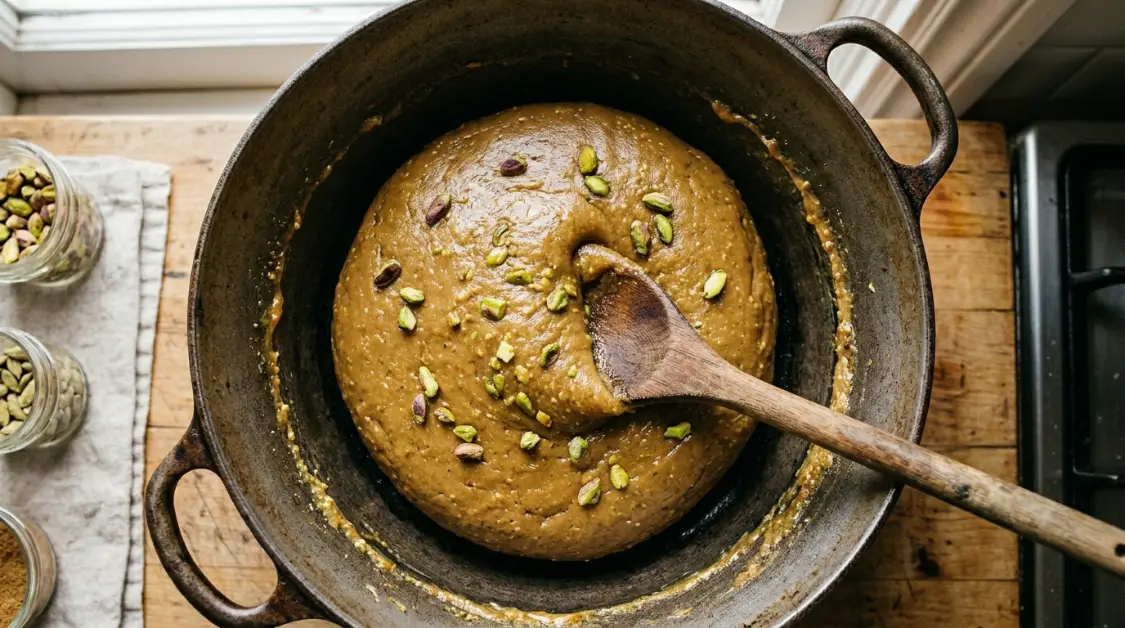
Step 4: Return to heat and stir to the pull-away stage (3–5 minutes). After the syrup is incorporated, return the pot to medium-low heat and stir continuously as the halva thickens. What you’re watching for: the mixture will begin to pull away from the sides of the pot and gather toward the centre as you stir, like a thick risotto pulling from the pan. This is your signal. At this stage the starch has fully gelatinized — McGee’s description of fully swollen starch granules forming a continuous gel matrix — and the halva is ready to receive the pistachios and transfer to the mould. Do not cook past this point. Over-cooked halva is dry and crumbles when sliced.
Assembly Steps 5–7: Pistachios, Mould, and the Press
Step 5: Fold in warm pistachios off heat. Remove pot from heat. Add 200g briefly-warmed pistachios (2 minutes in a dry pan, cooled to touchable but still warm) and fold through with the spatula using 8–10 deliberate strokes — you want them evenly distributed without breaking them. Do not over-fold — the halva is beginning to set and additional working toughens the texture.
Step 6: Transfer to the oiled tapsi — quickly. Pour the hot pistachio halva into the lightly oiled baking dish immediately. Work fast — it will begin setting within 2 minutes of leaving the heat. Spread to the corners and edges with an offset spatula. Do not fuss. Two or three wide strokes is all you get before the set begins.
Step 7: Press the surface and cool. Dip the back of a large spoon in cold water and press the surface of the halva firmly and evenly — this compacts the texture and creates the smooth, faintly shiny surface of properly made Greek semolina halva. Dust the top generously with ground cinnamon through a fine strainer. Score into diamond shapes while still warm — 4 cuts lengthwise and 4 diagonally — as the halva will be difficult to score cleanly once cold. Allow to cool at room temperature for 1 hour, then refrigerate for 2 hours before slicing along the scored lines.
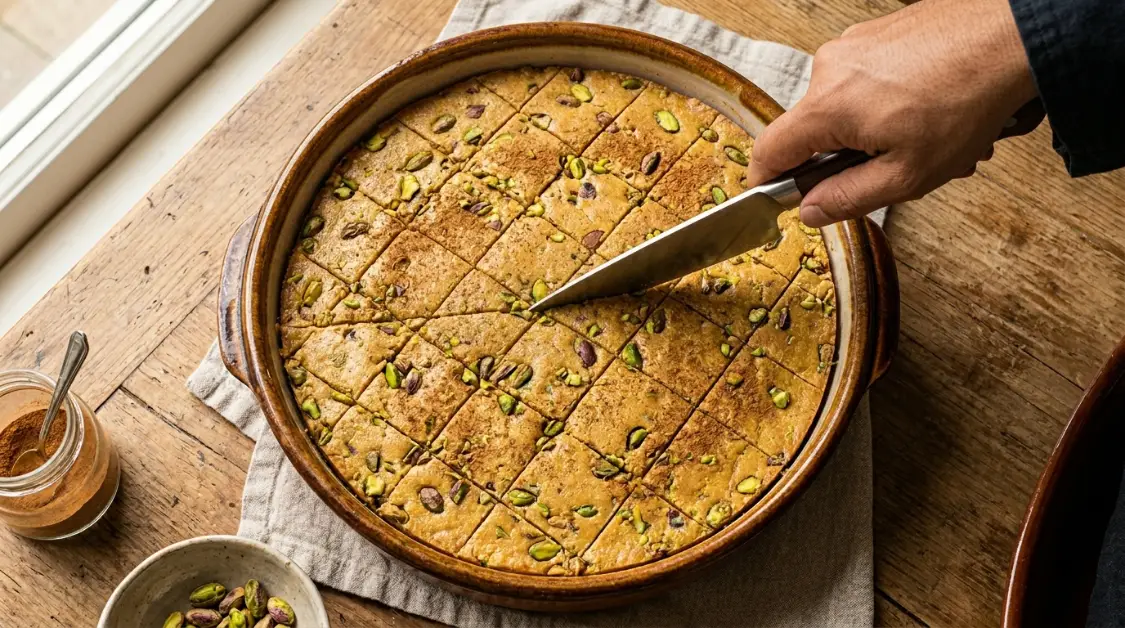
⭐ Yiayia’s Tip: My yiayia pressed the surface with a wet spoon and then pressed a sheet of parchment paper directly onto it for 5 minutes. She said it ‘convinces the halva to be flat.’ The parchment absorbs any surface steam and produces a uniformly smooth top that holds the cinnamon dusting beautifully. Remove before scoring.
The Secret Touches That Elevate Pistachio Halva
Four Insider Techniques From Thirty-Two Test Batches
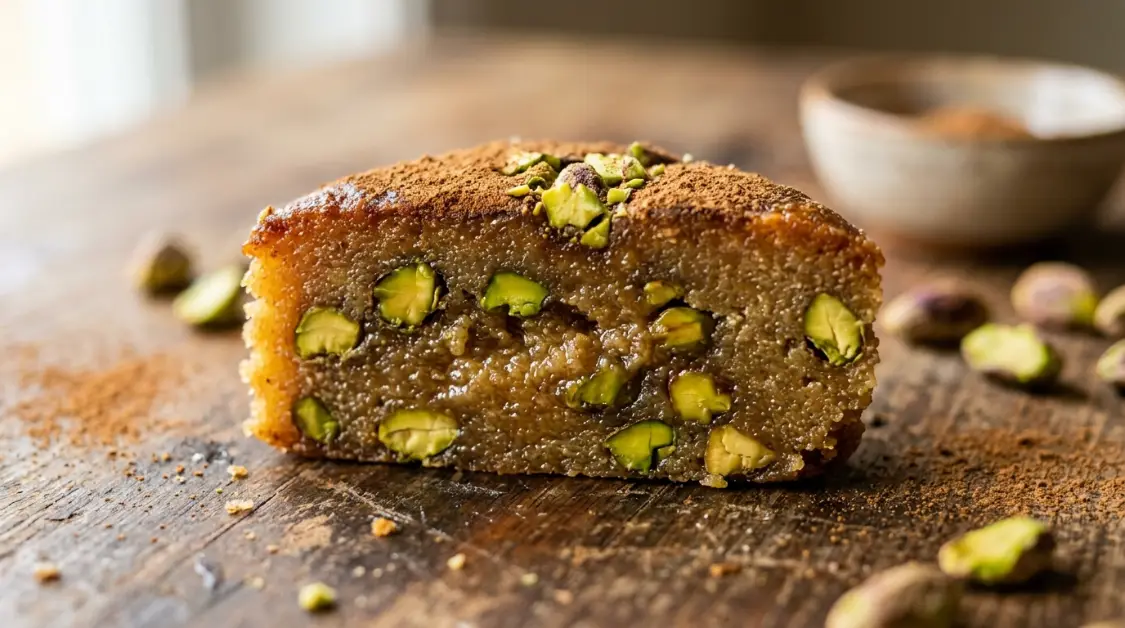
Secret 1 — The 1:2:3 ratio is sacred. I’ve tested ratios from 1:1.5:2.5 to 1:2.5:4. The 1:2:3 ratio (fat:semolina:syrup) is the only one that produces a pistachio halva that slices cleanly with a knife, holds its diamond shape at room temperature for 3 days, and remains fudgy rather than dry at the centre. Every deviation in either direction produces either a crumbling dry halva (less liquid) or a collapsed wet one (more liquid). Trust the ratio.
Secret 2 — Toast to amber, not gold. The specific Maillard reaction products that give toasted semolina halva its characteristic flavour — pyrazines, furanones, and maltol — form primarily in the amber-to-light-brown temperature range (300–340°F / 150–170°C surface temperature in the fat). Stopping at pale gold means you’ve only begun these reactions. Amber means you’ve completed the first and most important stage. Smell the pan: golden means nothing; amber smells nutty, warm, almost bread-like. That’s when you know.
Secret 3 — Rose water off heat, always. Added to the syrup while hot, rose water would lose its aromatic signature entirely within the first 3 minutes of boiling. Added off heat, it survives the subsequent cooking of the halva because the halva itself doesn’t return to a sustained boil after the syrup is incorporated. The floral note in the finished halva with rose water is the result of this precise addition moment. This is the same principle I use in the rizogalo and the tiramisu soak — floral aromatics belong off heat.
Secret 4 — Score while warm. Halva continues to firm as it cools, and trying to score cold pistachio halva into diamonds results in cracking and breaking rather than clean cuts. Score within the first 15 minutes of removing from heat — the knife will move smoothly through the set surface, and the scored lines will remain clean and deep after refrigeration. I score with a sharp chef’s knife dipped in hot water between each cut. The diamonds are traditionally served point-up on a serving plate — the pointed shape catches the cinnamon dusting and looks, if I’m honest, exactly right.
Common Mistakes and How to Fix Them
| Mistake | What Happens | How to Fix It |
| Toasting too pale (not to amber) | Flat, starchy halva with no depth of flavour; grey rather than golden colour | Toast minimum 12 minutes, stirring continuously. Amber = nutty smell and deep honey-gold colour. |
| Adding cold syrup to hot semolina | Fat seizes; mixture becomes greasy and uneven; lumps form | Always add warm syrup. If syrup has cooled, rewarm before adding. The temperature must match. |
| Not stirring continuously during toasting | Hot spots develop; semolina burns in patches; bitter flavour throughout batch | Stir every 15–20 seconds minimum — reach corners and bottom of pot at every stroke. |
| Cooking past the pull-away stage | Dry, crumbling halva; cracks when sliced; powdery texture | Watch for the pull-away cue, not the clock. Remove from heat immediately when sides pull clean. |
| Adding pistachios too late (after cooling) | Pistachios don’t incorporate evenly; they sit on surface rather than suspending in the set | Add warm pistachios immediately after removing from heat, before transferring to tapsi. |
| Scoring when cold | Halva cracks and splinters rather than cutting cleanly; ragged edges | Score with a wet sharp knife within 15 minutes of pouring into the mould, while still warm. |
Variations & Serving Pistachio Halva
Regional Variations Across Greece and the Eastern Mediterranean
The Greek halva tradition alone has remarkable regional diversity. The Macedonian version (northern mainland Greece) uses a higher proportion of butter and adds whole walnuts alongside the semolina. The island version from Chios and Lesvos often incorporates ground Chios mastic — a ¼ teaspoon ground with a pinch of sugar, added with the pistachios — which produces a resinous, piney note that is the region’s signature. The Cypriot halvas (note the ‘s’) is similar to the Greek semolina version but uses tahini to grease the mould and often adds raisins alongside the nuts, producing a richer, darker result.
The Middle Eastern tahini halva — the pressed, fudge-like confection sold in blocks — is structurally different: it is made from tahini (ground sesame paste) and sugar or honey cooked to the hard-crack stage, then allowed to crystallize into the distinctive flaky, sandy texture. It shares the name and the sweetness but is a completely different preparation. Both are extraordinary. They are not interchangeable.
Weeknight shortcut: you can use fine semolina instead of coarse and reduce the toasting time to 10 minutes instead of 15. The texture is smoother and the preparation slightly faster. You sacrifice the rustic bite of the coarse version, but the flavour is ninety percent as good with sixty percent of the stirring effort. I do this when I’m making pistachio halva on a Tuesday and not for a dinner party.
Serving Accompaniments and Non-Alcoholic Pairings
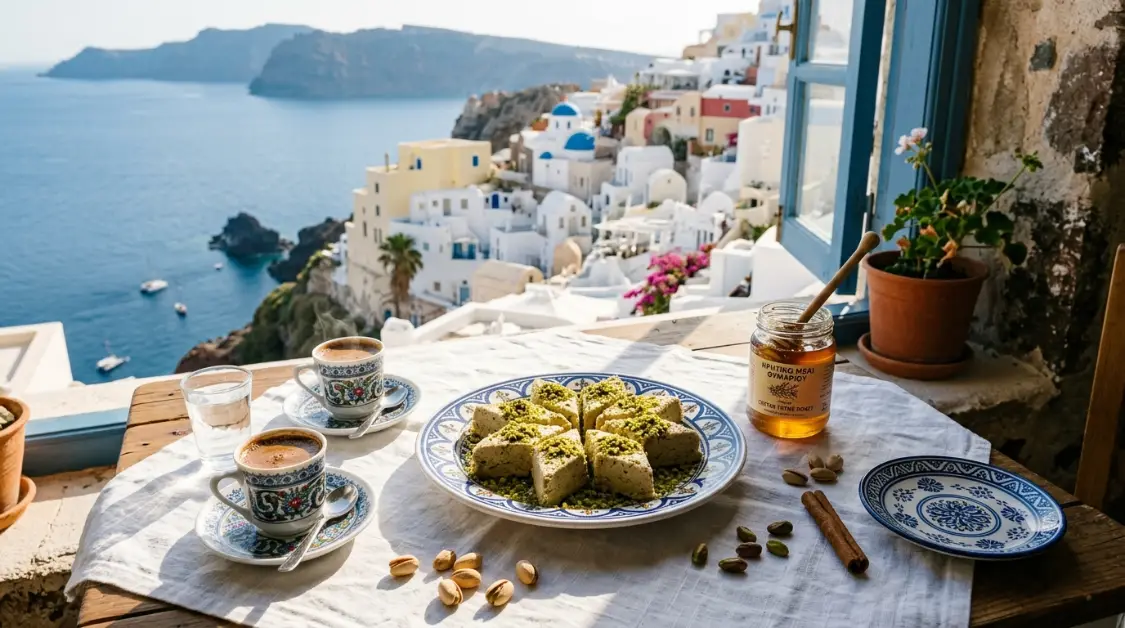
Serve pistachio halva at room temperature, cut into diamonds or rectangles, dusted with fresh cinnamon just before serving. A small drizzle of thyme honey from Sitia over the top is the Cretan embellishment I cannot resist — the herbal honey against the roasted semolina and floral rose water is one of those rare combinations where everything is amplified rather than competed. A light scatter of extra crushed pistachios over the surface adds visual drama and textural contrast.
For a full Mediterranean dessert spread alongside, our loukoumades Greek honey donuts and our semolina cake (basbousa/revani) make natural companions — the same semolina DNA expressed in three different forms. For something lighter to balance the richness, our strawberry basil sorbet as a palate cleanser between halva bites is extraordinary.
The beverage that belongs alongside pistachio halva is Greek coffee — sketo or me oligí záchari (black or lightly sweetened), brewed dense in a briki and served in a small cup. The bitter roasted coffee against the warm semolina sweetness is the definitive Mediterranean dessert pairing. Tsai tou vounou (Greek mountain tea) is the non-caffeine alternative — its herbal, slightly bitter quality provides the same counterpoint. Chilled hibiscus tea for summer service.
Storage & Reheating for Pistachio Halva
How to Store and How Long It Keeps
| Method | Container | Duration | Notes |
| Room temperature | Tapsi covered with foil or parchment, or airtight container | Up to 3 days | Ideal serving temperature; flavour and texture peak on day 2 |
| Refrigerator | Airtight container or wrapped tightly in parchment then foil | Up to 8–10 days | Texture firms in cold; bring to room temp 20 min before serving |
| Refrigerator (individual portions) | Individual pieces wrapped in parchment then placed in airtight container | Up to 10 days | Best method for preserving cut surfaces; prevents drying |
| Freezer | Parchment-wrapped individual diamonds in airtight container or zip bag | Up to 3 months | Freeze before cinnamon dusting; thaw overnight in fridge; excellent result |
Refreshing Pistachio Halva After Storage
Refrigerated pistachio halva firms considerably — this is the starch retrogradation that Harold McGee describes: as starch gels cool, the amylose and amylopectin molecules partially recrystallize, creating a firmer, sometimes slightly gritty texture.
The remedy: always bring refrigerated halva to room temperature for 20 minutes before serving. If you want to partially restore the just-made texture, 15 seconds in the microwave on medium power will relax the starch without making the halva wet.
From frozen: thaw overnight in the refrigerator, then 30 minutes at room temperature before serving. Before serving any stored halva: a fresh dusting of cinnamon is mandatory. The stored surface absorbs the first dusting; the second layer restores the visual finish and the spice fragrance that makes the first impression.
Frequently Asked Questions
Substitutions & Technique Questions
Can I make pistachio halva without the specific 1:2:3 ratio?
The ratio is the recipe’s structural foundation — it’s not a preference, it’s food chemistry. The 1:2:3 ratio (fat:semolina:sugar syrup) produces the specific water-to-starch ratio that creates the halva’s characteristic fudgy set. Too much liquid: it won’t set firmly enough to slice. Too little: it cracks and crumbles. If you want to adjust sweetness, reduce the sugar in the syrup but keep the total liquid volume the same by adding water. That’s the only safe adjustment within the ratio.
Why does my halva look grainy or feel sandy after cooling?
Two causes. First: semolina undertoasted (not enough Maillard reaction; insufficient starch modification). Second: syrup added too cold, causing partial starch gelatinization before full incorporation. The fix: toast to amber (not pale gold), and always add warm syrup. Sandy texture can also develop after days of refrigeration — starch retrogradation. Always bring refrigerated pistachio halva to room temperature before serving; this reverses partial retrogradation and restores the fudgy texture.
Can I replace the rose water entirely?
Yes. The rose water is traditional but not structural — the halva sets and slices perfectly without it. Replace with orange blossom water (1 tsp — it’s more potent, so use less), or add ½ tsp vanilla extract and ¼ tsp ground cardamom for a different but authentically Mediterranean aromatic profile. Or omit entirely for a purely semolina-and-pistachio expression of the recipe. All four versions — rose water, orange blossom, cardamom-vanilla, none — are legitimate halva recipes.
My halva didn’t set — it’s soft and won’t hold its shape. What went wrong?
Almost certainly too much liquid relative to semolina — either the ratio was altered or the syrup was not measured accurately. A second possibility: the syrup was added before the semolina reached amber (the starch wasn’t sufficiently toasted to gelatinize properly with the available liquid). A third: the mixture wasn’t cooked long enough after the syrup was added — you need to reach the pull-away stage before transferring. If it’s still liquid in the tapsi: return to the pot, cook over medium heat stirring constantly until pull-away, then re-pour.
Can I use a different nut instead of pistachios?
Absolutely — this is how you get walnut halva (the Macedonian style), almond halva (common in Turkey and Thessaloniki), or pine nut halva (occasionally found in Crete). Use the same 200g, briefly warmed in a dry pan, folded in at the same off-heat stage. Each nut changes the flavour character of the nut halva significantly: walnuts are more bitter and earthy, almonds are milder and sweeter, pine nuts are intensely rich and resinous. Pistachios, with their bright buttery flavour and green colour, are my first choice for visual and flavour impact.
Dietary, Make-Ahead & Authenticity Questions
Is this pistachio halva vegan and Lenten-appropriate?
With one swap, yes. Replace butter with olive oil (same volume, 150ml) and the halva is completely vegan and suitable for Orthodox Christian Lenten observance — halvás made with olive oil is one of the most traditional Lenten sweets in Greece, permitted even during the strictest fasting periods because it contains no meat, no dairy, no eggs, and no fish. The olive oil version is the original — butter was a later, richer variation. Our easy halva recipe is therefore simultaneously the most traditional and the most inclusive version.
How far ahead can I make this for a dinner party?
Up to 3 days ahead at room temperature (covered) or 10 days in the refrigerator. In fact, day 2 is peak pistachio halva — the flavours unify, the set firms to the ideal sliceable-but-fudgy consistency, and the rose water fragrance has fully permeated the semolina. Make it two days before your dinner party without hesitation. Slice and arrange on the serving plate the morning of; dust with cinnamon 30 minutes before serving.
What is the difference between Greek halva and tahini halva?
Completely different desserts with the same name. Greek semolina halva (halvás) is cooked from flour + fat + sugar syrup; its texture is fudgy and moist. Tahini halva (common in Middle Eastern, Israeli, and Turkish traditions) is made from sesame paste cooked with sugar to the hard-crack stage, then allowed to crystallize into a dense, flaky, slightly grainy block. Both are extraordinary; both are called halva because they are intensely sweet confections derived from the Arabic halawa. This recipe makes the Greek semolina halva — the tradition my yiayia practised in Chania.
Why does authentic halva have a diamond shape?
The diamond (lozenge) shape is traditional throughout the Eastern Mediterranean and Middle Eastern halva traditions — it’s found in Greek, Turkish, Lebanese, Syrian, and Egyptian versions. The shape may derive from ancient Persian confectionery presentation (the word halvah itself has Persian roots), where diamond cutting was a sign of careful craftsmanship. Practically speaking, diagonal cuts through a rectangular mould produces diamonds with pointed ends that hold their shape well at room temperature and create a visually striking serving presentation. You can absolutely cut squares — the flavour is identical.
Can children eat this pistachio halva?
Yes — this recipe contains no alcohol, no pork, and no dairy (with olive oil). It is appropriate for children with no nut allergies. The sugar content is significant (it is a dessert), and the pistachio pieces are a choking consideration for children under 3 — crush or finely chop pistachios for very young children’s portions. For nut-allergic children, substitute seedless raisins and sesame seeds for the pistachios (note in the substitutions table above).
Bringing Greece to Your Table
A Diamond of Semolina, Rose Water, and Memory
My yiayia’s halva has outlasted the kitchen she made it in. She passed in 2019, and the tapsi is still on the second shelf in Chania, behind the spanakopita pan. Last September I went back and made pistachio halva in that kitchen — same pan, same spoon, same ratio she’d taught me. The kitchen smelled identical to the September of my childhood. The Maillard reaction and the rose water and the warm pistachios don’t change. That’s what a good recipe does: it holds a moment in place across time.
Make a batch this week. Serve it at room temperature, cinnamon-dusted, with strong Greek coffee. Post the diamonds in the comments. Tell me what you added, what you changed, what it smelled like at minute twelve of the toasting. Kali orexi.
More Mediterranean Sweets to Explore
If this pistachio halva has started something in your kitchen, the natural companion piece is our semolina cake (basbousa/revani) — another semolina-based Mediterranean sweet with the same ancient DNA but a completely different texture and syrup-soaked personality. For fried celebration sweets, our loukoumades Greek honey donuts are the festive counterpart. And for the full breadth of the Mediterranean sweet table, our Mediterranean desserts collection has everything from delicate to indulgent — all worth your time.