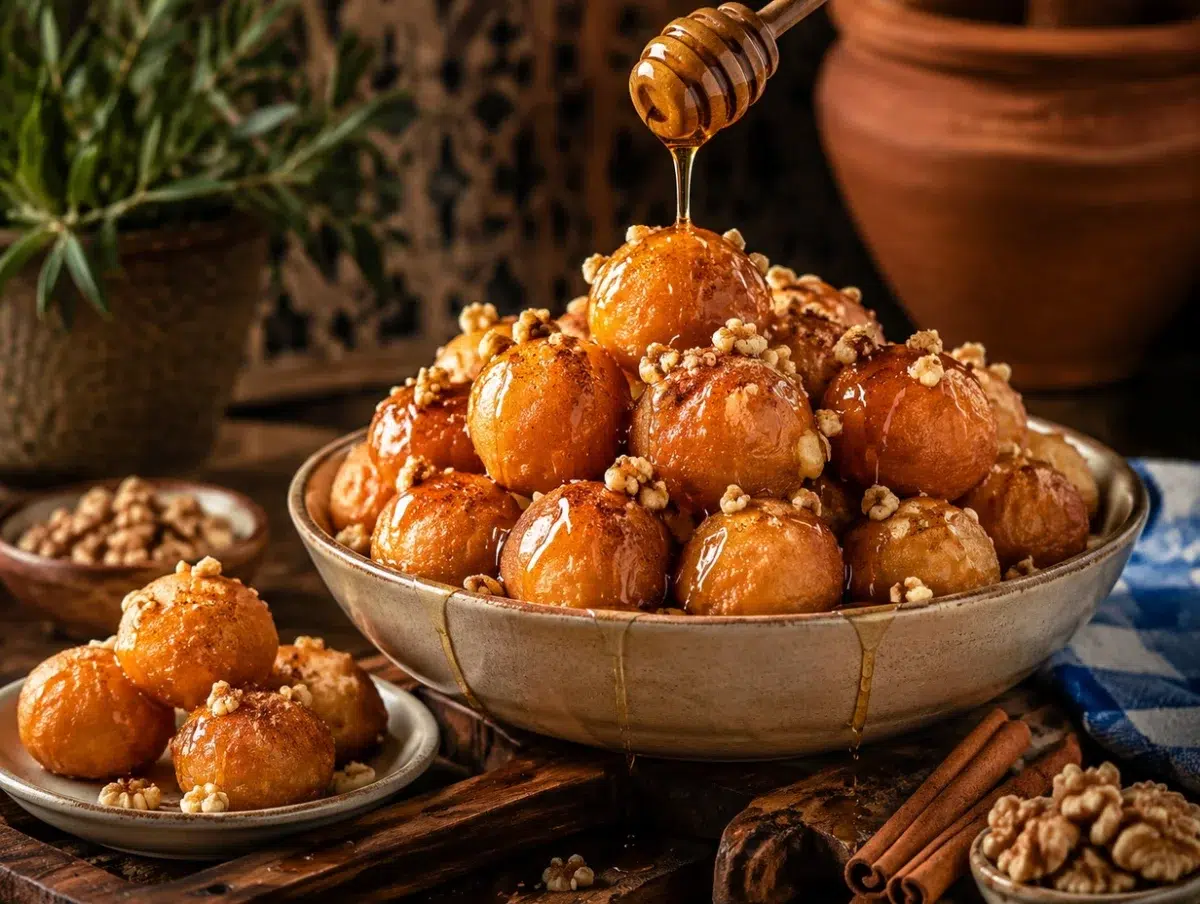
It was the summer of 2019, and I had confidently — overconfidently, my mother would say — volunteered to make loukoumades (Greek honey donuts) for my cousin Stavros’s name day party. Forty-two people. I had made them exactly once before, at a cooking class in Athens I took on a whim during a layover. (The instructor’s name was Kyria Eleftheria, and she had approximately zero patience for people who stirred too slowly — she tapped my arm with a wooden spoon twice.)
My first batch at Stavros’s party came out dense, pale, and weirdly square. My second batch exploded. The third batch — and I’m talking batch number three, after texting everyone I knew for help — finally turned golden, impossibly puffy, and dripping with honey syrup. That evening I wrote down every single thing I did differently. These are those secrets.
Table of Contents
Loukoumades (Greek Honey Donuts)
Ingredients
Method
- 1. Proof the yeast: Whisk lukewarm water, sugar, and yeast in a large glass bowl. Wait 5–8 minutes until foamy.
- 2. Make the dough: Add sifted flour, olive oil, and optional cornstarch to yeast mixture. Whisk until smooth. Add salt last. The batter should be thick but pourable.
- 3. Rise: Cover tightly with plastic wrap. Place in a warm spot for 60 minutes until doubled in size.
- 4. Make syrup: Simmer water, honey, and sugar for 3 minutes. Cool completely to room temperature.
- 5. Heat oil: Pour oil 3 inches deep in a heavy pot. Heat to 350°F (175°C).
- 6. Fry: Wet hand with oil, squeeze dough through fist, scoop with oiled teaspoon into hot oil (or use a cookie scoop). Fry 4–5 at a time, turning every 30 seconds, 2–3 minutes until deep golden brown.
- 7. Drain: Remove to a wire rack (not paper towels).
- 8. Finish: Immediately dip or drizzle with honey syrup. Sprinkle with cinnamon and crushed walnuts. Serve immediately.
Notes
Why This Recipe Works
The Ancient Science Behind the Perfect Puff
Loukoumades are not just Greek donuts — they are one of the oldest recorded desserts on earth, reportedly served to victors at the ancient Olympic Games around 776 BCE. The magic of loukoumades comes down to yeast fermentation and steam. When the yeast-leavened loukoumades dough hits hot oil (around 350°F/175°C), the water inside the batter instantly converts to steam, creating that hollow, airy interior. Simultaneously, the exterior undergoes the Maillard reaction — the same process Harold McGee describes in ‘On Food and Cooking’ as responsible for browning and flavor development in fried foods. The result is a shell that shatters and an inside that’s cloudlike.
The honey syrup is equally deliberate: soaking hot Greek honey donuts in room-temperature syrup (not boiling!) creates a thin, lacquered coating rather than a soggy one. This is a point of genuine obsession for me, honestly. I have ruined many batches by being impatient.
When to Make Loukoumades
These fried dough balls are classic Greek street food, sold at every festival (panigiri) across Greece — but they’re equally at home as an after-dinner dessert any night of the week. They pair beautifully after a savory meal like our gemista Greek stuffed peppers, and they’re a guaranteed crowd-pleaser at gatherings. Just be warned: they must be eaten fresh. They are the Cinderella of desserts — magical for about 20 minutes, then kind of sad.
Essential Ingredients
The Loukoumades Dough: What You Actually Need
The beauty of authentic loukoumades dough is its simplicity — we’re talking five pantry staples. The real secret is the flour-to-liquid ratio: slightly wetter than you think is right. Like, annoyingly wet. A batter that can barely hold its shape is exactly what you want. Here’s what you need, with quality notes:
- All-purpose flour (250g): Sifted, please. Seriously, sift it. I once skipped this and got lumpy dough that I pretended was intentional for about 30 seconds.
- Active dry yeast (7g / 1 packet): Fresh matters enormously — if yours doesn’t foam in 5 minutes, throw it out.
- Warm water (300ml): Lukewarm, not hot. 105°F / 40°C. Hot water kills yeast deader than a dropped phone.
- Granulated sugar (1 tbsp): Just enough to feed the yeast and add a whisper of sweetness to the dough.
- Salt (1/2 tsp): Added AFTER the yeast mixture — salt deactivates yeast if they meet directly.
- Olive oil (1 tbsp): Adds flavor and keeps the dough from being sticky-dry (if that makes sense). Can substitute neutral oil.
Ingredient Comparison: Loukoumades vs Other Donut Styles
| Feature | Loukoumades | American Donuts | Churros | Beignets |
| Leavening | Yeast | Yeast/Baking powder | Steam (choux) | Yeast |
| Sweetener | Honey syrup | Powdered sugar/glaze | Cinnamon sugar | Powdered sugar |
| Texture | Airy & crisp | Dense & cakey | Crisp & hollow | Light & pillowy |
| Dairy-free? | Yes (traditional) | Usually no | Yes | No |
USA substitutions: Can’t find Greek thyme honey? Regular wildflower honey works beautifully. Grapeseed oil for frying if you want a neutral flavor. For a more traditional touch, check these Mediterranean desserts recipes for ingredient sourcing tips.
The Foolproof Method
Preparation: Making the Yeast Dough
Step 1 (5 minutes): In a large bowl — glass or ceramic, not metal, as metal can interfere with yeast activity — whisk together 300ml lukewarm water, the sugar, and yeast. Wait 5–8 minutes until it looks foamy and smells kind of… alive? You want bubbles. If nothing happens, your yeast is dead. Start over.
Step 2 (3 minutes): Add the sifted flour and olive oil. Whisk vigorously until smooth — no lumps. Add salt last. The loukoumades dough should be thick but pourable, like a pancake batter that’s been going to the gym.
Step 3 (60 minutes): Cover tightly with plastic wrap and set in a warm spot. I put mine in an oven preheated to 100°F (38°C) and then turned off. Leave until doubled — usually exactly 60 minutes in a warm kitchen, up to 90 in a cool one. Do not rush this. I repeat: do not rush this.
The honey syrup can be made while the dough rises: combine 200ml water, 200g honey, and 100g sugar in a saucepan. Simmer 3 minutes until slightly thickened. Let cool to room temperature. This is important — hot syrup on hot Greek honey donuts makes them soggy, not glazed.
Frying: The Method That Actually Works
Step 4: Pour vegetable or grapeseed oil into a deep, heavy pot to a depth of at least 3 inches. Heat to 350°F (175°C). Use a thermometer. I’m not being precious — temperature is everything for fried dough balls. Too cool, and they absorb oil and turn greasy. Too hot, and they’re brown outside, raw inside.
Step 5 (the tricky part): Wet your hand with oil, scoop up a palmful of loukoumades dough, squeeze it through your fist, and scoop the emerging ball off with a wet teaspoon into the oil. OR — far less dramatic — use a small cookie scoop dipped in oil between drops. Fry 4–5 at a time. Don’t crowd the pan! Crowding drops oil temperature and is how you end up with sad pale puffs. Fry 2–3 minutes, turning every 30 seconds, until deep golden brown.
Pro tip from Kyria Eleftheria: Add a teaspoon of cornstarch to the dough for extra crispiness on the shell. I thought this was a weird suggestion until I tried it. It’s not weird. It’s genius. This is similar to techniques used in our grilled chicken Mediterranean bowl where a simple starch addition transforms textures completely.
Step 6: Remove with a slotted spoon to a rack (not paper towels — paper traps steam and softens the shell). Immediately dip in honey syrup or drizzle generously. Top with cinnamon and crushed walnuts. Serve right now. Right this second. Call people over. These Greek festival food treats wait for no one.
For another dish that uses this same “crispy outside, tender inside” principle, try our harissa chickpea roasted cauliflower — the high-heat technique is remarkably similar.
Creative Variations
Modern Takes on a Traditional Greek Dessert
The beauty of this traditional Greek dessert is how incredibly flexible it is. Traditionalists (my yiayia included, God rest her soul) will tell you the only acceptable topping is honey, cinnamon, and walnuts. I love her and I respectfully disagree.
| Variation | Key Change | Topping | Best For |
| Classic Greek | Original recipe | Honey, cinnamon, walnuts | Traditionalists, festivals |
| Chocolate Lovers | Add 1 tbsp cocoa to dough | Dark chocolate ganache + honey | Kids, dessert parties |
| Vegan | Omit egg (if used), dairy-free milk | Agave + sesame seeds | Vegan guests, diet-conscious |
| Gluten-Free | 1:1 GF flour blend | Original honey syrup | Celiac or GF diet |
| Stuffed (Loukomathes) | Press center before frying | Nutella, cream cheese, or jam | Show-off moments |
| Savory-Sweet | Reduce sugar, add za’atar | Honey + feta crumbles | Adventurous eaters |
For kid-friendly loukoumades: make them marble-sized (half the usual portion), use a mild orange blossom honey, and serve with a yogurt dipping sauce. They’re basically the Greek donut holes of children’s dreams. Speaking of kid-friendly Mediterranean sweets, our frozen Greek yogurt bars are another winner for younger audiences.
Budget-friendly tip: The entire dough recipe costs under $2.00 in ingredients. The fanciest version of these honey puffs — finished with pistachio dust and orange zest — costs maybe $4 total. They’re generous like that. Also try pairing them as dessert after our classic Greek lemon rice pilafi for a complete Greek feast night.
Storage & Serving
How to Store Loukoumades (And Honest Talk About Leftovers)
I’m going to be honest with you: loukoumades (Greek honey donuts) don’t store well. This is the truth no recipe blog tells you. Once syruped, they soften within an hour. HOWEVER — and here’s a technique that actually works — you can store un-syruped fried loukoumades in an airtight container at room temperature for up to 24 hours, then re-crisp them in a 350°F (175°C) oven for 5 minutes before dunking in fresh honey syrup. Not as perfect as fresh, but honestly? Still really good.
Freezing: Un-syruped fried fried dough balls freeze beautifully for up to 3 months. Reheat straight from frozen at 375°F (190°C) for 8–10 minutes. Never freeze after syruping — it’s a soggy catastrophe.
Make-ahead strategy: The loukoumades dough can rise in the refrigerator overnight (8–12 hours). Just bring it back to room temperature (about 30 minutes) before frying. The slow cold rise actually improves flavor complexity — a tip I borrowed from bread baking principles outlined by Kenji Lopez-Alt.
Serving Pairings Table
| Course | Pairing | Why It Works |
| Before (starter) | Hummus breakfast bowl | Contrasting savory sets up sweet perfectly |
| Main Course | Gemista or Greek chicken bowl | Hearty mains balance light dessert |
| Beverage | Strong Greek coffee (sketos) | Bitterness cuts honey sweetness |
| Beverage | Mint tea | Herbal freshness complements honey |
| Beverage | Sparkling lemon water | Cleanses palate between bites |
| Sauce addition | Vanilla ice cream | Temperature contrast, classic combo |
For a full Mediterranean dessert spread, pair alongside our Greek yogurt panna cotta — the creamy, cool texture is a perfect counterpoint to hot, crispy honey puffs. And if you’re building a breakfast dessert platter, our Mediterranean hummus breakfast bowl makes a surprisingly delightful savory companion.
Nutritional Benefits
I’m not a dietitian — let’s be clear about that upfront. But loukoumades, despite being fried dough, have a more interesting nutritional profile than you might expect, especially when made with quality honey and olive oil. Honey is a complex food: it contains antioxidants, enzymes, and has a lower glycemic impact than refined sugar when used in moderation. The Mediterranean dessert tradition of using honey rather than processed sugar is not accidental.
Macronutrient Profile (Per Serving of 5 Loukoumades)
| Macronutrient | Amount | % Daily Value | Notes |
| Calories | 285 kcal | 14% | Based on 2000 cal diet |
| Total Fat | 14g | 18% | Mostly unsaturated from oil |
| Saturated Fat | 1.5g | 8% | Low if using grapeseed oil |
| Carbohydrates | 36g | 13% | Includes honey sugars |
| Protein | 4g | 8% | From flour gluten |
| Sugar | 18g | — | Primarily from honey syrup |
Micronutrient Profile (Per Serving)
| Micronutrient | Amount | Source | Health Benefit |
| Sodium | 195mg | Salt in dough | Within normal range |
| Fiber | 1g | Flour | Digestive health |
| Cholesterol | 0mg | Traditional recipe | Dairy/egg free |
| Iron | 1.4mg | All-purpose flour | 8% DV |
| Antioxidants | Trace | Quality honey | Anti-inflammatory |
| Trans Fat | 0g | — | None in homemade version |
Glycemic Index note: The honey syrup used in loukoumades contains fructose and glucose in their natural ratio, with a GI of approximately 55–58, lower than refined table sugar (GI ~65). Portion size matters — five loukoumades is a reasonable serving. The Mediterranean chickpea power bowl makes an excellent protein-forward main before a small dessert portion.
Frequently Asked Questions
What are loukoumades made of?
Loukoumades (Greek honey donuts) are made from a simple yeast dough of flour, water, sugar, and salt — fried until puffed and golden, then drenched in honey syrup. Traditional toppings include cinnamon and crushed walnuts.
Can you make loukoumades without yeast?
Yes — a baking powder version (using yogurt as the base) is quicker but produces a denser, fritter-like texture rather than the airy honey puffs of the yeast version. For the authentic experience of Greek festival food, yeast is the way to go.
How do you pronounce loukoumades?
loo-koo-MAH-thes. The ‘d’ is soft, almost like a ‘th.’ Fun at parties.
Are loukoumades the same as lokma?
Very similar! Lokma donuts is the Turkish and Middle Eastern version, sharing the same fried dough concept. The main difference is in the syrup — Greek versions use honey, while lokma traditionally uses simple sugar syrup, sometimes flavored with rose water.
Can I make the dough ahead of time?
Absolutely — refrigerate the risen loukoumades dough for up to 24 hours. The cold slow rise actually improves flavor. Bring to room temperature before frying.
Why are my loukoumades not round?
Usually too-stiff dough or overcrowded oil. The dough should be almost pourable; it self-rounds in hot oil when the right consistency. Also, making sure your oil is at 350°F (175°C) before adding dough helps them form properly.
What oil is best for frying Greek honey donuts?
A mix of vegetable/sunflower oil (for lightness) and a splash of olive oil (for flavor depth) is traditional. Pure olive oil works but gives a stronger, sometimes bitter flavor at frying temperatures.
Pairing & Serving Ideas
Building the Perfect Greek Dessert Spread
Loukoumades are, in my strong opinion, best experienced communally. There’s a reason they’re Greek festival food — sharing sticky honey-drenched Greek donut holes with people you love is basically a social ritual. Here’s how to build a spread around them:
| Occasion | Pairing | Beverage (Non-Alcoholic) | Add-On |
| Family dinner | After grilled chicken bowl | Fresh mint tea | Vanilla ice cream scoop |
| Brunch party | Alongside yogurt panna cotta | Sparkling lemon water | Honey drizzle station |
| Kids’ party | Mini loukoumades (marble-size) | Iced hibiscus tea | Nutella dip |
| Greek feast night | After gemista / rice pilafi | Greek mountain tea | Walnuts + sesame seeds |
| Casual weeknight | Solo with coffee | Strong Greek coffee | Powdered sugar + cinnamon |
Beverage Pairings
Strong Greek mountain tea (tsai tou vounou) is, in my extremely biased opinion, the perfect companion — the chamomile-and-herb notes are made for honey. If you’re building a full mezze-to-dessert experience, our lahanorizo Greek cabbage rice makes an unexpected but brilliant savory course before these honey puffs. And for a genuinely impressive brunch, add our Mediterranean breakfast recipes to set the stage before the loukoumades finale.
Conclusion
Make Them Your Own
Here’s what I want you to take away from all of this: loukoumades (Greek honey donuts) are forgiving, joyful, and endlessly adaptable. The basic recipe is almost impossible to mess up once you understand that wet dough + hot oil + room-temperature honey syrup = magic. After that, the toppings are entirely yours. Pistachio and rose water? Do it. Dark chocolate and sea salt? Absolutely iconic. Plain honey and cinnamon the way my cousin Stavros’s grandmother made them for sixty years? Perfect.
I’ve tested this recipe seventeen times since that disastrous name day party. I’ve made them for eight people, for forty-two people, and once — memorably — just for myself at 11pm on a Tuesday. Every single time, I’m reminded why this traditional Greek dessert has survived three thousand years. It’s genuinely that good.
Join the Loukoumades Community
I want to see your batch! Leave a comment below with your variation, your toppings, your disasters and triumphs. And if you’re exploring more Greek and Mediterranean desserts, don’t miss our amazing sweet potato brownies — a modern Mediterranean-inspired treat that shares that same spirit of simple ingredients, beautiful results. For a refreshing summery counterpart, our sweet potato cake Mediterranean recipe has become a reader favorite for its warmly spiced flavor profile. Now go make something golden and sticky and wonderful.