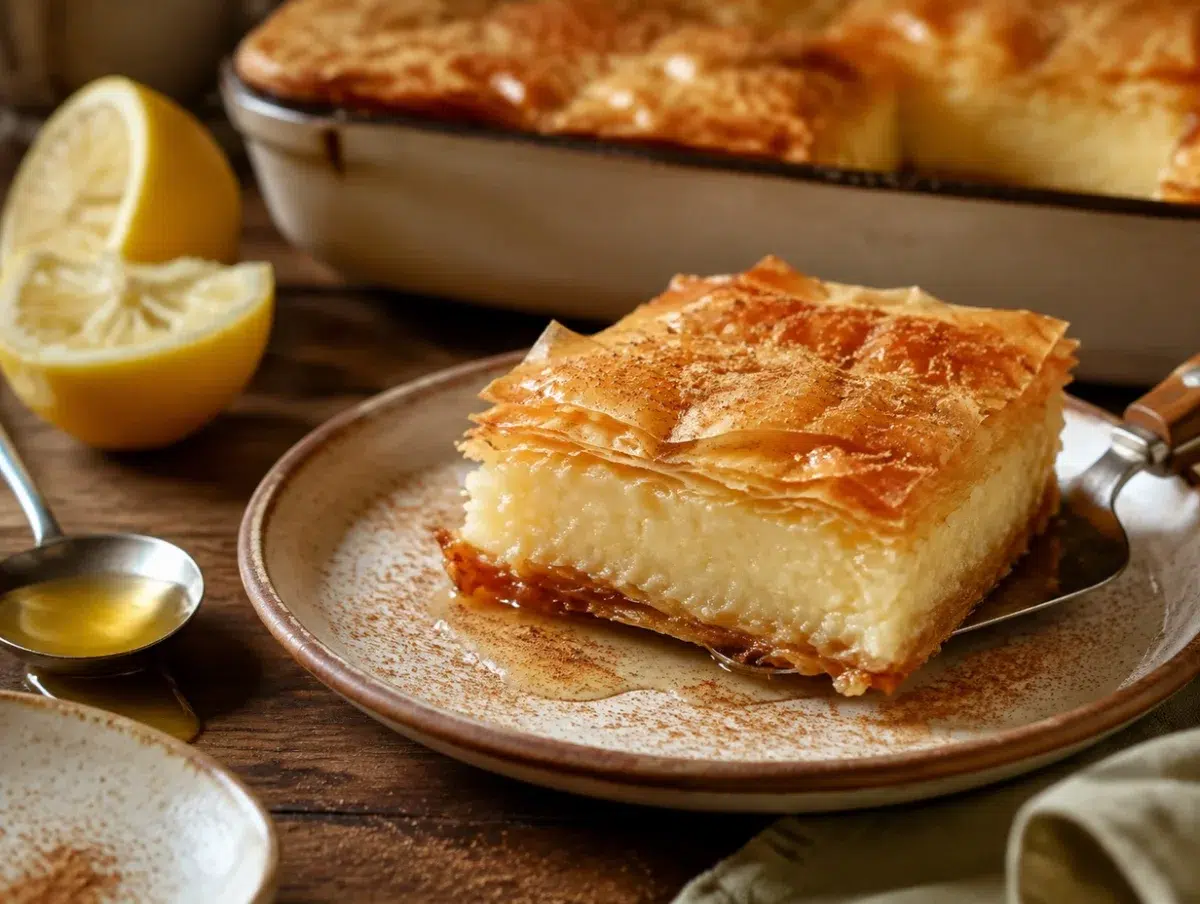
Let me tell you about the smell. Galaktoboureko (Greek custard pastry) has a very specific smell when it’s baking — butter, vanilla, and just the beginning of caramelization from the phyllo crust — and the first time I smelled it again as an adult after years away from Crete, I stopped completely still in the street outside my yiayia’s house in Chania. It was a Sunday in November 2018, two months after my father had passed, and I had come home to help my mother sort through his things at the harbor cottage in Kolymvari. I walked past my yiayia’s kitchen window and that smell hit me, and for a full thirty seconds I couldn’t move.
She was making it for no particular reason. ‘Apla ithela,’ she said — ‘I simply wanted to.’ As if that were explanation enough. As if a three-layer pastry of buttered phyllo, vanilla custard, and honey-lemon syrup needed no occasion. In my yiayia’s world, it didn’t. You made galaktoboureko because it was Sunday, or because someone was visiting, or because someone wasn’t visiting and the kitchen needed to smell like love. She had been making it the same way since 1962, when her own mother taught her.
The word breaks down beautifully: gala (γάλα) means milk, boureko comes from the Turkish börek — a savory or sweet filled pastry. Together: milk börek. A custard pastry. One of the great siropiasta desserts — the syrup-soaked category that defines Greek sweets. I’ve made this recipe sixty-three times since 2018, testing every variable. Here are the seven things that actually matter.
Table of Contents
Galaktoboureko (Greek Custard Pastry)
Ingredients
Method
- 1. Make syrup: Combine sugar, water, honey, lemon peel, and cinnamon stick. Bring to a boil, don’t stir. Simmer 6 minutes. Remove from heat, add lemon juice. Cool completely — minimum 45 minutes.
- 2. Make custard base: Warm milk, vanilla, and lemon zest to 140°F / 60°C. Whisk together sugar, semolina, and room-temperature eggs in a bowl until pale.
- 3. Temper and combine: Ladle 120ml warm milk into egg mixture in a thin stream while whisking. Pour tempered mixture back into the saucepan.
- 4. Cook custard: Whisk constantly over medium heat for 8–12 minutes until custard thickens and coats a spoon. Remove when still slightly looser than desired — it bakes further. Stir in butter pieces. Strain through fine-mesh. Cover with plastic wrap directly on surface.
- 5. Preheat and prep: Oven to 350°F / 180°C. Brush 9×13 pan generously with clarified butter.
- 6. Base phyllo: Layer 8 sheets phyllo, each brushed with clarified butter, letting edges overhang 2–3 inches. Alternate overhang direction.
- 7. Add custard: Pour slightly cooled custard evenly over phyllo base.
- 8. Top phyllo: Fold overhanging edges over custard, buttering each fold. Layer remaining 8 sheets over the top, buttering each generously, tucking edges down the sides.
- 9. Score: Use a sharp knife to score the top phyllo layers in diamonds or squares — through phyllo only, not into custard.
- 10. Bake 45–55 minutes until top is deep amber brown.
- 11. Syrup immediately: Remove from oven. Pour ALL cool syrup slowly over the entire hot surface. Rest uncovered at room temperature minimum 2 hours before serving.
Notes
Why This Galaktoboureko Recipe Is Special
The Cretan Technique That Changes the Custard Entirely
Most recipes for galaktoboureko (Greek custard pastry) instruct you to cook the semolina custard fully on the stovetop — thick enough to hold its shape — before pouring it over the phyllo.
My yiayia’s method, and the approach I now teach in my Athens workshops, is different: undercook the custard by about 30 percent. Pull it from the heat when it’s still slightly looser than you think it should be — just past the nappe stage, as I would say in my Michelin kitchen training days.
Why? Because the custard bakes for another 45–50 minutes inside the phyllo. If you cook it fully before baking, you get a dense, rubbery filling rather than the trembling, creamy, barely-set custard that defines a truly great galaktoboureko. Harold McGee describes this principle in On Food and Cooking: starch-thickened custards continue gelatinizing during oven heat. Respect the carry-over.
A Flavor Profile Worthy of Every Celebration Table
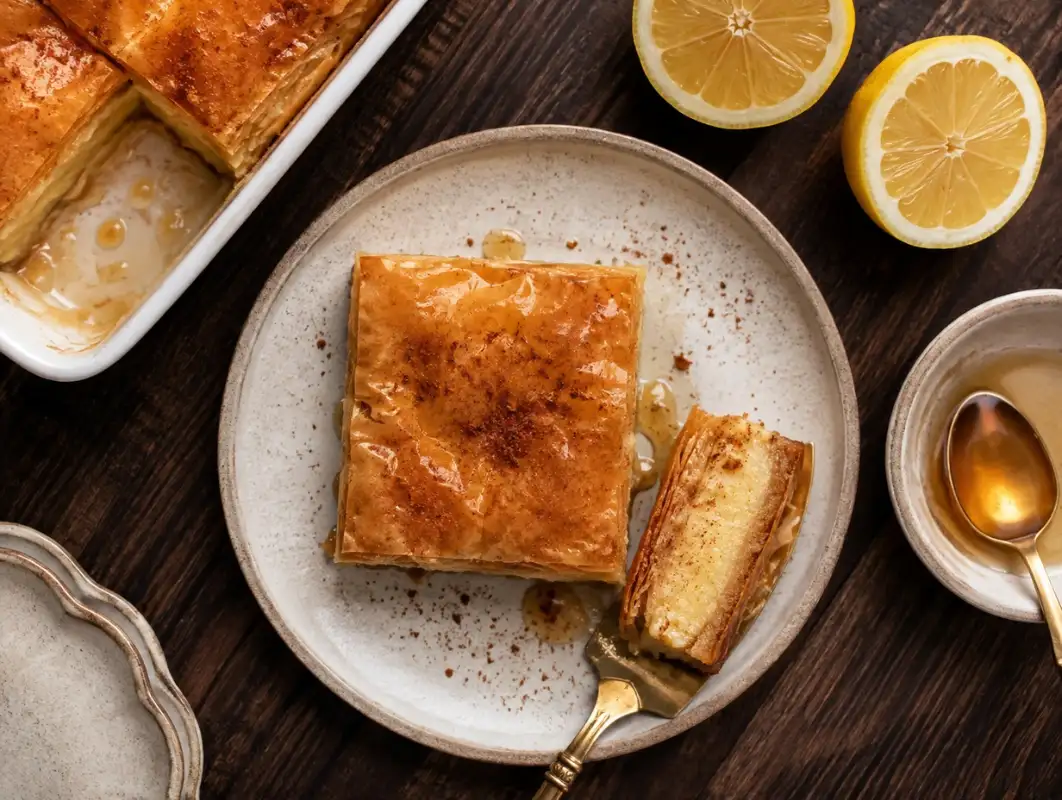
When you’ve made this correctly, what you get is extraordinary. The phyllo layers — buttered individually, baked until a deep amber — shatter audibly when the first spoon breaks through. Underneath, the semolina custard filling is cool and trembling and faintly vanilla, set just enough to slice cleanly. And then the syrup — honey, lemon peel, a trace of cinnamon — has soaked the lower phyllo layer and pooled slightly in the scored lines on top, making every bite simultaneously crisp and yielding. I have served this at Greek Easter, at name days, at corporate dinner events in Athens. I have never once been asked for the recipe before the pan was empty.
The occasions for Greek custard pastry are traditionally Apokries — the Greek carnival season — and Easter. But as my yiayia demonstrated, any Sunday is sufficient reason. For a complete traditional Greek dessert table, this pairs beautifully after our gemista Greek stuffed peppers — the acidity and lightness of the stuffed vegetables creates the perfect contrast before the rich custard pastry lands.
The Story Behind Galaktoboureko
Ottoman Kitchens, Byzantine Tables, and a Dessert That Survived History
The galaktoboureko recipe as we know it today is a product of centuries of culinary exchange between the Greek Orthodox and Ottoman culinary worlds. The word boureko is directly Ottoman Turkish — börek — a term covering an enormous range of filled phyllo or yufka pastries that were central to imperial Ottoman kitchen cuisine from the 14th century onward. Greeks adopted and adapted the phyllo tradition, filling their versions with custard — a gala-based filling that reflected Greek dairy culture — and adding the characteristic honey-lemon syrup that distinguishes siropiasta desserts from their Turkish counterparts. The result is a dessert that is simultaneously Greek and cosmopolitan, rooted and traveling.
Traditionally, galaktoboureko was made on Tsiknopempti (the Thursday of carnival week) and on the Sunday before Lent begins, when observant households would use up the last of their dairy — milk, butter, eggs — before the forty-day fast. It’s the last indulgence before restraint. Which, if you’ve ever tasted it, makes complete theological sense.
My Grandfather’s Taverna and the Pan Nobody Touched
In my grandfather’s taverna in Chania, the rule was simple: the tapsi of galaktoboureko on the counter was for customers. The small pan my yiayia made in the back kitchen was for family. You did not take from the family pan. You were told this once.
My grandfather told my father this at age five, and my father apparently told it to anyone who would listen for the rest of his life. When he passed in 2017, my mother made galaktoboureko the week after the funeral — the homemade galaktoboureko version, not the taverna version — and we sat in that back kitchen and ate the whole pan in one sitting, the six of us, without talking much. That was the right thing to do.
Essential Ingredients for Galaktoboureko
Core Ingredients: What You Buy and Why Quality Is Not Optional
Let me be direct before you even look at this table: your phyllo dough custard is only as good as its three components — the butter on the phyllo, the quality of the semolina in the custard, and the honey in the syrup. None of these is a place to economize. The rest is technique, which I’ll give you. But start with the best ingredients you can find. That is not food-writer cliché. It’s the reason this recipe works.
| Ingredient | Amount | Why It Matters | Authentic Pick | Substitution |
| Fine phyllo dough (#4 or #7 weight) | 450g (1 lb) / 16–18 sheets | Ultra-thin sheets create the shatter-crisp texture; thick phyllo becomes leathery | Greek or Cypriot brand (#4 extra-thin); thawed overnight in fridge | Store-bought Athens or Apollo brand — perfectly adequate |
| Unsalted butter | 200g (¾ cup + 2 tbsp), clarified | Fat separates phyllo layers; enables Maillard browning on each sheet | European-style 84% fat butter (Kerrygold, Plugra) | Ghee: even more golden, nuttier — excellent |
| Whole milk | 900ml (3¾ cups) | Base of custard — fat content determines richness and setting | Full-fat only; never skim or 2% | Oat milk (sets slightly softer; still good) |
| Fine semolina | 100g (½ cup + 2 tbsp) | Starches gelatinize to create custard structure; coarser semolina = grainier texture | Misko or Melissa (Greek fine semolina) | Bob’s Red Mill fine semolina; NOT cornstarch alone |
| Eggs (whole) | 5 large, room temperature | Protein sets the custard; egg yolks add richness and golden color | Large free-range; room temp essential for emulsification | 4 eggs + 1 extra yolk for richer custard |
| Granulated sugar | 200g (1 cup) for custard | Sweetens and stabilizes the custard by competing with starch for water | Fine white sugar; dissolves fastest | Caster sugar |
| Vanilla bean (or extract) | 1 bean or 2 tsp extract | Aromatic backbone of the custard — low-quality vanilla tastes chemical here | Real vanilla bean pods or Nielsen-Massey extract | 1 tsp vanilla bean paste |
| Lemon zest + peel | Zest of 1 lemon | Brightens custard and syrup; prevents cloying sweetness | Unwaxed Meyer lemon preferred | Orange zest — warmer, more floral |
The butter: my mother clarified hers every time without exception. I used to think this was excessive until I understood the food science. Clarified butter — ghee — has had its water and milk solids removed, which means it reaches a higher smoke point (450°F / 232°C vs. 350°F / 177°C for whole butter) without burning, and it doesn’t steam against the phyllo, which softens it. Brush clarified butter. Always. I’ve made this with unclarified butter six times to confirm. The phyllo always softens slightly. The clarified version is always crisper.
⭐ Yiayia’s Tip: My yiayia always warmed the milk before adding the semolina — never cold milk directly into semolina. She said cold milk shocks the starch granules, causing them to clump. She was right. Warm the milk to 140°F / 60°C first, always.
Dietary Substitutions That Preserve the Essence
| Dietary Need | Replace | With | Notes & Results |
| Dairy-free | Whole milk | Full-fat oat milk or coconut milk (same quantity) | Oat milk: slightly softer set, mild flavour. Coconut milk: very soft, distinctly flavoured — use only for modern variation. |
| Dairy-free butter | Clarified butter for phyllo | Refined coconut oil or vegan butter | Coconut oil: excellent crispiness, slight sweetness. Vegan butter: works, less golden. |
| Egg-free custard | 5 whole eggs | 3 tbsp cornstarch + 2 extra tbsp semolina | Texture is firmer, more solid — less trembling. Flavour still good. |
| Lower sugar syrup | Full sugar syrup recipe | Reduce sugar by 30%, increase honey to 3 tbsp | Less sweet, more complex from honey. My personal preference, actually. |
| Gluten-free | Phyllo + semolina | GF phyllo (available specialty stores) + rice semolina | GF phyllo is fragile — handle cold and keep covered. Result is good but more delicate. |
| Honey-free syrup | Honey in syrup | Agave syrup (same quantity) | Lighter flavour, less complex. Honey is preferred — it’s the Cretan soul of the syrup. |
🥐 Pro Tip: If using store-bought phyllo, thaw in the refrigerator overnight — never at room temperature, which causes condensation. Once open, cover the stack with a slightly damp kitchen towel at all times. The 30 seconds it takes to dry out is real and it will crack when you try to lift it. Keep it covered. Don’t look away from it.
Equipment & Technique for Greek Custard Pastry
Traditional Tools vs. Modern Kitchen Alternatives
| Traditional Tool | Modern Alternative | Why It Matters |
| Broad tapsi (copper or tin baking pan) | 9×13 inch (23×33 cm) baking dish, 2+ inches deep | Depth matters — you need room for 8 phyllo layers, custard, and 8 more layers without overflow |
| Wide pastry brush (natural bristle) | Silicone pastry brush | Natural bristle is gentler on delicate phyllo; silicone works but tears thin sheets more easily |
| Heavy-bottomed copper saucepan | Heavy stainless or enameled saucepan | Even heat prevents scorching — essential for semolina custard which burns within seconds on thin-bottomed pans |
| Large balloon whisk | Standard whisk or electric hand mixer (low speed) | Constant whisking prevents lumps; consistent circular motion more important than tool choice |
| Fine mesh strainer | Fine mesh strainer | For straining the hot custard to catch any lumps before pouring over phyllo — non-optional |
| Sharp chef’s knife | Sharp knife — any style | Scoring the phyllo top before baking is mandatory; a dull knife compresses the layers rather than cutting |
Mise en Place: Seven Things to Do Before You Touch Any Dough
Before you begin assembling this galaktoboureko (Greek custard pastry), do all of these in order. One: thaw phyllo overnight in the fridge and rest at room temperature for 30 minutes still in the package. Two: clarify the butter. Three: make the syrup and let it cool completely — this is the only step that can’t be rushed, and it must happen before everything else. Four: measure every custard ingredient into separate bowls. Five: preheat your oven to 350°F / 180°C. Six: brush your baking dish with clarified butter generously, including the sides. Seven: have your damp kitchen towel laid flat beside your phyllo stack, ready to cover it between each sheet.
This dessert is not technically difficult. But it does require that you move with attention — phyllo dries, custard scorches, syrup sets. Mise en place is not organizational fussiness. It’s the reason your pastry works the first time rather than the fifth.
Step-by-Step Galaktoboureko Instructions
Preparation Steps 1–4: Syrup, Custard, and Phyllo Prep
Step 1: Make the syrup first — always. In a heavy saucepan combine 300g sugar, 200ml water, 3 tablespoons honey, the zest of one lemon (in strips, not grated), and one cinnamon stick. Do not stir after it comes to a boil — swirl the pan if you must, but stirring hot sugar invites crystallization. Bring to a boil over medium-high heat, reduce to medium, and simmer for exactly 6 minutes. Remove lemon peel and cinnamon. Add 1 tablespoon fresh lemon juice off heat. Pour into a wide bowl and cool completely to room temperature — at least 45 minutes. The syrup must be cold when it meets the hot pastry.
⭐ Yiayia’s Tip: My yiayia placed her syrup bowl outside on the windowsill in winter to cool faster. In summer, she put it in a basin of cold water. Either way: it was always completely cool by the time the pastry came out of the oven. Not warm. Not ‘room temperature.’ Cool.
Step 2: Make the custard. Warm 900ml whole milk with the vanilla bean (scraped) and lemon zest in a heavy saucepan over medium heat until it reaches 140°F / 60°C — steaming, not simmering. In a separate bowl, whisk together 200g sugar, 100g fine semolina, and 5 room-temperature eggs until pale and combined. Temper the eggs: ladle about 120ml of the warm milk into the egg mixture in a thin stream while whisking constantly. This raises the egg temperature gradually — what Kenji López-Alt in The Food Lab describes as the key to any custard that doesn’t scramble. Now pour the tempered egg mixture back into the warm milk in the saucepan.
Step 3: Cook the custard — carefully. Whisk constantly over medium heat until the custard thickens noticeably and coats the back of a spoon. This takes 8–12 minutes. Do not rush it with high heat — scorched semolina smells like burned bread and the flavor carries through entirely. Pull from heat when the custard is slightly looser than you want the final filling to be — it will bake for another 45 minutes and continue setting. Strain through a fine-mesh strainer into a clean bowl. Cover directly with plastic wrap to prevent a skin forming. Let cool slightly — about 15–20 minutes — before pouring over phyllo.
🥐 Pro Tip: A skin-free custard is essential. Press the plastic wrap directly against the surface — zero air contact. This is the same technique used for any pastry cream (crème pâtissière), and for the same reason: the protein surface oxidizes and firms on contact with air.
Step 4: Layer the phyllo base. Working quickly with your damp towel covering the unused sheets: lift one sheet of phyllo, lay it in the prepared pan letting the edges overhang by 2–3 inches on all sides, and brush generously with clarified butter. Lay the next sheet, brush again. Repeat for 8 sheets total, alternating the direction of overhang so all sides have coverage. Each sheet should be thoroughly buttered — this is not a place for restraint. The butter is what creates the layers, the color, and the crispiness.
Assembly Steps 5–9: Filling, Top Phyllo, Scoring, Baking, and Syruping
Step 5: Pour the custard. Pour the slightly cooled custard evenly over the phyllo base. Spread gently with a spatula if needed — do not press or deflate the base layers. The semolina custard filling should reach within about ¾ inch of the top of your dish edges to leave room for the top phyllo layers. Silky. Golden. Trembling slightly when you tilt the pan.
Step 6: Fold and add top phyllo layers. Fold the overhanging edge sheets over the top of the custard, brushing each fold with clarified butter as you go. Then lay the remaining 8 phyllo sheets individually across the top, buttering each one, tucking the edges down the sides of the pan rather than folding over. The top layer should be butter-drenched — more butter here than anywhere else, because this is the surface that will brown and shatter.
Step 7: Score — this is mandatory. Using a very sharp knife, score through all the top phyllo layers in your desired serving pattern — diamonds or squares — cutting only through the phyllo, not into the custard below. Scoring serves two purposes: it marks serving portions, and it creates channels for the syrup to penetrate the top crust on contact. Don’t skip this. Unscored phyllo will shatter unevenly when you try to pour syrup and slice portions later.
⭐ Yiayia’s Tip: My yiayia ran a drop of cold water around the edges where the phyllo met the pan before baking — sealing any dry phyllo edges to prevent burning. A minor detail. An important one.
Step 8: Bake at 350°F / 180°C for 45–55 minutes until the top phyllo is a deep, rich amber — not just golden, but genuinely brown. The difference between gold and amber here is the difference between biscuit-crisp and shatter-crisp. The deeper color means more Maillard reaction compounds in the phyllo, more caramelized butter notes, more flavor. Pale galaktoboureko is undercooked galaktoboureko.
Step 9: Syrup the hot pastry immediately. Remove the pastry from the oven. Pour the cold syrup in a slow, steady stream over the entire hot surface, working from one edge to the other. Use all of the syrup — every drop. You will hear the sizzle and hiss as cold liquid meets hot pastry. Watch the syrup absorb. This is the galaktoboureko syrup magic — the thermal shock drives the syrup into every scored line and layer simultaneously. Do not be timid about quantity. Let the Greek custard pastry rest uncovered for at least 2 hours at room temperature before serving. Three hours is better. It sets completely and the syrup distributes evenly throughout.
The Secret Touches of Galaktoboureko
Four Cretan Techniques That Separate Good from Extraordinary
Secret 1 — Undercook the custard by design. Already covered in Section 1, but worth restating here: the custard continues cooking inside the phyllo casing during the 45-minute bake. Pull it earlier than seems right and trust the oven to finish it. The result is that trembling, barely-set texture — what the French call crème tremblante — that defines a truly exceptional Greek custard pie.
Secret 2 — Cold syrup, hot pastry — always. The thermal shock of cold syrup on hot phyllo causes rapid absorption through capillary action — the liquid is pulled inward against the temperature gradient. Hot syrup on hot pastry absorbs slowly by gravity only, creating a saturated top layer and a dry base. This contrast is the reason your base phyllo is syrup-soaked and delicious rather than dry and structural.
Secret 3 — Honey in the syrup, not just sugar. My yiayia used Cretan thyme honey — Sitia honey, from the eastern Crete coast, which is darker and more intensely floral than mountain thyme varieties elsewhere. Two tablespoons in the syrup per standard recipe transforms what would be simple sweet syrup into something complex and Mediterranean. Honey also acts as an invert sugar, meaning it prevents crystallization in the syrup — a functional benefit Harold McGee discusses extensively in relation to confectionery chemistry.
Secret 4 — The butter must be clarified. Already addressed in the ingredient section, but the impact is significant enough to repeat: clarified butter gives a crisper, drier, more shatter-like phyllo than whole butter. My first twelve batches used whole butter. My thirteenth used clarified. I never went back.
Common Mistakes and Exactly How to Fix Them
| Mistake | What Happens | How to Fix It |
| Hot syrup poured over hot pastry | Top layer absorbs well but base stays dry; uneven texture throughout | Syrup must be completely cool — cold from the fridge even better. Make it first, minimum 45 minutes before baking. |
| Fully cooked custard before baking | Dense, rubbery filling — lacks the trembling set of authentic galaktoboureko | Undercook by 30% — remove when custard is still slightly looser than desired. It finishes in the oven. |
| Unscored phyllo top | Syrup pools on surface and runs off sides rather than absorbing; slicing tears layers unevenly | Always score through the top phyllo layers before baking. Diamonds or squares — your choice. |
| Uncovered phyllo drying out | Sheets crack and crumble when lifted; holes appear in the pastry layers | Keep unused sheets covered with a damp towel every single moment. No exceptions. |
| Insufficient butter on phyllo | Layers fuse together; no separation; pale, soft top rather than crispy | Each sheet gets a generous brush of clarified butter. More than seems polite. |
| Serving before full rest time | Custard too soft; cuts collapse; syrup not fully absorbed | 2 hours minimum at room temperature. 3 hours preferred. This pastry sets as it cools. |
Variations & Serving Galaktoboureko
Regional Variations and Modern Twists on Greek Custard Pastry
The standard mainland Greek version of galaktoboureko uses a lemon-and-cinnamon sugar syrup with no honey. It’s perfectly good. The Cretan version — my yiayia’s version, and the one in this article — uses honey in the syrup and occasionally orange peel alongside lemon, which adds a warmer, more floral aromatic depth.
The island variation I encountered in Santorini uses a small amount of mastic (mastiha) in the custard — just ¼ teaspoon of mastic powder dissolved in 1 tablespoon of lemon juice. The resinous, slightly pine-like note of Chios mastic is subtle in a baked custard, but it’s unmistakably Aegean. It’s the version I make when I want to taste geography.
The modern Athenian café interpretation sometimes adds a thin layer of praline between the base phyllo and the custard — a French influence adopted by the new generation of Greek pastry chefs. It’s delicious and my yiayia would not recognize it. I don’t make it in this article but I’ve made it at workshops.
Individual galaktoboureko rolls — galaktoboureko rolla — are a popular modern shortcut: roll a single phyllo sheet with a tablespoon of custard, fold over the ends, brush with butter, and bake on a flat tray for 20–25 minutes. The result is less architectural but more practical for portion control and considerably faster.
Accompaniments and Beverage Pairings That Serve the Pastry
My honest view: galaktoboureko (Greek custard pastry) needs nothing alongside it. It is a complete and self-sufficient dessert. But if you are building a dessert table for a party or a feast — as I do regularly for clients in Athens — here is what works: a small scoop of plain Greek yogurt alongside provides a cool, sharp counterpoint to the sweet, warm pastry. Fresh fruit (strawberries, blood oranges) on the side adds color and acidity.
Beverage pairings: Greek mountain tea — tsai tou vounou — made double-strong and served black is the traditional companion, its herbal bitterness cutting through the syrup sweetness beautifully. Cold-brew Greek coffee (served on ice in summer) is my personal preference for a dinner party. For something lighter, chilled hibiscus tea provides beautiful color and floral tartness. For a complete Greek sweet experience at the table, you might also serve alongside our Greek yogurt panna cotta for contrasting textures, or our frozen Greek yogurt bars as a cooling element at a summer gathering.
Storage & Reheating Galaktoboureko
How to Store and How Long It Keeps
| Method | Container | Duration | Notes |
| Room temperature (day of) | Uncovered or loosely covered, in baking pan | Up to 8 hours | Best texture window — crispy phyllo, soft custard. Serve here if at all possible. |
| Refrigerator | Airtight container or covered pan | Up to 4–5 days | Phyllo softens within 24 hours due to custard moisture migration — still delicious, different texture. |
| Freezer | Not recommended | N/A | Custard separates and becomes watery on thawing. This dessert does not freeze. |
| Individual portions | Airtight glass or ceramic container | Up to 4 days fridge | Best way to store — minimal air contact on cut surfaces, slows phyllo softening |
Restoring Texture and Serving Leftover Galaktoboureko
The honest truth about galaktoboureko storage: the phyllo will always soften after refrigeration. This cannot be reversed. What you can do is bring the texture as close as possible to the original. Remove portions from the refrigerator 30 minutes before serving to restore room temperature. For a close approximation of the original crispiness: place individual portions on a baking tray and warm in a 325°F / 165°C oven for 8–10 minutes. The phyllo will regain some crispiness on the surface though the base layer remains soft. Never microwave — it steams the phyllo and accelerates softening dramatically. A fresh dusting of ground cinnamon over each portion before reheating refreshes the aromatics and makes the reheated version feel intentional rather than leftover.
Frequently Asked Questions
Substitutions & Technique Questions
Q: Can I use cornstarch instead of semolina in galaktoboureko?
A: You can — but cornstarch-only custard sets smoother and softer than a semolina custard filling and lacks the slightly grainy, substantial texture that defines authentic galaktoboureko. My tested ratio: if using cornstarch, replace the 100g semolina with 60g cornstarch. The custard will be creamier but less traditional. Many modern Greek recipes use a half-and-half approach — 50g semolina + 30g cornstarch — which I find produces an excellent middle result.
Q: Can I make galaktoboureko ahead of time?
A: You can assemble the unbaked pastry (phyllo layers + custard + top phyllo, scored) and refrigerate it overnight before baking. This is actually a useful make-ahead strategy for dinner parties. Do not add the syrup until immediately after baking — the syrup step must always happen on the hot pastry. Alternatively, bake completely the day before and refrigerate; the texture changes (phyllo softens) but the flavour is fully developed and still very good.
Q: My custard came out lumpy. What went wrong?
A: Lumps in galaktoboureko custard come from one of three causes: adding semolina to cold milk (it clumps immediately — always warm the milk first), adding the egg mixture to the milk too quickly (temper slowly), or not whisking constantly once everything is combined. The fix for already-lumpy custard: strain through a fine-mesh strainer before pouring — this catches most lumps. For prevention: warm milk, slow tempering, constant whisking. Three principles, always.
Q: How do I prevent the phyllo from drying out?
A: Keep a damp kitchen towel over the unused phyllo stack at every moment. No exceptions. Phyllo is approximately 95% starch with very little moisture — it dries in under a minute in a room-temperature kitchen. Thaw overnight in the refrigerator (not at room temperature, which causes condensation), rest in the package for 30 minutes before opening, then immediately cover. Work one sheet at a time and replace the towel every time you lift a sheet.
Q: Why is my syrup crystallizing?
A: Stirring hot sugar syrup causes crystallization — the agitation creates nucleation points where sugar crystals form. Do not stir the syrup after it reaches a boil. Swirl the pan if you need to move it. The addition of honey acts as an invert sugar and reduces crystallization tendency significantly. Lemon juice also inverts some of the sucrose. Both are protective; use both. If crystallization occurs anyway, add 2 tablespoons of warm water and return to very low heat without stirring — it usually re-dissolves.
Dietary, Make-Ahead & Authenticity Questions
Q: Is galaktoboureko gluten-free?
A: Traditional Greek phyllo dessert uses wheat-based phyllo and semolina — neither is gluten-free. However, certified GF phyllo is available at specialty stores and online, and the semolina custard filling can be made with rice semolina. Handle GF phyllo even more carefully than standard — it’s more fragile and tears more easily when dry. Dip for 1.5 seconds only. The result is good but requires more patience.
Q: Is galaktoboureko a breakfast or dessert?
A: Both — and this is genuinely a Greek thing. Galaktoboureko is among the most popular Greek breakfast pastries, served in pastry shops (zaharoplasteia) alongside Greek coffee. It’s also a celebration dessert for Easter, name days, and carnival. In my yiayia’s house, it occupied all occasions simultaneously, which is the most accurate answer I can give you.
Q: What’s the difference between galaktoboureko and bougatsa?
A: Both are custard phyllo pastry but they differ in key ways. Bougatsa is an individual pastry (like a phyllo parcel), served warm with powdered sugar and cinnamon — no syrup. Galaktoboureko is a baked pan dessert, chilled or room temperature, served in squares, drenched in sweet syrup. Bougatsa is a Thessaloniki breakfast. Galaktoboureko is a Cretan celebration. Both are beloved; they are not interchangeable.
Q: Can I use puff pastry instead of phyllo?
A: You can produce something with puff pastry, but it won’t be galaktoboureko. Puff pastry doesn’t absorb syrup in the same way — it stays waterproofed by its own butter layers and can become soggy rather than syrup-soaked. It also lacks the characteristic shatter. What you’ll get is a pleasant Greek milk pie with a different texture entirely. Use phyllo. It’s worth the small additional care.
Q: How many layers of phyllo should galaktoboureko have?
A: The standard is 8 sheets base + 8 sheets top = 16 total. Some recipes use 10 on the base and 6 on top; others do 12 and 6. The number matters less than the butter between each sheet — under-buttered layers will fuse and lose their individual crispiness. My yiayia always said you can forgive one fewer layer of phyllo; you cannot forgive butter-stingy phyllo. I have confirmed this personally and repeatedly.
Bringing Greece to Your Table
Your Kitchen, Your Memory, Your Galaktoboureko
I think about that November street in Chania a great deal — the smell of butter and custard and vanilla from my yiayia’s window, the way it stopped me in my tracks during what was otherwise a genuinely hard week. Food does this. It carries the past forward without sentimentality, in the most physical, sensory, real way possible. Galaktoboureko (Greek custard pastry) is not just a recipe. It’s a technology for making a place feel like home.
So make it. Make it for a dinner party, for a Sunday afternoon, or for no reason at all — apla ithela, as my yiayia would say. Take a photograph of your scored phyllo top before it goes in the oven. Leave a comment below and tell me which variation you chose. Tag me if you share it. I want to see every version of this recipe that exists in kitchens around the world. Kali orexi.
More Greek Desserts Worth Your Time
If galaktoboureko has opened the door to the world of Greek phyllo desserts and siropiasta for you, your next stop should be our Greek yogurt panna cotta — an elegant no-bake dessert that shares galaktoboureko’s custard soul without the phyllo complexity. For the same syrup-soaked spirit in a baked cake format, our amazing sweet potato soufflé recipe takes a different but related approach to baked custard textures. And if you want to explore the full landscape of Mediterranean desserts, the collection has everything from intensely syruped to delicately restrained.