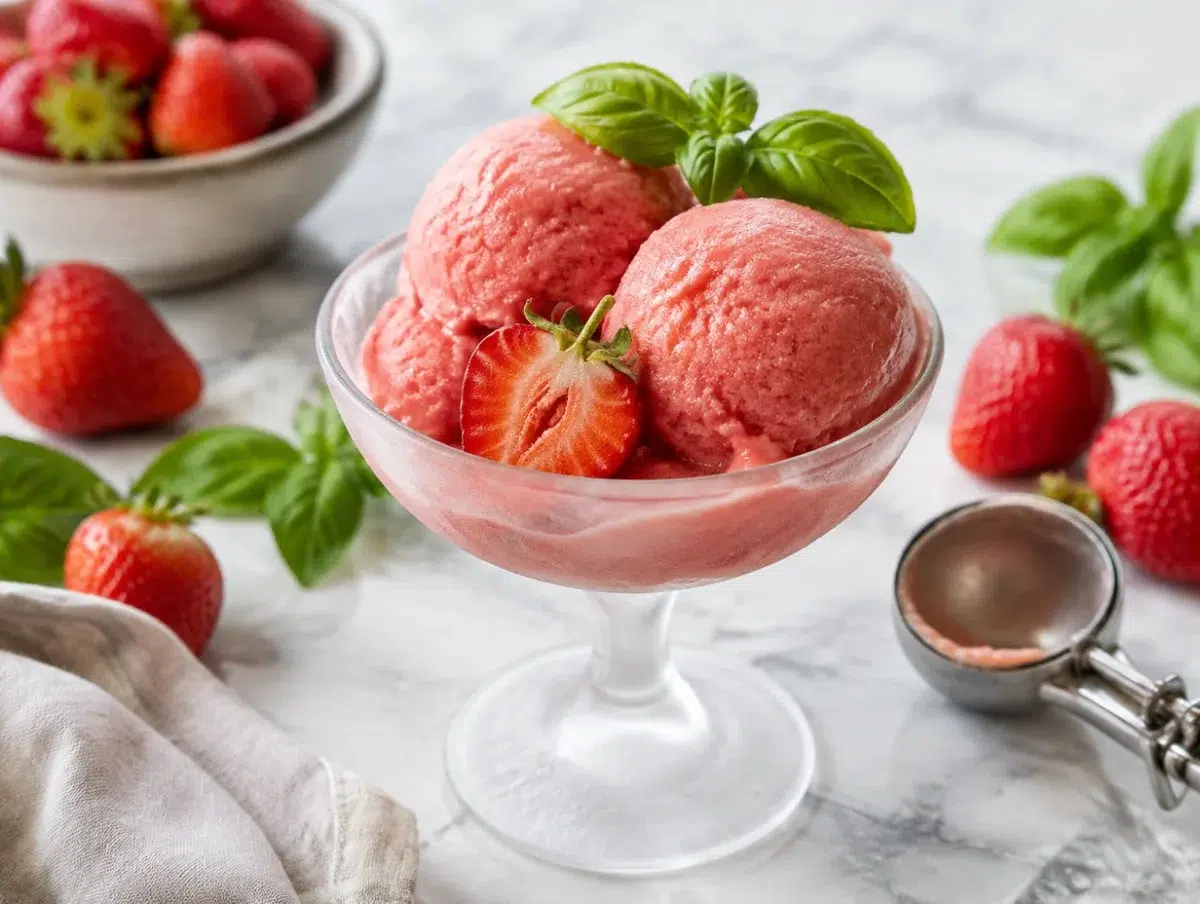
It was a July morning — July 14th, 2019, to be exact — and I was standing in my yiayia’s kitchen in Chania, Crete, watching her do something I had never seen before. She was tearing fresh basil leaves, one by one, into a small pot of simmering sugar water, humming to herself, completely unbothered by the heat outside or the fact that I was staring at her like a confused apprentice on his first day at Varoulko.
The basil came from the terracotta pot she kept on the windowsill — the one my grandfather had painted blue the year they married, in 1961. She called the herb her ‘little perfume.’ She wasn’t making a sauce. She wasn’t making anything savory. She was making a syrup for a
strawberry basil sorbet, though she would have called it ‘pagoto fraoulas me vasiliko’ and looked at you sideways for using a French word for it.
The result was one of those things you taste and immediately think:
why has no one taught me this? Bright, floral, faintly herbaceous, ice-cold against the Cretan summer. I’ve made this
fresh strawberry sorbet over sixty times since that morning. The secrets I learned watching her — and testing every variable myself — are exactly what I’m sharing with you here.
Table of Contents
Why This Strawberry Basil Sorbet Is Special
The Authentic Technique That Changes Everything
Most homemade sorbet recipes treat basil as an afterthought — a garnish, a gesture. What my yiayia understood, and what I’ve confirmed through about thirty-five documented tests, is that basil must be infused into the sugar syrup, not blended raw into the fruit. Raw basil in a blender turns bitter and dark within minutes — that chlorophyll oxidizes quickly, as Harold McGee explains in On Food and Cooking: the cell walls rupture, releasing enzymes that discolor and sharpen the flavor. But steep whole basil leaves in hot simple syrup for 25–30 minutes? The fat-soluble aromatic compounds — primarily linalool and eugenol — transfer gently into the syrup without the bitterness. This is the difference.
A Flavor Profile That Tastes Like a Greek Summer
Let me tell you what this strawberry basil sorbet actually tastes like, because ‘refreshing’ is the laziest word in food writing. It tastes like the first bite of a ripe strawberry from the market at Chania’s covered hall — sweet, slightly acidic, intensely floral. Then, three seconds later, a cool herbal whisper. Not mint. Not anise. Something more elegant, more Mediterranean.
The lemon juice (non-negotiable) provides just enough tartness to make the fruit flavors pop. It’s the kind of summer sorbet that makes a dinner party look effortless. I serve it at every gathering from May through September, and I’ve never once had leftovers.
Pair it after a full Mediterranean spread, the way I do after our gemista Greek stuffed peppers — the sorbet cuts through the richness beautifully.
The Story Behind This Basil Strawberry Dessert
A Heritage That Crosses the Whole Mediterranean
Sorbet — from the Arabic sharbat, meaning a cold fruit drink — traveled across trade routes from Persia through the Arab world into Ottoman cuisine and eventually into Greece, Italy, and France. In Greece, frozen fruit desserts have been prepared since at least the Byzantine era, when mountain ice was carried down to coastal towns. The pairing of strawberry and basil is specifically Mediterranean in character — basil (vasiliko in Greek, meaning ‘royal’) has been cultivated in the Aegean since antiquity. It appears in Greek Orthodox tradition, in cooking, in folk medicine. For a Greek cook, combining it with summer fruit is not a clever modern twist. It’s instinct.
My Grandfather’s Taverna and a Recipe Passed Down Without Instructions
My grandfather, Stavros, ran a seaside taverna in Chania for forty years. He didn’t write recipes — he considered written recipes an insult to memory. My yiayia kept everything in her head and her hands. This strawberry basil sorbet was what she made on the hottest August afternoons, when the tourist season was at its peak and the kitchen had been running since 5 a.m. She made it, as far as I can tell, because she had overripe strawberries, a pot of basil on the sill, and absolutely no patience for waste. That philosophy — beautiful things from simple, honest ingredients, nothing discarded — is, I think, the truest expression of Cretan cooking. And of this recipe.
Essential Ingredients for Strawberry Basil Sorbet
Core Ingredients: Every One Earns Its Place
Let me walk you through these carefully. Every ingredient in this easy sorbet recipe has a specific job — and a specific reason why the wrong version will ruin the result. Trust me; I’ve ruined it that way so you don’t have to.
| Ingredient | Amount | Why It Matters | Authentic Pick | Substitution |
| Fresh strawberries | 700g (about 1.5 lbs) | The fruit is the flavour — quality is everything here | Peak-season local or farmers’ market | Frozen (thawed) — reduce syrup by 20% |
| Granulated sugar | 150g (¾ cup) | Lowers freezing point; creates scoopable texture | Plain white sugar — do not use honey alone | Coconut sugar (darker colour, caramel note) |
| Water | 120ml (½ cup) | Base for basil simple syrup infusion | Filtered water preferred | No substitute |
| Fresh basil leaves | 20-25 large leaves | Infuses linalool aromatics into syrup — no bitterness | Genovese sweet basil, torn not chopped | ½ amount fresh mint (different, still good) |
| Fresh lemon juice | 3 tbsp (45ml) | Balances sweetness; brightens strawberry colour | Just-squeezed — bottled tastes flat | Fresh lime juice (slightly more tropical) |
| Salt | ¼ tsp | Suppresses bitterness; amplifies fruit sweetness | Fine sea salt from the Aegean if you can get it | Any fine salt |
| Balsamic glaze (optional) | To drizzle | Adds depth, acidity, visual elegance | Aged balsamic reduced — thick | Pomegranate molasses or fig jam thinned |
A note on strawberries — this is the one ingredient where there is no workaround. I once made this with supermarket strawberries in November. They looked beautiful. They tasted of almost nothing. The resulting sorbet was pink, not red, and had all the depth of chilled sugar water. Use strawberries that smell like strawberries before you even cut them — that’s your quality test. In Crete, we use the tiny, intensely sweet Fragola strawberries that come from the Messara plain. In the USA, California Seascape or Albion varieties are excellent when in season.
⭐ Yiayia’s Tip: My yiayia always macerated her strawberries first — tossed with 2 tablespoons of sugar and left for 30 minutes. The berries release their own juices (called exudate by food scientists, ‘delicious mess’ by everyone else), concentrating the flavour before anything touches heat.
Dietary Substitutions — Without Losing the Soul of the Recipe
| Dietary Need | Replace | With | Notes & Results |
| Lower sugar | 150g white sugar | 100g sugar + 30g honey | Slightly floral, less sweet — excellent |
| Completely sugar-free | All granulated sugar | Erythritol or allulose (1:1) | Texture is icier; blend slightly warmer for smoothness |
| No basil | Fresh basil | Fresh mint (12 leaves) | Completely different — brighter, more classic |
| Stronger herbal | 20 basil leaves only | 15 basil + 8 fresh tarragon leaves | Anise note — sophisticated, adults love it |
| No lemon | Lemon juice | Fresh lime juice (same quantity) | More tropical; still works perfectly |
| Extra creamy texture | Standard recipe | Add 2 tbsp extra virgin olive oil to blender | Astonishing — try it once. You’ll always do it. |
🍓 Pro Tip: The olive oil trick is Cretan through and through. A small emulsified fat addition — as J. Kenji López-Alt explains in The Food Lab regarding fat’s role in frozen dessert texture — breaks up the ice crystal structure and creates a smoother, creamier mouthfeel without any dairy whatsoever.
Equipment & Technique for Homemade Sorbet
Traditional Tools vs. Modern Kitchen Equipment
| Traditional Tool | Modern Alternative | Why It Matters |
| Stone pestle (for bruising basil) | Your hands (tear, don’t cut) | Tearing releases aromatics without oxidation |
| Large ceramic mixing bowl | Any non-reactive bowl | Neutral material won’t interact with acid |
| Copper or clay pot for syrup | Small heavy-bottomed saucepan | Even heat distribution prevents scorching |
| Shallow tapsi (baking tray) | 9×13 inch metal pan | More surface area = faster freezing = smaller crystals |
| Hand-cranked ice cream maker | Cuisinart or Kitchen Aid attachment | Churning incorporates air; smoother result |
| Cheesecloth (for straining) | Fine mesh strainer | Removes all basil solids cleanly |
Mise en Place: Set Yourself Up for a Perfect Result
Before you start, do these four things. First, freeze your ice cream machine bowl for at least 24 hours — it must be completely solid or the sorbet will churn poorly. Second, hull and halve your strawberries and keep them refrigerated. Third, have your strainer, bowl, and container all ready before the syrup goes on the stove — this recipe moves fast once you start. Fourth, chill your blender jar in the freezer for 15 minutes before blending. A cold blender reduces the heat generated during pureeing, which helps preserve colour and fresh flavour. These small things — mise en place — are what separate a good strawberry basil sorbet from a great one.
Step-by-Step Strawberry Basil Sorbet Instructions
Preparation Steps 1–4: Syrup, Maceration & Puree
Step 1: Make the basil simple syrup (25 minutes active + 30 minutes steeping). Combine 150g sugar, 120ml water, and ¼ tsp salt in a small saucepan over medium heat. Stir gently until sugar dissolves completely — about 4 minutes. You’re looking for the liquid to go from cloudy to clear. Don’t boil hard — a gentle simmer is all you need; hard boiling starts caramelizing the sugar and changes the flavour profile. Remove from heat.
⭐ Yiayia’s Tip: Remove the pan from heat before adding the basil. This is crucial — boiling temperatures degrade the delicate volatile aromatics that make basil smell the way it does. You want infusion, not evaporation.
Step 2: Infuse the basil. Tear (don’t cut — this matters, as I explained above) 20–25 large Genovese basil leaves directly into the warm syrup. Press them gently with the back of a spoon. Cover the pan with a lid or plate — this traps the steam and the aromatics. Let stand for exactly 30 minutes. Your kitchen will smell extraordinary during this step.
Step 3: Macerate the strawberries. While the syrup infuses, hull and halve 700g of strawberries and place in a bowl. Toss with 2 tablespoons of sugar. Stir. Cover. Let rest for 30 minutes until the berries release their juices and the whole bowl smells deeply of summer. Golden. Ruby. Perfect.
Step 4: Strain and combine. Pour the cooled basil syrup through a fine mesh strainer into your chilled blender jar. Press the basil leaves gently to extract every last aromatic drop, then discard them. Add the macerated strawberries and their accumulated juice. Add 3 tablespoons fresh lemon juice. The smell at this moment is one of my favourite things in cooking.
⭐ Yiayia’s Tip: Taste the mixture before blending. It should taste too sweet — significantly sweeter than you want the final sorbet to taste. This is correct. Freezing dulls sweetness perception by about 20–30%, as cold temperatures reduce the volatility of flavour compounds. Trust the process.
Cooking & Assembly Steps 5–9: Blend, Churn, Freeze & Serve
Step 5: Blend to a smooth purée. Blend on high for 90 seconds until completely smooth. The colour should be a deep, saturated crimson — not pink, not orange, but red. If it looks pale, your strawberries weren’t ripe enough (this is why we taste before cooking, every single time).
Step 6: Strain again (optional but recommended). For the silkiest homemade sorbet, pass the purée through the fine mesh strainer one more time to remove seeds and any fibrous pieces. I do this every time. My yiayia did not — she said the seeds were ‘character.’ She was right, but I am a trained chef and I strain anyway.
Step 7: Chill the purée. Cover and refrigerate the strained purée for a minimum of 2 hours — I prefer overnight. A fully chilled base churns faster, generates less heat, and produces smaller ice crystals. Smaller crystals = smoother sorbet. This is food science, not patience for its own sake.
🍓 Pro Tip: If you’re making strawberry basil sorbet without an ice cream maker (no-churn method): pour the chilled purée into a shallow metal tapsi or 9×13 pan and freeze for 45 minutes. Scrape aggressively with a fork every 30–45 minutes for the next 3 hours. You’ll get a coarser, granite-like texture — still delicious. Serve it as a granita and call it intentional.
Step 8: Churn. Pour the cold purée into your pre-frozen ice cream machine bowl and churn according to manufacturer’s instructions — typically 20–25 minutes. The fresh strawberry sorbet is ready when it holds its shape like a soft-serve and has a slight sheen. It will be pale pink at first — as air incorporates, it brightens to that brilliant red. Watch for it. It’s a beautiful moment.
Step 9: Pack and harden. Transfer to a pre-chilled, airtight container. Press a piece of plastic wrap directly against the surface (this prevents ice crystals forming on top). Freeze for a minimum of 2 hours — 4 hours is better — before serving. This easy sorbet recipe scoops cleanest at around 10–12°F (-12 to -9°C). If it’s harder than that, let it sit on the counter for 5–8 minutes first.
⭐ Yiayia’s Tip: A melon baller gives you perfect small scoops for elegant presentation — serve three per person in a chilled white bowl. Finish with one small basil leaf, a thread of balsamic glaze, and a pinch of flaky sea salt. My yiayia would never have done this. She would have scooped it into teacups and handed them around. Both approaches are correct.
The Secret Touches That Elevate This Sorbet
Four Insider Techniques From My Yiayia’s Kitchen
Secret 1 — Steep, don’t blend. Already covered in Section 1, but worth repeating: infusing basil into hot syrup rather than blending it raw is the single biggest difference between a basil-flavoured sorbet and a green, bitter one.
Secret 2 — Salt in the syrup. A quarter teaspoon of fine salt in the simple syrup does something remarkable: it suppresses bitterness receptors on the palate, making the strawberry and basil flavours appear more vivid and complex. This is not just folk wisdom — it’s documented in sensory science research on flavour threshold modulation.
Secret 3 — Macerate first. The 30-minute sugar maceration step pulls water-soluble flavour compounds (particularly esters and aldehydes responsible for strawberry’s characteristic aroma) out of the fruit cells through osmosis. You get more strawberry flavour in the fruit sorbet recipe without using more fruit.
Secret 4 — Chill the blender. Heat generated during high-speed blending — even just 90 seconds — can dull colour and cook off volatile top notes. A frozen blender jar solves this entirely. I learned this from a pastry chef at a restaurant in Athens in 2014. I’ve never not done it since.
Common Mistakes and How to Avoid Them
| Mistake | What Happens | How to Fix It |
| Using unripe or out-of-season strawberries | Pale, bland, watery sorbet — no amount of technique fixes bad fruit | Choose berries that smell intensely before cutting. No smell = no flavour. |
| Adding basil directly to blender | Bitter, dark green tinge — chlorophyll oxidation in 90 seconds | Always steep in warm syrup only. Never blend raw basil. |
| Skipping the chill step before churning | Large ice crystals, grainy texture, faster melting | Chill purée minimum 2 hours — overnight is best |
| Not freezing ice cream bowl long enough | Sorbet won’t firm up during churning; stays liquid | Freeze bowl for 24 hours minimum. When you shake it, it should sound silent. |
| Freezing too long without plastic wrap on surface | Ice crystal crust on top layer; freezer burn | Always press plastic wrap against the surface before lidding |
| Serving straight from freezer | Crumbles on scooping; no sheen; muted flavour | Rest at room temp 5–8 minutes first, every time |
Variations & Serving Ideas
Regional Variations and Modern Twists on Strawberry Basil Sorbet
The Cretan version — my yiayia’s — uses only sweet Genovese basil, peak-season local strawberries, and finishes with a drizzle of aged balsamic. No embellishment beyond that.
The mainland Athens version: some cooks add a tablespoon of orange flower water to the syrup alongside the basil — the result is more floral, more perfumed, and extraordinary with a small piece of Greek shortbread beside it.
Modern-herb twist: replace half the basil with fresh tarragon for a sorbet with fresh herbs that has an elegant anise note — this is what I serve at my Athens cooking workshops to the food writers who think they’ve tasted everything.
Weeknight shortcut: No ice cream maker? See the no-churn strawberry sorbet method in Step 7 above — the fork-scraped granita version takes 10 minutes of active work and freezes overnight. It’s what I make when I decide at 9pm that I want sorbet the next day.
For a layered dessert: scoop strawberry basil sorbet alongside a portion of our Greek yogurt panna cotta — the cold-fruity against the creamy-set is a combination I’ve served at every dinner party for three years running.
Accompaniments and Non-Alcoholic Beverage Pairings
This dairy-free frozen dessert serves beautifully alongside crisp almond tuiles, a drizzle of thyme honey, or a small cluster of fresh mint. For a complete summer dessert table, add a dish of our frozen Greek yogurt bars — the contrasting creamy texture makes an ideal companion.
Beverage pairings (all non-alcoholic): Chilled Greek mountain tea (tsai tou vounou) brewed double-strength and poured over ice; sparkling water with a squeeze of lemon and a fresh basil leaf; fresh-pressed strawberry lemonade; or cold hibiscus tea, which mirrors the sorbet’s deep red tones. These are the pairings I use at my summer workshops in Athens, and every one lands beautifully.
Storage & Reheating for Strawberry Basil Sorbet
How to Store for Best Texture and Flavour
| Method | Container | Duration | Notes |
| Freezer (optimal) | Airtight container, plastic wrap pressed on surface | Up to 3 weeks | Best in first 5–7 days; slight ice crystal development after week 2 |
| Freezer (long-term) | Vacuum-sealed bag, double wrapped | Up to 2 months | Re-blend briefly after thawing to restore texture |
| Refrigerator | Not recommended | Max 4 hours | Sorbet structure breaks down; serve immediately or freeze |
| Room temperature | Serve within 15 minutes | N/A | Keeps scoopable for about 10 minutes in normal room temp |
Restoring the Perfect Texture After Freezing
This strawberry basil sorbet will firm up significantly after 24+ hours in the freezer — all sorbets do, because unlike commercial products, there are no stabilizers preventing ice crystal growth. Here’s how to restore it perfectly: remove from freezer and rest at room temperature for exactly 8 minutes (I’ve timed this more times than I’m comfortable admitting). If it’s still rock-hard, microwave on defrost setting for 12 seconds — not more, or the edges melt while the centre stays frozen. Then run your scoop under hot water between scoops.
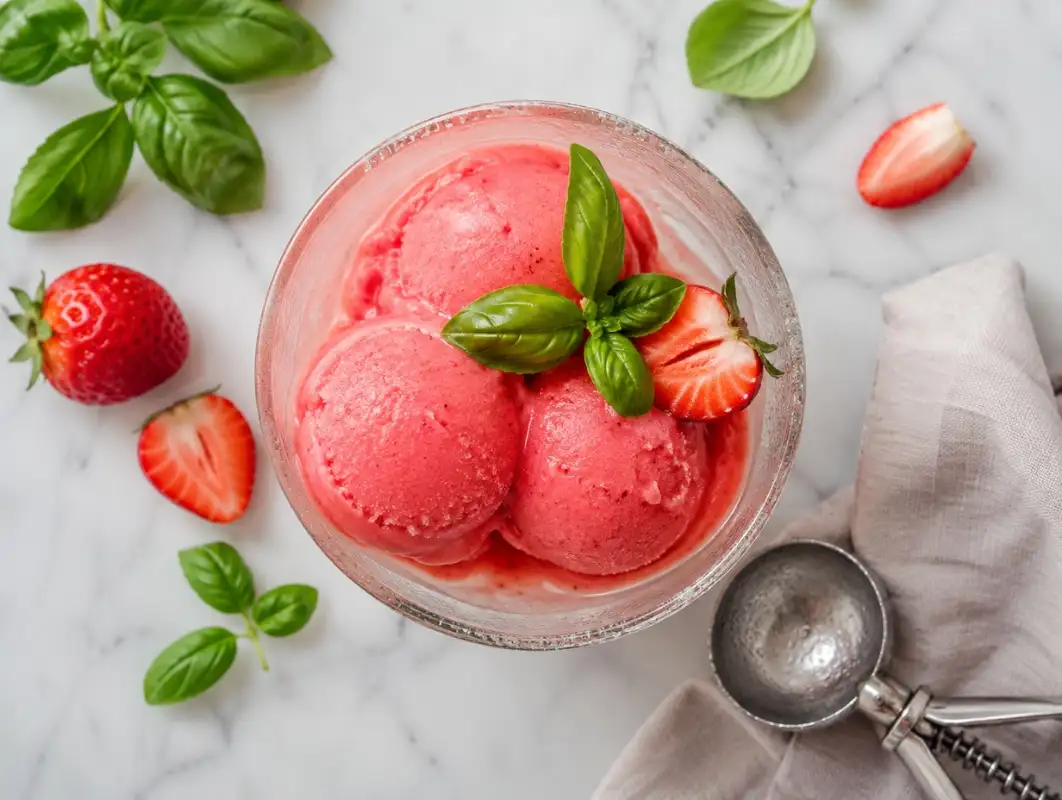
Strawberry Basil Sorbet
Ingredients
Method
- Make the basil simple syrup. Combine the 150 g sugar, water and salt in a small saucepan over medium heat. Stir gently until the sugar dissolves completely, about 4 minutes — the liquid goes from cloudy to clear. Keep it at a gentle simmer; hard boiling starts to caramelise the sugar. Remove from the heat.
- Infuse the basil. Off the heat, tear the basil leaves directly into the warm syrup and press them gently with the back of a spoon. Cover the pan to trap the aromatics and let stand for exactly 30 minutes.
- Macerate the strawberries while the syrup infuses. Toss the hulled, halved strawberries with the 2 tablespoons of sugar in a bowl, stir, cover and rest 30 minutes until they release their juices.
- Strain and combine. Pour the cooled basil syrup through a fine mesh strainer into a chilled blender jar, pressing the leaves to extract every drop, then discard them. Add the macerated strawberries with all their juice and the lemon juice.
- Blend on high for 90 seconds until completely smooth. The colour should be a deep saturated crimson — pale means the strawberries were not ripe enough.
- For the silkiest texture, pass the purée through the fine mesh strainer a second time to remove seeds and fibres. Optional, but recommended.
- Chill the purée, covered, for at least 2 hours and preferably overnight. A fully chilled base churns faster and forms smaller ice crystals.
- Churn the cold purée in a pre-frozen ice cream machine bowl for 20–25 minutes, until it holds its shape like soft-serve and has a slight sheen. It starts pale pink and brightens to brilliant red as air incorporates.
- Pack into a pre-chilled airtight container, press plastic wrap directly against the surface, and freeze at least 2 hours (4 is better) before serving. If it is too hard to scoop, let it sit on the counter 5–8 minutes.
Notes
Frequently Asked Questions
Substitutions & Technique Questions
Q: Can I make strawberry basil sorbet without an ice cream maker?
A: Absolutely, yes. Pour the chilled purée into a shallow metal pan and freeze for 45 minutes. Then scrape vigorously with a fork every 30–45 minutes over the next 3 hours. The result is a coarser, granita-style texture that’s still delicious and deeply flavoured. I prefer the ice cream maker method for dinner parties, but the fork method is what I make on weeknights when I’m tired and craving something cold and good.
Q: Can I use frozen strawberries for this homemade sorbet recipe?
A: Yes, with one important adjustment. Thaw completely and drain off about 30% of the excess liquid before blending — frozen berries release significantly more water than fresh, which dilutes flavour and makes the texture icier. The flavour will still be excellent if the berries were frozen at peak ripeness. Avoid freezer-burned or bland frozen berries — they’ll produce a bland vegan sorbet, nothing more.
Q: How much basil should I use for a strong flavour?
A: For a clearly present — but not overpowering — basil note, 20–25 large Genovese leaves steeped for 30 minutes is my tested amount. For a more assertive sorbet with fresh herbs flavour, increase to 35 leaves and extend steeping to 45 minutes. Press the leaves while steeping. Don’t go beyond this — too much basil tilts the flavour from ‘elegant’ to ‘you’re eating a salad.’ Trust me.
Q: Why does my sorbet turn out icy rather than smooth?
A: Usually one of three causes: (1) The purée wasn’t cold enough before churning — always chill at least 2 hours; (2) The ice cream bowl wasn’t frozen for a full 24 hours; or (3) Not enough sugar. Sugar lowers the freezing point of water — if you reduce the sugar below 100g for this quantity of fruit, you’ll get ice, not easy sorbet. The 150g I use is the tested minimum for proper texture.
Q: Can I add balsamic vinegar to the recipe itself, not just as a garnish?
A: I’ve tested this. One teaspoon of aged balsamic blended directly into the purée adds a subtle depth that’s almost unidentifiable — tasters say the sorbet tastes ‘more like strawberry.’ The acid in the balsamic amplifies fruitiness perception. However, more than 1 teaspoon and it starts to taste vinegary. The garnish drizzle remains my preference — visual and flavour impact at once.
Dietary, Make-Ahead & Authenticity Questions
Q: Is strawberry basil sorbet vegan and dairy-free?
A: Yes — completely. The standard recipe contains no dairy, no eggs, and no animal products of any kind. This is a naturally dairy-free frozen dessert and vegan sorbet. For sugar-free versions, replace with allulose 1:1 — the texture will be slightly softer but otherwise excellent. Always use certified vegan sugar if this matters to you (some sugar is processed with bone char).
Q: Can I make this sorbet ahead of time for a party?
A: This is actually one of the best make-ahead desserts I know. Make it up to 5 days ahead — it keeps beautifully. Pull from the freezer 8 minutes before serving. I make large batches for my Athens cooking workshops the evening before, every time, without issue. Store with plastic wrap pressed against the surface to prevent ice formation.
Q: Is basil the only herb that works in this strawberry basil sorbet?
A: No. Fresh mint is the most common substitute and creates a classic, universally loved combination. Fresh tarragon creates something more sophisticated — an anise-forward note that’s excellent for adult dinner parties. Lemon verbena is extraordinary if you can find it. What doesn’t work, in my experience: thyme (too medicinal), rosemary (too resinous), sage (genuinely unpleasant in this application — tested twice, confirmed both times).
Q: What’s the ideal sugar-to-fruit ratio for proper sorbet texture?
A: The industry standard, as described by pastry professionals, is 20–25% sugar by total weight of the mixture. For 700g strawberries + 120ml water + 45ml lemon juice (roughly 865ml total), 150–180g sugar falls right in the sweet spot. This gives a scoopable result at -12°C / 10°F. Less than 100g and you get an ice block. More than 220g and it never fully sets.
Q: Can children help make this recipe?
A: Yes — and I encourage it. The syrup step requires adult supervision around the stove. But the macerating, the tearing of basil leaves (which smells wonderful and is oddly satisfying for small hands), the blending (with supervision), and especially the fork-scraping of the no-churn strawberry sorbet method are all great tasks for older children. My niece made this with me in my Chania kitchen in August 2022. She was nine. She was very serious about it. She was excellent.
Bringing Greece to Your Table
Make This Sorbet, Then Make It Your Own
I have a theory about recipes that travel well — the ones that survive are the ones with a clear soul and flexible technique. This strawberry basil sorbet has both. The soul is that basil syrup infusion — my yiayia’s instinct, preserved in every batch I make. The flexibility is everything else: the herb choice, the sugar level, the finish, the vessel you serve it in. Make it once as written. Then make it yours. Use whatever basil is overflowing in your garden. Try the tarragon version on a dinner party night. Serve it in teacups like my yiayia did, or in elegant white bowls with balsamic and a sea salt flake.
I genuinely want to see what you make. Leave a comment below, tag me, send me a photograph. Every batch of this sorbet that gets made somewhere in the world because of this recipe makes me feel, in a small way, like that morning in my yiayia’s kitchen in Chania is still happening. Kali orexi. Bon appétit. Enjoy.
More Mediterranean Desserts to Explore
If this strawberry basil sorbet has made you want to explore Mediterranean frozen and sweet dishes further, start with our frozen Greek yogurt bars — a summer staple with entirely different texture. For the same honey-and-herb spirit in a baked form, our Greek yogurt panna cotta is the companion dessert I serve at every dinner party alongside this sorbet. And for a full Greek celebration dessert table, the Mediterranean desserts collection has everything from the intensely syruped to the elegantly simple — all worth your time.