 Written by Ines Zahraoui — Tunisian home cook and co-founder of The Mediterranean Recipe, developing and testing recipes in her own kitchen since 2020. More about Ines →
The first year I built a Halloween Mezze Board I made the mistake everyone makes: I bought things because they were delicious. Good cheese, good olives, nice bread, some figs. It tasted excellent and it photographed like a pile of beige objects with a candle next to it.
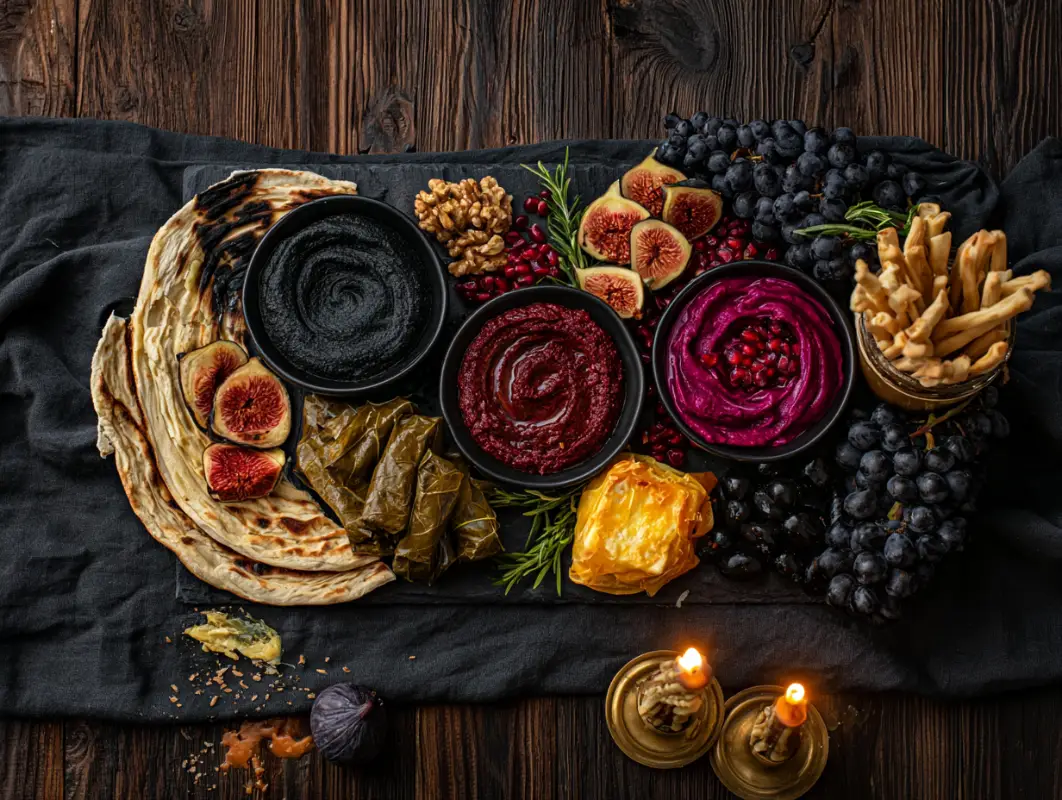
The second year I picked every single item by colour first and checked whether it was good second. Black olives, purple figs, oxblood muhammara, charred eggplant, black grapes, near-black bread. It looked like something out of a painting, and — this is the part I did not expect — it also tasted better, because choosing by colour forces you away from the default cheese-and-cracker board into ingredients that are actually interesting.
Table of Contents
Table of Contents
Gothic Mezze Board Recipe Card
Gothic Halloween Mezze Grazing Board for 12
Ingredients
Method
- Place all empty bowls on the board first, spaced unevenly, before any food goes down. This is the single step that decides whether the board looks composed or dumped.
- Fill the three dip bowls and groove each surface with the back of a spoon.
- Set the warm anchors — baked feta and vine leaves — in the two largest remaining gaps.
- Fold and fan the breads along one edge and through the middle, standing the breadsticks upright in a jar or leaning them against a bowl for height.
- Add the large fruit: figs cut side up, grapes in whole bunches so they drape over the edge.
- Fill every remaining gap with olives, nuts and pickles. The rule is that no board should be visible.
- Tuck in rosemary and thyme, scatter pomegranate seeds across the whole board from a height, drizzle olive oil over the dips and finish with flaky salt.
Notes
There is one more thing that separates a great board from a good one and almost nobody names it: texture. A board where everything is soft is a board people wander away from. You need something that shatters, something that resists, something that pops. Mediterranean food is unusually good at this — brittle flatbread, firm-crusted baked feta, pomegranate seeds that burst, walnuts, crisp raw fennel.
Halloween 2026 falls on a Saturday, which means a real party. And a board like this is not the starter. It is the meal. Twelve people, ninety percent of it made in advance, no plates, no seating plan, no main course to time.
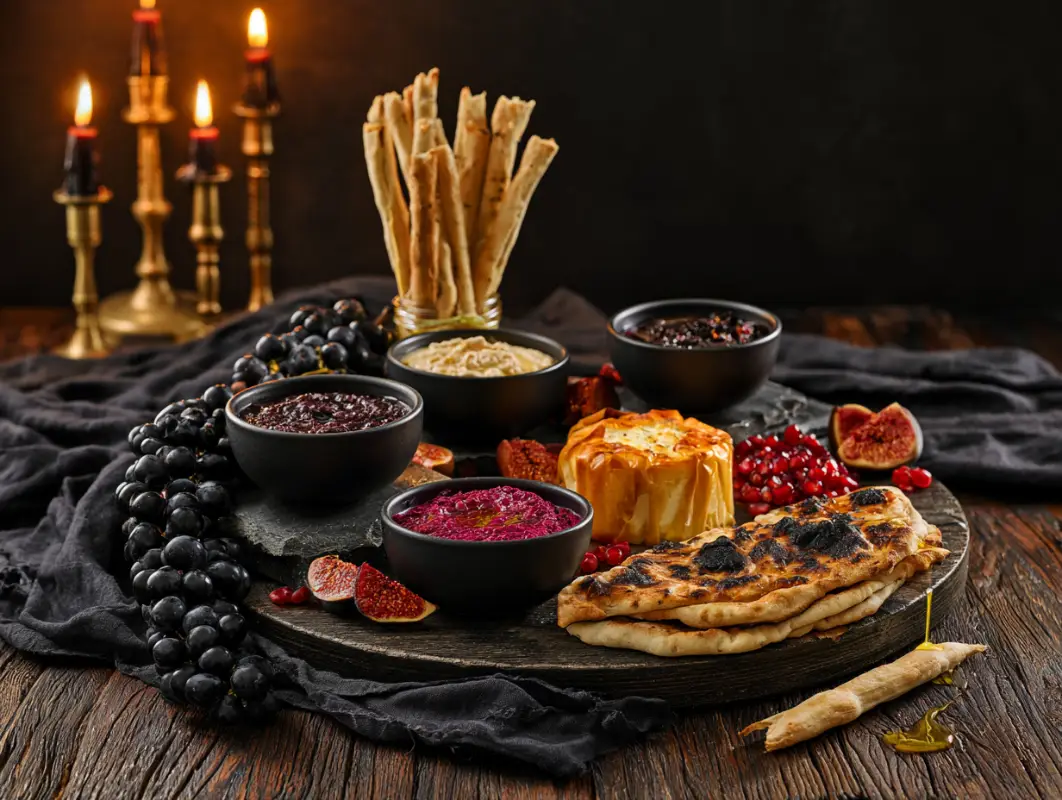
The short version. A gothic Halloween mezze board is a Mediterranean grazing table built to a dark palette — oxblood, matte black and deep purple — where every colour comes from an ingredient rather than from dye. For twelve people it needs three dips, two substantial anchors, bread, dark fruit, olives, nuts and one sweet, at roughly 80% dark to 20% cream. It takes about forty-five minutes to assemble and around ninety percent of it is made in the three days before.
Why This Board Actually Works
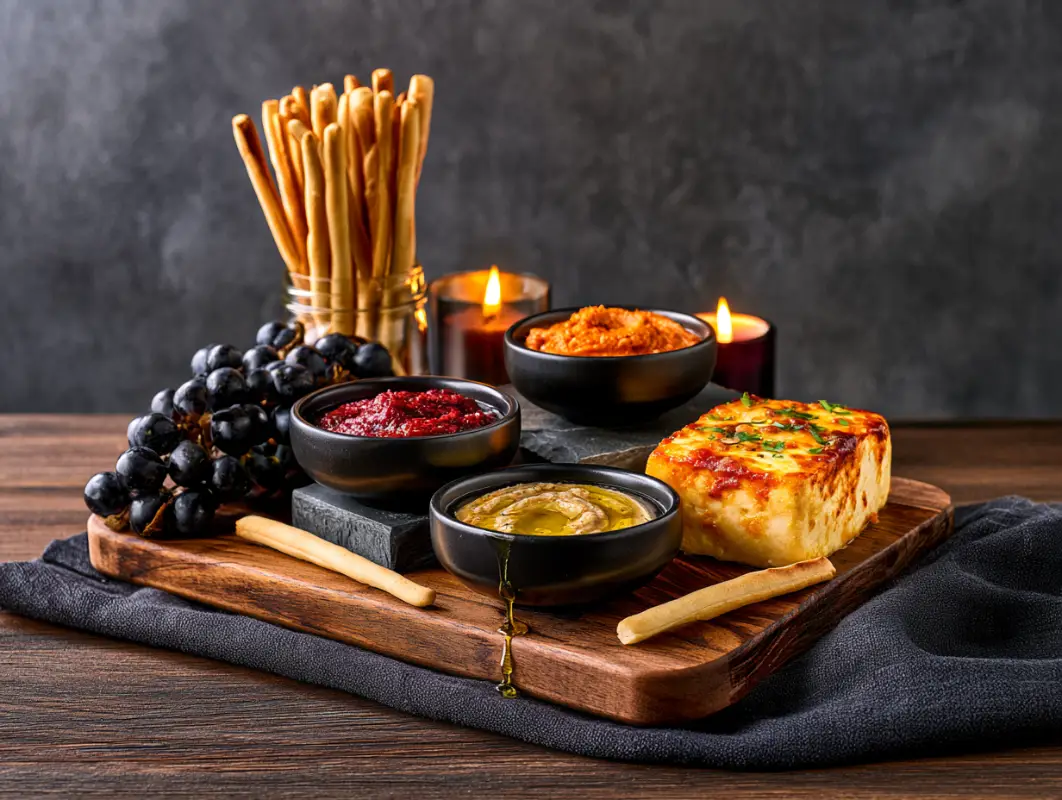
- It is built as a system, not a shopping list — every item has a role.
- The colour discipline is what makes it look designed. It is the entire difference between this and a supermarket platter.
- Ninety percent is made in advance, which is the only way a party works.
- There is a real meal in it. Three dips, two protein anchors, bread and fruit is dinner for twelve.
- Nothing is dyed and nothing is plastic. Every colour comes from an ingredient.
Why Mediterranean Food Is Already Halloween Food
The palette every 2026 forecaster converged on for Halloween — oxblood, blackened plum, matte black, with a little antique gold — is the natural colour range of the Mediterranean pantry. Pomegranate, eggplant, black olives, squid ink, beetroot, charred vegetables, black tahini, dark figs. You are not styling food to look like something else. You are just declining to add anything pale.
What Goes on a Gothic Mezze Board
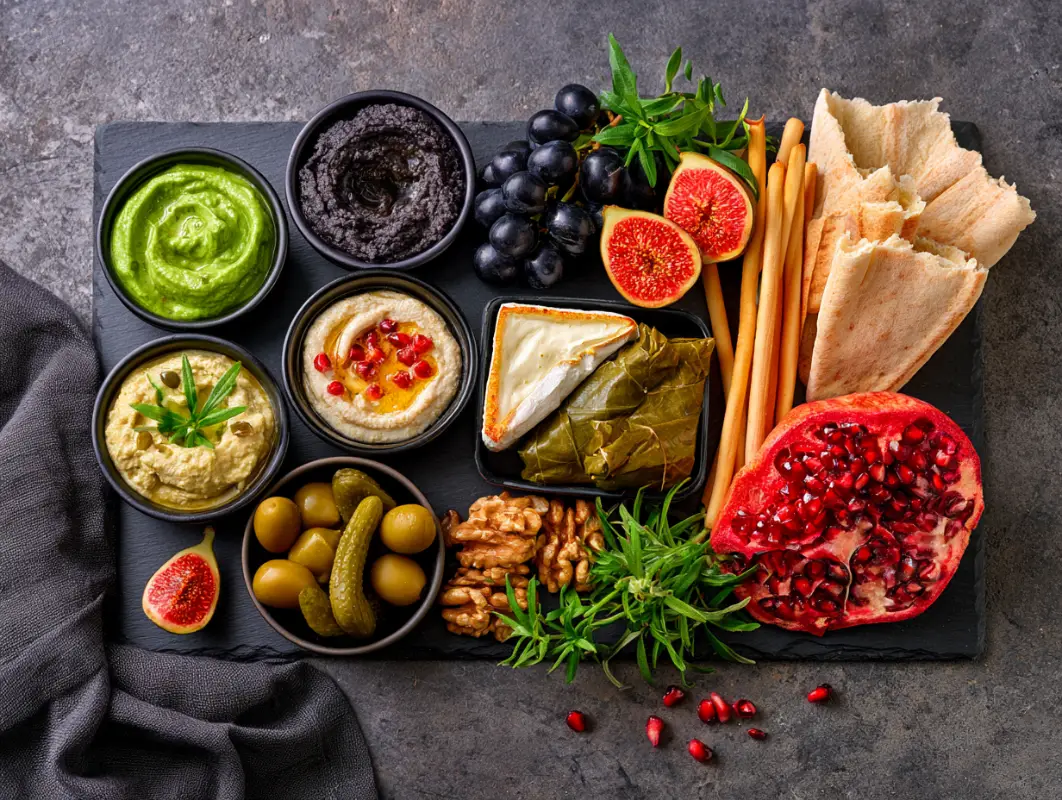
Organise by role, not by aisle. Every board needs all seven of these categories, and it needs them roughly in this proportion:
| Category | How much | What it is doing |
|---|---|---|
| Three dips | About half the board’s visual weight | The anchors, and the thing people actually eat most of. One black, one red, one earthy. Not five, not seven. Three. |
| Two anchors | Two of the largest gaps | Something warm and something substantial. These turn a snack board into a meal. |
| Breads and dippers | Always more than you think | The most commonly under-bought item on any board, by a wide margin. |
| Dark fruit | Large areas, and the edges | Fills space fast, drapes over the board edge, and cut figs give you interior colour. |
| Olives and pickles | Medium gaps | Salt and acid, and they fill gaps. |
| Nuts | The smallest gaps | Crunch, and they finish the surface. |
| One sweet | One corner | Halva or dark chocolate bark, so the board can end a meal as well as start one. |
The Colour Rule: Black, Oxblood and Deep Purple
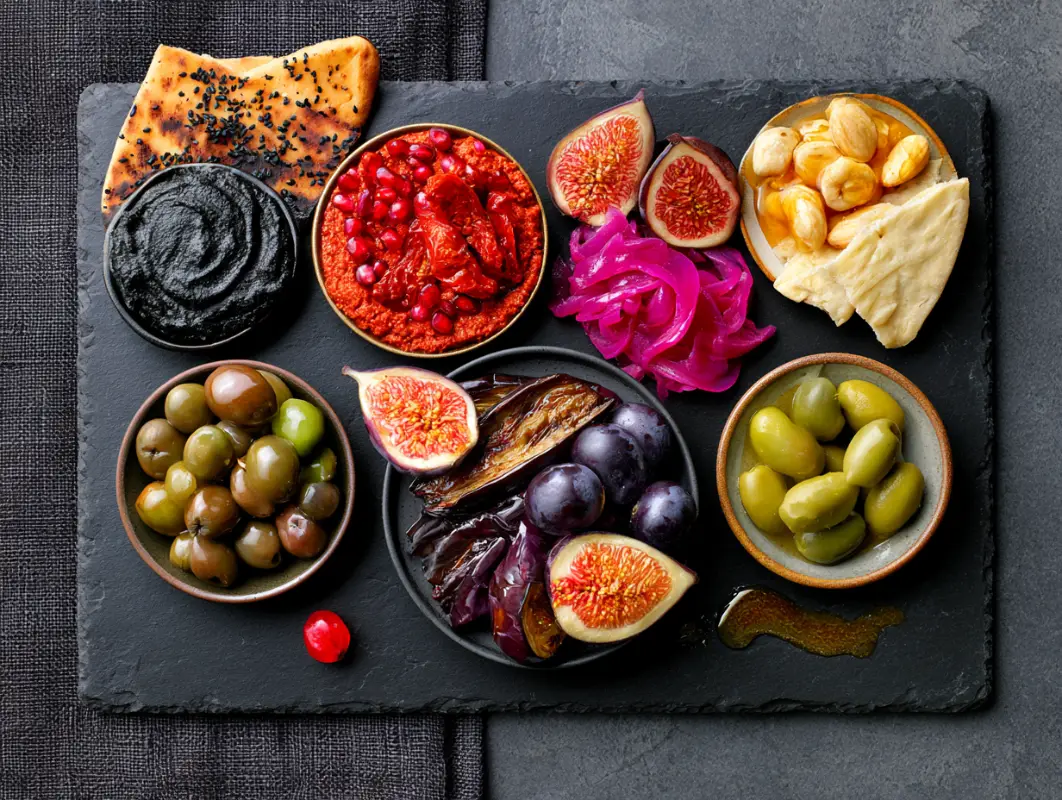
Choose every item by colour before you choose it by flavour. This feels backwards and it is the single most useful rule on this page.
| Colour | Share of the board | What to buy |
|---|---|---|
| Matte black | ~35% | Oil-cured black olives, black tahini hummus, squid-ink or charcoal-free dark bread, black grapes, blackened charred eggplant, black sesame |
| Oxblood | ~25% | Muhammara, pantzarosalata beet dip, pomegranate seeds and molasses, sun-dried tomatoes, Aleppo pepper, radicchio |
| Deep purple | ~20% | Fresh figs halved, purple carrots, Kalamata olives, purple basil, dried black mission figs, red endive |
| Cream and gold | ~20% | Baked feta, labneh, Marcona almonds, walnut halves, pale flatbread, honey, brass and candlelight |
The last row matters as much as the others. A board that is entirely dark reads as murky rather than dramatic. You want roughly 80% dark, 20% cream and gold — the pale elements are what make the dark ones look deliberate rather than underlit.
What you are avoiding: orange. Bright orange cheese, orange crackers, orange dips, orange napkins. It is the single fastest way to make a gothic board look like a supermarket Halloween aisle.
The Texture Rule Nobody Talks About
Here is a thing I have never seen written on a grazing board post, and it is the reason some boards get demolished and others get politely admired.
Nearly every board fails the same way: everything on it is soft. Dips are soft. Cheese is soft. Bread is soft. Fruit is soft. Guests take one round, feel vaguely unsatisfied without knowing why, and drift toward whatever else is in the kitchen.
You need four textures in play, and you need to place them deliberately:
| Texture | What it is | Where to put it |
|---|---|---|
| Something that shatters | Charred flatbread, seeded crackers, the phyllo crust on baked feta, breadsticks | Where people reach first |
| Something that resists | Raw fennel, endive, cornichons, firm dried apricots | Anywhere — this is the one that is almost always missing |
| Something that pops | Pomegranate seeds, whole olives, capers | Scattered across the entire board, not in a bowl |
| Something soft | The dips | You already have this covered |
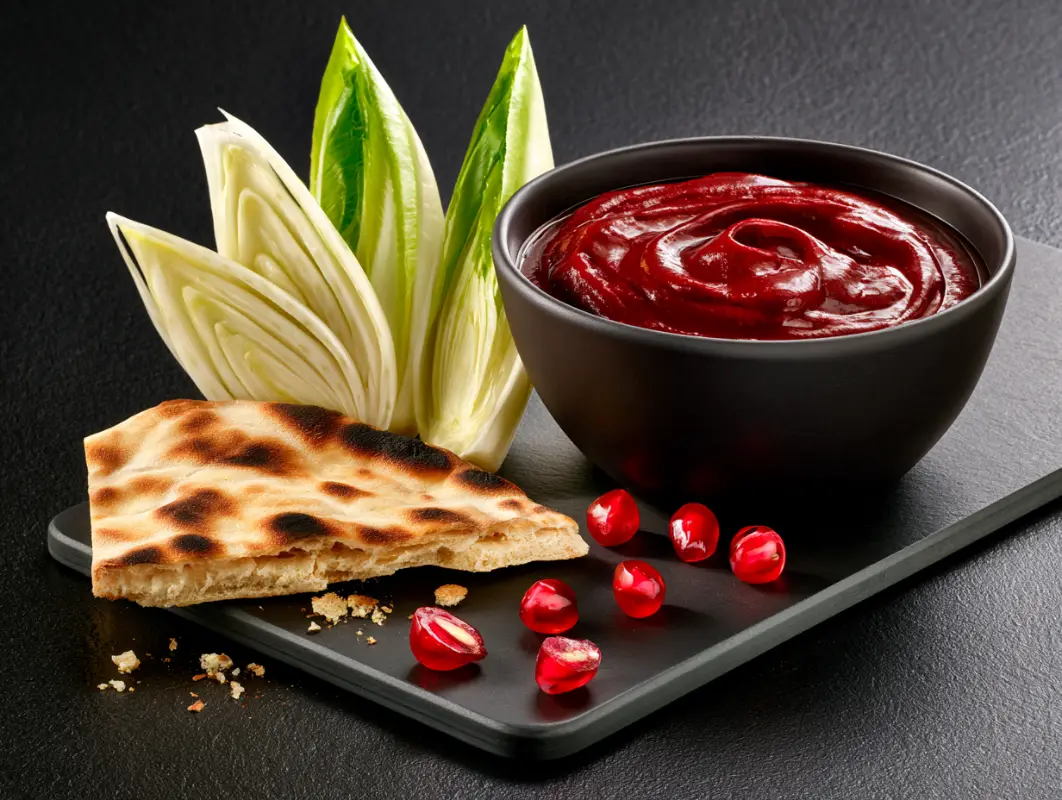
Scatter the pomegranate across the whole board rather than putting it in a bowl — it makes every mouthful different. Texture is not a garnish. It is what people remember.
How to Build It in 6 Steps
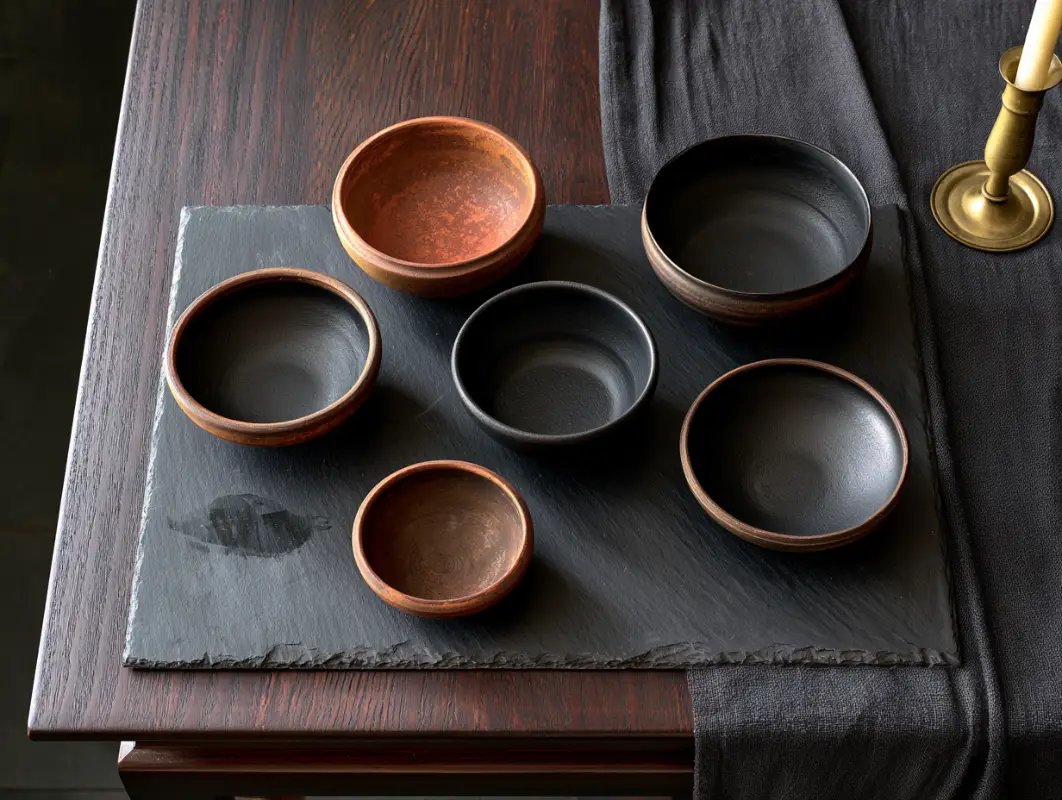
Step 1 — Bowls first. All of them, empty, spaced unevenly, before a single piece of food goes down. Uneven spacing is deliberate: three bowls in a neat triangle reads as a place setting.
Step 2 — Anchor with the big pieces. Baked feta, the vine leaves, the largest single items. These go in the biggest remaining gaps and they set the board’s centre of gravity.
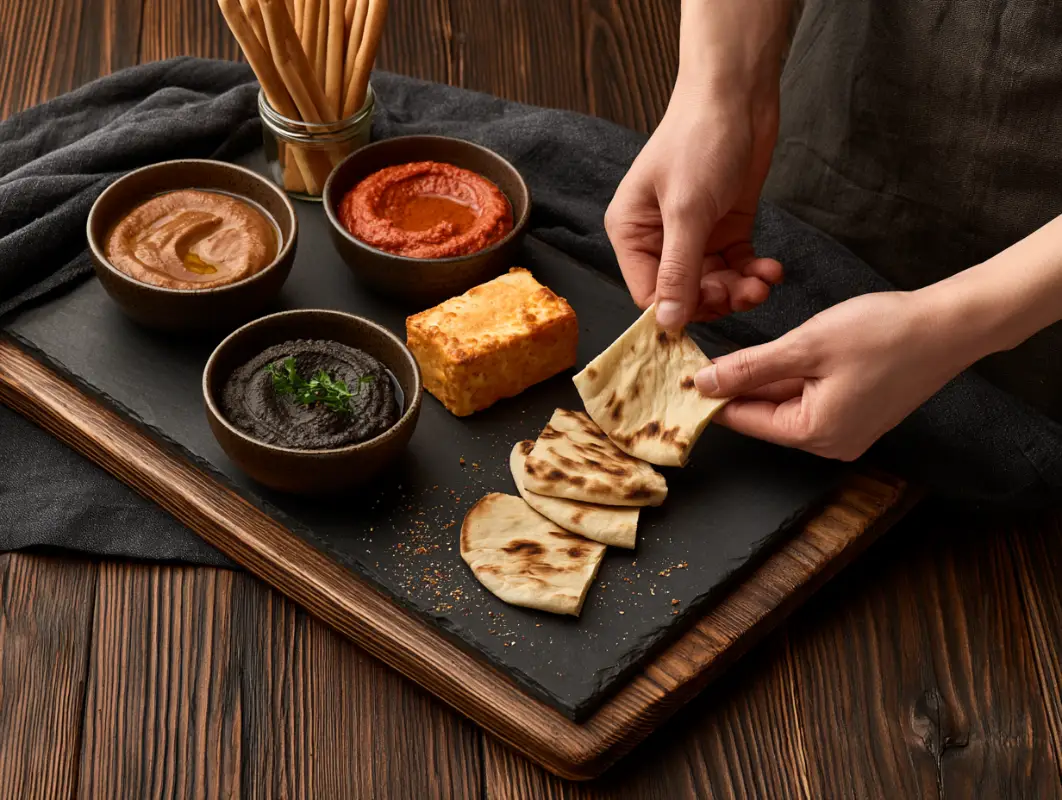
Step 3 — Fold and fan the breads. Never lay bread flat. Fold flatbread into loose quarters and overlap them in a curve; stand breadsticks upright in a short jar. Flat bread lies there. Folded bread has height and shadow.
Step 4 — Add the dark fruit. Figs cut side up so the interior shows. Grapes in whole bunches, positioned so one drapes over the board edge — an item breaking the edge is what stops a board looking contained.
Step 5 — Fill every gap. Olives, nuts, pickles, working from largest gap to smallest. The rule is that no board surface should be visible when you finish. An empty patch reads as a mistake; a crowded board reads as abundance.
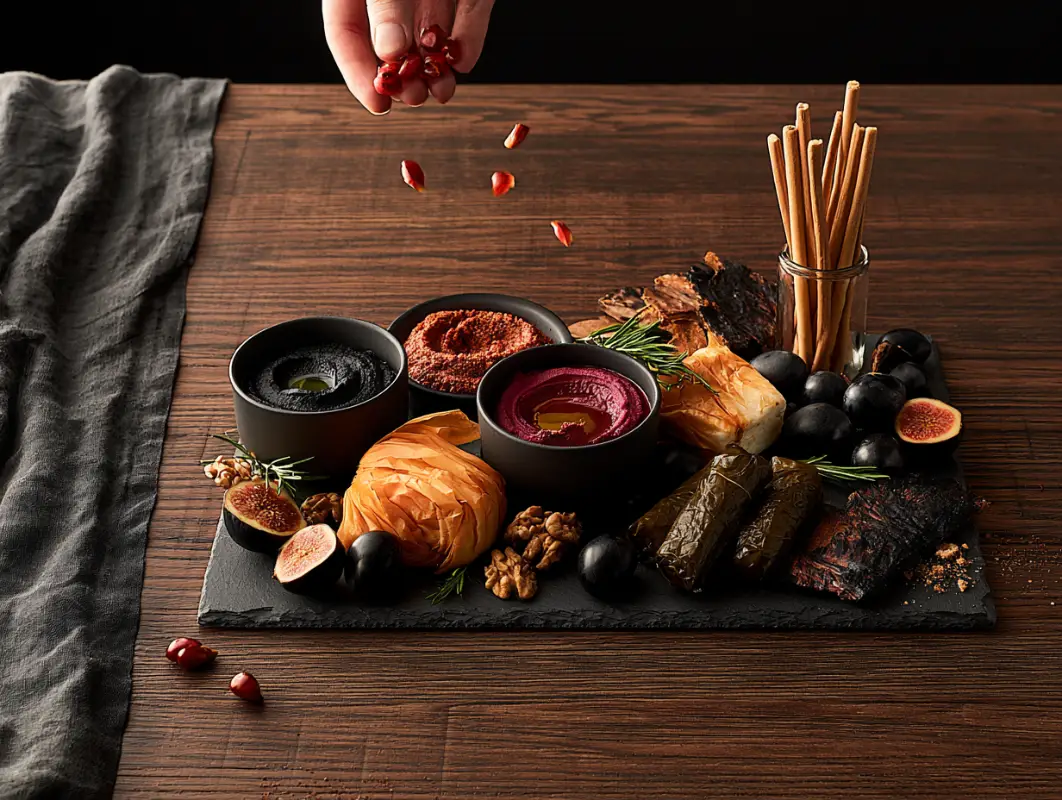
Step 6 — Herbs, oil and finish. Tuck rosemary and thyme into the seams. Drizzle oil over the dips only. Then scatter pomegranate seeds across the entire board from about a foot up, so they land unevenly. Flaky salt last.
Total time once everything is made: about forty-five minutes.
Quantities for 8, 12 and 20 Guests
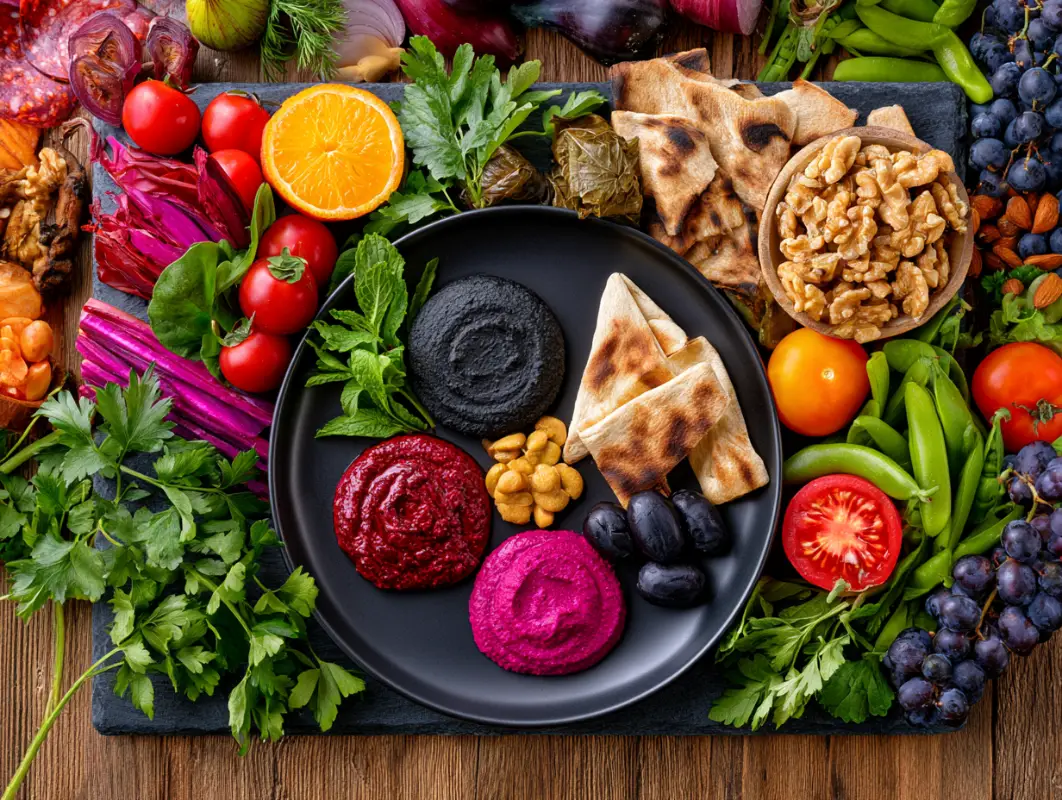
These are for a board serving as the main meal. If it is an appetizer before something else, use about 60% of these numbers.
| Component | Per person | For 8 | For 12 | For 20 |
|---|---|---|---|---|
| Dips | 6 oz | 2 batches | 3 batches | 5 batches |
| Bread and crackers | 3 oz | 4 flatbreads + 1 packet crackers | 6 flatbreads + 1 packet | 10 flatbreads + 2 packets |
| Breadsticks | 2 each | 16 | 20 to 24 | 40 |
| Warm anchors | — | 1 baked feta + 16 vine leaves | 1 baked feta + 24 vine leaves | 2 baked feta + 40 vine leaves |
| Fresh fruit | 3 oz | 8 figs + 12 oz grapes | 12 figs + 1 lb grapes | 20 figs + 2 lb grapes |
| Olives and pickles | 1.5 oz | 12 oz | 1 lb 2 oz | 2 lb |
| Nuts | 0.5 oz | 8 oz | 14 oz | 1 lb 8 oz |
| Raw vegetables | — | 1 endive + 1 fennel | 2 endive + 1 fennel | 3 endive + 2 fennel |
| Board size | — | ~18 in | ~24 in | two 18 in boards |
At 20 guests, build two boards rather than one large one. A single enormous board creates a queue and people at the back cannot reach. Two identical smaller boards at opposite ends of the room is a better party.
What to Make and What to Buy
Be ruthless about this. Making everything is how a board becomes a two-day project and stops being fun.
| Make these three | Buy everything else |
|---|---|
| Muhammara blood dip — 15 minutes, and better made two days ahead | Vine leaves, jarred — genuinely excellent, and rolling your own is a two-hour job nobody will detect |
| Black tahini hummus — 15 minutes, and nothing sold in a shop is this black | Olives — from a counter rather than a jar if you can |
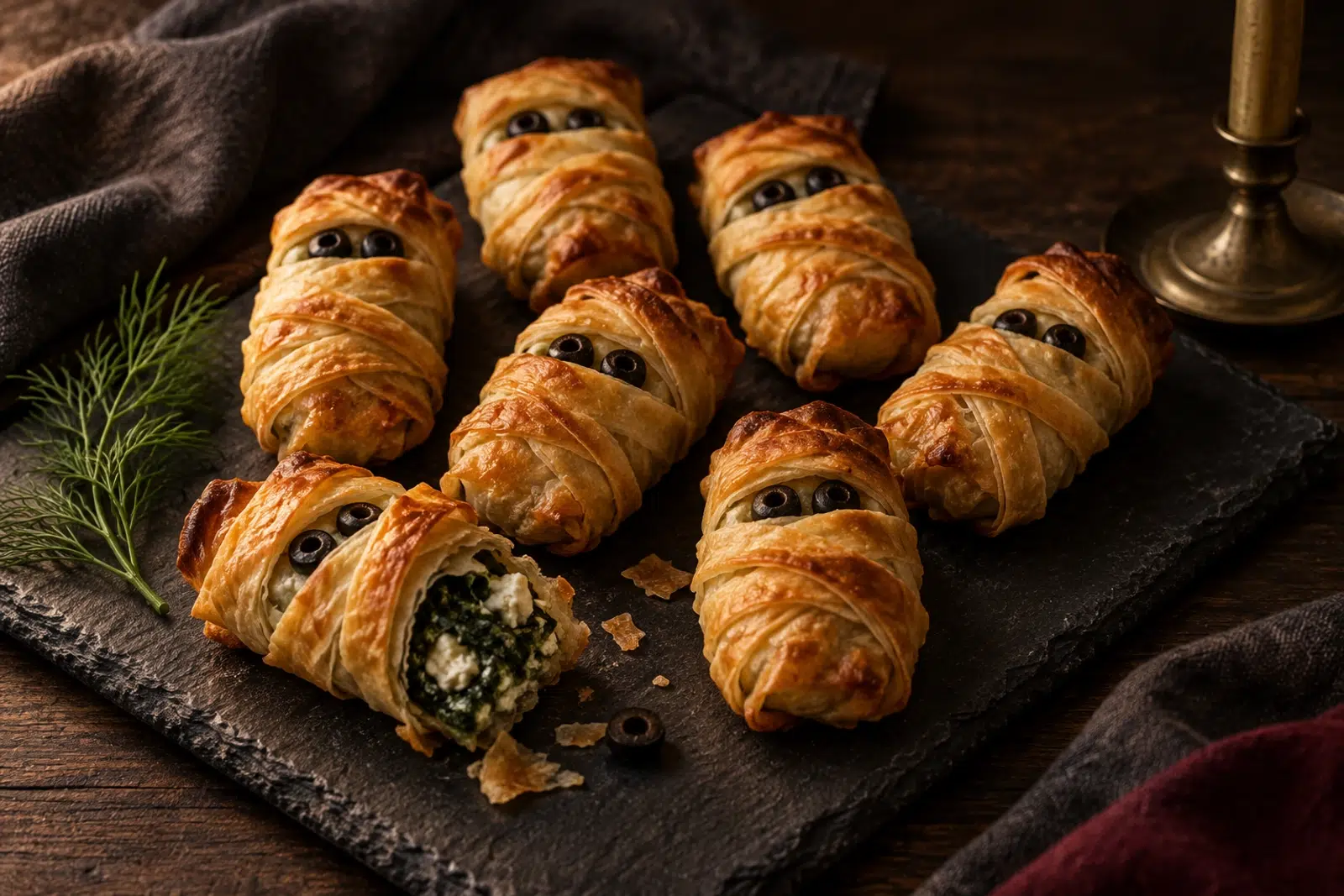
| Mummy baked feta in phyllo — four ingredients, and the only warm thing on the board | Crackers, dried fruit, cheese, breadsticks, fresh fruit — all of it, without guilt |
Buy the nuts and toast them yourself, which takes four minutes and doubles their flavour. That is the one shortcut worth undoing.
This Is Dinner, Not the Starter
Every grazing board article treats the board as an appetizer. On Halloween that is the wrong frame, and dropping it makes your whole evening easier.
The wider trend points the same way — entrées reimagined as dips and grazing boards, dinner as a snacking format rather than a plated sequence, one-bite snacks and mini meals moving from novelty to default.
Practically, on a Saturday-night Halloween, treating the board as the meal means:
- No timing problem. There is no main course to land while guests are talking.
- No seating plan. People eat standing, which is what they want to do at a costume party anyway.
- No plates to wash. Small plates and napkins, and that is it.
- You are in the room. Which is the entire point of hosting.
Scale up the anchors and the bread, add a soup shooter or a hot dish if you want one warm course, and stop planning a main.
Allergens and Swaps Before You Shop
This board feeds twelve people who did not choose the menu, which makes it different from cooking for yourself. Ask once, in the invitation, and you will never have to improvise at the table.
Four of the nine major allergens are structural here, not incidental:
| Allergen | Where it is | The swap |
|---|---|---|
| Sesame | Both tahini-based dips, za’atar breadsticks, black sesame garnish | Sunflower seed butter in place of tahini; skip the za’atar sticks and use plain grissini |
| Tree nuts | Muhammara (a full cup of walnuts), Marcona almonds, walnut halves | Toasted sunflower seeds in the muhammara; pumpkin seeds in place of the loose nuts |
| Dairy | Baked feta, yogurt in the beet dip, labneh | Drop the feta, use olive oil in the beet dip, add a fourth dip and roasted cauliflower as the second anchor |
| Gluten | Flatbread, crackers, breadsticks | Endive leaves, sliced fennel, cucumber, seeded gluten-free crackers — and buy more raw vegetables than you think |
Sesame is not a garnish-level concern. It has been the ninth major food allergen under US federal law since 1 January 2023, and tahini is load-bearing on a Mediterranean board rather than a sprinkle you can pick off — see the FDA’s guidance on the FASTER Act.
Label the board. Small folded cards in the same cream-on-black as everything else, one per bowl, naming the dip and its allergens. It reads as considered rather than clinical, and it means a guest with an allergy is not interrogating you in front of the room.
Make-Ahead and Timing
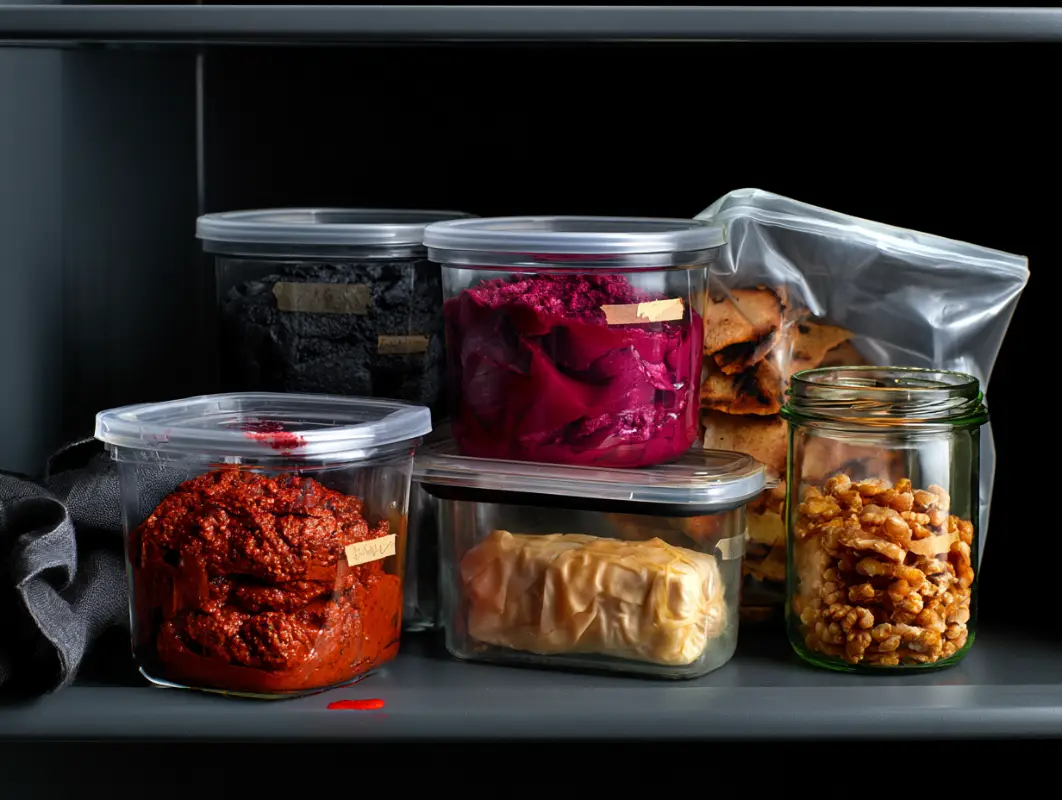
| When | What |
|---|---|
| 1 week ahead | Toast the nuts, store airtight. Buy anything jarred or dried. |
| 3 days ahead | Make all three dips. They all improve by day two. |
| 2 days ahead | Bake the breadsticks, store in a tin. |
| 1 day ahead | Shop for fresh fruit, bread and vegetables. Wrap the baked feta ready to bake. |
| 2 hours before | Assemble the board. Cover with a damp tea towel. This is the outside limit. |
| 25 minutes before | Baked feta into the oven, so it lands as guests arrive. |
| On serving | Oil over the dips, pomegranate scattered, candles lit, overhead light off. |
Do not assemble more than two hours ahead. Bread goes leathery, cut fruit browns and dips form a skin. Two hours covered is the outside limit.
And two hours is also the safety limit, not only the looks limit. Anything with dairy in it — the feta, the yogurt in the beet dip, the labneh — should not sit out for more than two hours in total, and no more than one hour if the room is above 90°F, which a candlelit room with twenty people in it can reach. That is the USDA Food Safety and Inspection Service’s holding guidance, and the reserve-tray method is how you keep to it without the board ever looking depleted: swap the bowl, do not top it up. Topping up resets nothing — the dip at the bottom has been out since the start.
Keeping it alive through the party: refill in halves rather than topping up — a half-empty board that gets refilled looks worse than a smaller board that stays full. Keep a reserve tray in the kitchen with pre-cut fruit and a second bowl of each dip, and swap bowls out rather than spooning more in.
Frequently Asked Questions
How far ahead can I make a Halloween grazing board?
The dips up to three days, the breadsticks two days, and the toasted nuts a week. The board itself should not be assembled more than two hours before guests arrive, covered with a damp tea towel. Bread and cut fruit are the limiting factors.
How much food do I need per person on a grazing board?
As a full meal, about 6 ounces of dip, 3 ounces of bread and crackers, 3 ounces of fruit and 2 ounces of olives and nuts per person. As an appetizer before dinner, roughly 60% of that. The table above breaks it down for 8, 12 and 20.
What can I use instead of a wooden board?
A large rimmed baking tray lined with parchment, a marble pastry slab, two slate tiles pushed together, or a clean unhinged cupboard shelf. Dark, matte and flat is all that matters. A dark surface flatters this board more than wood does.
How do I keep a grazing board looking good for a whole party?
Build a reserve tray in the kitchen and swap bowls out rather than topping up. Keep anything with dairy out for no more than two hours. Move remaining items toward the centre as the board empties so it never looks picked over at the edges.
Can I make a gothic mezze board vegan?
Yes, and easily. Drop the baked feta, add a fourth dip and a tray of charred cauliflower or roasted eggplant as the second anchor. All three dips are vegan if you skip the yogurt in the beet dip and use olive oil in its place.
What is the difference between a mezze board and a charcuterie board?
Charcuterie means cured meat — the word refers to the craft of it — so a charcuterie board is built around cured meats and cheese. Mezze is built around dips, breads, vegetables and small plates, and it is vegetarian by default. The board on this page contains no meat at all. Mezze also travels much better for a party, because most of it is make-ahead and only one component needs to stay cold.
Do I need to serve alcohol at a Halloween grazing table?
No, and a board like this is easier without it. The food is already sour, smoky and salty enough to carry a meal, which is exactly the job wine usually does. A batched pomegranate drink with a black sesame sugar rim, served in proper glassware, does more for the table than a bottle does — and it means every guest is holding the same glass.
Serving Ideas and Drinks
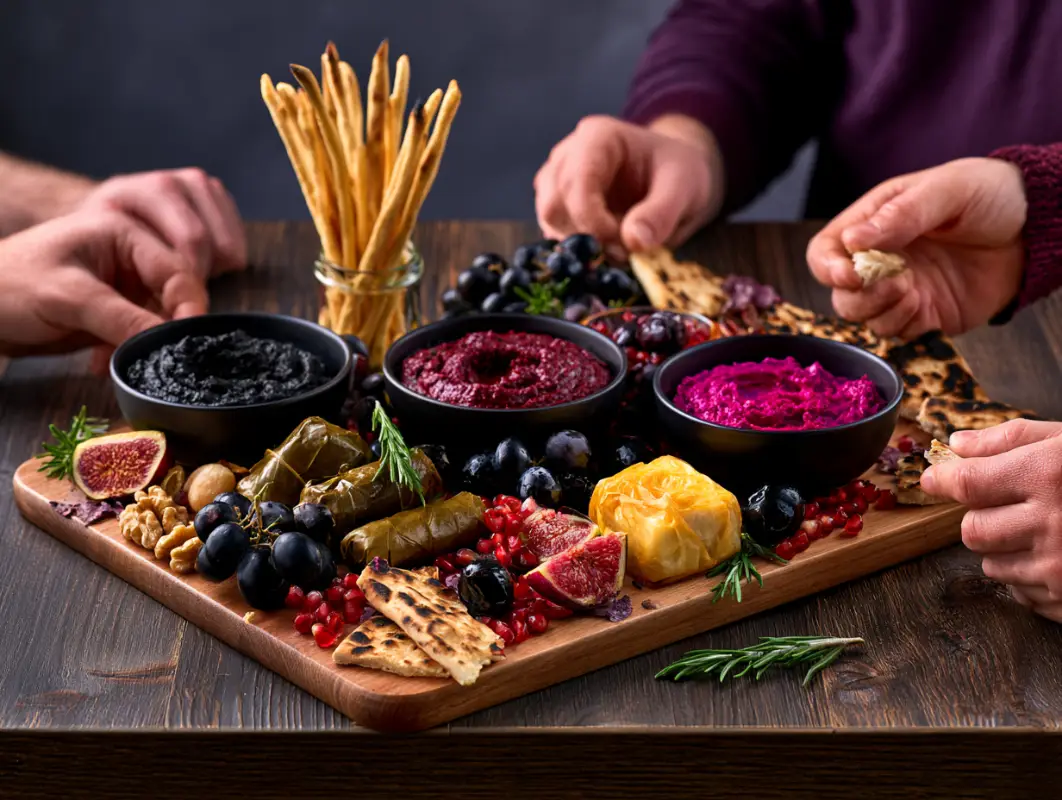
Light it properly. This is worth more than any prop. Candles only, at table height, and turn the overhead light off. Cordless tabletop lamps or a row of tapers along the board’s long edge will do more for how this looks than anything you can buy.
The drink. Pomegranate blood punch, batched in a jug so you are not making drinks all night — pomegranate juice, hibiscus tea steeped strong and cooled, a little pomegranate molasses for depth, topped with sparkling water per glass so it does not go flat. Deep red, no dye, alcohol-free, and it holds its colour for hours because it never goes near heat.
If you want a warm course, red pepper soup shooters in shot glasses are the right format — no bowls, no spoons, no seating.
The three dips this board is built on:
- Muhammara blood dip — oxblood, smoky, coarse
- Black tahini hummus — jet black, silky, nutty
- Pantzarosalata blood beet dip — magenta, earthy, sharp
Dressing the table further? The midnight masquerade menu covers the tablescape, the run sheet and what to do if guests actually wear masks.
Watch: The Six-Step Build
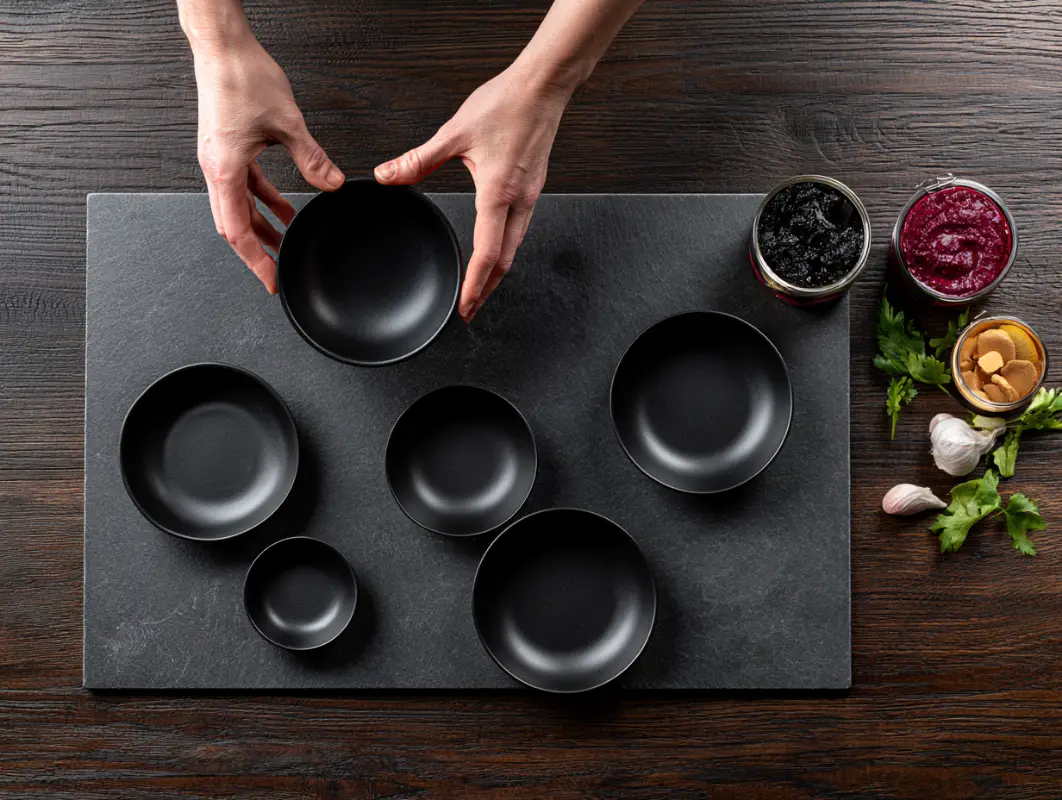
Empty bowls placed on the bare board, dips filled and grooved, baked feta set in, breads folded and fanned, figs and grapes added, gaps filled with olives and nuts, then pomegranate scattered from above and candles lit.
Ready to Build the Best-Looking Thing You’ve Ever Put on a Table?
Make three dips across the three days before. Buy everything else. Put the bowls down first, pick every item by colour, get four textures on there, and fill every gap.
Then turn the overhead light off and let the candles do the rest.
Sources and Further Reading
- Harvard T.H. Chan School of Public Health, The Nutrition Source — Mediterranean Diet. On the eating pattern this board sits inside: plant-forward, olive oil as the primary added fat, dairy and animal protein in smaller portions.
- US Food and Drug Administration — The FASTER Act: Sesame Is the Ninth Major Food Allergen.
- USDA Food Safety and Inspection Service — “Danger Zone” 40°F–140°F.