The first time I made muhammara for a Halloween party (Muhammara Blood Dip), a woman I’d never met stood over the bowl for a genuinely uncomfortable length of time and finally asked me what was in it, in the tone of someone who suspects a crime.
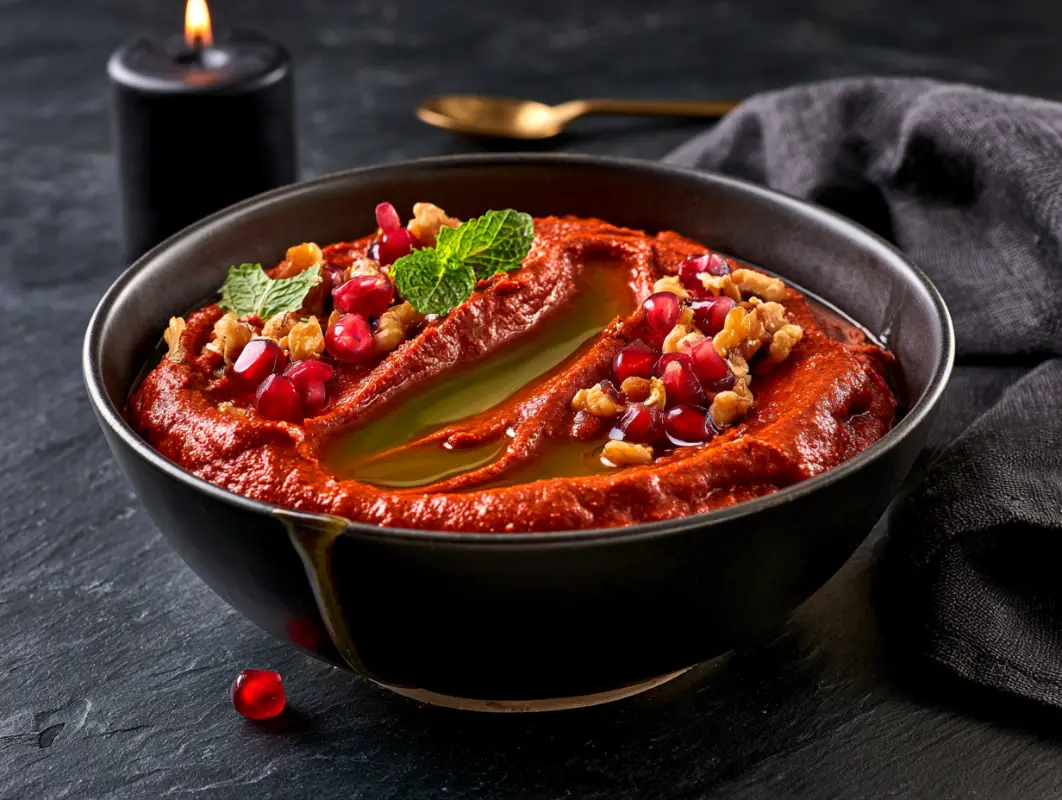
It was the color. Muhammara comes out the exact oxblood of something that has been drying for about an hour — not the flat orange-red of a tomato dip, not the pink of a beet one, but a deep brick that goes almost brown at the edges where the oil pools. It looks like a prop. It is roasted peppers, walnuts and pomegranate molasses, and there is not one drop of food coloring anywhere near it.
The texture is the part people remember, though. This is not a smooth dip. Walnuts pulsed short leave it faintly gritty in the way a good pesto is gritty, so when you drag a piece of flatbread through it you feel the thing you’re eating. That contrast — glossy surface, rough interior — is why it reads as unsettling on a table rather than merely dark.
Halloween 2026 lands on a Saturday, which means a real party, which means you are going to want at least one thing on the table that isn’t a variation on cheese. This is that thing. It takes fifteen minutes, it holds five days, and — this is the part almost nobody says out loud — it gets redder overnight.
One thing to say before anything else, because it belongs at the top and not in a footnote: this is a full cup of walnuts across eight servings. That is a serious allergen load for a party dish nobody reads a label on. Tree nuts are one of the nine major food allergens the FDA requires to be declared, and a grazing table carries no label at all. If there is any chance of a nut allergy at your table, make the sunflower-seed version in Creative Variations below, and say out loud what is in the bowl.
Table of Contents
Muhammara Blood Dip Recipe Card
Muhammara Blood Dip (Syrian Roasted Red Pepper & Walnut Dip)
Ingredients
Method
- Pat the peppers dry with paper towel until they stop leaving damp marks. Wet peppers are the single biggest cause of a loose, pale, disappointing muhammara.
- Toast the walnuts in a dry skillet over medium heat for 4 to 5 minutes until they smell nutty, then cool completely. Warm walnuts turn the dip greasy.
- Add walnuts, breadcrumbs and garlic to a food processor and pulse 5 to 6 times, until the walnuts are broken but still visibly walnut. Do not run it continuously.
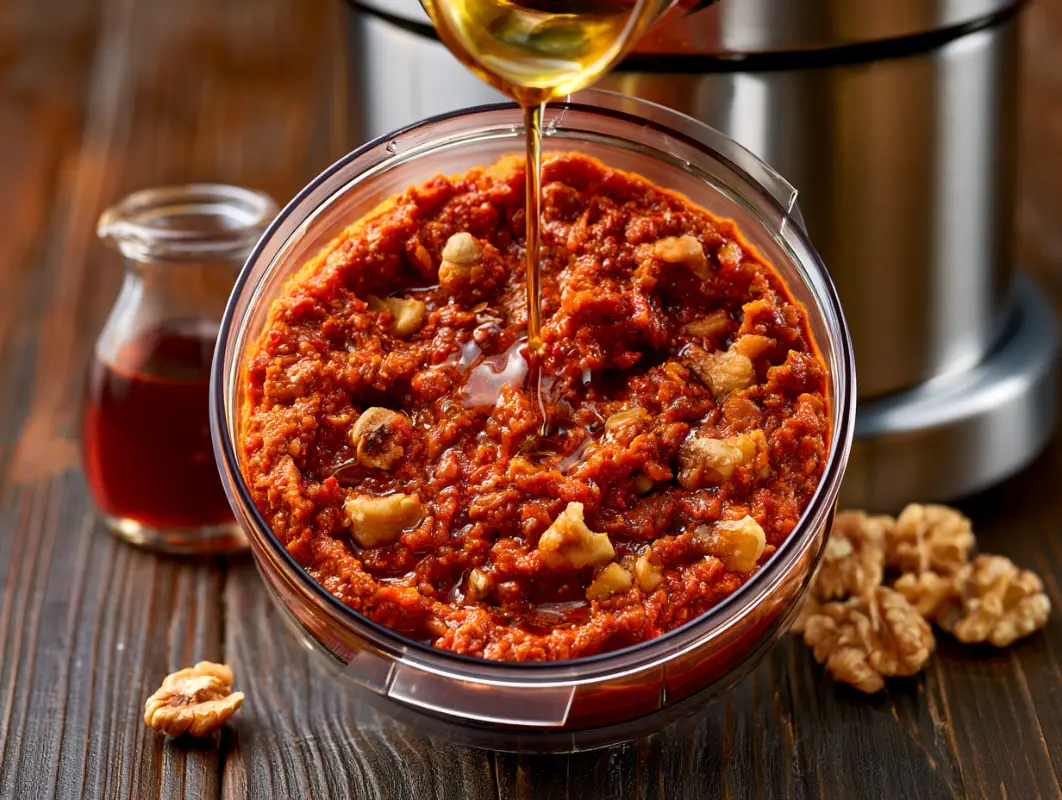
- Add the peppers, pomegranate molasses, lemon juice, Aleppo pepper, cumin and salt. Pulse in short bursts, 8 to 10 times, scraping down once. Stop while it is still coarse.
- With the machine running in short pulses, add the olive oil in a thin stream until it just comes together. It should look like a rough, glossy paste, not a puree.
- Taste. It wants more salt and more pomegranate molasses more often than you expect. Adjust in small amounts.
- Refrigerate at least 2 hours, ideally overnight. This is not optional if you care what colour it is.
- To serve, spread in a shallow dark bowl, drag the back of a spoon through it to make a groove, and pool olive oil and a little extra pomegranate molasses into the groove. Scatter pomegranate seeds, chopped walnuts and mint.
Notes
Why This Muhammara Recipe Actually Works
- The color is chemical, not cosmetic. Roasted pepper carotenoids, pomegranate molasses and Aleppo pepper stack into an oxblood that no bottle of red dye reproduces, because dye is flat and this is layered.
- It is coarse on purpose. Walnut texture is the difference between muhammara and a red hummus.
- Zero cooking. With jarred peppers this is a food processor and fifteen minutes.
- It improves with time, which almost nothing on a party table does.
- Nobody else brings it. In eleven years of American Halloween parties I have never once seen a second bowl of it.
The Aleppo Pepper Question
Aleppo pepper is the one ingredient I will not swap for you. It is sun-dried, coarsely ground, moderately hot and unusually fruity, with a raisiny depth that ordinary chile flakes simply do not have. The Slow Food Foundation lists the Aleppo chili pepper in its Ark of Taste, the catalogue of foods at risk of disappearing — which tells you both how specific it is and how fragile its supply has become. It also carries a deeper, browner red than cayenne, and in a dip whose entire visual argument is its color, that matters. If you truly cannot find it, use half sweet paprika and half regular red pepper flakes and accept that you have made something slightly different.
Essential Ingredients for Muhammara
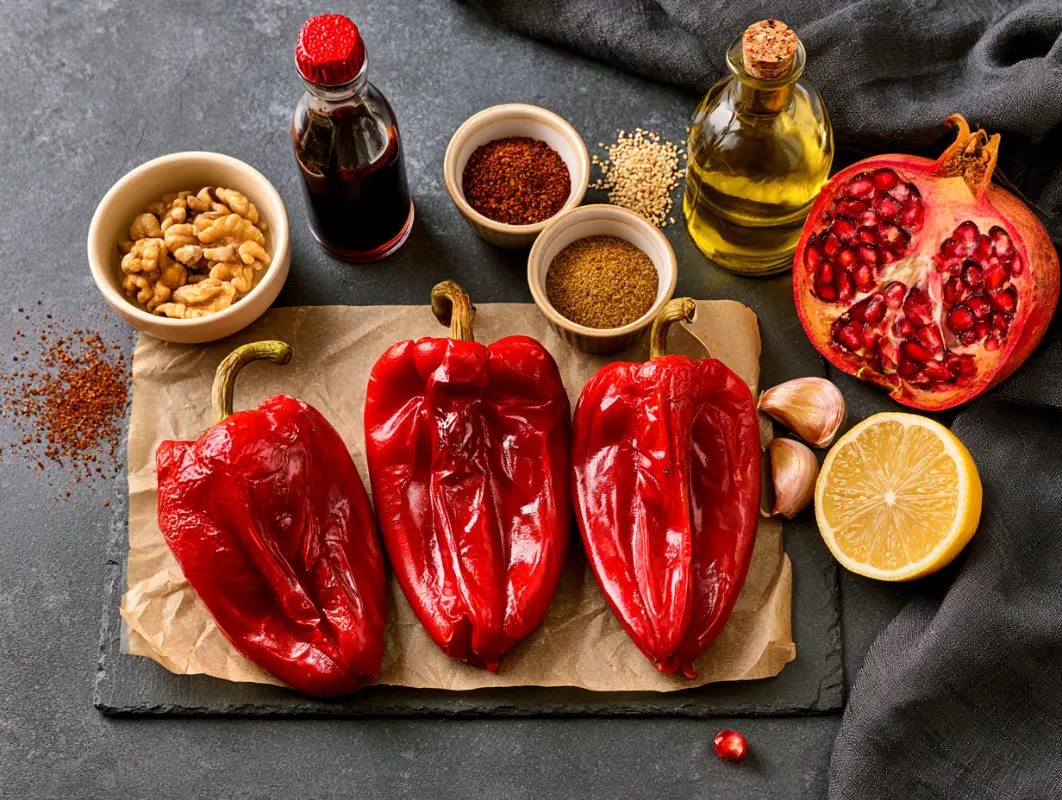
Roasted red peppers. Jarred is genuinely fine and it is what I use in October. Buy them packed in brine rather than oil, and drain and dry them properly. If you roast your own, blacken them completely over a gas flame or under a broiler, steam them covered for ten minutes, then peel. Do not rinse them under the tap — you will wash the smoke away.
Walnuts. Buy halves, not pieces; pieces are usually older and more bitter. Toast them. Untoasted walnuts make the dip taste faintly of cardboard.
Pomegranate molasses. Thick, dark, sour-sweet reduced pomegranate juice. It is doing three jobs here: acidity, depth and color. Check the label for a short ingredient list — many supermarket bottles are mostly glucose syrup, which will make your dip sweet and pale.
Breadcrumbs or bulgur. Structure. Traditional Aleppo versions use both depending on the household. Breadcrumbs are faster; bulgur gives a slightly chewier, more interesting body.
Aleppo pepper, cumin, garlic, lemon, olive oil. The frame. Use a fruity olive oil, not a peppery one — you want it to sit under the peppers, not fight them.
The Foolproof Method
- Dry the peppers. Properly. Paper towel, press, repeat until the towel stays dry.
- Toast and cool the walnuts. Both steps.
- Break the walnuts first, alone with the breadcrumbs and garlic, in 5 or 6 short pulses.
- Add everything else and pulse 8 to 10 times. Scrape down once, halfway.
- Stream the oil in on short pulses.
- Taste, adjust, chill. Minimum two hours, overnight if you can.
The whole recipe is really one instruction repeated: pulse, don’t blend.
What Is Muhammara, Actually?
Muhammara comes from Aleppo, in northern Syria, where it has been a mezze staple for centuries. The name comes from the Arabic for “reddened.” It travelled with the Aleppine diaspora into Turkish cooking as acuka, and it turns up across Lebanese and Armenian tables, each with small changes — more or less bulgur, sometimes tahini, sometimes a pinch of cinnamon.
It is not a Halloween food. It is a real dish that has been made continuously for a very long time and happens to be the correct color for one night in October. I think that distinction is worth making on the page, because the difference between a novelty and a recipe someone cooks again in February is whether you told them what it actually is.
Aleppo’s food culture has taken a catastrophic beating over the last decade. The Ancient City of Aleppo is a UNESCO World Heritage site, and has been on the List of World Heritage in Danger since 2013. Cooking one of its dishes properly, with the right pepper, is a small thing, but it is not nothing.
Why It’s This Red Without a Drop of Dye
Three pigments stack.
Roasted red peppers carry carotenoids — the same family that colors paprika and tomatoes — and roasting concentrates them as water cooks off, which is why roasted peppers are visibly deeper than raw ones. That is where the overwhelming majority of this color comes from. Pomegranate molasses comes second, and for depth rather than for hue: by the time it is reduced to that thickness it is mostly browned sugars and polyphenols, and while the anthocyanins still in it do sit firmly red in an acidic mixture rather than swinging blue-purple, they are not what is carrying the color. Aleppo pepper adds a browner, drier red on top of both.
The result is an oxblood with actual depth in it, and depth is what dye cannot do. Red food coloring is a single wavelength; it reads flat in photographs and it goes slightly pink under warm kitchen light. This does not, which is exactly why it photographs as unsettling rather than as a novelty.
If yours came out pale, it is almost always one of three things, and all three are color problems rather than flavor problems. The peppers went in wet, so water diluted the pigment and forced you to over-process. The pomegranate molasses was a glucose-heavy one rather than a reduced-juice one, which is browner, weaker and sweeter. Or you ate it the same day and never gave the color the two nights it needs. Dry the peppers until they stop marking the towel, check that the label lists pomegranate juice first and glucose syrup nowhere, and make it on Thursday.
Make It Two Days Before the Party (For the Color, Not the Convenience)
Here is the thing almost every muhammara recipe on the internet gets wrong, and it is the reason this page exists.
Every recipe tells you muhammara “keeps well” or “tastes better the next day,” filed under make-ahead as a convenience note. That is true and it undersells it enormously. The dip is measurably darker on day two than on day one, and darker again on day three.
Two things are happening, and the second one is the part nobody says. The walnut oils migrate slowly into the pepper solids over the first 24 to 48 hours, carrying fat-soluble carotenoids with them and redistributing them evenly through the mixture — which is why day three is uniform rather than streaky. And the breadcrumbs or bulgur absorb the free liquid the peppers release, concentrating everything left behind, the same reason a stew looks darker on the second night. Absorption explains why it gets deeper; migration explains why it gets even.
The practical consequence: for a Saturday 31 October party, make this on Thursday 29 October. Not because you’ll be busy Saturday, though you will be. Because Thursday’s dip is the right color on Saturday and Saturday’s dip is not.
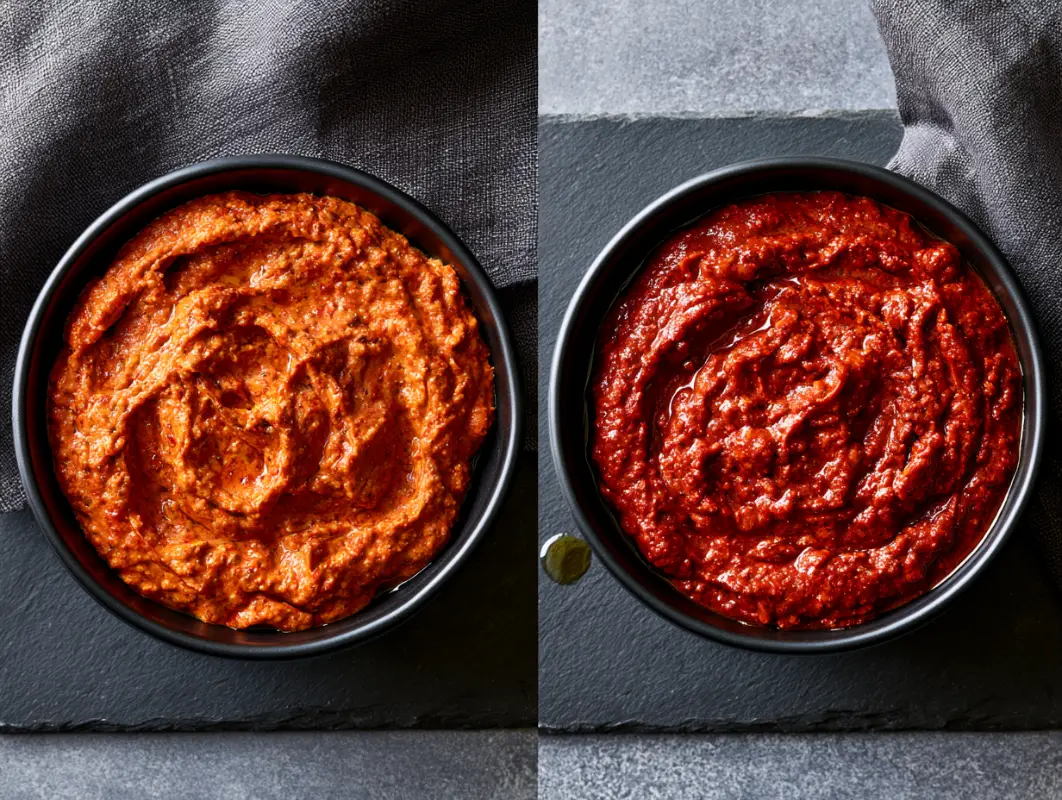
I test this every year, mostly out of stubbornness, and the two-day version wins every time. Marc, who does not care about food styling in any respect, can pick the older bowl out of two on the counter.
Getting the Texture Right: Pulse, Don’t Puree
The most common muhammara failure is a smooth one. It happens because we are all trained by hummus to run the machine until nothing is left, and muhammara is the opposite dish.
You are aiming for something between a coarse pesto and a chunky tapenade. Individual walnut pieces should be visible, roughly the size of coarse sea salt to small lentils. When you drag flatbread through it, you should feel resistance.
Three ways it goes wrong:
- You ran the processor continuously. Pulse in one-second bursts. Count them out loud if you have to. Fourteen or fifteen total pulses across both stages is enough.
- The peppers were wet. Excess water thins the mixture, which makes you over-process trying to bring it together, which destroys the texture and makes it paler at the same time.
- You added the oil too early. Oil added before the solids are broken emulsifies the whole thing into a smooth paste. It goes in last, on pulses, in a thin stream.
If you have already over-processed it: stir in a handful of hand-chopped toasted walnuts at the end. It is a rescue, not a fix, but it is a good one.
The Five Rules, In Order
- Dry the peppers until they stop marking the paper towel. Every other texture and color problem on this page starts here.
- Toast the walnuts, then cool them completely. Warm walnuts release oil under the blade and turn the dip greasy.
- Pulse, never run. One-second bursts, fourteen or fifteen in total across both stages. Count them.
- Add the oil last, in a thin stream, on pulses. Oil in early emulsifies the whole thing smooth.
- Make it two days before you need it. The color is the reason, not the convenience.
Creative Variations
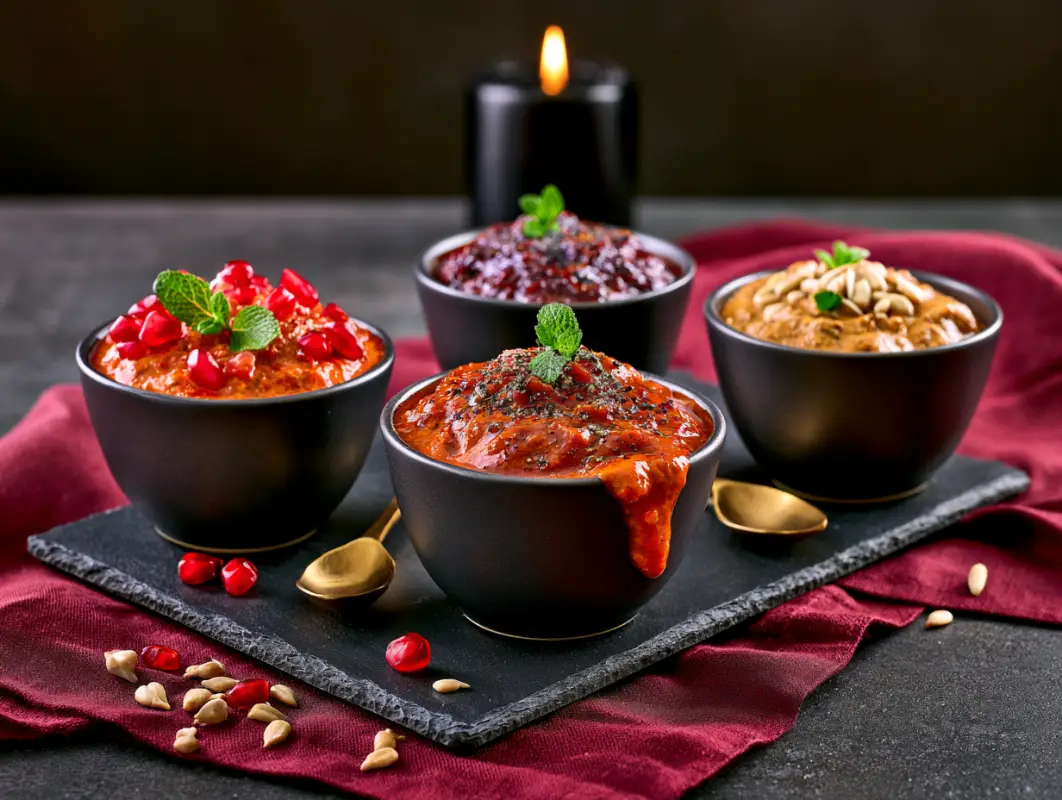
Muhammara with tahini. Two tablespoons in with the peppers. Rounder, creamier, slightly paler — better as a sandwich spread, worse as a Halloween showpiece.
Extra-hot Aleppo. Double the Aleppo pepper and add half a teaspoon of Urfa biber, which is smokier and almost raisin-dark. The color goes deeper still.
Walnut-free. Toasted sunflower seeds. Genuinely good, noticeably lighter in both color and body, and it makes the recipe safe for most nut-restricted tables.
The gothic board version. Skip the mint and pomegranate seeds. Finish with olive oil, a heavy grind of black pepper and nothing else, and serve it in a matte black bowl. Less pretty, considerably more sinister.
Storage and Serving Suggestions
Fridge: 5 days airtight. Best on days two and three. Bring to room temperature for 30 minutes before serving — cold muhammara is muted and stiff.
Freezer: 2 months. Freeze before the final oil and garnish, thaw overnight in the fridge, then stir hard and re-oil. Texture suffers slightly.
On the day: finish it in the last five minutes. Oil, molasses, seeds and mint all go on just before it hits the table. Pomegranate seeds bleed pink into the surface if they sit for an hour, which is a different look and not the one you want.
Quantity: for a grazing board, plan about 1/4 cup per person if it is one of three dips, or 1/3 cup if it is the only one.
For a party, in batches: six to eight guests is one batch. Twelve is one and a half. Twenty-four is three — and at that size make it two days ahead, because you will not want to be doing this on the day.
Say what is in it. A full cup of walnuts goes into this bowl. On a table where people are grazing and talking, nobody reads anything, so put a card next to it or tell people as you set it down.
Nutritional Benefits
Walnuts are the only common tree nut with a meaningful amount of alpha-linolenic acid (ALA), the plant form of omega-3 that the NIH Office of Dietary Supplements classifies as an essential fatty acid — one the body cannot make for itself. This recipe puts a full cup of them into eight servings. Roasted red peppers carry vitamin C and carotenoids; olive oil brings monounsaturated fat and polyphenols. Pomegranate molasses is a sugar, but you are using two tablespoons across eight portions.
It is a genuinely nutrient-dense thing to put on a table that is otherwise going to be candy, which is not the reason to make it, but it is not nothing either.
Frequently Asked Questions
What does muhammara taste like?
Smoky and sweet from the roasted peppers, sour and slightly molasses-y from the pomegranate, warm from cumin and Aleppo pepper, with a rich, faintly bitter walnut base underneath. It is more complex than hummus and less rich than baba ganoush. Most people describe it as tasting like something they cannot place, which is a good sign.
Can I make muhammara without pomegranate molasses?
You can, but it stops being muhammara in any meaningful sense. The closest workable substitute is 3 tablespoons pomegranate juice reduced to 1 tablespoon over low heat, plus an extra teaspoon of lemon juice. Balsamic is not equivalent — it is sweeter, less sour and browner, and it will drag the color toward mud.
How long does muhammara keep in the fridge?
Five days in an airtight container, and it genuinely improves for the first two or three. If a little oil separates on the surface, that is normal — stir it back in.
Can I use jarred roasted red peppers?
Yes, and I do most of the time. Buy them in brine rather than oil, drain them thoroughly and dry them well. Fire-roasted jarred peppers are better than plain if you can find them.
Is muhammara spicy?
Mildly. Aleppo pepper sits somewhere around a hot paprika — warm rather than sharp, with almost no heat spike. As written this is comfortably edible by most people who say they don’t like spicy food. Halve the Aleppo for a genuinely mild version.
Why is my muhammara pale?
Almost always wet peppers, an under-reduced or glucose-heavy pomegranate molasses, or eating it the same day. Dry the peppers harder, check the molasses label, and give it a night in the fridge.
Pairing and Serving Ideas
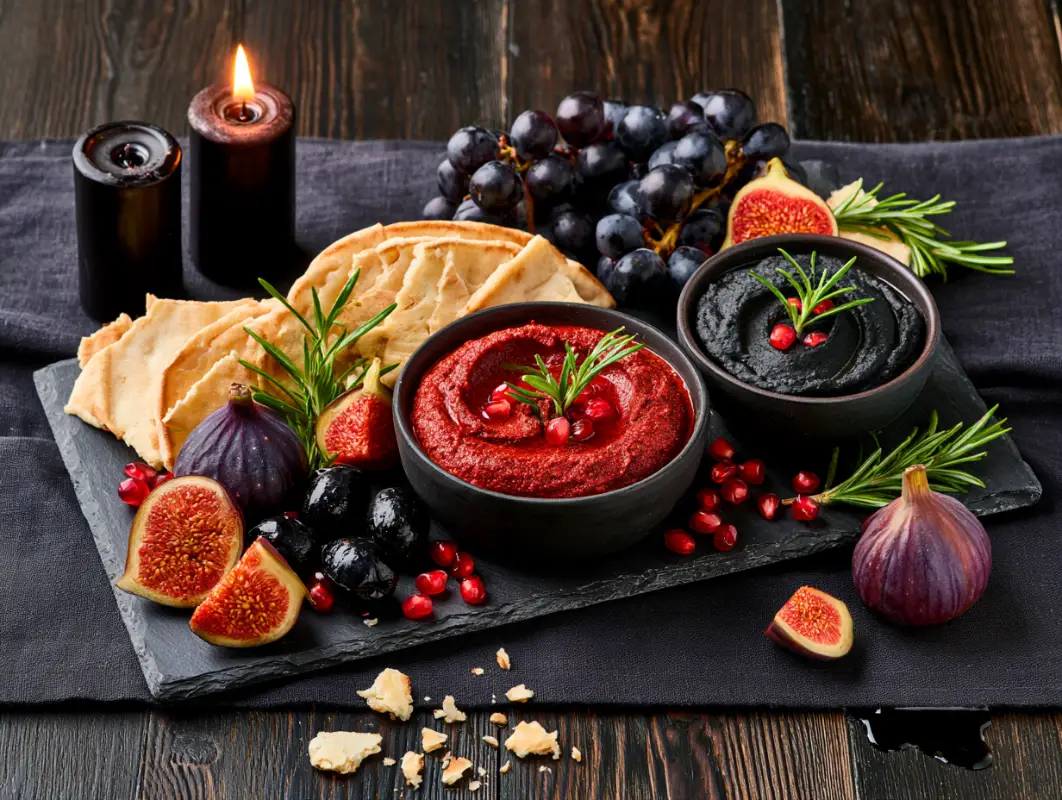
Muhammara is a supporting player on a great board and a lead on a small one.
Its natural partner is something jet black — the contrast is the entire visual point. Black tahini hummus beside it, in two matte bowls, is the single strongest thing you can do to a Halloween table for ten minutes of effort.
For dippers, warm flatbread torn rather than cut, thin cucumber, endive leaves, or breadsticks. Za’atar breadsticks shaped as fingers are the version I make when I have time.
For the rest of the board, the things that actually work beside it are grilled halloumi, spiced roasted chickpeas, dark olives and slow-roasted black grapes. All four sit inside the same Mediterranean register and none of them fights the pomegranate.
To drink: a dark pomegranate-and-hibiscus shrub over ice, or unsweetened pomegranate juice in a small brass cup. Both photograph darker than anything alcoholic would and both hold the oxblood palette, which is the entire point of the table.
It also works as a component rather than a dip: spread thickly under roast chicken, thinned with a little more oil as a sauce for lamb, or spooned into a sandwich with halloumi.
Watch: Muhammara in Four Minutes
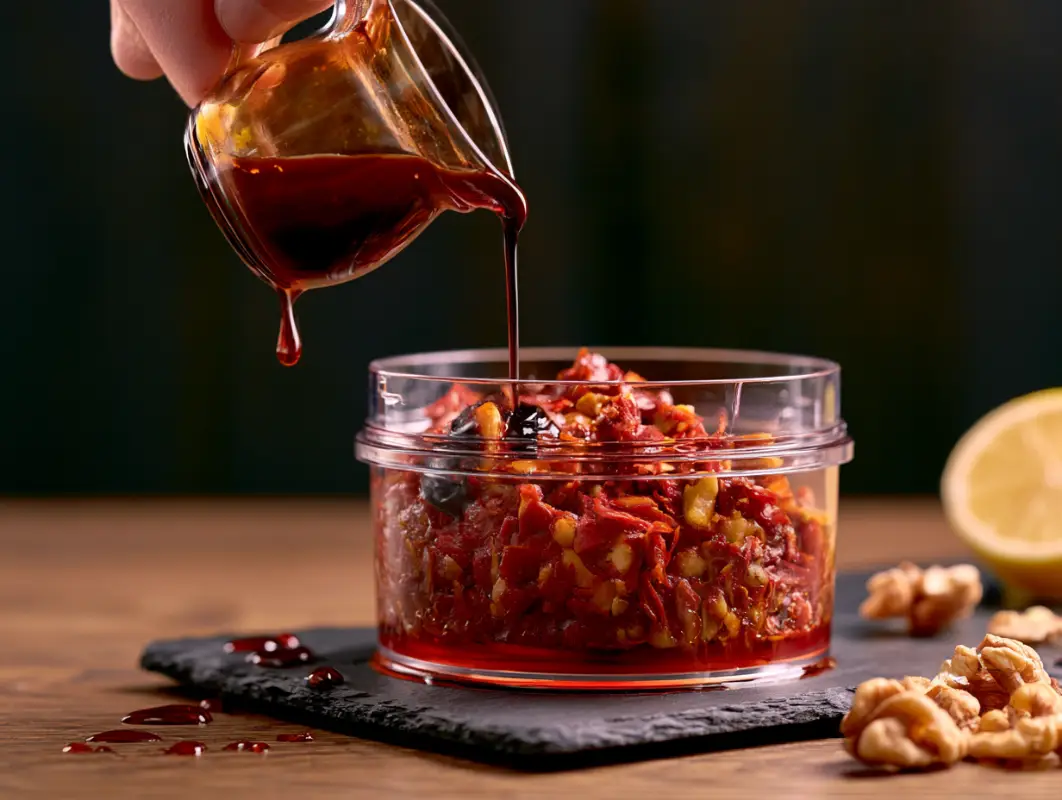
Toasted walnuts going into the processor, the short pulses, the molasses going in, the finished dip being spread and grooved with the back of a spoon, oil pooling into the groove.
Ready to Own the Snack Table?
Fifteen minutes on Thursday and you arrive on Saturday with the only thing on the table anyone asks about. Make it, chill it two nights, finish it in the last five minutes, and put it next to something black.
And if a stranger stands over the bowl looking mildly concerned — that’s the recipe working.