 Written by Ines Zahraoui — Tunisian home cook and co-founder of The Mediterranean Recipe, developing and testing recipes in her own kitchen since 2020. More about Ines →
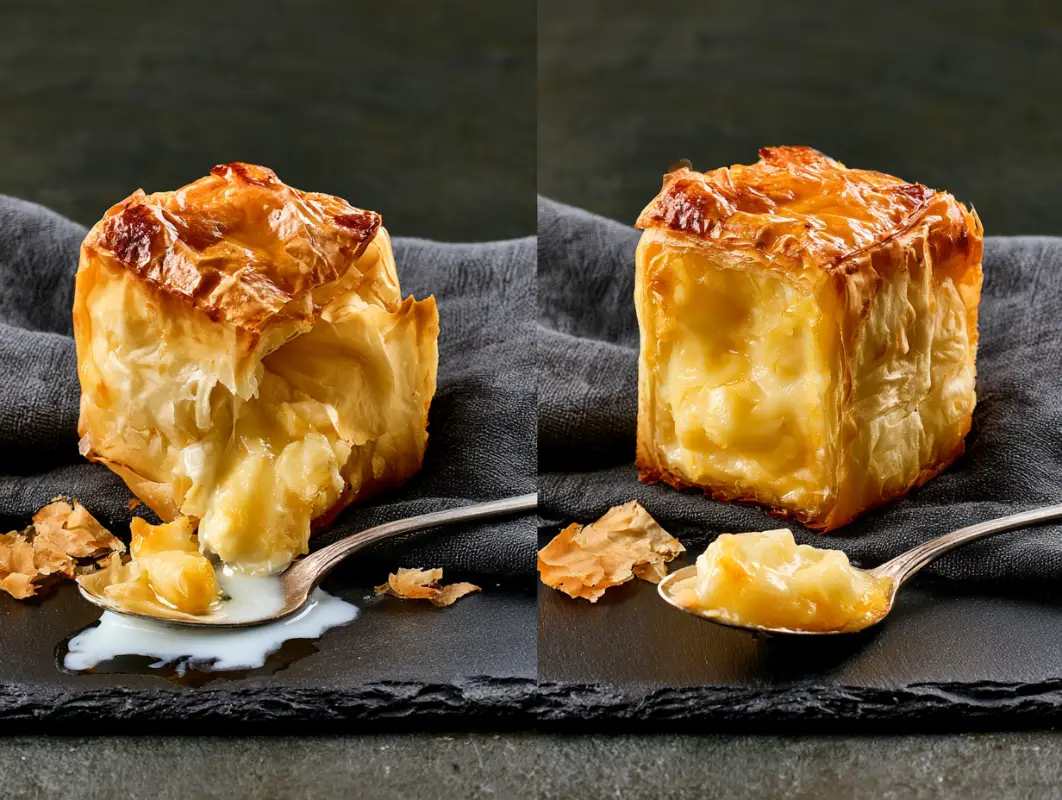
There is a moment about forty seconds after this Mummy Baked Feta comes out of the oven where you break the crust with a spoon and the feta underneath has gone from a solid block to something that stretches. Everyone at the table makes a noise. Every single time.
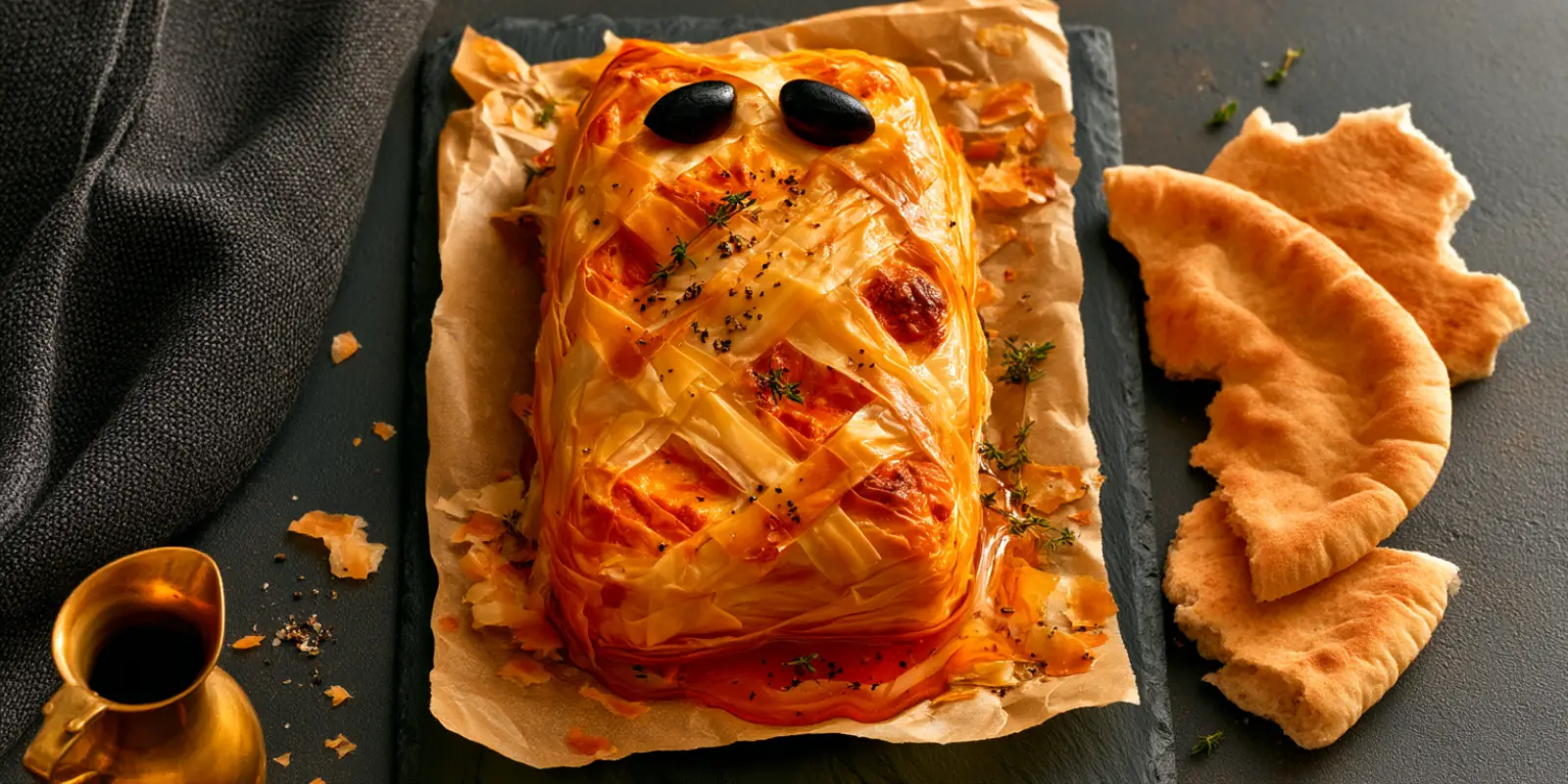
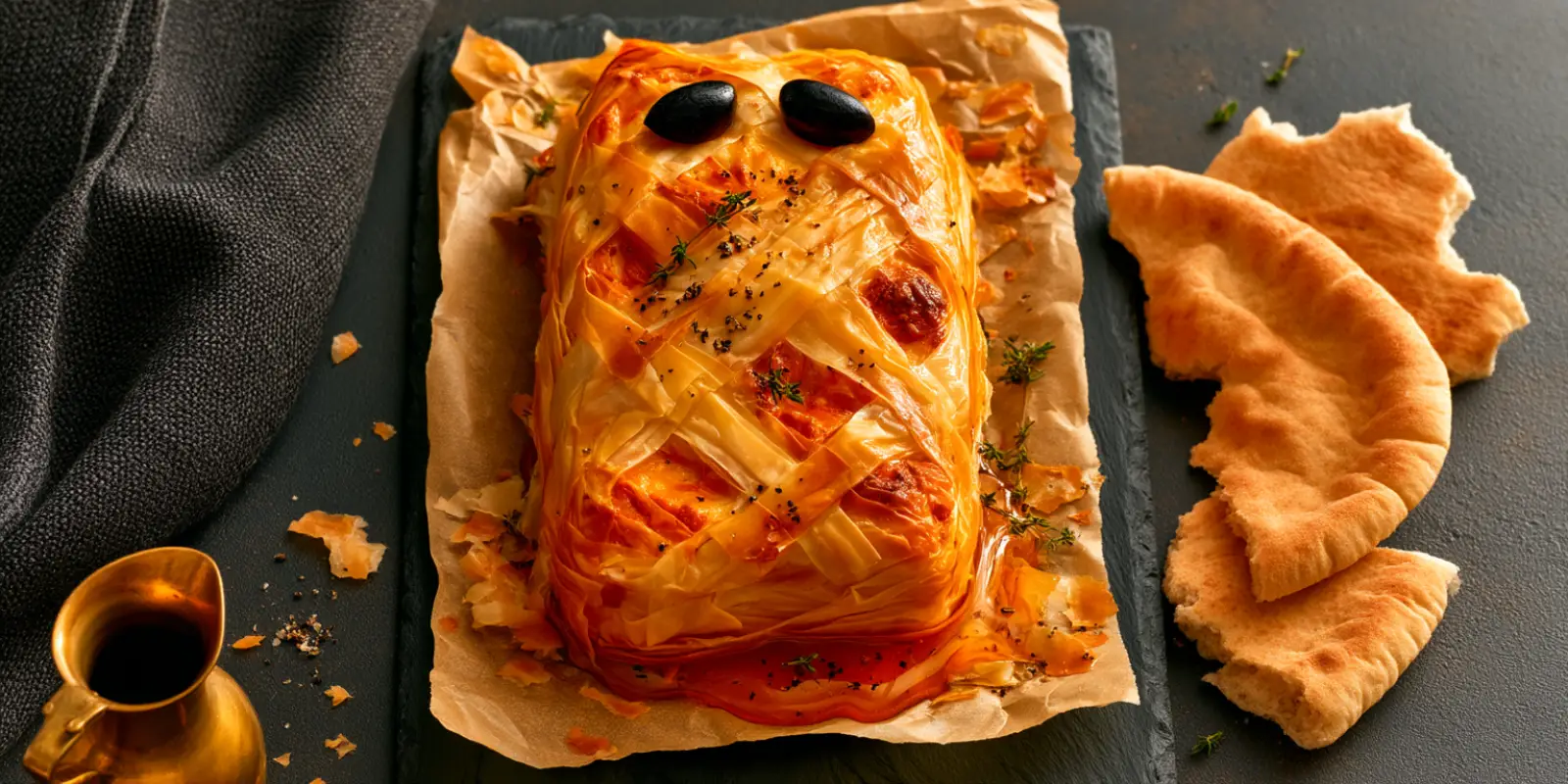
That is the entire recipe, really. A block of feta, wrapped badly on purpose in buttered strips of phyllo, baked until the pastry shatters and the cheese goes molten, then hit with hot honey and two olives for eyes. Four ingredients. Twenty minutes of work. It looks like you tried extremely hard.
The texture contrast is what makes it a Halloween dish rather than just a good one — brittle, blistered, flaking pastry giving way to something soft and hot underneath is exactly the kind of unsettling-in-a-good-way that reads on a table lit by candles. It is also, I should say plainly, genuinely Greek in mechanism: wrapping feta in phyllo and baking it with honey is feta me meli, a real dish. The mummy is a styling decision applied to something that already existed.
Halloween 2026 is a Saturday. If you are hosting and you want exactly one thing that makes people stop talking, this is it.
Table of Contents
Table of Contents
Mummy Baked Feta Recipe Card
Mummy Baked Feta in Phyllo with Hot Honey
Ingredients
Method
- Heat the oven to 400°F (200°C). Line a small baking tray with parchment.
- Take the feta out of its brine, pat it thoroughly dry on both sides and leave it on paper towel while you cut the pastry. Wet feta steams the pastry from the inside.
- Stack the phyllo sheets and cut the stack lengthwise into strips about 1 1/4 inches wide. Cover the strips with a damp — not wet — tea towel.
- Brush one strip with butter. Lay it across the feta at an angle, pressing the ends underneath. Repeat with 10 to 14 more strips, crossing at varying angles, leaving a gap of roughly 1 inch of bare feta near the top for the eyes.
- Brush the whole wrapped block generously with the remaining butter. Every exposed edge should be shiny or it will burn dry.
- Bake 22 to 25 minutes, until deep golden and blistered. The phyllo goes from pale to done fast in the last four minutes — watch it.
- While it bakes, warm the honey with the Aleppo pepper in a small pan for 60 seconds, just until fluid and fragrant. Do not boil.
- Press two olive halves into the gap for eyes as soon as it comes out, while the cheese is soft enough to hold them.
- Drizzle with the hot honey, scatter thyme and black pepper, and serve within ten minutes. This is not a dish that waits.
Notes
Why This Baked Feta Recipe Actually Works
- Four ingredients that all do real work. Feta, phyllo, butter, honey. There is nothing decorative on the list.
- Messy wrapping is the correct wrapping. The technique rewards imprecision, which is rare and very freeing.
- It can be assembled a day ahead and baked when guests arrive.
- The pull-apart is the payoff. Texture and sound, not just looks.
- It is a real Greek dish underneath the costume, so people ask for it again in March.
Why Phyllo Beats Puff Pastry Here
Puff pastry rises. That is its whole personality, and it is exactly wrong for a mummy — a risen, puffed, golden parcel looks like a parcel. Phyllo does not rise; it dries, blisters and shatters, and because you are laying individual strips the layers stay separate and visibly strip-like after baking. The bandages still read as bandages when it comes out. That is the entire argument.
Essential Ingredients
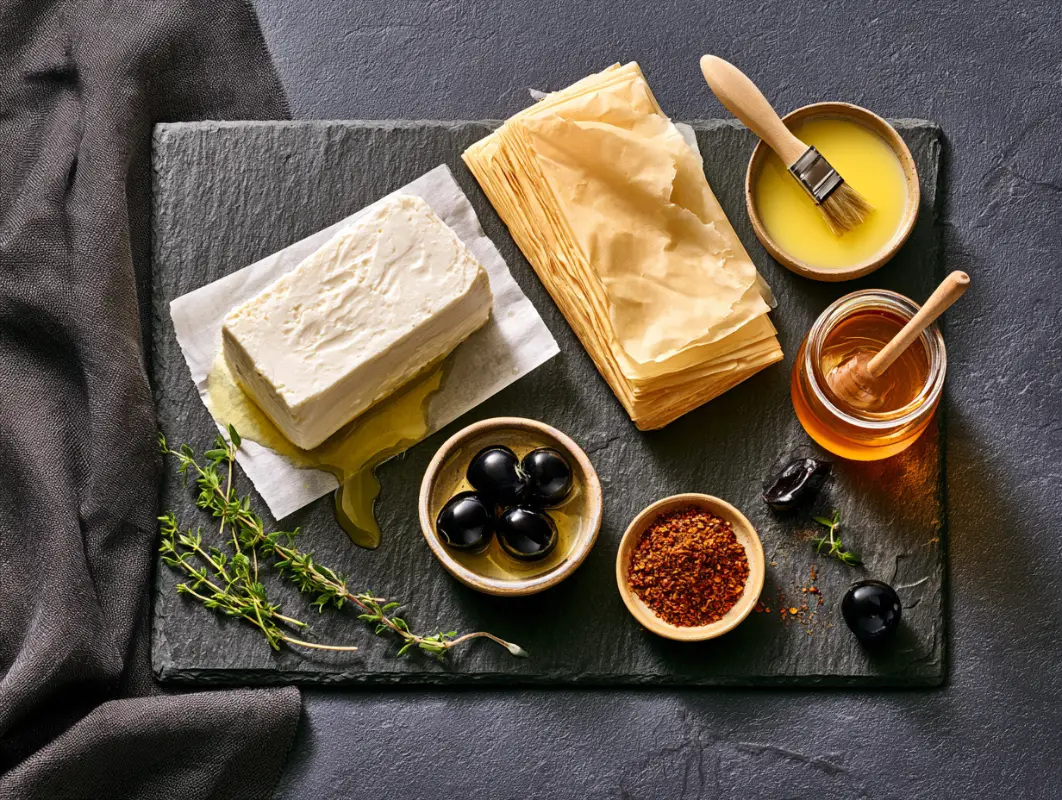
Feta. Greek, in brine, in a block. This is the one that decides everything — see the section below.
Phyllo. Thawed overnight in the fridge, never on the counter, never in the microwave. Six sheets is plenty for one block; buy a full box and freeze the rest.
Butter. Melted, and more than feels reasonable. Phyllo that is not fully buttered goes papery and dry rather than crisp, and the unbuttered patches burn first.
Honey. Something with character — thyme honey, orange blossom, or a good wildflower. Warm it with chile so it pours thin and clings.
Black olives. Two. Kalamata, halved, cut side down.
The Foolproof Method
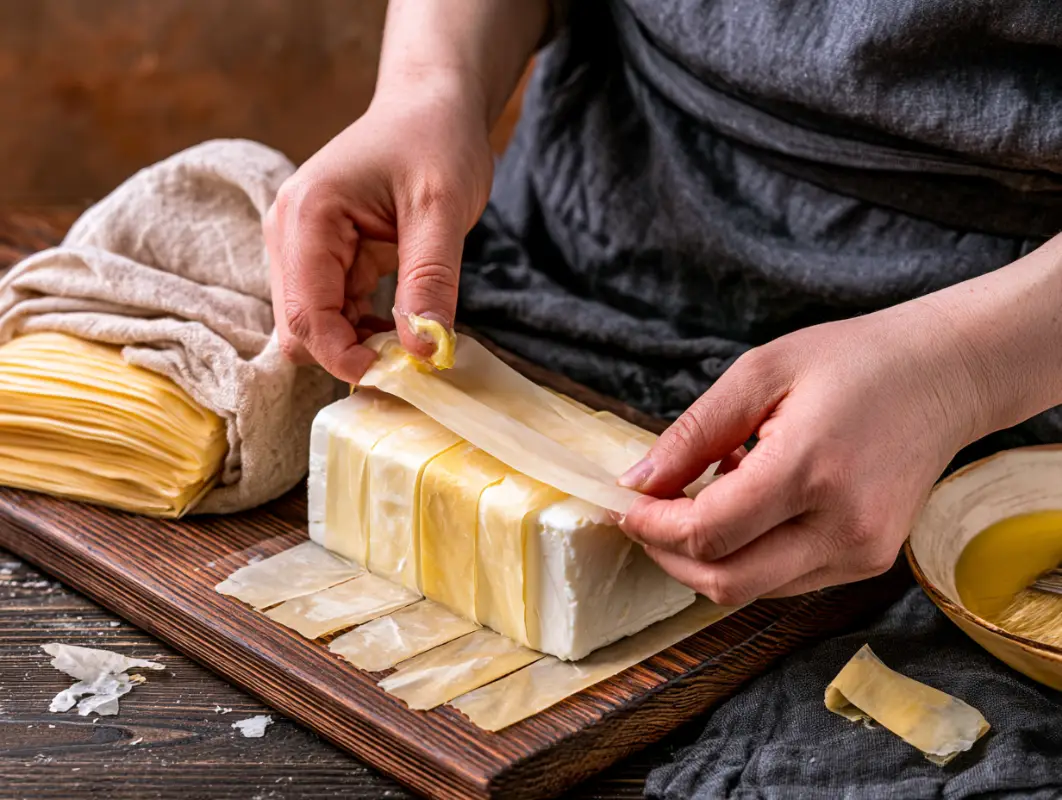
- Dry the feta hard. Both sides, paper towel, ten minutes if you have it.
- Cut the phyllo into strips and cover with a damp towel.
- Butter each strip, lay it at an angle, tuck the ends under. Leave a gap for the eyes.
- Butter the outside generously.
- Bake 22 to 25 minutes at 400°F. Watch the last four.
- Eyes on immediately, hot honey over, serve.
How to Wrap the Mummy (Badly, On Purpose)
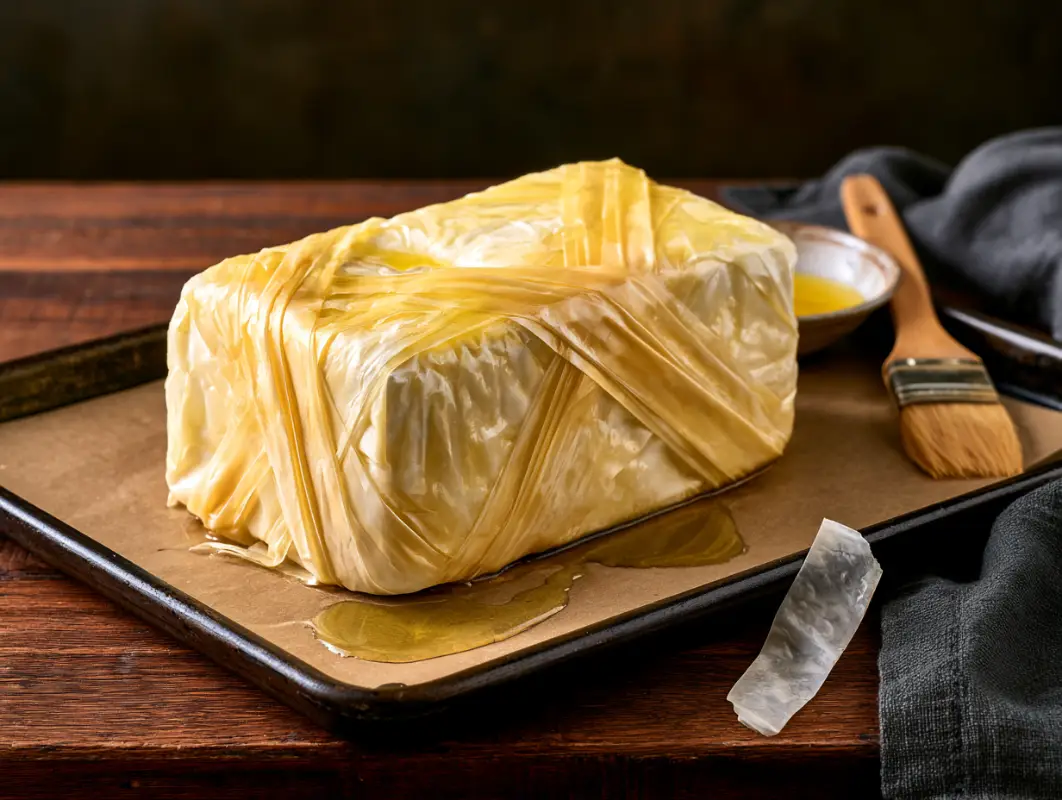
The first one I made was beautiful. Even spacing, parallel strips, tidy overlaps. It came out of the oven looking exactly like a small golden gift box, and my daughter asked what was inside it, which was a fair question and not the reaction I was after.
Neatness is the enemy here. What makes something read as wrapped in bandages rather than wrapped in pastry is inconsistency — varying angles, overlapping thicknesses, a strip that runs off at a diagonal, a corner where three cross at once and another where the cheese shows through.
Four rules that give you that reliably:
- Vary the angle on every strip. Not parallel. Cross them at 20, 40, 70 degrees, whatever the strip wants.
- Vary the tension. Pull some tight so they hug the block; lay others slack so they lift slightly and blister higher. The height variation is what catches the light.
- Leave real gaps. Bare feta showing between strips is correct, and the bits that show go golden and slightly crusty, which is delicious.
- Leave one deliberate gap near the top, about an inch wide, for the eyes. Everything else can be chaos; this one gap should be intentional, because the eyes are the only part of the effect that requires precision.
- Tuck every strip end underneath the block. Ends left on top curl up and burn.
Choosing Your Feta: The One Choice That Decides Everything
Buy Greek feta, sold as a block, packed in brine. Nothing else.
Real Greek feta is a PDO product with a specification attached: at least 70% sheep’s milk, no more than 30% goat’s milk, and produced in named regions of mainland Greece and on Lesbos — a protection the European Court of Justice confirmed in 2005. That specification is why it holds its shape through twenty-five minutes at 400°F while softening internally to that molten, stretchy state — the thing everyone came for — rather than collapsing.
Pre-crumbled feta is coated in anti-caking agents and will not re-form into a block. Obviously.
Vacuum-packed “feta-style” cheese, usually cow’s milk, usually from Denmark or the US, is the more common mistake. It is softer, saltier and much wetter, and it collapses into a puddle inside the pastry. You will open a golden parcel and find soup. I have done this and it is genuinely dispiriting.
Barrel-aged feta, if your store has it, is worth the extra dollar or two — firmer, tangier and it holds even better. Elena Paravantes, the Greek-American registered dietitian behind Olive Tomato, makes the same point about buying feta in brine rather than pre-cut and vacuum-sealed, and she is worth reading on Greek ingredients generally.
Whatever you buy: pat it dry. Feta comes out of brine wet, and that water turns to steam inside the pastry and softens it from within.
Working With Phyllo Without Panicking
Phyllo has a reputation for being difficult and it is not, really. It is fragile, which is a different thing, and everything that feels like failure with phyllo is cosmetic.
Thaw it in the fridge overnight. Thawing at room temperature makes the sheets sweat and stick together into a solid brick you cannot separate.
Work with a damp tea towel over the strips, wrung out properly. A wet towel makes them soggy; a dry kitchen turns them to parchment in about four minutes.
Tears do not matter. You are cutting the sheets into strips and layering them at random angles. A torn strip is indistinguishable from an intact one once it is on the block. Nothing you do here shows.
Work reasonably fast, but don’t rush. Twelve strips takes about six minutes at a normal pace.
Butter the edges especially. Dry phyllo edges go from golden to black in under a minute.
If the whole box has dried out and shatters on contact, it is not salvageable for this — but crumbled dry phyllo baked with butter and sugar makes a very good ice cream topping, so it is not wasted.
The Five Phyllo Rules
- Thaw it in the fridge overnight. Never on the counter, never in the microwave.
- Keep a damp tea towel over the strips, wrung out properly. Wet makes them soggy; nothing at all turns them to parchment in four minutes.
- Butter every edge. Dry edges go from golden to black in under a minute.
- Tears do not matter. You are layering strips at random angles; a torn one is invisible once it is on the block.
- Dry the filling. Feta straight from brine steams the pastry from the inside, and no amount of butter saves it.
Creative Variations
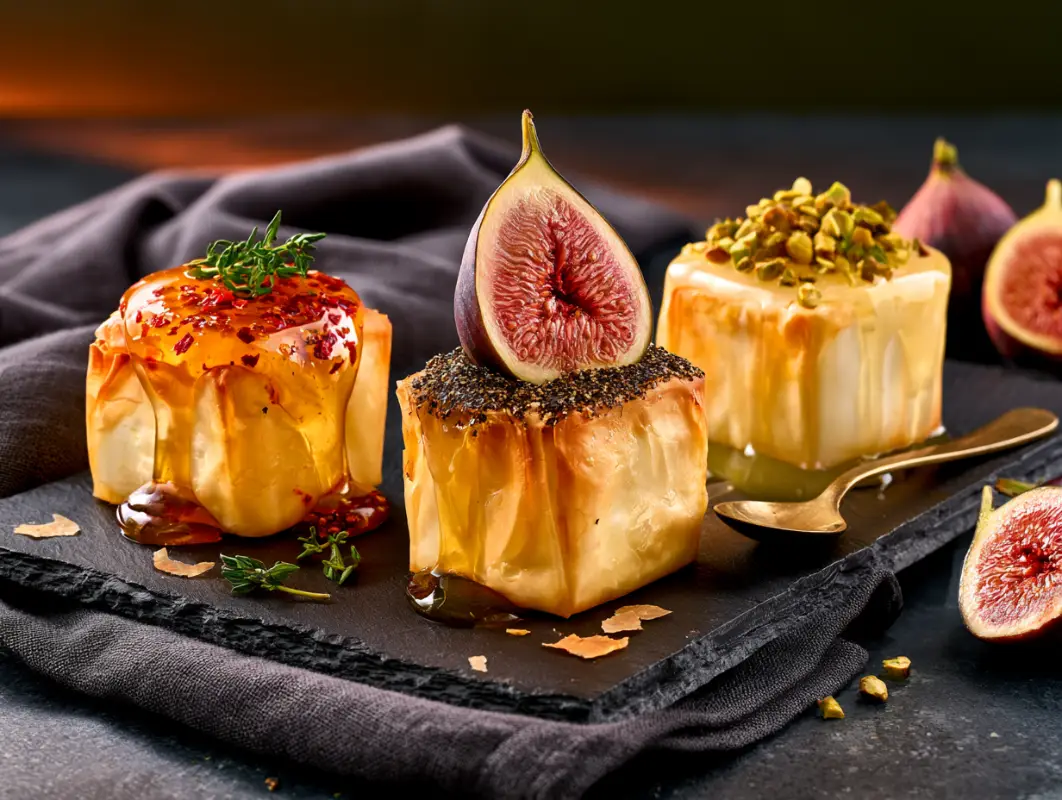
Fig and black pepper. Half a fresh fig pressed into the top before baking, heavy black pepper after. Autumnal and less overtly Halloween.
Pistachio and orange blossom honey. Chopped pistachios over the honey. Deep green against gold and a more Levantine register.
Whole roasted garlic. Six cloves tucked under the block before wrapping. They soften into the honey drippings.
Individual mummies. Cut the block into four smaller pieces and wrap each. More work, faster bake (16 to 18 minutes), and much easier to serve at a standing party.
Halloumi mummy. Swap the feta for a block of halloumi. It squeaks rather than stretches, holds its shape absolutely, and is a better choice if you need it to sit on a table for half an hour.
Make-Ahead and Storage
Assemble up to 24 hours ahead. Wrap completely, cover loosely with plastic, refrigerate. Re-butter before baking and add 3 minutes. This is the single most useful fact about the recipe for a Saturday party.
Do not bake ahead. Baked and reheated feta is a different, sadder thing. And serve it within ten minutes of it leaving the oven, not twenty: the residual heat in the block keeps working after you take it out, and the phyllo starts softening from the steam underneath within about five.
Scaling: half a block feeds four and bakes in about 18 minutes. Two blocks feed sixteen — wrap both, bake them side by side on one tray, give them about 28 minutes and turn the tray once. Check at 22 either way, because the phyllo goes from pale to done fast in the last four minutes.
The Saturday schedule, if it helps to have it as clock times:
- Friday evening — wrap the block completely, cover loosely, refrigerate.
- Saturday 6:00 — oven to 400°F.
- Saturday 6:35 — brush with fresh melted butter, bake 28 minutes from cold.
- Saturday 7:05 — olive eyes in, hot honey over, on the table within ten minutes.
Freezing: wrap the unbaked assembled block, freeze up to 1 month, bake from frozen at 375°F for 35 to 40 minutes.
Leftovers: 2 days in the fridge, reheated at 350°F for 8 minutes. Perfectly good; not the same event.
Nutritional Benefits
Feta runs roughly 21 g of fat per 100 g — moderate as cheeses go, and lower than cheddar or manchego, but not a low-fat food. What it does carry meaningfully is calcium, protein and phosphorus; you can check the full profile for feta in the USDA’s FoodData Central database. Sheep’s milk also contains more conjugated linoleic acid than cow’s milk. It is salty — that is not a secret — so if you are watching sodium, this is a shared appetizer for eight, not a personal one.
Served with pear, fig or raw vegetables rather than only bread, it is a reasonable thing to put on a party table, and it fills people up in a way that stops them eating three pounds of candy.
Frequently Asked Questions
Can I assemble mummy feta ahead and bake later?
Yes, and you should. Wrap the block completely, cover and refrigerate for up to 24 hours. Brush with fresh melted butter before it goes in and add about 3 minutes to the bake. Assembling ahead actually helps, because the chilled block softens more slowly and the pastry gets longer to crisp.
What can I use instead of phyllo?
Nothing that gives the same result. Spring roll wrappers cut into strips are the closest workable substitute — crisp, thin, no rise — though slightly chewier. Puff pastry works as a recipe but not as a mummy, because it rises into a parcel.
Why did my feta leak out of the pastry?
Usually the wrong feta. Soft cow’s-milk feta-style cheese collapses at oven temperature. It can also happen if the block was cracked before wrapping, or if the pastry was not fully sealed underneath. Tuck every strip end under the block.
Can I use puff pastry instead?
You can, and it is a good dish — just not this one. Puff pastry rises and unifies into a smooth parcel, so the bandage effect disappears. If you use it, cut the strips wider, lay them further apart, and accept a “wrapped gift” look rather than a mummy.
What do I serve with baked feta?
Warm pita or crusty bread first, then something sweet and sharp to cut it: sliced pear, fresh figs, grapes, or apple. Raw vegetables work but are a slightly odd match for the honey. On a Halloween board, put it next to something dark and savory.
How do I stop the phyllo burning?
Butter it all, especially the edges and the ends, and check at 20 minutes. If it is coloring unevenly, turn the tray. If the top is done and the bottom is not, drop to 375°F and give it 4 more minutes.
Pairing and Serving Ideas

This is a centerpiece, so build outward from it.
On a gothic Halloween board it sits in the middle as the warm anchor, with two cold dips flanking it. Blood-red muhammara on one side and jet-black hummus on the other gives you gold, oxblood and black in one frame, which is the entire 2026 palette in three bowls.
For dippers: warm pita torn by hand, seeded crackers, or breadsticks. Sliced pear and fresh figs are what I actually reach for.
To drink beside it: a short tumbler of dark pomegranate-and-hibiscus shrub over ice, or chilled almond milk. Both hold the oxblood-and-gold palette on a candlelit table and neither reads as juice on camera.
Time it to come out of the oven ten minutes after your first guests arrive. It is the best possible thing to hand people while they are still deciding whether they are having a good time.
Watch: The Pull-Apart

Buttering and laying the strips at angles, the tray going in, the golden blistered block coming out, olive eyes pressed in, honey poured, then the spoon breaking the crust and the cheese stretching.
Ready for the Loudest Thing on the Table?
Buy a block of real Greek feta, dry it properly, wrap it badly, and butter everything. Twenty minutes of work for the only appetizer anyone will photograph.
Wrap it on Friday. Bake it on Saturday. Stand near it when someone breaks the crust.