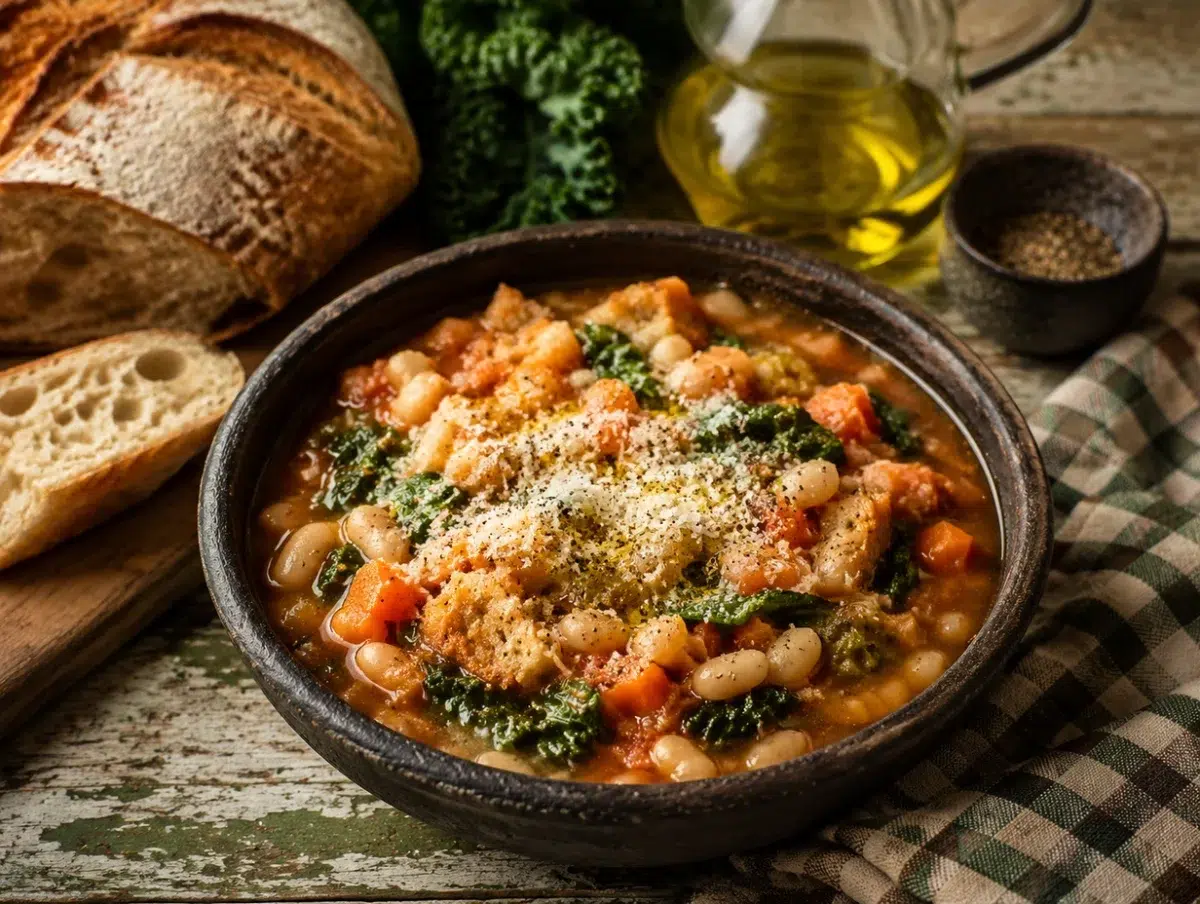
Can we talk about the magic of a soup that literally gets better every day? That’s the whole premise of Tuscan Ribollita Soup — the legendary Italian peasant dish whose name literally means ‘reboiled.’ I first ate it at my nonno’s farmhouse table in Tuscany when I was about nine years old, hunched over a deep earthenware bowl while the wood-fired stove crackled behind me. Rich, deeply savory, thick enough to stand a spoon in. I had no idea I’d spend 25 years trying to recreate that exact feeling in my San Diego kitchen.
Here’s what this Italian bread soup is all about: a deeply flavorful, stew-like soup made with Tuscan kale (cavolo nero), cannellini beans, seasonal vegetables, herbs, and thick slices of stale rustic bread that absorb into the broth and create the most luxurious, velvety texture you can imagine. It’s naturally vegan, incredibly nutrient-dense, and ridiculously budget-friendly.
Quick win list: 100% plant-based, packed with 18g of protein per bowl from beans alone, loaded with gut-friendly fiber, anti-inflammatory herbs and vegetables, and it takes under an hour to make (though I promise you’ll want the leftovers even more than the first batch). If there were ever a Mediterranean vegetable soup that could convert even the most devoted carnivore, this Tuscan Ribollita Soup is it. Let’s do this.
Why You’ll Love This Recipe
Health & Nutrition Benefits
Every bowl of Tuscan Ribollita Soup is a nutritional masterclass — and I mean that in the most delicious, non-preachy way possible. Cannellini beans alone deliver about 15g of protein and 11g of fiber per cup, making them one of the most satiating plant proteins on the planet. Tuscan kale (or cavolo nero) is loaded with vitamins K, A, and C, plus calcium and iron at levels that rival many animal products. The PREDIMED Mediterranean Diet study found that regular legume consumption was one of the strongest predictors of longevity and cardiovascular health in Mediterranean populations — and these beans are the star of the show here.
- 💚 Fiber powerhouse: One bowl provides ~14g of dietary fiber — more than half your daily target in one sitting
- 🌿 Anti-inflammatory herbs: Rosemary, sage, and thyme are rich in rosmarinic acid and luteolin, both researched for their inflammation-reducing effects
- ❤️ Heart-healthy: Cannellini beans contain resistant starch and soluble fiber that actively lower LDL cholesterol — Blue Zones research confirmed legume-rich diets are linked to longer, healthier lives
- 🫀 Blood sugar friendly: The combination of beans, whole grain bread, and vegetables has a low glycemic index — keeps energy levels steady, not spiked
Practical Benefits — This Is That Soup
Beyond the nutrition, ribollita bread soup is the ultimate practical weeknight hero. It comes together in under 60 minutes using pantry staples, costs about $1.50 per serving, freezes beautifully for up to 3 months, and — here’s the real kicker — it tastes significantly better on day 2 and 3 as the bread fully absorbs the broth. Meal prep-friendly! Make one big pot Sunday evening and eat royally all week. It’s also endlessly customizable (more on that in Section 7) and genuinely feeds a crowd without breaking the bank. Budget-friendly Italian comfort food that’s also genuinely good for you? That’s what I call a win.
The Mediterranean Diet Connection
How Ribollita Embodies Mediterranean Eating Principles
Ribollita is, at its soul, the Mediterranean Diet on a plate. It centers legumes, seasonal vegetables, whole grain bread, abundant olive oil, and aromatic herbs — every single key food group the Mediterranean pyramid emphasizes. This style of healthy bean soup is why the Tuscan region has historically produced some of the longest-lived populations in Europe. The dish wastes nothing (stale bread, wilted greens, leftover beans), celebrates abundance through simplicity, and provides complete plant-based nutrition in a single bowl. According to Blue Zones researcher Dan Buettner, populations in Sardinia and Ikaria — both Mediterranean — consume beans daily, and ribollita-style soups appear consistently in the diets of centenarians across Italy.
Why This Soup Has My Whole Heart — Maya’s Story
My Italian father grew up in a small town outside Siena, where ribollita wasn’t a recipe — it was just what you made with what was left in the garden and pantry at the end of the week. Peasant food, in the most beautiful sense. My nonno would make a massive pot on Friday, and then literally reboll (reboil) it every day through Monday, the bread getting thicker and more integrated each time. I spent every summer as a child at his farmhouse table, and that memory — the scent of rosemary, the golden glug of olive oil over the top — is so specific and so deeply happy. Bringing this Tuscan Ribollita Soup to my California life feels like carrying a little piece of him with me. And now I get to share it with you.
Essential Ingredients
Core Ingredients — What Makes Ribollita, Ribollita
The beauty of traditional ribollita is its simplicity. Every ingredient earns its place, and the quality of what you use matters enormously — this is peasant cooking elevated. Here’s your complete shopping guide:
| Ingredient | Amount | Why It’s Great | Best Pick | Substitution |
| Cannellini Beans | 2 × 14oz / 400g cans (or 3 cups cooked) | 15g protein + 11g fiber per cup; creamy texture thickens the broth naturally; authentic Tuscan staple | Dried beans soaked overnight for fullest flavor; canned is perfectly fine for weeknights | Great Northern beans or butter beans (1:1 ratio) |
| Cavolo Nero (Tuscan Kale) | 1 large bunch (~300g) | Exceptional source of vitamins K, A, C; more tender than curly kale after long simmering; authentically Tuscan | Fresh dark green leaves with no yellowing; remove ribs for best texture | Lacinato/dinosaur kale or curly kale (1:1); Swiss chard works well too |
| Stale Rustic Bread | 4-5 thick slices (~200g) | The soul of the dish — bread absorbs broth, thickens the soup, and creates that iconic velvety texture | Tuscan unsalted bread (pane sciocco) or sourdough; must be stale/day-old | Any hearty whole grain or sourdough bread; avoid soft sandwich bread |
| Extra Virgin Olive Oil | 4 tbsp + extra for drizzling | Heart-healthy monounsaturated fats; forms the flavour base; essential Tuscan finish drizzle | Cold-pressed Italian or Spanish EVOO — use generously | Avocado oil for sautéing (but use EVOO for finishing — non-negotiable!) |
| Soffritto (Onion, Carrot, Celery) | 1 onion + 2 carrots + 3 stalks celery | The aromatic backbone of Italian cooking — builds deep savory complexity over 10 minutes of gentle sautéing | Fresh, firm vegetables; take time with this step for best results | Frozen mirepoix works in a pinch; leek instead of onion is lovely |
| Whole Peeled San Marzano Tomatoes | 1 × 14oz / 400g can | Bright acidity balances the earthy beans; umami depth; real Tuscan ribollita uses tomatoes sparingly | San Marzano DOP canned tomatoes — worth the extra dollar | Fresh ripe tomatoes (2 large) or passata (same amount) |
| Fresh Rosemary + Sage | 2 sprigs rosemary + 6 sage leaves | Anti-inflammatory rosmarinic acid; essential Tuscan herb flavors that perfume the whole kitchen | Fresh always; dried is 1/3 the amount if substituting | Fresh thyme + bay leaf make a good alternative |
| Vegetable Broth | 6 cups / 1.4L | Forms the base — use a good quality broth since it drives the whole flavor profile | Homemade or a high-quality low-sodium store-bought broth | Mushroom broth for extra umami depth; water works but add extra seasoning |
🍲 Maya’s Tip: The stale bread step is non-negotiable — fresh bread turns gummy and pasty. Leave slices out on the counter overnight or pop them in a 300°F/150°C oven for 15 minutes. Day-old sourdough from the farmer’s market is my absolute favourite here.
Dietary Modifications & Ingredient Storage
Great news: Tuscan Ribollita Soup is already naturally vegan, dairy-free, and nut-free. Here’s how to adapt for other needs, plus storage tips for each key ingredient:
| Dietary Need | Replace / Adjust | With | Notes |
| Gluten-Free | Regular rustic bread | Certified GF sourdough or GF focaccia | Texture will be slightly softer; add in the last 15 min of simmering |
| Higher Protein | Standard recipe | Add 1 cup cooked farro or stir in ¼ cup nutritional yeast at end | Adds 6-8g protein per serving; farro also adds wonderful chewiness |
| Lower Carb | Stale bread (as thickener) | Use less bread (2 slices) + add 1 cup extra beans; mash some beans to thicken | Reduces carbs by ~20g per serving while keeping the thick, hearty texture |
| Extra Umami (Parmesan alternative) | Skip or use Parmesan rind | Stir in 1 tbsp soy sauce or 1 tbsp miso paste at end | Creates same savory depth without dairy — completely transforms the broth |
| Nut-Free | Already nut-free | Use as written | Double-check store-bought broth labels for hidden allergens |
Equipment & Quick Prep
Equipment You’ll Need
Good news: this Tuscan peasant soup was designed to be made with minimal equipment. Here’s what actually helps:
| Tool | Why It Helps | Alternative |
| Large Heavy-Bottomed Pot or Dutch Oven (5-6qt) | Distributes heat evenly for the soffritto stage; holds everything comfortably; ideal for stovetop and oven | Large stainless steel stockpot works well; avoid thin-bottomed pots that scorch |
| Wooden Spoon | Essential for scraping up fond (caramelized bits) from the bottom during soffritto — that’s pure flavor! | Any heat-safe stirring spoon |
| Immersion Blender (Optional) | For blending a portion of the beans to achieve that signature velvety-thick broth without fully pureeing | Ladle out 2 cups, blend in regular blender, stir back in |
| Sharp Chef’s Knife + Large Cutting Board | You’ll be chopping a lot of vegetables — a sharp knife makes this 5x faster and safer | Food processor for rough chop on carrots and onion |
| Ladle | For serving — you want a deep bowl that gets that beautiful thick broth AND chunky vegetables | Deep serving spoon works fine |
Prep-Ahead Checklist & Time Estimate
Ten minutes of prep, one hour of mostly hands-off cooking. Here’s how to make this Italian comfort food even easier:
- Soak dried beans: If using dried (highly recommended!), soak overnight in cold water. Cook 45-60 min or use an Instant Pot (25 min). Drain and set aside. Yields about 3 cups — perfect for this recipe.
- Make the soffritto: This 10-minute step of gently cooking onion, carrot, celery, and garlic in olive oil until soft and golden is 80% of the flavor. Don’t rush it!
- Chop and measure: Remove kale ribs, chop into 1-inch pieces. Dice vegetables roughly (rustic is perfect for ribollita). Measure out broth and tomatoes.
- Bread prep: Ensure bread is well dried out. Cut or tear into large chunks — they’ll break down as they cook.
- Time estimate: 10 min active prep + 45 min simmering = 55 minutes total. Even faster on Day 2 when you just reheat and it tastes EVEN better.
Step-by-Step Instructions
Part A: Building the Base (Steps 1–4)
Alright — let’s make Tuscan Ribollita Soup. The steps are simple, but take each one seriously. This is slow food, and the patience pays off enormously.
- Step 1 — Make the soffritto (10 min, MEDIUM-LOW heat): Heat 3 tablespoons of good extra virgin olive oil in your Dutch oven over medium-low heat. Add 1 large diced onion, 2 diced carrots, 3 diced celery stalks, and a pinch of salt. Cook, stirring occasionally, for 8-10 minutes until vegetables are soft, translucent, and just beginning to turn golden. Don’t rush this! Low and slow is the secret. Add 4 minced garlic cloves + the rosemary sprigs + sage leaves and cook 2 more minutes until fragrant. Your kitchen should smell incredible right now.
- Step 2 — Add tomatoes & season (3 min): Add 1 can whole peeled San Marzano tomatoes, crushing them with your hands as you add them directly to the pot (satisfying!). Stir in 1 teaspoon smoked paprika and ½ teaspoon dried chili flakes (optional but lovely). Cook for 3-4 minutes, stirring until the tomato deepens in color and the oil starts to separate slightly at the edges. Visual cue: Mixture should look jammy and concentrated, not watery. This is the Maillard reaction working its magic — building those deep, savory flavor layers.
- Step 3 — Add beans, broth & kale (2 min): Add the drained cannellini beans (reserving ¾ cup for mashing later), pour in all 6 cups of vegetable broth, and stir in the chopped cavolo nero or kale. The kale will look like way too much — it isn’t. It wilts dramatically within 5 minutes of simmering. You’ve got this! Season with 1 teaspoon kosher salt and ½ teaspoon black pepper.
- Step 4 — Simmer (30 min): Bring to a gentle boil, then reduce heat to LOW and simmer uncovered for 25-30 minutes, stirring occasionally. The kale should be very tender, the tomatoes broken down, and the broth beautifully fragrant. While it simmers, mash the reserved ¾ cup beans with a fork until mostly smooth and stir into the pot — this is how Tuscan Ribollita Soup gets its signature velvety thickness without any cream. Taste and adjust salt.
Part B: Adding the Bread & Final Assembly (Steps 5–10)
- Step 5 — Add the stale bread (5 min soak): Tear or cut 4-5 thick slices of stale rustic bread into large chunks and press them into the simmering soup. Stir gently. The bread will immediately begin absorbing broth and softening. Let the soup simmer for another 5-7 minutes, stirring gently, until bread has fully integrated and the soup has thickened to a hearty, stew-like consistency. It should be very thick — you want it to slowly fall off a spoon, not pour off it. This is the soul of the dish.
- Step 6 — Rest for 10 minutes (optional but worth it): Remove from heat, discard rosemary sprigs. Cover and let rest for 10 minutes — this lets the bread fully absorb and the flavors meld. The soup will thicken even more as it sits. This is also the moment when Italian bread soup reveals its genius: the longer it rests, the better it gets.
- Step 7 — The essential finish: This step is non-negotiable and takes 15 seconds: drizzle a generous amount of your very best extra virgin olive oil over each bowl. It’s not just garnish — the raw EVOO adds bright, peppery flavor and valuable polyphenols that are damaged by heat. Top with a few fresh sage leaves if you have them, a crack of black pepper, and optional freshly grated Parmesan (or nutritional yeast for vegan). That’s it. That’s ribollita.
- Step 8 — For day-two ribollita (the real magic): This is the step that makes ribollita ribollita. Transfer the cooled soup to a sealed container. Refrigerate overnight. The next day, reheat gently in the same pot over medium-low heat with a splash of extra broth if needed. The bread will have fully dissolved into the soup, creating an impossibly thick, unified texture. You might even slice it like polenta at this point! Many Tuscans prefer it pan-fried on day 3: spoon thick ribollita into a skillet with olive oil and cook until crispy on the outside. Life-changing.
🍲 Maya’s Tip: The best ribollita I ever tasted was my nonno’s Saturday version — two full days after he first made it. If you can wait, wait. Serve on Day 2. You will thank yourself.
Tips, Tricks & Shortcuts
Maya’s Success Tips
- 🫒 Use great olive oil twice: Once for the soffritto (any good EVOO), once as a raw drizzle at the end (your best bottle). The finishing drizzle is a Tuscan non-negotiable — it adds brightness, flavor, and a hit of those precious polyphenols.
- 🥖 Really stale bread only: My first ribollita was a paste disaster because I used fresh bread. Day-old minimum, two days is better. Toast it at 300°F/150°C for 15 minutes if you’re in a rush.
- 🌿 Don’t skip the rosemary infusion: Drop the whole rosemary sprigs into the soup while it simmers, then pull them out at the end. This method perfumes the whole pot without any woodsy bits ending up in your bowl.
- ⏱️ Soffrito shortcut: Batch-prep soffritto! Sauté triple the amount of onion, carrot, celery, and garlic in olive oil, then freeze in ice cube trays. Drop 3-4 cubes directly into the pot — instant flavor base for any Italian soup, any night.
- 🥣 Thickness control: Too thick? Add a splash of warm broth. Too thin? Let it simmer uncovered for 10 more minutes, or add a slice more bread. Ribollita is meant to be THICK — like a stew, not a broth-y soup.
- 🌶️ Finish with chili oil: Drizzle a tiny bit of good chili oil (or EVOO + chili flakes) over the top instead of plain olive oil for a gorgeous finish. Traditional in some Tuscan households and absolutely worth trying.
Common Mistakes to Avoid
| Mistake | Result | Fix |
| Rushing the soffritto (high heat) | Burnt, bitter flavor base that ruins the whole pot | Medium-low heat, patience — 10 full minutes until truly golden and soft |
| Using fresh bread | Gummy, pasty clumps instead of beautifully integrated thick soup | Always use day-old or oven-dried bread; stale is essential |
| Under-seasoning the beans | Flat, bland soup despite long cooking time | Season at every layer — soffritto, after adding broth, and final taste adjustment |
| Not simmering long enough | Broth-y, thin soup that misses the soul of ribollita | 30 min minimum simmer BEFORE adding bread; 10 min after. Total 40+ min |
| Skipping the day-2 reheat | Good ribollita instead of transcendent ribollita | Make a day ahead and reheat; the bread integration overnight is genuinely magical |
| Too much bread (more than 5 slices) | Soup becomes a bread pudding — dense and gluey | 4-5 slices maximum; you can always add more when reheating if desired |
Variations & Serving Ideas
Easy Variations for Every Diet & Season
Add protein: While traditional ribollita is beautifully vegan, there are wonderful ways to add protein if desired. Stir in 2 cans of drained chickpeas alongside the cannellini beans for extra plant protein — or try the chickpea approach from our Mediterranean chickpea power bowl for inspiration on spicing legumes. For meat lovers: shredded chicken thigh (slow-cooked) stirred in at the end works wonderfully — try the same method as our Italian chicken casserole.
Seasonal swaps: In spring, swap kale for peas and asparagus. Summer? Add zucchini and fresh basil at the end. Autumn is peak ribollita season — butternut squash in addition to the kale is absolutely spectacular (adds natural sweetness and extra vitamin A). Tuscan white bean soup variations are endless — this recipe adapts beautifully to whatever’s in season at the farmer’s market.
Extra vegetables: Add chopped savoy cabbage (very traditional!), diced potato for extra body, or a handful of frozen peas stirred in at the end. Some Tuscan variations include a Parmesan rind simmered in the soup for extra umami — pull it out before serving.
Serving Suggestions & Beverage Pairings
The essential ribollita table: Serve in deep, wide bowls with that generous olive oil drizzle. Crusty bread on the side for dunking is technically gilding the lily (bread is already IN the soup) but I will never stop doing it. Try our garlic parmesan focaccia — it’s extraordinary alongside this soup. For a full Mediterranean spread, start with our Mediterranean white bean salad as a light appetizer, or serve the ribollita alongside our Gemista Greek stuffed peppers for a beautiful Mediterranean feast.
What to drink alongside: Sparkling water with a slice of lemon and fresh rosemary — the herb echoes the soup beautifully and cleanses the palate. Warm herbal tea with thyme or chamomile is cozy and perfect. A tall glass of cold pomegranate juice cuts through the richness wonderfully. Or, my personal favorite in San Diego: iced hibiscus tea with a squeeze of orange — bright, slightly tart, refreshing against the deep savory soup.
Meal Prep & Storage
Storage Guide
Honestly? Tuscan Ribollita Soup is one of the best meal prep recipes in my entire rotation. It stores better than almost anything I make:
| Method | Container | Duration | Notes |
| Refrigerator | Airtight glass container or pot with lid | 5 days — gets BETTER each day | Add a splash of broth when reheating; soup thickens overnight |
| Freezer (full soup) | Freezer-safe glass or BPA-free plastic containers | 3 months | Freeze in individual portions for easy weeknight meals; thaw overnight in fridge |
| Freezer (soffritto base) | Ice cube trays then freezer bag | 3 months | Freeze the cooked soffritto separately for ultra-fast future soups |
| Day-2 pan-fried version | Covered baking dish or cast iron skillet | 2 days refrigerator after pan-frying | Refrigerate thick slabs; reheat in skillet with olive oil for crispy edges |
| Bread (for future use) | Paper bag at room temperature | 3-4 days stale on counter | Keep bread un-refrigerated to dry out naturally — refrigerating makes it spongy |
Meal Prep Assembly Tips
Make Italian bread soup a full week’s hero in one Sunday cooking session. Double the recipe (this scales perfectly — just use a very large pot or split between two pots). Divide into 5 individual portions in glass containers. Store without the fresh olive oil drizzle — add it fresh when serving. Reheating: stovetop with a splash of broth over medium-low is best; microwave works at 80% power for 2-3 minutes with a splash of water. For the pan-fried Day 3 version, press cold thick ribollita into a hot olive-oiled skillet and cook 3-4 minutes per side until crispy — serve as a stunning side or main. Your colleagues will be very jealous of your lunch.
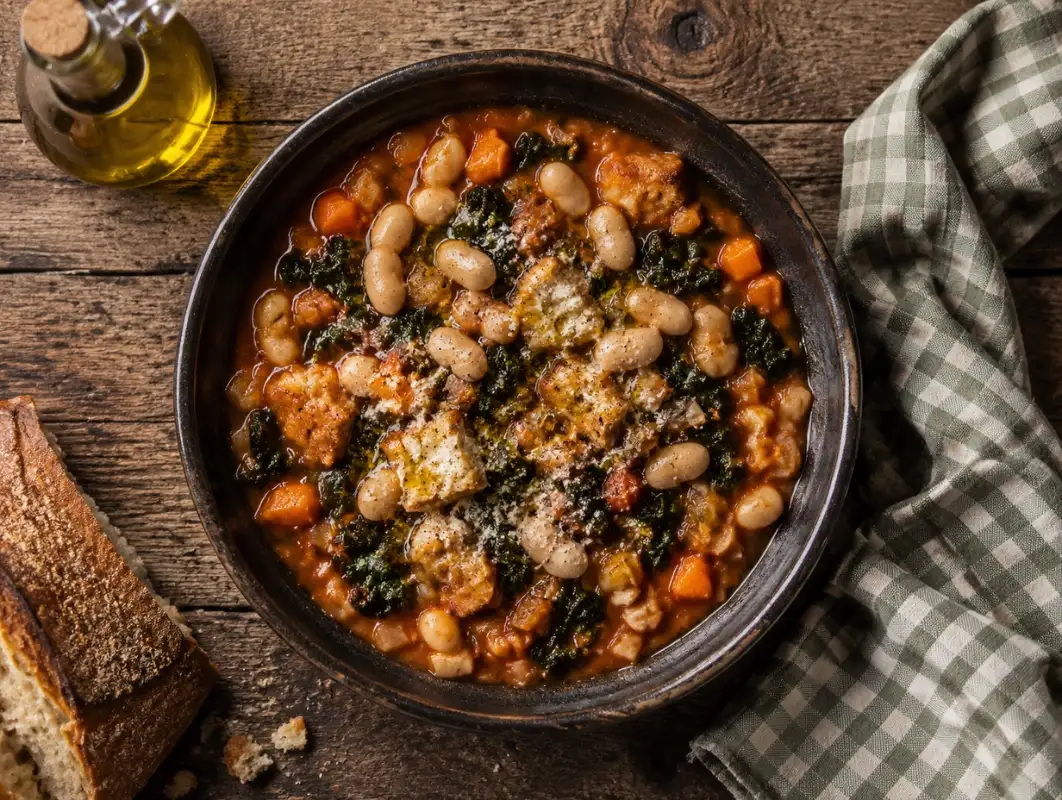
Tuscan Ribollita Soup
Ingredients
Method
- Make the soffritto. Heat 3 tablespoons of olive oil in a Dutch oven over medium-low heat. Add the diced onion, carrots, celery and a pinch of salt and cook, stirring occasionally, for 8–10 minutes until soft, translucent and just beginning to turn golden. Do not rush this — low and slow is the whole secret. Add the minced garlic, rosemary sprigs and sage leaves and cook 2 minutes more until fragrant.
- Add the tomatoes and season. Crush the whole peeled tomatoes with your hands as you add them to the pot. Stir in the smoked paprika and chili flakes if using and cook 3–4 minutes, stirring, until the tomato deepens in colour and the oil begins to separate at the edges. The mixture should look jammy and concentrated, not watery.
- Add the beans, broth and kale. Tip in the drained cannellini beans, reserving 3/4 cup for mashing later, pour in all the broth, and stir in the chopped cavolo nero. It will look like far too much kale — it wilts within 5 minutes. Season with the kosher salt and black pepper.
- Simmer. Bring to a gentle boil, reduce the heat to low and simmer uncovered for 25–30 minutes, stirring occasionally, until the kale is very tender and the tomatoes have broken down. Meanwhile mash the reserved 3/4 cup of beans with a fork until mostly smooth and stir them into the pot — this is what gives ribollita its velvety thickness without any cream. Taste and adjust the salt.
- Add the stale bread. Press the torn bread chunks into the simmering soup and stir gently. Simmer another 5–7 minutes until the bread has fully integrated and the soup has thickened to a hearty, stew-like consistency — it should slowly fall off a spoon, not pour off it.
- Rest. Remove from the heat, discard the rosemary sprigs, cover and let stand 10 minutes so the bread absorbs fully and the flavours meld. The soup thickens further as it sits.
- Finish and serve. Drizzle a generous amount of your very best extra virgin olive oil over each bowl — this is not garnish, the raw oil adds bright peppery flavour and polyphenols that heat destroys. Top with a few fresh sage leaves, a crack of black pepper and grated Parmesan or nutritional yeast if you like.
- For day-two ribollita, cool the soup, refrigerate overnight and reheat gently with a splash of extra broth. The bread dissolves completely into an impossibly thick, unified texture. On day three, press the cold soup into a hot oiled skillet and fry 3–4 minutes per side until crispy.
Notes
Frequently Asked Questions
Substitution & Technique Q&As
Q: What is the difference between ribollita and minestrone?
Great question! Italian minestrone is a broth-based vegetable soup — generally thinner and lighter. Tuscan Ribollita Soup is specifically distinguished by its stale bread, which is added directly to the soup and fully absorbs into the broth, creating that signature thick, stew-like consistency. Ribollita is also traditionally ‘reboiled’ the next day (that’s literally what the name means in Italian), where minestrone is typically served fresh. Ribollita is heartier, thicker, and honestly more filling — one bowl is a complete meal.
Q: Can I use regular curly kale instead of cavolo nero (Tuscan kale)?
Absolutely. Curly kale works well and is much easier to find at most grocery stores. Cavolo nero (also called dinosaur or lacinato kale) has a slightly more tender texture and subtler, less bitter flavor after long cooking — but curly kale produces an equally delicious kale and bean soup. If using curly kale, remove the tough center ribs and chop leaves into 1-inch pieces. Savoy cabbage is another wonderful and very traditional substitute — softer texture, sweeter flavor.
Q: My ribollita came out too thick — almost like bread pudding. How do I fix it?
This happens when you use too much bread or too little broth — both are easy fixes! Simply stir in ½ to 1 cup of warm vegetable broth and heat gently, stirring until it loosens to your preference. Some people (including my nonno!) actually prefer it nearly solid — in some Tuscan traditions, super-thick ribollita is sliced and pan-fried in olive oil. If it’s too thin (rarer), simmer uncovered for 10-15 more minutes or stir in one more torn slice of stale bread.
Q: Can I make this in an Instant Pot or slow cooker?
Yes to both! Instant Pot: Use the Sauté function for the soffritto, then add everything except the bread. Cook on HIGH pressure for 8 minutes, natural release 10 minutes. Stir in bread on Sauté mode for 5-10 minutes. Slow cooker: Sauté soffritto in a skillet first (don’t skip!), transfer to slow cooker with remaining ingredients. Cook on LOW 6-8 hours. Stir in bread during the last 30 minutes. Both methods work beautifully — though stovetop gives the most traditional flavor development.
Dietary, Nutrition & Meal Prep Q&As
Q: Is Tuscan Ribollita Soup actually vegan?
As written, yes — completely! Tuscan Ribollita Soup is naturally vegan as it contains no animal products: just vegetables, beans, bread, olive oil, and herbs. Traditional Italian versions sometimes add a Parmesan rind for depth (which would make it vegetarian, not vegan) — I’ve noted this as an optional addition. For a vegan umami boost, stir in 1 tablespoon of white miso paste or a splash of soy sauce at the end — absolute game-changer for depth without any dairy.
Q: How much fiber and protein is in each bowl of ribollita?
Each serving of this healthy bean soup provides approximately 14-15g of dietary fiber (over 50% of the daily recommended intake for most adults) and around 15-18g of plant-based protein from cannellini beans and bread. These numbers make ribollita genuinely exceptional for a plant-based meal — most vegan soups fall short on protein, but the legume + whole grain bread combination creates a nearly complete amino acid profile. I loved learning this through my plant-based nutrition coursework at Cornell.
Q: Can I prepare any components ahead to make this faster on a weeknight?
Absolutely — and this is my favorite strategy for this Tuscan peasant soup. The soffritto freezes beautifully in ice cube trays — sauté a big batch on Sunday and freeze. Cooked cannellini beans can be prepared from dried beans on the weekend and refrigerated up to 5 days. The bread just needs to be stale — set slices out on the counter the night before. With these components prepped, you can have a pot of ribollita simmering in under 15 minutes on a Tuesday night.
Nutritional Highlights + Closing
Why Ribollita Is Genuinely Good For You
As someone with a nutrition science background from the University of Barcelona AND a plant-based nutrition certificate from Cornell, I find ribollita genuinely remarkable nutritionally — and I don’t say that lightly. Each bowl delivers legumes, leafy greens, whole grains, and quality olive oil in one dish. Cannellini beans contain resistant starch — a prebiotic fiber that feeds beneficial gut bacteria and has been shown in research published in the American Journal of Clinical Nutrition to improve insulin sensitivity and reduce LDL cholesterol. The cavolo nero provides more calcium per gram than cow’s milk. And extra virgin olive oil’s oleocanthal compound has comparable anti-inflammatory effects to ibuprofen — not a medical claim, just fascinating food-science context!
🌿 Disclaimer: I’m a certified health coach, not a doctor or registered dietitian. Nutritional values are estimates. Always consult your healthcare provider for personalized nutrition guidance, especially if managing specific health conditions.
Closing — Go Make This Soup!
Friends, if you make one recipe from this blog this winter, please let it be this Tuscan Ribollita Soup. Make it on a Sunday. Eat it Monday. Eat it Tuesday when it’s even better. Maybe pan-fry it Wednesday. This is what cooking well and eating abundantly actually looks like — simple, seasonal, nourishing food that costs almost nothing and tastes like it cost everything.
Tag me on Instagram @MayaCastellanoEats when you make it — I genuinely love seeing your ribollita bowls! Drop a comment below with any questions or your own family variations. And for more cozy Italian and Mediterranean recipes, check out our Ragu alla Bolognese, the stunning Pasta alla Sorrentina, our warming Creamy Chicken Orzo, and the incredibly satisfying Lemon Chickpea Patties with Yogurt Sauce. Happy cooking — and happy reboiling. 🍲