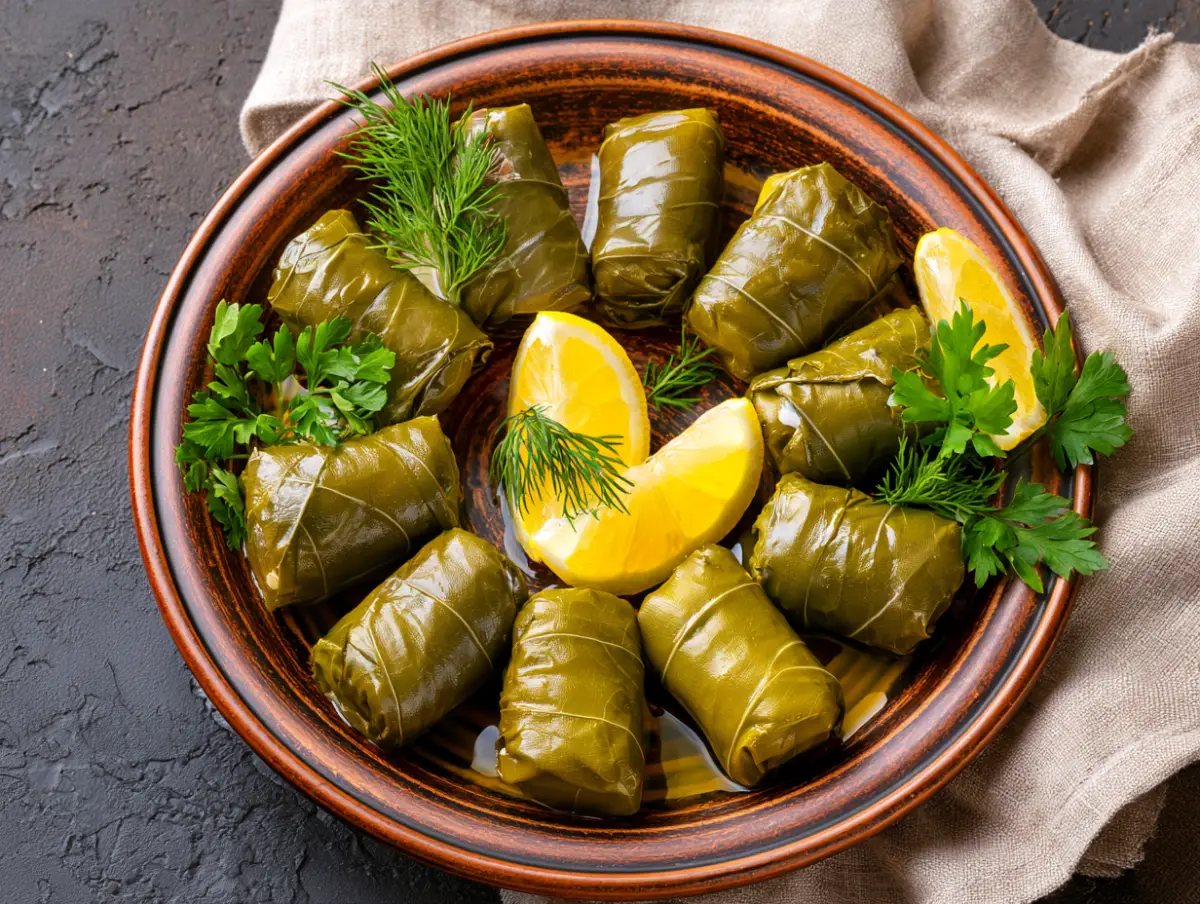
There is a sound that takes me straight back to my yiayia’s kitchen in Chania every single time I hear it: the soft, rhythmic pat-pat-pat of grape leaves being smoothed flat on a marble countertop. I was maybe six years old, standing on a wooden stool, watching her weathered hands lay each leaf shiny-side down and spoon a tiny mound of herbed rice into the center. The kitchen smelled of dill, warm lemon, and the sea breeze drifting through the open window. “Niko,” she’d say without looking up, “tight enough to hold, loose enough to breathe. That’s the secret to everything worth making.”
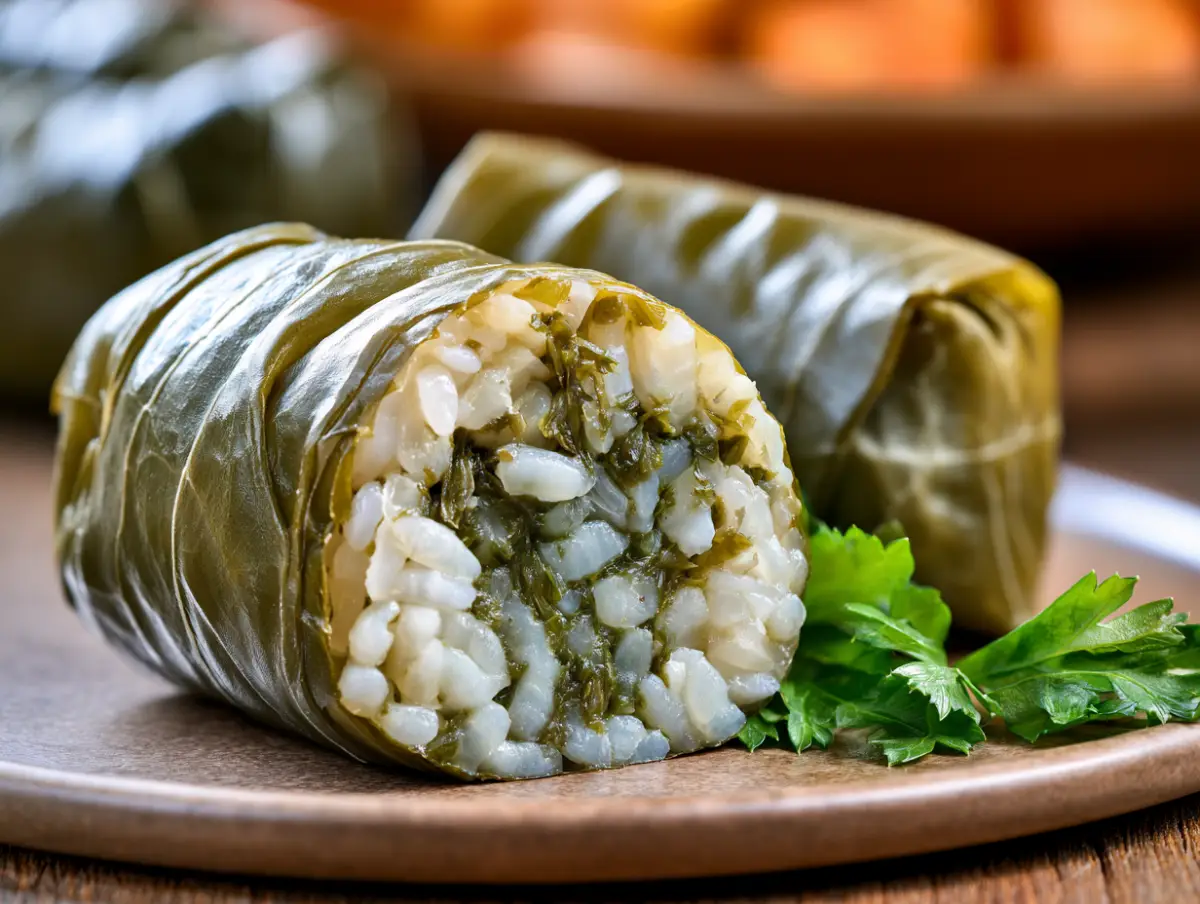
Stuffed grape leaves — dolmadakia in Greek, dolmas across the broader Mediterranean — are one of those dishes that feel ancient in the best possible way. A tender vine leaf wrapped around seasoned rice, braised gently in lemon and olive oil until the filling swells and the leaf turns silky. Every culture from Greece to Turkey to Lebanon claims them (and every grandmother insists hers are best). My yiayia never entered that debate. She just smiled, handed you three more, and said, “Eat.”
I’ve been making this dolmades recipe for over twenty years now, and I still hear her voice when I roll each one. Below is everything I’ve learned — her techniques, my refinements, and every mistake I’ve already made so you don’t have to. Let’s get rolling.
Table of Contents
Stuffed Grape Leaves (Dolmas)
Ingredients
Method
- 1. Prepare grape leaves: soak jarred leaves in cold water 30 min, rinse, trim thick stems. (Or blanch fresh leaves 30 sec, ice-bath, pat dry.)
- 2. Par-cook rice: boil 5 minutes, drain, rinse with cold water.
- 3. Make filling: sauté onions in 3 Tbsp olive oil until soft (5–6 min). Combine with rice, herbs, 2 Tbsp olive oil, 2 Tbsp lemon juice, salt, and pepper.
- 4. Line pot bottom with torn/imperfect grape leaves.
- 5. Roll dolmas: place leaf shiny-side down, add 1–1.5 Tbsp filling near stem, fold bottom up, fold sides in, roll into a snug cylinder.
- 6. Pack seam-side down in pot in tight concentric circles. Stack second layer perpendicular if needed.
- 7. Mix remaining olive oil (~½ cup), remaining lemon juice (~6 Tbsp), and warm water. Pour over dolmas.
- 8. Place heat-safe plate on top as weight. Bring to gentle boil, reduce to lowest simmer, cover.
- 9. Cook 45–50 minutes until rice is tender and leaves are silky. Do not lift lid for first 35 minutes.
- 10. Cool completely in braising liquid (at least 2 hours, ideally overnight in fridge). Serve at room temperature.
Notes
Why This Stuffed Grape Leaves (Dolmas) Recipe Stands Out
The Technique That Changes Everything
Most stuffed grape leaves recipes dump raw rice into raw leaves and hope for the best. Here’s what I do differently: I par-cook the rice for exactly 5 minutes before filling. Why? Because partially gelatinized starch absorbs the braising liquid more evenly, swelling inside the leaf without bursting it. Harold McGee explains in On Food and Cooking that the first stage of starch gelatinization begins around 140°F (60°C), and giving the grains a head start means they finish perfectly tender inside the leaf rather than staying chalky at the center.
The second difference is my ladolemono braising method — a generous bath of extra-virgin olive oil and fresh lemon juice that the dolmas simmer in under a weighted plate. This isn’t just for flavor (though the flavor is extraordinary). The acidity from the lemon keeps the grape leaves bright green instead of turning army-drab, and the olive oil creates a gentle poaching environment that prevents the leaves from tearing.
Flavor Profile & When to Serve
These rice stuffed grape leaves are herbaceous, bright, and impossibly aromatic — dill and mint up front, a long lemony finish, and that unmistakable earthy sweetness from the vine leaf itself. Serve them cold or at room temperature as part of a Mediterranean mezze spread, and watch them disappear. They’re the first thing gone at every gathering I’ve ever brought them to. (Is that a humble brag? Maybe. But it’s also just true.)
This is a cold dolmas appetizer at its finest — ideal for summer dinners, holiday tables, picnics, and any occasion where you want something elegant that you can make entirely ahead of time.
The Story Behind Dolmas
A Dish That Crossed Empires
Stuffed vine leaves date back to at least the Ottoman Empire, where dolma (from the Turkish “to fill”) appeared in palace kitchens alongside hundreds of other stuffed vegetable preparations. The concept traveled in every direction — east to Persia, south to the Levant, west to Greece and the Balkans. Greek dolmades, or dolmadakia (“little dolmas”), are traditionally served during Lent, at Easter celebrations, and at summer gatherings when fresh vine leaves are in season.
My Family’s Sunday Dolmas Tradition
In my family, dolmas were never just appetizers — they were a Sunday ritual. My yiayia would pick grape leaves from the vine that climbed the stone wall behind my grandfather’s taverna. My mother and aunts would take over the filling and rolling while my father, the fisherman, would squeeze lemons. Dozens and dozens of little bundles would fill a massive copper pot. By early afternoon the whole house smelled of herbs and citrus, and you’d find me sneaking them off the platter before they even hit the table. This is how we make it in Crete, and it’s the version I’m sharing with you today.
Essential Ingredients for Dolmas
Core Ingredients
Every ingredient in these traditional Greek dolmades earns its spot. I’ve tested this recipe at least 40 times over the years — in my Athens kitchen, at workshops, even once on a friend’s boat (don’t ask about the mess). Here’s exactly what you need.
| Ingredient | Amount | Why It Matters | Authentic Pick | Substitution |
| Grape leaves | 50–60 leaves (one 16 oz / 450 g jar, or fresh) | The wrapper — adds tannic, earthy flavor | Fresh vine leaves, blanched 30 sec | Jarred (Orlando or Krinos brand); rinse well |
| Short-grain rice | 1½ cups (300 g / 10.5 oz) | Starchy, swells to fill the leaf perfectly | Egyptian or Calrose rice | Arborio; avoid long-grain (too firm) |
| Fresh dill, chopped | ½ cup (20 g) | Signature Greek herb, bright anise note | Freshly picked, not dried | 1 Tbsp dried dill (less aromatic) |
| Fresh mint, chopped | ¼ cup (10 g) | Cool counterpoint to the lemon | Spearmint preferred | 2 tsp dried mint |
| Flat-leaf parsley | ¼ cup (15 g) | Grassy freshness | Italian flat-leaf | Cilantro (non-traditional but works) |
| Yellow onions, finely diced | 2 medium (300 g / 10.5 oz) | Sweetness base for the filling | Yellow or white | 4 large scallions (milder) |
| Extra-virgin olive oil | ¾ cup (180 ml) total | Braising medium + richness | Kolymvari or Sitia Cretan EVOO | Any quality EVOO |
| Fresh lemon juice | ½ cup (120 ml) from ~3 lemons | Brightness, keeps leaves green | Freshly squeezed only | No substitute — bottled tastes flat |
My mother always insisted on fresh dill — “dried dill is for people who don’t have a garden,” she’d say (slightly unfairly). And the olive oil? Don’t skimp. This is a dish where you taste every drop of oil, so use something you’d be happy to pour over bread. We have a guide on choosing quality olive oil if you want help picking the right bottle.
Dietary Substitutions & Pro Tips
| Dietary Need | Replace | With | Notes |
| Gluten-free | No changes needed | — | Naturally GF as written |
| Lower calorie | ¾ cup olive oil | ½ cup olive oil + ¼ cup vegetable broth | Still delicious, slightly less rich |
| Grain-free / keto | Rice | Cauliflower rice (same volume, squeeze dry) | Cook time drops to 25 min; texture softer |
| Nut-allergy-safe | Pine nuts (if using) | Omit or use toasted sunflower seeds | Some variations include pine nuts; this one doesn’t |
Pro Tip: If using jarred grape leaves, soak them in cold water for 30 minutes and rinse each leaf individually. This removes excess brine and prevents your dolmas from tasting salty. I learned this the hard way after an aggressively salty batch in 2019 that my friends still tease me about.
Equipment & Kitchen Setup
Tools You’ll Need
My yiayia used a copper pot wider than my arm span. You probably don’t have one of those, and that’s completely fine.
| Traditional Tool | Modern Alternative | Why It Matters |
| Wide copper pot (tapsi) | Heavy-bottomed Dutch oven or wide saucepan | Even, gentle heat distribution for braising |
| Marble work surface | Large cutting board | Cool surface keeps leaves pliable while rolling |
| Ceramic plate (as weight) | Heat-safe plate that fits inside pot | Keeps dolmas submerged and prevents unrolling during cooking |
| Sharp paring knife | Kitchen shears | Trims thick stems from grape leaves |
Mise en Place Checklist
Before you roll a single leaf, get everything prepped. Trust me — once your hands are covered in rice and oil, you don’t want to be chopping herbs. Rinse and drain grape leaves; trim any thick stems flush with the leaf. Par-cook rice 5 minutes, drain, and cool slightly. Dice onions finely. Chop dill, mint, and parsley. Juice your lemons (strain out seeds). Measure olive oil. Line the bottom of your pot with 4–5 torn or imperfect grape leaves — this creates a protective layer so the bottom dolmas don’t stick or scorch.
Step-by-Step Dolmas Instructions
Preparation (Steps 1–4)
Step 1: Prepare the grape leaves. If using jarred leaves, unroll them carefully, place in a large bowl, and cover with cold water. Soak for 30 minutes, then rinse each leaf under running water and lay flat on kitchen towels. If using fresh leaves, blanch in boiling salted water for 30 seconds, then transfer to ice water. Pat dry. Trim any thick stems flush with the leaf using kitchen shears — you want the base flexible, not rigid.
Why it matters: Unrinsed jarred leaves carry brine that throws off your seasoning. Fresh leaves need that quick blanch to become pliable. Either way, dry leaves roll better and don’t dilute the filling.
Yiayia’s Tip: “Sort your leaves into three piles: large ones for rolling, small ones for patching any tears, and torn ones for lining the pot. Nothing gets wasted in my kitchen.”
Step 2: Par-cook the rice. Bring a pot of water to a boil. Add 1½ cups rice, stir once, and cook for exactly 5 minutes. Drain immediately and rinse with cold water to stop the cooking. The grains should be firm — still slightly chalky in the center. They’ll finish cooking inside the leaf.
Why it matters: Fully raw rice absorbs too much liquid and can burst the leaves. Fully cooked rice turns to mush. Five minutes is the sweet spot — I’ve tested 3, 5, 7, and 10 minutes, and 5 wins every time.
Step 3: Make the filling. Heat 3 tablespoons olive oil in a skillet over medium heat. Sauté diced onions for 5–6 minutes until soft and translucent — not browned. You want sweetness, not caramelization here. Remove from heat and combine in a large bowl with the par-cooked rice, dill, mint, parsley, ½ teaspoon salt, ¼ teaspoon black pepper, 2 tablespoons olive oil, and 2 tablespoons lemon juice. Mix gently with your hands (a spoon crushes the herbs). The filling should smell incredible — bright, green, lemony.
Yiayia’s Tip: “If you can’t smell the dill from arm’s length, you haven’t added enough.”
Step 4: Set up your rolling station. Lay a damp kitchen towel on your work surface. Place prepared grape leaves, filling bowl, and your lined pot within reach. You’re about to enter a rhythm, and reaching across the kitchen breaks it.
Rolling & Cooking (Steps 5–10)
Step 5: Roll the dolmas. Place a grape leaf shiny-side down, stem end toward you. Place about 1 tablespoon of filling (for medium leaves) or 1½ tablespoons (for large leaves) in a line near the stem end. Fold the bottom of the leaf up over the filling, fold both sides inward like an envelope, then roll away from you into a snug cylinder. Tight enough to hold, loose enough for the rice to swell — remember my yiayia’s words.
Don’t stress about perfection. Your first ten will look rough. By number twenty, you’ll have a rhythm. By number forty, you’ll feel like a Cretan grandmother.
Step 6: Pack the pot. Arrange rolled dolmas seam-side down in your lined pot, packing them snugly in concentric circles. They should be touching each other — this prevents unrolling during cooking. Stack a second layer on top if needed, placing them perpendicular to the first layer.
Step 7: Add the braising liquid. Mix remaining olive oil (about ½ cup / 120 ml), remaining lemon juice (about 6 tablespoons / 90 ml), and 1½ cups (360 ml) warm water. Pour gently over the stuffed grape leaves. The liquid should almost cover them — if it doesn’t, add a splash more water.
Step 8: Weight and simmer. Place a heat-safe plate directly on top of the dolmas (it should fit just inside the pot). This keeps them submerged and pressed together. Bring to a gentle boil over medium heat, then immediately reduce to the lowest possible simmer. Cover the pot.
Step 9: Cook low and slow. Simmer for 45–50 minutes. Do not lift the lid for the first 35 minutes (seriously, don’t). The rice needs consistent gentle steam to swell properly. After 40 minutes, carefully lift one dolma with a spoon and test — the leaf should be tender and the rice should be soft with a slight bite. If the rice is still firm, re-cover and cook another 5–10 minutes. Internal temperature should reach 165°F (74°C).
Yiayia’s Tip: “You’ll know they’re done when the kitchen smells like a lemon grove. If it still smells like raw herbs, give it more time.”
Step 10: Cool and serve. Remove from heat and let the dolmas cool completely in their braising liquid — this is where they absorb the last of the ladolemono. Serve at room temperature or chilled, arranged on a platter with lemon wedges. A drizzle of fresh olive oil on top. Maybe a sprinkle of dill. Beautiful.
The Secret Touches
Insider Techniques from Three Generations
These are the details that separate good stuffed grape leaves from the ones people remember.
1. The Lemon-Plate Trick. Before placing your weighted plate on top, lay 4–5 thin lemon slices directly on the dolmas. They release citrus oils during cooking and infuse the top layer with extra brightness. My mother started this, and I’ve never stopped.
2. The Cold-Rest Rule. Never serve dolmas straight from the pot. Cooling in the braising liquid for at least 2 hours (or overnight in the fridge) lets the rice retrograde slightly — as J. Kenji López-Alt explains in The Food Lab, retrograded starch firms up and gives each dolma a more pleasant, cohesive bite. Hot dolmas taste fine; room-temperature dolmas taste perfect.
3. The Olive Oil Finish. Just before serving, drizzle your best Cretan olive oil — Kolymvari or Sitia — over the platter. The fresh, uncooked oil adds a peppery fruitiness that the cooked oil has lost.
4. The Herb Ratio. The classic Greek ratio is 2 parts dill to 1 part mint to 1 part parsley. I’ve played with this endlessly. More mint makes it refreshing (great for summer). More dill makes it deeply savory (better for holiday tables). But that 2:1:1 baseline? Don’t skip it.
Common Mistakes to Avoid
| Mistake | What Happens | How to Fix It |
| Rolling too tight | Rice has no room to expand; leaves split open | Leave a little give — think snug, not strangled |
| Using raw, unsoaked rice | Rice stays crunchy; filling is gritty | Always par-cook 5 min or soak 1+ hours |
| Boiling instead of simmering | Leaves disintegrate; dolmas fall apart | Keep heat at lowest setting; bubbles should barely break the surface |
| Skipping the plate weight | Dolmas unroll during cooking; messy pot | Use a plate slightly smaller than pot diameter, directly on dolmas |
| Not cooling in braising liquid | Dry dolmas with less flavor | Cool completely in pot; they absorb liquid as they rest |
Variations & Serving Ideas
Regional Twists & Modern Adaptations
Across the Mediterranean, every region has its own take on stuffed vine leaves. In Turkey, yaprak sarma often includes currants and pine nuts in the rice filling — a sweeter, richer version. Lebanese-style dolmas lean heavily on tomato and allspice. My Cretan version stays clean and herbaceous, letting the grape leaf and lemon do the talking.
For a modern weeknight shortcut, skip the rolling entirely: layer grape leaves and rice filling in a baking dish like lasagna (we call it dolma tray-bake), pour over the ladolemono, cover with foil, and bake at 350°F (175°C) for 45 minutes. Not traditional, not what my yiayia would do — but delicious on a Tuesday when you don’t have an hour for rolling.
Want to add protein? Some mainland Greek versions include ground lamb in the filling. Use 200 g (7 oz) of lean ground lamb or beef, browned and drained, mixed into the rice. This turns the dish from an appetizer into a light main course. The rolling technique stays exactly the same.
What to Serve With Dolmas
Stuffed grape leaves belong on a mezze table. Build a spread with authentic hummus, baba ganoush, a vibrant fattoush salad, and a bowl of marinated olives. For something warm alongside, our spanakopita makes a perfect contrast — flaky pastry against silky rolled leaves.
The classic accompaniment is a generous spoonful of tzatziki sauce right next to the dolmas. The cool yogurt and cucumber play off the bright lemon beautifully. For a heartier meal, serve alongside Greek roasted vegetables or a Mediterranean grain bowl.
For beverages, pour chilled sparkling water with a squeeze of lemon and fresh mint — it mirrors the flavors in the dolmas. I also love tsai tou vounou (Greek mountain tea) served cold in summer, or a glass of ayran. Homemade lemonade with a touch of honey and thyme is another favorite from my yiayia’s repertoire.
Storage & Make-Ahead Tips
How to Store Dolmas
| Method | Container | Duration | Notes |
| Refrigerator | Airtight container with braising liquid poured over | Up to 5 days | Flavor peaks at day 2; serve at room temp |
| Freezer | Single layer on tray, then transfer to freezer bag | Up to 3 months | Thaw overnight in fridge; drizzle with olive oil before serving |
| Room temperature (serving) | Covered platter | Up to 3 hours | Ideal serving temperature for best flavor |
This is one of the greatest make-ahead dishes in the Mediterranean. In fact, stuffed grape leaves improve with time. I always make them the day before a gathering.
Refreshing Stored Dolmas
Straight from the fridge, dolmas can taste a bit muted. Take them out 25–30 minutes before serving. A squeeze of fresh lemon juice, a drizzle of your best olive oil, and a scattering of chopped fresh dill brings them right back to life. If they’ve dried out slightly in the fridge, spoon a tablespoon of the reserved braising liquid over each layer. Never microwave dolmas — it makes the leaves rubbery and the rice mushy. Room temperature is the way.
Frequently Asked Questions
Substitutions & Technique
Can I use fresh grape leaves instead of jarred?
Absolutely, and I encourage it if you have access to a grapevine. Pick young, tender leaves (about the size of your palm) in late spring or early summer. Blanch in boiling salted water for 30 seconds, shock in ice water, and pat dry. Fresh leaves have a more delicate flavor and softer texture than jarred. They’re what my yiayia always used, plucked right from the vine behind the taverna.
How do I prevent dolmas from falling apart?
Three things: don’t overfill (1 tablespoon for medium leaves), pack them seam-side down snugly in the pot so they hold each other in place, and keep the simmer gentle. A heavy boil is the enemy of stuffed vine leaves. Also, the plate-weight is non-negotiable — it keeps everything compressed during cooking.
Can I use long-grain rice instead of short-grain?
You can, but I don’t recommend it. Long-grain rice (like basmati) stays firm and separate, which means the filling won’t hold together as a cohesive bite. Short-grain rice releases more starch as it cooks, naturally binding the filling. Arborio works in a pinch. This rice stuffed grape leaves recipe relies on that starchy creaminess.
What’s the best way to roll dolmas quickly?
Set up an assembly line: stack of leaves on the left, filling bowl in the center, pot on the right. Place the leaf, scoop filling, fold-fold-roll, place in pot. Don’t aim for perfection on each one. After 10–15 leaves you’ll find a rhythm, and the whole batch goes fast. I can roll 50 in about 25 minutes now, but my first batch took well over an hour.
Dietary, Make-Ahead & Authenticity
Are dolmas naturally vegan?
This recipe is 100% vegan as written — no dairy, no eggs, no animal products. Just rice, herbs, olive oil, and lemon. In Greece, vegetarian dolmas (without meat) are one of the most beloved Lenten dishes. The richness comes entirely from good olive oil and long, slow cooking.
How far ahead can I make stuffed grape leaves?
Up to three days ahead is ideal. Make the full batch, let them cool completely in the braising liquid, and refrigerate in the pot or an airtight container. They genuinely taste better on day two as the flavors meld. Bring to room temperature and refresh with lemon juice and olive oil before serving.
Is this recipe authentic Greek dolmades?
The foundation is completely traditional Cretan — grape leaves, short-grain rice, dill, mint, lemon, olive oil. My par-cooking technique is a refinement I developed after years of testing, but every ingredient and flavor profile stays true to what my yiayia made. This is how traditional Greek dolmades taste when made with care.
Can I freeze dolmas?
Yes! Freeze them in a single layer on a baking sheet, then transfer to a freezer bag. They keep for up to 3 months. Thaw overnight in the refrigerator, then bring to room temperature. Refresh with a drizzle of olive oil and a squeeze of lemon. The texture holds up remarkably well — much better than most stuffed dishes.
What dipping sauce goes with dolmas?
Our tzatziki sauce is the classic pairing — cool yogurt, cucumber, and garlic against the warm herbs and lemon. You could also try creamy labneh drizzled with olive oil and za’atar, or simply serve with extra lemon wedges and a saucer of good olive oil for dipping.
A Taste of the Mediterranean at Home
Bringing Greece to Your Table
Every time I arrange dolmas on a platter — those tight little cylinders, glossy with olive oil, bright with lemon — I think about my yiayia’s hands. She made this look effortless. It isn’t, not at first. But that’s the point. The rolling, the patience, the slow simmer — it’s a meditation, a connection to something older and deeper than a recipe. If she were here, she’d tell you to stop reading and start rolling.
I’d love to see your stuffed grape leaves. Tag me, drop a comment, share a photo of your platter. Especially if you’ve roped your kids into helping — that’s how the tradition continues.
More Recipes to Explore
If these dolmas have you craving more Mediterranean flavors, dive into our moussaka for the ultimate Greek comfort food, or try avgolemono soup — a silky egg-lemon soup that shares dolmas’ love of citrus. For a complete mezze spread, pair these with our homemade falafel and a bowl of classic tabbouleh. And if you enjoyed the rolling technique, you’ll love our Mediterranean stuffed peppers recipe, which uses many of the same filling principles.