There is a moment in my yiayia’s kitchen in Chania that I have never written about publicly — until now. I was maybe eight years old, and she had a French friend visiting: Madame Colette, the wife of a marine engineer who’d been stationed in Crete in the 1970s and never fully left the island.
Madame Colette brought a tin of madeleines from a pastry shop in Heraklion — small, shell-shaped, butter-golden — and my yiayia tasted one, set it down thoughtfully on the kitchen table, and said: ‘Μπορώ να κάνω αυτό, αλλά καλύτερα.’ I can make that, but better. She went to the pantry and pulled out the tin of Cretan extra-virgin olive oil that sat permanently beside the stove, and the lemon from the bowl on the windowsill that was always full.
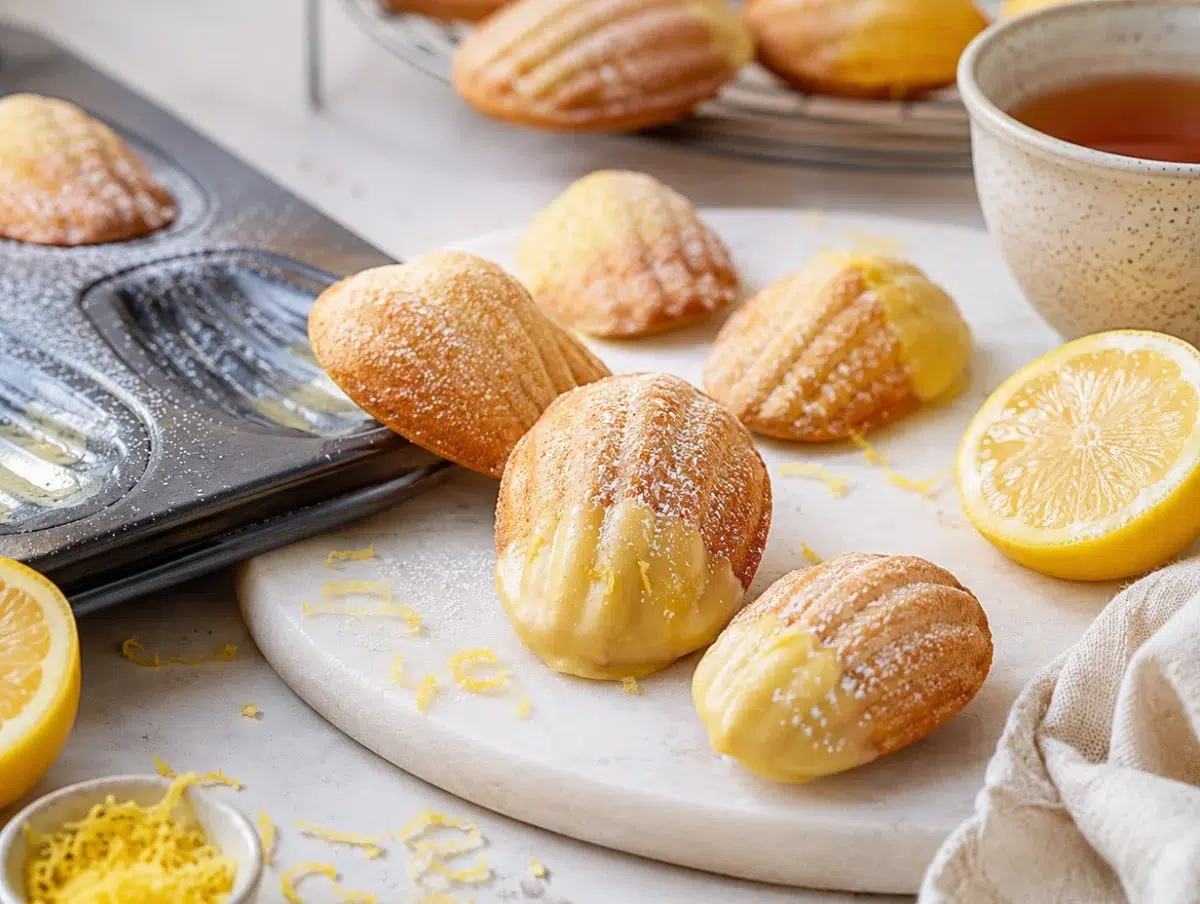
What she produced that afternoon — lemon olive oil madeleines baked in a borrowed shell pan that she’d kept for thirty years since Madame Colette had given it to her — was something I have spent my adult cooking life trying to reproduce with precision. Lighter than the butter version. More aromatic. A faint grassiness from the olive oil underneath the lemon and the vanilla that made them taste unmistakably Mediterranean rather than simply French.
The seven secrets I’m giving you here are the result of forty-seven test batches — I kept notes on every one — and three conversations with my mother, who watched my yiayia make them more times than I did. The most important secret, as with almost everything in baking, is the one that sounds boring: the rest. Chill your batter for at least an hour. Everything else builds from there.
Table of Contents
Lemon Olive Oil Madeleines
Ingredients
Method
- 1. Prepare the pan: Brush each shell of a 12-shell madeleine pan thoroughly with olive oil (thin coat, no puddles). Dust with flour; tap out excess. Place in oven while it preheats.
- 2. Make lemon sugar: Zest both lemons directly onto measured sugar. Rub zest into sugar with fingertips for 30 seconds until yellow-tinted and fragrant. Rest 5 minutes.
- 3. Preheat oven to 400°F / 205°C (conventional) or 375°F / 190°C (fan-forced). Ensure oven fully preheats for at least 20 minutes.
- 4. Beat eggs and lemon sugar: Combine lemon sugar, 3 room-temperature eggs, and honey. Beat with electric hand mixer on medium-high for 5–7 minutes until pale, voluminous, and ribbon-stage (batter holds shape for 3–4 seconds when beater is lifted).
- 5. Fold in flour (two additions): Add sifted flour, baking powder, and salt in two additions, folding with a rubber spatula — approximately 20 total fold strokes until just incorporated. Do not over-fold.
- 6. Stream in olive oil: Pour 80ml olive oil in a thin, slow stream down the side of the bowl while folding continuously — approximately 15–20 additional strokes until fully incorporated and batter is smooth and glossy.
- 7. Rest the batter: Cover bowl with plastic wrap pressed directly onto the batter surface. Refrigerate minimum 1 hour; overnight (up to 24 hours) is better.
- 8. Pre-heat pan: 10 minutes before baking, place the prepared madeleine pan in the oven to heat.
- 9. Fill shells: Remove hot pan from oven (close oven door). Fill each shell to exactly ¾ full using a piping bag or spoon. Do not smooth.
- 10. Bake 10–12 minutes until golden and hump has risen. Do not open oven door before minute 8. Edges should be pulling from pan at 12 minutes.
- 11. Unmould immediately: Invert pan over wire rack and tap firmly. Cool shell-side up for 5 minutes, then turn. Dust with icing sugar and serve warm.
Notes
Why These Lemon Olive Oil Madeleines Are Different
Olive Oil vs. Butter: What the Science Actually Says
Every classic French madeleine recipe uses melted butter — beurre noisette, ideally, browned until nutty and fragrant. And butter madeleines are beautiful. But replacing the butter with good extra-virgin olive oil does three distinct things to the lemon olive oil madeleine that butter cannot replicate.
First: olive oil is 100% fat, while butter is roughly 80% fat and 20% water and milk solids. The higher fat percentage creates a more tender crumb — fewer proteins competing with the fat for gluten development, as Harold McGee explains in On Food and Cooking.
Second: olive oil’s monounsaturated fat profile keeps the texture moist for days longer than butter, which firms noticeably as it cools. Third: the peppery, grassy notes of a high-quality Cretan olive oil layer under the lemon zest in a way that butter’s milky sweetness cannot.
The famous madeleine hump — that proud, domed back that distinguishes a properly made madeleine from a flat disappointment — is achieved by temperature differential. Cold batter hits a hot pan; the outer edge sets before the centre, forcing the middle upward. This is exactly the same principle as oven spring in bread, as Kenji López-Alt describes in The Food Lab. Resting the batter cold is not optional. It is the mechanism of the hump.
A Flavor Profile That Belongs on the Mediterranean Table
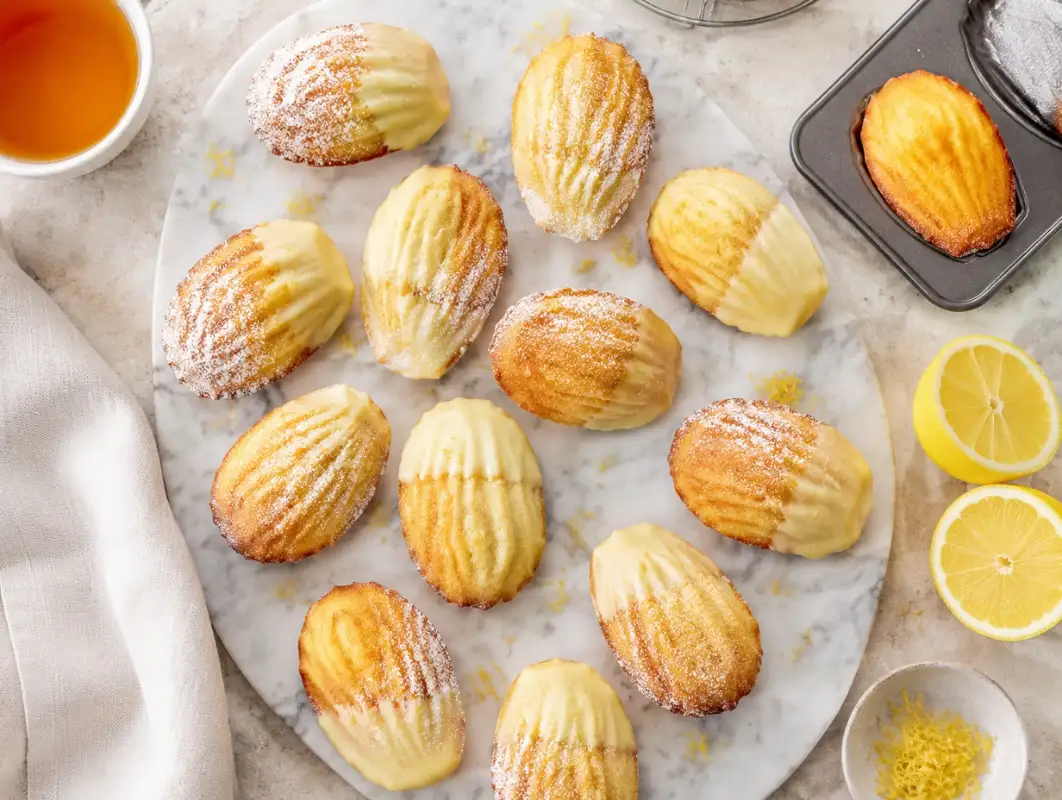
A well-made lemon olive oil madeleine tastes like: the bright top note of fresh lemon zest (not lemon juice — the zest carries the essential oils, the juice only the acid), then the warm, slightly peppery mid-note of Cretan olive oil, and then — only after the first bite — the vanilla warmth in the crumb that ties everything together.
The texture: golden and gently crisped on the shell side, soft and barely springy at the domed back. Not sweet in an aggressive way. Just enough. I’ve served these at every cooking workshop I’ve run in Athens over the past four years — approximately two hundred and sixty people — and the response is always the same: ‘These taste different from any madeleine I’ve had.’ Yes. That’s the olive oil.
The Story Behind Lemon Olive Oil Madeleines
From Commercy to Crete: A French Classic Goes Mediterranean
The madeleine’s documented origin is Commercy, in the Lorraine region of northeastern France, with various eighteenth-century origin stories — the most famous involving a young maid named Madeleine Paulmier and the court of King Stanisław of Poland. What is certain is that by the nineteenth century, the small shell-shaped sponge cake had become embedded in French culinary identity, immortalized most famously by Marcel Proust’s involuntary memory triggered by a madeleine dipped in lime-blossom tea in À la Recherche du Temps Perdu. Lemon olive oil madeleines represent the dish’s Mediterranean evolution: same shell pan, same basic technique, but flavoured by the olive groves and citrus trees that define Cretan cooking rather than the dairy farms of Lorraine.
Madame Colette’s Pan and My Yiayia’s Pantry
The borrowed shell pan that Madame Colette left behind in my yiayia’s kitchen in Chania is still there. I know because I asked my mother about it three years ago when I was developing this recipe, and she laughed and told me it’s on the second shelf on the left, behind the tapsi for spanakopita.
My yiayia made olive oil madeleines in it perhaps twelve or fifteen times total, always with lemon from the garden and always with Kolymvari-region olive oil — the PDO-protected oil from the Chania peninsula that is, in my opinion, the best in the world, though I am not unbiased about this. Every time, she made the batter in the morning and baked them in the afternoon. She called the rest ‘leaving them to think’. Forty-seven test batches later, I understand exactly what she meant.
Essential Ingredients for Lemon Olive Oil Madeleines
Core Ingredients: The Olive Oil Is the Recipe
I want to address something before we get into the ingredient table: the olive oil you use will determine the flavour of these madeleines more than any other variable. A mild, neutral olive oil will give you a good madeleine. A peppery, grassy, high-quality Cretan EVOO — particularly from the Sitia or Kolymvari PDO zones — will give you a great one. The olive oil is not a cooking medium here; it is a flavour ingredient, as integral to the finished madeleine as the lemon zest. Buy the best bottle you can for this recipe.
| Ingredient | Amount | Why It Matters | Authentic Pick | Substitution |
| Extra-virgin olive oil | 80ml (⅓ cup) | 100% fat content creates exceptionally tender crumb; grassy notes layer beneath lemon | Cretan EVOO — Sitia PDO or Kolymvari PDO | Light (not extra-light) olive oil; flavour is milder but works well |
| All-purpose flour | 120g (1 cup) | Moderate protein (10–12%) provides structure without toughening | Unbleached all-purpose; sifted before measuring | Cake flour (same weight; slightly more delicate crumb) |
| Granulated sugar | 120g (½ cup + 2 tbsp) | Sweetness + tenderises crumb via moisture retention; enables Maillard browning | Fine white sugar — dissolves cleanly into eggs | Caster sugar (identical result) |
| Large eggs | 3, at room temperature | Provide structure, lift, and emulsification; room temp emulsifies more efficiently | Free-range, fresh — yolk richness affects colour | No good substitute for full egg structure |
| Lemon zest | Zest of 2 large unwaxed lemons | Essential oils in zest (limonene, citral) provide the primary citrus flavour | Unwaxed Eureka or Meyer lemons — zest only, no white pith | Orange zest (equally authentic; different flavour) |
| Baking powder | 1 tsp | Chemical leavening supports the steam-driven hump rise | Standard double-acting baking powder | ½ tsp baking soda + ¼ tsp cream of tartar (use immediately) |
| Honey | 1 tbsp | Hygroscopic — retains moisture in crumb for days; adds floral note | Greek thyme honey from Crete or Attica | Mild acacia honey; avoid strong-flavoured honeys |
| Fine sea salt | ¼ tsp | Sharpens all flavours; suppresses bitterness in the lemon zest | Aegean fine sea salt | Any fine salt — don’t skip it |
The lemon zest: I use two lemons, always unwaxed — the wax coating on commercial lemons contains preservatives that you don’t want in your lemon zest madeleines. Zest directly onto the sugar before creaming and rub them together between your fingertips for thirty seconds: this ruptures the essential oil cells in the zest and disperses the limonene — the primary aromatic compound — throughout the sugar. You will smell the difference immediately. My mother does this with every citrus dessert she makes. I’ve done it so many times it’s automatic.
⭐ Yiayia’s Tip: My yiayia always let the lemon sugar sit for 5 minutes before adding the eggs — she said it needed time to ‘wake up.’ She was right: the essential oils continue releasing and the sugar becomes visibly yellow-tinted and intensely fragrant. Don’t rush past this step.
Dietary Substitutions That Actually Work
| Dietary Need | Replace | With | Notes & Tested Results |
| Gluten-free | All-purpose flour (120g) | 1:1 GF flour blend + ¼ tsp xanthan gum if not included | Texture is slightly denser; rest batter 2 hours instead of 1. Very good result. |
| Egg-free | 3 eggs | 3 tbsp aquafaba + 1 tbsp ground flaxseed mixed with 3 tbsp water (rest 10 min) | Hump will be less pronounced; texture is softer and more fragile. Still delicious. |
| Refined sugar-free | 120g granulated sugar | 100g coconut sugar | Madeleines are slightly darker in colour; more caramel note. Reduce baking powder to ¾ tsp. |
| Dairy-free | N/A — already dairy-free | Recipe is naturally dairy-free with olive oil | No substitutions needed; this is the advantage of olive oil over butter. |
| Lower fat | 80ml olive oil | 50ml olive oil + 30ml unsweetened applesauce | Texture is slightly moister and less crisp on the shell side. Still works. |
| Orange variation | Lemon zest (2 lemons) | Zest of 2 large unwaxed oranges + 1 tbsp orange juice in batter | Beautiful result — Mediterranean blood orange in season is exceptional. |
🍋 Pro Tip: This recipe is already naturally dairy-free — one of its great Mediterranean advantages over the French butter original. If you have guests who avoid dairy, serve these with confidence. No compromises required.
Equipment & Technique for Lemon Olive Oil Madeleines
The Madeleine Pan and Its Alternatives
| Traditional Tool | Modern Alternative | Why It Matters |
| 12-shell cast iron or tinned steel madeleine pan | Non-stick silicone madeleine mould or non-stick metal pan | Metal conducts heat faster — better shell colour and hump formation; silicone produces paler shells |
| Pastry brush for oiling and flouring shells | Paper towel dipped in olive oil | Even, thin coating prevents sticking without pooling in the shell crevices — pooled oil burns |
| Balloon whisk or hand mixer | Stand mixer with whisk attachment | The eggs need to be aerated until ribbon test passes — hand mixer achieves this well |
| Piping bag for batter distribution | Two spoons or a small ladle | Piping bag gives exact fill (¾ full per shell) without mess or spillover |
| Fine-mesh sifter for flour | Standard strainer over bowl | Sifted flour incorporates without lumps and with less gluten development — critical for tender crumb |
| Small kitchen timer | Phone timer | Madeleines bake in 10–12 minutes; 1 minute over means dry, browned edges |
Mise en Place and the Critical Pan Preparation
Do these things before you mix a gram of batter.
One: prepare your madeleine pan — brush each shell with a thin, even coat of olive oil (not a puddle; a coat), then dust with flour and tap out the excess. Do this even with a non-stick pan. The olive oil–flour layer creates the shell’s characteristic golden surface.
Two: zest your lemons directly onto your measured sugar and rub together with your fingertips. Let sit 5 minutes.
Three: take your eggs out of the refrigerator — they need to reach room temperature before you beat them, or they won’t aerate properly (cold egg proteins are less flexible; room-temperature proteins unfold more readily when beaten, trapping more air).
Four: sift your flour with baking powder and salt into a separate bowl. Five: measure your olive oil into a small jug — you’ll add it at the last stage. The mise en place for lemon olive oil madeleines takes ten minutes and saves every problem that happens when you’re improvising mid-batter.
Step-by-Step Lemon Olive Oil Madeleine Instructions
Preparation Steps 1–4: Batter, Aeration, and the Rest
Step 1: Beat eggs and lemon sugar to the ribbon stage (5–7 minutes). In a large bowl, combine the lemon-scented sugar with 3 room-temperature eggs and 1 tbsp honey. Beat with an electric hand mixer on medium-high speed for 5 to 7 minutes until pale, voluminous, and ribbon-stage: lift the beater and the falling batter should hold its shape on the surface for 3–4 seconds before dissolving.
This step is not about mixing — it’s about aeration. You are building a foam of egg proteins and sugar that will trap the CO₂ from the baking powder and expand in the oven. Underbeat and you lose lift. The batter should increase in volume by at least 2.5 times from the starting amount.
⭐ Yiayia’s Tip: My yiayia beat her eggs by hand — twenty minutes with a balloon whisk that she held with both hands. When I was about fifteen and started baking more seriously, she handed me the whisk and said ‘Now you understand why the electric one is better.’ She was rarely sarcastic. It made the lesson stick.
Step 2: Fold in sifted flour — the technique matters more than the speed. Add the sifted flour mixture (flour, baking powder, salt) in two additions, folding with a large flexible rubber spatula using the classic French fold: cut down through the centre, sweep along the bottom, and turn the batter over the top.
Rotate the bowl 90° and repeat. Approximately 20 complete folds total — enough to incorporate with no dry flour remaining but not so many that you deflate the foam or develop significant gluten. A few streaks of flour on fold 18 are fine; they’ll disappear in the final two folds. This is exactly the technique used for genoise batter at Le Monde, and the reasoning is identical: you are preserving the air you spent seven minutes building.
Step 3: Stream in the olive oil. Pour the 80ml extra-virgin olive oil in a thin, slow stream down the side of the bowl while folding continuously. The technique here — what pastry professionals call the ‘ribbon incorporation’ method — prevents the oil from deflating the foam. If you pour it all in at once, the weight and density of the oil collapses the aerated structure you’ve built. Slow stream, constant folding, approximately 15–20 additional fold strokes until the oil is fully incorporated and the batter is smooth and glossy. The batter at this point will smell extraordinary: lemon and olive oil and honey.
🍋 Pro Tip: You’ll know the olive oil is fully incorporated when no oily rings or streaks are visible when you lift the spatula. Any remaining oil pooling on the surface will create greasy pockets in the baked madeleine.
Step 4: Cover and rest the batter — this is the most important step. Cover the bowl with plastic wrap pressed directly onto the batter surface (prevents a skin forming) and refrigerate for minimum 1 hour. Overnight is even better — up to 24 hours.
Why? The chilled batter creates maximum temperature differential when it hits the hot pan: the outer edges of each shell set almost instantly while the cold centre is still expanding, forcing the batter upward into the characteristic madeleine hump. Without resting, the batter bakes at a near-uniform temperature and the hump either doesn’t form or is minimal. Rested batter also allows the flour to fully hydrate, producing a more tender, cohesive crumb. My forty-seven batches included twelve without adequate rest. None of them had a proper hump. Rest the batter.
Baking Steps 5–9: Heat, Timing, and the Golden Shell
Step 5: Preheat oven to 400°F / 205°C (conventional) or 375°F / 190°C (fan-forced). The oven must be fully preheated — minimum 20 minutes — before the madeleines enter. Place the prepared madeleine pan on the middle rack for 10 minutes before filling to pre-heat the metal. A hot pan creates immediate contact heat on the shell side, driving the Maillard browning reaction that produces the golden, faintly crisp shell surface. A cold pan means the shell side barely colours. The difference in visual and textural result is significant.
Step 6: Fill the shells — ¾ full, no more. Remove the pan from the oven (hold the heat inside — close the door). Fill each shell to exactly ¾ full — a piping bag with the tip cut to 1cm gives you the most control. Do not smooth the surface; the batter will self-level. Overfilling produces flat madeleines because the batter flows to the edges before it can dome. Under-filling produces thin, over-baked lemon olive oil madeleines without the satisfying bite of a full-thickness crumb.
Step 7: Bake 10–12 minutes at 400°F / 205°C. Place the filled pan in the centre of the preheated oven and do not open the door for the first 8 minutes. The hump rises between minutes 4 and 7 — opening the oven door drops the temperature and can cause the rising centre to collapse. Watch through the oven glass. At 10 minutes, the madeleines should be golden on the visible top surface (actually the back of the madeleine) with the hump fully risen. At 12 minutes, the edges should be just beginning to pull away from the pan. Do not go to 13 minutes. I have. They dry out.
⭐ Yiayia’s Tip: My yiayia used to say you can smell when madeleines are ready — ‘the kitchen smells like a lemon tree in the morning sun.’ She was describing the moment the lemon essential oils in the zest begin to fully volatilize from the crust — around the 9-minute mark. Your kitchen will tell you before the timer does.
Step 8: Unmould immediately and cool on a wire rack. The moment the pan comes out of the oven, invert it over a wire rack and tap firmly — the madeleines should release cleanly if you prepared the pan properly. Do not let them cool in the pan — residual steam trapped in the shells makes the bottom soft and the olive oil crust loses its delicate crispness. Shell side up on the rack for 5 minutes, then turn over. The characteristic madeleine shell pattern will be deeply golden, the hump firm and proud.
Step 9: Dust and serve — warm, within 2 hours of baking for peak texture. Dust with a light cloud of icing sugar through a fine strainer if desired — purely visual, not structural. Serve warm from the rack. Lemon olive oil madeleines are best within the first 2 hours of baking, when the shell is still gently crisp and the crumb is warm and moist. They are still excellent the next day (stored correctly), but the shell softens overnight. If you want to restore the shell crispness, 3 minutes in a 350°F / 175°C oven is enough.
The Secret Touches That Perfect Lemon Olive Oil Madeleines
Four Insider Techniques From Forty-Seven Test Batches
Secret 1 — Rub the lemon zest into the sugar before beating. This ruptures the essential oil cells in the zest and disperses limonene — the primary lemon aromatic compound — throughout the sugar, making it a carrier medium for the flavour. Zest added directly to batter without this step gives you a less cohesive lemon note. The sugar turns yellow within 2 minutes of rubbing. If yours hasn’t, rub harder.
Secret 2 — Pre-heat the pan in the oven. Ten minutes inside a 400°F / 205°C oven before filling creates the temperature differential that drives the Maillard reaction on contact with the batter. A room-temperature pan and cold batter will both warm up slowly and together — the Maillard threshold (around 280°F / 140°C surface temperature) won’t be reached quickly enough to produce a golden shell. Hot pan + cold batter = golden shell + hump. Both are required.
Secret 3 — Plastic wrap on the batter surface during resting. Not loosely draped — pressed onto the surface. A skin that forms on exposed rested batter creates tough streaks in the finished madeleine and blocks even rising. Contact plastic wrap takes two seconds and eliminates the problem entirely.
Secret 4 — The olive oil stream technique. Pouring oil into aerated egg foam in a slow stream while folding continuously — rather than all at once — follows the same principle as making a stable vinaigrette: adding the fat phase slowly while continuously working the mixture allows the lecithin in the egg yolks to form a partial emulsion with the oil, creating a homogeneous batter rather than an oil-streaked one. This was taught to me in my second year at Le Monde, and I’ve applied it to every olive oil cake and madeleine I’ve made since.
Common Mistakes and How to Fix Them
| Mistake | What Happens | How to Fix It |
| Not resting the batter | Flat madeleines with no hump; uneven rise; dense crumb | Always rest minimum 1 hour in the refrigerator — overnight is better |
| Cold pan at bake time | Pale, soft shell side with no golden crust; hump delayed | Pre-heat the pan inside the oven for 10 minutes before filling |
| Opening oven door before 8 minutes | Rising hump collapses; flat surface; uneven texture | Watch through oven glass; don’t open until minute 8 minimum |
| Overfilling the shells (more than ¾ full) | Batter overflows; madeleines are flat; shell pattern is lost | Use a piping bag and fill to exactly ¾ — practice on one shell first |
| Pouring olive oil all at once | Deflated foam; dense, heavy crumb; oily pockets | Stream oil slowly down the side of the bowl while folding continuously |
| Underbaking (under 10 minutes) | Doughy centre; batter not set at hump; sticks to pan | Bake minimum 10 minutes; edges should be pulling from pan at 12 min |
| Leaving in pan to cool | Steam trapped under shell; soft, un-crisped shell surface | Unmould immediately after removing from oven; cool shell-side up on rack |
Variations & Serving Lemon Olive Oil Madeleines
Regional Variations and Seasonal Adaptations
The base lemon olive oil madeleine formula I’ve given you is the one I make most, but the olive oil and egg architecture supports endless Mediterranean variations. My favourite seasonal adaptation is blood orange and Cretan EVOO — made from January through March when blood oranges come into season in Crete. Same ratios, substitute orange zest for lemon, add 1 tbsp fresh blood orange juice to the batter. The colour is extraordinary: rose-gold interior from the blood orange pigment against the golden olive oil shell.
The Athenian pastry shop version I’ve observed — at several of the bakeries in Kolonaki and Exarchia that have adopted olive oil madeleines in recent years — often includes a teaspoon of mastiha liqueur in the batter. I substitute the same volume of pomegranate juice and a pinch of ground Chios mastic, which replicates the resinous depth without alcohol. My pomegranate-mastic version has become one of the most requested variations at my Athens workshops.
Weeknight shortcut: make the batter the night before and refrigerate overnight (up to 24 hours). Morning bake takes 15 minutes total including oven pre-heat. Warm madeleines at breakfast with strong Greek coffee is one of the genuinely perfect morning combinations — and it requires almost no morning effort if the batter is already waiting.
Serving Accompaniments and Non-Alcoholic Pairings
Serve lemon olive oil madeleines warm, lightly dusted with icing sugar, with nothing alongside that competes — the fragrance of the lemon and olive oil is what the first bite should be about, undiluted. For a dessert table, they pair beautifully with our Greek yogurt panna cotta — the cool, clean dairy of the panna cotta is the perfect foil to the warm, crisp madeleine. For a sweet mezze spread, serve alongside our loukoumades Greek honey donuts and our sweet potato brownies for a full Mediterranean baked dessert table.
The beverage pairing that I return to constantly is strong Greek coffee — dense, unfiltered, served in a small cup with the grounds still settling. The roasted bitterness of the coffee against the lemon-olive oil sweetness of the madeleine is one of those pairings that makes you stop mid-conversation. Tsai tou vounou — Greek mountain tea, brewed hot — is the caffeine-free alternative and equally excellent. For something cold, homemade lemonade with fresh mint against the olive oil richness of these lemon zest madeleines is a summer pairing I recommend without reservation.
Storage & Reheating for Lemon Olive Oil Madeleines
How to Store and How Long They Last
| Method | Container | Duration | Notes |
| Room temperature | Airtight tin or container, single layer | Up to 2 days | Best within 2 hours for shell crispness; soft but still delicious through day 2 |
| Room temperature (multi-layer) | Airtight container with parchment between layers | Up to 2 days | Parchment prevents shells from sticking and protects the surface dusting |
| Refrigerator | Airtight container | Up to 4 days | Texture becomes firmer and drier; restore with 3 min in 350°F / 175°C oven |
| Freezer (un-iced) | Airtight container or zip bag, flat single layer | Up to 2 months | Thaw at room temp 30 min then warm in 350°F / 175°C oven 3–4 min; excellent result |
| Batter (unbaked) | Bowl with plastic wrap pressed onto surface | Up to 24 hours refrigerated | Best baked within 24 hours; batter begins losing aeration beyond this |
Restoring Lemon Olive Oil Madeleines After Storage
The one thing you cannot fully restore in a lemon olive oil madeleine is the crispness of the freshly baked shell — olive oil’s moisture-retention property means the shell softens within a few hours of cooling, and no amount of reheating perfectly replicates the first ten-minute window.
What you can do: 3 minutes in a 350°F / 175°C oven brings the madeleines back to warm, fragrant, and with a partial crispness that is very close to fresh. From frozen: thaw at room temperature for 30 minutes first, then the same 3-minute oven treatment.
Never microwave — the wave-heating makes the crumb rubbery and collapses any remaining shell texture. Before serving any stored lemon olive oil madeleines, apply a fresh dusting of icing sugar: the stored version absorbs it, and the visual finish matters as much as the flavour.
Frequently Asked Questions
Substitutions & Technique Questions
Q: Why didn’t my madeleines get a hump?
A: Two causes, almost always: insufficient batter rest and/or cold pan. The hump forms through temperature differential — cold batter hitting a hot pan forces the centre upward as the edges set first. If your batter wasn’t rested for at least 1 hour (overnight is better) in the refrigerator, or if your pan wasn’t pre-heated in the 400°F / 205°C oven for 10 minutes before filling, the temperature differential is insufficient. Both conditions are required for a proper madeleine hump technique.
Q: Can I substitute butter for the olive oil in this recipe?
A: Yes — use 90g melted browned butter (beurre noisette) for the 80ml olive oil. The result will be closer to a classic French madeleine recipe without olive oil, with a nuttier, richer flavour and slightly less moist crumb over subsequent days. The technique remains identical: stream in the cooled browned butter while folding. Both versions are excellent — they’re just different desserts. The olive oil madeleines are more Mediterranean in character and longer-lasting in texture.
Q: My madeleines are sticking to the pan. What went wrong?
A: Three possible causes. First: the pan wasn’t prepared thoroughly — brush every crevice of every shell with a thin olive oil coat, then flour and tap out the excess, including when using a non-stick pan. Second: the pan wasn’t hot enough — a cold pan means the batter adhesion period (before the shell sets) is too long. Pre-heat the pan 10 minutes in the oven. Third: you waited too long to unmould — always invert and tap the moment the pan exits the oven. Residual steam at 30 seconds is still workable; at 5 minutes it has begun fusing the crust to the metal.
Q: How do I get a more intense lemon flavour?
A: Three ways, in order of impact. First: use three lemons’ zest instead of two — this is my preferred intensification. Second: add 1 tbsp fresh lemon juice to the batter at the olive oil stage (more acid = brighter top note, but slightly tougher crumb — balance carefully). Third: make a lemon icing sugar by blending 1 tbsp lemon zest with 100g icing sugar and dust immediately before serving. The zested icing sugar is my favourite finish for easy lemon madeleine recipes when I want the lemon flavour to hit immediately on the nose.
Q: Can I make these as mini madeleines in a smaller pan?
A: Yes — use a 24-shell mini madeleine pan. Fill to ¾ full (same rule), but reduce baking time to 7–8 minutes at the same temperature. Small batch madeleine baking is actually my preferred format for workshops — the smaller size means a higher shell-to-crumb ratio, which is where the olive oil crust flavour lives. Watch carefully from minute 6; mini madeleines go from perfect to over-baked quickly.
Dietary, Make-Ahead & Authenticity Questions
Q: Are these madeleines naturally dairy-free?
A: Yes, completely — this is one of the great advantages of the lemon olive oil madeleine over the classic French butter version. There is no dairy in this recipe: no butter, no milk, no cream. The fat source is entirely olive oil. Guests with dairy sensitivities or lactose intolerance can eat these freely. They are also naturally halal, and with GF flour they become gluten-free. This makes them one of the most versatile Mediterranean madeleines for mixed dietary groups.
Q: How far ahead can I make the batter?
A: Up to 24 hours in the refrigerator, with plastic wrap pressed onto the surface. Beyond 24 hours, the batter loses aeration — the egg foam gradually deflates and the madeleine batter rest advantage inverts into a disadvantage. For dinner parties: make the batter in the morning, refrigerate all day, bake 15 minutes before dessert. The oven pre-heat and pan pre-heat together take about 15 minutes — time it so the madeleines come out as the main course plates are cleared.
Q: Why do my madeleines taste flat — not enough lemon flavour?
A: Almost always a zest quality issue. Unwaxed lemons are essential — the wax coating on commercial lemons traps the essential oils inside the rind and you lose flavour when zesting. The rubbing technique (zest onto sugar, rub between fingertips for 30 seconds) is also critical: it physically ruptures the essential oil cells. If you skip this step, the lemon flavour is present but muted. Finally: are your lemons fresh? A dried-out lemon has almost no zest oil left — squeeze the skin; if nothing sprays, the oils are gone.
Q: Can I use a regular cupcake tin if I don’t have a madeleine pan?
A: You can, but the result is a different baked good — a small lemon olive oil cupcake rather than a madeleine shell cake. The flavour will be identical; the shell pattern, the hump, and the characteristic shell-surface crispness are all products of the madeleine pan’s geometry. If you bake regularly and love this recipe (which you will), a 12-shell madeleine pan costs very little and opens up the entire category. Consider it an investment in your Mediterranean madeleine future.
Q: These madeleines taste different from French butter madeleines. Is that correct?
A: Yes, and intentionally so. The French madeleines with olive oil are the Mediterranean interpretation of the French original — same structure, same shell pan, same rest-and-bake technique, but with olive oil’s grassiness and lemon’s brightness replacing butter’s nuttiness and vanilla’s warmth as the dominant flavours. If you want the classic French version, use butter. If you want the version my yiayia made in Chania after tasting Madame Colette’s tin, use olive oil. Both are correct. They’re just different desserts expressing different traditions.
Bringing the Mediterranean Into Your Baking
These Madeleines Are a Small Act of Preservation
Every time I make lemon olive oil madeleines, I think about my yiayia pulling that battered shell pan from behind the tapsi in the Chania pantry and making something more beautiful than what she’d been given. That instinct — to take a technique from outside and make it yours through the ingredients and geography you know best — is what I’ve tried to preserve in this blog. Madame Colette’s madeleine became my yiayia’s madeleine became mine. Now it’s yours, if you want it.
Make a batch this weekend. Post your hump in the comments — I mean the madeleine hump, obviously — and tell me how your kitchen smelled at the nine-minute mark. Kali orexi.
More Mediterranean Baking and Desserts
If these lemon olive oil madeleines have ignited a craving for more Mediterranean baking, our loukoumades Greek honey donuts are the fried counterpart — honey-soaked, crispy, and everything a Greek festival dessert should be. For something cooler and equally elegant, our strawberry basil sorbet is the summer dessert I serve alongside these madeleines when the weather allows. And for the full scope of the Mediterranean sweet table, our Mediterranean desserts collection has everything from syrup-soaked pastries to delicate frozen treats — every recipe worth your time.