The hills above Chania smell like thyme in late winter — thymari the Cretans call it — and when I was eleven, my father and I used to walk out to my grandfather’s old taverna at first light with the fog still low over the sea, passing lemon trees heavy with fruit we weren’t meant to pick (we always picked them).
My yiayia would meet us at the door with her apron dusted in flour, and on those mornings she’d bake what she called her tarta me lemoni kai thymari — the tart with lemon and thyme. The kitchen smelled of the hillside itself: green olive oil, warm citrus, resinous thyme.
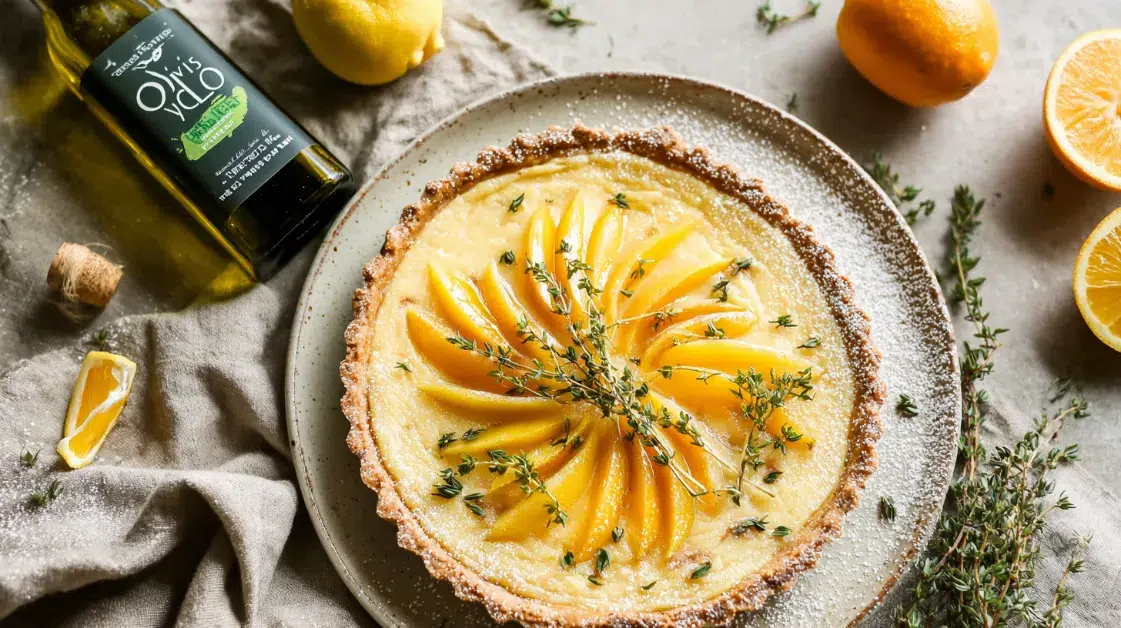
That is the memory behind this Citrus Olive Oil Tart with Thyme Crust. The crust is a pat-in-the-pan shortbread made with good Greek extra virgin olive oil and fresh thyme — fragrant, tender, just slightly savory. The filling layers three citrus fruits: lemon for tang, orange for warmth, grapefruit for that beautiful bitter edge. No butter anywhere. Just what grows on the land behind my grandfather’s taverna. If you make this on a Saturday afternoon, open a window. Let the smell of it travel. That’s how my yiayia would have wanted it. Let me show you exactly how she taught me.
Table of Contents
Citrus Olive Oil Tart with Thyme Crust
Ingredients
Method
- 1. Preheat oven to 350°F (175°C). Line a rimmed baking sheet with parchment.
- 2. Whisk flour, sugar, salt, and chopped thyme in a large bowl.
- 3. Stir in olive oil and ice water with a fork until a soft shaggy dough forms (30 seconds).
- 4. Press ¾ of the dough into a 9-inch fluted tart pan; use remaining dough for the fluted sides.
- 5. Smooth with a flat-bottomed measuring cup; freeze 15 minutes.
- 6. Bake crust 28 to 32 minutes until deep golden. Cool on rack.
- 7. In a nonreactive saucepan, whisk sugar, 2 Tbsp flour, and salt.
- 8. Whisk in whole eggs and yolks; then add citrus juices and zests.
- 9. Cook over medium-low heat, whisking constantly, 5 to 8 minutes until curd reaches 160°F (71°C). Do not boil.
- 10. Off heat, slowly stream in ⅓ cup olive oil while whisking to emulsify.
- 11. Strain curd through a fine-mesh sieve into a clean bowl.
- 12. Pour warm curd into cooled crust. Bake 8 to 12 minutes until set with a slight center jiggle.
- 13. Cool completely on a wire rack (2 hours), then chill (2 hours) for clean slicing.
- 14. Dust with powdered sugar, scatter fresh thyme and candied citrus peel, drizzle with olive oil.
Notes
Storage:
Refrigerate covered up to 3 days; freeze whole unsliced up to 1 month.Make-ahead:
bake a full day ahead and refrigerate; flavors deepen overnight.Key substitutions:
1:1 gluten-free flour + ½ tsp xanthan gum GF; 3 Tbsp cornstarch + ½ cup silken tofu blend for egg-free.Dietary modifications:
naturally dairy-free; halal and vegetarian as written.Serving suggestion:
serve alongside Greek yogurt panna cotta, warm loukoumades with Greek honey, a plate of pistachio halva, or a comforting bowl of Mediterranean rice pudding.Why This Citrus Olive Oil Tart with Thyme Crust Is Special
The Pat-in-the-Pan Crust That Changed My Baking
Most tart crust recipes are a knuckle-whitening affair — cold butter, ice water, rolling pins, chilling, sometimes more chilling. This one? You mix flour, olive oil, sugar, salt, and fresh thyme in a single bowl and press it into the pan with your fingertips. Done. The food science is simple: olive oil is a liquid fat, so it coats flour proteins before water hits them. Harold McGee explains in On Food and Cooking that this coating physically blocks gluten development, giving you a tender, shortbread-like texture with zero effort. It’s the perfect olive oil tart crust — honest and foolproof.
The Flavor Profile and When to Serve It
This tart tastes like a Cretan garden in February. The thyme tart crust gives you a resinous, green base note that makes the citrus curd feel alive instead of one-dimensional. The three-citrus filling is bright, custardy, and not too sweet — more Mediterranean than French patisserie. I serve this at Easter lunches, at dinner parties in my Athens apartment where nobody expects an olive oil dessert, and on quiet Sunday afternoons with a small glass of fresh lemonade. I’ve made this probably fifty times. I trust this version completely.
The Story Behind the Dish
Olives, Citrus, and the Mediterranean Table
Citrus and olive trees have grown side by side in Greek soil since the time of Homer. Greek bakers have been pairing lemon juice and olive oil in desserts for at least two thousand years — long before French patissiers discovered butter shortcrust. In Crete we have a saying: ladi, lemoni, kai thymari — kafenio tou Theou — oil, lemon, and thyme, the café of God. These three ingredients, on their own, make almost anything taste Cretan.
A Yiayia Recipe, Re-Remembered
My grandmother didn’t have a written recipe for her lemon-thyme tart. When she passed in 2014, I drove from Athens to Chania and spent a week in her old kitchen trying to reconstruct it from my mother’s memories. What you have here is not a reproduction — it’s a conversation across three generations. On the mainland, similar tarts lean on butter and sugar; on the islands, olive oil and honey dominate. This Cretan version sits somewhere humble and elegant in between, which is exactly how my yiayia would have wanted it remembered.
Essential Ingredients for Your Citrus Olive Oil Tart with Thyme Crust
Core Ingredients — What Each One Brings
Before I list substitutions, one thing: the olive oil matters more than almost any other ingredient. You taste it. Get the best Greek extra virgin you can afford — something from Kolymvari or Sitia, with a peppery finish. A tired, rancid supermarket olive oil will ruin this tart no matter how carefully you bake it.
| Ingredient | Amount | Why It Matters | Authentic Pick | Substitution |
| Extra virgin olive oil | ½ cup (120 ml) crust + ⅓ cup (80 ml) filling | The soul of the tart — flavor and fat | Greek Kolymvari or Sitia PDO EVOO | High-quality Spanish or Italian EVOO |
| All-purpose flour | 1½ cups (190 g) | Crust structure | Unbleached, 10–11% protein | 1:1 gluten-free blend (Bob’s Red Mill) |
| Fresh thyme leaves | 2 Tbsp (5 g), chopped | Resinous green herbal note | Wild Cretan thyme or garden thyme | 1 Tbsp dried thyme (culinary) |
| Lemon juice + zest | ⅓ cup juice + zest of 2 | The tart backbone | Organic Amalfi or Meyer lemons | Bottled lemon juice in a pinch |
| Orange juice + zest | ¼ cup juice + zest of 1 | Warmth and sweetness | Valencia or Cara Cara | Tangerine or mandarin juice |
| Pink grapefruit juice | 2 Tbsp | Bitter elegance | Ruby or Oro Blanco | Omit and add 2 Tbsp more lemon |
| Granulated sugar | ¾ cup (150 g) | Balances the citrus acidity | Fine cane sugar | Honey (¾ cup — softer set) |
| Eggs + yolks | 2 whole + 3 yolks | Custardy structure, silk texture | Pasture-raised, room temp | Egg replacer not recommended |
I’ll share a confession: for years I used dried thyme in this crust because I thought it was ‘more concentrated.’ Wrong. Dried thyme gives you a dusty, tea-like flavor; fresh thyme gives you the hillside. My cousin Maria, who runs a café in Rethymno, finally walked me through it one summer. Use fresh whenever you can. The difference is everything.
On the citrus: three is the magic number. One alone is boring; two is pleasant; three layers beautifully. Don’t skip the grapefruit — especially don’t skip the grapefruit. That bitter edge is what makes the curd feel grown-up instead of like pink lemonade.
Dietary Substitutions — Tested and True
| Need | Replace | With | Notes | ||
| Gluten-free | All-purpose flour | Bob’s Red Mill 1:1 GF + ½ tsp xanthan | Press crust slightly thicker; expect a tender result | ||
| Dairy-free | (already dairy-free!) | No change needed | One of Greece’s gifts to the lactose-intolerant | ||
| Vegan | Eggs + yolks | 3 Tbsp cornstarch + ½ cup silken tofu, blended | Crust is already vegan; filling is softer | ||
| Lower sugar | ¾ cup sugar | ½ cup sugar + 2 Tbsp allulose | Same bake time; slightly less glossy | ||
| Nut-free | (already nut-free) | Just skip pistachio garnish | Safe for most tree-nut allergies | ||
| Yiayia’s Tip: Zest your citrus before you juice them — this sounds obvious but every week I have a student who tries to zest an already-squeezed lemon half and ends up crying over a slippery, useless rind. My grandmother used a tiny bone-handled grater she kept in a drawer for fifty years. A modern microplane works even better. Zest finely, deeply, and only the colored layer — never the white pith beneath, which is bitter. | |||||
Equipment & Technique
Tools — Traditional and Modern
| Traditional Tool | Modern Alternative | Why It Matters |
| Ceramic fluted tart dish (tartopiata) | 9-inch fluted tart pan with removable bottom | Clean release, beautiful ruffled edge |
| Mortar and pestle (goudi) | Cutting board + sharp chef’s knife | Releases thyme oils without bruising |
| Copper-lined saucepan | Stainless steel saucepan (nonreactive) | Aluminum reacts with citrus acid |
| Horsehair sieve | Fine-mesh stainless sieve | Strains curd to perfect silk |
| Wooden whisk | Balloon whisk + heatproof silicone spatula | Prevents scrambled eggs in the curd |
Mise en Place — The Varoulko Way
During my three years at Varoulko, Chef Lefteris drilled one rule into us: no curd is ever made in a hurry. Here’s how I set up for this tart: zest all three citrus fruits first (before juicing), juice into a fine-mesh sieve directly, crack the eggs and yolks into a single bowl, measure the sugar into another, and keep a bowl of iced water with plastic wrap ready by the stove. The crust gets pressed into the pan and chilled in the freezer for 15 minutes while the oven heats to 350°F (175°C). Total setup: 10 minutes.
Step-by-Step Instructions
Preparation — Steps 1 Through 4
Step 1 — Make the thyme crust dough. In a large bowl, whisk 1½ cups (190 g) flour, 3 tablespoons sugar, ¾ teaspoon fine sea salt, and 2 tablespoons chopped fresh thyme leaves. Pour in ½ cup (120 ml) good Greek extra virgin olive oil and 2 tablespoons ice water. Stir with a fork until a soft, shaggy dough forms — about 30 seconds. It should look crumbly but hold when squeezed. Why it matters: the olive oil coats the flour first, blocking gluten. Mistake to avoid: overworking the dough — 30 seconds, not three minutes.
Step 2 — Press into the pan. Crumble three-quarters of the dough evenly across the bottom of a 9-inch fluted tart pan with a removable bottom. Press firmly with your fingertips into a uniform ⅛-inch layer. Crumble the remaining dough around the fluted edge and press up the sides. Use the flat bottom of a ¼-cup measuring cup to smooth and level the base. Freeze for 15 minutes while the oven heats.
Step 3 — Blind-bake the crust. Place the frozen tart shell on a rimmed baking sheet (this catches any oil drips and makes it easier to move). Bake at 350°F (175°C) for 28 to 32 minutes, rotating the pan halfway, until the olive oil tart crust is deep golden brown and firm to the touch. The thyme will turn fragrant — the whole kitchen will smell like a Cretan hillside. Pull it out and let it cool on the counter while you make the curd.
Step 4 — Prep the citrus curd. In a medium nonreactive saucepan (stainless or enameled — never aluminum), whisk ¾ cup (150 g) sugar, 2 tablespoons all-purpose flour, and a pinch of sea salt. Add 2 whole eggs plus 3 egg yolks and whisk until smooth. Stir in ⅓ cup fresh lemon juice, ¼ cup fresh orange juice, 2 tablespoons grapefruit juice, and the zest of 2 lemons + 1 orange. The mixture will look thin and pale — that’s normal.
| Yiayia’s Tip: Never use an aluminum or unlined copper saucepan for citrus curd. The acid reacts with the metal and turns your beautiful yellow curd an unpleasant gray-green color with a metallic aftertaste. My mother learned this the hard way in 1982 and she still mentions it. Stainless steel, enameled cast iron, or lined copper — those are your three friends. |
Cooking and Assembly — Steps 5 Through 10
Step 5 — Cook the curd low and slow. Place the saucepan over medium-low heat. Whisk constantly, scraping the corners and bottom. The curd will thicken gradually — after 5 to 8 minutes it will coat the back of a spoon and reach 160°F (71°C). Do not let it boil. J. Kenji López-Alt explains in The Food Lab that egg proteins denature cleanly at 160°F; above 180°F they scramble into grainy curds. A thermometer is your friend here.
Step 6 — Emulsify the olive oil. Remove the saucepan from the heat. Pour in ⅓ cup (80 ml) extra virgin olive oil in a slow, thin stream while whisking hard. The curd should turn glossy and satiny as the oil emulsifies. This is the same principle as mayonnaise — tiny oil droplets suspended in an egg-based matrix. Whisk for a solid minute until fully incorporated.
Step 7 — Strain for silk. Pour the finished curd through a fine-mesh sieve into a clean bowl to catch the zest and any egg threads. Press gently with a spatula to extract every drop. The strained curd should be pale gold, glossy, and smooth. Taste it — bright, barely sweet, with a faint floral whisper of olive oil. Adjust salt if needed.
Step 8 — Fill the tart shell. Pour the warm curd into the cooled crust, filling to just below the rim. Shake the pan gently to level. If you want an ultra-glossy top, skim any foam with a small spoon. Return the filled tart to the oven at 350°F (175°C) for exactly 8 to 12 minutes — until the filling is set but has a barely-there jiggle at the center when you shake the pan gently.
Step 9 — Cool completely. Transfer to a wire rack and cool at room temperature for at least 2 hours. The curd will finish setting as it cools. For the cleanest slices and firmest texture, chill in the refrigerator for another 2 hours before serving. Do not skip this. A warm tart slumps when cut.
Step 10 — Garnish and serve. Remove the outer ring of the tart pan (the crust will release cleanly if fully cooled). Dust lightly with powdered sugar through a fine sieve, scatter fresh thyme leaves and a few strips of candied citrus peel over the top, and — if you like — drizzle a final teaspoon of your best olive oil across the surface just before bringing it to the table. Slice with a hot, dry knife for clean edges.
| Yiayia’s Tip: Heat your knife in a glass of hot water, then wipe it dry between every single slice. My grandmother called this ‘kathara kopi’ — clean cutting. It takes thirty extra seconds and gives you bakery-perfect wedges instead of the smeared, rustic cuts that make people think you bought it at a supermarket. Trust me. Once you try it, you’ll never slice a tart any other way. |
The Secret Touches
Four Insider Techniques From My Athens Kitchen
First, the thyme bloom. Rub chopped thyme leaves into the sugar before mixing into the flour — the sugar crystals bruise the leaves and release the essential oils. Second, the zest massage — work the citrus zest into the sugar with your fingertips for 30 seconds, just as I do in my lavender cakes. It distributes flavor evenly through the curd. Third, the double-cool — cool at room temperature first, then refrigerate. Chilling hot curd can cause condensation droplets on the surface that ruin the finish. Fourth, the oil drizzle at the end — a ceremonial final drip of great olive oil across each slice just before serving. It’s dramatic, it’s delicious, and it tells guests this dessert is unapologetically Mediterranean.
Common Mistakes and How to Rescue Your Tart
| Mistake | What Happens | How to Fix It |
| You used a cheap, rancid olive oil | Bitter, off flavor throughout | Start over — there’s no rescue for bad oil |
| You used an aluminum saucepan | Gray-green curd with metallic taste | Discard curd; switch to stainless or enameled |
| You boiled the curd | Scrambled egg bits in the filling | Strain hard; texture won’t be perfect |
| You skipped the resting time | Curd slumps when sliced | Refrigerate 2 more hours before cutting |
| The crust shrank during baking | Empty gap around the edge | Press next batch slightly above rim; freeze 20 min |
| Curd won’t set | Too-liquid filling after cooling | Likely underbaked — briefly re-warm in 300°F oven |
Variations & Serving Suggestions
Regional Variations and Modern Adaptations
On the Greek islands — especially Naxos and Rhodes — bakers make a similar tart with thick vyssino glyko (sour cherry spoon sweet) swirled into the curd before baking, giving a rosy marbled effect. On the mainland around Thessaloniki, some cooks swap the grapefruit for mastic syrup from Chios for a resinous edge. In Crete, where I’m from, we sometimes replace half the thyme with fresh oregano for a more savory-sweet crust — surprising, addictive, perfect for serving as the sweet end of a long lunch.
For a weeknight shortcut, skip the three-citrus blend and use just lemon juice at double the quantity. The curd will be sharper and brighter; the tart comes together 15 minutes faster. Another shortcut: use store-bought tart shells and just make the thyme-infused curd as a standalone dessert in ramekins. Still beautiful, still Cretan in spirit.
Accompaniments and Beverage Pairings
This tart is bright and acidic, so it wants creamy accompaniments. A cold dollop of Greek yogurt whipped with a touch of honey is my favorite. For a full Mediterranean dessert spread, slice it alongside Greek yogurt panna cotta and a small plate of warm loukoumades drizzled with Greek honey. If you’re serving a crowd, pair this with a tray of pistachio halva — the density of the halva plays beautifully against the bright citrus tart. For something lighter, finish the meal with Mediterranean rice pudding and sliced strawberries.
For drinks — no alcohol — my recommendations: ice-cold sparkling water with crushed fresh thyme and a strip of orange peel; a hot glass of tsai tou vounou (Greek mountain tea); homemade lemonade with mint; iced hibiscus tea; or a small demitasse of Greek coffee on the side. Serving on a warm evening? A pitcher of chamomile iced tea with honey is spectacular beside each slice.
Storage & Reheating Your Citrus Olive Oil Tart
How and How Long to Store
| Method | Container | Duration | Notes |
| Room temperature (covered) | Tart dome or loose foil | Up to 4 hours | Best flavor, firmest set |
| Refrigerator (whole) | Airtight container or plastic wrap | Up to 3 days | Bring to room temp 20 min before serving |
| Refrigerator (sliced) | Parchment between slices, airtight | Up to 3 days | Crust softens slightly after day 2 |
| Freezer (whole, unsliced) | Double plastic + foil | Up to 1 month | Thaw overnight in fridge, not at room temp |
| Freezer (crust alone) | Wrapped, frozen before filling | Up to 2 months | Bake directly from frozen |
Refreshing and Restoring
This is a tart best eaten within 48 hours of baking, but if you’re serving leftovers, here’s how to refresh them: never microwave — the curd separates and the crust turns soggy. Instead, place slices on a parchment-lined sheet pan in a 300°F (150°C) oven for 5 to 7 minutes, just until the crust re-crisps and the top loses its chilled sheen. Dust with fresh powdered sugar and a scatter of new thyme leaves to restore visual brightness. If the crust has gone seriously soft, a 10-minute visit to a 325°F (165°C) oven fixes it completely.
Frequently Asked Questions
Substitution and Technique Questions
Can I use dried thyme instead of fresh?
You can, but expect a different result. Use 1 tablespoon dried for every 2 tablespoons fresh, and rub it between your palms before adding to release the oils. Fresh thyme is brighter, greener, more alive; dried thyme is duskier and more tea-like. For this particular tart, fresh wins every time. If you can grow one pot of thyme on a windowsill, you will use it constantly.
Which olive oil should I use?
Extra virgin, always. Specifically, a fresh bottle — oil older than 18 months goes rancid and will ruin the tart. I prefer a medium-intensity Greek oil from Kolymvari or Sitia with a peppery finish and green-grass notes. If you can’t get Greek, a good Italian or Spanish EVOO works. Avoid light, refined, or ‘pure’ olive oil — they have no flavor.
Why is my curd lumpy?
Three likely reasons: heat was too high (above 180°F), you didn’t whisk constantly, or you didn’t strain at the end. The cure is the strainer — a fine-mesh sieve catches zest, tiny egg threads, and any curdled bits, leaving you with silk. Strain even if the curd looks perfect. It’s the one step that guarantees a bakery-quality result.
Can I make this without eggs?
Yes, but the texture will be different. Replace the 2 whole eggs and 3 yolks with 3 tablespoons cornstarch whisked into ½ cup silken tofu, blended smooth. Add during Step 5 and cook exactly as directed. The result is softer, less custardy, more like a citrus pudding pie — still delicious, just not the same elegance.
Dietary, Make-Ahead, and Authenticity Questions
Is this Citrus Olive Oil Tart with Thyme Crust gluten-free?
Not as written, but it adapts beautifully. Swap the flour for Bob’s Red Mill 1:1 gluten-free baking blend plus ½ teaspoon xanthan gum (if the blend doesn’t already include it). Press the crust slightly thicker to compensate for reduced gluten structure. I’ve made this GF three times this year for a friend with celiac, and nobody could tell.
Can I make this a day ahead?
Absolutely — in fact, I recommend it. The flavors deepen overnight, and the filling firms up nicely. Bake the tart in the afternoon, cool at room temperature for 2 hours, then refrigerate covered. Before serving, let it come to room temperature for 20 to 30 minutes and add fresh garnishes. A day-old slice, to me, is even better than a fresh one.
Is this halal / kosher / vegetarian?
Vegetarian: yes. Halal: yes, as written — no alcohol or pork anywhere. Kosher: yes, if you use certified ingredients; the tart is dairy-free so it pairs with meat meals too. I make this for my friend’s Iftar gatherings every Ramadan. Inclusive desserts are the most Mediterranean desserts.
Is this an authentic Greek recipe?
The foundation — olive oil tart shell, citrus curd, thyme — is deeply Cretan. The three-citrus layering is my modern refinement. My yiayia would have used only lemon (because that’s what grew in her yard), but the technique and ingredient family are hers. If she tasted this today, she’d nod and ask for a second slice. That’s my authenticity test.
Closing: Bringing Greece to Your Table
A Final Thought Before You Bake
Baking this tart feels like standing on the hillside above Chania with my father, early morning fog, lemon trees heavy with fruit. I hope when you make this Citrus Olive Oil Tart with Thyme Crust, it gives you a little of that feeling — slow, aromatic, quietly Mediterranean. If you bake it, please leave a comment below and tell me how it went. Share photos on Instagram and tag me. I read every message, I reply to most, and I genuinely love seeing your kitchens take on this recipe.
More Mediterranean Desserts You’ll Love
If this tart made you fall in love with olive oil baking, try my loukoumades — Greek honey donuts next — they use the same quality olive oil for frying. For something silky and easy, the Greek yogurt panna cotta is unbeatable. If you want something ancient and nutty, my pistachio halva is a must, and for pure comfort nothing beats Mediterranean rice pudding on a cool evening. Kali sas orexi — good appetite, my friends.