 Written by Ines Zahraoui — Tunisian home cook and co-founder of The Mediterranean Recipe, developing and testing recipes in her own kitchen since 2020. More about Ines →
Every witch finger recipe I have made from the internet has told me to stick the almond nails on afterwards, with cream cheese or melted chocolate or royal icing.
They fall off. They fall off in the bowl, they fall off when someone picks one up, and by the time the party has been going an hour you have a jar of breadsticks and a small pile of almonds at the bottom.
Press the almonds into the raw dough before baking. The dough rises around them and grips, and they stay put through baking, cooling, transporting and being handled by a room full of people. It is a two-second change and it is the difference between the recipe working and not.
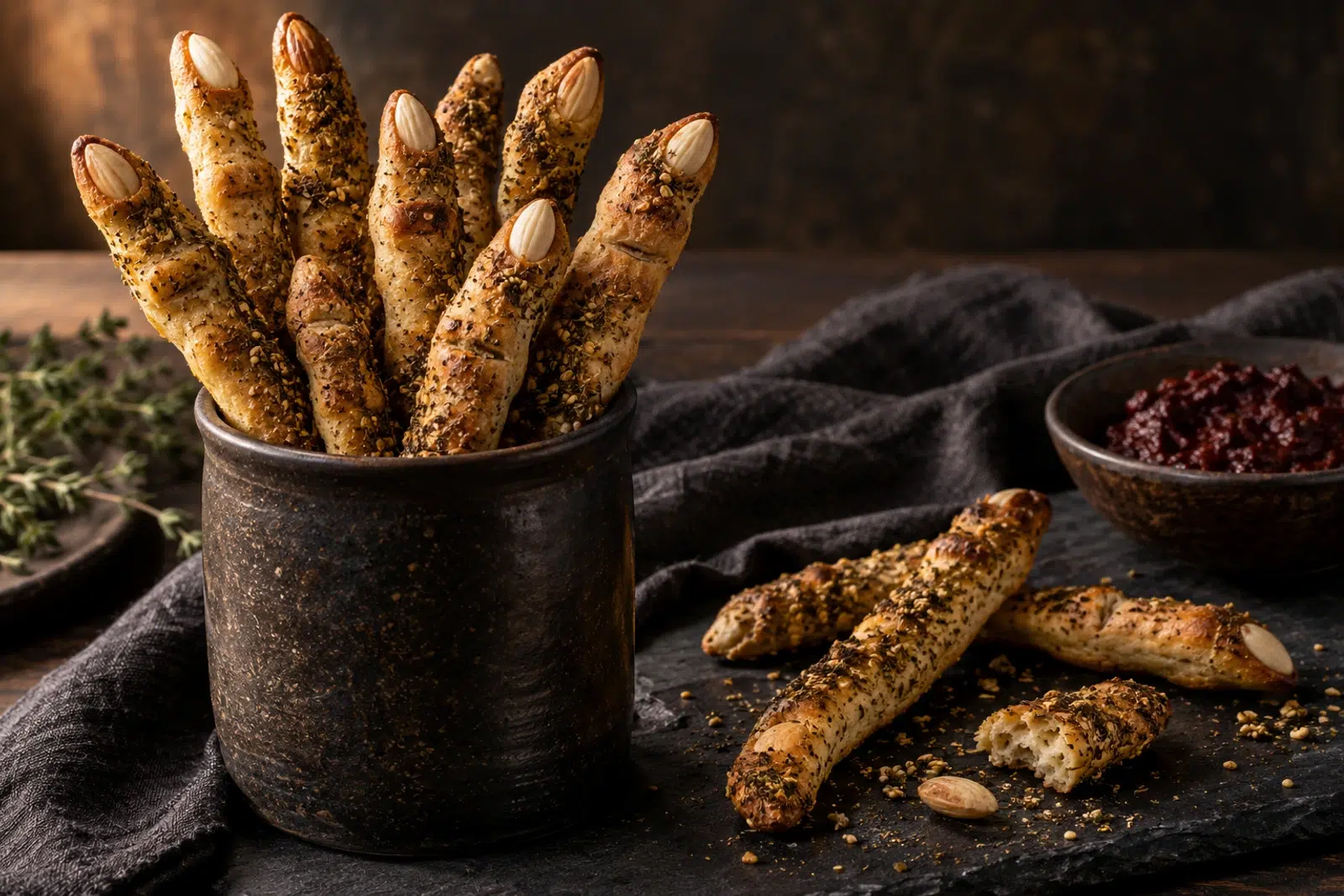
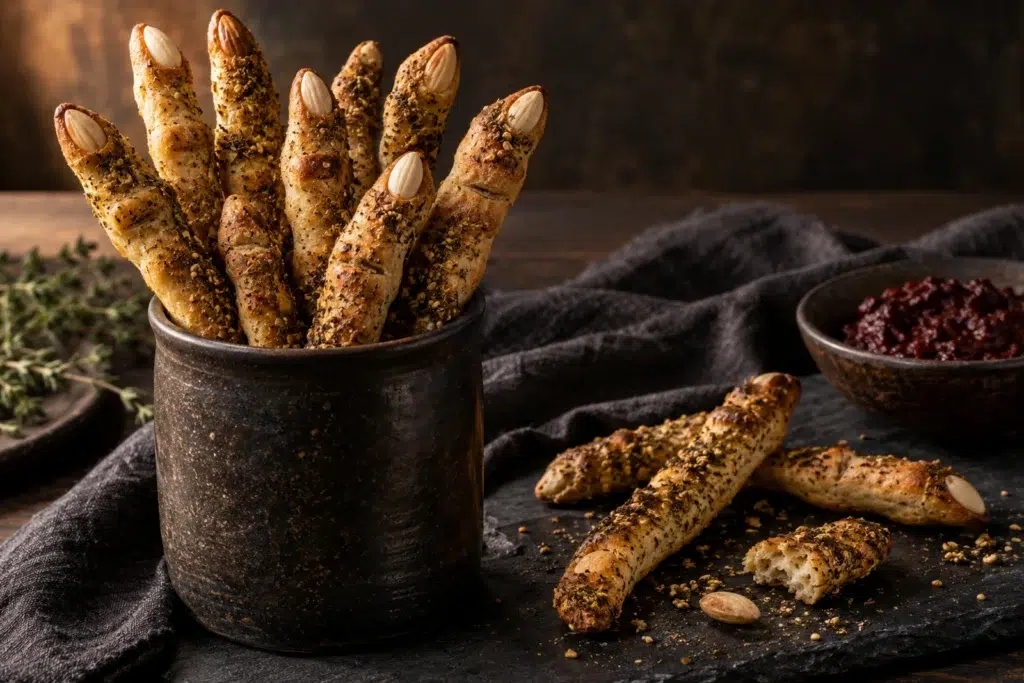
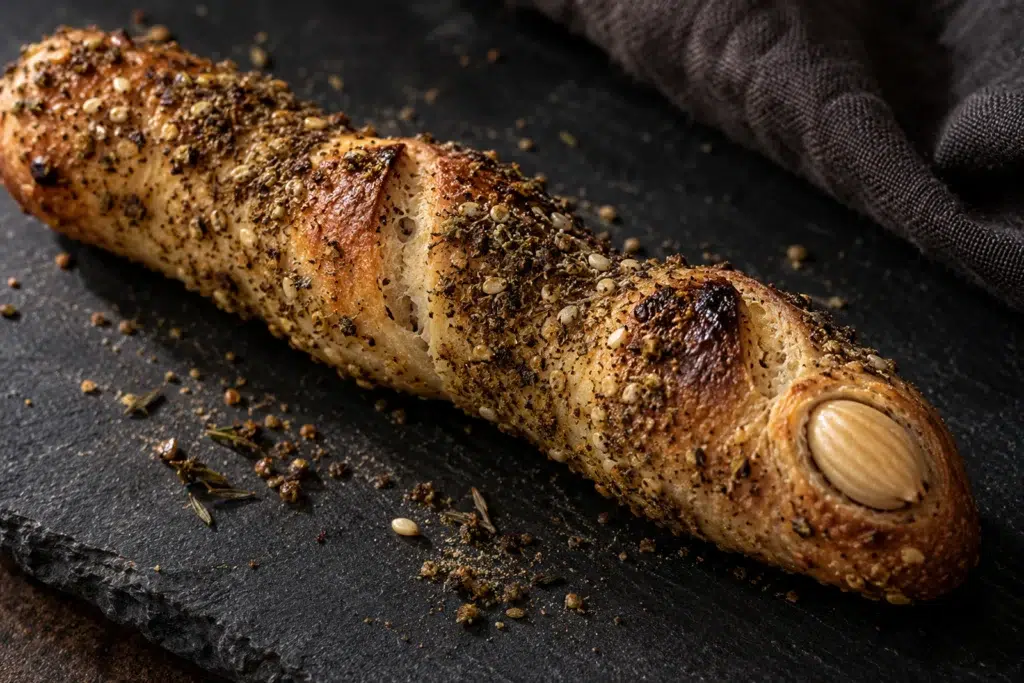
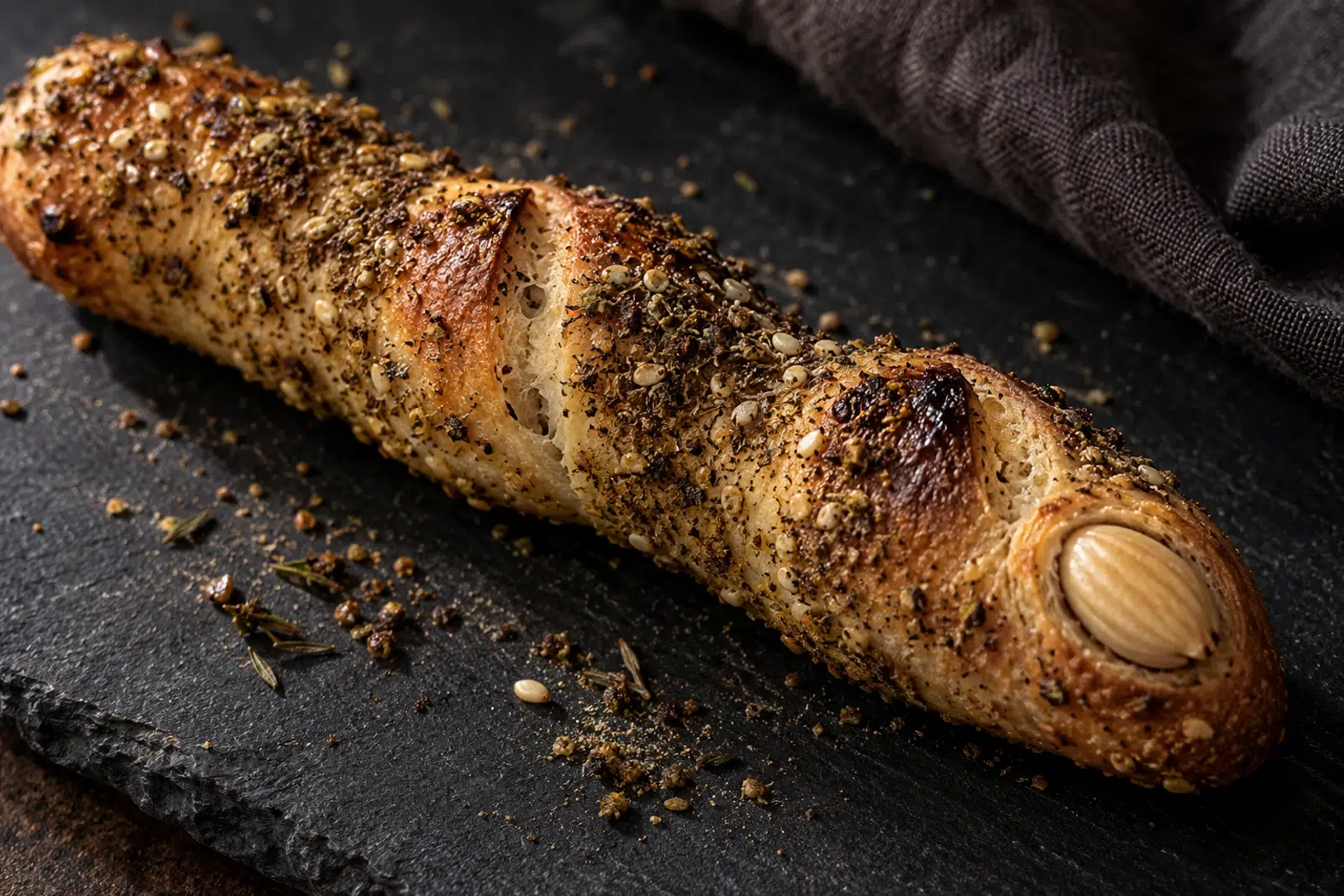
The rest is a za’atar breadstick, which is a genuinely good thing to have on a table regardless of the season — thyme, sesame and sumac pressed into the surface before baking so it toasts rather than sitting on top. Crooked is better than straight. Knobbly is better than smooth. Fingers are not uniform and neither should these be.
Twenty minutes with shop-bought pizza dough, forty if you make your own.
Table of Contents
Table of Contents
Witch Finger Breadsticks Recipe Card
Witch Finger Za’atar Breadsticks
Ingredients
Method
- Heat the oven to 425°F (220°C). Line two trays with parchment.
- If the dough is cold, let it sit at room temperature 20 minutes — cold dough springs back and will not hold a shape.
- Divide into 20 pieces. Roll each into a rough finger about 5 inches long, slightly thicker in the middle and at the base and tapering toward the tip. Do not roll them even.
- Bend each one. Curve it slightly, or put a kink in the middle. Straight fingers look like breadsticks.
- Score two knuckles on each finger with the back of a small knife — a shallow cut two-thirds up and another halfway, slightly off-centre from each other.
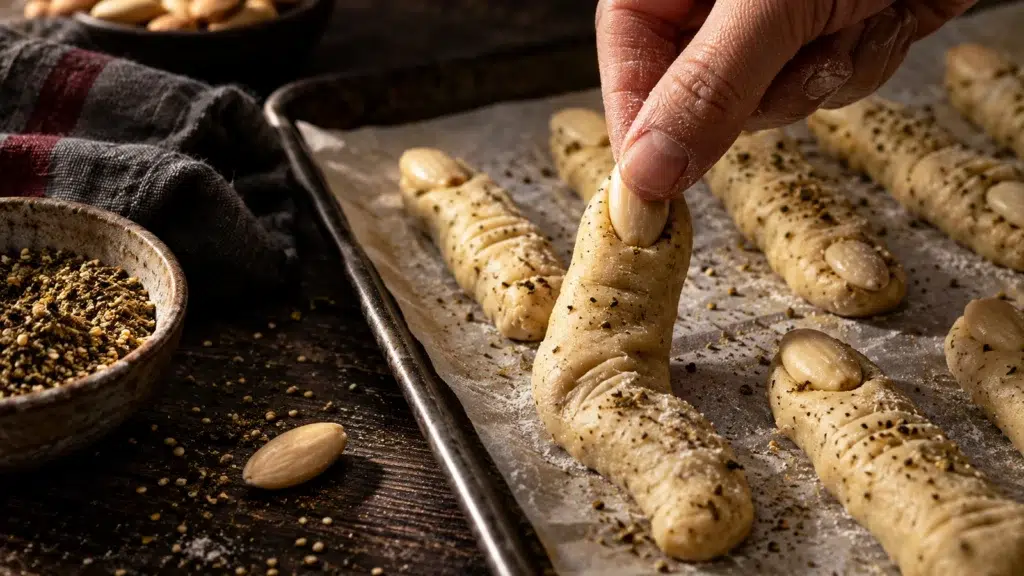
- Press a blanched almond firmly into the tip of each one, pushing it about a third of its depth into the dough so the surrounding dough comes up around its edges.
- Brush all over with olive oil.
- Mix the za’atar and sesame seeds on a plate and roll or press each finger into it, coating the sides but keeping the almond nail mostly clear.
- Bake 13 to 15 minutes until deep golden and firm. Turn the trays once.
- Finish with flaky salt. For a bloodier version, brush a little pomegranate molasses around the base of each nail while still warm.
Nutrition
Notes
Tried this recipe?
Let us know how it was!Why This Recipe Actually Works
- The nails stay on, because they are baked in rather than glued on.
- Imperfection is the goal, so there is no way to do it badly.
- Twenty minutes with shop-bought dough, which is what most people will use.
- Za’atar toasts into the crust rather than dusting off onto everyone’s fingers.
- They stand upright in a jar, which is half the visual effect and costs nothing.
Why Za’atar Rather Than Garlic
Garlic breadsticks are fine and there are ten thousand of them. Za’atar — dried thyme, toasted sesame and sumac — gives you a dusty green-brown crust with a sour edge from the sumac, which looks considerably more like something dug up than golden garlic butter does. It also happens to be widely used on flatbreads across the Levant, with blends that vary by region and household, so it is not a costume.
Essential Ingredients
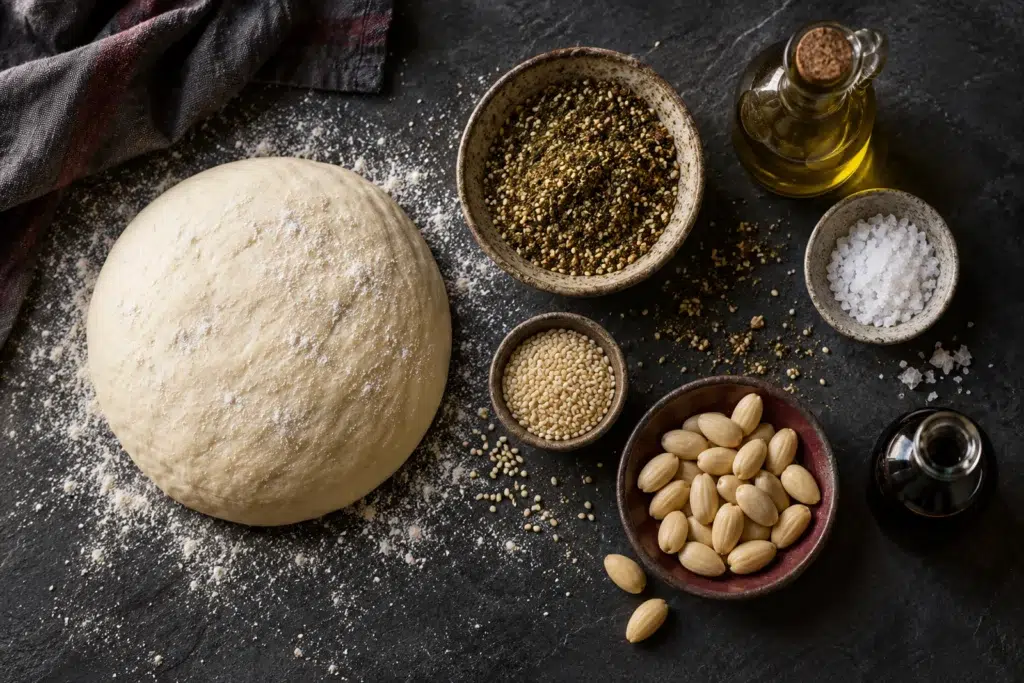
Dough. Shop-bought pizza dough from the chilled section, or a bakery ball if you have a good one nearby. Homemade is better and takes an extra ninety minutes, most of which is waiting.
Za’atar. Buy it from a Middle Eastern grocer if you can — the supermarket versions are often heavy on the thyme and light on the sumac. Or make it: roughly two parts dried thyme, one part toasted sesame, one part sumac, and a pinch of salt.
Blanched almonds. Whole, skinless, and the flatter oval ones look most like nails. Buy blanched rather than blanching them yourself.
Sesame seeds. Extra, on top of what is in the za’atar, for a heavier crust.
Olive oil. Generously. It is what makes the za’atar stick and what crisps the outside.
Pomegranate molasses. Optional, at the end. A dark red-brown smear around the nail base reads as dried blood without any dye.
The Foolproof Method
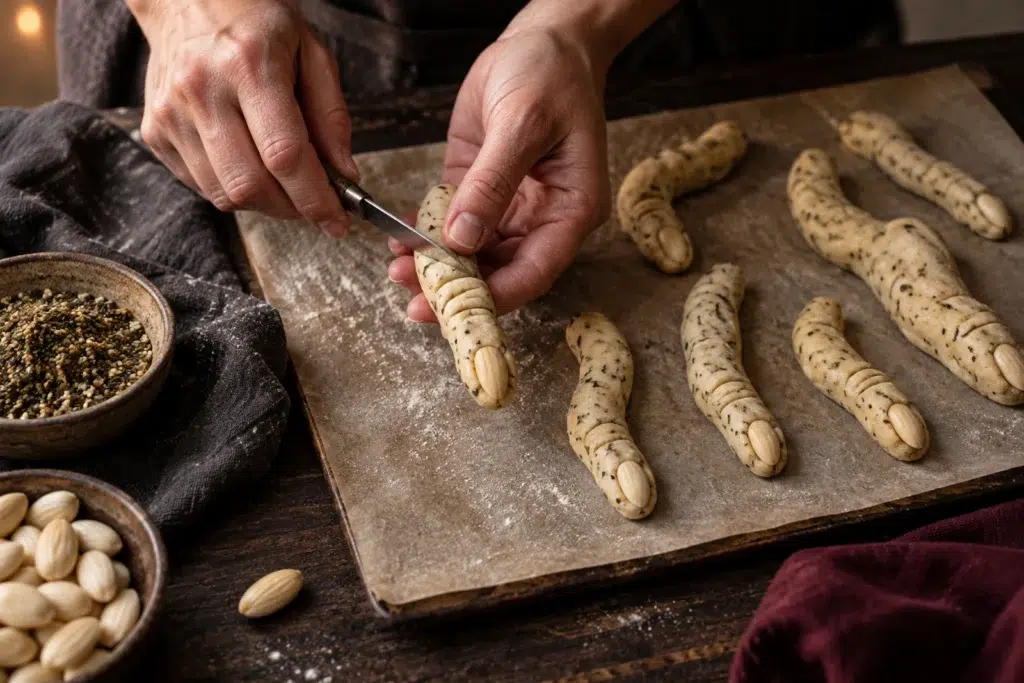
- Let cold dough warm up 20 minutes.
- Roll rough uneven fingers, thicker in the middle.
- Bend each one.
- Score two knuckles, slightly off-centre from each other.
- Press the almond in a third of its depth.
- Oil, then roll in za’atar and sesame.
- Bake 13–15 min at 425°F. Salt.
Press the Nails In Before You Bake
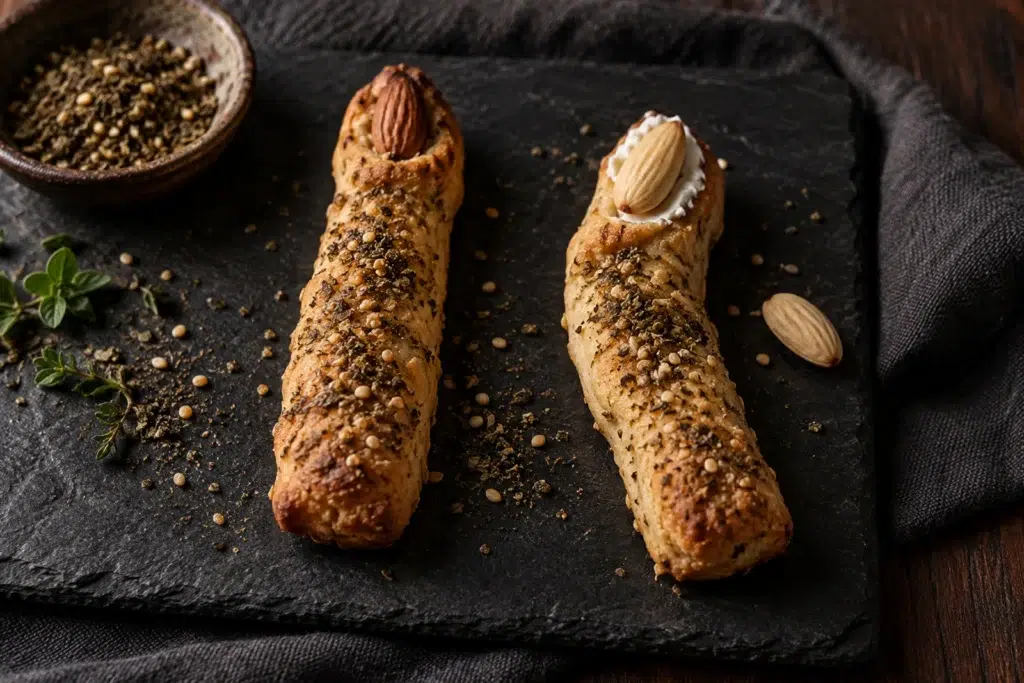
The claim, and it is small and completely decisive.
Push the almond into the raw dough. About a third of its depth, firmly enough that the dough comes up slightly around its lower edge. As the dough proves and bakes it expands around and under the almond and grips it mechanically, and the almond itself toasts at the same time so it darkens to roughly the colour of the crust.
What happens if you stick them on afterwards, as most recipes tell you to: you are relying on an adhesive — cream cheese, icing, melted chocolate — to hold a hard smooth nut onto a hard crisp surface. It works for about ten minutes. Then the adhesive softens or dries, the breadsticks get handled, and the almonds come off. By the end of the party you have a jar of plain breadsticks and a pile of almonds nobody eats.
There is also a flavour argument. A baked-in almond toasts and tastes of something. An almond stuck on with icing on a savoury breadstick tastes like a mistake.
Two details that make it work better:
Press, do not just place. The almond should sit in a shallow socket with a visible ridge of dough around its base, not on the surface.
Push it in at a slight angle, tip-first, following the line of the finger. A nail that sits perpendicular to the dough looks stuck on even when it is not.
For a almond-free version, a large sunflower seed pressed in the same way works surprisingly well at a smaller scale, or you can score a nail shape directly into the dough with a knife and skip the nut entirely — less dimensional, but free of almonds. It is not automatically allergy-safe: verify school rules and cross-contact, and remember that za’atar normally contains sesame.
Crooked Is Better Than Straight
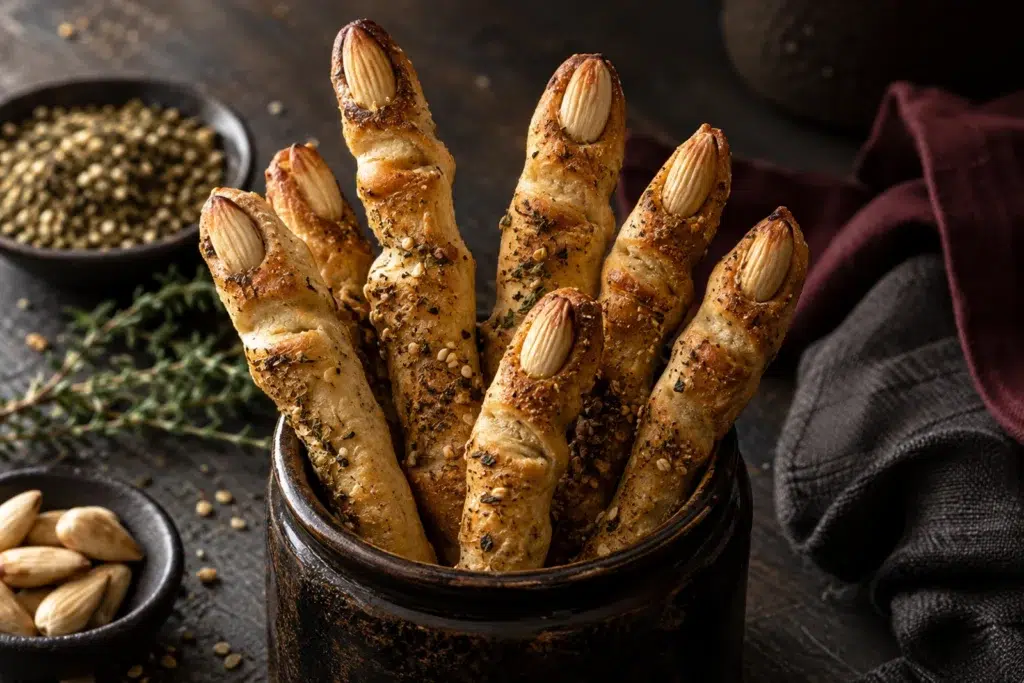
The second rule, and it is the one people resist.
Nothing about a finger is uniform. They are lumpy, they taper, they bend, the knuckles are not evenly spaced and the two on one hand do not match. A tray of neat, straight, evenly spaced sticks with an almond on the end reads as breadsticks with a nut on them.
Four things to do deliberately:
Vary the thickness. Thicker at the base and through the middle, tapering toward the tip. Roll with more pressure at the ends than the centre.
Bend every one. A gentle curve, or a distinct kink at one knuckle. Do it after scoring so the score opens slightly on the outside of the bend, which looks exactly right.
Score the knuckles off-centre from each other. Two shallow cuts, one about two-thirds up and one near the middle, not aligned. Cut on a slight diagonal rather than straight across.
Make them different lengths. Four inches to six. A tray of identical fingers is the giveaway.
Where to stop: they should read as fingers at a glance from across a room. If you have to explain them, they went too abstract; if they are perfectly uniform, they went too neat. The middle is wide and forgiving.
Shop-Bought Dough Is the Right Call
I am going to be direct about this rather than burying it in the notes.
Most people should use shop-bought pizza dough for this recipe. It takes the whole thing from forty minutes to twenty, it is inexpensive, and in a breadstick that is coated in za’atar, brushed with olive oil and baked hard, the flavor difference is small in this crisp, heavily seasoned format.
Homemade dough is better. It is better in a focaccia, where the crumb is the point. In a five-inch stick with a crisp crust and a thin interior, the margin is small and the cost is ninety minutes of proving on a day when you probably have other things to do.
What to buy: chilled pizza dough from the supermarket, or a ball of dough from a local pizzeria or bakery, which is usually better and often cheaper. Frozen bread dough works too, thawed overnight.
One adjustment: shop-bought dough is usually slacker than homemade and it is often cold. Let it sit out for twenty minutes. Cold dough springs back as you roll and will not hold a bend or a knuckle score.
If you do want to make your own: any basic bread or pizza dough works, and I would use a slightly firmer, lower-hydration one than you would for pizza so it holds the shaping.
Creative Variations
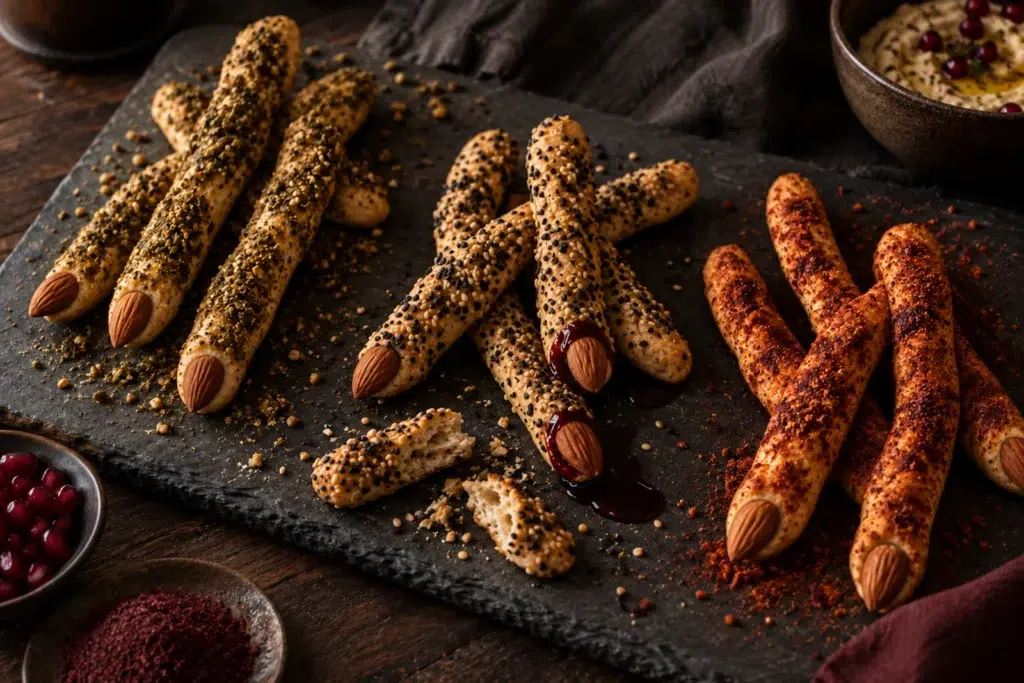
Bloodied. Pomegranate molasses brushed around the nail base while warm, and a little more pooled on the serving plate. The most effective single addition.
Black sesame. Half the sesame seeds swapped for black. Speckled and considerably darker.
Smoked paprika and sumac. Instead of za’atar, for a rust-red crust that reads more scorched than earthy.
Cheesy. Grated kefalotyri or parmesan pressed in with the za’atar. Less traditional, gone faster.
Long fingers. Rolled to eight inches for a jar centrepiece rather than a snack. They stand better and look considerably more alarming.
Storage and Serving
Tin, room temperature, 2 days. They soften slightly overnight; three minutes in a hot oven brings them back completely.
Do not refrigerate.
Make-ahead: shape completely, including the almonds, and refrigerate on the tray covered for up to 24 hours. Bake straight from cold with 2 extra minutes.
Freezing: shaped raw fingers freeze for a month on a tray then bagged. Bake from frozen with 4 extra minutes.
How to serve them, which matters as much as the recipe: stand them upright in a jar or a tall glass, tips up, packed loosely so they lean at different angles. A tray of them lying flat is a plate of breadsticks. A jar of them standing is a jar of fingers, and it costs nothing.
Quantity: 20 fingers serves 8 to 10 alongside dips.
Nutritional Benefits
These are bread, and there is no point claiming otherwise. What they have going for them is that they are bread with olive oil, sesame and thyme rather than bread with butter — za’atar carries the sesame’s calcium and iron and thyme’s polyphenols, and each finger is small at around 85 calories. As party carbohydrates go they are a reasonable one.
Five Rules to Keep Beside the Recipe
Warm cold dough for about 20 minutes
Vary every length, bend and knuckle
Press each almond one-third deep before baking
Oil before coating with za’atar
Declare wheat, almond and sesame allergens clearly
Scaling line: 10 fingers: 225g dough + 10 almonds · 20: 450g + 20 · 40: 900g + 40, baked in four trays
Frequently Asked Questions
How do I stop the almond nails falling off?
Press them into the raw dough before baking rather than sticking them on afterwards. Push each almond about a third of its depth into the tip so the dough comes up around its edge, and it will grip through baking, cooling and handling. Nails attached after baking with cream cheese or icing reliably fall off within the hour.
Can I use shop-bought dough?
Yes, and most people should. Chilled supermarket pizza dough or a ball from a local pizzeria takes this from forty minutes to twenty, and in a breadstick coated in za’atar and baked hard the convenience tradeoff is small in this crisp, heavily seasoned format. Let cold dough sit out for twenty minutes first or it will not hold the shaping.
What is za’atar?
A Levantine blend of dried thyme, toasted sesame seeds and sumac, usually with salt. It is widely used on flatbreads across the Levant and eastern Mediterranean, with regional variation. Buy it from a Middle Eastern grocer if you can, or make it with roughly two parts thyme to one part sesame to one part sumac.
How do I make these nut-free for a school party?
Press a large sunflower seed into the tip in the same way, or score a nail shape directly into the dough with a knife and skip the nut. Both avoid almonds, but neither is automatically safe for every school. Za’atar normally contains sesame, a major allergen, and school policies may also restrict seeds or cross-contact.
Can I make witch finger breadsticks ahead of time?
Shape them completely, including the almonds, and refrigerate covered on the tray for up to 24 hours, then bake from cold with two extra minutes. Baked ones keep two days in a tin and refresh in a hot oven in three minutes. Shaped raw fingers also freeze for a month.
Why do mine look like breadsticks rather than fingers?
They are probably too straight and too even. Bend each one, vary the thickness so the middle is fatter than the tip, score the two knuckles off-centre from each other, and make them different lengths. Uniformity is the thing that gives them away.
Pairing and Serving Ideas
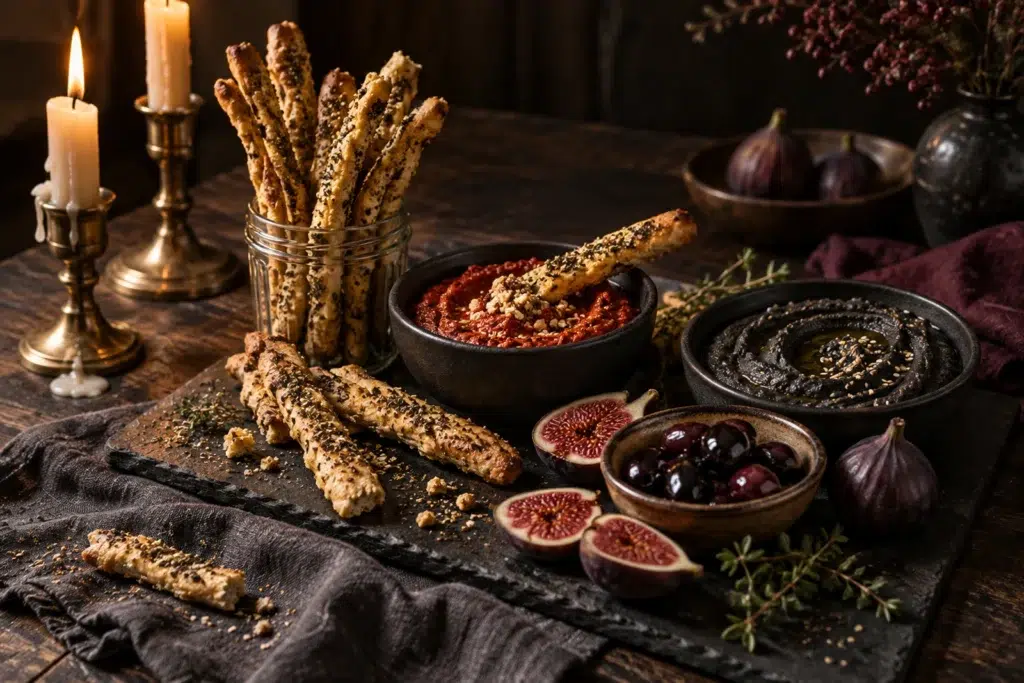
Standing in a jar on a grazing board, which is where they earn their place — they are the only item that adds height, and height is what stops a board looking flat.
With something red to dip into. Muhammara is the natural partner, and the pomegranate molasses variation echoes it.
With something black, for contrast — black tahini hummus, with the fingers laid across the bowl rim.
As an adult-supervised shaping task for children. Rolling and bending the dough is a useful hands-on task; an adult should handle the knife scoring and allergen decisions, and they are more careless about uniformity than adults are, which produces better fingers. [LIVE — /kid-friendly-halloween-recipes-mediterranean/]
In the full appetizer list, with the other twenty-nine: [LIVE — /mediterranean-halloween-appetizers/]
Watch: Rolled, Knuckled, Baked
[VIDEO EMBED — 17 seconds, vertical 9:16]
Dough divided and rolled into rough uneven fingers, each one bent, two knuckles scored with the back of a knife, an almond pressed firmly into the tip, the fingers rolled in za’atar and sesame, then the baked crooked results stood upright in a dark jar.
Ready to Make the Thing That Stands Up?
Warm the dough. Roll them uneven. Bend every one. Score the knuckles off-centre.
And push the almonds in before they go anywhere near the oven.