There’s a sound that means Sunday in my family. Not church bells — though those, too — but the crack of a chicken backbone being snipped with heavy shears, followed by the thump of a palm pressing the breastbone flat against the counter. My yiayia did this every week in her Chania kitchen, standing at that worn butcher block by the window overlooking the harbor.
The chicken would go flat on her old tapsi, doused in lemon juice squeezed through her fist, rubbed with garlic she’d crushed with the side of her knife, and covered in oregano from the hillside behind the house. The whole thing went into an oven that ran hot and unpredictable, and forty-five minutes later the skin was shatteringly crisp and the meat fell off the bone. The smell — roasted garlic, charred lemon, chicken fat sizzling with herbs — that was the smell of love made edible.
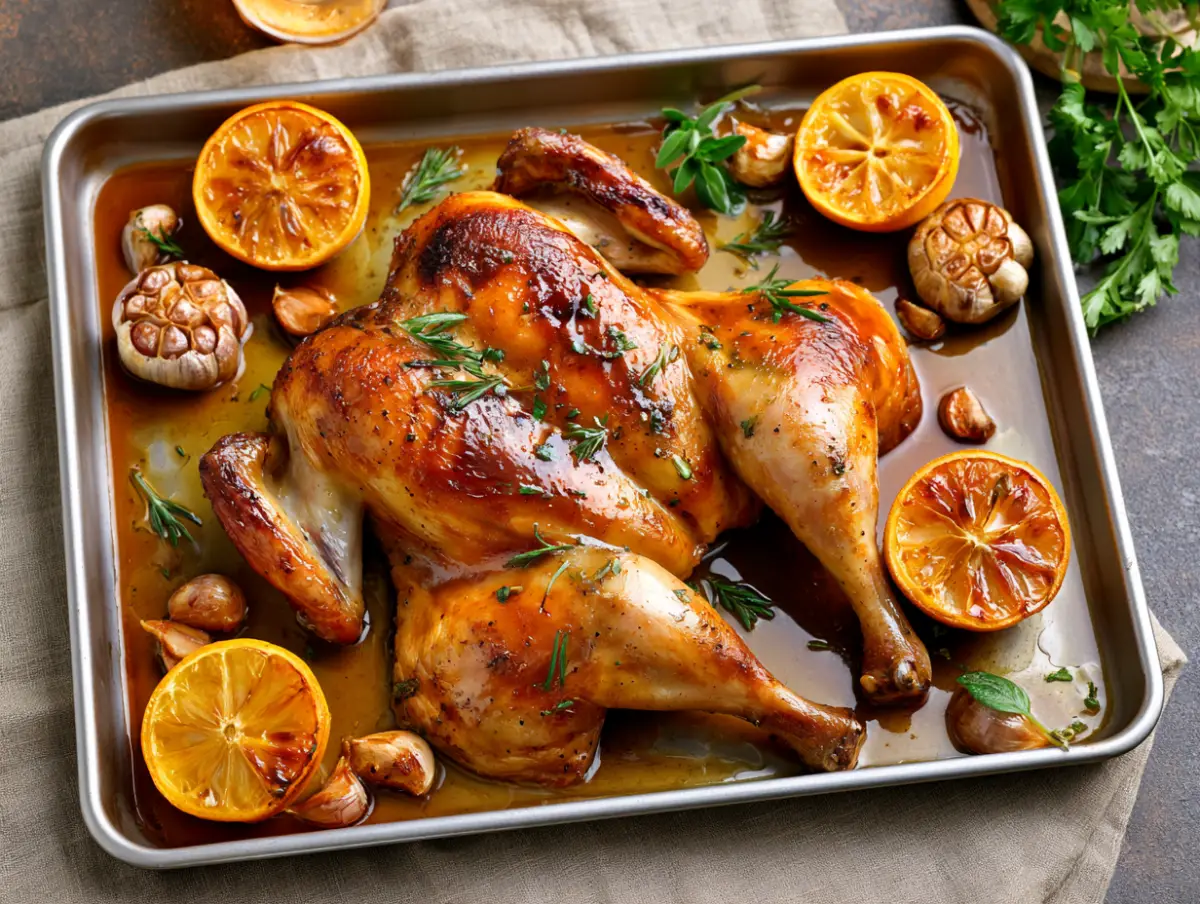
This sheet pan lemon garlic whole spatchcock chicken is that Sunday meal, streamlined for your kitchen. Spatchcocking (or butterflying) the bird means it cooks flat, so every inch of skin faces the heat and crisps evenly while the meat stays impossibly juicy underneath. One pan, five core ingredients, forty-five minutes. If my yiayia wouldn’t recognize it, it doesn’t belong in the recipe — and trust me, she’d know this bird by the smell alone. Let me show you how we’ve been roasting chicken in Crete for three generations.
Table of Contents
Why This Spatchcock Chicken Recipe Is Special
The Science Behind Spatchcocking
Here’s the problem with roasting a whole chicken the traditional way: the breast, being thinner, overcooks before the thighs reach a safe temperature. By the time the dark meat hits 175°F, the breast is dry cardboard. Spatchcocking solves this completely. Removing the backbone and pressing the bird flat means uniform thickness across the entire chicken. As Harold McGee explains in On Food and Cooking, even thickness ensures even heat penetration — the breast and thigh reach their target temperatures within minutes of each other. The result? A crispy skin spatchcock chicken with breast meat that’s still succulent and thighs that are perfectly rendered. Don’t skip this technique. It changes everything about roast chicken.
A Flavor That Stays With You
Imagine cracking through skin so crisp it shatters, revealing juicy meat perfumed with roasted garlic, bright lemon, and woody oregano. The pan juices collect beneath the bird — a glorious mix of chicken drippings, caramelized lemon, and olive oil — and become an instant sauce you’ll soak up with bread. This Greek roasted chicken is my go-to for everything: Sunday family dinners, casual dinner parties (it looks incredibly impressive with almost no effort), and even weeknight meals when I plan ahead. I’ve made this at least 60 times, and my family still asks for it weekly. You’ll love this.
The Story Behind the Dish
Roast Chicken: The Heart of Greek Home Cooking
Roast chicken is universal, but the Greek version has a particular identity: aggressive lemon, unapologetic garlic, dried oregano that smells like the Mediterranean hillside, and always — always — good olive oil. The butterflied whole chicken method has roots in taverna cooking, where cooks needed to prepare large quantities quickly over charcoal. Splitting the bird open meant faster, more even cooking and maximum crispy skin. In Athens, you’ll find spatchcocked chickens spinning on rotisseries in every neighborhood. On the islands, they’re grilled over vine cuttings. In Crete, we roast them flat on a tapsi with potatoes underneath to catch the drippings.
My Yiayia’s Sunday Chicken
My yiayia never called it “spatchcocking” — she called it “opening the chicken” (anoigma tou kotopoulo). Every Sunday, same ritual. She’d buy the chicken from Kyrios Manolis at the market in Chania, snap out the backbone with shears that were older than my father, flatten it with one decisive press, and rub it down with enough garlic to keep vampires away from the entire neighborhood. The lemon was always Cretan — thin-skinned, incredibly juicy — and she’d squeeze it hard, seeds and all, letting the juice run into every crevice. “The chicken needs to swim in lemon,” she’d say. “A dry chicken is a sad chicken.”
Essential Ingredients for Lemon Garlic Spatchcock Chicken
Core Ingredients Breakdown
The beauty of this lemon garlic roast chicken is its simplicity — just a handful of honest ingredients, each doing maximum work. I’ve tested every variable in this recipe over the years (different oils, dried vs. fresh herbs, skin-on garlic vs. minced) and what follows is the definitive version.
| Ingredient | Amount | Why It Matters | Authentic Pick | Substitution |
| Whole chicken | 4–5 lbs (1.8–2.3 kg) | Size affects cook time; 4–5 lb roasts evenly in 45 min | Free-range, air-chilled | Spatchcocked turkey (adjust time) |
| Extra virgin olive oil | 3 tbsp (45 ml) | Promotes browning; carries fat-soluble herb flavors | Kolymvari or Sitia Cretan EVOO | Avocado oil or melted ghee |
| Lemons | 3 large | Juice for marinade; halves roast alongside for sauce | Thin-skinned Cretan lemons | Meyer lemons or 2 lemons + 1 orange |
| Garlic | 2 whole heads + 4 cloves minced | Heads roast to sweet paste; minced garlic in rub | Fresh, firm, large heads | 3 tbsp garlic paste (not ideal) |
| Dried Greek oregano | 2 tbsp | Signature Greek flavor; more potent than fresh when roasted | Cretan wild oregano (rigani) | Italian oregano + 1 tsp thyme |
| Kosher salt | 1 tbsp + more | Dry-brining crisps skin; seasons deeply | Flaky sea salt for finishing | Fine sea salt (use ⅔ amount) |
| Black pepper | 1 tsp, freshly cracked | Warmth; aromatic when hit by oven heat | Whole peppercorns, freshly ground | White pepper (milder) |
A note on the chicken: air-chilled birds have drier skin, which means crispier results. My mother was adamant about this — she’d feel the skin at the market and reject anything that felt waterlogged. (She embarrassed me more than once doing this in front of other shoppers.) And for the olive oil: reach for something good. A peppery, green Cretan oil from Kolymvari or Sitia makes the skin taste extraordinary.
Dietary Substitutions and Pro Tips
| Dietary Need | Replace | With | Notes |
| Dairy-Free | No dairy in recipe | N/A | Already dairy-free; use olive oil, not butter |
| Lower Fat | Full chicken skin | Remove skin after cooking | Skin protects meat during roasting; remove at table |
| AIP/Paleo | Black pepper | Omit or use ground ginger | Recipe is naturally Paleo-friendly |
| Low-Sodium | 1 tbsp kosher salt | ½ tbsp + herbs for flavor | The rub does the heavy lifting; reduce gradually |
| Smaller household | 4–5 lb chicken | 3 lb chicken; reduce time to 35 min | Leftovers shred beautifully for salads and wraps |
Pro Tip: Pat the chicken BONE-DRY with paper towels, then let it sit uncovered on the sheet pan in the fridge for 1–2 hours (or overnight) before roasting. This is the dry-brining technique that J. Kenji López-Alt champions in The Food Lab — the surface moisture evaporates, the salt penetrates, and you get skin so crispy it crackles when you cut into it. I learned this accidentally when I forgot a chicken on the counter too long before roasting and it came out with the best skin I’d ever achieved.
Equipment and Technique
Tools You’ll Need
| Traditional Tool | Modern Alternative | Why It Matters |
| Heavy kitchen shears (poultry shears) | Sharp heavy-duty scissors | Cuts through backbone and rib bones cleanly |
| Tapsi (large Greek baking tray) | Heavy-duty rimmed sheet pan (18×13″) | Thick metal = even heat; rim catches juices |
| Wire cooling rack (fits inside pan) | Oven-safe rack or crumpled foil bed | Elevates chicken for 360° airflow = crispier skin |
| Instant-read meat thermometer | Digital probe thermometer | Non-negotiable — the only reliable way to check doneness |
Mise en Place and Workspace Setup
Before you touch the chicken, get organized. Preheat oven to 425°F (220°C) — you need aggressive heat. Set a wire rack inside your sheet pan (if you have one; if not, the chicken goes directly on the pan — still great). Have paper towels ready for drying the bird. Mix your herb-garlic rub in advance. Cut your garlic heads in half horizontally. Halve two lemons for roasting alongside. And clear your counter space — a spatchcocked chicken takes up more room than you think, and you need a stable surface for pressing it flat. This easy spatchcock chicken recipe comes together in 10 minutes of active prep, but that prep needs to be focused.
Step-by-Step: Sheet Pan Lemon Garlic Whole Spatchcock Chicken
Preparation (Steps 1–4)
Step 1: Spatchcock the Chicken
Place the chicken breast-side down on a cutting board, legs facing you. Using heavy kitchen shears, cut along one side of the backbone from tail to neck. Then cut along the other side. Remove the backbone entirely. (Save it — it makes incredible stock with our lahanorizo Greek cabbage rice or any soup.) Flip the bird breast-side up and press firmly on the breastbone with the heel of your palm. You’ll feel a crack — that’s the keel bone breaking, allowing the chicken to lie flat. Tuck the wing tips behind the breasts so they don’t burn.
Yiayia’s Tip: “Don’t be gentle — the chicken is already dead.” My yiayia would say this every time I hesitated at the pressing step. She was right. A firm, decisive press flattens the bird properly. Timid pressing leaves a hump in the middle that cooks unevenly.
Step 2: Dry and Season
Pat the entire chicken completely dry with paper towels — top, bottom, and inside the cavities. Moisture is the enemy of crispy skin. Drizzle 2 tablespoons of olive oil over the skin side and rub it in. In a small bowl, combine the minced garlic, dried oregano, 1 tablespoon kosher salt, pepper, the zest of one lemon, and the remaining tablespoon of olive oil into a paste. Rub this paste all over the chicken — generously on the skin side, and don’t forget the underside. Here’s the real trick: carefully loosen the skin over the breast with your fingers and push some of the garlic-herb paste underneath. This seasons the meat directly and creates an aromatic layer between skin and flesh.
Step 3: Build the Pan Bed
Squeeze the juice of two lemons all over the chicken. Place the squeezed lemon halves on the sheet pan along with the halved garlic heads, cut-side down. If using a wire rack, set it on top — the chicken goes on the rack, skin-side up. If no rack, place the chicken directly on the pan with the lemon and garlic tucked underneath and around. The lemons and garlic roast alongside the chicken, caramelizing into an incredible foundation for your pan sauce.
Step 4: Optional Dry-Brine (For Ultimate Crispiness)
If you have time, do this: after seasoning, place the chicken uncovered on the sheet pan in the fridge for 2–24 hours. The cold, dry air of the refrigerator wicks moisture from the skin surface while the salt penetrates the meat. This is how restaurants achieve that glass-like crackling skin. Even 2 hours makes a noticeable difference. I tested side-by-side: dry-brined versus immediate roasting. The dry-brined bird’s skin was audibly crunchier — you could hear it across the room.
Pro Tip: If dry-brining, pull the chicken from the fridge 30 minutes before roasting. Starting from room temperature means more even cooking and a shorter time in the oven. Cold spots in the center lead to undercooked thighs.
Cooking and Assembly (Steps 5–10)
Step 5: Roast at High Heat
Slide the pan into the 425°F (220°C) oven, center rack. Set your timer for 25 minutes. Don’t open the oven. The high heat immediately begins rendering the skin fat and triggering the Maillard reaction — that complex cascade of browning reactions between amino acids and sugars that Harold McGee describes as the source of roast chicken’s incomparable flavor.
Step 6: Check and Rotate
At 25 minutes, rotate the pan 180°. The skin should already be turning golden. The garlic heads alongside should be softening and caramelizing. If certain areas are browning too quickly, tent just those spots with a small piece of foil. The kitchen should smell incredible by now — that’s the lemon juice caramelizing with the chicken drippings.
Step 7: Finish Roasting
Continue roasting another 15–20 minutes (40–45 minutes total). You’re looking for an internal temperature of 165°F (74°C) in the breast and 175°F (80°C) in the thickest part of the thigh. But honestly? I go by sight too — the skin should be deep golden-brown, almost amber, with crispy edges that have pulled back slightly from the wing tips. The lemon halves should be deeply caramelized. The garlic should be soft enough to squeeze.
Step 8: Rest (Non-Negotiable)
Pull the pan and transfer the chicken to a cutting board. Let it rest for 10 full minutes. I know it’s tempting to cut in immediately — don’t. During resting, the internal temperature continues rising 5–10°F (carryover cooking), and the muscle fibers relax, reabsorbing the juices that were pushed to the surface by heat. Cut too early and those juices run onto your board instead of staying in the meat. Ten minutes. Set a timer.
Step 9: Make the Pan Sauce
While the chicken rests, make the simplest, most delicious pan sauce. Squeeze the roasted lemon halves over the pan drippings (careful — they’re hot). Squeeze the soft roasted garlic cloves out of their skins into the juice. Mash and stir with a fork. Add a splash of fresh lemon juice and a drizzle of olive oil. Whisk to combine. That’s it — a ladolemono-style sauce from nothing more than pan drippings, roasted garlic, and lemon. My grandfather served this at his taverna in Chania. Simple. Perfect.
Step 10: Carve and Serve
Carve the sheet pan lemon garlic whole spatchcock chicken into pieces: separate the legs from the thighs, remove the breasts, portion the wings. Arrange on a warm platter. Spoon the pan sauce over everything. Scatter fresh herbs if you like — flat-leaf parsley or dill — and serve with lemon wedges. Golden. Crackling. Juicy down to the last bite. This is how we eat chicken in Crete, and it’s the finest roast chicken you’ll ever make.
Yiayia’s Tip: “The best pieces are the ones nobody fights over — the oysters.” Those two small, dark-meat nuggets on the back of the chicken, near where the thigh meets the spine, are the juiciest, most flavorful bites on the entire bird. Yiayia always ate them standing at the counter before anyone else saw the chicken. I do the same.
The Secret Touches
Insider Techniques from Three Generations
1. The Under-Skin Garlic Rub
Pushing the herb-garlic paste under the skin is the single most impactful technique in this recipe. The fat layer between skin and meat bastes the flesh as it cooks, infusing it with garlic and oregano from the inside. The skin itself stays dry on the surface, which means it crisps rather than steams. This is what my mother did that restaurant chefs don’t always bother with — and it’s the reason her roast chicken tasted deeper, richer.
2. The Lemon-Garlic Pan Bed
Roasting the chicken on top of lemon halves and garlic heads does three things: elevates the bird slightly for better air circulation, perfumes the drippings with roasted citrus and garlic, and creates a ready-made sauce base. As the lemons caramelize, their sugars concentrate and their bitterness softens, creating a complex sweet-tart flavor that balances the rich chicken fat. This technique is used in our Greek sheet pan chicken dinner recipe as well.
3. The 425°F Rule
Most recipes say 375°F or 400°F. I go 425°F (220°C). Why? Because spatchcocked chicken is thinner than a whole bird, it can handle — and benefits from — higher heat. The aggressive temperature renders the skin fat quickly, crisps the surface before the interior overcooks, and produces the Maillard browning that gives roast chicken its soul. If your oven runs hot, 400°F works fine. But don’t go lower.
Common Mistakes to Avoid
| Mistake | What Happens | How to Fix It |
| Not drying the skin thoroughly | Skin steams instead of crisping; pale, rubbery texture | Pat bone-dry with paper towels; dry-brine uncovered 2–24 hrs |
| Overcrowding the pan with vegetables | Everything steams; chicken skin stays soft; veggies get soggy | Keep the pan uncluttered; roast vegetables on a separate pan |
| Skipping the resting period | Juices run out when carved; dry, disappointing meat | Rest 10 full minutes tented loosely with foil; be patient |
| Not pressing the breastbone flat enough | Uneven thickness; breast overcooks while thighs lag | Press firmly with heel of palm until you feel/hear the crack |
| Using dried-out lemons | Weak flavor; not enough juice for sauce or marinade | Use heavy, juicy lemons; 3 large = about ½ cup juice |
Variations and Serving Ideas
Regional Variations and Modern Adaptations
In Crete, this chicken always has extra oregano and sometimes a sprinkle of dried savory (throumbi). Mainland Greek versions from Thessaloniki incorporate paprika and sometimes a whisper of cinnamon in the rub. Island cooks on Lesvos add sumac for a tangy, floral note. For a weeknight shortcut, ask your butcher to spatchcock the chicken for you — many will do it free of charge. Then it’s truly just rub, pan, oven. You can also adapt the herb profile: swap oregano for za’atar for a Middle Eastern twist, or rosemary and thyme for a more French-Mediterranean approach.
For a complete one-pan meal, add halved baby potatoes and thick-cut vegetables to the pan around the chicken for the last 25 minutes of roasting. They’ll cook in the drippings. Our Mediterranean sheet pan salmon uses a similar approach with vegetables if you’re looking for a fish variation.
Perfect Accompaniments
This Mediterranean roast chicken wants simple, bright sides. A classic Greek salad — cucumbers, tomatoes, red onion, feta, olives — is the traditional pairing. For something heartier, serve alongside our classic Greek lemon rice pilafi or pile everything onto a platter with our Mediterranean white bean salad for a feast.
Warm pita bread or our garlic Parmesan focaccia is essential for mopping up those pan juices. For starters, our whipped feta and garlic confit dip sets a beautiful table. Beverages? Keep it bright: sparkling water with cucumber and mint, chilled tsai tou vounou (Greek mountain tea), homemade lemonade with honey, or a cold hibiscus tea with cinnamon.
Storage and Reheating
How to Store Roast Spatchcock Chicken
| Method | Container | Duration | Notes |
| Refrigerator (whole) | Airtight container or wrapped tightly | 3–4 days | Store whole; carve when ready to reheat |
| Refrigerator (shredded) | Airtight container | 4–5 days | Best for salads, wraps, grain bowls, sandwiches |
| Freezer (shredded/portioned) | Freezer bags, air removed | Up to 3 months | Thaw overnight in fridge; add to soups or our grilled chicken Mediterranean bowl |
| Pan sauce | Glass jar in fridge | 5 days | Reheat gently; add splash of lemon to refresh |
Reheating for Best Results
The oven is best for reheating this sheet pan lemon garlic whole spatchcock chicken. Place pieces skin-side up on a rack-fitted sheet pan and warm at 375°F (190°C) for 10–12 minutes. The rack re-crisps the skin from underneath. For just the meat (no crispy skin needed), microwave in 30-second bursts with a damp paper towel covering.
Shredded chicken reheats beautifully in a skillet with a splash of the reserved pan sauce and a squeeze of lemon. Use it in our grilled chicken Mediterranean bowl or tuck it into our Greek chicken gyros with tzatziki. Always add fresh lemon, a drizzle of good olive oil, and a pinch of oregano when reheating — it restores the brightness that fades in storage.
Sheet Pan Lemon Garlic Whole Spatchcock Chicken
Ingredients
Method
- Spatchcock the chicken. Place it breast-side down with the legs facing you and cut along both sides of the backbone with heavy kitchen shears, removing it entirely (save it for stock). Flip breast-side up and press firmly on the breastbone with the heel of your palm until you feel the keel bone crack and the bird lies flat. Tuck the wing tips behind the breasts.
- Dry and season. Pat the chicken completely dry — top, bottom and cavities. Drizzle 2 tablespoons of olive oil over the skin and rub it in. Combine the minced garlic, oregano, 1 tablespoon kosher salt, pepper, the zest of one lemon and the remaining tablespoon of olive oil into a paste. Rub it all over the bird, then loosen the skin over the breast with your fingers and push some of the paste underneath.
- Build the pan bed. Squeeze the juice of two lemons over the chicken and place the squeezed halves on the sheet pan with the halved garlic heads, cut-side down. Set a wire rack on top if using and lay the chicken on it skin-side up; otherwise place the chicken directly on the pan with the lemon and garlic tucked around it.
- Optional dry-brine for maximum crispiness: leave the seasoned chicken uncovered on the sheet pan in the fridge for 2–24 hours, then pull it out 30 minutes before roasting. The cold dry air wicks moisture from the skin while the salt penetrates the meat.
- Roast at high heat. Slide the pan onto the centre rack of a 425°F (220°C) oven and set a timer for 25 minutes. Do not open the oven.
- At 25 minutes, rotate the pan 180°. The skin should be turning golden and the garlic heads softening. Tent any spots that are browning too fast with a small piece of foil.
- Continue roasting another 15–20 minutes (40–45 minutes total), until the skin is deep golden-brown and the internal temperature reads 165°F (74°C) in the breast and 175°F (80°C) in the thickest part of the thigh.
- Transfer the chicken to a cutting board and rest for a full 10 minutes. Carryover cooking raises the temperature another 5–10°F and the muscle fibres relax and reabsorb their juices.
- Make the pan sauce while the chicken rests. Squeeze the roasted lemon halves over the pan drippings, then squeeze the soft roasted garlic cloves out of their skins into the juices. Mash and stir with a fork, add a splash of fresh lemon juice and a drizzle of olive oil, and whisk to combine.
- Carve the chicken — separate the legs from the thighs, remove the breasts, portion the wings — and arrange on a warm platter. Spoon the pan sauce over everything, scatter fresh herbs if you like, and serve with lemon wedges.
Notes
Frequently Asked Questions
Substitution and Technique Questions
How do I spatchcock a chicken if I’ve never done it before?
It’s simpler than it sounds. Place the chicken breast-down. Use heavy kitchen shears to cut along both sides of the backbone — about ½ inch from center on each side. Remove the backbone (save it for stock). Flip the bird, press the breastbone flat with your palm until it cracks. Done. The whole process takes 3 minutes. The first time I did it, I was terrified. Now I can do it with my eyes half-closed on a Sunday morning.
Can I use butter instead of olive oil?
Butter burns at high oven temperatures and can cause smoking. Olive oil has a higher practical smoke point when mixed with the chicken’s own fats. However, you can absolutely use ghee (clarified butter) — it handles high heat well and adds a rich, nutty flavor. Or use a combination: olive oil on the skin for crisping, a small pat of ghee in the herb rub under the skin.
What if I don’t have a wire rack?
No problem — the chicken cooks beautifully directly on the sheet pan. You lose a little crispiness on the underside, but the top skin still gets gorgeously golden. Alternatively, crumple aluminum foil into loose balls and place them on the pan as an improvised rack. Not pretty, but it works.
How long does a spatchcock chicken take to cook?
At 425°F (220°C), a 4–5 pound spatchcocked chicken takes 40–45 minutes. A smaller 3-pound bird takes 30–35 minutes. Always use an instant-read thermometer: 165°F (74°C) in the breast, 175°F (80°C) in the thigh. Spatchcocking cuts standard whole-chicken roasting time nearly in half — that’s the magic of it.
Can I add vegetables to the same pan?
Yes, but be strategic. Hard vegetables (potatoes, carrots) go in from the start, arranged around the chicken. Quick-cooking vegetables (zucchini, cherry tomatoes, asparagus) go in for the last 15–20 minutes. Don’t crowd the pan — if it’s too full, everything steams. Use two pans if feeding a crowd.
Dietary, Make-Ahead, and Authenticity Questions
Is this recipe gluten-free and halal?
Yes to both. The recipe contains no flour, breadcrumbs, or gluten-containing ingredients. All components are halal — chicken, olive oil, lemon, garlic, herbs, salt, and pepper. No alcohol or pork products anywhere.
Can I prep this the night before?
Absolutely — and you should. Spatchcock the chicken, apply the rub, and let it dry-brine uncovered in the fridge overnight. This is the best weeknight roast chicken hack I know: all the prep is done, and tomorrow you just slide the pan into a hot oven. The overnight dry-brine also produces the crispiest skin imaginable.
Is this an authentic Greek recipe?
The flavors are completely traditional Greek — lemon, garlic, oregano, olive oil are the pillars of Greek poultry cooking. Spatchcocking has been practiced in Greek kitchens for generations, especially for grilling. My yiayia did exactly this every Sunday. The only modern element is the sheet pan itself. The soul is authentic; the convenience is updated.
What should I do with the backbone?
Never throw it away. Freeze it in a bag, and once you’ve collected 2–3 backbones, make Greek chicken stock: simmer with onion, carrot, celery, bay leaf, and peppercorns for 2 hours. Strain. You’ll have the most flavorful broth for our creamy chicken orzo or any soup. My mother had a bag of bones in the freezer at all times.
Bringing Greece to Your Table
More Than Just Roast Chicken
Every time I make this sheet pan lemon garlic whole spatchcock chicken, I hear that crack of the backbone, that press of the breastbone, that sizzle when it hits the hot pan. I smell my yiayia’s kitchen — garlic and lemon and oregano filling the house until everyone wanders in asking “is it ready yet?” When my father passed in 2017, I realized these weren’t just recipes. They were the way my family said I love you without ever saying the words.
Make this chicken. Make it on a Sunday. Make it on a busy Tuesday with the prep done the night before. Make it for someone who needs a good meal. And when that smell fills your kitchen — you’ll understand why this is the dish I’ll never stop cooking. I’d love to hear how it turns out for you. Leave a comment, tag me in your photos, or just tell me what sides you served.
More Greek Recipes to Explore
If this roast chicken made you happy, keep exploring. Our Greek marinated chicken thighs in the air fryer uses a similar garlic-oregano profile with even faster cooking time. The Greek chicken casserole with orzo is pure comfort — creamy, herby, and perfect for meal prep. For something lighter, our chicken shawarma crispy rice salad is a showstopper. And if you’re starting the meal with something special, the whipped feta with hot honey is impossibly good alongside warm bread.