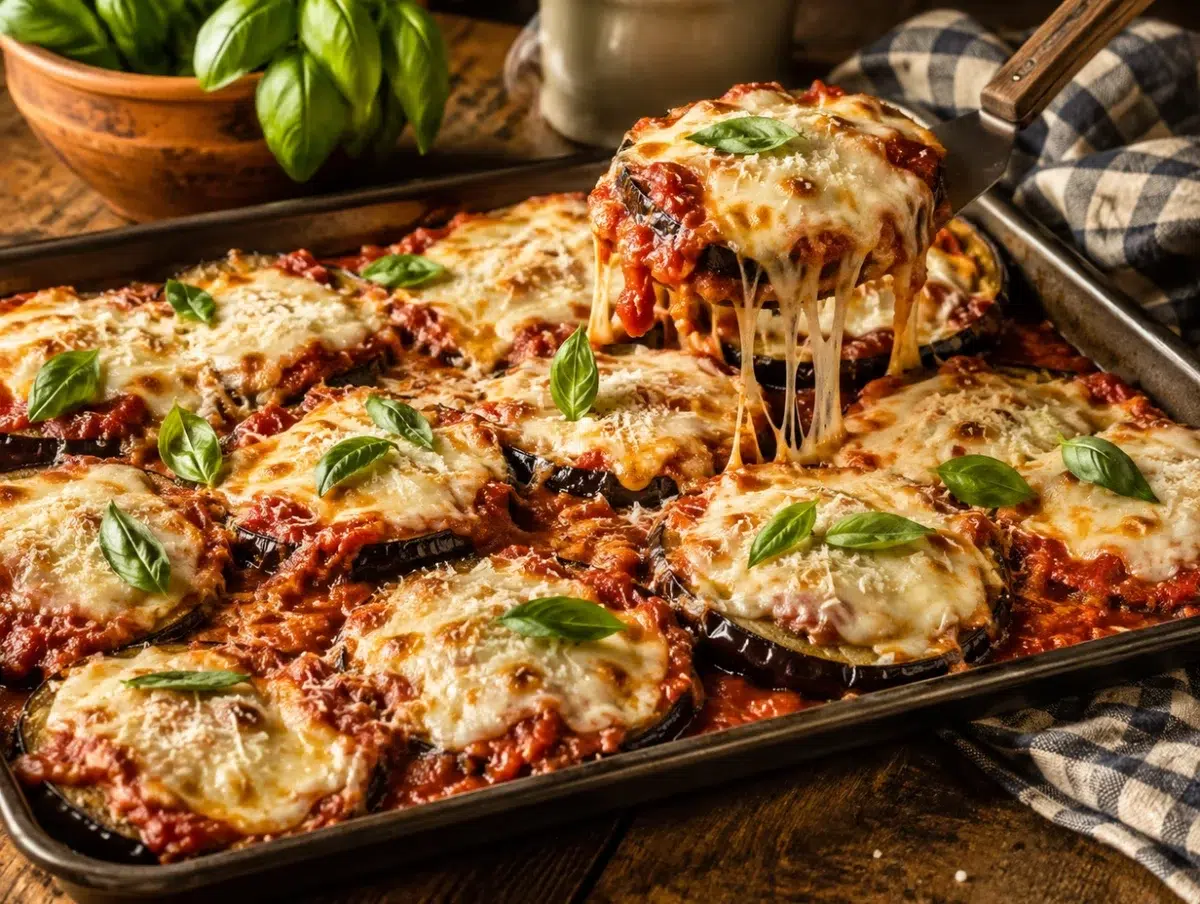
I still remember the evening light pouring through my yiayia’s kitchen window in Chania, turning everything the color of warm honey. She stood at the counter slicing aubergines — we just call them melitzanes — while the scent of simmering tomato sauce and dried oregano filled every corner of the house. Outside, the Cretan sea whispered against the rocks, and my grandfather’s old fishing nets hung drying on the terrace wall. I was maybe nine, standing on a wooden stool beside her, watching each thick round of eggplant disappear into a pan of shimmering olive oil. She would fry batch after batch until the kitchen felt like a sauna, oil spattering everywhere, flour dust coating the tiles. It was glorious chaos.
Decades later, in my tiny Athens apartment, I asked myself: does sheet pan eggplant parmesan (no-fry) actually work? Can you get that same crispy, golden crust without submerging slices in a centimeter of oil? After roughly 40 test batches — and one minor smoke alarm incident I’d rather not discuss — the answer is a definitive yes. This baked eggplant parmesan captures everything I loved about yiayia’s version: the shattering breadcrumb crust, the tender, almost creamy interior, the bubbling blanket of cheese and tomato sauce. But it’s lighter, simpler, and requires exactly one sheet pan. Whether you’re feeding a weeknight family table or impressing guests at a Saturday dinner, this Mediterranean eggplant recipe belongs in your rotation. Trust me on this.
Table of Contents
[IMAGE 1 — Hero shot placement]
Why This Sheet Pan Eggplant Parmesan Is Special
The No-Fry Technique That Changes Everything
Traditional eggplant parm demands deep-frying each breaded slice — a technique that, while delicious, leaves you with a greasy cooktop and roughly half a liter of used oil. This no fry eggplant parm takes a different path. By preheating the sheet pan and brushing it with just two tablespoons of extra-virgin olive oil (I use Kolymvari or Sitia estate oil — the kind my father would approve of), the bottom of each slice crisps through direct contact with scorching-hot metal.
Harold McGee explains in On Food and Cooking that the Maillard reaction — the same browning chemistry behind a perfectly seared steak — activates above 280 °F (138 °C). A preheated pan at 425 °F (218 °C) triggers that reaction almost instantly, giving you a golden, crunchy base without the oil bath.
Flavor Profile & Best Occasions
What you get is a healthy eggplant parmesan that tastes indulgent: smoky-sweet eggplant encased in a shatteringly crisp breadcrumb shell, draped in homemade tomato sauce that’s bright with garlic and basil, and finished with stretchy, golden-brown mozzarella. It’s the kind of dish that makes the whole house smell like a Southern Italian trattoria. Serve it on a Sunday when you want something impressive but low-effort, or on a Wednesday when you need a vegetarian sheet pan dinner that actually excites people. You’ll love this.
[IMAGE 2 — Ingredients flat lay placement]
The Story Behind the Dish
From Naples to the Mediterranean Table
Eggplant parmesan — or melanzane alla parmigiana, as the Italians say — traces its roots to Southern Italy, most likely Naples or Sicily, where aubergines arrived via Arab traders centuries ago. The dish became a celebration food, served on feast days and Sunday gatherings. Across the Mediterranean, versions emerged: in Greece, we have a cousin called melitzanes sto fourno, layered with béchamel and baked in a tapsi. The principle is the same — transform a humble vegetable into something extraordinary through layering, sauce, and cheese.
My Family’s Sunday Tradition
In my yiayia’s kitchen, eggplant dishes appeared every August when the garden overflowed with glossy purple fruit. She never measured anything — a handful of this, a splash of that — but the results were always perfect. My mother adapted the recipe when she married my father, adding a pinch of dried mint that became our family’s signature. When I started developing this oven baked eggplant version in 2019, I kept that mint. If my yiayia wouldn’t recognize it, it doesn’t belong in the recipe. But she would have recognized this one, I’m certain.
Essential Ingredients for Sheet Pan Eggplant Parmesan
Core Ingredients
Let me walk you through everything you need. Quality matters here — there are only a handful of components, so each one has to pull its weight.
[IMAGE 3 — Key ingredient close-up placement]
| Ingredient | Amount | Why It Matters | Authentic Pick | Substitution |
| Italian eggplant | 2 large (about 2 lb / 900 g) | Meaty texture, fewer seeds than globe | Sicilian or Italian variety | Globe eggplant (salt 30 min) |
| Panko breadcrumbs | 1½ cups (90 g) | Extra-crispy baked crust, lighter than Italian crumbs | Japanese panko | Gluten-free panko or crushed rice cereal |
| Parmesan cheese | ¾ cup (60 g), finely grated | Adds umami depth + helps browning | Parmigiano-Reggiano (24-month) | Pecorino Romano or nutritional yeast (vegan) |
| Low-moisture mozzarella | 8 oz (225 g), shredded | Melts evenly, browns without excess water | Fresh if you prefer stretch | Vegan mozzarella shreds |
| Marinara sauce | 2 cups (480 ml) | Ties layers together, adds acidity | Homemade San Marzano | Quality jarred marinara |
| Extra-virgin olive oil | 3 Tbsp (45 ml) | Crisps bottom, adds Mediterranean flavor | Kolymvari or Sitia Cretan oil | Avocado oil |
| Large eggs | 2 | Bind breadcrumbs to eggplant | Room temperature for better adhesion | Flax eggs (1 Tbsp ground flax + 3 Tbsp water each) |
| All-purpose flour | ½ cup (65 g) | Creates dry surface for egg to grip | Unbleached preferred | Chickpea flour (GF) or almond flour |
I buy my Parmesan from a small import shop in Athens that sources wheels directly from Emilia-Romagna — the difference between pre-grated and freshly grated is night and day. And the panko? Don’t skip it. I tried regular Italian breadcrumbs in my early tests and the result was dense, almost soggy. Panko’s coarser texture traps air pockets that stay crispy even under sauce and cheese.
Dietary Substitutions & Pro Tips
| Dietary Need | Replace | With | Notes |
| Gluten-Free | Panko + all-purpose flour | GF panko + chickpea flour | Results are nearly identical — tested 5x |
| Vegan | Eggs, Parmesan, mozzarella | Flax eggs, nutritional yeast, vegan mozz | Add 1 Tbsp olive oil to flax eggs for richness |
| Egg-Free | Eggs | Buttermilk or plain yogurt wash | Slightly tangier crust, still excellent |
| Lower Sodium | Parmesan + regular salt | Swiss cheese + reduced salt | Swiss melts well, less salty by 40% |
| Dairy-Free | All cheese | Cashew ricotta + vegan Parm | Blend soaked cashews with lemon and garlic |
Pro Tip: If you’re making the vegan version, toss 2 tablespoons of nutritional yeast directly into the panko mixture. It mimics that Parmesan savoriness beautifully — I’ve served this to non-vegan friends and they didn’t notice the swap.
Equipment & Technique Setup
Tools You’ll Need
[IMAGE 4 — Equipment/tools placement]
| Traditional Tool | Modern Alternative | Why It Matters |
| Heavy ceramic tapsi | Half-sheet pan (18×13 in / 46×33 cm) | Even heat distribution for crispy bottoms |
| Mortar and pestle | Food processor | Crushing breadcrumbs to ideal coarseness |
| Wire cooling rack | Same — no substitute | Elevates slices for airflow, prevents sogginess |
| Cast iron skillet | Stainless steel saucepan | For quick stovetop marinara |
| Microplane grater | Box grater, fine side | Finely grated Parmesan melts into breadcrumbs evenly |
Mise en Place & Workspace Setup
Before you touch a single eggplant, get organized. This is how we were trained at Varoulko, and it applies just as much at home. Set up a breading station: three shallow dishes in a row — flour, egg wash, panko mixture — left to right (reverse if you’re left-handed). Place your sheet pan in the oven and preheat to 425 °F (218 °C) for at least 10 minutes. Yes, preheat the pan. This is non-negotiable if you want that crispy baked eggplant bottom. Line a separate area with paper towels for salted eggplant rounds. Clear your counter — you’ll need space to move quickly through the breading assembly line.
Step-by-Step Instructions for Sheet Pan Eggplant Parmesan
Preparation (Steps 1–4)
Step 1: Salt and Drain the Eggplant. Slice your eggplant into ½-inch (1.3 cm) rounds. Arrange them in a single layer on paper towels and sprinkle both sides generously with kosher salt — about 1½ teaspoons total. Let them sit for 25–30 minutes. You’ll see beads of moisture forming on the surface. This is how we make it in Crete — the salt draws out the bitter liquid (technically, it pulls water through osmosis, reducing compounds like solanine). Pat every slice completely dry. Don’t skip this. Wet eggplant = soggy breadcrumbs.
Yiayia’s Tip: My grandmother would press each slice between her palms like she was wringing out a dishcloth. Dramatic? Maybe. Effective? Absolutely.
Step 2: Build the Breading Station. In dish one, spread the flour seasoned with ½ teaspoon each of garlic powder, salt, and black pepper. In dish two, whisk the eggs with 1 tablespoon of water (this thins the wash for even coating). In dish three, combine panko, ¼ cup grated Parmesan, 1 teaspoon dried oregano, ½ teaspoon dried basil, and a pinch of red pepper flakes. Toss with a fork until integrated.
[IMAGE 5 — Breading station / prep process placement]
Step 3: Bread Each Slice. Working one round at a time: dredge in flour (shake off excess), dip in egg (let the extra drip off for 2 seconds), then press firmly into the panko mixture on both sides. The secret is pressing hard — I mean really pressing — so the crumbs embed into the surface. Lay each breaded slice on a parchment-lined tray while you finish the rest. I’ve made this easy eggplant parmesan over 50 times now, and the pressing step is the single biggest factor in whether the crust stays on or falls off.
Step 4: Preheat and Oil the Pan. Your sheet pan should already be screaming hot inside the 425 °F (218 °C) oven. Carefully remove it (use thick oven mitts — I learned this the hard way with a towel that was too thin), and brush the surface with 2 tablespoons of olive oil. Work fast. The oil should shimmer almost immediately.
Cooking & Assembly (Steps 5–10)
[IMAGE 6 — Early cook / eggplant on sheet pan placement]
Step 5: Arrange Eggplant on Hot Pan. Place breaded slices in a single layer on the oiled pan. Don’t overlap. They should sizzle when they hit the surface — that’s the Maillard reaction starting instantly, exactly what we want. Leave about ½ inch between each slice for airflow.
Step 6: First Bake — Bottom Crisps. Bake at 425 °F (218 °C) for 12 minutes. Don’t open the oven. The bottom is developing that gorgeous golden crust through direct conduction from the hot metal. As J. Kenji López-Alt explains in The Food Lab, preheated surfaces create a sear effect similar to a cast-iron pan.
[IMAGE 7 — Mid-cook / flip stage placement]
Step 7: Flip for Even Crispiness. Using a thin spatula, carefully flip each slice. They should be deep golden on the underside. If they’re pale, give them 2–3 more minutes before flipping. Drizzle or brush the remaining tablespoon of olive oil over the tops. Return to the oven for another 10 minutes at the same temperature.
Step 8: Add Sauce and Cheese. Remove the pan. Spoon about 1½ tablespoons of marinara sauce onto each eggplant round, then pile on shredded mozzarella and a final dusting of Parmesan. The sauce goes first — it creates a moisture barrier that keeps the bottom crust from getting soggy. This is something I learned through trial and error (batch number 12, I think, when I put cheese directly on the eggplant and it turned into a rubbery mess).
[IMAGE 8 — Adding sauce and cheese placement]
Yiayia’s Tip: Tear a few fresh basil leaves and tuck them UNDER the cheese before the final bake. They’ll steam gently and infuse everything with fragrance without burning on top.
Step 9: Final Bake — Melt and Bubble. Return to the oven at 400 °F (204 °C) — dropping the temperature slightly prevents the breadcrumbs from over-browning while the cheese melts. Bake for 12–15 minutes until the mozzarella is bubbling and has golden-brown spots. The internal temperature of the eggplant should read about 200 °F (93 °C), which means it’s perfectly tender.
Step 10: Rest, Garnish, Serve. Let the pan rest for 5 minutes — this allows the cheese to set slightly so slices hold together when you lift them. Garnish with fresh torn basil, a drizzle of your best olive oil, and freshly cracked black pepper. Serve straight from the pan, family style, the way we do it in Crete. Golden. Crispy. Perfect.
[IMAGE 9 — Final baked stage / assembly placement]
The Secret Touches
Insider Techniques from My Kitchen
1. The Hot-Pan Sear: Preheating the sheet pan is the single most important trick. It mimics the effect of a deep fryer without the oil. The breading hits a surface well above 400 °F and begins crisping from the bottom up within seconds.
2. The Double-Parmesan Method: I mix Parmesan into both the breadcrumb coating AND sprinkle it on top before the final bake. The first layer adds savory crunch (the cheese melts into the crumbs during the initial bake, creating a kind of frico shell). The second layer browns under the broiler for that irresistible cheese crust.
3. The Basil-Under-Cheese Technique: Fresh herbs on top of a 400 °F bake turn black and bitter. Tucking them under the cheese lets them steam and infuse flavor without burning. My mother taught me this — she does the same with her baked fish.
[IMAGE 10 — Secret technique close-up placement]
4. The Dried-Mint Whisper: A quarter teaspoon of dried Cretan mint in the breadcrumb mixture adds a subtle herbal note that nobody can quite identify, but everyone notices. It’s our family’s signature. (If you can find tsai tou vounou — Greek mountain tea — crush a pinch of that in instead. Extraordinary.)
Common Mistakes to Avoid
| Mistake | What Happens | How to Fix It |
| Skipping the salting step | Soggy, watery eggplant that steams instead of crisps | Salt for 25–30 min and pat completely dry |
| Overcrowding the sheet pan | Slices steam rather than bake — no crunch | Use two pans if needed; leave ½ in gaps |
| Not preheating the pan | Pale, soft bottom crust that sticks | Preheat pan 10 min at 425 °F (218 °C) |
| Adding cheese directly on eggplant (no sauce barrier) | Cheese melts into crust, turns rubbery | Always spoon sauce first, then cheese on top |
| Slicing eggplant too thin | Burns before interior softens, crust falls apart | Keep slices ½ inch (1.3 cm) thick minimum |
Variations & Serving Ideas
Regional Twists & Modern Adaptations
In Crete, we often add a thin layer of creamy béchamel between the sauce and cheese — think of it as a bridge between Italian eggplant bake and Greek moussaka. On the mainland, some cooks fold roasted red peppers into the sauce for sweetness.
On the islands, I’ve seen versions topped with crumbled feta alongside mozzarella, which adds a tangy, salty punch. For a modern weeknight shortcut, skip the breading entirely: slice the eggplant, roast it plain until tender, then add sauce and cheese for the final 10 minutes. It won’t be as crispy, but it’s still delicious and takes half the time. The flavor approach works similarly to our gemista (Greek stuffed peppers and tomatoes), which also relies on simple, high-quality ingredients layered thoughtfully.
Accompaniments & Beverages
A crisp green salad dressed with lemon and olive oil is all you really need alongside this dish. If you want something heartier, serve it over spaghetti or alongside our classic Greek lemon rice pilafi — the bright citrus cuts through the richness beautifully.
For bread lovers, warm slices of our garlic Parmesan focaccia are ideal for mopping up extra sauce. Pair the whole meal with sparkling water infused with lemon and fresh mint, or brew a pot of chamomile tea for a genuinely Mediterranean experience. A cold glass of homemade lemonade with a sprig of rosemary also works wonderfully.
The leftovers, by the way, make incredible next-day sandwiches — tuck a reheated slice into crusty bread with a smear of basil pesto.
[IMAGE 11 — Side dish / table setting placement]
Storage & Reheating
How to Store Sheet Pan Eggplant Parmesan
| Method | Container | Duration | Notes |
| Refrigerator | Airtight glass container, single layer with parchment between layers | Up to 4 days | Cool completely before storing to prevent condensation |
| Freezer (assembled, baked) | Wrap individual portions in plastic wrap, then foil | Up to 3 months | Flash-freeze on a sheet pan first, then wrap |
| Freezer (breaded, unbaked) | Parchment-separated slices in freezer bag | Up to 2 months | Bake from frozen — add 5-7 extra minutes |
| Sauce (separate) | Mason jar or airtight container | Fridge 5 days / Freezer 4 months | Store sauce separately for best results |
Reheating for Maximum Crispiness
The oven is your best friend for reheating this eggplant parm recipe. Preheat to 375 °F (190 °C), place portions on a wire rack set over a sheet pan, and bake for 12–15 minutes until the cheese re-bubbles and the crust re-crisps. The wire rack prevents the bottom from going soggy — a trick I picked up from reheating crispy Greek chicken tenders, which have the same breading challenge. If you’re in a rush, a 3-minute stint under the broiler does wonders.
For microwave reheating (I know, I know — sometimes life demands it), cover loosely and heat for 90 seconds, then pop under the broiler for 1 minute to rescue the texture. Always add a few fresh basil leaves and a drizzle of olive oil after reheating to restore that just-made brightness.
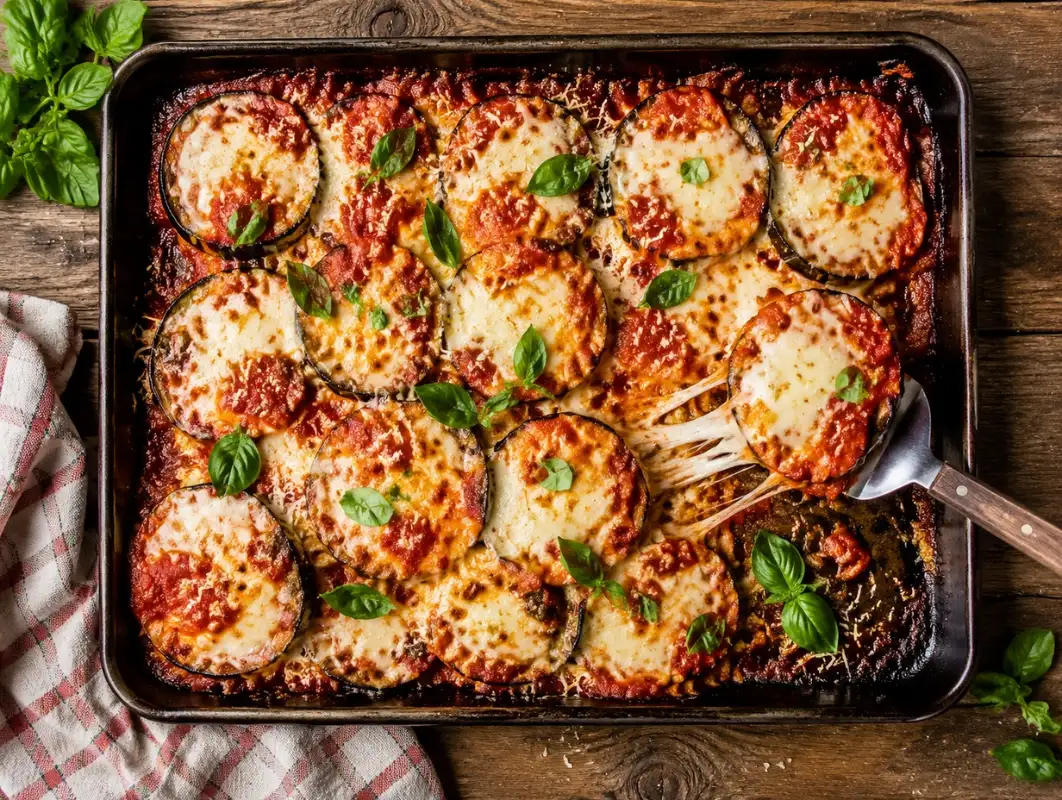
Sheet Pan Eggplant Parmesan (No-Fry)
Ingredients
Method
- Salt and drain the eggplant. Slice into 1/2-inch (1.3 cm) rounds, lay them in a single layer on paper towels and sprinkle both sides generously with about 1 1/2 teaspoons of kosher salt. Leave 25–30 minutes until beads of moisture form on the surface, then pat every slice completely dry. Wet eggplant means soggy breadcrumbs.
- Build the breading station. Dish one: the flour seasoned with 1/2 teaspoon each of garlic powder, salt and black pepper. Dish two: the eggs whisked with 1 tablespoon of water. Dish three: the panko with 1/4 cup grated Parmesan, the dried oregano, dried basil, a pinch of red pepper flakes and the dried mint if using.
- Bread each slice one at a time — dredge in flour and shake off the excess, dip in egg and let it drip for 2 seconds, then press firmly into the panko on both sides. Press hard, so the crumbs embed into the surface; this is the single biggest factor in whether the crust stays on. Lay the breaded slices on a parchment-lined tray.
- Preheat the oven to 425°F (218°C) with the sheet pan inside so it gets screaming hot. Remove it carefully with thick oven mitts and brush the surface with 2 tablespoons of olive oil — it should shimmer almost immediately.
- Arrange the breaded slices on the hot pan in a single layer with about 1/2 inch between them for airflow. They should sizzle the moment they hit the surface.
- Bake at 425°F for 12 minutes without opening the oven, while the bottom develops a golden crust through direct conduction from the hot metal.
- Flip each slice with a thin spatula — the underside should be deep golden; if pale, give them another 2–3 minutes first. Brush the tops with the remaining tablespoon of olive oil and return to the oven for 10 minutes.
- Remove the pan and spoon about 1 1/2 tablespoons of marinara onto each round, then pile on the shredded mozzarella and a final dusting of Parmesan. The sauce goes on first — it creates a moisture barrier that keeps the bottom crust crisp. Tuck a few torn basil leaves under the cheese so they steam rather than burn.
- Return to the oven at 400°F (204°C) — the lower temperature stops the breadcrumbs over-browning while the cheese melts — and bake 12–15 minutes until the mozzarella is bubbling with golden-brown spots and the eggplant reads about 200°F (93°C) inside.
- Rest the pan 5 minutes so the cheese sets and the slices hold together when lifted. Garnish with fresh torn basil, a drizzle of your best olive oil and cracked black pepper, and serve straight from the pan.
Notes
Frequently Asked Questions
Substitution & Technique Questions
Can I make sheet pan eggplant parmesan without breadcrumbs?
Absolutely. Skip the breading station and simply brush eggplant slices with olive oil before roasting. You’ll lose the crispy shell but gain a lighter, cleaner-tasting dish. I’ve done this many times when I want a quicker weeknight version — just roast at 425 °F for 20 minutes, flip, then add sauce and cheese.
Do I need to salt the eggplant first?
I strongly recommend it. Salting for 25–30 minutes draws out excess moisture that would otherwise make your breading soggy. Modern eggplant varieties are less bitter than they used to be, but the moisture issue remains. Think of it as insurance.
Can I use regular breadcrumbs instead of panko?
You can, but panko produces a noticeably crispier crust. Italian breadcrumbs are finer and denser, which means they absorb more oil and can turn heavy. If regular crumbs are all you have, pulse them in a food processor for 5 seconds to create some texture variation.
What’s the best eggplant variety for this recipe?
Italian eggplant (the elongated, deep purple variety) works best — it has fewer seeds, denser flesh, and less moisture than globe eggplant. Chinese or Japanese eggplant also work beautifully. If you only have globe, increase the salting time to 35 minutes. I’ve tested all three varieties and the results are consistently great, much like choosing the right vegetable for our Mediterranean chickpea power bowl.
Why is my breading falling off?
Three likely reasons: the eggplant wasn’t dry enough after salting, you didn’t press the panko firmly into the slices, or you skipped the flour step. The flour creates a dry, tacky surface that the egg wash grips. Without it, the coating slides right off. Press hard. Really hard.
Dietary, Make-Ahead & Authenticity Questions
Is this sheet pan eggplant parmesan healthy?
Compared to the traditional fried version, significantly so. We’re using about 3 tablespoons of olive oil total versus the 1–2 cups required for frying. Each serving comes in around 285 calories with 14g of protein. It’s naturally vegetarian and can be made gluten-free or vegan with simple swaps.
Can I assemble this ahead of time?
You can bread the eggplant slices up to 6 hours in advance — refrigerate them on a parchment-lined tray. I wouldn’t add sauce and cheese until you’re ready to bake, though, as the moisture will compromise the crust. The marinara can be made up to 3 days ahead.
Is melanzane alla parmigiana the same as eggplant parmesan?
Essentially yes — melanzane alla parmigiana is the Italian name. Regional variations exist: some versions in Naples use hard-boiled eggs, Sicilian versions sometimes include fried eggplant with no breading at all. Our Mediterranean take draws from both Italian roots and Greek baking traditions.
Can I make this in an air fryer?
Yes! Bread the slices the same way, spray or brush with olive oil, and air-fry at 400 °F (204 °C) for 8 minutes per side. Then transfer to an oven-safe dish, add sauce and cheese, and finish under the broiler. It’s similar to the approach we use for our Greek marinated chicken thighs in the air fryer.
What can I serve alongside this for a complete meal?
A simple arugula salad with shaved Parmesan, our Mediterranean white bean salad, or a side of roasted vegetables all pair beautifully. For something more substantial, try it alongside our spinach and feta pasta.
Bringing Greece to Your Table
A Final Reflection
There’s a Greek word — kerasma — that means the act of treating someone, offering them food from your heart. Every dish I share here is a kerasma, a small piece of the world I grew up in. This sheet pan eggplant parmesan (no-fry) is exactly that: the flavors of my yiayia’s kitchen, simplified for yours. I hope you make it, adapt it, make it your own. And when you do, I’d love to see it — drop a photo in the comments or tag me on social media. Your kitchens are extensions of mine, and nothing makes me happier than knowing these recipes are traveling.
More Mediterranean Recipes You’ll Love
If this recipe speaks to you, you’ll also enjoy our pasta alla Sorrentina, which layers that same tomato-mozzarella magic with tube pasta. For another baked vegetable centerpiece, try the gemista (Greek stuffed peppers and tomatoes) — it’s one of the most popular recipes on the site. And if you want a lighter complement for a multi-dish spread, our whipped feta and garlic confit dip disappears in minutes. For a complete Mediterranean dinner party, round it out with our Mediterranean sheet pan salmon as a seafood option.