I can still hear the wind whipping through the old shutters of my yiayia’s kitchen in Chania, the afternoon sunlight painting golden streaks across her worn marble countertop. She’d have a whole cauliflower sitting on the cutting board — fresh from old Manolis’s cart at the morning market — and she’d slice it into thick, dramatic slabs with the confidence of a woman who had been feeding a family of twelve for forty years. “Koita, Niko,” she’d say, holding up a perfect cross-section. “Look at this. Nature made this beautiful. Our job is not to ruin it.”
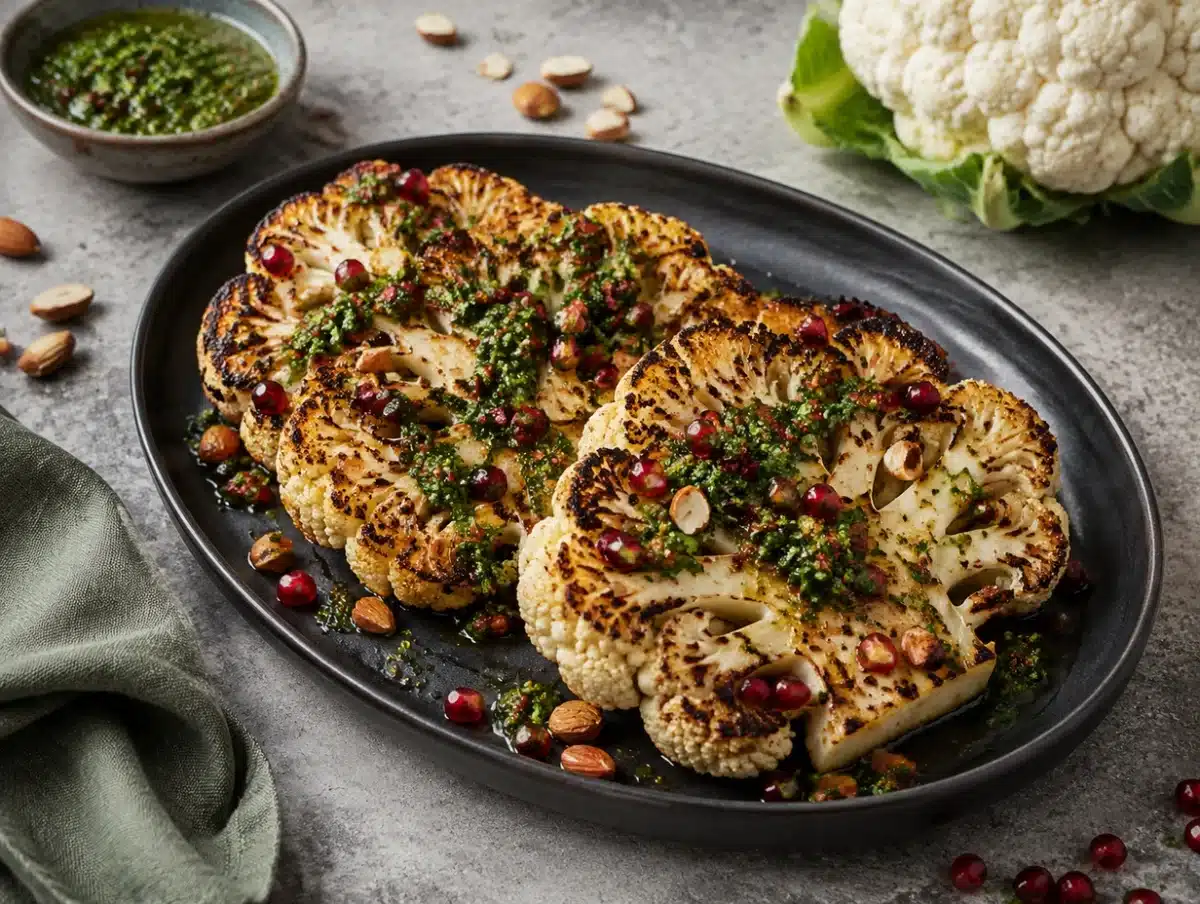
That memory is the reason these roasted cauliflower steaks with chimichurri exist on this blog. The technique is simple — high heat, good olive oil, patience — but the result is something that stops people mid-conversation at the dinner table. Golden. Crispy. Deeply caramelized. And then you spoon that bright, herbaceous chimichurri sauce over the top, and suddenly this humble vegetable becomes the centerpiece of your entire meal.
In Greece, we understand that vegetables deserve the same respect we give to lamb or fish. This cauliflower steak recipe is proof. Whether you’re hosting a Friday night dinner, need a stunning plant-based main course, or simply want to eat more vegetables without feeling like you’re missing out, this dish delivers. I’ve made it over 200 times, and I genuinely believe it’s one of the best things I’ve ever put on a plate. Trust me on this.
Table of Contents
Roasted Cauliflower Steaks with Chimichurri
Ingredients
Method
- 1. Preheat oven to 230°C (450°F). Heat a 12-inch cast iron skillet over medium-high heat for 5 minutes.
- 2. Trim cauliflower leaves and bases. Slice each head through the center, then cut 2.5 cm (1-inch) thick steaks from each half.
- 3. Brush steaks generously with olive oil on both sides. Season with salt and pepper.
- 4. Add 1 tbsp olive oil to skillet. Sear steaks 3–4 minutes per side until deeply golden.
- 5. Transfer skillet to oven. Roast 15–20 minutes until stem is knife-tender and edges are charred.
- 6. While steaks roast, combine all chimichurri ingredients in a bowl. Stir well and let sit.
- 7. Rest steaks 2–3 minutes. Spoon chimichurri generously over top. Finish with flaky salt and a drizzle of olive oil.
Notes
Why This Cauliflower Steak Recipe Is Special
The Sear-Then-Roast Technique
Most roasted cauliflower recipes just throw everything in the oven and hope for the best. Not this one. I start my cauliflower steaks in a screaming-hot cast iron skillet — 230°C (450°F) oven, but the sear happens on the stovetop first. Why? Because the Maillard reaction — that magical browning process Harold McGee describes so beautifully in On Food and Cooking — needs direct contact with intense heat. The proteins and natural sugars on the surface of the cauliflower caramelize, creating hundreds of new flavor compounds that you simply cannot get from oven roasting alone.
A Flavor That Commands the Table
The flavor profile here is a love letter to the Mediterranean: nutty, sweet caramelization from the roasted cauliflower paired with the punchy, herbaceous brightness of fresh chimichurri sauce. It’s simultaneously rich and refreshing. I serve this for everything from weeknight dinners to holiday gatherings, and every single time, someone asks for the recipe. You’ll love this combination — the crispy cauliflower against that garlicky herb sauce is genuinely addictive.
The versatility here is extraordinary. Serve it as the star of a plant-based dinner alongside our Mediterranean sheet pan salmon for a surf-and-turf twist, or pair it with a simple pasta primavera for a vegetable-forward feast.
The Story Behind the Dish
Where Crete Meets Argentina
Cauliflower has been a staple of Mediterranean cooking for centuries — the ancient Romans grew it, and it became a beloved winter vegetable across Greece, especially in Crete where the mild climate allows for gorgeous harvests. Chimichurri, on the other hand, is Argentina’s gift to the world. The marriage of these two traditions happened in my kitchen around 2019, when I was experimenting with herb sauces for roasted vegetables and realized the classic parsley-garlic-vinegar combination was practically designed for caramelized cauliflower.
My Yiayia’s Cauliflower Wisdom
In my yiayia’s kitchen, cauliflower was never an afterthought. She’d roast it in her tapsi with olive oil from our family’s trees in Kolymvari, sometimes with just lemon and oregano, and it was magnificent. “The secret is the oil, Niko,” she’d tell me. “You cannot be cheap with the oil.” She was right — and that lesson carries directly into this recipe. Good Cretan olive oil makes all the difference.
Essential Ingredients for Roasted Cauliflower Steaks with Chimichurri
Core Ingredients
Every ingredient here earns its place. When my mother taught me to cook, she used to say, “If something doesn’t have a reason to be in the pot, take it out.” I’ve tested this recipe with dozens of variations, and what you see below is the final, perfected version. My father used to bring home the most extraordinary cauliflower from the Chania market — dense, white heads with leaves still attached — and that’s exactly the quality you should look for.
| Ingredient | Amount | Why It Matters | Authentic Pick | Substitution |
| Cauliflower (large heads) | 2 heads (~800g each) | Dense heads yield thicker, sturdier steaks that won’t crumble | Firm, tight florets, white or cream | Romanesco or broccoflower |
| Extra-virgin olive oil | 4 tbsp (60 ml) | High smoke point EVOO creates the Maillard crust; adds fruity depth | Kolymvari or Sitia Cretan EVOO | Avocado oil |
| Fresh flat-leaf parsley | 1 large bunch (60 g) | Backbone of chimichurri; bright, peppery, grassy | Italian flat-leaf, stems removed | Fresh cilantro (50/50 blend) |
| Fresh oregano | 2 tbsp, finely chopped | Earthy, slightly bitter; classic Mediterranean herb | Greek dried oregano if fresh unavailable | Fresh marjoram |
| Garlic | 6 cloves, minced | Raw garlic in chimichurri gives pungent heat that mellows as it sits | Fresh, firm, no green sprouts | 2 tsp garlic paste |
| Red wine vinegar | 3 tbsp (45 ml) | Acid brightens the sauce and balances the richness of olive oil | Quality aged red wine vinegar | Sherry vinegar or lemon juice |
| Red pepper flakes | 1 tsp | Gentle warmth without overwhelming; adjustable to taste | Aleppo pepper or Marash pepper | Cayenne (use ½ tsp) |
| Flaky sea salt | To taste | Enhances every flavor; finish with flaky salt for texture contrast | Maldoni or Greek sea salt | Kosher salt |
A note on olive oil: I’ve tested this recipe with supermarket olive oil and with our family’s Kolymvari oil. The difference is night and day. (Is it worth the splurge? Always.) The same quality-first approach applies to other Mediterranean dishes — it’s what makes the difference.
If you’re building a Mediterranean pantry, the ingredients here overlap beautifully with recipes like our Mediterranean shrimp and white bean salad and our creamy tomato basil chicken — stock up on good olive oil, fresh herbs, and quality vinegar and you’re halfway to a dozen meals.
Dietary Substitutions & Smart Swaps
| Need | Replace | With | Notes |
| Nut-free | Pine nuts (if adding) | Sunflower seeds or pumpkin seeds | Toast them lightly for similar crunch |
| Low-sodium | Sea salt | Lemon zest + herbs | Brightness compensates for reduced salt |
| AIP / Nightshade-free | Red pepper flakes | Ginger + extra black pepper | Omit paprika; use turmeric for color |
| Oil-free chimichurri | Olive oil in sauce | Vegetable broth + 1 tbsp tahini | Less rich but still flavorful |
| Vinegar-free | Red wine vinegar | Fresh lemon juice (equal amount) | Slightly sweeter; very Mediterranean |
Pro Tip: Buy cauliflower with the leaves still on — they protect the florets during transport and tell you how fresh the head is. Bright green, perky leaves mean your cauliflower was harvested recently. Don’t throw those leaves away either: toss them with olive oil and roast them alongside the steaks. They’re delicious.
Equipment & Technique
Traditional vs. Modern Tools
| Traditional Tool | Modern Alternative | Why It Matters |
| Clay tapsi (roasting dish) | 12-inch cast iron skillet | Heavy material retains heat for superior sear and even roasting |
| Wood-fired oven | Conventional oven at 230°C / 450°F | Intense dry heat mimics the crust a wood oven creates |
| Mortar and pestle (for chimichurri) | Sharp chef’s knife, hand-chopped | Hand-chopping gives better texture than a food processor; avoids bruising herbs |
| Olive wood cutting board | Any large stable cutting board | Broad surface needed for safely slicing cauliflower heads into steaks |
Mise en Place: Your Workspace Setup
Before you start — and I cannot stress this enough — get everything ready. In culinary school at Le Monde, my chef instructor used to say mise en place is not a suggestion, it’s a philosophy. Here’s what to do: Preheat your oven to 230°C (450°F) with a rack in the center position. Get your cast iron skillet heating on medium-high for at least 5 minutes. Mince all your garlic, chop your herbs, measure your vinegar. Line a sheet pan with parchment as backup. Have your best olive oil within arm’s reach. When that skillet starts lightly smoking? You’re ready.
Step-by-Step: How to Make Roasted Cauliflower Steaks with Chimichurri
Preparation (Steps 1–4)
Step 1: Select and Trim the Cauliflower. Choose two large heads of cauliflower with firm, tightly packed florets — this is crucial for steaks that hold together. Remove the outer leaves (save them!). Trim the very bottom of the stem to create a flat base, but don’t cut too much — that core is what keeps everything connected. I learned this the hard way when I got overenthusiastic with my knife and ended up with a pile of florets instead of steaks. Don’t skip this.
Step 2: Cut the Steaks. Place the cauliflower stem-side down on a stable cutting board. Using a large, sharp chef’s knife, slice straight down through the center. Then cut one 2.5 cm (1-inch) thick steak from each half, keeping the core attached. You’ll get 2–3 good steaks per head. The outer pieces will fall into florets — don’t discard them! They roast beautifully alongside the steaks and make tomorrow’s lunch.
Yiayia’s Tip: My yiayia always said to cut cauliflower with one confident motion, never sawing back and forth. “The knife does the work, Niko. You just guide it.” She was right — a single clean cut gives you much cleaner steaks.
Step 3: Season Generously. Lay the steaks on a sheet pan and brush both sides liberally with extra-virgin olive oil — about 1 tablespoon per steak. Season with flaky sea salt and freshly cracked black pepper. (Here’s where most people go wrong: they’re too timid with the oil. The oil is what creates that golden, crispy crust. Be generous.)
Step 4: Make the Chimichurri Sauce. While your skillet heats, finely chop the parsley — and I mean by hand, not in a food processor. A food processor bruises the herbs and turns them into a paste. As J. Kenji López-Alt explains in The Food Lab, hand-chopping preserves the cell structure of the herbs, keeping the flavors brighter and the color more vivid. Combine the parsley, oregano, minced garlic, red pepper flakes, red wine vinegar, and ¼ cup olive oil in a bowl. Stir, taste, and adjust salt. Let it sit while you cook — the flavors will marry and deepen.
Cooking & Assembly (Steps 5–10)
Step 5: Sear the Steaks. Add 1 tablespoon of olive oil to your screaming-hot cast iron skillet. Carefully lay the cauliflower steaks in the pan — you should hear an aggressive sizzle. If you don’t? The pan isn’t hot enough. Wait. Sear for 3–4 minutes without moving them until the bottom is deeply golden brown. This is the Maillard reaction doing its thing, and it’s beautiful.
Step 6: Flip and Transfer to Oven. Using a large spatula (or two, for stability), carefully flip each steak. Transfer the entire skillet to the preheated oven at 230°C (450°F). If your skillet isn’t oven-safe, transfer steaks to a parchment-lined baking sheet.
Step 7: Roast Until Tender. Roast for 15–20 minutes. Here’s how you know they’re done: a knife should slide through the thickest part of the stem with zero resistance — like butter. The edges will be deeply caramelized, almost charred in spots. That’s exactly what you want. The interior should be creamy and tender while the exterior stays crispy.
Yiayia’s Tip: My yiayia never used a timer for roasting vegetables. She’d say, “Use your nose, Niko. When the kitchen smells sweet and nutty, it’s ready.” Honestly? She was almost always right.
Step 8: Rest Briefly. Let the steaks rest on the pan for 2–3 minutes. (Yes, just like a proper cut of meat.) This allows the residual heat to finish cooking the very center and the juices to settle.
Step 9: Spoon on the Chimichurri. Transfer each steak to a warmed plate. Give your chimichurri a good stir, then spoon it generously over the top. Don’t be shy. The warm cauliflower will absorb the sauce slightly, creating layers of flavor with every bite.
Step 10: Garnish and Serve. Finish with an extra drizzle of your best olive oil, a scatter of flaky sea salt, and a squeeze of fresh lemon juice if desired. Serve immediately while the contrast between crispy exterior and creamy interior is at its peak. Golden. Crispy. Perfect. A side of sweet potato puree makes this a truly elegant plate, or keep it simple with warm pita and a drizzle of tahini.
The Secret Touches
Insider Techniques from a Greek Kitchen
The Pre-Heat Soak. Before searing, I soak my cauliflower steaks in warm salted water for 10 minutes. This seasons the interior and also drives out any hidden grit or insects — something my mother taught me after my father brought home market cauliflower that had… surprises. The salt also begins to break down the cell walls, leading to a more tender, creamier interior after roasting.
The Two-Oil Method. I use a robust everyday olive oil for the initial sear (it handles high heat without burning), then drizzle my best Kolymvari EVOO over the finished dish. Two different oils, two different purposes. The first builds the crust; the second adds fruity, peppery flavor that would be destroyed by high heat.
The Vinegar Bloom. I let my chimichurri sit for at least 15 minutes before serving. As food scientist Harold McGee explains, the acid in the vinegar softens the raw garlic’s harsh bite, creating a mellower, rounder flavor. Patience pays off.
The Smash Technique. For extra crispy edges, I gently press the cauliflower steak with a spatula during the first 30 seconds of searing. This maximizes surface contact with the hot pan, accelerating caramelization. Don’t press too hard or it’ll crumble.
Common Mistakes (And How to Fix Them)
| Mistake | What Happens | How to Fix It |
| Cutting steaks too thin | They fall apart during flipping and turn into florets | Cut at least 2.5 cm (1 inch) thick; keep core attached |
| Pan not hot enough | No sear, pale color, steaming instead of browning | Preheat cast iron 5+ minutes; oil should shimmer and lightly smoke |
| Using food processor for chimichurri | Herbs turn into a bitter, dark green paste | Hand-chop with a sharp knife; it takes 5 minutes and the texture is superior |
| Overcrowding the skillet | Steam builds up; cauliflower stews instead of searing | Sear in batches of 2–3 steaks max; leave space between them |
| Skipping the rest | Cut too early and the interior is slightly underdone | Rest 2–3 minutes after roasting; carry-over heat finishes the job |
Variations & Serving Suggestions
Regional Variations & Modern Twists
This is how we make it in Crete, but the beauty of this cauliflower steak recipe is its adaptability. On the Greek mainland, cooks often add smoked paprika and cumin to the seasoning for a warmer, earthier profile. On the islands — think Santorini and Mykonos — you’ll find versions topped with caper berries and sun-dried tomatoes instead of chimichurri, leaning into that sharp, briny Aegean flavor. For a modern weeknight shortcut, skip the stovetop sear entirely and roast the steaks directly on a preheated sheet pan at 230°C (450°F) for 25–30 minutes, flipping halfway. You lose a little caramelization depth, but you gain simplicity.
For a completely different herb sauce, try a Greek-style gremolata — or top the steaks with a generous spoonful of cheese sauce with feta for an indulgent twist. If you’re looking for a heartier vegetable-forward dinner, our gemista (Greek stuffed peppers and tomatoes) makes a beautiful companion dish.
Perfect Pairings & Accompaniments
These roasted cauliflower steaks pair brilliantly with a bed of classic Greek lemon rice pilafi for a satisfying vegan main course. If you want something lighter, a crisp Mediterranean white bean salad complements the richness of the caramelized cauliflower beautifully. For a protein boost, serve alongside our Mediterranean chickpea power bowl.
For non-alcoholic beverages, I love sparkling water infused with fresh mint and cucumber, or a warm cup of tsai tou vounou (Greek mountain tea) if the weather is cool. A glass of cold homemade lemonade with a sprig of rosemary is also lovely alongside this dish. For dessert, our Greek yogurt panna cotta provides a light, elegant finish after such a vibrant main.
Storage & Reheating
How to Store Roasted Cauliflower Steaks
| Method | Container | Duration | Notes |
| Refrigerator | Airtight glass container | 3–4 days | Store steaks and chimichurri separately for best texture |
| Freezer (steaks only) | Freezer-safe bag, air removed | Up to 2 months | Texture softens slightly; best for use in grain bowls or wraps |
| Chimichurri (fridge) | Small glass jar with lid | Up to 7 days | Flavor improves over first 24 hours; stir before using |
| Chimichurri (freezer) | Ice cube tray, then bag | Up to 3 months | Freeze in cubes; thaw at room temperature for 20 minutes |
Reheating for Best Results
The oven is your best friend for reheating. Preheat to 200°C (400°F), place steaks on a parchment-lined baking sheet, and heat for 7–8 minutes until warmed through and the edges re-crisp. For the stovetop, use a hot skillet with a drizzle of olive oil — 2 minutes per side brings back that beautiful sear. The microwave works in a pinch (90 seconds on high, covered), but you’ll lose the crispiness. Whatever method you use, always add fresh chimichurri after reheating, never before. The heat would dull the bright herb flavors. A final squeeze of lemon and a pinch of flaky salt will make leftover roasted cauliflower taste almost as good as fresh.
Leftover cauliflower steaks are fantastic crumbled over our Mediterranean hummus breakfast bowl the next morning, or chopped and tossed into a grilled chicken Mediterranean bowl for a quick lunch.
Frequently Asked Questions
Substitution & Technique Questions
Can I grill cauliflower steaks instead of roasting them?
Absolutely! Brush them with olive oil, season well, and grill over medium-high heat for 5–6 minutes per side until charred and tender. Grilling adds a wonderful smoky dimension that pairs even better with chimichurri sauce. Just make sure to oil your grill grates well so the steaks don’t stick. I do this all summer on my balcony in Athens.
Grilled cauliflower steaks are especially wonderful as part of a bigger Mediterranean spread — try them alongside our pesto pasta with grilled chicken or our creamy chicken orzo for a memorable summer dinner.
What can I use instead of red wine vinegar in the chimichurri?
Fresh lemon juice is my top substitute — it’s what my yiayia would have used anyway. Sherry vinegar or white wine vinegar also work beautifully. The key is maintaining that acidic brightness. Without it, the sauce falls flat. I’d use the same quantity as the vinegar called for in the recipe.
How do I keep my cauliflower steaks from falling apart?
The secret is keeping the core (stem) intact. That central core is the glue that holds each steak together. Cut through the center of the cauliflower and make sure every slice has a section of the core attached. Thicker slices (at least 2.5 cm) also help significantly.
Can I use dried herbs in the chimichurri?
I’d strongly advise against it. Fresh herbs chimichurri is what makes this dish sing — the vibrancy, the color, the aroma. Dried herbs will give you a dull, muted sauce. If you can’t find fresh parsley, try fresh cilantro or even fresh basil as a substitute before reaching for dried.
Dietary, Make-Ahead & Authenticity Questions
Is this recipe vegan and gluten-free?
Yes and yes! These roasted cauliflower steaks with chimichurri are naturally vegan, gluten-free, low carb, and Whole30-compliant. They’re also soy-free and nut-free (unless you add optional toppings). It’s one of the most allergen-friendly showstopper recipes I know.
Can I make the chimichurri ahead of time?
You should! Chimichurri sauce actually improves after resting in the fridge for a few hours — the flavors meld and the garlic mellows. Make it up to 2 days ahead. Just bring it to room temperature before serving and give it a good stir. I always have a jar of this herb sauce for vegetables in my fridge.
Is this an authentic Greek recipe?
The cauliflower roasting technique is absolutely rooted in Greek tradition — my family has been roasting vegetables in olive oil and sea salt for generations. The chimichurri is an Argentinian addition that I fell in love with and adapted to our Mediterranean palate. So it’s a fusion, but one that my yiayia would approve of (I think).
How many servings does this make as a main course?
As a plant-based main course, plan on one large steak per person, which means two cauliflower heads serve roughly 4–6 people. As a healthy side dish, you can slice each steak in half and easily serve 8–10. The chimichurri recipe makes about 1 cup, which is plenty for 6 steaks with extra for dipping.
Can I add cheese or other toppings?
Of course! Crumbled feta is magnificent on top (very Greek). Toasted pine nuts or pumpkin seeds add great crunch. For a richer version, a dollop of our whipped feta and garlic confit dip alongside is absolutely heavenly. Just keep in mind that adding cheese will make it no longer vegan.
Cultural Closing
Bringing Greece to Your Table
Every time I make these roasted cauliflower steaks with chimichurri, I’m transported back to that kitchen in Chania — the sound of sizzling olive oil, the smell of roasting vegetables, my yiayia humming an old Cretan song. That’s what cooking should be: a connection to somewhere, to someone, to a story worth telling. I hope this recipe becomes part of your story too. Make it for the people you love. Make it on a Tuesday because you deserve something beautiful on a Tuesday. And when you do, drop me a comment below or tag me on social media with your photos — nothing makes my day more than seeing these dishes come to life in kitchens around the world.
More Mediterranean Recipes to Explore
If you loved this dish, you’ll want to try our gemista (Greek stuffed peppers and tomatoes) for another stunning vegetable-forward meal. For weeknight ease, our Mediterranean keto ground chicken skillet comes together in under 30 minutes. And if you’re in the mood for something comforting, our lahanorizo (Greek cabbage rice) is pure Cretan soul food that pairs wonderfully with fresh chimichurri on the side.