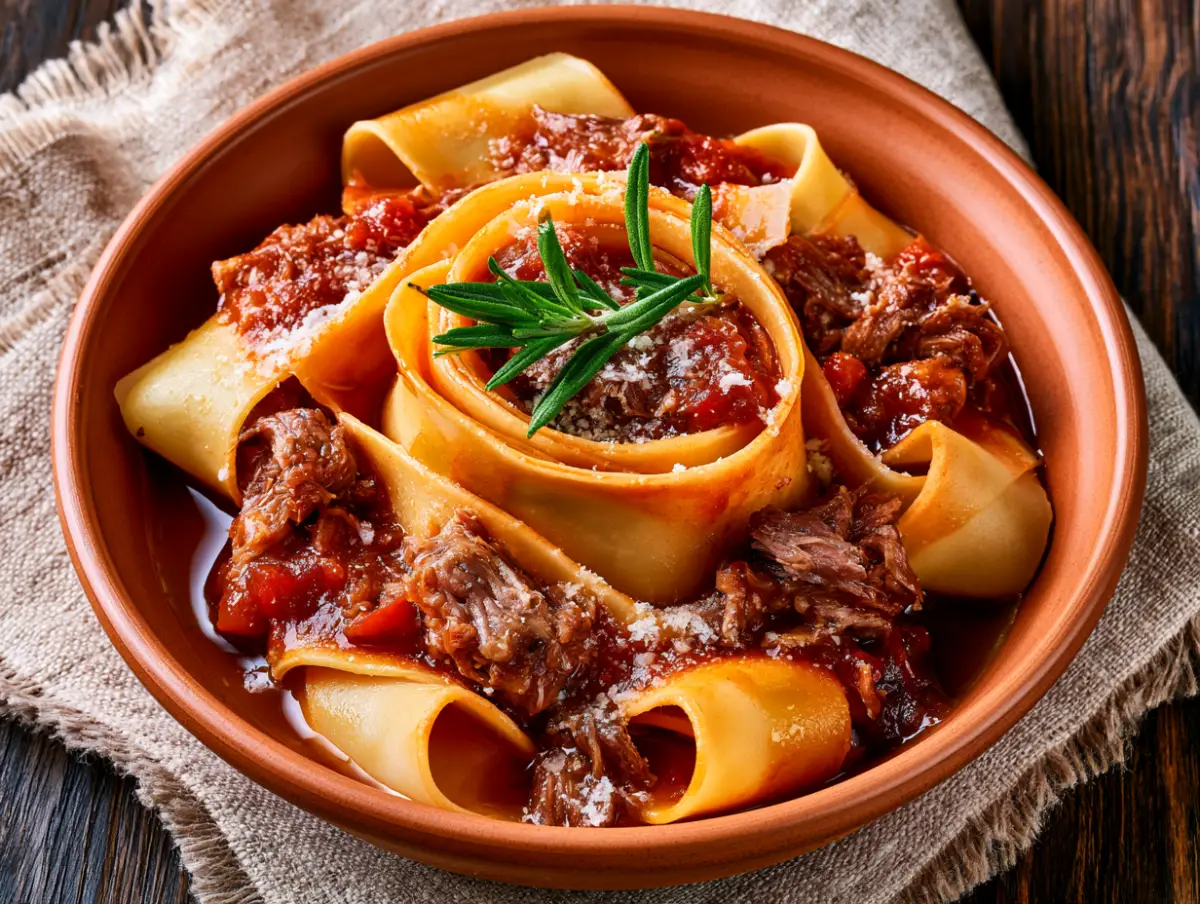
Can we talk about how a dish you spend three hours making on a Sunday can feel like the single greatest culinary achievement of your week? Because that is exactly what Lamb Ragu Pappardelle does. One Dutch oven. A handful of humble ingredients. Low heat, long time, and the most extraordinary transformation of a tough lamb shoulder into something so rich, so deeply flavored, so meltingly tender that the meat shreds at the touch of a fork. Then it goes over wide, silky ribbons of pappardelle. And suddenly you’re not in your kitchen anymore — you’re in Tuscany.
This is the Sunday project dinner. The one you start in the morning, let the oven do all the work while you go about your weekend, and plate just as the house fills with that extraordinary braising aroma — lamb, rosemary, tomato, warming spices. My father’s side of the family in Tuscany cooked lamb this way every Easter — agnello al forno, slow and patient, filling the whole farmhouse with warmth. I’ve adapted that tradition into a rich, silky braised lamb ragu that pairs beautifully with wide pappardelle and a nutritional profile that genuinely fits the Mediterranean Diet framework.
Here’s what you’re getting: lamb shoulder — one of the most nutrient-dense and budget-friendly cuts of lamb — braised for 2½ hours until fork-tender, then shredded into a luscious pomegranate-and-tomato-based sauce with a classic soffritto, rosemary, and Kalamata olives. Served over wide egg pappardelle with freshly grated Pecorino and a drizzle of EVOO. This Lamb Ragu Pappardelle is a meal prep champion (the ragu gets better on days two and three), fully dairy-optional, and one of the most impressive dinners you can put on a table. You’ve absolutely got this. 🐑
Table of Contents
Lamb Ragu Pappardelle
Ingredients
Method
- 1. Preheat oven to 325°F / 163°C. Pat lamb pieces completely dry. Season all over with salt and pepper.
- 2. Sear lamb in batches: Heat EVOO in Dutch oven over medium-high. Brown lamb on all sides 4–5 min per side. Work in 2–3 batches — do not crowd. Remove to plate.
- 3. Build soffritto: Reduce heat to medium. Cook onion, carrot, and celery in the same pot 12–15 min until deeply softened and golden. Add garlic and cook 2 more minutes.
- 4. Add tomato paste: Stir in tomato paste and cook 2 min. Pour in pomegranate juice and broth, scraping all browned bits from the pot. Add hand-crushed tomatoes. Nestle rosemary bundle and bay leaves. Return lamb and all juices to the pot.
- 5. Braise: Bring to a gentle simmer, cover tightly, and transfer to the oven. Braise 2½ hours without lifting the lid. Lamb is done when it shreds at a fork’s touch.
- 6. Shred and finish ragu: Discard rosemary and bay leaves. Shred lamb with two forks. Add Kalamata olives if using. Taste and adjust seasoning. Simmer uncovered 10 min if sauce needs thickening.
- 7. Cook pappardelle: Bring generously salted water to a boil. Cook pappardelle 1–2 min shy of al dente. Reserve 1 cup pasta water before draining.
- 8. Finish in ragu: Transfer pasta to Dutch oven over medium-low. Add ¼ cup pasta water and fold gently into the ragu for 2–3 min until pasta is al dente and sauce coats every ribbon.
- 9. Plate: Twirl into warm wide bowls. Top generously with lamb shreds and sauce. Finish with Pecorino, a drizzle of EVOO, and optional lemon zest.
Notes
Why You’ll Love This Recipe
Health & Nutrition Benefits
I know braised lamb might not be the first thing that comes to mind when you think healthy, but bear with me — and my Barcelona nutrition degree — for a moment. Lamb shoulder is a genuinely nutrient-dense protein source. A single 4-ounce serving provides over 25g of complete protein and meaningful amounts of zinc (essential for immune function), iron (heme iron, the most bioavailable form), B12, and selenium (a potent antioxidant cofactor). The USDA nutritional database records lamb as one of the richer dietary sources of conjugated linoleic acid (CLA), a fatty acid studied for potential anti-inflammatory and metabolic benefits. The long, slow braise in this lamb ragu pappardelle also breaks down collagen in the shoulder into gelatin — making the sauce naturally unctuous without any cream, and providing gut-supporting glycine in the process.
The tomato-and-pomegranate braising liquid adds lycopene and polyphenolic antioxidants. Kalamata olives bring oleic acid (the same heart-healthy fat as olive oil) and anthocyanins. And rosemary contributes rosmarinic acid and carnosol — both well-studied anti-inflammatory phytocompounds. This is comfort food with genuine nutritional substance.
- ⚡ 2½ hours hands-off oven time — active prep is only 30 minutes
- 💚 Packed with heme iron, zinc, B12, selenium & CLA from lamb shoulder
- 🍱 Ragu freezes for 3 months — the ultimate make-ahead feast
- 🍽️ Serves 6 generously for under $25 total — exceptional value
- ❄️ Flavor peaks on day 2 and 3 — the world’s best leftovers
Practical Benefits
The practical genius of braised lamb ragu is that most of its time is completely hands-off. You spend about 30 active minutes at the stove (browning lamb, building soffritto, building the sauce), then the oven does 2½ hours of patient, invisible work while you do anything else — laundry, a walk on the beach, a good book. The result is a rich lamb sauce that stores and reheats beautifully for 5 days in the fridge or 3 months in the freezer. Make it on Sunday and have restaurant-quality lamb pappardelle dinner waiting all week. It also scales effortlessly — double the batch costs almost nothing extra and gives you enough freezer portions to last weeks. For special-occasion cooking that impresses without stress: this is your recipe.
The Mediterranean Diet Connection
How This Dish Fits Mediterranean Diet Principles
The Mediterranean Diet is not, contrary to popular belief, exclusively plant-based or light. Traditional Mediterranean eating includes lamb and other meats — consumed in moderate portions, paired with abundant vegetables, whole grains, and quality olive oil. Lamb appears prominently in Greek, Turkish, Spanish, and Southern Italian food traditions precisely because it thrives on Mediterranean hillside pastures. The PREDIMED study validated that it’s the overall dietary pattern that drives health outcomes — and this Italian lamb ragu fits that pattern beautifully: quality protein in an appropriate portion, vegetable-forward soffritto, extra-virgin olive oil as the cooking fat, tomatoes, olives, fresh herbs, and whole-grain or egg pasta. Abundance and balance, not restriction.
Maya’s Personal Wellness Connection
Easter in Tuscany meant one thing: lamb. My nonno raised a small flock on the hillside behind the farmhouse, and every spring the village macelleria (butcher) would be lined with lamb shoulders, shanks, and legs for a week. My nonna’s braised lamb was legendary — rosemary and garlic, long and slow, the entire house perfumed for hours. I’ve carried that sensory memory my whole life. Living in San Diego now, I source my lamb from the Saturday farmers market where a local rancher brings pasture-raised shoulders every week. Standing at that market stall, I think of my father’s market stall in Tuscany and feel the whole tradition alive. This slow braised lamb is the bridge between those worlds — and making it never fails to feel like an act of care, for yourself and for whoever gets to eat with you.
Essential Ingredients
Core Ingredients
Great Lamb Ragu Pappardelle is about choosing the right cuts and building flavor in layers. Here’s every ingredient and exactly why it matters:
| Ingredient | Amount | Why It’s Great | Best Pick | Substitution |
| Bone-in lamb shoulder | 2.5–3 lbs / 1.1–1.4kg | Highest collagen content — dissolves into gelatin during braise for silky sauce; rich lamb flavor; excellent protein and mineral profile | Bone-in shoulder from a halal butcher or farmers market — pasture-raised when possible | Bone-in lamb shanks (spectacular but more expensive); boneless lamb shoulder (reduce braise to 2 hrs) |
| Pappardelle pasta | 12–14 oz / 340–400g dry (or 1 lb fresh) | Wide, flat ribbons grip the rich lamb sauce beautifully; classic pairing for heavy Italian ragus | Dry egg pappardelle (Cipriani or De Cecco brands); fresh pappardelle from a pasta shop for occasions | Wide egg noodles; rigatoni or pappardelle-cut tagliatelle; gluten-free pappardelle (Jovial) |
| Soffritto: onion, carrot, celery | 1 large onion, 2 carrots, 3 celery stalks | Classic Italian vegetable base — sweetness, depth, body; carrot provides beta-carotene; celery provides anti-inflammatory phthalides | Fresh, roughly diced — no need to be precise as they will cook down fully | Shallots for onion; parsnip for extra sweetness in place of some carrot |
| Garlic cloves | 5–6 cloves, crushed | Allicin = anti-inflammatory and immune-supporting; aromatic depth that melds into the braise perfectly | Fresh whole cloves, skin removed, lightly crushed with the flat of a knife | ¼ tsp garlic powder per clove as last resort only |
| Canned San Marzano whole tomatoes | 1 can (28 oz / 794g) | Bright acidity; lycopene antioxidants; authentic Italian tomato base for the braise | Mutti or Bianco DiNapoli DOP San Marzano — quality matters here | 2 lbs (900g) fresh plum tomatoes, roughly chopped; or Pomi strained tomatoes |
| Pomegranate juice + lamb/beef broth | ½ cup (120ml) pomegranate juice + 1 cup (240ml) broth | Pomegranate replaces the acidity and depth of red wine; polyphenol-rich; gorgeous color; broth provides gelatin and umami body | 100% pomegranate juice (Pom Wonderful); quality low-sodium lamb or beef broth | All broth only (slightly less complex); balsamic vinegar splash (2 tbsp) + broth for wine-alternative depth |
| Fresh rosemary + bay leaves | 3 sprigs rosemary + 2 bay leaves | Rosemary’s rosmarinic acid = anti-inflammatory; woodsy, piney fragrance classic to Italian lamb; bay adds subtle eucalyptus warmth | Fresh rosemary sprigs — tie with twine for easy removal; fresh or dried bay leaves | Dried rosemary (1 tsp) + thyme (1 tsp) if fresh unavailable |
| Kalamata olives (optional) | ⅓ cup / 55g pitted, halved | Briny, savory pop that balances the richness of the lamb; oleic acid (heart-healthy fat); classic Greek-Italian pairing | Kalamata olives packed in brine or olive oil — avoid canned black olives | Castelvetrano olives for milder flavor; omit entirely for a simpler ragu |
🐑 Maya’s Tip: Brown your lamb shoulder in batches in a very hot pan — don’t crowd the pot. This is the Maillard reaction at work: the high heat caramelizes the surface proteins and sugars into hundreds of complex flavor compounds that define the depth of your ragu. Rushing this step or over-crowding (which steams rather than sears) is the single biggest lost opportunity in braised dishes. Patience here pays dividends in every bite.
Dietary Modifications
This lamb ragu sauce is naturally flexible. Here’s how to adapt it:
| Dietary Need | Replace | With | Notes |
| Dairy-Free | Pecorino/Parmigiano finish | Nutritional yeast (2 tbsp) or high-quality dairy-free Parmesan (Violife) | The ragu itself contains zero dairy — only the optional cheese garnish |
| Gluten-Free | Regular pappardelle | Jovial brown rice pappardelle or Tinkyada GF pasta | Cook GF pasta al dente (it continues absorbing sauce); reserve extra pasta water |
| Lower Calorie | Full lamb shoulder | Lean ground lamb (1.5 lbs / 680g) — cook faster (45 min) but less textural depth | Ground lamb version is still excellent and saves time; reduce oil to 1 tbsp |
| Extra Vegetables | Plain tomato base | Add 2 cups diced zucchini + 1 cup mushrooms in the last 45 min of braise | Mushrooms especially complement the earthy lamb and add B vitamins |
| Paleo / Grain-Free | Pappardelle pasta | Serve ragu over creamy cauliflower mash, polenta (if corn is accepted), or spiralized zucchini noodles | The lamb ragu itself is naturally grain-free |
| Higher Fiber | Regular egg pappardelle | Whole wheat pappardelle (De Cecco brand) or chickpea pappardelle (adds 8g fiber per serving) | Earthier flavor pairs beautifully with the robust lamb sauce |
Equipment & Quick Prep
Equipment Overview
| Tool | Why It Helps | Alternative |
| Dutch oven or heavy oven-safe pot (6–8 qt) | ESSENTIAL: even heat distribution for searing and braising; tight-fitting lid traps moisture; goes from stovetop to oven | Any heavy oven-safe pot with lid; a high-sided skillet + foil lid for braising in a pinch |
| Sharp chef’s knife | For quickly cubing the lamb shoulder into 2-inch pieces that brown evenly and shred cleanly | Any large sharp knife; ask your butcher to cube the shoulder for you at no charge |
| Two forks or meat claws | For shredding the braised lamb directly in the pot — takes 2 minutes when meat is properly braised | Two spoons; the back of a wooden spoon (meat should fall apart on its own) |
| Spider strainer or pasta tongs | For transferring pappardelle directly into the ragu without draining all the pasta water | A slotted spoon; pour pasta and water together into the Dutch oven with the ragu |
| Liquid measuring cup | For reserving pasta water before draining — set next to the pot as a reminder | Any heatproof cup; a ladle positioned near the pot |
Prep-Ahead Checklist
The active prep for braised lamb pasta is about 30 minutes — then the oven handles everything else. Here’s your complete prep sequence: Cube the lamb shoulder into 2-inch pieces, pat very dry with paper towels (moisture prevents browning — this step matters), and season generously on all sides with salt and black pepper. Dice the onion, carrots, and celery into rough ¾-inch pieces. Crush the garlic cloves. Open and hand-crush the canned tomatoes. Measure pomegranate juice and broth. Tie rosemary sprigs into a bundle with kitchen twine for easy removal. That’s all the prep — everything else happens organically as the dish builds. One important note: if your Dutch oven is going in the oven at 325°F (163°C), make sure your oven is fully preheated before the lamb goes in.
🐑 Pro Tip: The lamb ragu tastes even better made a day or two ahead! The flavors intensify and meld overnight in the fridge. Make the full braise on Saturday, refrigerate overnight, skim any solidified fat from the surface Sunday morning, reheat gently, and plate with freshly cooked pappardelle. This is actually the professional catering approach — advanced prep means better flavor and zero day-of stress.
Step-by-Step Instructions
Prep & First Steps (Steps 1–4)
You’ve got this — I promise. The technique for Lamb Ragu Pappardelle is more straightforward than it looks. Most of the “skill” is just patience. Let’s go step by step:
- Preheat oven and prep the lamb (5 min): Preheat your oven to 325°F / 163°C. Pat all lamb pieces completely dry with paper towels — do not skip this. Moisture on the surface of the meat creates steam in the pan, preventing the deep brown crust that defines a good braise. Season generously on all sides with 1½ teaspoons fine sea salt and ½ teaspoon freshly cracked black pepper. Let the seasoned lamb sit at room temperature for 10 minutes while the oven heats — slightly-room-temperature meat browns more evenly than cold meat straight from the fridge.
- Sear the lamb in batches (12–15 min total): Heat 2 tablespoons of extra-virgin olive oil in your Dutch oven over medium-high heat until shimmering. Add lamb pieces in a single layer — don’t crowd. Sear without moving for 4–5 minutes until a deep mahogany crust develops, then flip. Brown the other side 3–4 minutes. Work in 2–3 batches. The Maillard reaction happening here (amino acids and sugars reacting to high heat) creates hundreds of aromatic flavor compounds that define the sauce’s depth. Remove seared lamb to a plate. Pour off all but 1 tablespoon of fat.
- Build the soffritto (12–15 min): Reduce heat to medium. Add the diced onion, carrot, and celery to the same pot — all those browned bits on the bottom (the fond) will incorporate as the vegetables release moisture. Cook, stirring occasionally, for 12–15 minutes until the vegetables are deeply softened, slightly golden, and sweet-smelling. This soffritto is the foundation of your lamb pasta sauce — don’t rush it. Add the crushed garlic in the last 2 minutes and cook until fragrant.
- Build the braising liquid (5 min): Add the tomato paste (2 tablespoons) and stir into the soffritto, cooking for 2 minutes — it will darken and concentrate, adding umami depth. Pour in the ½ cup pomegranate juice and 1 cup broth, scraping the bottom of the pot vigorously to deglaze all the browned fond. Add the hand-crushed San Marzano tomatoes with their juices. Nestle the rosemary bundle and bay leaves into the liquid. Return the seared lamb and any accumulated juices from the plate into the pot. The liquid should come about halfway up the lamb pieces — add more broth if needed.
Cooking & Assembly (Steps 5–10)
- Braise in the oven (2½ hours at 325°F / 163°C — hands-off!): Bring the pot to a gentle simmer on the stovetop, then cover tightly and transfer to the preheated oven. Braise for 2 hours 30 minutes without lifting the lid — the steam inside is doing all the work. Your kitchen will begin smelling extraordinary within the first hour: lamb, rosemary, tomato, a warm sweetness from the pomegranate. Trust the process. When done, the lamb should shred at the lightest touch of a fork. If it resists at all, cover and return to the oven for another 20–30 minutes. The goal is meltingly tender — not just cooked through.
- Shred the lamb and finish the sauce (10 min): Remove the Dutch oven from the oven. Discard the rosemary bundle and bay leaves. Use two forks or meat claws to shred the lamb directly in the pot — it should pull apart in seconds into rich, silky strands. Remove any bones. If you’re adding Kalamata olives, stir them in now. Taste the ragu and adjust seasoning: more salt? A squeeze of lemon? A pinch of red pepper flakes? If the sauce seems too thin, set the pot over medium heat uncovered for 10–15 minutes, stirring, until it thickens to a consistency that coats the back of a spoon. This is your shredded lamb ragu — and it already looks spectacular.
- Cook the pappardelle (7–9 min dry, 3–4 min fresh): Bring a large pot of generously salted water to a boil. Cook pappardelle until just shy of al dente — 1–2 minutes less than package directions. Reserve 1 cup of pasta water before draining — have your measuring cup at the pot edge RIGHT NOW. Drain carefully; pappardelle is delicate and tears if handled roughly.
- Finish pasta in the ragu (2–3 min): Use tongs or a spider strainer to transfer the just-shy-of-al-dente pappardelle directly into the ragu pot over medium-low heat. Add ¼ cup of pasta water and gently fold the pasta through the lamb sauce, letting everything finish cooking together. The pappardelle will absorb some sauce and the starchy pasta water emulsifies everything into a cohesive, glossy whole. Add more pasta water as needed. You want each ribbon coated in a silky layer of that extraordinary lamb ragu pappardelle sauce. 🐑
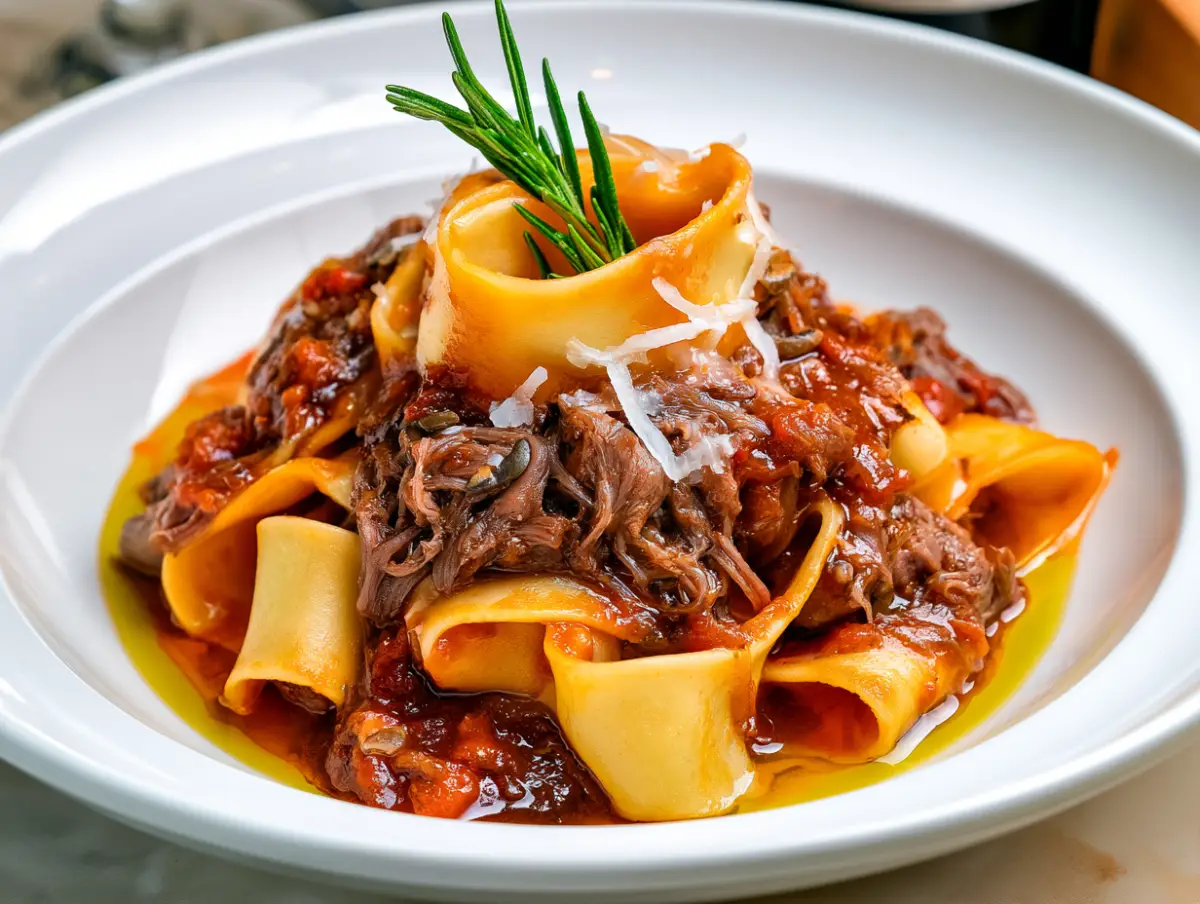
- Plate and finish: Use tongs to twirl generous nests of pasta into warm wide bowls. Spoon additional lamb and sauce over the top — be generous. Finish with freshly grated Pecorino Romano or Parmigiano Reggiano, a drizzle of your finest extra-virgin olive oil, a sprig of fresh rosemary, and optionally a curl of lemon zest for brightness. Serve immediately while the lamb sauce is steaming hot and the pasta is at its peak.
🐑 Maya’s Tip: Serve this in wide, shallow pasta bowls rather than deep dinner bowls. Wide bowls let the pappardelle ribbons fall gracefully and give you space to properly plate the lamb shreds over the top — it looks like restaurant presentation and takes 10 extra seconds. Little details like this transform a home dinner into a moment.
The 5 Rules of Lamb Ragù
- Cook the wine completely dry before the tomatoes. Acid stops browning. This is the whole recipe.
- Cubes, not mince, and brown them in three batches. Crowding is steaming.
- Two hours, not six. Past about three hours the lamb stops tasting of lamb.
- One can of tomatoes, not two. It is a meat sauce.
- Finish the pasta in the pot with pasta water and cold butter. Never sauce on top.
Tips, Tricks & Shortcuts
Success Tips for Exceptional Results
- Dry the lamb completely before searing — moisture is the enemy of a good crust. Paper towels, all over, until bone dry.
- Don’t rush the soffritto — 12–15 minutes of gentle cooking transforms raw vegetables into a sweet, deeply flavored foundation that defines the ragu.
- The ragu freezes perfectly for up to 3 months. Freeze in quart-sized zip bags, flat. Thaw overnight in the fridge for a weeknight dinner that feels like Sunday effort.
- Make it a day ahead — seriously. The ragu flavors deepen and meld overnight in the fridge in a way that real-time cooking can’t replicate. Reheat gently on the stovetop with a splash of broth.
- Use the best canned tomatoes you can find — San Marzano DOP or Bianco DiNapoli. This is a long braise where tomato quality shines through. It matters.
- Fresh pappardelle is extraordinary here if you can find it or make it — it takes this dish from excellent to transcendent. Most Italian delis and specialty grocery stores carry it.
Common Mistakes
| Mistake | Result | The Fix |
| Skipping the sear or rushing it | Ragu lacks depth; flat, stew-like flavor without the roasted caramelized notes | Work in batches in a very hot pan; don’t touch the meat for 4–5 min per side; accept it takes 12–15 minutes total |
| Lifting the lid during braising | Steam escapes; lamb dries out instead of becoming tender; braising liquid reduces too quickly | Trust the process — the lid stays on for the full 2½ hours |
| Under-braising (meat not shredding) | Chewy, tough lamb that won’t pull apart; sauce lacks gelatin from collagen breakdown | Return to oven for 20–30 min more; properly braised lamb shreds with zero resistance |
| Adding pasta to too-thin ragu | Watery, loose sauce that slides off the pasta instead of coating it | Reduce uncovered on stovetop 10–15 min before adding pasta; sauce should coat a spoon |
| Cooking pappardelle fully before adding to ragu | Overcooked, mushy pasta that falls apart in the sauce | Pull pasta 1–2 minutes early; it finishes cooking in the ragu |
| Using a dark non-stick pan for searing | Can’t achieve high enough sear temperature; lamb steams rather than browns | Use stainless steel or enameled cast iron; it needs to be very hot |
Variations & Serving Ideas
Dietary Adaptations & Variations
The base slow cooked lamb pasta technique is beautifully adaptable. Here are my favorite variations:
- Ground lamb ragu (faster!): Use 1.5 lbs (680g) ground lamb instead of shoulder. Brown it deeply in the soffritto and simmer the full sauce for just 45 minutes–1 hour instead of braising. Less textural complexity, but still a genuinely excellent lamb ragu pappardelle and ready in under 90 minutes.
- Moroccan-inspired: Add 1 teaspoon each of ground cumin, coriander, and cinnamon to the soffritto along with the garlic. Finish with a handful of golden raisins and toasted pine nuts. The North African spice profile is extraordinary against lamb.
- Greek lamb ragu: Add 1 teaspoon dried oregano, ½ cup Kalamata olives, and finish with crumbled feta and fresh mint instead of Pecorino. The brightness of feta against the rich braised lamb is incredible.
- Slow cooker method: After building the soffritto and braising liquid on the stovetop, transfer everything to a slow cooker and cook on LOW for 7–8 hours or HIGH for 4–5 hours. Same melt-apart result, completely hands-free.
- Instant Pot / pressure cooker: Sear and build soffritto using the Sauté function. Pressure cook on HIGH for 45 minutes, then natural release 15 minutes. Remarkably close to the slow-braised version in a fraction of the time.
Serving Suggestions & Beverage Pairings
This rich Sunday ragu is a complete meal over pappardelle, but it’s magnificent over creamy polenta or alongside our Classic Greek Lemon Rice Pilafi for a Greek-Italian fusion moment. For a lighter vegetable counterbalance to the rich lamb, our Mediterranean White Bean Salad is a brilliant side — the lemon and herbs cut beautifully through the lamb richness. If you’re hosting a dinner party, start with our Mediterranean Hummus Breakfast Bowl as a mezze-style appetizer before the lamb pappardelle main. And a simple arugula salad with lemon dressing is the easiest, most refreshing complement to this hearty dish.
Non-alcoholic beverage pairings that work beautifully with the bold lamb: pomegranate sparkling water (the same pomegranate that went into the braise — a lovely thematic echo) is elegant and cuts the richness perfectly. Iced hibiscus tea with a splash of lemon has deep ruby color and floral tartness that complements the lamb’s earthiness beautifully. Fresh-squeezed blood orange juice or sparkling water with a squeeze of orange and fresh rosemary sprig is a gorgeous, sophisticated pairing. For a cozy evening, warm apple cider with a cinnamon stick is a winter-perfect companion to this dish.
Meal Prep & Storage
Storage Guide
| Method | Container | Duration | Notes |
| Refrigerator (ragu only) | Airtight glass container | 4–5 days | BEST method — ragu flavor intensifies daily; skim fat if desired before reheating |
| Refrigerator (assembled pasta) | Airtight container | 2–3 days | Pappardelle absorbs sauce; add 3–4 tbsp water when reheating; pasta texture softens |
| Freezer (ragu only) | Quart freezer bags (lay flat) or glass containers | Up to 3 months | Freeze in individual or double portions; label with date; thaw overnight in fridge |
| Freezer (assembled pasta) | Not recommended | — | Pappardelle texture suffers severely when frozen; always freeze ragu separately |
| Reheat stovetop | Dutch oven or heavy saucepan | 8–10 min over low-medium | Add splash of broth or water; stir gently; bring to a gentle simmer; cook fresh pasta fresh |
| Reheat microwave (ragu) | Microwave-safe covered bowl | 2–3 min at 70% power | Stir every 60 seconds; add 2 tbsp water or broth; cover to retain moisture |
Meal Prep Assembly Tips
Here’s how Lamb Ragu Pappardelle works as a meal prep powerhouse: make a full batch of ragu on Sunday (or even Saturday). Divide into 3–4 meal-sized glass containers (ragu only — no pasta). Each weeknight, boil fresh pappardelle (8–9 minutes), reheat the ragu in the pasta pot with a splash of broth, toss together, plate, finish with Pecorino. Restaurant-quality braised lamb pasta in under 12 minutes on a Wednesday night. The batch cooking effort on one weekend day eliminates cooking stress for multiple weeknights. I’ve served this to guests mid-week and had them convinced I cooked for hours. (I had. Just on Saturday.)
Frequently Asked Questions
Substitution & Technique Questions
Q: Can I use lamb shanks instead of shoulder?
Absolutely — and many would argue lamb shanks are even better for this lamb ragu pappardelle. They’re extraordinarily flavorful (the shank muscle does a lot of work) and braise to the same fall-off-the-bone tenderness. Use 2 large bone-in lamb shanks in place of the shoulder. The braise time is similar — 2½ to 3 hours at 325°F. Shanks cost slightly more per pound but waste very little, and their presentation before shredding is visually dramatic. Both cuts are excellent; it truly comes down to what’s available and your budget.
Q: What can I substitute for red wine in traditional lamb ragu recipes?
In this recipe, we use ½ cup pomegranate juice plus 1 cup lamb or beef broth in place of wine — and it genuinely delivers comparable depth and complexity. Pomegranate contributes acidity, sugar, and polyphenolic tannins that mimic wine’s flavor contribution to braised meat. Alternatively, use ½ cup balsamic vinegar diluted with ½ cup water, or simply use 1½ cups of high-quality broth. The rich lamb sauce will be excellent any way you approach this. Trust me.
Q: Can I make this in a slow cooker?
Yes! After searing the lamb and building the soffritto on the stovetop (steps 1–4), transfer everything to your slow cooker. Cook on LOW for 7–8 hours or HIGH for 4–5 hours. The ragu will be equally tender and deeply flavored — the slow cooker is particularly convenient for a weekday where you start it before work. Transfer to a wide pan for 10 minutes of uncovered simmering if the sauce needs to thicken before tossing with pappardelle. This slow cooked lamb pasta method is an absolute meal prep winner.
Q: My ragu sauce seems too thin — how do I fix it?
Easy! Remove the shredded lamb with a slotted spoon temporarily and set aside on a plate. Bring the sauce to a vigorous simmer over medium-high heat, stirring frequently, for 10–15 minutes until it reduces to a thicker, glossy consistency that coats a spoon. Return the lamb and proceed. You can also add a quick beurre manié (1 tablespoon softened butter + 1 tablespoon flour, kneaded together) or a cornstarch slurry (1 teaspoon cornstarch dissolved in 2 teaspoons water) for faster thickening without long reduction time.
Dietary, Nutrition & Meal Prep Questions
Q: Is Lamb Ragu Pappardelle healthy?
By Mediterranean Diet standards, genuinely yes — in appropriate portions. Lamb shoulder is nutrient-dense: exceptional sources of complete protein, heme iron (the most bioavailable form), zinc, B12, and selenium. The PREDIMED study showed that adherence to overall Mediterranean patterns (which include moderate lamb consumption in traditional cultures) reduces cardiovascular events significantly. The collagen in the shoulder dissolves into gut-supporting gelatin during the braise. The olive oil, tomatoes, and herbs all contribute documented anti-inflammatory compounds. As a certified health coach — not your doctor — I’d say savor it. It’s Mediterranean eating at its most traditional.
Q: How do I make this gluten-free?
Simply substitute your preferred gluten-free pappardelle — Jovial brown rice pappardelle is my top recommendation for the best texture. Cook it slightly under al dente (GF pasta absorbs sauce more aggressively) and have extra pasta water ready to loosen the lamb ragu sauce as needed. The ragu itself is 100% naturally gluten-free. Be sure to double-check your broth label — some commercial broths contain wheat-derived additives. A quality homemade or certified GF broth is always safest.
Q: How many people does this serve, and can I scale up?
This recipe serves 6 generously as a main course — which is part of its magic. It scales up beautifully: simply multiply the braise quantities (a larger Dutch oven handles 5 lbs of lamb shoulder without issue) and the sauce component scales proportionally. When serving a crowd, I always make the ragu a day ahead, which actually improves the flavor. Fresh pasta takes 8 minutes to cook, so even serving 10 guests becomes a calm, organized affair when the sauce is pre-made.
Q: Can I meal prep the pappardelle itself?
Dry pappardelle is best cooked fresh each time — it only takes 8–9 minutes, so it’s not worth pre-cooking and refrigerating (it clumps and becomes mushy). However, fresh homemade pappardelle can be made 2–3 days ahead, dried at room temperature for 30 minutes, and stored layered with parchment in the fridge. The lamb pappardelle dinner strategy is: freeze the ragu in portions, keep dry pappardelle in the pantry, and you’ll always have a spectacular dinner 20 minutes from refrigerator to table.
Nutritional Highlights & Closing Thoughts
Why This Recipe Is Good for You
Let me give you the nutrition case for Lamb Ragu Pappardelle as a regular part of a balanced Mediterranean Diet. A 4-ounce portion of braised lamb shoulder delivers approximately 26g of complete protein — all essential amino acids — along with 38% of the daily zinc requirement, 15% of daily iron needs (as heme iron, which is 2–3x more bioavailable than plant iron), 70% of daily B12, and 30% of daily selenium. These nutrients collectively support immune function, thyroid health, energy metabolism, and antioxidant defense.
The collagen breakdown during the long braise produces gelatin, which supports gut lining integrity and joint health — a bonus that purely muscle-based proteins don’t offer. The pomegranate braising liquid adds ellagic acid and punicalagins, among the most potent polyphenolic antioxidants studied in human nutrition research. And the Mediterranean olive oil + tomato + herb combination adds well-established anti-inflammatory compounds to every bowl. This is real food, deeply nourishing, and worth every moment of the braise.
Closing & Call to Action
Making Lamb Ragu Pappardelle is one of those cooking experiences that genuinely changes how you feel about being in the kitchen. The patience it asks of you — the slow build, the waiting, the trust — is rewarded with something so deeply satisfying that you’ll want to do it every weekend. Or at least every other weekend. (Your family will request it weekly. I’m not responsible for the expectations you set.)
Drop a comment below and tell me — shoulder or shank? Classic or Moroccan variation? Did you make it a day ahead? (The answer should be yes.) Tag me @MayaCastellanoKitchen so I can see your gorgeous plates. 🐑🌿
For more Mediterranean pasta inspiration after this weekend project, our Caprese Pasta is the light, summery counterpart to this hearty winter dish. Our Fresh Tomato Basil Spaghetti (Pomodoro) is another Italian pasta classic worth having in your permanent repertoire. If you loved the lamb, our Italian Chicken Casserole brings similar slow-cooked Italian comfort with less waiting time. And for a vegetable-forward Mediterranean main to balance the week after this indulgent weekend, our Harissa Chickpea Roasted Cauliflower is bold, plant-based, and deeply satisfying. Buon appetito! 🐑