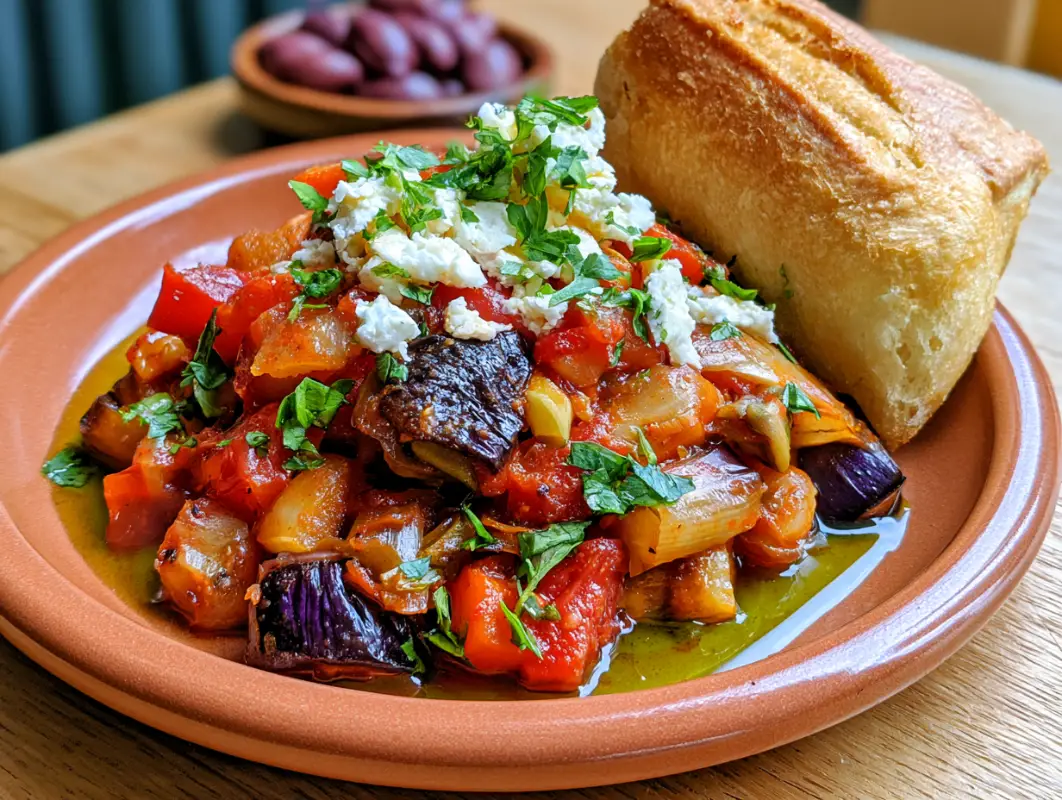
The first — and I do mean the very first — time I made a Greek Briam (Roasted Vegetable Bake), I produced something my sister-in-law Dimitra (who grew up in Thessaloniki and has exactly zero patience for bad Greek food) politely called ‘vegetable soup.’ It was May 2022, I’d used way too much water, sliced my potatoes so thick they could stop a bullet, and roasted everything in a crowded pan at 325°F. The resulting puddle was technically vegetables in tomato liquid, which is not — at all — what Greek Briam is supposed to be.
Seventeen batches later (yes, my household survived seventeen rounds of test briam — honestly my neighbors started asking why it smelled so good every Tuesday), I finally understood the five things that separate a soggy mess from the deeply caramelized, olive-oil-luscious, melt-and-also-somehow-crispy traditional Greek Briam (Roasted Vegetable Bake) that grandmothers across Greece have been making for centuries. Let me share all five secrets with you.
Why This Recipe Works
The Science of Ladera — Greece’s Olive Oil Alchemy
Greek Briam belongs to a beloved category of Greek cooking called ladera — derived from the Greek word for oil. Ladera dishes are built on a principle that sounds almost too simple: vegetables plus generous olive oil plus time equals something transcendent. But there’s real food science underpinning this. When vegetables are coated in fat and exposed to sustained high heat (around 400°F), the water inside them evaporates slowly while the exterior develops complex caramelized compounds through — you guessed it — the Maillard reaction and caramelization. The olive oil simultaneously acts as a heat conductor and flavour vehicle, carrying fat-soluble herb compounds (the thymol in thyme, the rosmarinic acid in oregano) deep into the vegetable flesh. The result: vegetables that are both yielding and rich. Not soggy. Not raw. Something entirely else. Harold McGee notes in On Food and Cooking that fat-coated vegetables achieve dramatically more even browning than their uncoated counterparts — which is why skimping on olive oil in briam is genuinely counterproductive.
When to Make Greek Briam — And Why It’s Always the Right Answer
Traditionally, the Greek Briam (Roasted Vegetable Bake) is a summer dish — prepared during the Greek Orthodox Lenten calendar when meat is forbidden, and celebrated again in July and August when zucchini and eggplant are collapsing off every market stall. But honestly? I make it year-round, and so do most Greeks I know (um, according to everyone I’ve ever asked). It works as a hearty vegan main, an impressive vegetarian centerpiece, a generous side to grilled fish or chicken, and — perhaps most usefully — a Sunday batch-cook that tastes even better on Thursday. The Gemista Greek Stuffed Peppers and Tomatoes shares this same beloved ‘better the next day’ quality that makes traditional Greek vegetable cooking so brilliant for real life.
Essential Ingredients
The Core Six — and Why Each One Earns Its Place
Right, so — let me rephrase — there are technically a lot of vegetables you can add to briam, but the six essential ones are non-negotiable if you want the authentic Greek Briam (Roasted Vegetable Bake) experience: potatoes (Yukon Gold or any waxy variety), zucchini, eggplant, ripe tomatoes (or good-quality canned), onion (red is traditional), and extra-virgin olive oil — please, a generous amount. The olive oil is not optional, and I will hear no arguments about it. This is one of those cases where the fat is the point. For the herbs: dried Greek oregano, fresh flat-leaf parsley, and optionally fresh thyme or rosemary.
The game-changing secret that none of the basic recipes mention? Salt your eggplant and zucchini first — 20 minutes under salt draws out excess moisture that would otherwise steam in the oven and prevent caramelization. This single step is why some versions turn out richly browned and others turn to mush. The Mediterranean White Bean Salad uses a similar technique of salting vegetables in advance to control moisture — it’s a principle worth internalizing across Mediterranean cooking.
Quality Specs, Comparison Table & USA Substitutions
| Ingredient | Quality Spec | USA Substitute | Impact if Skipped/Swapped |
| Extra-virgin olive oil (½ cup+) | Greek or Spanish EVOO, fruity & low acidity | California Olive Ranch, Kirkland Organic | Less depth; vegetables won’t caramelize properly |
| Eggplant (1 large) | Globe eggplant, firm with no soft spots | Japanese eggplant (use 2-3); or omit | Loses that creamy, luxurious texture layer |
| Yukon Gold potatoes (1½ lb) | Waxy, not starchy — holds shape when baked | Red potatoes or fingerlings; avoid Russet | Starchy potatoes disintegrate into the sauce |
| Canned crushed tomatoes (28 oz) | San Marzano or similar low-acid | Pomi strained tomatoes or 1½ lb fresh grated | Acidic tomatoes overpower the vegetables |
| Dried Greek oregano | Whole-leaf Greek (stronger than Italian) | Italian dried oregano — use 30% more | Loses that signature Hellenic aroma |
| Fresh flat-leaf parsley (big bunch) | Italian parsley, very fresh, bright green | Curly parsley works; basil as a twist | Dish loses freshness and that green lift |
No alcohol or pork in this recipe — it’s naturally, beautifully vegan as written. If you’re serving alongside protein, our Creamy Tomato Basil Chicken makes an outstanding pairing, the tomato base in both dishes creating a lovely through-line.
The Foolproof Method
Preparation — The 20-Minute Secret That Changes Everything
Preheat your oven to 400°F (200°C). While it heats: slice your eggplant and zucchini into ¼-inch rounds. Spread in a single layer on a cutting board or sheet tray, sprinkle generously with salt, and let sit for 20 minutes. You’ll see beads of moisture appear on the surface — that’s the moisture you don’t want in your baking dish. Pat dry thoroughly with paper towels before proceeding. Meanwhile, peel and slice potatoes into ⅛-inch rounds (thinner than you think — thick potatoes are the number-one reason briam takes too long and comes out uneven). Halve and thinly slice the red onion. Mince four cloves of garlic.
In a very large mixing bowl, combine all the sliced vegetables (eggplant, zucchini, potatoes, onion). Add: the minced garlic, ¼ cup of the olive oil, 1½ teaspoons dried Greek oregano, a generous handful of fresh parsley (roughly chopped), 1 teaspoon of salt, and ½ teaspoon of black pepper. Toss thoroughly — every surface should be glistening with oil and coated with herbs. This step is important not just for flavor but for even cooking: the oil coating prevents any vegetable surface from drying out before it has a chance to brown properly. It also means the herb flavors penetrate the vegetable flesh during the long roast, rather than just sitting on the surface.
The Main Method — Layering, Baking, and the Critical Uncovering
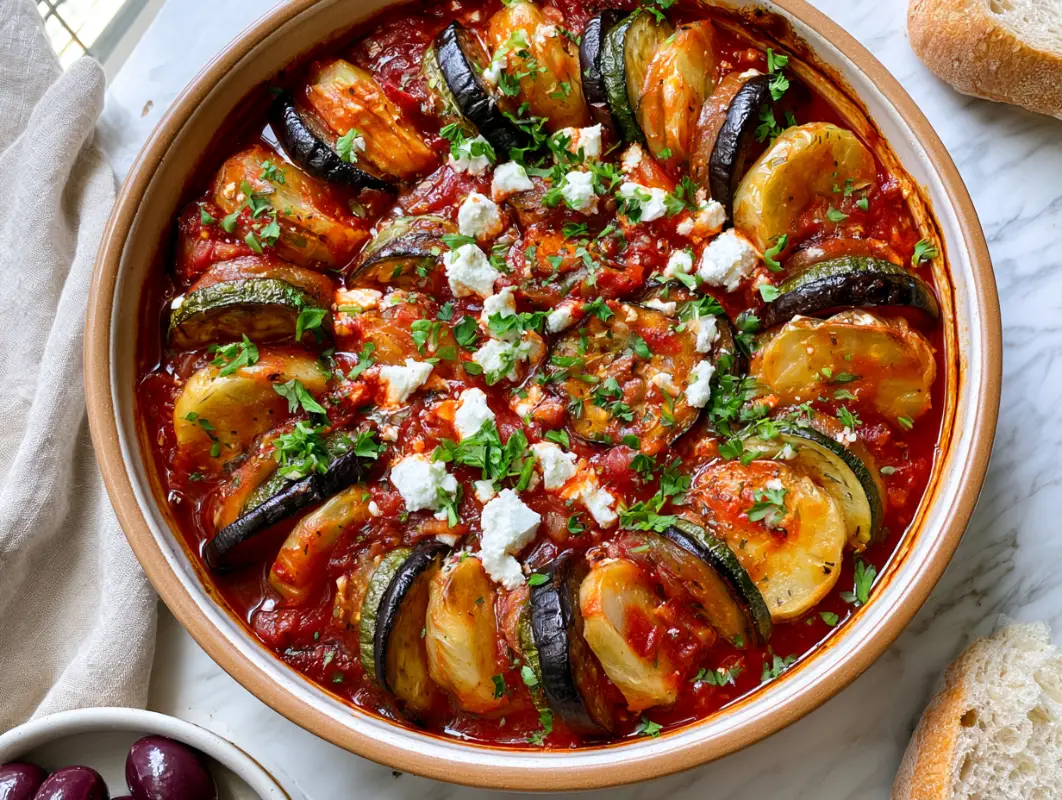
Pour your canned crushed tomatoes into a large oven-safe baking dish (a 9×13 or a large round gratin dish both work beautifully — the round is more traditional and, if we’re being honest, produces a more Instagram-worthy result). Spread the tomatoes to evenly coat the bottom — this creates a sauce layer that will bubble up and baste the vegetables from below. Drizzle with the remaining 2 tablespoons of olive oil.
Now arrange the seasoned vegetables in the dish. You have two options: the tidy overlapping rows method (alternating potato, zucchini, eggplant, onion in rows — looks spectacular, takes 8 extra minutes) or the rustic random arrangement (scatter them in a rough single layer — faster, equally delicious, and what most Greek home cooks actually do, per my friend Konstantinos who cooks at a taverna in Nafplio and laughed when I asked if his mother arranges them). Pour any remaining herb-oil from the bowl over the top. Drizzle with a final flourish of olive oil. The dish should look wet at this stage.
Cover tightly with aluminum foil. Bake at 400°F for 45 minutes — the foil traps steam and cooks the potatoes through without burning the exterior. After 45 minutes, remove the foil, stir gently if needed, and return to the oven for 30-40 more minutes, uncovered. This is the phase where the magic happens: moisture evaporates, the tomato sauce concentrates and caramelizes around the edges, and the vegetable tops develop those gorgeous brown patches. The potatoes should be completely tender when pierced with a fork, and the sauce should be reduced to a thick, glossy consistency — what Greeks describe as melomeno, ‘honeyed.’ Total bake time: 75-85 minutes. Allow to rest 10 minutes before serving; the flavors deepen noticeably.
Pro tip I learned after batch 11: if your oven runs hot, check at the 35-minute uncovered mark. If your potatoes aren’t quite done but the top is browning fast, tent loosely with foil for another 10 minutes, then uncover again for the final blast. For a similarly satisfying layered baking technique, our Gemista Greek Stuffed Peppers and Tomatoes uses the same principle of covered-then-uncovered roasting for deeply caramelized results. And if you’re serving the briam alongside a grain, the Classic Greek Lemon Rice Pilafi is the most classically Greek accompaniment imaginable.
Creative Variations
Twisting the Tradition Without Breaking It
I want to be clear about something: Greek Briam (Roasted Vegetable Bake) is technically already a variation dish — the name ‘tourlou tourlou’ (the Greek slang for it) roughly means ‘this and that,’ reflecting its nature as a ‘whatever’s in season’ recipe. So variations aren’t a departure from tradition; they basically are the tradition. Here are the combinations I’ve tested and actually loved:
| Variation | Key Changes | Dietary Notes | Best Season / Occasion |
| Classic Greek Vegan | As written — no feta, no dairy | 100% vegan, GF, dairy-free | Summer; Greek Orthodox Lent |
| With Feta Crumble | Top with 150g crumbled feta last 10 min | Vegetarian; omit feta for vegan | Any season — instant upgrade |
| Bell Pepper & Okra Twist | Add 2 sliced bell peppers + 200g okra | Vegan, GF, paleo | Summer peak season |
| Sweet Potato Variation | Sub half the Yukon Gold with sweet potato | Vegan, GF, paleo, lower GI | Autumn / winter |
| Kid-Friendly Version | Omit eggplant; add extra zucchini + carrot | Vegan-adaptable; very mild | Year-round; picky-eater households |
| Budget Briam | Double potatoes, skip eggplant | Under $5 for 4 servings | Any time; 3-ingredient pantry version |
Dietary Adaptations — Paleo, Gluten-Free & More
The base recipe is naturally vegan, gluten-free, and dairy-free — which is honestly one of the things I love most about it. For paleo: simply omit the potatoes entirely (or substitute sweet potato) and increase the other vegetables to compensate. For a lower-carb version, halve the potatoes and double the zucchini and eggplant — you get the same luxurious sauce, fewer carbs. For a richer, more indulgent approach, try the feta crumble version alongside our Mediterranean Hummus Breakfast Bowl, which makes a surprisingly brilliant brunch spread. For a complete weeknight Mediterranean feast, the Grilled Chicken Mediterranean Bowl alongside briam is as satisfying as it gets.
Storage & Serving
Storage — Why This Is the Rare Dish That Gets Better
Here’s something genuinely wonderful about the Greek Briam (Roasted Vegetable Bake): it is objectively better the next day. I don’t say this about many dishes, but I will defend this position vigorously. As it cools and rests overnight, the olive oil, tomato sauce, and herb compounds redistribute through the vegetables in a way that essentially gives them a prolonged marinade. The potatoes go from ‘great’ to ‘why is this so good.’ Store in an airtight container in the refrigerator for up to 5 days. To reheat: a medium oven (350°F) with a splash of water added and the dish covered loosely with foil works best — 20 minutes is usually enough. Alternatively, eat it at room temperature, which is how it’s frequently served in Greek households and, frankly, just as good.
Meal Prep Strategy & Serving Suggestions
This is a genuinely excellent meal-prep dish. Make a full batch on Sunday and you have lunches or easy dinners through Wednesday minimum. The components don’t need to be kept separate — assembled briam stores perfectly as-is. For freezing: let it cool completely, then store in a freezer-safe container for up to 2 months. Thaw in the refrigerator overnight and reheat as above. (The texture of the zucchini and eggplant softens slightly after freezing — not bad, just different.)
| Storage Method | Container | Duration | Reheating Instructions |
| Refrigerator | Airtight container or covered dish | Up to 5 days | 350°F oven, covered, 20 min + splash of water |
| Room Temperature | Covered dish | Up to 6 hours same day | Serve as-is; flavor actually improves |
| Freezer | Freezer-safe airtight container | Up to 2 months | Thaw overnight in fridge; reheat covered 30 min |
| Meal Prep | Individual glass containers (portioned) | 5 days refrigerated | Microwave 2-3 min or oven as above |
For a complete make-ahead Greek spread, the briam pairs magnificently with our Lahanorizo Greek Cabbage Rice — both improve overnight and can be made in parallel on a Sunday. And if you’re pairing the briam with a proper grain side, the Classic Greek Lemon Rice Pilafi is the most authentically Greek option, the bright lemon cutting beautifully through the olive oil richness.
Nutritional Benefits
Macronutrient Profile (per serving, serves 4)
Quick disclaimer: I’m not a dietitian, and these numbers are approximate based on standard ingredient databases. Your exact values will vary depending on how generously you pour that olive oil. (I pour generously. No regrets.)
| Macronutrient | Per Serving (¼ recipe) | % Daily Value (2000 cal) | Notes |
| Calories | ~380 kcal | 19% | Primarily from olive oil and potatoes |
| Total Fat | 22g | 28% | ~90% heart-healthy monounsaturated fats |
| Carbohydrates | 38g | 14% | High fiber slows glucose absorption |
| Dietary Fiber | 8g | 29% | Excellent — from eggplant, zucchini, tomato |
| Protein | 5g | 10% | Plant protein from vegetables |
| Sugars | 9g | — | Naturally occurring from tomatoes & onion |
Micronutrient & Health Highlights
| Nutrient | Amount per Serving | Key Source | Primary Benefit |
| Vitamin C | ~85mg (94% DV) | Zucchini, tomatoes, bell peppers | Immune support; iron absorption |
| Potassium | ~850mg (18% DV) | Potatoes, eggplant, tomato | Blood pressure regulation |
| Vitamin K | ~40mcg (33% DV) | Parsley, olive oil, greens | Bone health; blood clotting |
| Folate | ~80mcg (20% DV) | Eggplant, tomatoes | Cell repair; vital during pregnancy |
| Manganese | ~0.5mg (22% DV) | Potatoes, herbs | Antioxidant enzyme function |
| Lycopene | ~15mg | Slow-cooked tomatoes | Cardiovascular protection; antioxidant |
Glycemic note: the combination of fiber (8g per serving), healthy fat (22g), and the low-GI properties of eggplant and zucchini means the overall glycemic load of this dish is significantly lower than its carb count suggests. Studies on the Mediterranean diet consistently show that dishes like this — olive-oil-rich vegetable preparations eaten as whole meals — are associated with improved insulin sensitivity. This is one of the central pillars behind why the Mediterranean diet consistently tops global health rankings. Our Mediterranean Chickpea Power Bowl similarly demonstrates how plant-based Mediterranean dishes can be both deeply satisfying and metabolically excellent.
Greek Briam (Roasted Vegetable Bake)
Ingredients
Method
- Preheat the oven to 400°F (200°C). Slice the eggplant and zucchini into 1/4-inch rounds, spread them in a single layer, sprinkle generously with salt and leave for 20 minutes. Beads of moisture will appear on the surface — that is exactly the moisture you do not want in the baking dish. Pat thoroughly dry with paper towels.
- Meanwhile, peel and slice the potatoes into 1/8-inch rounds — thinner than you think, since thick potatoes are the number one reason briam cooks unevenly. Halve and thinly slice the red onion and mince the garlic.
- Combine all the sliced vegetables in a very large bowl with the minced garlic, 1/4 cup of the olive oil, the dried oregano, a generous handful of chopped parsley, 1 teaspoon salt and the black pepper. Toss thoroughly until every surface glistens.
- Pour the crushed tomatoes into a 9×13 or large round gratin dish and spread to coat the bottom evenly — this sauce layer bubbles up and bastes the vegetables from below. Drizzle with 2 tablespoons of the olive oil.
- Arrange the seasoned vegetables in the dish, either in tidy overlapping rows alternating potato, zucchini, eggplant and onion, or scattered rustically in a rough single layer. Pour over any remaining herb-oil from the bowl and finish with a last drizzle of olive oil. The dish should look wet at this stage.
- Cover tightly with foil and bake at 400°F for 45 minutes. The trapped steam cooks the potatoes through without burning the exterior.
- Remove the foil, stir gently if needed, and return to the oven uncovered for 30–40 minutes. Moisture evaporates, the tomato sauce concentrates and caramelises at the edges, and the vegetable tops develop brown patches. Total bake time is 75–85 minutes; the potatoes should be completely tender when pierced and the sauce thick and glossy.
- Let the dish rest 10 minutes before serving — the flavours deepen noticeably.
Notes
Frequently Asked Questions
Greek Briam Questions — Answered Honestly
Q: What does Briam mean in Greek? Interestingly, the word ‘briam’ isn’t originally Greek at all — it’s derived from Turkish, loosely meaning ‘roasted food.’ In Greece you’ll also hear it called ‘briami’ or the charming ‘tourlou tourlou,’ which roughly translates as ‘this and that’ — reflecting its flexible, season-driven nature. It belongs to the ladera family of Greek dishes, meaning vegetables cooked generously in olive oil.
Q: What vegetables go in Greek Briam (Roasted Vegetable Bake)? The traditional core is: potatoes, zucchini, eggplant, ripe tomatoes (or canned), red onion, and garlic. Common additions include bell peppers and okra. You can technically add other vegetables, but if you stray too far from these you’re making something else delicious — just not briam.
Q: Is Greek Briam the same as ratatouille? The comparison is fair but imprecise. Both are slow-cooked Mediterranean vegetable dishes using olive oil and similar vegetables. But ratatouille is French, often features a more elaborate sauce, and the vegetables are typically cooked separately before combining. Briam is simpler — raw vegetables tossed in oil and herbs, then baked together — and uses potatoes (which ratatouille never does). The flavor profile is also distinct: briam is more earthy and olive-oil forward, where ratatouille tends toward the herbal and tomato-sweet.
Q: Can I make Greek Briam ahead of time? Yes — and you probably should. Briam genuinely improves after a night in the refrigerator. The olive oil, tomato, and herb flavors continue to meld and penetrate the vegetables during storage. Make it up to 24 hours in advance for the best possible flavor.
Q: Why are my briam vegetables soggy and not caramelized? Three likely culprits: (1) you didn’t salt and dry the eggplant/zucchini first; (2) the pan was too crowded and the vegetables steamed instead of roasting; (3) you didn’t remove the foil long enough in the second baking phase. The fix for all three: salt your veg, use a big enough baking dish so they’re in a shallow single layer, and give the uncovered phase a full 30-40 minutes.
Q: Is Greek Briam (Roasted Vegetable Bake) healthy? Genuinely yes — it’s one of the most nutritionally dense meals in the Mediterranean canon. Per serving: ~8g fiber, ~5g plant protein, 94% DV of Vitamin C, significant potassium, and the olive oil delivers monounsaturated fats associated with cardiovascular health. The lycopene in slow-cooked tomatoes is actually more bioavailable than in raw tomatoes, thanks to the heat breaking down cell walls.
Q: Can I freeze Greek Briam? Yes, for up to 2 months. Let it cool completely before freezing in a sealed container. Thaw overnight in the fridge. The texture of eggplant and zucchini softens slightly after freezing, but the flavor remains excellent. Reheat in the oven at 350°F, covered, for about 25-30 minutes.
Pairing & Serving Ideas
The Art of Serving Briam — Greece’s Most Generous Dish
| Pairing | Type | Why It Works | Best Occasion |
| Crumbled feta + crusty village bread | Classic accompaniment | Salty creaminess + the briam juices = perfection | Every occasion — this is the standard |
| Classic Greek Lemon Rice Pilafi | Grain side | Lemon lifts the richness; both are ladera-adjacent | Weeknight dinner; serving a crowd |
| Sparkling water with lemon & fresh mint | Beverage | Crisp and cleansing with the olive oil richness | Lunch; warm weather dining |
| Fresh mint iced tea | Beverage | Herbal echo to the dish’s oregano and parsley | Afternoon meal; family gathering |
| Greek Yogurt Panna Cotta | Dessert | Cool, creamy contrast after the rich vegetables | Dinner party; special occasion |
Occasion Guide — From Tuesday Night to Dinner Party
Quick weeknight dinner: the briam bakes mostly unattended — prep 10 minutes, walk away for 85 minutes, come back to dinner. It’s genuinely one of the easiest hands-off meals in existence. For a dinner party: serve it in the baking dish at the center of the table, let guests scoop their own portions, provide a generous block of feta, good bread, and olives. The communal presentation feels properly Greek and impressively rustic. For Greek Orthodox Lent, this is one of the definitive ladera dishes, and our Lahanorizo Greek Cabbage Rice is another classic companion for fasting-friendly Greek eating. And if you’re planning a Greek-themed dessert, the Greek Yogurt Panna Cotta is a light, elegant finish after the satisfying richness of briam.
Make It Yours
A Recipe That Belongs to Everyone Who Makes It
The thing about the Greek Briam (Roasted Vegetable Bake) that I find — um — most beautiful about it is that there’s no ‘right’ version. Every Greek household makes it slightly differently. My friend Konstantinos’s mother makes it with just three vegetables and half a litre of olive oil. My version has six vegetables and the aggressive eggplant-salting step. Both are correct. That’s the whole point of ladera cooking — it’s a philosophy of generosity (plenty of oil, plenty of time, plenty of vegetables) expressed in infinitely personal ways. So take the framework here, follow the five secrets (dry your veg, don’t crowd the pan, use good olive oil, bake covered then uncovered, be patient), and then make it entirely your own. Add what’s in season. Use what you love.
If you’d like to build out a whole Greek-inspired spread, the Pasta Primavera and our Mediterranean White Bean Salad both make wonderful companions to briam for a vegetable-forward feast.
Share Your Briam — We’re Listening
Genuinely, drop a comment below and tell me which vegetable combination you tried. Did you go with the sweet potato variation? Add okra? Skip the eggplant because someone in your house has a strong opinion about it? (My nephew. He’s very committed to disliking eggplant.) I read every comment and I’m always curious what people do with the recipe once it’s in their hands. Tag your creations and let’s keep this beautiful, humble, deeply Greek Briam tradition alive in kitchens everywhere. Καλή όρεξη — good appetite!