My father was a fisherman. I know I say this often, but it matters here more than anywhere. He’d come home to Chania harbor at dawn, and before the fish even reached the market, the best pieces came to our kitchen. My yiayia would already have basil growing in the terracotta pots on the terrace— thick-stemmed, impossibly fragrant, the kind that stains your fingers green when you pinch the leaves. She’d crush it with garlic and olive oil using a wooden mortar that was older than she was, and the smell— sweet, peppery, alive— would drift through the whole house.
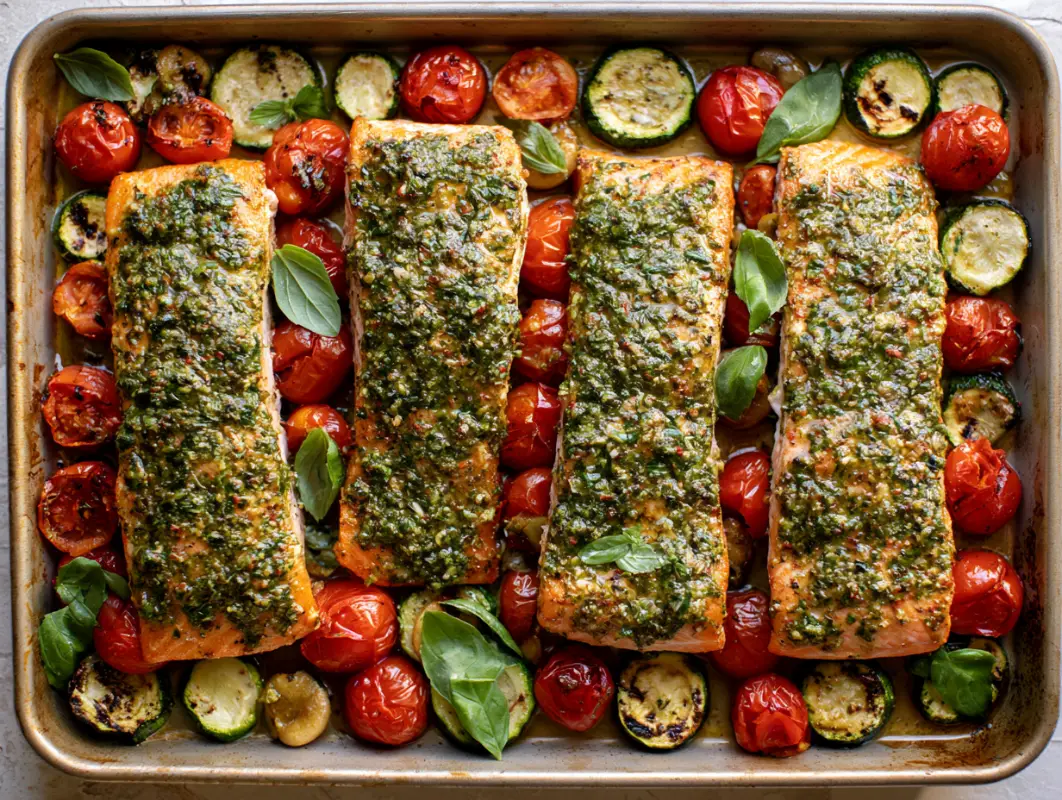
That homemade pesto, spread over whatever fish my father brought home, baked with tomatoes from the garden and zucchini from the neighbor’s plot— that was summer in Crete. This sheet pan pesto salmon with zucchini & tomatoes is my attempt to bottle that memory. I’ve tested it twenty-four times in my Athens kitchen (my neighbor Dimitris has been the grateful beneficiary of at least ten test batches), and this version— bright, herby, with flaky salmon and burst cherry tomatoes— is the one that finally made me close my eyes and taste Chania.
The beauty is the simplicity: one pan, 25 minutes of oven time, and a technique my yiayia would recognize instantly. Let me walk you through it.
Table of Contents
Why This Pesto Salmon Recipe Is Special
The Pesto-as-Shield Technique
Most baked pesto salmon recipes tell you to slather pesto on raw fish and hope for the best. The problem? Salmon dries out fast at high heat because its proteins contract and squeeze moisture out— Harold McGee explains this process in On Food and Cooking as thermal denaturation.
My technique uses the pesto as a protective shield: a thick, oil-rich layer that insulates the delicate fish, slowing heat transfer to the interior while the surface caramelizes. The olive oil in the pesto also conducts heat more gently than dry air, meaning the salmon cooks evenly from edge to center. The result? Flaky. Moist. Perfect. This is the same food science that keeps our garlic butter mushrooms so juicy under their butter coating.
Summer on a Sheet Pan
What I love about this Mediterranean salmon recipe is that it tastes like the best parts of July in Crete. You get the bright, herby punch of basil pesto, the sweet-acid burst of roasted cherry tomatoes, the tender bite of zucchini with those charred edges, and underneath it all, rich, buttery salmon. It’s the kind of sheet pan salmon dinner I make when friends come over unannounced (which happens often in Greece— we don’t really do the “call first” thing). Fifteen minutes of prep, twenty-five in the oven, and everyone thinks you’ve been cooking for hours.
The Story Behind This Mediterranean Salmon
Fish and Pesto: A Mediterranean Love Story
The pairing of fish with herb-and-oil sauces is ancient Mediterranean tradition. In Greece, we have ladolemono (olive oil and lemon); in Italy, pesto Genovese; in the Levant, tahini with herbs. They’re all variations on the same genius idea: a fat-based sauce that protects delicate fish while adding layers of flavor. Basil pesto, with its garlic, pine nuts, and olive oil, is the Italian cousin of what my yiayia made with her mortar and pestle every summer morning. Different herbs, same philosophy.
My Father’s Fish, My Yiayia’s Hands
In our family, fish was sacred. My father Giorgos spent thirty years pulling his nets from the waters off western Crete, and he believed— with religious conviction— that good fish needed almost nothing. “Olive oil, herbs, heat. That’s it, Niko. Don’t ruin it.” He was right, mostly. But my yiayia Eleni would quietly add garlic, a handful of basil, sometimes pine nuts she’d toast in a dry pan, and she’d create something that was more than the sum of its parts. She never called it pesto. She called it “the green.” This recipe is her green, my father’s fish, and a sheet pan that makes it foolproof.
Essential Ingredients for Pesto Salmon Sheet Pan Dinner
Ingredients list
Pesto (or use 1/3 cup store-bought):
2 cups packed fresh basil leaves
2 garlic cloves
2 Tbsp pine nuts, toasted
3 Tbsp (45ml) extra virgin olive oil
2 Tbsp grated Parmesan (optional for dairy-free)
Squeeze of lemon juice
Salt to taste
Salmon:
4 skin-on salmon fillets (6 oz / 170g each)
Vegetables:
3 medium zucchini, sliced into ½-inch half-moons
2 pints (600g) cherry tomatoes
4 garlic cloves, thinly sliced
1 lemon, sliced into rounds + juice of ½ lemon for finishing
2 Tbsp (30ml) extra virgin olive oil
Salt and black pepper
Finishing:
1–2 Tbsp finishing olive oil
Juice of ½ lemon
2 Tbsp pine nuts, toasted
Fresh basil leaves, torn
Core Ingredients for the Best Baked Pesto Salmon
Every ingredient here earns its place. I’ve tested substitutions across twenty-four batches, and this combination produces the most balanced, deeply satisfying salmon and zucchini recipe. As my yiayia said: if it doesn’t improve the dish, leave it out.
| Ingredient | Amount | Why It Matters | Authentic Pick | Substitution |
| Salmon Fillets (skin-on) | 4 fillets (6 oz / 170g each) | Rich, omega-3 packed fish that pairs beautifully with pesto | Wild-caught sockeye or king salmon | Trout, arctic char, or cod (reduce cook time 3 min) |
| Basil Pesto | 1/3 cup (80g) | Herby, garlicky, oil-rich coating that protects and flavors the fish | Homemade (see recipe); Greek basil if available | Store-bought (quality matters); or sun-dried tomato pesto |
| Zucchini | 3 medium, sliced into half-moons | Mild flavor, tender texture; absorbs pesto and tomato juices | Fresh, firm zucchini with tight skin | Yellow squash or patty pan squash |
| Cherry Tomatoes | 2 pints (600g) | Burst in the oven releasing sweet, acidic juice that becomes the sauce | Vine-ripened cherry or Santorini tomatoes | Grape tomatoes; halved Roma in winter |
| Extra Virgin Olive Oil | 3 Tbsp (45ml) | Roasting medium; adds fruity richness to vegetables | Cretan Kolymvari or Sitia EVOO | Any quality EVOO |
| Garlic | 4 cloves, sliced | Roasts into sweet, mellow paste; backbone of Mediterranean flavor | Fresh, never jarred | 1 tsp garlic powder (inferior) |
| Lemon | 1 whole (juice + wedges) | Acid brightens everything; the ladolemono finish | Fresh unwaxed lemons | White balsamic (1 Tbsp) in a pinch |
| Pine Nuts | 2 Tbsp, toasted | Buttery crunch as a garnish; traditional in pesto | Italian stone pine nuts | Toasted walnuts, almonds, or sunflower seeds |
The salmon must be skin-on— the skin protects the bottom of the fillet from the direct heat of the pan and peels off easily after cooking. (My father would disown me if I used skinless fillets. He always said the skin holds the flavor to the flesh.) The olive oil is from Kolymvari, where my family has bought it for three generations. For similar bright, herby Mediterranean pairings, our caprese pasta salad with orzo uses the same basil-tomato foundation.
Dietary Substitutions & Pro Tips
| Need | Replace | With | Notes |
| Dairy-Free | Parmesan in pesto | Nutritional yeast or omit; add extra pine nuts for richness | Most store-bought pestos contain cheese—check labels |
| Nut-Free | Pine nuts in pesto + garnish | Sunflower seeds or pumpkin seeds | Toast them first for maximum flavor |
| Pescatarian | No changes needed | N/A | Recipe is naturally pescatarian |
| Low-Carb/Keto | No changes needed | N/A | Already very low-carb |
| Whole30 | Parmesan in pesto | Omit cheese entirely; increase basil and oil | Compliant pesto tastes different but still good |
| Fish Allergy | Salmon | Chicken breast or thick-cut tofu | Adjust cook time; chicken needs 25-30 min; tofu 20 min |
Yiayia’s Tip: “Buy more basil than you think you need. The mortar eats half of it, and you’ll want to scatter the rest fresh at the end.” She was never wrong about herbs. For a protein-rich plant-based alternative, our Mediterranean plant protein power bowl uses similar Mediterranean herb flavors beautifully.
Equipment & Technique for One Pan Salmon
Essential Equipment
| Traditional Tool | Modern Alternative | Why It Matters |
| Stone mortar and pestle (for pesto) | Food processor or blender | Mortar produces chunkier, more rustic pesto; processor is faster |
| Wooden fish board (Papou’s method) | Heavy-duty rimmed half-sheet pan (18×13″) | Sheet pan provides even heat; rim catches tomato juices |
| Olive wood spatula | Wide fish spatula | Thin, flexible blade slides under salmon without breaking it |
| Charcoal grill (summer) | Oven at 400°F | Oven gives consistent results; grill adds smoky flavor |
Setting Up Your Workspace
Mise en place is everything with fish— salmon cooks fast and waits for no one. Before you start: preheat oven to 400°F (200°C), line your sheet pan with parchment paper, make or measure the pesto, slice the zucchini, halve the tomatoes if large, slice the garlic, and— crucially— take the salmon out of the fridge 15 minutes early. Cold fish in a hot oven cooks unevenly. This easy pesto salmon comes together in 10 minutes of active prep once everything is ready.
Step-by-Step: Sheet Pan Pesto Salmon with Zucchini & Tomatoes
Preparation (Steps 1–4)
Step 1 — Make the Pesto (5 min, or use store-bought): In a mortar (or food processor), pound 2 cups packed fresh basil, 2 cloves garlic, 2 Tbsp toasted pine nuts, 3 Tbsp olive oil, and 2 Tbsp grated Parmesan (optional for dairy-free) until you get a chunky, vibrant green paste. Season with salt and a squeeze of lemon. The smell alone will transport you. When I make this in summer, I use Greek basil from my terrace pots— smaller leaves, more intense flavor. The pesto’s olive oil is what Kenji López-Alt calls the “thermal buffer” in The Food Lab— it slows heat transfer and keeps the salmon moist.
Step 2 — Prepare the Salmon (3 min): Pat 4 salmon fillets very dry with paper towels (surface moisture = steam = no caramelization). Place skin-side down on the parchment-lined sheet pan. Spread 1–1½ tablespoons of pesto over the top and sides of each fillet. Don’t be shy. The pesto layer should be thick and generous— it’s the protective shield that keeps the fish flaky.
Step 3 — Prepare the Vegetables (5 min): Slice 3 zucchini into ½-inch half-moons. Halve 2 pints of cherry tomatoes (or leave whole if small). Slice 4 garlic cloves. Toss everything in a bowl with 2 Tbsp olive oil, remaining pesto (about 1 Tbsp), salt, and pepper. The zucchini should be glistening.
Step 4 — Arrange on Pan (2 min): Scatter the vegetables around (not on top of) the salmon fillets in a single layer. Give the tomatoes space to burst. Tuck the garlic slices among the vegetables. Add lemon slices to the pan— they’ll caramelize and add a bright, floral note.
Yiayia’s Tip: “Never put vegetables on top of the fish, Niko. The fish needs to breathe in the oven. Vegetables on the side, always.” She meant that the dry oven heat hitting the pesto surface directly is what creates the light crust. Covering it with vegetables traps steam.
Cooking & Assembly (Steps 5–10)
Step 5 — Roast (18–22 min): Place the pan in the center of the oven at 400°F. Roast for 18–22 minutes. What to watch for: the pesto will darken slightly and develop a thin crust. The cherry tomatoes will split and release their juices, creating a natural sauce on the pan. The zucchini edges will char lightly. The salmon should be just opaque in the center— an instant-read thermometer should read 125–130°F (52–54°C) for medium, 145°F (63°C) for well done.
Step 6 — Check Doneness: Press the thickest part of a fillet gently with your finger. It should feel like the fleshy part of your palm when you touch your thumb to your index finger— yielding but with resistance. Silky. Flaky. Not dry. If it feels firm, it’s overcooked. Better to pull it 2 minutes early than 2 minutes late.
Step 7 — Toast the Pine Nuts (while salmon rests): In a dry skillet over medium heat, toast 2 Tbsp pine nuts for 2–3 minutes, shaking constantly. They go from golden to burned in about 8 seconds. (I’ve ruined more pine nuts than I care to admit. My record at Varoulko was three batches in one service. Chef Nikolaou was… expressive about it.)
Step 8 — Rest (3 min): Remove the pan from the oven and let it rest for 3 minutes. The carryover heat finishes the cooking gently, and the juices redistribute through the salmon. During this time, the tomato juices on the pan will thicken slightly into a glossy sauce.
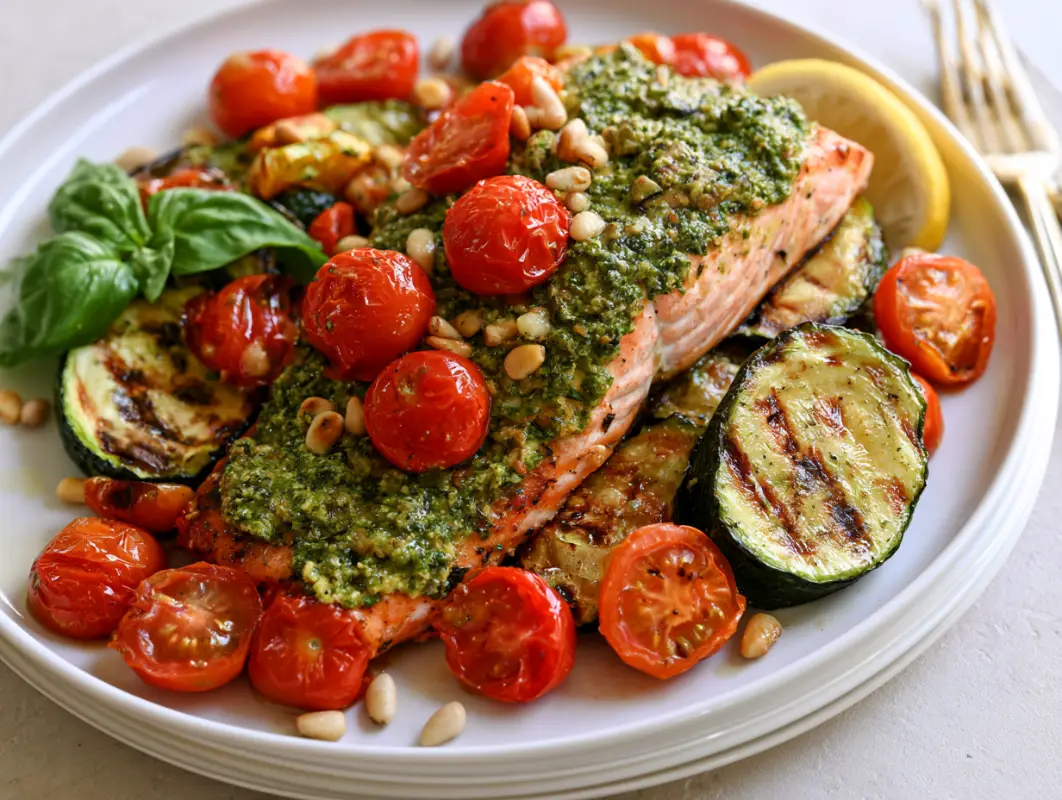
Step 9 — Finish: Squeeze fresh lemon juice over everything. Drizzle with your best finishing olive oil— the fruity, peppery Cretan kind. Scatter toasted pine nuts and torn fresh basil leaves. This is the ladolemono moment. The raw oil and acid lift every flavor on the pan. Our spicy rigatoni uses a similar bold finishing technique.
Step 10 — Serve: Bring the sheet pan pesto salmon with zucchini & tomatoes to the table on the pan. Spoon the burst tomato juices over each fillet. Serve with crusty bread, orzo, or alongside our red quinoa tabbouleh for a complete Mediterranean meal.
Pro Tip: The burst tomato juices on the pan are essentially a roasted tomato sauce. Spoon every last drop over the fish or soak it up with bread. My father would say wasting pan juices is a sin worse than overcooking the fish.
The Secret Touches That Elevate This Dish
Insider Techniques from a Fisherman’s Family
1. The Pesto Shield: A thick pesto layer isn’t just for flavor— it’s thermal insulation. The oil-rich paste slows heat transfer, meaning the salmon’s interior cooks more gently while the surface develops a light herb crust. Harold McGee explains that fats have lower thermal conductivity than water, so the pesto literally protects the fish.
2. Skin-Side Down, Always: The skin acts as a barrier between the hot pan and the delicate flesh. It also crisps slightly from the bottom heat. After cooking, it peels off in one satisfying sheet (or eat it— crispy salmon skin is a delicacy my father would fight you for).
3. Room Temperature Fish: Taking the salmon out 15 minutes before cooking ensures even heat penetration. Cold-center salmon overcooks on the outside before the inside reaches temperature. This is the difference between silky-flaky and dry-chalky.
4. The Double-Pesto Method: Pesto on the salmon AND tossed with the vegetables means everything on the pan tastes cohesive. The vegetables become infused with basil-garlic flavor as they roast, and the burst tomato juices mix with the pesto oil to create a unified sauce.
Common Mistakes to Avoid
| Mistake | What Happens | How to Fix It |
| Using cold salmon from the fridge | Overcooked exterior, raw center | Remove salmon 15 min before cooking |
| Applying pesto too thinly | Fish dries out; no herb crust develops | Use a generous, thick layer (1–1.5 Tbsp per fillet) |
| Overcrowding the zucchini | Steams instead of roasting; soggy texture | Single layer with space; use two pans if needed |
| Over-baking the salmon | Dry, chalky, sad fish | Check at 18 min; pull at 125–130°F internal |
| Skipping the lemon finish | Flavors fall flat; dish tastes one-dimensional | Always finish with fresh lemon juice + olive oil |
Variations & Serving Ideas for Pesto Salmon
Regional Twists & Adaptations
Cretan Style: Replace basil pesto with a wild herb blend— horta (wild greens) pounded with garlic and Cretan olive oil. Add Kalamata olives and capers to the pan in the last 5 minutes. Finish with dried oregano instead of basil. This is closest to what my yiayia actually made.
Greek Island Style: Add crumbled feta over the zucchini and tomatoes in the last 3 minutes of baking. The feta softens and turns golden. Finish with fresh dill. Gorgeous with our crispy zucchini fritters on the side.
Weeknight Express: Use store-bought pesto (no judgment— quality jarred pesto is perfectly good). Skip the pine nut toasting. Total time drops to 30 minutes with almost no prep.
Accompaniments & Beverages
This healthy salmon sheet pan dinner is a complete meal, but it pairs beautifully with sides. Orzo or couscous catches the burst tomato juices perfectly. A simple arugula salad with lemon dressing adds a peppery contrast. Crusty sourdough for mopping up the pan sauce. For grain bowls, shred leftover salmon into our enlightened Mediterranean chicken bowl components (replacing the chicken) for an incredible lunch.
Non-alcoholic beverages: Sparkling water with lemon and fresh basil, Greek mountain tea (tsai tou vounou), homemade lemonade, iced hibiscus tea, or pomegranate juice with sparkling water. My yiayia always served fish with lemon water— she said it helped digestion. I’m not a doctor, but I’m also not arguing.
Storage & Reheating for Baked Pesto Salmon
How to Store Leftovers
| Method | Container | Duration | Notes |
| Room Temperature | Covered plate | 1 hour max | Fish spoils faster than meat; refrigerate promptly |
| Refrigerator | Airtight glass container | 2–3 days | Store salmon and vegetables together; excellent cold |
| Freezer (salmon only) | Freezer bag, air removed | Up to 2 months | Texture changes slightly; best flaked into salads or pasta |
Here’s a secret: this pesto salmon is spectacular cold. Straight from the fridge, flaked over a salad with the burst tomatoes spooned on top— it’s one of my favorite lunches. The same make-ahead quality makes our chicken salad with tzatziki another great prep-ahead option.
Reheating for Best Results
Oven (best): 300°F for 8–10 minutes, loosely covered with foil. Low heat prevents the salmon from drying out further. Add a squeeze of lemon after reheating.
Stovetop: Medium-low heat in a skillet with a splash of olive oil, 3–4 minutes per side. Good for getting a light re-crisp on the pesto crust.
Microwave: I am going to level with you— microwaved salmon is not something I can endorse. The texture suffers and your kitchen will smell like fish for a day. If you must: 30-second intervals on 50% power.
Sheet Pan Pesto Salmon with Zucchini & Tomatoes
Ingredients
Method
- Make the pesto: pound or pulse the packed basil, 2 cloves garlic, 2 tablespoons toasted pine nuts, 3 tablespoons olive oil and the Parmesan into a chunky, vibrant green paste. Season with salt and a squeeze of lemon. (Or use 1/3 cup good store-bought pesto.) Heat the oven to 400°F (200°C) and line a sheet pan with parchment.
- Pat the salmon fillets very dry with paper towels and set them skin-side down on the lined pan. Spread 1–1½ tablespoons of pesto over the top and sides of each fillet — the layer should be thick and generous, because it is what keeps the fish moist.
- Slice the zucchini into 1/2-inch half-moons, halve the cherry tomatoes (leave them whole if very small) and slice the 4 garlic cloves. Toss with 2 tablespoons olive oil, about 1 tablespoon of the remaining pesto, salt and pepper.
- Scatter the vegetables around — never on top of — the salmon in a single layer, giving the tomatoes room to burst. Tuck the garlic slices among them and add the lemon rounds to the pan.
- Roast in the center of the oven for 18–22 minutes. The pesto will darken and form a thin crust, the tomatoes will split into a natural sauce and the zucchini edges will char lightly. The salmon should read 125–130°F (52–54°C) for medium, 145°F (63°C) for well done.
- Check doneness by pressing the thickest part of a fillet — it should yield with a little resistance and flake, not feel firm. Pull it 2 minutes early rather than 2 minutes late.
- While the salmon rests, toast the remaining 2 tablespoons pine nuts in a dry skillet over medium heat for 2–3 minutes, shaking constantly. They go from golden to burnt in seconds.
- Rest the pan 3 minutes. Carryover heat finishes the salmon gently and the tomato juices thicken into a glossy sauce.
- Squeeze over the juice of 1/2 lemon, drizzle with your best finishing olive oil, and scatter the toasted pine nuts and torn basil leaves.
- Bring the pan to the table, spooning the burst tomato juices over each fillet. Serve with crusty bread, orzo or a grain salad.
Notes
Frequently Asked Questions
Substitution & Technique Questions
Can I use frozen salmon for this sheet pan pesto salmon recipe?
Yes— thaw it completely in the fridge overnight or under cold running water for 30 minutes. Pat it very dry before applying pesto. Frozen-then-thawed salmon releases more moisture, so thorough drying is even more important. The texture won’t be quite as silky as fresh, but it’s still delicious.
What’s the best temperature for baked pesto salmon?
I bake at 400°F (200°C) for 18–22 minutes. For medium-rare (my preference): pull at 125°F internal. For medium: 130–135°F. For well done: 145°F. The pesto crust insulates the fish, so cook times are slightly longer than bare salmon at the same temperature.
Can I use a different fish?
Arctic char, trout, and cod all work well. For thinner fillets like trout, reduce cooking time by 3–5 minutes. For thicker cod, add 2–3 minutes. The pesto-as-shield technique works on any fish— it’s the protective coating that matters, not the species underneath.
Should I use homemade or store-bought pesto?
Homemade is brighter and more aromatic, but quality store-bought pesto (look for one with olive oil, basil, garlic, and pine nuts as the first ingredients) works perfectly. Avoid pestos made with cheap oils or excessive fillers. I keep both on hand— homemade for weekend cooking, jarred for Tuesday emergencies.
Dietary, Make-Ahead & Authenticity Questions
Is this salmon and vegetables sheet pan dinner gluten-free?
Yes— everything in this recipe is naturally gluten-free. Just verify your pesto (homemade is automatically GF; some store-bought versions may contain unexpected additives). Serve with GF bread or rice instead of regular crusty bread.
Can I prep the ingredients ahead of time?
Make the pesto up to 3 days ahead (store in a jar with a thin layer of olive oil on top to prevent browning). Slice the zucchini and halve the tomatoes up to 24 hours ahead. Do NOT apply pesto to the salmon until right before baking— the acid in the lemon juice will start to “cook” the fish surface.
What makes this Mediterranean rather than Italian?
The technique and finishing. Classic Italian pesto pasta doesn’t involve roasting. This recipe uses Greek olive oil, the sheet pan roasting method, the ladolemono finishing drizzle, and the philosophy of minimal intervention with maximum-quality ingredients. It’s where Italian pesto meets Greek fish cookery.
Can I add other vegetables to this sheet pan fish dinner?
Asparagus, green beans, and bell peppers all work beautifully. For denser vegetables like potatoes or carrots, give them a 15-minute head start. Spinach can be scattered on the pan in the last 3 minutes to wilt. Our spinach and feta guide explores similar green-vegetable pairings.
How many servings does this make?
Four generous servings. For larger groups, use two sheet pans rather than crowding— overcrowded pans steam the vegetables instead of roasting them.
Bringing the Cretan Coast to Your Kitchen
More Than a Fish Dinner
Every time I make this sheet pan pesto salmon with zucchini & tomatoes, I hear the morning bells from the harbor church in Chania, I smell my yiayia’s basil terrace, and I see my father’s hands— rough from nets, gentle with fish. Food is the closest thing we have to time travel. This dish is my portal.
Make it tonight. Use the best salmon you can find. Be generous with the pesto. And when the tomatoes burst and the kitchen fills with that smell— basil, garlic, roasted fish, lemon— close your eyes for a second. Maybe you’ll taste Crete too.
More Mediterranean Recipes to Explore
If this weeknight salmon dinner has you craving more Mediterranean seafood, explore our lamb shakshuka for a bold land-based alternative. For lighter meals, our Mediterranean breakfast bowl uses many of the same fresh Mediterranean elements. Try our spinach and feta pizza when you want something completely different, or finish with our pistachio tiramisu— because my yiayia always said a meal without something sweet at the end is a meal unfinished.