There’s a particular morning I keep returning to. August, maybe 2003. I was thirteen, barefoot on the stone floor of my yiayia’s kitchen in Chania, and the air smelled like the sea had walked straight through the door. Which, in a way, it had — my father had just come back from the harbor with a basket of blue swimming crabs, their shells still glistening wet. My grandmother took one look at that basket and said, “Kavourokeftedes.” Just the word. No discussion. She already knew.
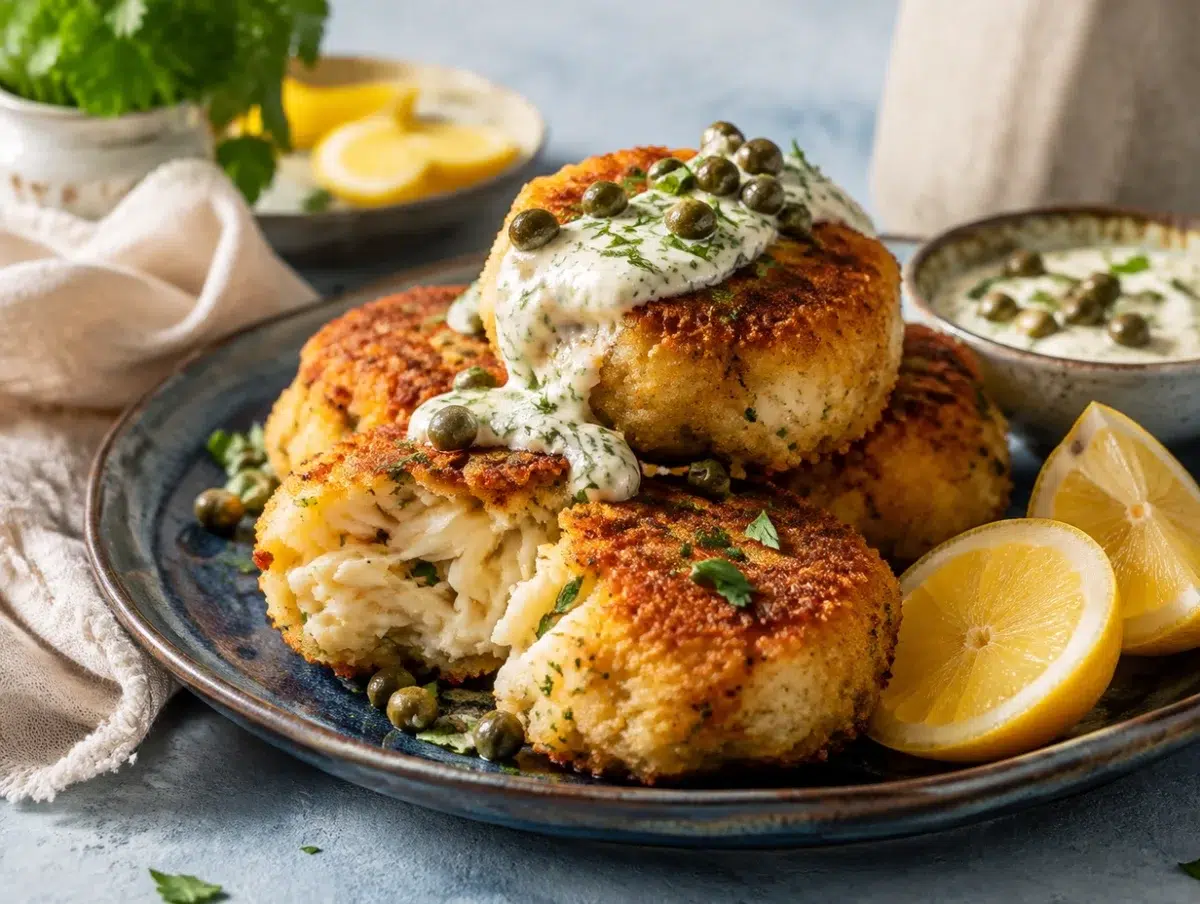
Within the hour, the kitchen was thick with the smell of crab meat sizzling in olive oil, sharp dill cutting through the warmth, and that unmistakable tang of crumbled feta melting at the edges of each little cake. The sound of them hitting the hot pan — that decisive, confident hiss — I can hear it right now if I close my eyes. Golden. Crispy. Impossibly fragrant.
These Mediterranean crab cakes are that morning, given back to you. I’ve made kavourokeftedes at least 80 times since my yiayia first guided my hands through the process, and this version — refined during my years at Varoulko, tested obsessively in my Athens apartment — is the one I’m most proud of. No heavy fillers, no mayo drowning the crab. Just sweet lump crab meat, fresh herbs, a whisper of feta, and a technique that gives you a crackling golden crust every time. In Crete, we believe the sea feeds the soul. Let me show you what I mean.
Table of Contents
Mediterranean Crab Cakes
Ingredients
Method
- 1. Spread crab on a plate, pick through for shells. Gently pat dry.
- 2. Whisk egg, yogurt, lemon juice, zest, paprika, salt, pepper in a large bowl.
- 3. Fold in crab meat, feta, dill, and garlic. Fold gently to preserve lumps.
- 4. Add panko. Fold until just combined. Shape into 8 patties (~2.5” / 6cm wide).
- 5. Chill on a parchment-lined tray for 30–60 minutes.
- 6. Heat olive oil in a large skillet over medium-high until shimmering.
- 7. Fry in batches, 3–4 minutes per side, until deep golden brown.
- 8. Rest on wire rack 2 minutes. Finish with fresh lemon zest.
- 9. Mix all sauce ingredients. Serve alongside cakes with lemon wedges.
Notes
Why These Mediterranean Crab Cakes Are Special
The Cretan Technique That Changes Everything
Most crab cake recipes — and I’ve studied dozens, believe me — use mayonnaise as both a binder and a moisture source. It works, but it also masks the crab. The Cretan approach is different. We use a combination of egg, a touch of Greek yogurt, and minimal breadcrumbs to create a cake that’s structurally sound but still lets the crab sing. As Harold McGee explains in On Food and Cooking, egg proteins coagulate at around 160°F / 71°C, creating a firm network that holds delicate ingredients together without adding competing flavors. That’s the food science behind why my yiayia’s healthy crab cakes held together beautifully with nothing more than an egg and a prayer.
A Flavor Profile Worth Remembering
The flavor here is unmistakably Greek-style seafood: sweet crab, salty feta, bright lemon, herbaceous dill, a gentle warmth from smoked paprika. It’s a crispy crab patty on the outside, tender and almost creamy within. I serve these as an appetizer for dinner parties, a main course over horta (wild greens), or honestly just standing at the counter at midnight. Don’t skip this. These Greek crab cakes are the dish that made my neighbor Eleni knock on my door and ask, “What is that smell and why haven’t you invited me?”
The Story Behind the Dish
Kavourokeftedes: A Mediterranean Tradition
Kavourokeftedes — literally “crab fritters” — belong to a broader family of Greek keftedes (patties) that includes everything from lamb keftedes to tomato fritters. In coastal Crete, crab cakes were historically a fisherman’s meal, made with whatever the nets brought in. The tradition of shaping seasoned seafood into patties and pan-frying in olive oil predates written recipes; it’s a technique passed through hands, not cookbooks. This Mediterranean seafood dinner was born from resourcefulness and refined by generations of home cooks.
My Yiayia’s Kitchen, My Classroom
My grandmother didn’t measure. She’d crack the crab with her bare hands (those hands could crush walnuts, I swear), mix in “enough dill to smell it from the garden,” and crumble feta until she “felt” the balance was right. I spent years trying to translate her intuition into measurements. This recipe is the result — tested, adjusted, and tasted until it earned her nod of approval. She passed in 2019, but every time I make these kavourokeftedes, she’s right there in the kitchen with me.
Essential Ingredients for Mediterranean Crab Cakes
Core Ingredients: What You Need and Why
In a dish this clean, every ingredient carries weight. Cut corners here and you’ll taste it. Let me walk you through what matters and why, because the right lump crab meat recipe starts at the market, not the stove.
The crab: you want lump or jumbo lump crab meat. Claw meat is fine for crab soups, but for cakes you need those beautiful large pieces that give you distinct flakes in every bite. I prefer fresh, but high-quality refrigerated pasteurized crab works too — I used it for half my test batches, and the difference was subtle. Whatever you do, pick through the meat for shell fragments. My mother used to say, “Nothing ruins a perfect bite like an unexpected crunch.”
The feta: this is non-negotiable. Use a good block feta packed in brine — not the pre-crumbled dust they sell in bags. I use PDO feta from sheep’s milk (Dodoni or Kolios are excellent). The tanginess cuts through the richness of the crab in a way that transforms the cake from “good” to “why have I never done this before?” The dill should be fresh. Dried dill is a shadow of itself. I grow mine on my Athens balcony, but bunches from the store work beautifully. Fresh herbs are a pillar of our approach in every recipe, from our Mediterranean shrimp white bean salad to our gemista (Greek stuffed peppers).
| Ingredient | Amount | Why It Matters | Authentic Pick | Substitution |
| Lump Crab Meat | 1 lb / 450g | Sweet, tender, the star | Fresh Cretan blue crab | Pasteurized lump or canned (drained well) |
| Feta Cheese | 2 oz / 60g, crumbled | Salty tang, binds moisture | PDO sheep’s milk feta | Ricotta salata or goat cheese |
| Fresh Dill | 3 tbsp / 10g, chopped | Bright, anise-like aroma | Garden-fresh Cretan dill | Fresh mint + parsley blend |
| Egg | 1 large | Binding agent — protein coagulation | Free-range | Flax egg (1 tbsp ground flax + 3 tbsp water) |
| Panko Breadcrumbs | 1/3 cup / 25g | Light crispy texture | Fine homemade breadcrumbs | GF panko or almond flour |
| Greek Yogurt | 2 tbsp / 30g | Moisture + tang, replaces mayo | Full-fat strained (Fage) | Dairy-free yogurt |
| Lemon | 1 medium (zest + juice) | Brightness, lifts all flavors | Thin-skinned Greek lemons | Meyer lemon |
| Smoked Paprika | 1 tsp | Warmth, color, depth | Cretan or Spanish smoked | Sweet paprika + pinch cayenne |
Dietary Substitutions & Pro Tips
| Dietary Need | Replace | With | Notes |
| Gluten-Free | Panko breadcrumbs | GF panko or almond flour | Almond flour makes them slightly nuttier — I actually love this |
| Dairy-Free | Feta + Greek yogurt | Dairy-free feta + coconut yogurt | Season extra; dairy-free feta is milder |
| Low-Carb / Keto | Breadcrumbs | Almond flour or crushed pork rinds… wait, no — crushed almonds | Keeps carbs under 3g per cake |
| Egg-Free | Egg | Flax egg or 2 tbsp aquafaba | Chill the mixture 30 extra minutes for firmness |
| Paleo | Breadcrumbs + yogurt | Coconut flour + extra egg | Use 2 tbsp coconut flour — it absorbs more moisture |
Yiayia’s Tip: After mixing, always taste a tiny pinch of the raw mixture (yes, the egg is there — I know — but a tiny taste won’t hurt). If it doesn’t make you want to eat the whole bowl, add more salt, more lemon, or more dill. My yiayia tasted everything, at every stage, without exception.
Equipment & Technique
The Right Tools for the Job
You don’t need a professional kitchen — my yiayia proved that with her ancient gas burner and one good pan. But the right tools help these pan fried crab cakes shine.
| Traditional Tool | Modern Alternative | Why It Matters |
| Heavy cast iron skillet (12-inch) | Non-stick or stainless steel | Even heat retention = uniform golden crust |
| Wooden spoon (for gentle mixing) | Silicone spatula | Prevents breaking up precious crab lumps |
| Ceramic lemon juicer | Fork + bowl | Catches seeds, maximizes juice |
| Flat metal spatula (thin) | Fish spatula | Slides under cakes without breaking them |
Setting Up Your Workspace
Before anything else: mise en place. Every component prepped, every tool within reach. Crab cakes move fast once you start cooking. My setup: mixing bowl center-left, plate lined with paper towels on the right, hot pan behind. Crab picked through, dill chopped, feta crumbled, lemon juiced, egg beaten. Everything ready. This discipline saved me during my Varoulko apprenticeship, and it’ll save you from a frantic Wednesday night disaster. (I speak from experience. Batch #4 of my testing? Let’s just say the smoke detector and I had a conversation.)
Step-by-Step: How to Make Mediterranean Crab Cakes
Preparation (Steps 1–4)
Step 1: Pick Through the Crab. Gently spread the crab meat on a clean plate and run your fingers through it, feeling for any shell or cartilage fragments. Be thorough but gentle — you want to preserve those beautiful lump pieces. This takes 3–4 minutes and is genuinely important. Trust me on this: one shell shard ruins the illusion of elegance.
Step 2: Mix the Binder. In a large bowl, whisk together the egg, Greek yogurt, lemon juice (about 1½ tablespoons), lemon zest, smoked paprika, a pinch of salt, and freshly cracked pepper. This wet base is your foundation. The yogurt adds tang and moisture without the heaviness of mayo — a hallmark of these healthy crab cakes that distinguishes them from traditional American versions.
Step 3: Fold In the Stars. Add the crab meat, crumbled feta, chopped dill, and a minced garlic clove to the bowl. Fold — fold, not stir — with a spatula or wooden spoon. You want to distribute everything evenly while keeping those crab lumps intact. If you treat this like you’re mixing cement, you’ll end up with crab paste. Gentle hands. My yiayia used to fold mixture like she was rocking a baby to sleep.
Step 4: Add Breadcrumbs and Shape. Sprinkle in the panko and fold again, just until combined. The mixture should hold together when pressed but still feel loose and moist. Form into 8 patties, about 2½ inches / 6cm across and ¾ inch / 2cm thick. Place on a parchment-lined tray and refrigerate for at least 30 minutes. Don’t skip the chill. The cold firms the cakes and prevents them from falling apart in the pan. I refrigerate mine for a full hour when I have the patience (which, honestly, is about 40% of the time).
Yiayia’s Tip: Wet your hands slightly before shaping each cake. The mixture won’t stick to your palms, and you’ll get smoother, more uniform patties. My yiayia dipped her hands in a bowl of lemon water — practical and fragrant.
Cooking & Assembly (Steps 5–10)
Step 5: Heat the Pan. Set a large skillet over medium-high heat. Add 3 tablespoons of extra-virgin olive oil (Kolymvari or Sitia, if you can find them). Wait until the oil shimmers and flows easily across the surface. If you drop a tiny breadcrumb in, it should sizzle immediately. That’s your signal. The oil temperature is critical — too cool and the cakes absorb grease; too hot and the outside burns before the inside warms through.
Step 6: Pan Fry the Mediterranean Crab Cakes. Working in batches (do not overcrowd), carefully place 4 cakes in the pan. Cook for 3–4 minutes per side at 350–375°F / 175–190°C. Don’t press them down (you’ll lose the airy texture) and resist the urge to flip too early. You want a deep golden-brown crust — not pale beige. When the edges look set and you can see color creeping up the sides, that’s your cue to flip.
Step 7: Flip and Finish. Use a thin spatula, slide it fully under each cake, and flip confidently. One motion. No hesitation. The second side needs another 3 minutes until equally golden. The internal temperature should reach 165°F / 74°C for food safety. Transfer to a paper-towel-lined plate.
Step 8: Build the Sauce (While Cakes Rest). In a small bowl, mix ½ cup Greek yogurt with 1 tablespoon lemon juice, 1 minced garlic clove, 1 tablespoon chopped dill, salt, and a drizzle of olive oil. This is essentially a quick ladolemono-yogurt hybrid — the crab cake dipping sauce that ties the whole plate together. Refrigerate until serving.
Step 9: Plate with Intention. Arrange the Mediterranean crab cakes on a warm plate (my yiayia always warmed plates in the oven — “Cold plates are for cold hearts,” she’d say). Spoon the sauce alongside or in a small ramekin. Add a wedge of lemon, a few dill fronds, and if you’re feeling Cretan, a small pile of lightly dressed horta. The technique here mirrors how we plate our Mediterranean sheet pan salmon — components arranged, never piled.
Step 10: Serve Immediately. These are best hot, within minutes of leaving the pan. The crust is still crackling, the inside is warm and flaky, and the feta has gone slightly molten at the edges. Serve as a Greek-style seafood appetizer for 4, or as a main course for 2 with sides. Pour yourself a cold sparkling water with mint. Take a breath. Eat.
Pro Tip: For an even crispier exterior, double-dredge the shaped cakes in panko before frying. The extra layer creates restaurant-level crunch. This is what we did at Varoulko for our kavourokeftedes tasting plate, and the texture difference is remarkable.
The Secret Touches
Three Techniques from My Family’s Kitchen
1. The Lemon Zest Finish: After frying, while the cakes are still glistening with heat, grate fresh lemon zest directly over them. The essential oils bloom on contact with the hot surface, releasing a citrus perfume that no amount of lemon juice alone can achieve. Kenji López-Alt discusses this in The Food Lab — volatile aromatic compounds are most impactful when applied to warm surfaces.
2. The Feta Pocket: Instead of mixing all the feta into the batter, tuck a small nugget of feta into the center of each cake before shaping. When you bite in, you hit a hidden pocket of warm, melting cheese. My mother invented this trick, and it’s why her kavourokeftedes were legendary in our Chania neighborhood.
3. The Rest Period: Let the cakes rest on a wire rack (not paper towels) for 2 minutes after frying. The bottom stays crispy instead of steaming against a flat surface. This small change took my homemade crab cakes from “great” to “why don’t I eat these every night.”
Common Mistakes (and How to Fix Them)
| Mistake | What Happens | How to Fix It | Prevention |
| Too much binder/breadcrumb | Dense, bready cakes — no crab flavor | Reduce breadcrumbs by half, add crab | Use minimum crumbs; crab should dominate |
| Not chilling before frying | Cakes fall apart in the pan | Return to fridge 20 more minutes | Always chill 30–60 minutes minimum |
| Oil not hot enough | Greasy, soggy exterior | Increase heat, let oil re-shimmer | Breadcrumb test: must sizzle on contact |
| Flipping too early | Crust tears, cake breaks | Wait until edges set and color appears | 3–4 full minutes, no peeking |
| Overmixing the batter | Crab becomes paste, loses texture | Can’t undo — start fresh with gentle folding | Fold 10–12 times max. Stop when combined |
Variations & Serving Ideas
Regional Twists and Modern Adaptations
The beauty of kavourokeftedes is their adaptability. In Crete, we keep things pure: crab, herbs, feta, olive oil. But on the islands like Santorini, I’ve had versions with sun-dried tomatoes folded in. In Athens, modern tavernas add a pinch of za’atar or sumac for a North African-Mediterranean twist. One of my favorite modern adaptations: swap half the crab for finely chopped grilled shrimp — the texture contrast is beautiful. For a weeknight shortcut, use canned crab (drained and squeezed dry in a towel) and skip the chilling step — just shape firmly and fry. It’s 85% as good in half the time. You can even bake these — our baked crab cakes version uses 400°F / 200°C for 15–18 minutes, flipping once.
What to Serve Alongside
I love these Mediterranean crab cakes over a bed of our classic Greek lemon rice pilafi for a full dinner, or alongside our Mediterranean white bean salad for a lighter meal. The citrus in both dishes echoes the lemon in the cakes beautifully. For a Greek meze spread, add our Mediterranean hummus breakfast bowl (it works for any meal, honestly) and our Mediterranean chickpea power bowl for a vegetable-heavy contrast.
Non-Alcoholic Beverage Pairings: Chilled tsai tou vounou (Greek mountain tea) is my first choice — it’s herbal, subtle, and gorgeous with seafood. Fresh mint lemonade works brilliantly. Sparkling water with cucumber and a sprig of dill mirrors the cakes’ flavors. For something unexpected: cold hibiscus tea with a squeeze of orange.
Storage & Reheating
How to Store Mediterranean Crab Cakes
| Method | Container | Duration | Notes |
| Refrigerator | Airtight container, single layer with parchment between | 3–4 days | Store sauce separately |
| Freezer | Freeze on sheet pan, then transfer to zip-lock bag | Up to 2 months | Thaw in fridge overnight before reheating |
| Room Temperature | Covered plate | Up to 2 hours | Food safety limit |
Reheating for Maximum Crispiness
The oven is your best friend for reheating these homemade crab cakes. Place on a wire rack set over a sheet pan at 375°F / 190°C for 8–10 minutes. The wire rack lets hot air circulate underneath, re-crisping the bottom. A quick 30-second blast under the broiler at the end brings back that golden crunch.
Avoid the microwave — it turns the crispy exterior into a damp blanket. (I tried it once for “science.” The science was sad.) For stovetop: medium heat, 1 tablespoon olive oil, 2 minutes per side. Serve with a fresh squeeze of lemon and a spoonful of the yogurt-dill sauce. Even leftover cakes are delicious sliced over greens — our grilled chicken Mediterranean bowl template works perfectly with crumbled crab cakes instead of chicken.
Frequently Asked Questions
Substitution & Technique Questions
Can I use canned crab meat for Mediterranean crab cakes?
Absolutely. Drain it thoroughly and squeeze dry in a clean towel. The flavor will be slightly less sweet than fresh, but the texture works well. I’ve made these with canned crab probably 30 times — still delicious. Go for lump or fancy grades, not the shredded variety.
What’s the best way to get a golden crust on my pan fried crab cakes?
Three things: dry your cakes (chill them), hot oil (shimmer, not smoking), and patience (3–4 minutes per side without touching). The Maillard reaction needs time, heat, and a dry surface. As Harold McGee notes, moisture on the surface will steam rather than brown.
Can I bake these instead of frying?
Yes! Place on a parchment-lined sheet pan, brush with olive oil, and bake at 400°F / 200°C for 15–18 minutes, flipping once at the halfway mark. The crust won’t be quite as crispy as pan-fried, but it’s excellent for a lighter version. Our baked crab cakes are a great weeknight option.
Do I really need to chill the cakes before cooking?
Yes. The chilling step firms the binding agents and sets the shape. Skipping it is the number-one reason crab cakes fall apart in the pan. Thirty minutes minimum; one hour is better. I know patience is hard (trust me), but this step is non-negotiable.
What can I use instead of feta?
Ricotta salata has a similar salty tang. Mild goat cheese works too, though it’s softer. For dairy-free, use a plant-based feta crumble. The feta isn’t just flavor — it helps bind and adds moisture, so you’ll want something with similar salinity.
Dietary, Make-Ahead & Authenticity Questions
Are these crab cakes gluten-free?
Not as written (panko contains wheat), but easily adapted. Swap regular panko for gluten-free panko or use almond flour. The texture is slightly different — nuttier, less airy — but honestly? I sometimes prefer the almond flour version. It’s a great healthy crab cake option.
Can I make the mixture ahead of time?
Yes — mix everything, shape the cakes, and refrigerate for up to 24 hours before frying. This is actually ideal because the longer chill produces even firmer cakes. I often prep these Saturday morning for Saturday evening dinner.
What makes this recipe authentically Mediterranean rather than just ‘crab cakes with feta’?
The philosophy: restraint, quality ingredients, and olive oil. We don’t drown in mayonnaise or Old Bay. The herbs are fresh, the cooking fat is EVOO, and the sauce is yogurt-based — all pillars of Mediterranean cooking. The feta, dill, and lemon are specifically Greek. My grandmother would recognize every element.
How many crab cakes per person?
For an appetizer: 2 per person. For a main course: 3–4 per person with sides. This recipe makes 8 cakes, which serves 4 as a starter or 2 as a main. Scale up by 1.5x for a dinner party of 6.
Bringing Greece to Your Kitchen
From Chania’s Harbor to Your Table
Every time I make these Mediterranean crab cakes, I’m back on that stone floor in Chania, watching my yiayia’s hands move with that impossible certainty. The sizzle of olive oil, the smell of dill and lemon, the first golden bite. This is my inheritance, and I’m giving it to you. If my yiayia wouldn’t recognize it, it doesn’t belong in the recipe. She’d recognize every bite of these.
Make them. Photograph them. Tag us. Tell me what you served on the side. Cooking was never meant to be solitary — it’s a conversation between generations.
More Mediterranean Recipes to Explore
If these crab cakes have you craving more seafood, our roasted vegetables salmon is another one-pan wonder. For a full Greek meze night, add our pasta primavera and finish with our Greek yogurt panna cotta — light, creamy, and the perfect ending. And for those cozy evenings, our creamy tomato basil chicken brings the same warm Mediterranean spirit in a completely different direction.