I can still hear the sound of my yiayia’s wooden spoon scraping the bottom of her big copper pot on a Saturday afternoon in Chania. The kitchen smelled of bay leaves and slow-cooked onions — a smell that still makes me close my eyes and exhale. She would stand at that old gas stove for what felt like hours, grating carrots directly into the sauce, folding in handfuls of spinach. “Nobody needs to know what’s in it,” she’d whisper to me with a wink. “They just need to eat.”
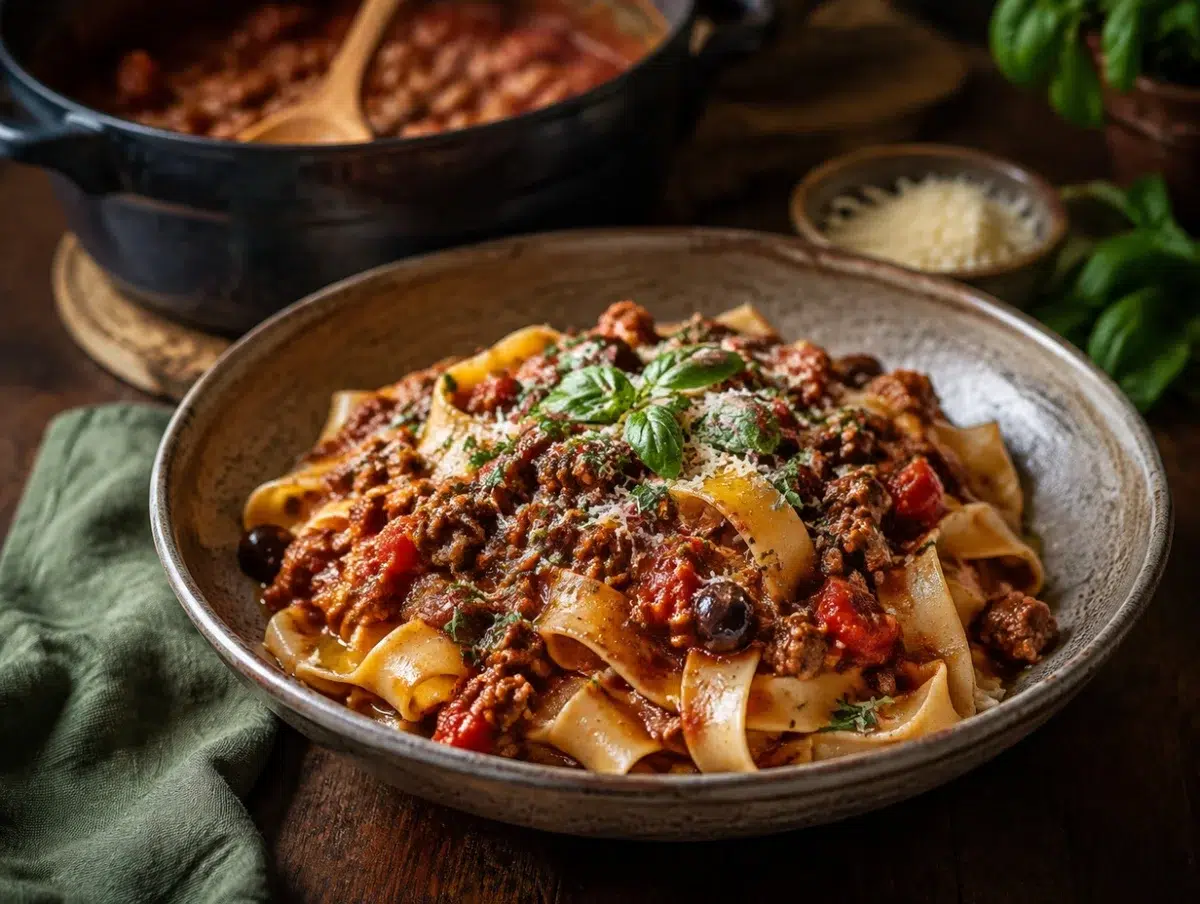
That was my first introduction to the art of the hidden vegetable pasta sauce. My yiayia’s Mediterranean Bolognese with Hidden Veggies was never called that, of course — she simply called it her ragù — but it was loaded: zucchini, carrots, mushrooms, and spinach, all disappearing into a thick, glistening, deeply savory lamb and tomato sauce that clung to every strand of pasta like a warm embrace.
When my father passed away in 2017, I started cooking this dish every Sunday. Not just to keep him close, but to preserve what three generations of my Cretan family had built around that table. This recipe is that dish — elevated with techniques I’ve refined over 20 years working in professional kitchens, simplified for a Tuesday night. It’s a family-friendly pasta dinner that sneaks in five vegetables without anyone being the wiser. Picky eaters beware. This sauce is not what it looks like.
Table of Contents
Mediterranean Bolognese with Hidden Vegetables
Ingredients
Method
- 1. Heat olive oil in a large Dutch oven over medium heat. Add onion and celery with a pinch of salt; cook 8–10 minutes until golden and soft.
- 2. Add garlic; cook 60 seconds. Add mushrooms with a pinch of salt; cook 6–8 minutes until liquid evaporates and mushrooms begin to brown.
- 3. Increase heat to medium-high. Add ground lamb; break into pieces and press flat. Leave undisturbed 3–4 minutes to brown. Season with salt, pepper, cinnamon, paprika, and oregano. Add bay leaves.
- 4. Add grated carrots and zucchini (squeezed dry). Stir and cook 5 minutes. Add tomato paste; stir and cook 2–3 minutes until paste darkens to rust-orange.
- 5. Pour in crushed tomatoes and warm broth. Scrape up any browned bits from the pot bottom. Bring to a gentle boil, then reduce to the lowest possible simmer.
- 6. Simmer uncovered for 45–60 minutes, stirring every 10 minutes, until the sauce is thick, dark, and coats the back of a spoon. Add splashes of broth if it thickens too quickly.
- 7. In the last 5 minutes, stir in fresh spinach until fully wilted. Remove bay leaves. Taste and adjust seasoning.
- 8. Cook pasta in generously salted boiling water until al dente. Reserve 250ml pasta water. Drain. Add pasta to sauce, toss over medium heat with pasta water splashes until glossy.
- 9. Serve in warm bowls topped with grated Kefalotyri/Parmesan, fresh basil, and a drizzle of raw olive oil.
Notes
Storage:
Sauce refrigerates up to 5 days (airtight container) or freezes up to 4 months. Always freeze sauce separately from pasta.Make-ahead:
Sauce is better the next day — make up to 48 hours ahead and reheat gently on the stovetop.Key substitutions:
Replace lamb with ground beef (80/20) or ground turkey. Replace spinach with frozen spinach, squeezed dry.Dietary:
Use GF-certified pasta for gluten-free version. Skip cheese topping for dairy-free. Recipe is halal as written (verify broth label).Grating tip:
Always squeeze grated zucchini and carrot in a clean towel to remove excess water before adding to the pan.Related recipes for complete meal planning:
pair with our Crustless Spinach and Feta Quiche as a starter, or follow with our Easy Tiramisu Recipe for dessert. Explore more pasta inspiration with our Spicy Rigatoni and Mediterranean Breakfast Bowl for a full Mediterranean week.Why This Mediterranean Bolognese with Hidden Veggies Is Special
The Cretan Technique That Makes All the Difference
Most Bolognese recipes stop at the soffritto — onion, carrot, celery. We go further. In Crete, we grate the zucchini and carrots directly into the pot so they dissolve completely into the sauce as it simmers, building what food scientist Harold McGee describes as layered umami from natural glutamates in the vegetables. The mushrooms are diced so finely they vanish, contributing what J. Kenji López-Alt calls “meaty depth” without a single visible piece of fungus. This Mediterranean Bolognese with Hidden Veggies achieves something most sauces never do: it tastes richer than its ingredients suggest.
The addition of a half-teaspoon of ground cinnamon — a hallmark of Cretan meat sauces, used in pastitsio and stifado — adds warmth that sits just below the palate’s radar. It doesn’t taste like cinnamon. It tastes like “more.” Trust me on this.
🫒 Yiayia’s Tip: Use the large holes on your box grater for the zucchini and carrots — they melt into the sauce in under 20 minutes of gentle simmering.
The Flavor Profile and When to Serve It
This healthy Bolognese sauce is simultaneously bold and gentle: earthy lamb, sweet slow-cooked carrot, the iron-green whisper of spinach, bright San Marzano tomatoes anchored by the herbaceous hit of Greek oregano. It’s what I call a “Mediterranean tomato sauce with ambition.” Serve it for a Sunday family dinner, a weeknight meal prep session, or whenever you need to feed a group of people — including children who “don’t like vegetables” — without a single complaint. I’ve made this at least 60 times since 2018 and every time the pot is empty before dessert.
The Story Behind This Dish
Cultural and Historical Roots
Bolognese as we know it in the West traces back to Emilia-Romagna in northern Italy. But slow-cooked meat sauces with vegetables hidden inside are a Mediterranean tradition far older than any Italian ragù recipe. In Greece, pastitsio and moussaka both rely on the same principle: vegetables layered or grated into a meat base, enriched with warming spices, built to feed a crowd. This is not a fusion recipe. It’s a convergence of two great Mediterranean cultures around a shared instinct — the slow-simmered tomato ragù that makes a house smell like a home.
A Family Tradition from the Island of Crete
My grandfather’s taverna in Chania served a version of this sauce over thick, hand-cut noodles every Friday. My mother learned it from watching him, then adapted it at home with whatever the garden offered — zucchini in summer, sweet potato in autumn, mushrooms in winter. The hidden vegetable pasta sauce was never a clever “hack.” It was simply Cretan practicality: use what you have, feed who you love, waste nothing. When I tested this recipe for the blog, I sat with my mother over video call and we cooked it together — me in Athens, her in Chania. She told me I was using too much cinnamon. She was right.
Essential Ingredients for the Perfect Hidden Veggies Bolognese
Core Ingredients: What Goes In and Why
Every ingredient in this Mediterranean Bolognese with Hidden Veggies earns its place. Here’s a full breakdown, including why the authentic picks matter and what you can substitute without losing the soul of the dish.
| Ingredient | Amount | Why It Matters | Authentic Pick | Substitution |
| Ground lamb | 500g / 1.1 lb | Richer, earthier flavor than beef; classic in Greek meat sauces | Grass-fed New Zealand lamb | Ground beef or turkey |
| Extra-virgin olive oil | 3 tbsp | The flavor base; carries fat-soluble aromatics into the sauce | Cretan EVOO (Kolymvari PDO) | Any quality EVOO |
| Zucchini (grated) | 2 medium (~300g) | Dissolves fully, adds moisture and subtle sweetness | Fresh garden zucchini | Grated yellow squash |
| Carrot (grated) | 2 large (~200g) | Balances tomato acidity with natural sugar; virtually invisible | Heirloom carrots | Sweet potato, grated |
| Mushrooms (diced fine) | 150g / 5oz | Adds glutamate-rich umami; disappears into the sauce | Cremini (brown) | White button or portobello |
| San Marzano tomatoes | 2 × 400g cans | Low acidity, plum-sweet — the gold standard for a Mediterranean tomato sauce | D.O.P. certified cans | Quality crushed tomatoes |
| Ground cinnamon | ½ tsp | Cretan spice that adds warm depth without tasting sweet | Ceylon cinnamon (true cinnamon) | A pinch of allspice |
| Fresh spinach | 2 large handfuls | Iron, color, and volume — completely hidden once wilted | Baby spinach leaves | Frozen spinach, squeezed dry |
The lamb is where this recipe diverges from a traditional Italian version. I have cooked this sauce with beef, turkey, and even a 50/50 lamb-beef mix. Lamb wins every time. It has a slight gaminess that the cinnamon and oregano embrace completely — like old friends meeting again. My grandfather used lamb from the Cretan hills and nothing else would do. (I once tried beef to save money during a lean month and my mother somehow sensed it over the phone. I still don’t know how.)
Dietary Substitutions for Every Lifestyle
This is an inherently flexible recipe. Here’s how to adapt it without compromising flavor:
| Dietary Need | Replace | With | Notes |
| Gluten-free | Regular pasta | Certified GF pasta (rice, chickpea, lentil) | Reserve extra pasta water — GF pasta absorbs sauce faster |
| Dairy-free | Parmesan/Kefalotyri topping | Nutritional yeast or dairy-free cheese | Add a squeeze of lemon to compensate for tang |
| Vegetarian | Ground lamb | 250g lentils + 200g walnuts (blitzed) | Use vegetable broth; add 1 extra tbsp tomato paste |
| Lower-fat | Lamb mince | Lean ground turkey (93%) + 1 tbsp olive oil | Lamb fat carries flavor; compensate with extra oregano |
| Low-sodium | Regular canned tomatoes | No-salt-added San Marzano | Season at table with a pinch of fleur de sel |
★ Pro Tip: Halal pasta dinner option: this recipe is already halal as written — lamb, beef, or turkey all work. Just ensure your broth is halal-certified.
Equipment and Technique Essentials
Traditional vs. Modern Kitchen Tools
Good tools matter. My yiayia used a heavy copper pot that had been in the family since before I was born. You probably don’t have that. Here’s what works in a modern kitchen:
| Traditional Tool | Modern Alternative | Why It Matters |
| Heavy copper pot (tapsi) | Enameled cast-iron Dutch oven (5–7 qt) | Even heat distribution prevents scorching during the long simmer |
| Box grater (wooden-handled) | Food processor with grating disc | Grating keeps veg textures consistent — don’t over-process |
| Wooden spoon | Silicone spatula with straight edge | Scrapes the fond (browned bits) that carry flavor |
| Wide, shallow serving bowl | Warmed pasta bowl | Pasta cools fast — always serve in warm bowls |
Mise en Place and Workspace Setup
Before you begin: grate the zucchini and carrots over a clean kitchen towel and squeeze out as much liquid as possible. This is critical. Excess water will steam your meat instead of browning it, robbing you of the Maillard reaction — the high-heat browning that creates hundreds of savory flavor compounds, as McGee explains in On Food and Cooking. Lay out all your vegetables, measured and ready. Dice the mushrooms very fine — I mean fine, like 3–4mm. Mince the garlic. Have your broth warm and waiting. This dish rewards preparation.
🫒 Yiayia’s Tip: Salt your grated zucchini lightly, let it sit 5 minutes, then squeeze in the towel. You’ll be amazed how much liquid comes out.
Step-by-Step Instructions for Mediterranean Bolognese with Hidden Veggies
Preparation Steps 1–4: Building the Foundation
- Heat 3 tablespoons of extra-virgin olive oil in your Dutch oven over medium heat until it shimmers — about 90 seconds. Add the diced onion and celery with a pinch of salt. Cook for 8–10 minutes, stirring occasionally, until the onion is completely translucent and beginning to turn golden. This is your soffritto base: don’t rush it. The natural sugars caramelize slowly, and that sweetness forms the backbone of your Mediterranean Bolognese with Hidden Veggies. The kitchen should smell like the beginning of something wonderful.
- Add the minced garlic and cook for 60 seconds until fragrant — you’ll smell it almost immediately. Then add the finely diced mushrooms with another small pinch of salt. Stir everything together and cook over medium-high heat for 6–8 minutes. The mushrooms will release liquid, then reabsorb it, then begin to brown. Wait for the browning. The sizzling will shift from wet to dry — that’s your cue.
- Add the ground lamb. Break it up aggressively with your wooden spoon and push it into a single layer across the pan. Leave it alone for 3–4 minutes before stirring. This is how you get proper Maillard browning — contact with heat, not constant movement. The lamb should develop a deep mahogany crust on the bottom. Brown the meat in two batches if your pot feels crowded. Season generously with salt, black pepper, ½ tsp cinnamon, ½ tsp smoked paprika, and 1 tsp dried Greek oregano. Add the bay leaves.
🫒 Yiayia’s Tip: When you hear the sizzle change from a wet “splash” to a dry “crackle,” your meat is properly browning. That sound is money.
- Add the grated, squeezed carrots and zucchini, stirring them into the meat. Cook for 5 minutes until they begin to soften and their color deepens slightly. The pan will look alarmingly full — this is normal. Add 2 tablespoons of tomato paste and stir it into every corner of the pan. Cook the paste for 2–3 minutes until it darkens from bright red to rust-orange. This concentrating step, called “pinçage” in classical technique, eliminates the raw tin taste and deepens the umami of your grated zucchini pasta sauce.
Cooking and Assembly Steps 5–10: The Long Simmer
- Pour in the two cans of San Marzano tomatoes, crushing them with your hands as they go in (yes, with your hands — this is the Cretan way). Add 250ml / 1 cup of warm beef broth. Stir everything thoroughly, scraping up any fond from the bottom of the pot. Bring to a gentle boil, then immediately reduce to the lowest simmer your stove can manage. The surface should barely tremble — a bubble every 3–4 seconds. This slow-simmered tomato ragù is where patience pays dividends.
- Simmer uncovered for 45–60 minutes, stirring every 10 minutes. If the sauce thickens too fast, add a splash of broth. The sauce is ready when it’s thick enough to coat the back of a spoon and holds a clear line when you drag your finger through it. The color should deepen from bright red to a rich burgundy-brown. You will want to eat it with a spoon directly from the pot. This is allowed.
🫒 Yiayia’s Tip: My mother adds a small square of dried orange peel in the last 20 minutes of simmering — a classic Cretan trick that brightens the sauce without making it taste citrusy. Remove before serving.
- Add the fresh spinach in the last 5 minutes of cooking. Push it under the sauce with a spoon and stir until completely wilted — about 2 minutes. The spinach will disappear almost entirely, contributing iron, magnesium, and a gentle earthiness without any visible green that might alert a suspicious eight-year-old. This is your Mediterranean Bolognese with Hidden Veggies in its final, complete form. Taste and adjust salt. Remove bay leaves.
- Cook your pasta. Bring a large pot of water to a rolling boil. Salt it generously — it should taste lightly of the sea. Cook 500g of spaghetti or pappardelle according to package instructions until just al dente, about 1–2 minutes less than the packet suggests. Reserve 250ml / 1 cup of pasta water before draining — this starchy liquid is your sauce’s best friend.
- Combine. Add the drained pasta directly to the sauce pot. Toss over medium heat for 90 seconds, adding splashes of pasta water as needed to achieve a glossy, sauce-coated consistency. The pasta water’s starch acts as an emulsifier, binding the fat and liquid into a unified, silky coating — as Kenji López-Alt demonstrates in The Food Lab.
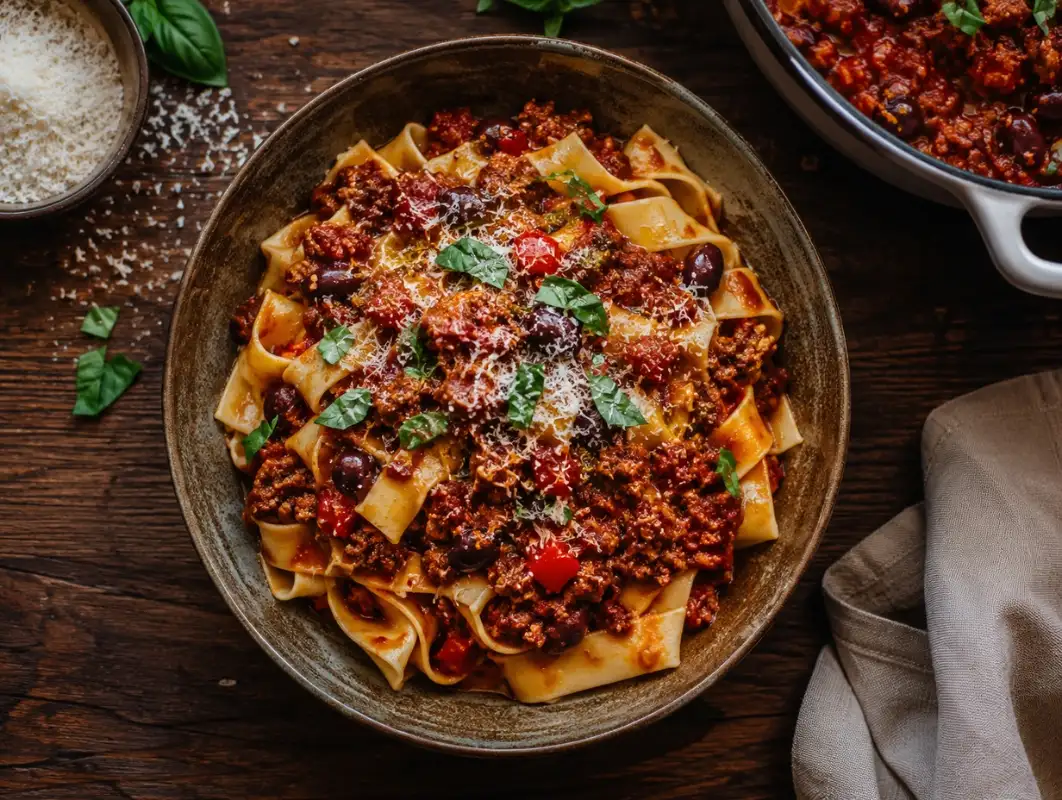
- Serve immediately in warm bowls. Top with freshly grated Kefalotyri cheese (the authentic Cretan choice) or Parmesan. Tear a few fresh basil leaves over each bowl. Drizzle with your best olive oil. Call your family to the table.
The Secret Touches That Elevate This Sauce
Three Insider Techniques from My Yiayia’s Kitchen
The first secret is the double-salt technique. Salt the vegetables when you add them — not just at the end. Each layer of salt draws out moisture, concentrating flavor. My yiayia never measured; she seasoned the way you’d salt pasta water: with confidence.
The second is what I call the “patience point.” Every sauce has a moment when it looks slightly broken — too much liquid, too pale, too flat. With this healthy Bolognese sauce, that moment comes at the 20-minute mark. Push through it. The sauce transforms around the 35-minute mark, darkening and thickening almost visibly.
The third secret is cold fat finish. When the pasta is plated, I drizzle a thin ribbon of cold, raw Cretan olive oil over each bowl. The contrast between the warm, slow-cooked sauce and the bright, grassy raw oil is what makes this dish sing. My grandfather did this at his taverna. I’ve never stopped.
★ Pro Tip: If you have Kolymvari PDO olive oil — the estate-pressed Cretan variety — save it for the finishing drizzle. It’s too good to cook with.
Common Mistakes and How to Fix Them
| Mistake | What Happens | How to Fix It |
| Not squeezing grated zucchini | Watery sauce that won’t thicken; steamed (not browned) meat | Squeeze grated zucchini in a clean towel until no more liquid drips out |
| Rushing the onion soffritto | Harsh, bitter sauce lacking sweetness and depth | Cook onion/celery minimum 8 minutes on medium — they should be golden, not just translucent |
| Stirring the meat constantly | Gray, boiled-looking mince with no Maillard browning | Press meat flat, leave undisturbed 3–4 min, then flip. Brown in batches if needed |
| Simmering at too high a heat | Sauce burns on the bottom, develops bitter notes | The surface should barely move. Use a flame diffuser if your stove runs hot |
| Undersalting pasta water | Bland pasta that fights with the flavorful sauce | Add at least 10g of salt per liter of pasta water — it should taste mildly of the sea |
Variations and Serving Suggestions
Regional Variations and Modern Adaptations
In Crete, we use lamb as a matter of tradition. On the Greek mainland, beef is more common, and the sauce is often spiked with a splash of pomegranate juice instead of broth — a technique borrowed from the Byzantine-era cooking that still echoes in Macedonian kitchens. On the islands of the Aegean, a baked version called pastitsio uses the same vegetable-laden meat sauce layered with thick pasta tubes and béchamel. Try this recipe as a pastitsio filling — it works beautifully.
For a weeknight shortcut, skip the long simmer: after browning the meat and adding the tomatoes, transfer to a slow cooker and cook on LOW for 4–6 hours. The result is slightly looser but deeply flavored. The hidden vegetable pasta sauce also works brilliantly as a lasagne filling — layer it with our Cheese Sauce with Feta for a Mediterranean twist on a classic, or use it to top a bowl of our Rigatoni Pomodoro for a simpler weeknight variation.
🫒 Yiayia’s Tip: Freeze individual portions in zip-lock bags, pressed flat. They thaw in 20 minutes in warm water — perfect for a last-minute family-friendly pasta dinner.
Accompaniments and Non-Alcoholic Pairings
This Mediterranean Bolognese with Hidden Veggies needs very little beside it. A simple green salad dressed with ladolemono — the classic Cretan lemon and olive oil dressing — is all you need. A warm flatbread to mop the bowl is never wrong. For beverages, try chilled sparkling water with a slice of lemon and fresh mint, homemade pomegranate lemonade, or a cold glass of ayran (yogurt drink) — its tangy creaminess cuts through the richness of the lamb in the most satisfying way. Alternatively, tsai tou vounou, the Greek mountain tea brewed from dried sideritis herbs, makes a wonderfully aromatic pairing for a cold evening.
Start the meal with our Crustless Spinach and Feta Quiche — a light, protein-rich opener — and finish with our Limoncello Tiramisu for a complete Mediterranean dinner party spread.
Storage and Reheating
How to Store Your Mediterranean Bolognese with Hidden Veggies
| Method | Container | Duration | Notes |
| Refrigerator (sauce only) | Airtight glass container | Up to 5 days | Sauce thickens in the fridge — add a splash of broth when reheating |
| Refrigerator (pasta + sauce combined) | Airtight container | Up to 3 days | Pasta absorbs sauce; reheat gently with extra pasta water |
| Freezer (sauce only) | Freezer bags (lay flat) or containers | Up to 4 months | Thaw overnight in fridge or 20 min in warm water bath |
| Freezer (pasta + sauce) | Not recommended | — | Pasta texture deteriorates on freezing — freeze sauce separately |
Reheating Methods
For the best results, reheat the sauce alone in a wide skillet over medium-low heat with a splash of broth or water. Cook fresh pasta to serve alongside — this takes only 8 minutes and makes a genuine difference to the texture. If you must reheat pasta-plus-sauce, add 3–4 tablespoons of water, cover, and microwave on 70% power in 90-second intervals, stirring between each. Never reheat on full power: you’ll get rubbery meat and mushy vegetables. A drizzle of fresh olive oil after reheating revives the gloss and flavor.
Frequently Asked Questions
Substitutions, Technique, and Troubleshooting
Can I use beef instead of lamb for this recipe?
Absolutely. Ground beef (80/20 fat ratio) produces a slightly milder, richer sauce that’s more familiar to many palates. I recommend using a good-quality grass-fed beef for the best flavor. A 50/50 mix of lamb and beef is actually my second favorite after pure lamb — you get the depth of the lamb with the familiarity of beef. I’ve tested this combination at least 15 times with consistently excellent results.
My sauce looks watery at the 20-minute mark. Is something wrong?
No — this is the “patience point” I describe in the secret touches section. The vegetables (especially the zucchini) release water as they cook. Keep simmering uncovered. Between minutes 30 and 40, the sauce will visibly tighten and deepen in color. If it’s still thin at 50 minutes, increase heat slightly for the final 10 minutes, stirring frequently. Never cover the pot during the final simmer.
What pasta shape works best with this veggie-loaded meat sauce?
Spaghetti is classic and works beautifully, but pappardelle — wide, ribbony egg pasta — is my personal preference. The broad surface area catches every bit of sauce. For a shorter pasta, rigatoni is excellent. The ridges and tubes trap the hidden vegetables and meat perfectly. For an entirely different texture, try our Mezzi Rigatoni — the half-sized rigatoni works especially well with thicker sauces.
Can I make this sauce ahead for a dinner party?
Yes — and it’s actually better the next day. Make the sauce up to 48 hours ahead and store in the refrigerator. Reheat slowly on the stovetop while you cook fresh pasta. The flavors meld and deepen overnight. This make-ahead pasta sauce is one of the reasons I keep it in regular rotation — one Sunday cook session means pasta dinners all week.
Dietary, Make-Ahead, and Authenticity Questions
Is this recipe halal?
Yes. This halal pasta dinner uses lamb or beef with no pork products whatsoever. The broth should be halal-certified (most standard beef broths are, but check the label). There is no alcohol in this recipe — the depth traditionally achieved with wine is replaced here by the lamb broth, tomato paste caramelization, and the slow simmer itself, all of which produce a completely authentic-tasting result.
How many vegetables can I hide without affecting flavor?
The recipe comfortably hides five: zucchini, carrot, mushrooms, celery, and spinach. You can add finely diced red bell pepper (sweeter, fully dissolved by the end) and even grated sweet potato without anyone noticing. I wouldn’t go beyond six different vegetables — too many competing flavors begin to muddy the sauce. Stick with mild, water-rich vegetables and avoid cruciferous ones like broccoli, which turn sulfurous when long-cooked.
Is this an authentic Greek recipe?
It’s authentically inspired. Greece doesn’t have a dish formally called “Bolognese” — that’s Italian. But slow-cooked, vegetable-laden meat sauces for pasta have existed in Greek cooking for centuries. The specific combination here — lamb, cinnamon, oregano, and hidden grated vegetables — reflects genuine Cretan cooking tradition, adapted into a format recognizable to international home cooks. My family has been making this in Chania for at least three generations.
Can children help make this recipe?
Absolutely — it’s one of my favorite recipes to cook with young people. Children can help grate the carrots and zucchini (supervised), stir the sauce during the simmer, and tear the basil leaves for serving. The irony of having a picky eater grate the vegetables they’ll later unknowingly consume is something I find deeply satisfying.
Bringing the Mediterranean to Your Table
A Final Word from Nikos’s Kitchen
Every time I make this Mediterranean Bolognese with Hidden Veggies, I think about my grandfather’s taverna in Chania — the long wooden tables, the sound of the sea just outside the door, the way my yiayia’s sauce would fill the entire building with its smell by noon on a Saturday. Cooking is memory. Cooking is love made edible. And hiding five vegetables in a sauce that everyone cleans their bowl of is, I think, one of the highest forms of culinary love there is.
Make this recipe. Make it on a Sunday afternoon with no particular rush. Let it simmer. Invite someone to your table. Share the recipe only after they’ve asked for it three times. That’s the Mediterranean way.
I’d love to see your version! Leave a comment below, or tag me with a photo of your bowl. And if your picky eater came back for seconds? That story absolutely belongs in the comments.
Related Recipes Worth Exploring
If you loved this dish, your next adventure might be exploring the broader world of Mediterranean pasta. Our Rigatoni Carbonara is another crowd-pleaser that never fails at a dinner party. For a lighter option on busy weeknights, try our Rigatoni Pomodoro — just five ingredients and 30 minutes. And if you’re looking for a way to continue the Mediterranean theme into dessert, our Easy Tiramisu Recipe is the perfect finale, or treat yourself to the citrusy elegance of our Limoncello Tiramisu.