Every April, when I was a boy in Chania, my father would come home from his fishing boat with rubber boots muddy to the knee and a fistful of wild asparagus — agriosparanga, the kind that grows between the olive trees on the way down to the harbor. Skinny, almost purple at the tips, bitter in the best way. Yiayia would wash them in cold water, drop them in a hot pan with olive oil, and eat them standing at the stove, one by one, like candy. That memory is the reason I now make this Asparagus & Gruyère Tart with Herb Pastry every single spring.
The idea came together during my apprenticeship at Varoulko in Athens, where Chef Lefteris taught me the French classics — pâte brisée, blind baking, cold butter cut into flour. I kept thinking: what if the pastry itself tasted like yiayia’s herb garden? Cretan oregano, fresh thyme, a whisper of chives. What if I used the nutty graviera-style Alpine cheese — gruyère, really, just the Swiss cousin — that melts into gold?
What you get, after forty-five minutes and one gorgeous oven moment, is a tart so pretty you’ll photograph it before you slice. Flaky herb pastry shattering under the knife. Nutty gruyère cheese bubbling at the edges. Spring asparagus, tender but still with a snap. Serve it for Easter brunch, Mother’s Day, or a rainy Sunday. Trust me on this. Let me show you how.
Table of Contents
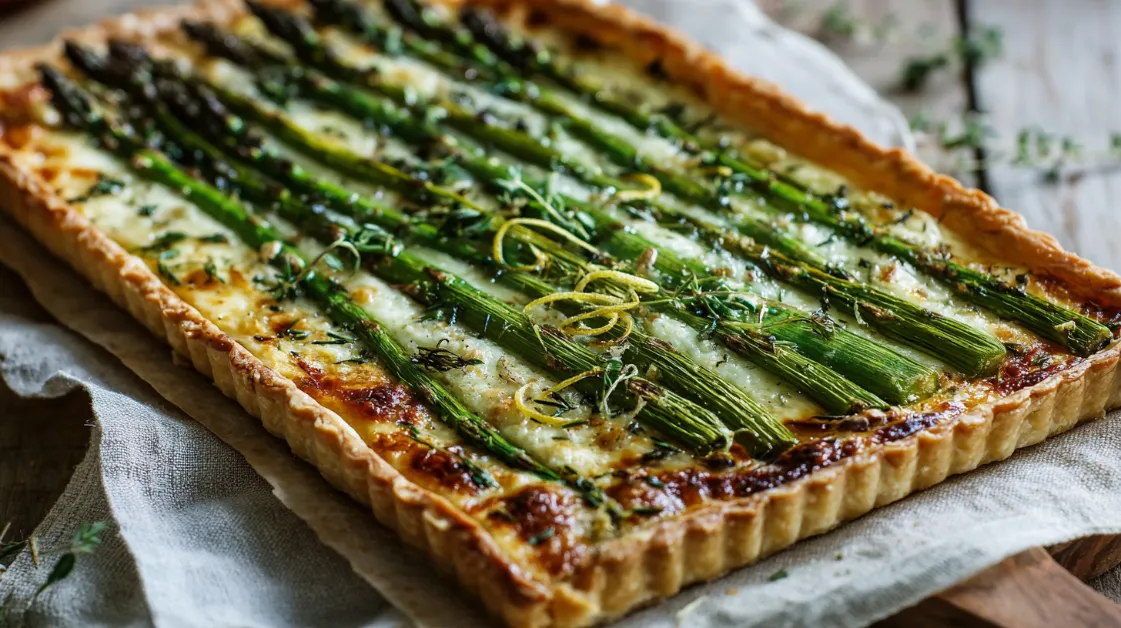
Asparagus & Gruyère Tart with Herb Pastry
Ingredients
Method
- 1. Whisk flour, salt, and minced herbs. Cut in cold butter until you see pea-sized chunks.
- 2. Add 3 tbsp ice water, mix gently, adding more 1 tbsp at a time until the dough just comes together. Shape into a disk, wrap, and chill at least 1 hour. Roll to a 14 × 10 inch rectangle on a floured surface, transfer to a parchment-lined sheet pan, score a 1-inch border, dock the center, and chill 15 more minutes while the oven heats to 400°F (200°C).
- 3. Line the center with parchment and pie weights; blind bake 15 minutes. Remove weights.
- 4. Spread Dijon inside the border. Sprinkle half the gruyère over the mustard.
- 5. Arrange asparagus in a single layer, alternating tip-and-end. Drizzle olive oil, season with salt and pepper, and scatter the remaining gruyère.
- 6. Brush the border with egg wash (egg yolk + 1 tsp water). Bake 20–25 minutes, rotating halfway, until the border is deep gold and the cheese is bubbling.
- 7. Rest 5 minutes on the pan. Finish with lemon zest, fresh herbs, and optional balsamic glaze. Slice and serve warm.
Notes
Storage:
Refrigerate up to 3 days, reheat in a 350°F oven for 8 minutes to re-crisp. Freeze baked tart up to 1 month; freeze dough disk up to 3 months.Make-ahead:
Dough disk keeps 3 days chilled. Blind-baked crust holds 24 hours at room temp. Fully assembled (unbaked) tart holds 2 hours chilled.Substitutions:
Cretan graviera 1:1 for gruyère. Half butter + half olive oil for a rustic pastry. Half puff pastry sheet to skip the dough-making step.Dietary:
Vegetarian and halal as written. For gluten-free, use 1:1 GF baking flour. For vegan, use vegan butter and vegan cheese shreds with olive oil wash.Serving suggestions:
Pair with a peppery arugula salad, a side of our Mediterranean white bean salad, or the vibrant classic tabbouleh. For a complete brunch, add our ultimate Mediterranean mezze platter.Why This Asparagus Tart Is Special
The Herb Pastry Is the Whole Game
Most recipes for asparagus tart start with store-bought puff pastry. Fine for a weeknight. But this one is worth making from scratch. The herbs go directly into the dough — finely minced thyme, chives, and Cretan oregano worked into the butter-flour pebbles before the water. The flavor is baked through the entire crust, not sprinkled on top. Food science time: cold butter is essential. Harold McGee writes in On Food and Cooking that flaky layers form when steam from water trapped inside firm butter chunks forces the dough to separate as it bakes. Warm butter melts in and gives you a cracker. Keep everything cold. Trust me on this one.
The Flavor, and When to Serve It
Flavor-wise: grassy asparagus, nutty cheese, the soft bite of Dijon, herb-scented shortcrust, a finish of lemon zest and cracked black pepper. It’s restaurant-elegant without being precious. I serve this savory tart at Easter brunch every year, on my wife’s Mother’s Day table, at spring dinners where I want someone to feel celebrated. Big wedges for a main; small squares for an appetizer. Good both ways. Flaky pastry, melty cheese, bright green spears — you’ll love it.
The Story Behind the Dish
A French Tart with Mediterranean Soul
The savory tart — tarte salée — is a fixture of French home cooking, with roots stretching back to medieval Alsace. Gruyère itself comes from the canton of Fribourg in Switzerland, a cheese so important it has AOP protection. The Mediterranean tradition of vegetable pies runs deeper still: my yiayia’s spanakopita, the Provençal tourte aux blettes, the Sicilian scaccia. Same basic truth: pastry plus vegetables plus cheese equals one of the most reliably beautiful dishes in the world.
Wild Asparagus and My Father’s Boots
Back home in Crete, real fresh asparagus doesn’t come in perfect bundles with rubber bands. It grows wild in the hills above Chania, foraged in late March and early April. My father taught me the trick: walk slowly, look for the feathery ferns, snap the spear low with your thumb. When he passed in 2017, I inherited a pair of those muddy rubber boots. I wear them every April to the farmers’ market. A little tribute.
Essential Ingredients for Asparagus & Gruyère Tart with Herb Pastry
The Core Ingredients (and Why Each Matters)
Seven honest ingredients. Use the best cheese you can afford — this is a dish where each flavor has nowhere to hide.
| Ingredient | Amount | Why It Matters | Authentic Pick | Substitution |
| All-purpose flour | 1½ cups (190 g) | Structure of the shortcrust | Italian 00 or King Arthur AP | Whole wheat pastry flour |
| Cold unsalted butter | ½ cup (115 g), cubed | Creates flaky layers via steam pockets | European-style (higher fat) | Half butter + half olive oil |
| Fresh thyme, chives, oregano | 2 tbsp total, minced | The ‘herb pastry’ signature, woven into the dough | Greek oregano from Crete | Tarragon + parsley, or dill |
| Fresh asparagus | 1 lb (450 g), thin spears | The hero; thin spears cook through in time | Pencil-thin spring asparagus | Medium spears, blanched 90 sec |
| Gruyère cheese | 1½ cups (150 g), grated | Nutty, melts like a dream | Gruyère AOP or Cretan graviera | Comté, fontina, or aged cheddar |
| Dijon mustard | 2 tbsp | Paints the base; tangy counterpoint | Maille Dijon Originale | Whole-grain mustard |
One confession: I tested this with Cretan graviera instead of gruyère last Tuesday, and my wife — who grew up eating both — couldn’t tell them apart. Graviera is, essentially, Greek gruyère. If you have a good Greek deli nearby, try it.
Substitutions That Actually Work
I’ve tested every one of these in my Athens kitchen. Most are excellent.
| Dietary Need | Replace | With | Notes |
| Gluten-free | All-purpose flour | 1:1 GF baking flour (King Arthur) | Handle gently; texture is more delicate |
| Vegan | Butter, gruyère, egg wash | Vegan butter + cashew-miso cream + olive oil wash | Flavor holds; texture is different but good |
| Dairy-free | Butter, gruyère | Margarine + Violife shreds | Choose a brand that actually melts |
| Egg-free | Egg wash | Heavy cream or olive oil brushed on | Less shine, still golden |
| Low-sodium | Gruyère (aged cheeses are salty) | Fresh mozzarella + pinch smoked paprika | Milder, creamier |
Pro Tip: Grate your own gruyère. Pre-shredded cheese is coated in starch or cellulose to prevent clumping — both interfere with smooth melting. Ninety seconds on a box grater, night-and-day difference.
Equipment & Technique Setup
What You Need (and What You Don’t)
Not gear-heavy. The only non-negotiable is cold — cold butter, cold water, cold work surface.
| Traditional Tool | Modern Alternative | Why It Matters |
| Marble pastry slab | Any counter, chilled first with a bag of ice | Cold surface keeps butter from melting into flour |
| French rolling pin | Standard straight rolling pin | Either works; tapered gives more control |
| Metal bench scraper | Butter knife or your hands | For gathering and folding dough |
| Half-sheet pan + parchment + pie weights | Silicone mat + dried beans | Saves you a tart tin; critical for blind baking |
Mise en Place Before You Touch the Dough
Cube the butter and return it to the fridge for 10 minutes to firm up. Measure flour. Mince herbs. Ready the ice water. Preheat oven to 400°F (200°C). Line a sheet pan with parchment. Snap the asparagus ends (don’t cut — they break where they want to). Five minutes of mise en place saves you twenty minutes of scrambling later.
Step-by-Step: How to Make Asparagus & Gruyère Tart with Herb Pastry
Preparation — The First Three Steps
Step 1 — Make the herb pastry. Whisk 1½ cups flour, 1 teaspoon kosher salt, and 2 tablespoons minced fresh herbs (I use 1 tbsp thyme, 2 tsp chives, 1 tsp oregano) in a large bowl. Cut in ½ cup cold cubed butter using your fingertips or a pastry cutter until you have coarse crumbs with pea-sized butter chunks still visible. Those visible chunks are what make the pastry flaky — do not over-work.
Yiayia’s Tip: If your kitchen is warm — anywhere above 72°F / 22°C — work the butter into the flour with the bowl sitting inside a larger bowl of ice. My yiayia never had air conditioning in Chania. This was her summer trick for spanakopita. It works.
Step 2 — Hydrate, chill, roll, dock. Sprinkle in 3 tablespoons ice water and mix with a fork. Add more, 1 tablespoon at a time, until the dough just comes together. Shape into a disk (not a ball), wrap tightly, and refrigerate at least 1 hour (overnight is better). On a lightly floured surface, roll the chilled dough into a 14 × 10 inch rectangle about ⅛ inch (3 mm) thick. Transfer to a parchment-lined sheet pan. Score a 1-inch border with a paring knife (do not cut through). Prick the center all over with a fork. Chill 15 more minutes while the oven heats to 400°F (200°C).
Step 3 — Blind bake the base. Line the center with parchment and fill with pie weights or dried beans. Bake at 400°F (200°C) for 15 minutes until the edges turn pale gold. Remove the weights and parchment. If the center puffed, press it down gently with the back of a spoon.
Assembly & Baking — Steps 4 Through 7
Step 4 — Paint the base. Brush the center with 2 tablespoons of Dijon mustard, staying inside the scored border. Sprinkle half the gruyère cheese (¾ cup) evenly over the mustard. This first cheese layer is your moisture barrier — fat repels water, so it keeps the base crisp. J. Kenji López-Alt explains this physics beautifully in The Food Lab.
Step 5 — Arrange the asparagus. Lay the trimmed asparagus spears in a single layer, alternating tip and end so they fit snugly without overlapping. Drizzle 1 tablespoon olive oil, season with ½ teaspoon flaky sea salt and a few grinds of black pepper. Scatter the remaining ¾ cup gruyère over the top, tucking some into the gaps.
Step 6 — Egg wash and bake. Whisk 1 egg yolk with 1 teaspoon water. Brush carefully over the scored border only (not the filling — shine lands in the wrong place if it drips). Bake at 400°F (200°C) for 20 to 25 minutes, rotating the pan halfway, until the border is deep gold, the cheese is bubbling with browned edges, and a thin spear is tender when pierced.
Step 7 — Rest and finish. Let the tart sit on the pan for 5 full minutes — this lets the cheese set and the pastry finish crisping. Finish with a microplane of lemon zest, a shower of fresh thyme or chives, and if you love the sweet-tang hit, a thin drizzle of balsamic glaze. Slice into six rectangles for a main or twelve squares for an appetizer. Serve warm.
Yiayia’s Tip: Warm your plates for 2 minutes in a 200°F oven before serving. Cold plates steal heat from the tart and the cheese goes from silky to waxy within a minute. This is the kind of tiny, invisible detail that separates a home cook from a chef. Be the chef.
The Secret Touches That Make It Showstopper
Three Techniques I Wish I’d Known Sooner
1. The fraisage smear. After mixing, use the heel of your hand to smear portions of dough forward one at a time — a French technique called fraisage. This creates long streaks of butter instead of uniform distribution, which is exactly what you want for maximum flakiness. I learned this from a pastry chef at Varoulko. Best trick I ever picked up.
2. A splash of white vinegar. Replace 1 teaspoon of your ice water with ice-cold white vinegar (or apple cider vinegar). The mild acid inhibits gluten development, so you can hydrate the dough enough to roll it smoothly without making it tough. You won’t taste the vinegar — it cooks off and leaves only tenderness behind. My yiayia swore by this trick for her tyropita dough. Pastry chefs worldwide use it. Works every time.
3. Two cheese layers and matched spears. Put half the gruyère under the asparagus, half on top. The under-layer melts into the mustard and forms the moisture barrier; the top layer browns into lacy crispy edges. While you’re at it, sort your spears by thickness — mixed sizes cook unevenly. My rule: anything thicker than a pencil gets blanched 60 seconds first.
Common Mistakes (and How to Rescue Them)
| The Mistake | What Happens | How to Fix It |
| Over-working the dough | Tough, cracker-like pastry with no flake | Stop when you see pea-sized butter chunks; chill well |
| Skipping the blind bake | Soggy, underbaked bottom crust | 15 min blind bake with weights, non-negotiable |
| Warm butter in the dough | Pastry melts into a greasy sheet | Chill dough 1 hr; re-chill after rolling |
| Slicing hot from the oven | Filling slides off, pastry crumbles | Rest 5 minutes on the pan before cutting |
Variations and Serving Suggestions
Regional Variations and Modern Adaptations
In Crete I make this with local graviera and wild foraged agriosparanga — sharper, rustier, unmistakably Cretan. In Provence, goat cheese and fresh tarragon take over. My mother adds a handful of cooked leeks underneath the asparagus — a trick that makes the whole tart taste like spring soup. Swap half the gruyère for goat cheese for a tangier bite, or fold in a cup of sautéed spinach for a heartier main.
Short on time? Store-bought all-butter puff pastry (Dufour is my pick) gets you 90% there in 15 fewer minutes. Not as good as the herb pastry from scratch, but honest, on a Tuesday I reach for puff too. For a different spring-vegetable dinner, try our pasta primavera or the peas-forward spring minestrone with peas and herbs. The silky Mediterranean egg and vegetable bake lives in the same brunch universe.
What to Serve Alongside (and What to Drink)
This vegetarian tart is rich, so I pair it with something bright — a simple arugula salad with shaved parmesan and lemon vinaigrette. For a full Easter brunch spread, serve it alongside our Mediterranean hummus deviled eggs and a platter of Mediterranean shrimp with asparagus. A scoop of labneh with za’atar on the side is never a mistake.
For drinks we skip alcohol. Sparkling water with lemon slices and fresh mint is my default — cuts the richness. Tsai tou vounou (Greek mountain tea) iced with a spoon of honey works beautifully with the nutty cheese. Homemade lemonade with a pinch of sea salt and crushed thyme is what I pour when I want to feel fancy.
Storage, Make-Ahead, and Reheating
How to Store It (and How Long)
This Asparagus & Gruyère Tart with Herb Pastry is glorious fresh from the oven and still lovely the next day — the herb flavor deepens with a rest.
| Method | Container | Duration | Notes |
| Refrigerator (baked) | Airtight, parchment between slices | Up to 3 days | Reheat in oven to re-crisp |
| Freezer (baked) | Foil + freezer bag | Up to 1 month | Thaw overnight in fridge |
| Freezer (dough disk) | Plastic wrap + zip bag | Up to 3 months | Thaw overnight; roll as normal |
Reheating Without Ruining the Crust
The enemy is the microwave — it softens the crust in 40 seconds. Instead: oven at 350°F (175°C) for 8 to 10 minutes on a parchment-lined sheet pan, uncovered. This drives out the moisture leftovers reabsorb and brings back the crisp. Finish with fresh herbs and lemon zest at the table — fresh herbs lose their brightness in the fridge, so adding them again makes the leftover taste just-made.
Frequently Asked Questions
Substitution and Technique Questions
Can I use store-bought puff pastry instead of the herb pastry?
Yes, absolutely — I do it on weeknights. Use one 14 oz sheet of all-butter puff pastry (Dufour is the gold standard; Pepperidge Farm works too). Roll it lightly, score a border, dock the center, and skip the separate blind bake — puff pastry bakes in one stage. Brush with herb-infused melted butter before assembling to get some of the herb-pastry flavor back.
What’s the best asparagus to use?
Pencil-thin spears, bright green, firm tips that aren’t flowering. If the tips are loose and feathery, they’re past prime. In April and May you’ll find the best at farmers’ markets. Medium spears also work, but blanch them 60 to 90 seconds first. Thick spears should be peeled and blanched, or skipped entirely for this recipe.
My pastry came out tough. What happened?
Three likely causes: you over-worked the dough (gluten develops from handling, not just water), the butter got warm (it melted into the flour instead of staying in chunks), or you added too much water (more water = more gluten). Next time: stop mixing the moment the dough comes together, keep butter and water ice cold, and give the disk a full hour in the fridge.
Can I skip the blind bake?
Not for a proper shortcrust pastry tart — skipping the blind bake gives you a soggy center. The blind bake sets the crust before the moisture from the cheese and asparagus arrives. If you’re using puff pastry, you can skip it because puff puffs up and away from moisture. For herb-pastry shortcrust: blind bake, always.
Dietary, Make-Ahead, and Authenticity Questions
Can I make this gluten-free or ahead of time?
Yes to both. For GF, use a 1:1 GF baking flour (King Arthur Measure for Measure works); handle the dough gently and chill an extra 30 minutes. For make-ahead: the dough disk keeps 3 days in the fridge or 3 months frozen. The blind-baked crust holds 24 hours at room temperature. I don’t recommend fully baking more than 2 hours ahead — the crust softens.
Is this really authentic, or a fusion?
Honest answer: a fusion, and I’m proud of it. The pâte brisée is classic French. The gruyère is Swiss. The Cretan oregano, thyme, and the story behind it — my yiayia, my father’s boots, Varoulko — are Greek. This is my table. Your version might lean more French or more Greek, and that is the beauty of cooking.
How do I know the tart is done?
Four signs at once: deep gold border (not pale yellow), bubbling cheese with browned spots at the edges, asparagus tips showing a tiny bit of char, and a firm, dry bottom when you lift a corner with a spatula. If the bottom flexes or feels damp, bake another 3 to 5 minutes.
Bringing the Mediterranean to Your Table
A Final Thought Before You Bake
Every April, I make this Asparagus & Gruyère Tart with Herb Pastry four or five times — for Easter lunch, my wife’s birthday, the dear friend who drops by unannounced. Every time I pull it from the oven, I think of my father’s muddy rubber boots and my yiayia at her stove. If you make this tart for someone you love, tag us and leave a comment. Did you use graviera? Add leeks? I read every single one. This blog is my inheritance, passed on.
Related Recipes You’ll Love
If this tart spoke to you, try our creamy Mediterranean egg and vegetable bake for another oven-to-table brunch centerpiece, or our Mediterranean hummus deviled eggs for a show-stopping starter. The fluffy herb and feta scrambled eggs use the same spring-herb palette and make a perfect weekend breakfast. And for dessert? The light, lemony almond flour cake with spring berries finishes the spring table with grace.