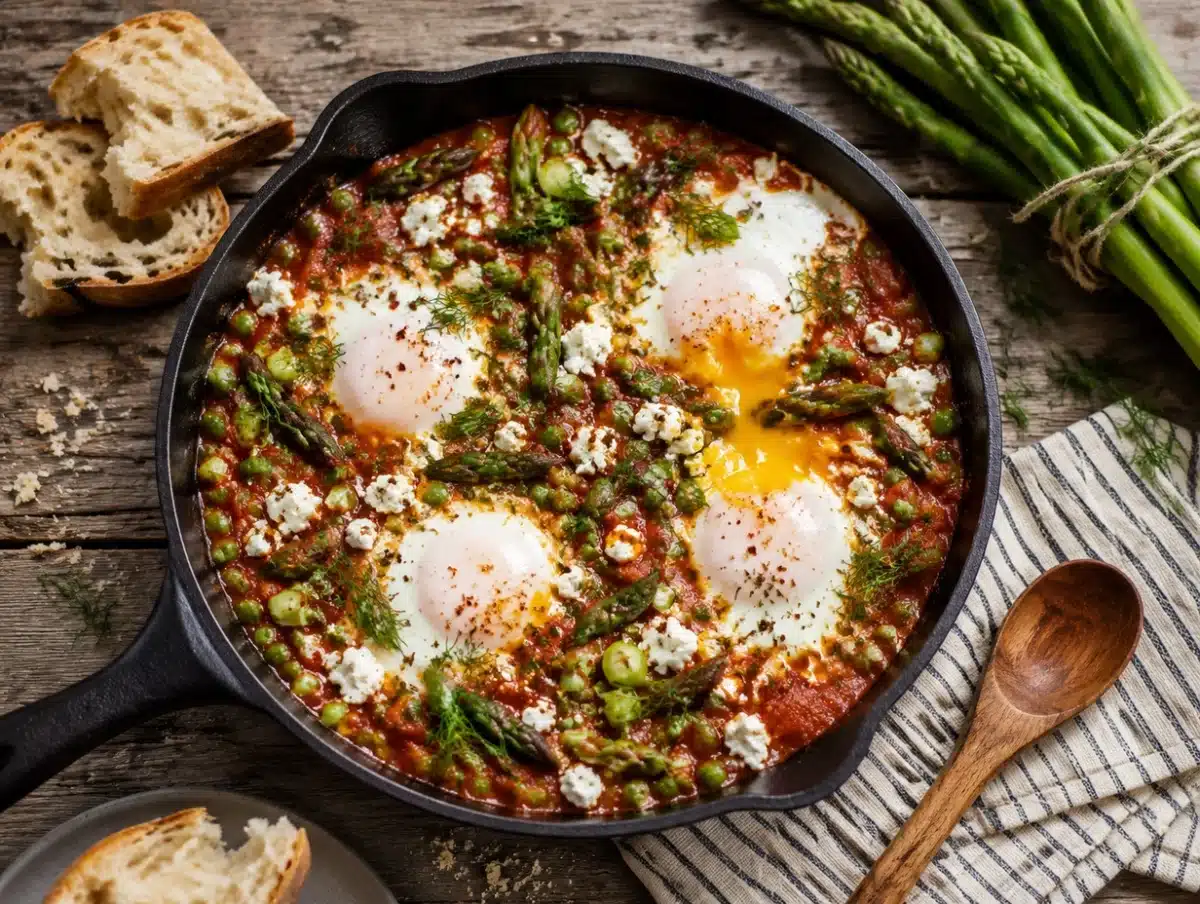
Some mornings in Chania stay with you forever. I’m thinking of one in particular — early May, when the air coming off the harbor smelled like salt and wild thyme, and my yiayia’s kitchen windows were wide open to let the breeze through. She had a blackened skillet the size of a steering wheel sitting on the stove, and in it, something was bubbling away that filled the whole house with the most extraordinary aroma: tomatoes, garlic, cumin, and something green and fresh I couldn’t quite place. “Spring onions,” she told me, dropping a handful into the sauce. “And the little zucchini your father brought from the garden. Sit. Eat.”
That was my first shakshuka with spring vegetables, though my yiayia would never have called it that. In Crete, it was simply “avga me ntomata kai horta” — eggs with tomatoes and greens. But the spirit is identical: a fragrant, spiced tomato sauce loaded with whatever the season offers, with eggs nestled in and gently poached until the whites set and the yolks stay gloriously runny. It’s one-skillet magic.
This version celebrates spring at its peak — tender zucchini, sweet peas, artichoke hearts, and baby spinach join the classic tomato base. It’s the kind of dish that works for a lazy weekend brunch, a quick weeknight dinner, or honestly, any moment you want something beautiful, nourishing, and ready in 30 minutes. Let me walk you through it.
Table of Contents
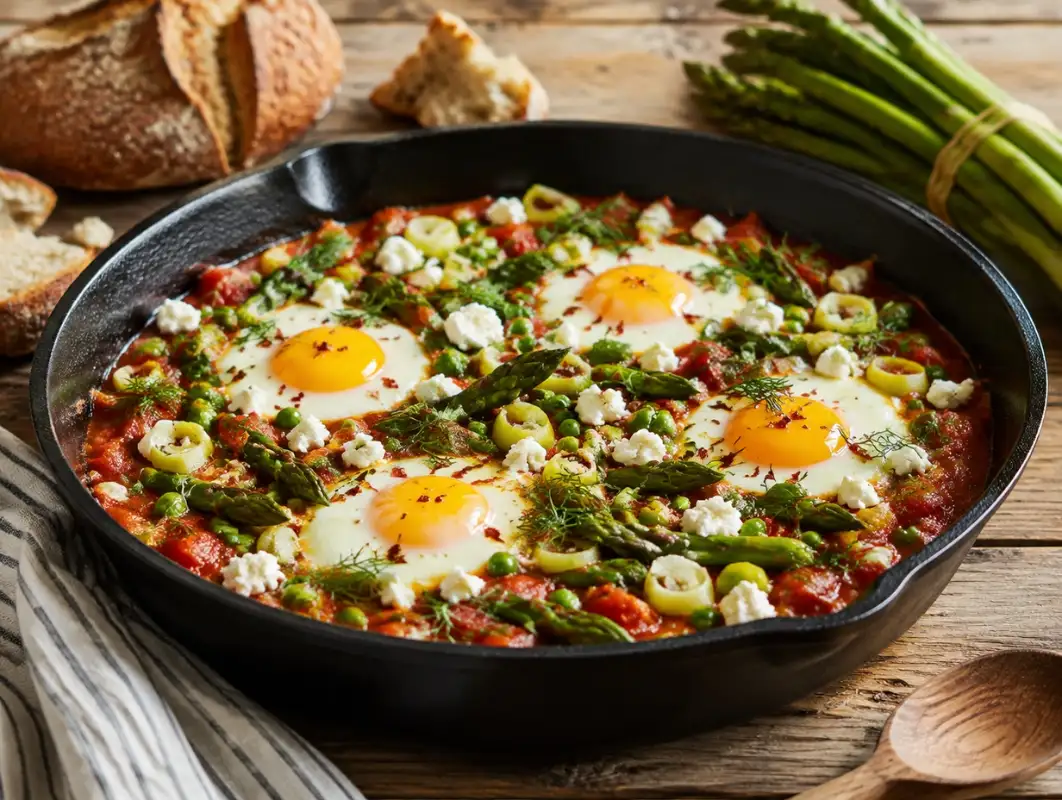
Shakshuka with Spring Vegetables
Ingredients
Method
- 1. Heat olive oil in a 12-inch cast iron skillet over medium heat. Sauté onion 5–6 min until golden. Add garlic, 30 seconds.
- 2. Add cumin, paprika, pepper flakes to oil in center of pan. Bloom 30–45 seconds until fragrant.
- 3. Add hand-crushed tomatoes, sugar, salt, pepper. Simmer 8–10 min until thick and jammy.
- 4. Add zucchini and artichoke hearts. Simmer 5 min. Add peas and spinach. Stir until spinach wilts, 1–2 min. Add lemon juice. Taste, adjust.
- 5. Make 6 wells. Slide one egg into each. Season eggs with salt and pepper.
- 6. Cover. Cook medium-low 5–8 min until whites are set and yolks are still soft.
- 7. Remove lid. Top with feta, parsley, dill, olive oil drizzle. Serve immediately from the skillet with warm bread.
Notes
Why This Shakshuka Recipe Is Special
The Two-Stage Sauce Technique
Most shakshuka recipes dump everything in at once. That’s fine. But I do something different: I build the spiced tomato sauce in two stages. First, the aromatics and spices cook until deeply fragrant (this blooms the fat-soluble compounds in cumin and paprika — Harold McGee explains in On Food and Cooking that toasting spices in oil can increase their aroma intensity by up to 50%). Then, the spring vegetables go in at staggered intervals based on how long each needs to cook. Zucchini first, then artichoke hearts, then peas and spinach last. The result? Every vegetable is perfectly cooked — not a single mushy pea in sight. This is how we make shakshuka with spring vegetables in my kitchen.
A Brunch That Feels Like a Celebration
The flavor here is warm, bright, and layered: smoky paprika and earthy cumin in the tomato base, sweet pops of spring peas, the gentle bitterness of artichoke, and that gorgeous moment when you break the yolk and it runs into the sauce. Rich. Vibrant. Alive. I serve this vegetable shakshuka for everything from Easter brunch to Tuesday dinners when I’m craving something comforting but don’t want to spend an hour cooking. You’ll love it. Trust me.
The warming spices work beautifully here, much like in our lamb shakshuka recipe, but the spring vegetables keep things lighter and fresher.
The Story Behind the Dish
From Tunisia to Every Mediterranean Table
Shakshuka — the word itself means “a mixture” in Arabic — likely originated in Tunisia before spreading across North Africa, the Middle East, and the broader Mediterranean. In Israel, it’s practically a national dish. In Greece, the concept of eggs poached in tomato sauce has existed for generations under different names: kagianas in Thessaloniki, strapatsada in Crete. What makes the spring version special is its seasonality — it captures the brief, glorious weeks when peas, artichokes, and young zucchini overlap at the market.
How My Family Makes Eggs in Tomato Sauce
My yiayia never used the word “shakshuka,” but she made versions of eggs in tomato sauce at least twice a week during spring. Her trick? She’d cook the sauce until it was thick and jammy — “The sauce must be ready before the eggs go in, Niko. Otherwise the eggs sit in water.” She’d crack the eggs with one hand (show-off), season each one with a tiny pinch of sea salt and dried oregano, then cover the pan with a battered lid and disappear for exactly five minutes. Every single time, the eggs came out perfect. I’ve been chasing that consistency for 20 years.
Essential Ingredients for Shakshuka with Spring Vegetables
Core Ingredients
The tomato base is everything. During my time at Varoulko, Chef Nikolaos drilled into me that a great tomato sauce starts with great tomatoes. For this spring shakshuka, I use whole peeled San Marzano tomatoes (crushed by hand — never a blender, which incorporates too much air and gives the sauce a weirdly frothy texture). For the vegetables, I shop whatever looks brightest at the market, but this combination of zucchini, peas, artichoke hearts, and spinach is my tested favorite after making this dish 60+ times.
| Ingredient | Amount | Why It Matters | Authentic Pick | Substitution |
| Whole peeled tomatoes | 800 g / 28 oz (2 cans) | Hand-crushed gives chunky, rustic texture with natural sweetness | San Marzano or Mutti | Fresh ripe tomatoes (blanched, peeled, chopped) |
| Eggs | 6 large | The star — gently poached in the sauce; runny yolks are essential | Room temperature, free-range | No real substitute |
| Zucchini (small) | 2, diced (200 g) | Sweet, tender, absorbs spices beautifully; cooks quickly | Young spring zucchini | Yellow squash |
| Frozen peas | 150 g / 1 cup | Burst of sweetness and bright color; add last to keep texture | Fresh shelled spring peas | Frozen edamame |
| Artichoke hearts | 200 g / 6–8 hearts | Subtle bitterness adds complexity; holds shape in the sauce | Frozen, thawed and quartered | Canned (rinsed well) |
| Baby spinach | 100 g / 2 cups | Wilts into the sauce; adds iron and vibrant green color | Fresh, not pre-washed bags | Baby kale or Swiss chard |
| Extra-virgin olive oil | 3 tbsp (45 ml) | Blooms the spices and builds the aromatic base | Kolymvari Cretan EVOO | Any fruity EVOO |
| Yellow onion | 1 large, diced | Foundation of flavor; caramelized sweetness balances tomato acidity | Sweet spring onion | 2 shallots |
I always keep a jar of smoked paprika from Crete in my pantry — it’s sweeter and less bitter than Hungarian varieties, and it gives this spiced tomato sauce a gorgeous russet color. Also: cumin. Can you make shakshuka without cumin? Technically. Should you? Absolutely not.
Dietary Substitutions & Smart Swaps
| Need | Replace | With | Notes |
| Egg-free / Vegan | 6 eggs | Silken tofu cubes or chickpea “eggs” | Simmer tofu in sauce 5 min; different but satisfying |
| Nightshade-free | Tomatoes + paprika | Roasted beet sauce + turmeric | Completely different flavor; still beautiful |
| Low-sodium | Canned tomatoes | No-salt-added canned tomatoes + extra lemon | Season carefully at the end |
| Dairy-free (if adding feta) | Feta cheese | Nutritional yeast or dairy-free feta | Sprinkle on top after cooking |
| No artichokes | Artichoke hearts | Asparagus spears, cut into 2 cm pieces | Add with peas; cooks in 3–4 minutes |
Pro Tip: Bring your eggs to room temperature before cracking them into the sauce. Cold eggs dropped into a hot sauce seize on contact, cooking the whites unevenly and sometimes breaking the yolks. I learned this the embarrassing way — six broken yolks at a brunch for twelve. Set the eggs on the counter 20 minutes before you start cooking.
Equipment & Technique
The Right Skillet Makes All the Difference
| Traditional Tool | Modern Alternative | Why It Matters |
| Cast iron skillet (12-inch / 30 cm) | Enameled cast iron or heavy stainless steel | Retains heat evenly; goes from stovetop to oven; serves at the table |
| Tagine lid or domed cover | Any tight-fitting lid | Traps steam for even egg poaching; prevents top from drying out |
| Wooden spoon | Silicone spatula | Won’t scratch cast iron; lets you scrape up fond (browned bits) |
| Mortar and pestle (spice grinding) | Spice grinder or pre-ground | Freshly ground cumin is dramatically more aromatic |
Setting Up for Success
Mise en place is non-negotiable here — this Mediterranean breakfast comes together fast once the oil hits the pan. Dice your onion and zucchini, mince your garlic, measure your spices into one small bowl (cumin, paprika, pepper flakes, salt), thaw and drain your artichoke hearts, and set out your peas and spinach. Crack your eggs into individual ramekins or cups — this makes nestling them into the sauce infinitely easier. Set out your lid. Have your fresh herbs chopped and ready. When everything is prepped, cooking takes exactly 25 minutes. I time it every time.
Step-by-Step: How to Make Shakshuka with Spring Vegetables
Preparation (Steps 1–4)
Step 1: Build the Aromatic Base. Heat the olive oil in a 12-inch cast iron skillet over medium heat. Add the diced onion with a pinch of salt and cook for 5–6 minutes, stirring occasionally, until soft and golden. Not brown — golden. You’re looking for that moment when the kitchen starts to smell sweet and the onion pieces turn translucent around the edges. Add the garlic and cook for 30 seconds, stirring constantly. (Thirty seconds. Not a minute. Burnt garlic is the fastest way to ruin this dish.)
Step 2: Bloom the Spices. Push the onions to the sides of the pan and add the cumin, smoked paprika, and red pepper flakes directly to the oil in the center. Stir for 30–45 seconds until the spices are deeply fragrant and the oil turns a beautiful rust color. This is called blooming — the fat extracts and amplifies the volatile aroma compounds in the spices. As J. Kenji López-Alt explains in The Food Lab, blooming spices in oil can double their perceived flavor intensity. Don’t skip this.
Yiayia’s Tip: My yiayia always said: “If you can’t smell the spices from the next room, they’re not ready.” She’d stand in the doorway of the kitchen, sniff, and only come back when the cumin hit her nose. It sounds theatrical, but she was right about the timing every time.
Step 3: Add the Tomatoes. Pour in the whole peeled tomatoes. Using the back of your wooden spoon, crush them directly in the pan — you want chunky, irregular pieces, not a smooth purée. Stir in a pinch of sugar (just ½ teaspoon — this balances the acidity without making it sweet), season with salt and black pepper, and let the sauce simmer for 8–10 minutes until it thickens and reduces slightly. The sauce should be jammy and rich, not watery. If it looks thin, give it more time.
Step 4: Add the Spring Vegetables (Staggered). This is where my two-stage technique comes in. Add the diced zucchini and artichoke hearts first — they need 5 minutes of simmering to become tender. Then add the peas and baby spinach, stirring gently until the spinach wilts (about 1–2 minutes). Now taste the sauce. Adjust salt, add more pepper flakes if you like heat, and squeeze in a tablespoon of lemon juice for brightness. The vegetable shakshuka base is ready.
Cooking & Assembly (Steps 5–10)
Step 5: Create the Wells. Using the back of a spoon, make 6 evenly spaced wells in the sauce. Press them deep enough that the eggs will nestle down into the vegetables, not just sit on top.
Step 6: Add the Eggs. Gently slide one egg from its ramekin into each well. This is the moment that separates good shakshuka from great shakshuka — be gentle. Don’t break those yolks. Season each egg with the tiniest pinch of flaky salt and a crack of black pepper.
Step 7: Cover and Poach. Reduce heat to medium-low, cover the skillet with a tight-fitting lid, and cook for 5–8 minutes. Here’s the crucial part: at 5 minutes, check your eggs. The whites should be just set — opaque and firm — while the yolks are still soft and jiggly. If you prefer firmer yolks, go to 8 minutes. I personally stop at 6 minutes. Perfectly jammy. (My yiayia did exactly 5. Hers were slightly runnier than mine. Both are correct.)
Yiayia’s Tip: When checking the eggs, lift the lid away from you so the steam escapes backward. My yiayia burned her forearm once reaching over a hot lid in a hurry — she told this story every time she taught me to cook eggs, and I’ve never forgotten it.
Step 8: Add the Fresh Herbs. Remove the lid and scatter chopped flat-leaf parsley and fresh dill over the top. (Dill in shakshuka? Very Greek. My yiayia insisted.) The herbs go on off-heat to preserve their color and volatile oils.
Step 9: Optional Finishing Touches. Crumble feta cheese over the top if you like (I always do — the salty creaminess against the spiced tomato sauce is incredible). A drizzle of your best olive oil. A sprinkle of za’atar or Aleppo pepper for extra warmth.
Step 10: Serve Immediately. Bring the skillet straight to the table — shakshuka with spring vegetables is meant to be served family-style, right from the pan. Warm crusty bread, pita, or sourdough is non-negotiable for soaking up that gorgeous sauce. For a complete spread, add a bowl of our Mediterranean white bean salad alongside.
The Secret Touches
Techniques That Elevate This Dish
The Sugar Balance. Half a teaspoon of sugar in the tomato sauce isn’t about making it sweet. It’s about chemistry: sugar neutralizes the sharp edges of tomato acidity, allowing the deeper, rounder flavors to come forward. Harold McGee confirms this — even a small amount of sugar can dramatically change how we perceive tomato sauces. My yiayia used honey instead of sugar, straight from our neighbor’s hives in Chania. Either works.
The Staggered Vegetable Add. Adding all the vegetables at once means the peas turn to mush while the zucchini is still raw. My two-stage approach means every spring vegetable hits its ideal texture — a technique I refined during my years as a sous chef, where timing is everything.
The Lid Steam Method. Covering the skillet doesn’t just poach the eggs — it creates a micro-environment of gentle, moist heat (essentially steam-poaching) that cooks the egg whites from the top down while keeping the yolks liquid. Without the lid, the whites cook unevenly and the tops stay raw. Five to eight minutes, lid on. That’s the secret.
The Ramekin Pour. Cracking eggs directly into the sauce is risky (broken yolks, shell fragments). Using individual ramekins lets you inspect each egg before adding it and gives you control over exactly where it lands. Professional kitchens do this. You should too.
Common Mistakes to Avoid
| Mistake | What Happens | How to Fix It |
| Sauce too thin when eggs go in | Eggs slide to the bottom; whites spread everywhere | Reduce sauce until thick and jammy before adding eggs (8–10 min) |
| Adding cold eggs to hot sauce | Whites cook unevenly; yolks break on impact | Bring eggs to room temp 20 min before; use ramekins |
| Overcrowding with vegetables | Sauce becomes watery from released moisture | Don’t exceed the amounts; pat artichokes dry before adding |
| Lifting lid too often | Steam escapes; eggs take forever to poach | Set a timer. Check once at 5 minutes. Resist the urge. |
| Overcooking the eggs | Hard, chalky yolks; loses the luxurious runny center | Pull skillet off heat at 5–6 min for jammy yolks; residual heat finishes them |
Variations & Serving Suggestions
Regional Twists & Modern Adaptations
In Crete, my family adds a handful of wild horta (greens) to the sauce — whatever’s growing in the hills that week. On the mainland, you’ll find versions with roasted red peppers and kasseri cheese instead of feta. In the islands, especially Santorini, cooks use their famous cherry tomatoes, which are intensely sweet and make the sauce almost candy-like. For a green shakshuka variation, swap the tomato base entirely for a sautéed spinach-and-pea base with lemon — it’s lighter, greener, and perfect for those who can’t eat nightshades. Weeknight shortcut: use a jar of good-quality marinara as the base, add frozen spring vegetables, and you’re eating in 15 minutes.
For a heartier version, serve this spring shakshuka alongside our classic Greek lemon rice pilafi or stir leftover sauce into our creamy chicken orzo for an incredible fusion dinner.
Perfect Pairings & Accompaniments
Warm crusty bread is absolutely essential — sourdough, pita, or challah all work beautifully for scooping up the spiced tomato sauce and runny yolk. A simple side of our Mediterranean chickpea power bowl makes this a filling lunch. For a stunning brunch spread, add our whipped feta and garlic confit dip with crudites and olives alongside.
For drinks, I love this with fresh-squeezed orange juice, a glass of homemade lemonade with mint, or tsai tou vounou (Greek mountain tea) if it’s a cooler morning. Sparkling water with a slice of lemon is simple and refreshing.
Storage & Reheating
Storing Shakshuka with Spring Vegetables
| Method | Container | Duration | Notes |
| Refrigerator (sauce only) | Airtight glass container | 3–4 days | Store sauce and eggs separately; eggs become rubbery if stored |
| Refrigerator (with eggs) | Covered skillet or container | 1–2 days | Yolks will firm up; still tasty but not as luxurious |
| Freezer (sauce only) | Freezer bag, flat | Up to 3 months | Freeze sauce base without eggs; thaw and add fresh eggs when reheating |
Bringing It Back to Life
Reheat the tomato sauce gently on the stovetop over medium-low heat until simmering (5–7 minutes). If it’s thickened in the fridge, add a splash of water. Then crack fresh eggs into the warmed sauce and poach as normal — this gives you that perfect runny yolk every time, even with leftover sauce. The microwave works for the sauce alone (2 minutes, covered, stirring once), but never microwave the eggs. Fresh herbs, a drizzle of olive oil, and a squeeze of lemon at serving completely refresh the dish.
Leftover sauce (without eggs) makes an incredible base for our pasta primavera or can be spooned over our Mediterranean hummus breakfast bowl for a spiced twist.
Frequently Asked Questions
Substitution & Technique Questions
Can I use fresh tomatoes instead of canned? Absolutely — but only when tomatoes are in peak summer season. You’ll need about 1 kg of ripe tomatoes, blanched, peeled, and roughly chopped. Off-season, canned San Marzano tomatoes are actually better than pale, mealy grocery store tomatoes. Trust me, I’ve tested both extensively.
Can I make this in the oven instead of stovetop? Yes! Build the sauce on the stovetop, add the eggs, then transfer the skillet to a preheated oven at 190°C (375°F) for 7–9 minutes. The oven gives more even heat and slightly puffier whites. Just watch carefully — ovens vary, and an extra 2 minutes can mean hard yolks.
How do I get perfectly runny yolks? Three keys: room-temperature eggs, a thick (not watery) sauce base, and a lid that traps steam. Cover and cook on medium-low for exactly 5–6 minutes. Check at 5 — the whites should be just set while the yolks jiggle like jelly. Pull it off the heat immediately. Residual heat will finish the job.
What other spring vegetables can I add? Asparagus (cut into 2 cm pieces, add with the zucchini), leeks (slice thinly, add with the onion), green beans (blanch first), fresh fava beans (peeled, add with peas), or snap peas. This spring vegetable recipe is incredibly flexible — use what’s freshest at your market.
Dietary, Make-Ahead & Authenticity Questions
Is shakshuka vegetarian? Yes! Traditional shakshuka with spring vegetables is completely vegetarian. It’s also naturally gluten-free (just serve with GF bread). To make it vegan, replace eggs with silken tofu cubes simmered in the sauce, or with chickpeas for a heartier variation. The sauce itself is already fully plant-based.
Can I make the sauce ahead? This is one of the best make-ahead dishes I know. The spiced tomato sauce actually improves overnight as the flavors meld. Make the full vegetable-loaded sauce up to 2 days ahead, refrigerate, then reheat and poach fresh eggs right before serving. Brunch prep, done.
Is this authentically Greek? Shakshuka as a dish is North African / Middle Eastern in origin. But the concept of eggs poached in tomato sauce exists throughout Greece — we call it kagianas or strapatsada depending on the region. My version is a Greek interpretation using spring vegetables, Cretan olive oil, and our beloved dill. It’s a Mediterranean bridge dish, and it belongs everywhere.
What’s the best bread to serve with this? Crusty sourdough, warm pita, or Greek village bread. Anything with a good crust for scooping and enough body to hold up to the sauce. Our grilled chicken Mediterranean bowl also pairs wonderfully if you want to turn this into a complete protein-rich meal.
Cultural Closing
Bringing Greece to Your Table
This shakshuka with spring vegetables is everything I love about cooking: simple ingredients, honest technique, and a dish that brings people together. When I bring the skillet to the table and everyone tears off pieces of bread and dips into that gorgeous, bubbling sauce — yolks breaking, cheese melting, steam rising — that’s when cooking feels like more than food. It feels like home. Like Chania. Like my yiayia’s kitchen. Make this for your family. Make it on a Sunday morning when there’s nowhere to rush. And please, leave me a comment or tag me with your photos — I love seeing these recipes come alive in your kitchens.
More Mediterranean Recipes to Explore
If this brunch recipe inspired you, explore our gemista (Greek stuffed peppers and tomatoes) for another gorgeous vegetable-forward dish. For lighter mornings, our Mediterranean hummus breakfast bowl is quick and nourishing. And for a sweet finish, our Greek yogurt panna cotta is the most elegant ending to any brunch.