The memory is specific enough that I can still smell it. Late August, 1994 — I was ten years old — and I had climbed the stone steps to my yiayia’s kitchen in Chania before anyone else in the house was awake. She was already at the stove. The light through the shutters was the pale gold of early Cretan morning, and the whole room smelled of warm milk and vasiliko — basil — from the windowsill pot.
She was making Mediterranean rice pudding, the Greek version we call rizogalo, and she was stirring it with the long wooden spoon that had been her own mother’s before her. Unhurried. Deliberate. The soft sound of milk against the sides of the pot was the only sound in the house.
She didn’t look up when I came in. She just said: ‘Kάθισε, Νίκο.’ Sit, Nikos. So I sat at the kitchen table and watched, and she taught me the first serious lesson of my cooking life: a good rice pudding cannot be rushed. It teaches you patience the way the sea teaches you respect — gradually, and without sympathy if you ignore the lesson.
My Mediterranean rice pudding is built on that morning in Chania. Whole milk, short-grain rice, vanilla, a thread of rose water, a whisper of mastic — the flavours that define Greek and Mediterranean dessert culture. What I’ve added over thirty years of making it is the technique: the why behind every step, the food science that explains what my yiayia knew by feel. Here are the seven secrets she never needed to say out loud — and that I’ve spent three decades learning to articulate.
Table of Contents
Mediterranean Rice Pudding
Ingredients
Method
- 1. Rinse rice under cold water until water runs clear. Cook in 250ml cold water over medium heat for 8 minutes, stirring occasionally, until water is absorbed and rice is al dente.
- 2. Add 750ml whole milk in a slow steady stream while stirring. Add vanilla pod (seeds scraped into milk), ¼ tsp salt. Set heat to medium-low.
- 3. Cook, stirring continuously, for 20 minutes. Add 100g sugar at the 20-minute mark and stir until dissolved.
- 4. Continue stirring for 5–8 more minutes until mixture coats the back of a spoon and holds a clean line.
- 5. Pour cornstarch slurry in a slow stream while stirring vigorously. Cook at a gentle simmer for 2 full minutes, stirring constantly — this cooks out the raw starch.
- 6. If using ground mastic, stir in now while still on heat. Stir for 30 seconds until dissolved.
- 7. Remove from heat completely. Add rose water (poured over the back of a spoon) and vanilla extract (if using extract). Stir gently with wide strokes.
- 8. Pour into wide shallow tapsi or individual ramekins. Dust generously with ground cinnamon while still warm.
- 9. Cool at room temperature for 30 minutes (allow skin to form). Then refrigerate uncovered for 2 hours, or overnight. Cover with plastic wrap touching the surface for storage beyond 2 hours.
- 10. Before serving: apply fresh cinnamon dusting and optional honey drizzle. Serve cold.
Notes
Why This Mediterranean Rice Pudding Recipe Is Special
The Technique That Separates Creamy From Starchy
Most rice pudding recipes instruct you to boil the rice in water first, then add milk. That approach is efficient. It is also wrong — or at least, it produces an inferior result. The reason: starch gelatinization. When you cook rice directly in whole milk from the start, the starch granules in the rice swell and release slowly into the dairy fat, creating a continuous, unified emulsion.
Harold McGee explains in On Food and Cooking that milk proteins and fat molecules form a coating around starch granules during slow cooking, which is what produces that famously silky, voluptuous texture in properly made creamy rice pudding. Cook in water first and you skip this interaction entirely. Your pudding will be starchy and thin where it should be rich and lush.
The second distinction in this rizogalo recipe is flavour architecture. I use three aromatic layers: vanilla (in the milk, from the start), rose water (stirred in off heat, so it doesn’t cook away), and ground mastic or cinnamon (dusted at serving). Each is added at a different temperature for a different reason. This is Mediterranean dessert technique — layered aromatics, not a single flavour hit.
A Flavor Profile That Belongs to the Mediterranean Table
What a well-made Mediterranean rice pudding actually tastes like is something I’m asked to describe constantly at my Athens workshops. The closest I’ve come: imagine warm, sweet dairy — the milk itself slightly caramelized from long cooking — with a floral note from the rose water that doesn’t announce itself but would be noticed if missing, a subtle resinous depth from the mastic, and then the rice itself: yielding but still with a slight bite, suspended in the cream like islands in white sea.
Warm or cold, it is one of the great Mediterranean desserts. I’ve served it for breakfast at Sitia on cold mornings and as a dinner dessert in Athens to guests who had never heard the word rizogalo — both times, identical reaction: silence first, then requests for the recipe.
The Story Behind Mediterranean Rice Pudding
From Ottoman Kitchens to Greek Sunday Tables
Rice pudding has been eaten across the Mediterranean and Middle East for over a thousand years — the Arabic ruz bi-laban and the Persian shir berenj predate the Greek rizogalo by centuries. The Ottoman culinary tradition spread milk-based rice desserts across Greece, the Balkans, and the Levant during the fifteenth through nineteenth centuries, which is why Middle Eastern rice pudding and Greek rice pudding share so many DNA markers — short-grain rice, full-fat milk, aromatic spices — while each has developed its own signature character.
The Greek version is typically thicker and more starchy, with cinnamon as its primary garnish; the Lebanese riz b’haleeb leans on rose water and orange blossom water; the Turkish sütlaç is often baked until the top surface caramelizes. All of them are no-bake rice pudding desserts in spirit — nourishing, humble, honest.
My Yiayia’s Rizogalo and the Wooden Spoon That Started Everything
My yiayia made rizogalo every Sunday without exception from September through April — the cold months, she called them, when the body needs something warm and the soul needs something sweet. Her tapsi — a wide, shallow terracotta dish — would be filled and set on the kitchen table with a dusting of cinnamon while it was still warm. By the time everyone sat down, the surface had set just enough to resist the spoon for a second before giving way.
That resistance — that moment — is what I’m chasing every time I make Mediterranean rice pudding. She never wrote down her recipe. I’ve reconstructed it over thirty years and approximately sixty test batches — and I believe this version is as close as I’m ever going to get.
Essential Ingredients for Mediterranean Rice Pudding
Core Ingredients: The Quality of Your Milk Is the Quality of Your Pudding
Let me say this plainly before we go further: the quality of your whole milk determines eighty percent of this dish. Thin, ultra-pasteurized milk produces thin, wan pudding. Full-fat, good milk — ideally organic, preferably from a local dairy if you have access — produces something entirely different. I spent my first years in Athens making this with whatever milk was on promotion at the supermarket and wondering why my homemade rice pudding never tasted like my yiayia’s. The answer was the milk. Buy the best you can access.
| Ingredient | Amount | Why It Matters | Authentic Pick | Substitution |
| Short-grain rice | 100g (½ cup) | High starch content creates the thick, creamy body that defines rizogalo | Arborio or Calrose; Greek giaourti rice if available | Medium-grain works; avoid long-grain (too low starch) |
| Whole full-fat milk | 1 litre (4 cups) | Fat content enables starch–protein emulsion that creates silky texture | Organic whole milk, ideally local; never UHT | Oat milk (same volume; adds slight cereal note; works well) |
| Granulated sugar | 100g (½ cup) | Sweetens + slightly inhibits starch gelatinization for smoother body | Fine white sugar — dissolves cleanly | Caster sugar; avoid honey (flavour dominates) |
| Cornstarch | 2 tbsp | Secondary thickener; ensures clean-setting, spoonable consistency | Standard cornstarch (cornflour) | Arrowroot (1:1 ratio; slightly glossier finish) |
| Rose water | 1½ tsp, added off heat | Floral top note that is the Mediterranean signature — must be added off heat or it cooks away | Real rose water (not synthetic; check ingredient list) | Orange blossom water (different but equally authentic) |
| Vanilla | 1 tsp extract or ½ pod | Rounds and anchors the floral rose water; prevents dairy flatness | Vanilla pod (split + scraped into milk) | Pure vanilla extract; avoid imitation |
| Mastic (mastiha) | ¼ tsp ground (optional) | Resinous, piney Mediterranean depth — the secret of many Greek pastry shops | Chios mastiha, ground finely | Omit entirely; or add extra cinnamon |
| Fine sea salt | ¼ tsp | Sharpens all flavours and suppresses bitterness in milk | Aegean fine sea salt | Any fine salt — do not skip |
A note on mastiha: Chios mastic is the crystallized resin of the Pistacia lentiscus tree grown exclusively on the Greek island of Chios, and it has been traded across the Mediterranean since antiquity — the word ‘mastic’ is the root of the English word ‘masticate,’ meaning to chew. My grandfather kept a small jar of it at his taverna in Chania and used it in exactly three recipes, of which this rizogalo was one. Grind it cold (freeze it for 10 minutes first — it softens at room temperature and clogs the grinder) with a pinch of the recipe’s sugar to prevent clumping.
⭐ Yiayia’s Tip: My yiayia always added the rose water by pouring it over the back of a spoon held just above the surface of the warm pudding — she said it ‘spread it gently without disturbing.’ I’ve tried both methods. She was right. The even dispersion before you stir it in prevents pockets of concentrated rose flavour.
Dietary Substitutions Without Losing the Soul of the Dish
| Dietary Need | Replace | With | Notes & Tested Results |
| Dairy-free | Whole milk (1 litre) | Full-fat oat milk or coconut milk (same volume) | Oat milk: closest to original texture. Coconut milk: richer, tropical note. Both work. |
| Lower sugar | 100g white sugar | 70g sugar + stevia to taste | Slightly less body; the pudding sets marginally softer. |
| Egg-thickened version | Cornstarch | 2 egg yolks (temper before adding) | Traditional method; richer, more custard-like. Add yolks as per Step 5. |
| Gluten-free | Cornstarch | Arrowroot starch (same ratio) | Virtually identical result. Check your rose water label is GF too. |
| Vegan | Milk + cornstarch | Full-fat oat milk + cornstarch; omit egg yolk version | Works very well. Texture 90% identical to dairy. Use orange blossom over rose water. |
| Lower calorie | Full-fat milk | Semi-skimmed milk (same volume) | Pudding will be thinner and less rich; increase cornstarch to 3 tbsp to compensate. |
🍚 Pro Tip: If using coconut milk for a dairy-free version, use half coconut milk and half unsweetened oat milk. Pure coconut milk produces a pudding that is rich but so strongly tropical it stops being Mediterranean rice pudding and becomes something else — still delicious, but a different dessert.
Equipment & Technique for Mediterranean Rice Pudding
Traditional Tools and Their Modern Equivalents
| Traditional Tool | Modern Alternative | Why It Matters |
| Wide, heavy copper or clay pot | Heavy-bottomed stainless steel or enamelled cast iron saucepan | Even heat distribution prevents hot spots that scorch the milk and create lumps |
| Long-handled wooden spoon (yiayia’s non-negotiable) | Silicone spatula or wooden spoon | Reaches the bottom and corners; prevents sticking and scorching |
| Wide terracotta tapsi (serving dish) | Wide, shallow ceramic or glass dish (20×30 cm / 8×12 in) | Surface area determines the set — wide and shallow sets correctly |
| Fine-mesh brass strainer | Standard fine-mesh strainer | For straining vanilla pod seeds and any skin; keeps surface clean |
| Small pitcher for rose water | Any small measuring cup | Precision matters — rose water is potent; even distribution is critical |
Mise en Place: Set Up for Success Before the Stove Is On
Rinse the rice under cold water until the water runs clear — this removes excess surface starch that would make the creamy rice pudding gluey rather than smooth. Measure all your ingredients before you touch the stove. Once the milk comes to temperature, you cannot leave it — it scorches in minutes on an unattended burner, and scorched milk creates a bitterness that no amount of rose water can mask. (I learned this in my first month as a sous chef in Crete, at the cost of one ruined batch and a thorough reprimand from the head chef, Kyrios Manolis.)
Have your cornstarch already dissolved in 3 tablespoons of cold milk in a small bowl — this is your slurry, and having it ready prevents lumps. Have your rose water measured and standing by. Set a wide serving tapsi at the edge of the stove. This is a stovetop rice pudding and it moves quickly once the starch activates.
Step-by-Step Mediterranean Rice Pudding Instructions
Preparation Steps 1–4: Rice, Milk, Aromatics, and the Slurry
Step 1: Rinse and pre-cook the rice (10 minutes). Rinse 100g short-grain rice under cold running water until the water is clear. Place in a heavy-bottomed saucepan with 250ml (1 cup) cold water over medium heat. Bring to a gentle boil and cook, stirring occasionally, for 8 minutes — until the water is almost fully absorbed and the rice is al dente: tender on the outside but still with resistance at the core.
You are not cooking it through; you are beginning the starch release in water first so the milk cooking is more controlled. Don’t skip this step. Rice dropped directly into cold milk takes much longer to soften and you lose the nuanced starch-into-dairy emulsification you’re trying to achieve.
⭐ Yiayia’s Tip: My yiayia added the salt at this first water-cooking stage, not later. Salt penetrates the rice grain at the beginning and seasons it throughout — adding it only to the milk means it only coats the surface. Try it both ways once and you’ll understand immediately.
Step 2: Add the milk (in stages — this is crucial). With your rice still in the pot and the water absorbed, add 750ml (3 cups) of the whole milk in a slow, steady stream while stirring constantly. Why not all the milk at once? Adding cold milk all at once drops the pot temperature sharply, which stops the rice cooking and causes the starches to seize rather than release gradually. Add the milk slowly, allowing the pot temperature to recover between pours. Set heat to medium-low. Add your vanilla pod (split, seeds scraped into the milk) and ¼ tsp fine sea salt.
Step 3: Slow-cook, stirring constantly (25–30 minutes). This is where patience becomes the recipe. Cook the rice-and-milk mixture over medium-low heat, stirring continuously with a wooden spoon or silicone spatula, reaching the bottom and corners of the pot at every stroke, for 25–30 minutes. The milk will gradually thicken as the rice starches release. What you’re watching for: the mixture should coat the back of a spoon after 20 minutes and leave a clean line when you run your finger through it after 25 minutes. Do not walk away. At around 20 minutes, add 100g sugar and stir to dissolve completely.
🍚 Pro Tip: If the pudding is thickening too fast before the rice is fully tender, reduce heat to low and add the remaining 250ml milk in a thin stream. This slows the starch gelatinization and gives the rice time to finish cooking into the cream.
Step 4: Prepare the cornstarch slurry and the mastic. In a small bowl, dissolve 2 tbsp cornstarch in 3 tbsp cold milk (use the remaining 250ml of your litre, minus the 3 tbsp). Stir until completely smooth — no lumps. Separately, if using Chios mastic, grind ¼ tsp cold mastic granules with a pinch of sugar in a spice grinder or mortar. Have your rose water (1½ tsp) measured and standing by the stove, off-heat application only.
Cooking Steps 5–9: The Thickening, the Aromatics, and the Set
Step 5: Add the cornstarch slurry (2 minutes). At the 25-minute mark, when the mixture is thickened and the rice is tender throughout, add the cornstarch slurry in a slow stream while stirring vigorously. The mixture will thicken noticeably within 60–90 seconds — you are looking for a consistency that falls heavily from a spoon but is still pourable. Cook at this thickness for 2 minutes to ensure the raw starch taste cooks out. As J. Kenji López-Alt notes in The Food Lab, cornstarch reaches full thickening power only after it passes 203°F / 95°C — keep the heat active for the full 2 minutes at a gentle simmer.
Step 6: Add ground mastic (optional). If using, stir the ground mastic into the hot Mediterranean rice pudding now, while it is still on the heat. It dissolves fully into the cream within 30 seconds of stirring.
Step 7: Remove from heat. Add rose water and vanilla extract. Pull the pot off the heat completely. Now add 1½ tsp rose water and 1 tsp pure vanilla extract (if using extract rather than a vanilla pod). Off heat only. Rose water contains delicate aromatic compounds — primarily geraniol and citronellol — that volatilize and dissipate under sustained heat. Adding them to a hot but off-heat mixture preserves their fragrance. Pour the rose water over the back of a spoon held just above the surface, then stir in slowly with wide, gentle strokes. The kitchen will smell extraordinary.
⭐ Yiayia’s Tip: My yiayia tasted for rose water with her eyes closed. She said you should smell it first: ‘if your nose is happy, the spoon will be happy.’ What she meant: the aroma off the surface of the pudding should be gently floral, not perfumed. If it smells too strong before you taste, it will be overwhelming in the bowl.
Step 8: Pour into serving dish or individual cups. Pour the hot homemade rice pudding into your wide, shallow tapsi or individual ceramic cups or ramekins. Move quickly — the pudding begins setting on the surface within minutes. A wide dish gives you the traditional rizogalo format (served with a large spoon at the table); individual cups give you a more elegant presentation for dinner parties. Either is correct. Neither is wrong.
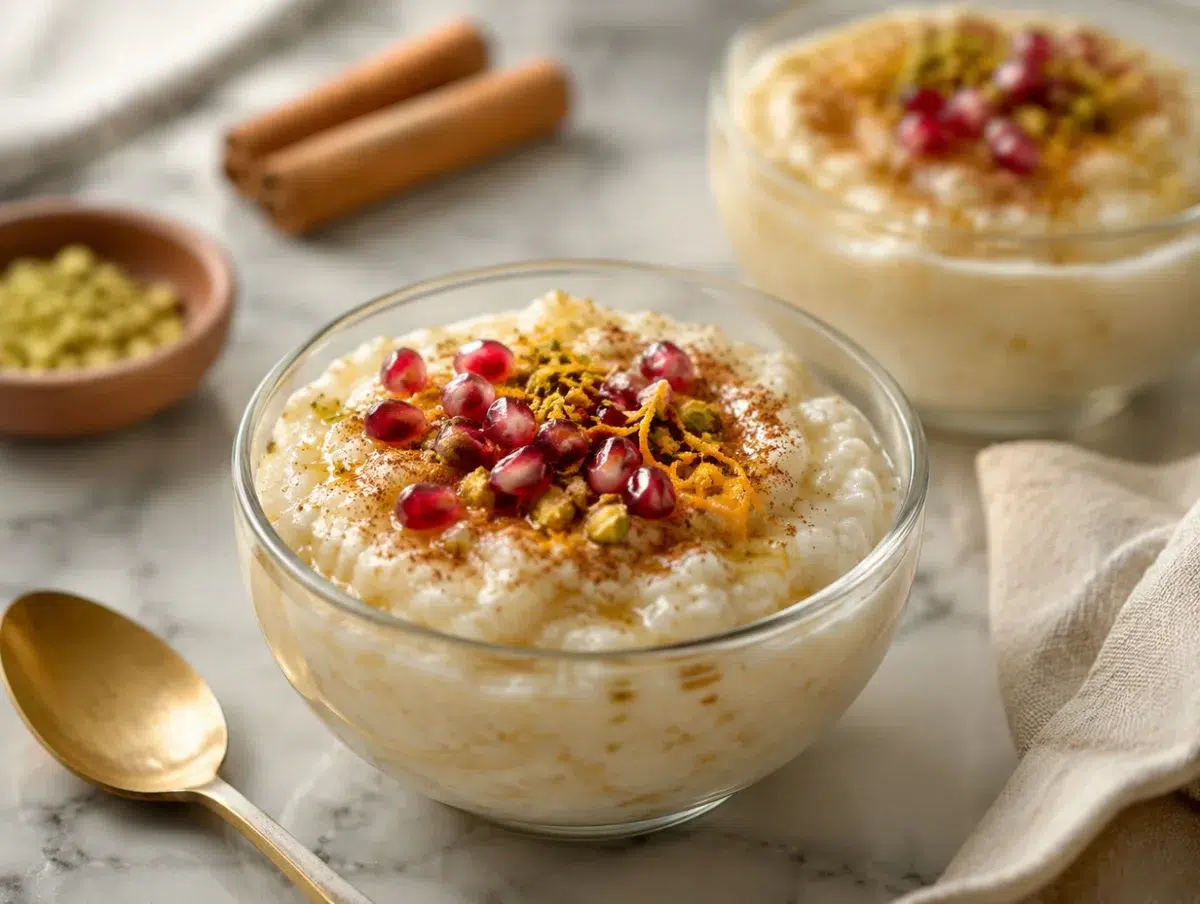
Step 9: Dust with cinnamon and allow to set. While still warm, dust the surface generously with ground cinnamon — hold the strainer at about 6 inches above the surface for an even, fog-like coating. For the traditional Greek finish, a pinch of ground mastic is added here too. Allow the pudding to cool at room temperature for 30 minutes before refrigerating uncovered for at least 2 hours. The surface skin that forms is intentional. In Greece, the skin of rizogalo is the part that children fight over. I was one of those children.
The Secret Touches That Make Mediterranean Rice Pudding Extraordinary
Four Insider Techniques From Three Generations of Rice Pudding
Secret 1 — Start in water, finish in milk. Already explained in Step 1, but worth reinforcing: this two-stage cooking method — partial water pre-cook, then transfer to milk — produces a creamy rice pudding with superior texture. The water stage begins starch hydration gently; the milk stage completes it slowly and with fat. Skipping the water stage and cooking directly in milk produces a denser, stickier result. This is the single most important structural decision in the recipe.
Secret 2 — The cold-milk slurry prevents lumps every time. Cornstarch stirred directly into a hot mixture forms lumps immediately because the outer starch granules gelatinize before the inner ones disperse. Dissolve cornstarch in cold milk only before adding it to the hot pudding. McGee’s explanation: cold liquid keeps the starch granules separated until they’re uniformly distributed throughout the hot mixture, at which point they all swell together — the definition of lump-free thickening.
Secret 3 — Rose water off heat, always. You want the rose water to perfume the cream, not cook into it. The volatile aromatic compounds responsible for the characteristic floral note begin breaking down above 160°F / 71°C with sustained exposure. Add off heat, after the pot has been removed from the burner. Stir gently. Do not return to heat after this point.
Secret 4 — Let the skin form. The skin on the surface of cooling rice pudding with cinnamon is caused by the evaporation of surface moisture concentrating the proteins in the milk — specifically casein micelles, as McGee describes — into a thin, set layer. This skin is not a defect; it is a feature. In my yiayia’s house, you got a bowl with skin or you got a bowl without skin, and the allocation was a matter of genuine household politics. Don’t cover the pudding while it cools unless you want to prevent the skin — some people do, and that’s legitimate. But know what you’re giving up.
Common Mistakes and How to Fix Them
| Mistake | What Happens | How to Fix It |
| Cooking rice directly in cold milk from the start | Rice takes 40+ minutes to soften; starch releases unevenly; texture is gluey | Always pre-cook rice in water for 8 minutes until al dente before adding milk |
| Adding all the milk at once to hot rice | Temperature drops sharply; starch seizes; rice stops cooking; texture is grainy | Add milk slowly in a steady stream while stirring, allowing temperature to recover |
| Stirring only occasionally | Milk scorches on the bottom; lumps form; burnt milk flavour ruins the batch | Stir continuously — every 30 seconds minimum — keeping the spoon on the pot bottom |
| Adding rose water to hot mixture on the heat | Aromatic compounds volatilize and dissipate; pudding is flat and unscented | Remove from heat completely before adding rose water; never return to heat after |
| Adding cornstarch directly to hot pudding | Lumps form instantly as surface starch gelatinizes before it disperses | Always dissolve cornstarch in cold milk first — the slurry method prevents lumps entirely |
| Refrigerating uncovered long-term | Surface dries out; texture becomes firm and unpleasant on top | Cover after first 2 hours once set; add a circle of plastic wrap touching the surface |
Variations & Serving Mediterranean Rice Pudding
Regional Variations From Greece to the Levant
The classic Greek rizogalo is what I’ve given you — milk, short-grain rice, sugar, rose water, cinnamon. But the Mediterranean is wide, and every coastline has its variation. The Lebanese riz b’haleeb uses orange blossom water instead of rose water and is typically served slightly looser, almost pourable. The Turkish sütlaç is sometimes baked after the stovetop cook to caramelize the surface — a beautiful and completely legitimate technique you can apply to this recipe (200°C / 390°F for 10–12 minutes under a grill or broiler). The Egyptian roz b’laban is nearly identical to the Greek version but often includes a layer of ground pistachios or crushed almonds scattered over the top before the cinnamon dust — extraordinary.
In Crete specifically, my mother’s variation adds two tablespoons of thyme honey from Sitia to the finished pudding instead of white sugar — it is stirred in off heat with the rose water, and the flavour is considerably more complex: floral, herbal, slightly bittersweet. It is my favourite version of Mediterranean rice pudding in the world, and I’ve had it in eighteen countries.
Weeknight shortcut: skip the mastic entirely (it adds complexity but not structure) and use vanilla extract instead of a vanilla pod. You lose perhaps ten percent of the flavour depth and save fifteen minutes. I do this on Tuesday evenings and have no regrets.
Serving Accompaniments and Non-Alcoholic Beverage Pairings
Serve Mediterranean rice pudding cold from the refrigerator, with a fresh dusting of cinnamon over the surface before it hits the table. A small drizzle of thyme honey from Crete — from the Sitia or Kolymvari region — is the one embellishment I’d recommend beyond the recipe itself.
The natural companion is tsai tou vounou — Greek mountain tea, brewed strong and served hot in small glasses. Its gentle herbal bitterness is the perfect counterpoint to the sweet cream of the rice pudding dessert. Chilled hibiscus tea is a stunning cold-season alternative — the tartness cuts the fat richness exactly right. For a lighter dessert spread, serve alongside our Greek yogurt panna cotta and our frozen Greek yogurt bars for a full Mediterranean dessert table that requires no baking and very little stress.
Storage & Reheating for Mediterranean Rice Pudding
How to Store and For How Long
| Method | Container | Duration | Notes |
| Refrigerator (whole dish) | Original tapsi or baking dish covered with plastic wrap touching the surface | Up to 4 days | Best flavour on days 1–2; rice continues absorbing liquid; texture thickens over time |
| Refrigerator (individual portions) | Airtight ceramic ramekins or containers | Up to 4 days | Prevents surface drying; best for single-serving convenience |
| Refrigerator (make-ahead base) | Airtight container, no rose water added yet | Up to 3 days | Add rose water and cinnamon only when serving, for freshest aroma |
| Freezer | Airtight container with no cinnamon topping | Up to 2 months | Thaw overnight in fridge; texture softens slightly; re-stir after thawing |
How to Restore Mediterranean Rice Pudding After Storage
After 3–4 days in the refrigerator, Mediterranean rice pudding thickens significantly as the rice absorbs more of the surrounding cream. To restore it: add 2–3 tablespoons of cold whole milk per serving and stir gently until loosened. This works for both cold serving (stir and serve immediately) and warm serving (stir in the milk and heat gently in a small saucepan over low heat for 3–4 minutes, stirring).
Never microwave rizogalo without adding milk first — the moisture heats unevenly and the texture becomes unpleasantly gummy. Before serving any stored version, always refresh the surface: a fresh dusting of cinnamon and a drizzle of honey restores both the visual and the flavour. As if it never sat in the fridge for three days.
Frequently Asked Questions
Substitutions & Technique Questions
Can I use long-grain rice instead of short-grain for this recipe?
Technically yes, but the result is different. Long-grain rice has lower starch content (less amylopectin) and produces a thinner, more granular rice pudding. It won’t give you the thick, porridge-like creaminess of the rizogalo recipe — that characteristic is almost entirely dependent on short-grain or medium-grain rice. Arborio works best; Calrose is also excellent. If long-grain is all you have, increase cornstarch to 3 tbsp to compensate for the lower starch release.
My pudding keeps developing lumps when I add the cornstarch. What am I doing wrong?
The slurry — dissolve cornstarch in cold milk only before adding it to the hot pudding. Cornstarch dropped directly into hot liquid forms surface lumps instantly because the outer granules gelatinize before the inner ones can disperse. Cold liquid keeps all granules separated until they’re uniformly distributed throughout the hot base. Pour the slurry in a slow, steady stream while stirring vigorously. No lumps, ever.
How do I prevent the milk from scorching on the bottom of the pot?
Three things: use a heavy-bottomed pot (thin pots create hot spots), keep heat at medium-low after the milk is added (never medium-high), and stir continuously — reaching the bottom and corners of the pot at every stroke. If you see or smell any hint of browning, immediately reduce heat to low and add a splash of cold milk while stirring vigorously. A scorched milk note will persist through the entire stovetop rice pudding if you let it go past the first sign.
Can I add egg yolks to this recipe?
Yes — this is the traditional rizogalo method, pre-dating cornstarch use. Whisk 2 egg yolks with 2 tablespoons of sugar until pale. When the pudding is cooked and thickened (before the rose water step), temper the yolks by slowly whisking in ½ cup of hot pudding to raise their temperature, then stir the tempered yolk mixture back into the pot. Stir over low heat for 2 minutes. Remove from heat. Add rose water. The result is richer, slightly more custard-like — closer to the older village-style homemade rice pudding.
How do I adjust the thickness — I prefer mine more pourable?
Reduce cornstarch to 1 tbsp (instead of 2) and add an additional 200ml milk. For a very loose, Lebanese riz b’haleeb-style pudding, skip the cornstarch entirely and rely only on the rice starch, cooking for 35 minutes instead of 25. The result is more liquid but wonderfully delicate. Conversely, for a firmer, sliceable make-ahead rice pudding that holds its shape on a plate, increase cornstarch to 3 tbsp.
Dietary, Make-Ahead & Authenticity Questions
Is this recipe vegan-friendly?
With two substitutions, yes. Replace whole milk with full-fat oat milk (same volume — the starch release and texture are nearly identical) and omit the egg yolk variant. The Mediterranean rice pudding will be vegan, gluten-free, and still entirely delicious. Use orange blossom water if rose water feels too floral without the dairy richness to anchor it. I’ve served the oat milk version at three workshops this year; nobody identified it as dairy-free until I told them.
How far ahead can I make this for a dinner party?
Up to 3 days ahead in the refrigerator, though 1–2 days is optimal. One pro tip: make the pudding base without the rose water, then add it only 30 minutes before serving — this preserves the fresh floral note at its most vibrant. Dust with cinnamon at the table, not in advance. This make-ahead rice pudding is one of the genuinely stress-free dinner party desserts: it requires no day-of work beyond taking it from the refrigerator.
What is the difference between Greek rizogalo and regular rice pudding?
The primary differences are in flavour and consistency. Greek rizogalo uses rose water as its signature aromatic (not just vanilla), often includes ground mastic or cinnamon from Chios-tradition spice use, and is cooked to a thicker consistency — firm enough to hold a slight shape when spooned into a shallow dish. British-style rice pudding dessert is typically baked, uses a longer-grain rice, and relies on cream or condensed milk for richness. French riz au lait is stovetop, like rizogalo, but uses crème fraîche and rarely includes floral aromatics. Rizogalo is the most aromatically complex of the three.
Can I make this without rose water?
Yes, and the result is still excellent — a cleaner, more vanilla-forward creamy rice pudding. Replace rose water with ½ teaspoon of orange blossom water (more restrained floral note) or simply increase vanilla to 1½ teaspoons and skip the floral element entirely. The mastic, if used, provides enough aromatic complexity to carry the dish. But if you’ve never tried rice pudding with rose water, I encourage you to — it transforms the dessert from ‘comforting’ to ‘unmistakably Mediterranean.’
Why does my rice pudding get too thick after refrigerating overnight?
Rice continues to absorb liquid even after cooking, and cold temperatures accelerate this slightly. After one night, the pudding will be noticeably thicker than when you poured it. This is normal and expected. Simply stir in 2–3 tablespoons of cold whole milk per serving before serving — this restores the original consistency within 30 seconds of gentle stirring. Never add more sugar at this stage; the sweetness intensifies slightly as the pudding rests and any additional sugar will make it cloying.
Bringing the Mediterranean to Your Table
A Bowl of Rice Pudding Is a Bowl of Memory
I’ve made Mediterranean rice pudding in professional kitchens, in my Athens apartment at midnight, in cooking classes for people who had never heard the word rizogalo, and for my own children who now fight over the surface skin exactly as I once did. What hasn’t changed in any of those contexts is this: the moment the cinnamon cloud settles over the warm white surface, and the kitchen fills with that particular smell — warm milk and rose and spice — time stops for a second. My yiayia is at her stove in Chania. The sea is half a mile away. The wooden spoon is her mother’s.
Make this recipe this week. Make it for someone you love. Post your photo in the comments below and tell me: did you use mastic? Did the skin form the way it should? Kali orexi.
More Mediterranean Desserts to Love
If this Mediterranean rice pudding has awakened a craving for the silky, gentle desserts of the Greek tradition, our Greek yogurt panna cotta is the natural next recipe — another cold-set, make-ahead dessert that rewards patience and good dairy. For something with a little more sweetness and crunch, our loukoumades Greek honey donuts are the dessert I grew up eating at festivals in Crete. And if you’d like to explore the full range of Mediterranean sweets, our Mediterranean desserts collection has everything from intensely syruped pastries to refreshing frozen treats — every recipe worth your time.