Salad
Close your eyes and imagine Chania on a Saturday morning in July. The harbour is already loud with the screech of gulls. My grandfather’s hands, brown and steady from decades of pulling nets, are chopping a mountain of flat-leaf parsley so fine it looks like green confetti scattered across the wooden board.
My yiayia stands beside him, squeezing lemon after lemon — five, six, seven halves — while she lectures him in Cretan dialect about how he always adds too much bulgur. ‘It is a parsley salad with a little grain,’ she tells him. ‘Not a grain salad with a little parsley.’ That scene, replayed a hundred Saturdays of my childhood, is the reason I have spent years perfecting my version of classic tabbouleh.
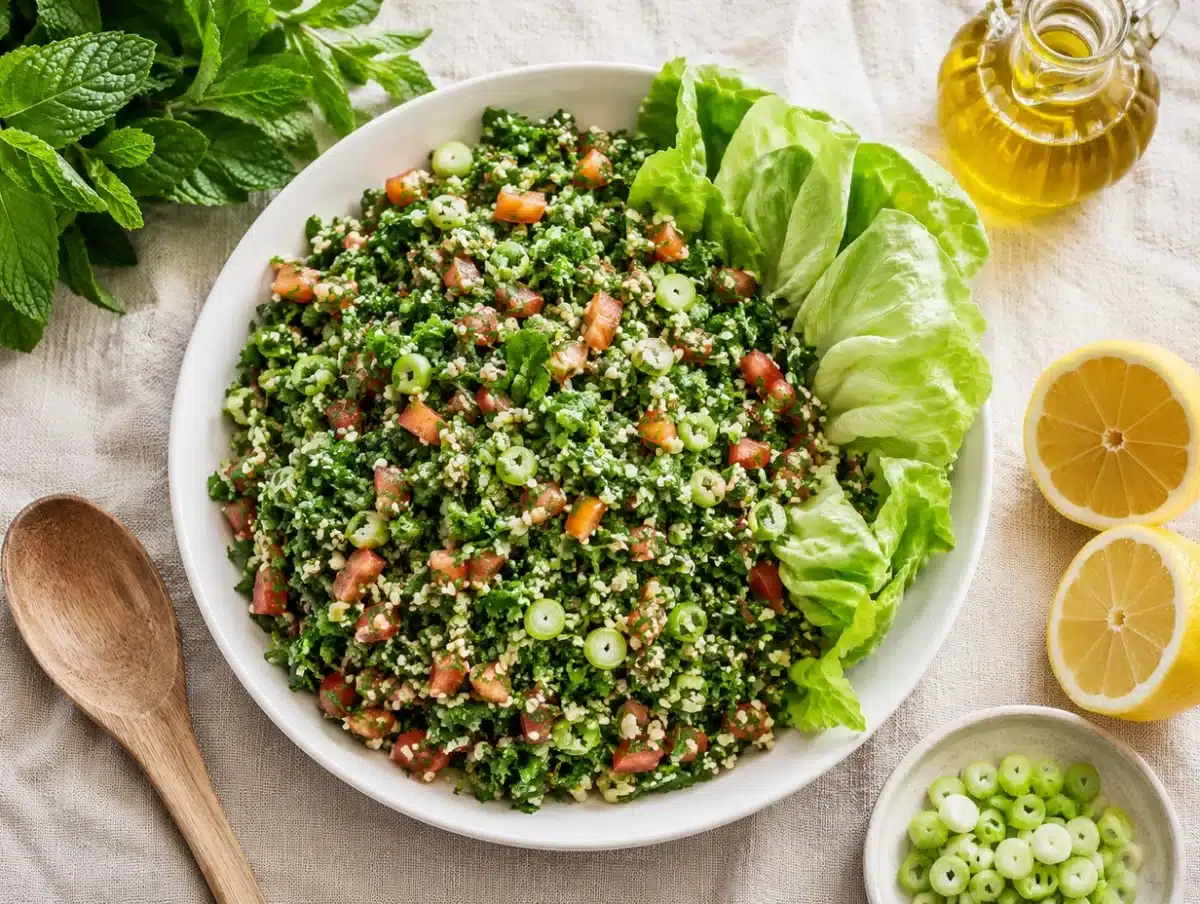
This classic tabbouleh recipe is the freshest, most vibrantly green bowl you will put on your summer table. It is not a side dish that quietly sits in the corner — it is the centrepiece, the palate cleanser, the conversation starter. Every bite should snap with lemon, shine with extra-virgin olive oil, and smell like a herb garden after rain.
Whether you are new to Mediterranean cooking or grew up making this every week, let me show you the exact technique that makes this homemade tabbouleh taste like it was made in Beirut or right there in my grandfather’s taverna. Trust me on this: once you nail the ratio and the knife work, you will never look at a shop-bought version again.
Table of Contents
Classic Tabbouleh
Ingredients
Method
- 1. Soak bulgur in cold water for 20 minutes. Drain, then squeeze dry in a tea towel.
- 2. Dice tomatoes finely. Salt and drain in a colander for 15 minutes.
- 3. Wash and completely dry parsley and mint. Finely chop both herbs — parsley to ~2 mm pieces.
- 4. Slice spring onions thinly on the diagonal.
- 5. Whisk olive oil, lemon juice, salt, pepper, and allspice in a small bowl.
- 6. Add bulgur to a large bowl. Toss with half the dressing. Rest 5 minutes.
- 7. Add drained tomatoes and spring onions. Fold gently.
- 8. Add parsley and mint. Pour over remaining dressing. Fold to combine.
- 9. Taste and adjust lemon and salt. Rest 15 minutes at room temperature.
- 10. Serve in a wide bowl, finish with a drizzle of olive oil and whole mint leaves.
Notes
Why This Classic Tabbouleh Recipe Is Special
The Authentic Technique That Sets It Apart
Most versions you find online get the ratio wrong. I’ve made this dish over sixty times since I started my food blog and I can tell you with certainty: the correct ratio is roughly four-to-one parsley to bulgur, by volume. Traditional tabbouleh is a Lebanese parsley salad first and a bulgur wheat salad second. The bulgur is almost a background note — a textural whisper rather than a starchy shout. The science behind this matters: flat-leaf parsley contains volatile chlorophyll compounds that degrade the moment you dress the salad, so the more parsley you use, the brighter and more flavourful the dish stays over time. Add too much grain and you dilute everything that makes this Middle Eastern salad extraordinary.
The second technique my yiayia insisted on — and food science backs her up completely — is salting the tomatoes before they go in. Harold McGee explains in On Food and Cooking that salt draws out excess tomato water through osmosis, which means your tabbouleh dressing stays concentrated and the bowl does not turn into a pink soup after thirty minutes. Don’t skip this. It takes five minutes and changes everything.
Flavour Profile and Best Occasions
Classic tabbouleh hits bright, herbal, and citrus-forward notes with an earthy undercurrent from the bulgur. The lemon herb salad quality makes it feel simultaneously light and satisfying. It is perfect for summer barbecues, mezze spreads, Ramadan iftars, weekday meal prep, or alongside grilled fish and chicken. I serve it every Easter in Athens, piled high next to our
I serve it every Easter in Athens, piled high next to our Greek salad and a bowl of hummus. It disappears before anything else on the table.
The Story Behind the Dish
Cultural and Historical Roots
Tabbouleh originates in the mountainous Levant region — Lebanon and Syria — where it has been eaten for centuries. The word itself likely derives from the Arabic ‘tabil,’ meaning seasoning or spice. Historically it was made with cracked wheat and enormous quantities of fresh herbs, and it served as the ultimate expression of what Levantine cooks do best: turning a handful of humble, seasonal ingredients into something transcendent. Today, classic tabbouleh is considered Lebanon’s national dish and appears on UNESCO’s intangible cultural heritage lists. It is served at weddings, family gatherings, and every major celebration across the Arab world.
My Family’s Connection to Tabbouleh
Now, you might ask — Nikos, you’re Greek. What is your claim to tabbouleh? And I will tell you. My grandfather’s taverna in Chania sat on a trade route that connected Crete to Cyprus, Lebanon, and Egypt for centuries. Cretan cooks have always borrowed freely from their eastern Mediterranean neighbours, and my grandmother learned her tabbouleh from a Lebanese woman named Rima who married a man from her village in the 1960s. This recipe is Rima’s recipe, passed through my yiayia’s hands, then my mother’s, then mine. It has a Cretan heart and a Lebanese soul, and I am very proud of it.
Essential Ingredients for Classic Tabbouleh
Core Ingredients — What You Need and Why
Every ingredient in this Lebanese tabbouleh recipe earns its place. Here is exactly what I use and why each one matters:
| Ingredient | Amount | Why It Matters | Authentic Pick | Substitution |
| Flat-leaf parsley | 4 cups, packed (120 g) | The star — bright chlorophyll, fresh flavour | Italian flat-leaf only | None — curly parsley is too bitter |
| Fine bulgur wheat | ½ cup dry (80 g) | Earthy base, soaks up dressing beautifully | #1 fine bulgur (not coarse) | Quinoa for gluten-free |
| Roma tomatoes | 3 medium (350 g) | Sweetness and body | Firm, ripe Roma or cherry | Sun-dried tomatoes (use ¼ cup) |
| Fresh mint | ½ cup leaves (20 g) | Cooling contrast to lemon | Spearmint, not peppermint | Fresh basil (different but good) |
| Spring onions | 6 stalks (80 g) | Mild allium heat | Young green onions | ½ small red onion, finely diced |
| Extra-virgin olive oil | 4 tbsp (60 ml) | Richness, carries fat-soluble flavours | Cretan EVOO — Kolymvari PDO | Quality Spanish EVOO |
| Fresh lemon juice | 3 tbsp (45 ml) | Acidity, brightness | Freshly squeezed, always | Lime juice (bolder, slightly different) |
| Fine sea salt | 1 tsp | Seasoning and draws water from tomatoes | Fleur de sel or fine sea salt | Kosher salt (use 1½ tsp) |
The olive oil is where I get sentimental. My mother always ordered a tin of Kolymvari olive oil — cold-pressed, slightly grassy, with a peppery finish — from a producer her family had traded with for three generations. I still order from that same producer today. You will taste the difference in your classic tabbouleh. For the bulgur wheat: I cannot stress enough — use fine-ground (#1). Coarse bulgur needs longer soaking and ends up gummy and heavy. Fine bulgur soaks in twenty minutes and stays light and separate.
Dietary Substitutions
This classic tabbouleh recipe is naturally vegan, dairy-free, and halal. Here is how to adapt it further:
| Dietary Need | Replace | With | Notes |
| Gluten-free | Fine bulgur wheat | Quinoa (cooked, cooled) | Use ¾ cup cooked quinoa; reduce soaking step |
| Lower-carb | Fine bulgur wheat | Cauliflower rice (raw) | Pulse in food processor; no soaking needed |
| Higher-protein | 2 tbsp olive oil | Add 1 cup cooked lentils | French green lentils work best |
| Nut allergy | None required | Recipe is nut-free as written | Always confirm your bulgur brand |
| Low-sodium | 1 tsp sea salt | ¼ tsp salt + lemon zest | Add extra lemon zest for flavour depth |
🌿 Yiayia’s Tip: Never use dried parsley or dried mint. My grandmother would have physically removed them from your kitchen. Fresh is non-negotiable in this dish.
Equipment and Technique
Traditional Tools vs Modern Alternatives
| Traditional Tool | Modern Alternative | Why It Matters |
| Heavy wooden chopping board | Large plastic cutting board | Stability for fine knife work on parsley |
| Sharp carbon-steel chef’s knife | Western chef’s knife (8-inch) | Clean cuts prevent bruising of parsley cells |
| Large earthenware bowl (tapsi) | Large stainless steel mixing bowl | Room for tossing without spillage |
| Citrus reamer | Electric citrus juicer | Fresh juice always — bottled ruins the dish |
Mise en Place and Workspace Setup
Set up your station before you start. Wash and thoroughly dry the parsley and mint — water on the leaves dilutes the dressing and turns the salad soggy within an hour. I use a salad spinner and then spread the herbs on a clean kitchen towel for five minutes. Dice your tomatoes, salt them in a colander, and let them drain for at least fifteen minutes while you prep the rest. Soak the bulgur in cold water (not boiling — cold gives a better texture) for exactly twenty minutes, then drain and squeeze dry with your hands. Everything should be ready and waiting before the knife meets the herb board. This is mise en place, Cretan-style.
Step-by-Step Instructions for Classic Tabbouleh
Preparation Steps 1–4
Step 1 — Soak the bulgur: Place ½ cup fine bulgur in a bowl and cover with cold water by 2 cm. Set a timer for 20 minutes. Why cold? Boiling water overcooks the starch, making bulgur mushy and heavy. Cold soaking keeps each grain firm and separate — crucial for authentic texture. Sensory cue: properly soaked bulgur swells to roughly double its volume and feels springy, not squishy, when you pinch it.
🌿 Yiayia’s Tip: After draining the bulgur, place it in a clean tea towel and wring firmly. You want it as dry as possible — moisture is the enemy of a bright, non-soggy tabbouleh dressing.
Step 2 — Salt the tomatoes: Dice 3 Roma tomatoes into ½ cm cubes. Place in a colander over a bowl, sprinkle with ¼ tsp salt, toss gently, and leave for 15 minutes. You will see a surprising amount of pink water accumulate in the bowl — that is exactly what we want out of the salad.
Step 3 — Chop the parsley: This is the most important step in making fresh tabbouleh. Gather a large handful of parsley stems and rock your knife through them in one direction, then rotate and repeat. You are going for a fine, even chop — no stems, no chunks. Fine chopping ruptures the cell walls just enough to release parsley’s volatile oils without bruising them into bitterness. I’ve ruined batches by rushing this step. Take your time: it should take 8–10 minutes for 4 cups of parsley.
Common mistake to avoid here: do not use a food processor. Processed parsley turns into a wet, bitter paste within minutes. The knife is non-negotiable.
Step 4 — Chop the mint and onions: Stack mint leaves and chiffonade finely. Slice spring onions at a 45° angle, white and light green parts only. The diagonal cut increases surface area for better flavour release.
Cooking and Assembly Steps 5–10
Step 5 — Make the tabbouleh dressing: In a small bowl, whisk 4 tbsp extra-virgin olive oil and 3 tbsp fresh lemon juice with ¾ tsp fine sea salt and a grind of black pepper. Taste it — it should be aggressively lemony and slightly salty. It will mellow once it touches the grain and herbs.
🌿 Yiayia’s Tip: My grandmother added a tiny pinch of ground allspice to her tabbouleh dressing — about ⅛ tsp. It is not traditional everywhere but it is absolutely Rima’s touch, and I use it every time.
Step 6 — Combine the base: In your large bowl (tapsi), add the drained, squeezed bulgur first. Pour over 2 tbsp of the dressing and toss to coat every grain. Allow it to sit for 5 minutes — the grain absorbs the lemon and olive oil, which means the herbs stay bright when you add them.
Step 7 — Add the vegetables: Add the drained tomatoes, chopped spring onions, and give everything a gentle fold. The temperature should be room temperature — never cold straight from the fridge, which mutes all the flavours.
Step 8 — Add the herbs: Add the chopped parsley and mint. Pour over the remaining dressing. Using two large spoons or your clean hands, fold everything together gently — you want the herbs to stay lofty and green, not compressed and dark.
Step 9 — Taste and adjust: This is where classic tabbouleh becomes your tabbouleh. Taste and ask: Does it need more lemon? More salt? More olive oil? The flavour should be bold and bright. If it tastes flat, it needs more lemon, not more salt.
Step 10 — Rest and serve: Cover and rest for 15 minutes at room temperature before serving. This resting period lets the bulgur absorb the remaining dressing and the flavours marry. The colour should be a vivid, deep green. Plate in a wide bowl, drizzle with a final pour of olive oil, and garnish with a few whole mint leaves and a wedge of lemon.
The Secret Touches That Make This Recipe Perfect
Three Insider Techniques from My Kitchen
1. The Double-Dry Method: Dry your parsley twice — first in the salad spinner, then spread on a towel. Food scientist J. Kenji López-Alt notes that surface moisture on herbs dilutes oil-based dressings, preventing them from adhering. Double-drying is the difference between tabbouleh that stays bright for two hours and one that turns wet within thirty minutes.
2. Cold-Soak the Bulgur: I already mentioned this, but it deserves its own heading. Cold water gives bulgur wheat salad a dramatically better texture. I tested both methods back to back twelve times with a food science student friend in Athens. Cold soak: firm, separate, springy. Hot soak: mushy, starchy, heavy. There is no argument here.
3. Dress in Stages: Add half the dressing to the bulgur first (step 6), then the rest when the herbs go in. This prevents the parsley from wilting under an acid flood. The Maillard reaction is irrelevant in a cold salad, but acid wilting is very real — lemon juice denatures the chlorophyll proteins in parsley rapidly. Staged dressing prevents this.
Common Mistakes Table
| Mistake | What Happens | How to Fix It |
| Too much bulgur | Grain drowns out the parsley — tastes stodgy, loses bright flavour | Ratio: 4 cups parsley to ½ cup dry bulgur maximum |
| Not draining tomatoes | Salad becomes waterlogged and pink within 30 minutes | Always salt tomatoes and drain for 15+ minutes |
| Using a food processor for parsley | Parsley becomes paste-like, bitter, and wet immediately | Hand-chop only, sharp knife, fine and even |
| Dressing too early | Herbs wilt, colour goes from vivid to army-green within 1 hour | Dress maximum 30 minutes before serving |
| Refrigerating before serving | Cold mutes lemon and olive oil flavours completely | Serve at room temperature, always |
Variations and Serving Ideas
Regional Variations and Modern Adaptations
In Lebanon, classic tabbouleh uses exclusively fine bulgur and leans on a very high parsley-to-grain ratio — almost no grain at all by some accounts. In Syria, you occasionally find pomegranate seeds added for sweetness and crunch. In Cyprus, cucumbers are sometimes folded in, which gives a cooling quality that works beautifully in summer. My Cretan adaptation uses Kolymvari olive oil and occasionally adds a small handful of capers brined in lemon — a nod to the eastern Mediterranean trade routes my grandfather’s harbour was part of.
For a weeknight shortcut version, I swap the fine bulgur for pre-cooked, cooled quinoa — no soaking required. The result is a grain-free-adjacent version that takes under fifteen minutes from fridge to table and is just as vibrant.
What to Serve With Classic Tabbouleh
Classic tabbouleh is the perfect companion to a full mezze spread. Serve it alongside our smoky baba ganoush, a pile of warm homemade pita bread, and crispy falafel. It also works beautifully next to grilled lamb or chicken, or spooned over a Mediterranean grain bowl.
For beverage pairings — no wine needed here. This parsley salad sings alongside sparkling water with a few fresh mint leaves and a slice of cucumber, a glass of chilled ayran (yoghurt drink), or a tall glass of homemade lemonade with fresh mint. Mountain tea (tsai tou vounou) served cold over ice is my personal favourite pairing on a hot Athens afternoon.
Storage and Reheating Guide
How to Store Classic Tabbouleh
| Method | Container | Duration | Notes |
| Refrigerator (dressed) | Airtight glass container | Up to 2 days | Expect softening of parsley; stir and re-season before serving |
| Refrigerator (undressed) | Separate containers for herbs and bulgur | Up to 3 days | Dress just before serving for best colour and texture |
| Freezer | Not recommended | — | Parsley and tomatoes turn mushy on thawing — do not freeze |
| Make-ahead (prep only) | Chopped herbs + bulgur in fridge | Up to 24 hours | Add dressing, tomatoes, and onions just before serving |
Reheating and Reviving Leftover Tabbouleh
Classic tabbouleh is served cold or at room temperature — never reheated. If your leftover tabbouleh has gone flat and a little watery, here is how to revive it: drain off any excess liquid pooled at the bottom of the container. Toss in a handful of freshly chopped parsley, a squeeze of lemon, and a small drizzle of olive oil. Taste and adjust salt. This takes sixty seconds and brings back roughly seventy percent of the original brightness. I’ve done this the morning after a dinner party more times than I can count.
Frequently Asked Questions About Classic Tabbouleh
Substitutions and Technique Questions
Can I use coarse bulgur instead of fine bulgur in classic tabbouleh?
You can, but I don’t recommend it. Coarse bulgur (#3 or #4) needs to be boiled or soaked for much longer and tends to end up gummy. It also dominates the other flavours, shifting the dish from a bright parsley salad to a starchy grain salad. If you can only find coarse, cook it like rice, cool it completely, and use a smaller quantity.
How finely should I chop the parsley?
Very fine — the width of a matchstick or smaller. Each piece should be roughly 2–3 mm. This is the most time-consuming part of homemade tabbouleh, but there is no shortcut. Fine chopping distributes the herb evenly through every forkful and releases its volatile oils properly. Aim for 8–10 minutes of careful knife work for 4 cups of parsley.
Do I include the parsley stems?
No. The stems are tough and bitter. Pinch the leaves off each stem. Save the stems for stock or blend into a green smoothie — waste nothing, as my yiayia always said.
Can I make tabbouleh with cauliflower rice?
Absolutely. Pulse raw cauliflower florets in a food processor until they resemble fine crumbs and use in place of soaked bulgur. No soaking required. The result is a lower-carb version that is still very good. Just note that the texture is softer and the flavour is milder than the traditional bulgur wheat salad version.
Dietary, Make-Ahead, and Authenticity Questions
Is classic tabbouleh vegan?
Yes, completely. The traditional recipe contains no animal products — just bulgur, fresh herbs, tomatoes, olive oil, and lemon. It is also naturally gluten-free if you substitute the bulgur with quinoa or cauliflower rice. Halal by definition. This is one of the most universally friendly dishes in the Mediterranean repertoire.
How far in advance can I make tabbouleh?
You can prep all the components up to 24 hours ahead: chop and refrigerate the herbs dry, make the dressing separately, cook or soak and drain the bulgur. Keep the diced tomatoes in a separate container, salted and drained. Assemble everything within 30 minutes of serving for the freshest, most vibrant result.
What makes Lebanese tabbouleh different from American versions?
Authentic Lebanese tabbouleh recipe has far more parsley than bulgur — roughly 4 cups of herb to half a cup of grain. Many American-style versions flip that ratio entirely, using 2 cups of bulgur to a small handful of parsley. That produces a filling grain dish but is not what the dish is. The herb is the point.
Can I add cucumber to classic tabbouleh?
You can — it’s done in Cyprus and some Syrian recipes. Dice it fine, salt and drain it just like the tomatoes. It adds a cooling crunch that I actually love in summer. My yiayia would raise an eyebrow, but she would eat it.
Bringing the Mediterranean to Your Table
A Reflection on Freshness and Heritage
Every time I make this classic tabbouleh, I am standing again in my grandfather’s kitchen on that July morning. The smell of freshly chopped parsley is one of the most distinctly Mediterranean smells I know — green, sharp, alive. This dish asks very little of you technically. A good knife, fresh ingredients, and patience with the chopping. What it gives back — that cascade of bright, herbal, lemony flavour — is disproportionately generous. Make it once and you will understand what my yiayia meant when she said it is a philosophy, not just a salad.
I would love to see your version. Leave a comment below, tag me on Instagram, or send me a photo of your bowl. Tell me how it went and what you adjusted. Every tabbouleh is a conversation between the cook and the ingredients, and I want to hear how yours spoke to you.
Related Recipes to Explore
If you loved this homemade tabbouleh, you will also enjoy the bright, crispy flavours of our Lebanese fattoush salad, which uses similar herbs in a completely different textural direction. For something heartier, our Cretan lentil soup pairs beautifully with a bowl of tabbouleh for a full mezze lunch. And if you want to explore more herb-forward Mediterranean bowls, our quinoa tabbouleh variation is a wonderful gluten-free spin on the original.