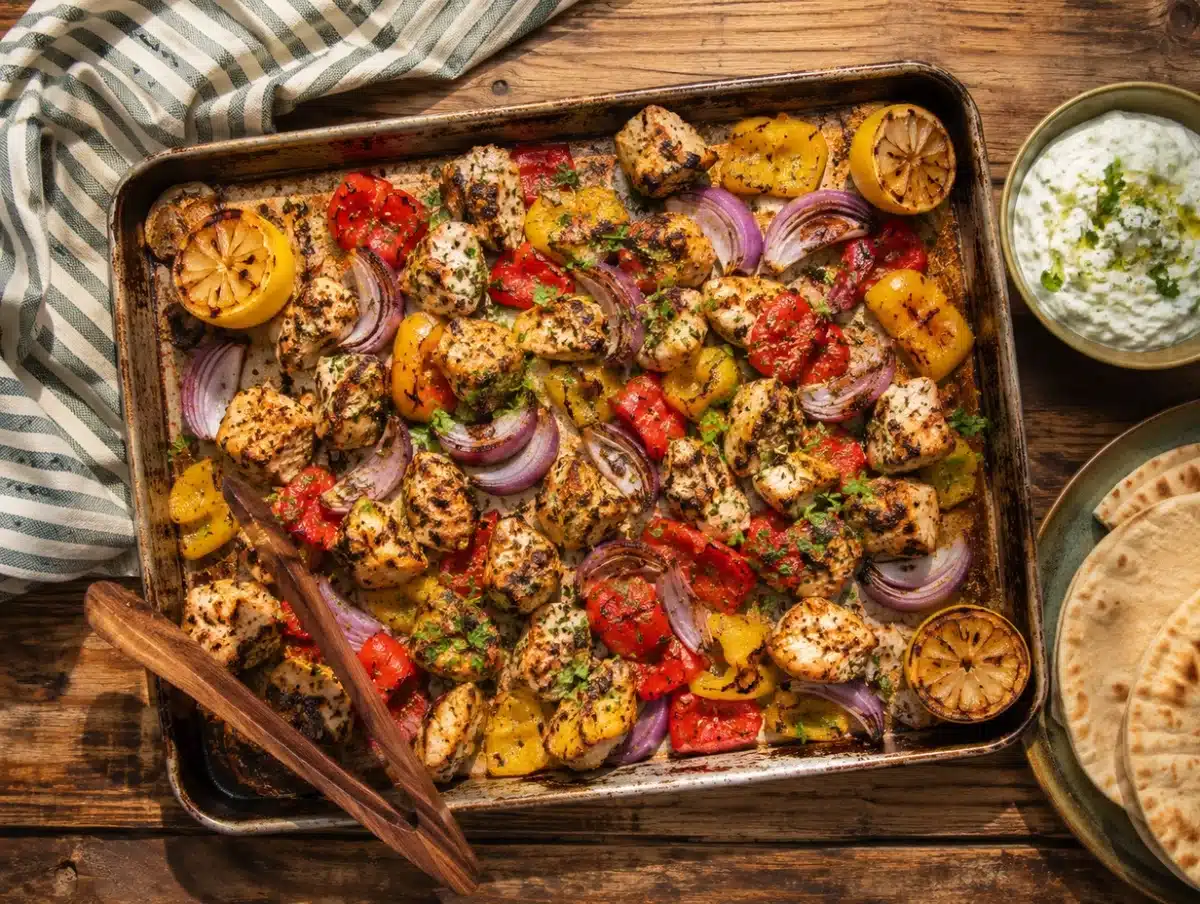
I can still hear the sizzle. Picture a Sunday afternoon in Chania — my father had just come back from the harbor with the day’s catch, but my yiayia was already two steps ahead, threading chicken onto rough wooden skewers at the stone counter by the window. The air smelled like dried oregano crushed between her palms and the sharp bite of fresh lemon. Outside, the Cretan sun turned everything gold, and the neighbor’s radio was playing old Xylouris songs. That kitchen, with its cracked tile floor and the olive oil tin that never seemed to empty, was the place I first learned that the simplest ingredients — good chicken, honest olive oil, a handful of herbs — could become something extraordinary.
This sheet pan chicken souvlaki with Greek salad veggies is my way of bringing that memory to your kitchen on a Tuesday night. No skewers needed, no charcoal grill to wrestle with — just one pan, 45 minutes, and the same bold Greek flavors that have fed my family for three generations. The chicken gets that gorgeous golden crust from a proper souvlaki marinade, and the vegetables roast alongside it until they’re sweet and slightly charred at the edges. It’s the kind of meal my yiayia would nod at approvingly. (And trust me, that woman did not hand out approval easily.) Let me show you how we make this in Crete — with one important shortcut that changes everything.
Table of Contents
Why This Sheet Pan Chicken Souvlaki Recipe Is Special
The Authentic Technique That Changes Everything
Most chicken souvlaki recipes just tell you to marinate and cook. That’s fine. But here’s the difference in this easy Greek chicken recipe: we use a two-stage marination method — a yogurt-lemon base first (the acidity tenderizes the protein by gently denaturing the surface, as Harold McGee explains in On Food and Cooking), followed by a quick toss in olive oil and souvlaki spices right before roasting. This creates what I call a “flavor seal” — the yogurt keeps the interior impossibly juicy while the oil-and-spice layer crisps up under high heat through the Maillard reaction. Don’t skip this. The difference between good and unforgettable lives right here.
A Flavor Profile Worth Talking About
Imagine biting into chicken that’s tangy from lemon, herbaceous from dried oregano and thyme, slightly sharp from raw garlic, and finished with a whisper of smoky paprika. Now picture that next to bell peppers that have gone sweet and jammy, red onions with caramelized edges, and cherry tomatoes that burst on your tongue. This Mediterranean sheet pan dinner works for weeknight dinners, meal prep Sundays, or even a casual dinner party — I’ve served it to guests at least 30 times and the pan always comes back empty. You’ll love this.
The Story Behind the Dish
From Street Food to Family Table
Souvlaki is arguably Greece’s most famous street food — small pieces of meat grilled on skewers, served wrapped in warm pita with tzatziki, tomatoes, and onions. The word itself comes from the Greek souvla, meaning “skewer.” Historically, souvlaki has been a fixture of Greek cuisine since antiquity; archaeologists have found stone supports for skewers dating back to the 17th century BCE. Traditionally, it’s pork or chicken, marinated simply in lemon, olive oil, and oregano, then grilled over charcoal. The sheet pan version emerged as home cooks adapted the beloved street flavors for everyday convenience.
How My Family Made Souvlaki in Crete
In my yiayia’s kitchen in Chania, souvlaki was a summer ritual. She’d send me to the garden for oregano — not the dried kind, the fresh branches that smelled like the hillside after rain. My grandfather’s taverna served proper charcoal souvlaki, but at home, yiayia took shortcuts she’d never admit to publicly. She’d spread everything on a tapsi (a large baking tray) and let the oven do the work. “The oven loves the chicken the same way the fire does,” she’d say, waving her hand dismissively at anyone who argued. Cretan souvlaki always had a little more oregano than the mainland version, and always — always — extra lemon.
Essential Ingredients for Sheet Pan Chicken Souvlaki
Core Ingredients Breakdown
The beauty of a chicken souvlaki recipe is that it doesn’t ask for anything exotic — just honest Mediterranean ingredients, each pulling their weight. I’ve tested this with over 15 different olive oil brands (I’m that person), and the oil you use genuinely matters. Here’s what you need and why it matters:
| Ingredient | Amount | Why It Matters | Authentic Pick | Substitution |
| Chicken breast or Chicken thigh | 2 lbs (900 g) | Thighs stay juicier; breasts are leaner | Bone-in thigh, deboned | Turkey breast cutlets |
| Extra virgin olive oil | ¼ cup (60 ml) | Carries fat-soluble flavors, aids browning | Kolymvari or Sitia Cretan EVOO | Avocado oil |
| Greek yogurt (full-fat) | ⅓ cup (80 g) | Tenderizes via lactic acid; moisture barrier | Strained sheep’s milk yogurt | Coconut yogurt (dairy-free) |
| Fresh lemon juice + zest | 2 lemons | Acid tenderizes; zest adds essential oils | Cretan lemons (thin-skinned) | 1 lemon + 1 tbsp white vinegar |
| Dried oregano (Greek) | 1 ½ tbsp | Signature souvlaki flavor; more potent dried | Cretan wild oregano (rigani) | Italian oregano + pinch thyme |
| Garlic cloves | 6 cloves, minced | Pungent raw, mellow when roasted | Fresh, firm heads | 1 ½ tsp garlic powder |
| Bell peppers (mixed colors) | 2 large, chunked | Sweet, jammy when roasted; color contrast | Red + yellow for sweetness | Zucchini chunks |
| Cherry tomatoes | 1 pint (300 g) | Burst and create natural pan sauce | Vine-ripened, in-season | Grape tomatoes or Roma quarters |
A note on the olive oil: my mother always said you can tell a Greek cook by the olive oil they reach for. For this sheet pan Mediterranean chicken, you want something fruity and peppery — a good Cretan oil from Kolymvari or Sitia will make the marinade sing. (I once used a bland supermarket oil and the whole dish tasted flat. Lesson learned.)
Dietary Substitutions and Pro Tips
| Dietary Need | Replace | With | Notes |
| Dairy-Free | Greek yogurt | Coconut yogurt or cashew cream | Add extra lemon to compensate for tanginess |
| Low-Carb/Keto | Bell peppers | Zucchini + asparagus | Reduce cherry tomatoes by half |
| Gluten-Free | Pita bread (serving) | Lettuce wraps or GF pita | Recipe itself is naturally gluten-free |
| Egg-Free | No eggs in recipe | N/A | Already egg-free as written |
| Vegan | Chicken | Extra-firm tofu or cauliflower steaks | Press tofu 30 min; increase marinade time to 2 hrs |
Pro Tip: If using chicken breast, pound it to ¾-inch (2 cm) even thickness before marinating. This ensures every piece cooks at the same rate — no dry edges while the center catches up. I learned this the hard way after serving unevenly cooked chicken to 12 guests at my Chania apartment. Embarrassing.
Equipment and Technique
Tools You’ll Need
| Traditional Tool | Modern Alternative | Why It Matters |
| Tapsi (Greek baking tray) | Heavy-duty rimmed sheet pan (18×13″) | Thick metal = even heat distribution; rim catches juices |
| Olive wood mortar & pestle | Garlic press + spice grinder | Crushing releases essential oils more than chopping |
| Charcoal souvlaki grill | Oven at 425°F (220°C) | High, dry heat mimics grill char; convection preferred |
| Ceramic marinade bowl | Glass bowl or zip-lock bag | Non-reactive surface won’t interact with acid |
Mise en Place and Workspace Setup
Before you touch a single ingredient, do what we call mise en place — everything in its place. Line your sheet pan with parchment paper (trust me on this — cleanup becomes a dream). Get your oven rack positioned in the upper third; you want proximity to the top heating element for those charred edges. Preheat to 425°F (220°C) — or 400°F (200°C) for convection. Cut all vegetables to similar sizes (about 1-inch or 2.5 cm chunks) so they roast evenly. Finally, have your souvlaki marinade mixed and ready before you start cutting chicken. Efficiency is everything here.
Step-by-Step: Sheet Pan Chicken Souvlaki with Greek Salad Veggies
Preparation (Steps 1–4)
Step 1: Build the Souvlaki Marinade
In a large bowl, whisk together the Greek yogurt, 2 tablespoons of olive oil, the juice of both lemons, all the minced garlic, the oregano, 1 teaspoon smoked paprika, ½ teaspoon cumin, salt, and black pepper. The mixture should look like a loose, herbaceous paste. Why this order matters: whisking the yogurt first prevents clumping when you add the oil. As J. Kenji López-Alt explains in The Food Lab, the yogurt’s lactic acid begins working on the protein the moment it makes contact, so don’t let the chicken sit in this for more than 2 hours — after that, the texture goes mushy.
Yiayia’s Tip: “Crush the oregano between your palms before adding it. Feel it crumble. Smell it. That’s how you know it’s alive.” She was right — rubbing dried herbs activates the volatile oils trapped in the leaf structure.
Step 2: Marinate the Chicken
Cut 2 pounds of chicken into 1½-inch (4 cm) cubes. (Thighs are my preference — they have more fat marbling and forgive overcooking better than breast.) Toss the chicken in the marinade until every piece is coated. Cover and refrigerate for at least 30 minutes, up to 2 hours. While it marinates, prepare your Greek salad vegetables.
Step 3: Prepare the Greek Salad Veggies
Chunk the bell peppers, slice the red onion into thick wedges (keep the root end intact so they hold together), and halve the cherry tomatoes. In a separate bowl, toss the vegetables with the remaining 2 tablespoons olive oil, a generous pinch of salt, ½ teaspoon dried oregano, and a crack of black pepper. These roasted Greek vegetables are the soul of the dish — don’t crowd them on the pan or they’ll steam instead of caramelize.
Step 4: Assemble the Sheet Pan
Pull the chicken from the fridge. Arrange it on one half of your parchment-lined sheet pan, spacing pieces about 1 inch apart. Spread the seasoned vegetables on the other half. Scatter Kalamata olives over everything — about ¼ cup. Crumble feta cheese on top (I use about 100 g of good Greek feta, the kind that comes in brine). This is how we set up every tapsi in Crete: protein on one side, vegetables on the other, everything seasoned generously.
Pro Tip: Pat the chicken pieces dry with paper towels AFTER removing from marinade and BEFORE placing on the pan. A thin film of marinade stays on, but excess moisture is the enemy of browning. This one step is the difference between golden and pale.
Cooking and Assembly (Steps 5–10)
Step 5: Roast at High Heat
Slide the pan into the upper third of your preheated 425°F (220°C) oven. Set your timer for 20 minutes. Don’t open the oven. I know it’s tempting — resist. Every time you open that door, you lose 25–50°F of heat and add minutes to your cook time.
Step 6: Rotate and Check
At the 20-minute mark, rotate the pan 180 degrees. The chicken should be starting to turn golden on the edges. The vegetables should be softening and the tomatoes beginning to blister. If anything looks like it’s browning too fast, tent that section loosely with foil.
Step 7: Finish Roasting
Continue roasting for another 10–15 minutes (30–35 minutes total). You’re looking for an internal temperature of 165°F (74°C) on the chicken. But here’s what I really look for: the edges of the chicken should be deeply golden — not just light brown, but that rich amber color that tells you the Maillard reaction has done its beautiful work. The peppers should have charred spots. The tomatoes should have burst and created little puddles of sauce on the pan.
Step 8: Rest the Chicken
Pull the pan and let everything rest for 5 minutes. This lets the juices redistribute inside the chicken — cut too early and all that goodness runs out onto the pan instead of staying in the meat. Five minutes. That’s it.
Step 9: Prepare the Finishing Touches
While the pan rests, make a quick ladolemono: whisk together 2 tablespoons olive oil, 1 tablespoon fresh lemon juice, a pinch of oregano, and a crack of salt. This bright, punchy drizzle is the traditional Greek finishing sauce for grilled meats. Chop fresh parsley and dill.
Step 10: Plate and Serve
Drizzle the ladolemono over everything on the pan. Scatter the fresh herbs on top. Add a few extra crumbles of feta if you’re feeling generous (and you should be). Serve this sheet pan chicken souvlaki with Greek salad veggies directly from the pan with warm pita on the side, or spoon it over classic Greek lemon rice pilafi for a more substantial meal. Golden. Juicy. Absolutely loaded with flavor.
Yiayia’s Tip: “Always finish with fresh lemon — the cooked lemon is for depth, the raw lemon is for life.” She’d squeeze a quarter lemon over the finished dish right at the table. The burst of brightness is transformative.
The Secret Touches
Insider Techniques from a Greek Kitchen
1. The Yogurt Pre-Marinade (Tenderization Science)
This is the technique that separates good Greek chicken from great Greek chicken. The lactic acid in yogurt gently denatures the surface proteins without turning them to mush (unlike straight lemon juice, which can go too far). My mother used this on every piece of chicken that entered her kitchen. Apply the yogurt base 30 minutes before adding the oil-and-spice layer.
2. The Oregano Palm-Crush
I mentioned this earlier, but it bears repeating. Never add dried oregano straight from the jar to the pan. Cup it in your dry palm, press your hands together, and rub. You’ll immediately smell the difference — a wave of piney, peppery aroma that tells you the essential oils are releasing. This is how they do it in every taverna in Crete.
3. The Two-Temperature Roast
Start at 425°F (220°C) for 20 minutes to get aggressive browning, then if your chicken is ahead of your vegetables, reduce to 400°F (200°C) for the final stretch. This is similar to how our Greek sheet pan chicken dinner uses controlled heat for perfect results.
4. The Pan Sauce Technique
Those tomato juices, olive oil, and chicken drippings pooling on the pan? That’s liquid gold. After plating, scrape the pan with a spatula and spoon that sauce over everything. My grandfather would soak bread in it. So should you.
Common Mistakes to Avoid
| Mistake | What Happens | How to Fix It |
| Overcrowding the pan | Vegetables steam instead of roast; chicken stays pale | Use two pans if needed, or roast in batches |
| Marinating too long (4+ hrs) | Yogurt acid breaks down chicken texture; mushy result | Keep to 30 min–2 hrs max; set a timer |
| Skipping the yogurt base | Chicken dries out; no tenderization barrier | Always do the two-stage marinade for juicy results |
| Cutting vegetables too small | They burn before chicken finishes cooking | Cut to 1-inch (2.5 cm) uniform chunks |
| Not preheating the oven fully | Uneven cooking; no initial sear from pan contact | Preheat 15 min; verify with oven thermometer |
Variations and Serving Ideas
Regional Variations and Modern Adaptations
In Crete, we load this with extra oregano and always add a squeeze of bitter orange if we can find it. Mainland Greek versions might include more paprika and sometimes ground cinnamon in the souvlaki spices — a subtle warmth that works surprisingly well with chicken. Island variations from the Cyclades often add capers and sundried tomatoes for a briny, concentrated punch.
For a weeknight shortcut, skip the two-stage marinade: combine everything into one bowl, toss, and roast immediately. You’ll lose a bit of the tenderization magic, but the flavor still comes through strong. And for a modern twist, try adding a drizzle of tahini or serving over cauliflower rice for a low-carb version that rivals our Mediterranean keto ground chicken skillet in satisfaction.
Perfect Accompaniments
This one pan Greek dinner pairs beautifully with so many sides. Warm pita bread is traditional — tear off pieces and use them to scoop the vegetables and soak up the pan juices. For a heartier meal, serve alongside creamy chicken orzo or pile everything into a bowl over rice.
On the lighter side, a simple cucumber-tomato salad dressed with ladolemono is all you need. Our Mediterranean white bean salad adds protein and pairs wonderfully with the Greek flavors. For appetizers, start with our whipped feta and garlic confit dip and some warm bread.
For beverages, skip anything heavy — this meal wants brightness alongside it. A glass of sparkling water with fresh mint and lemon slices is my go-to. Traditional Greek mountain tea (tsai tou vounou) served cold is another beautiful pairing. Homemade lemonade with a touch of honey works perfectly, and for something more festive, try hibiscus iced tea with a cinnamon stick.
Storage and Reheating
How to Store Sheet Pan Chicken Souvlaki
| Method | Container | Duration | Notes |
| Refrigerator | Airtight glass container | 3–4 days | Store chicken and veggies separately for best texture |
| Freezer | Freezer-safe bag, air removed | Up to 3 months | Freeze chicken only; veggies don’t freeze well |
| Meal Prep (assembled) | Divided containers | 4 days max | Add feta and fresh herbs when reheating, not before |
| Marinade only (make-ahead) | Sealed jar or bag | 24 hours in fridge | Great for Greek chicken meal prep; marinate night before |
Reheating for Best Results
The oven is your best friend here. Spread the chicken and vegetables on a sheet pan, cover loosely with foil, and reheat at 350°F (175°C) for 10–12 minutes. Remove the foil for the last 3 minutes to restore crispiness. The microwave works in a pinch — cover with a damp paper towel and heat in 30-second bursts — but you’ll lose that roasted texture.
On the stovetop, heat a drizzle of olive oil in a skillet over medium-high heat. Add the chicken pieces and sear for 2 minutes per side to re-crisp the exterior. Add the vegetables and warm through. Always add fresh lemon juice, a sprinkle of oregano, and crumbled feta after reheating — it makes leftover oven baked souvlaki taste nearly as good as fresh.
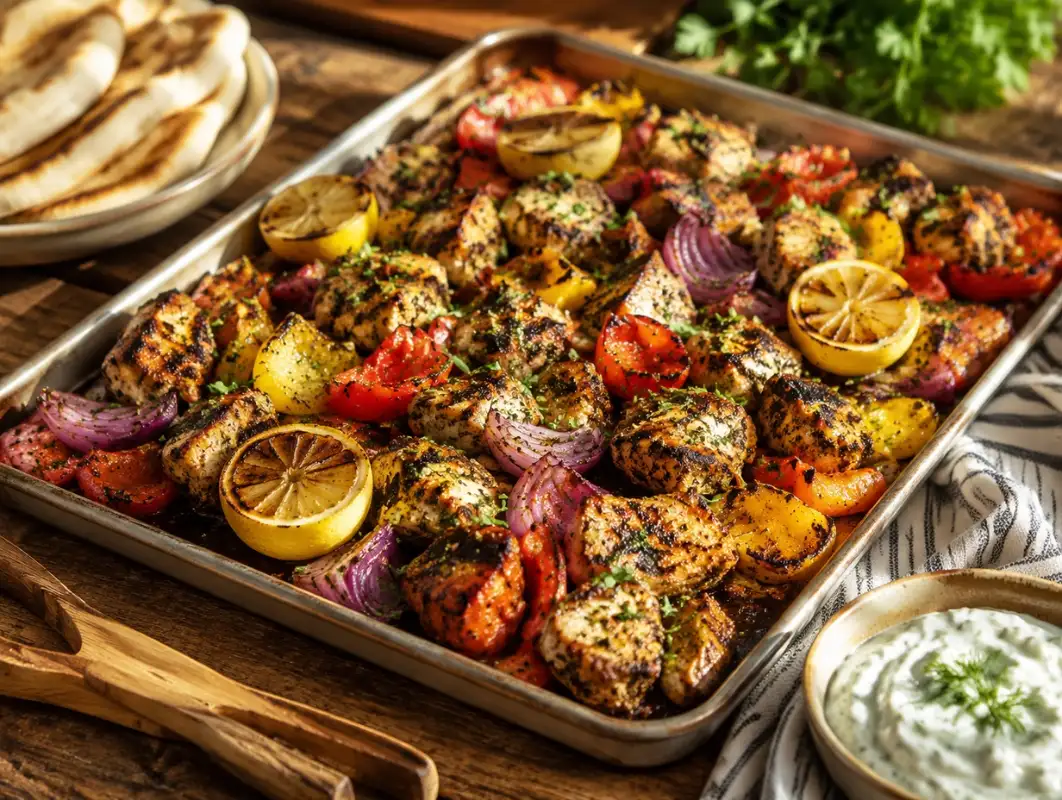
Sheet Pan Chicken Souvlaki with Greek Salad Veggies
Ingredients
Method
- Build the souvlaki marinade. In a large bowl, whisk the Greek yogurt first on its own, then whisk in 2 tablespoons of the olive oil, the juice of both lemons, the minced garlic, 1 1/2 tablespoons oregano, the smoked paprika, cumin, salt and pepper. It should look like a loose, herbaceous paste. Crush the oregano between your palms before adding it to wake up the volatile oils.
- Cut the chicken into 1 1/2-inch (4 cm) cubes and toss in the marinade until every piece is coated. Cover and refrigerate for at least 30 minutes and no more than 2 hours — the lactic acid keeps working, and past 2 hours the texture goes mushy.
- Prepare the Greek salad vegetables while the chicken marinates. Chunk the bell peppers, slice the red onion into thick wedges and halve the cherry tomatoes. Toss them in a separate bowl with the remaining 2 tablespoons olive oil, a generous pinch of salt, 1/2 teaspoon dried oregano and a crack of black pepper.
- Assemble the sheet pan. Pat the chicken pieces dry with paper towels as you lift them from the marinade — a thin film should remain, but excess moisture prevents browning. Arrange the chicken on one half of a parchment-lined sheet pan, spacing the pieces about an inch apart, and spread the vegetables over the other half. Scatter the Kalamata olives over everything and crumble the feta on top.
- Slide the pan into the upper third of a preheated 425°F (220°C) oven and set a timer for 20 minutes. Do not open the door — every opening costs 25–50°F.
- At 20 minutes, rotate the pan 180 degrees. The chicken edges should be turning golden, the vegetables softening, the tomatoes starting to blister. Tent any section that is browning too fast with foil.
- Continue roasting another 10–15 minutes (30–35 minutes total), until the chicken reaches an internal temperature of 165°F (74°C) and its edges are deep amber, the peppers have charred spots and the tomatoes have burst into little puddles of sauce.
- Pull the pan and let everything rest 5 minutes so the juices redistribute through the chicken.
- Make the ladolemono while the pan rests: whisk 2 tablespoons olive oil, 1 tablespoon fresh lemon juice, a pinch of oregano and a crack of salt. Chop the fresh parsley and dill.
- Drizzle the ladolemono over everything on the pan, scatter the fresh herbs and a few extra crumbles of feta, and serve straight from the pan with warm pita — or spooned over Greek lemon rice.
Notes
Frequently Asked Questions
Substitutions and Technique Questions
Can I use chicken breast instead of thighs for sheet pan chicken souvlaki?
Absolutely. Chicken breast works well, but it needs a little extra care. Pound it to an even ¾-inch thickness, and don’t skip the yogurt marinade — that moisture barrier is even more important with lean breast meat. I’ve made this with both cuts at least 50 times, and thighs are more forgiving, but well-prepared breast is just as delicious. Reduce cook time by about 5 minutes.
What can I substitute for Greek yogurt in the souvlaki marinade?
Coconut yogurt is the best dairy-free swap — it has a similar fat content and tanginess. You can also use cashew cream blended with a tablespoon of lemon juice. Sour cream works if dairy isn’t the issue. The key is maintaining that acidic, creamy base that tenderizes and protects the chicken.
Can I grill this instead of using the oven?
Yes! Thread the marinated chicken onto skewers and grill over medium-high for 3–4 minutes per side. Roast the vegetables on a grill basket or in a foil packet. The smoky flavor from a real grill is incredible — it’s actually closer to the traditional preparation. However, the sheet pan version is unbeatable for convenience, which is why this healthy Mediterranean chicken recipe is so popular.
How do I prevent the vegetables from getting soggy?
Three things: cut them large (1-inch chunks), don’t overcrowd the pan, and make sure your oven is fully preheated. Moisture is the enemy of caramelization. If you’re cooking for a crowd, use two sheet pans rather than cramming everything onto one. The vegetables should have breathing room — just like in our gemista recipe, where proper spacing matters.
What are the best souvlaki spices to use?
The foundation is dried oregano — Greek rigani if you can find it. After that: smoked paprika, cumin, garlic powder, onion powder, a touch of cinnamon, salt, and black pepper. Some versions include dried thyme and a pinch of coriander. You can make a big batch of this Greek seasoning for chicken and keep it in a jar for months.
Dietary, Make-Ahead, and Authenticity Questions
Is this recipe halal and gluten-free?
Yes to both. The recipe uses chicken, olive oil, yogurt, vegetables, and herbs — all naturally halal and gluten-free. If serving with pita bread, choose a certified gluten-free pita for celiac needs. No alcohol or pork products are used anywhere in this recipe.
Can I make this ahead for meal prep?
This is one of the best Greek chicken meal prep recipes I know. Prepare the marinade and cut your vegetables the night before. In the morning, assemble and refrigerate. Roast when ready. For weekly prep, cook the full recipe Sunday, store chicken and veggies separately, and reheat portions through the week. The flavors actually deepen overnight.
Is this authentic Greek souvlaki?
Traditional souvlaki is skewered and grilled over charcoal. This sheet pan adaptation uses the same marinade and flavors but with a modern method. If my yiayia wouldn’t recognize it? She’d actually love it — she used to roast chicken on a tapsi exactly like this when she didn’t feel like lighting the grill. The flavors are completely authentic; only the cooking method has been updated.
What vegetables work best for this recipe?
Bell peppers, red onion, cherry tomatoes, and zucchini are the classic Greek salad vegetables that work brilliantly here. You can also try eggplant, artichoke hearts, or asparagus. Harder vegetables like potatoes need to be par-boiled or started 15 minutes early. Our Mediterranean sheet pan salmon uses a similar vegetable approach if you want to explore.
How many calories are in a serving?
One serving (approximately ¼ of the recipe) contains roughly 420 calories, with 38 g protein, 24 g fat, and 14 g carbohydrates. The exact count depends on whether you use breast or thigh meat and how much feta you add. Full nutrition details are in the recipe card below.
Bringing Greece to Your Table
More Than Just a Meal
Every time I make this sheet pan chicken souvlaki with Greek salad veggies, I’m transported back to that stone kitchen in Chania. The smell of oregano in warm olive oil is, for me, the smell of home. When my father passed in 2017, I worried that these recipes — these rituals — would fade. They haven’t. They’ve grown. Now they live in this blog, in your kitchen, and in every comment from someone who tells me this reminded them of a meal they had in Athens or Santorini.
Make this recipe. Make it your own. Add more lemon if you’re like me. Use different vegetables based on the season. But please — use good olive oil, crush the oregano in your hands, and eat it with people you love. That’s how we do it in Greece. I’d love to see your versions — tag me in your photos or leave a comment below telling me how it turned out.
More Greek Recipes to Explore
If you loved this recipe, you’ll enjoy exploring more dishes from our collection. Our Greek chicken gyros uses a similar yogurt marinade with an incredible spice blend. For another easy weeknight option, try the Greek marinated chicken thighs in the air fryer — same bold flavors, even faster. And if you want something lighter, our grilled chicken Mediterranean bowl builds a complete meal around similar Greek ingredients. For a show-stopping appetizer to start the evening, the whipped feta with hot honey is impossibly good.