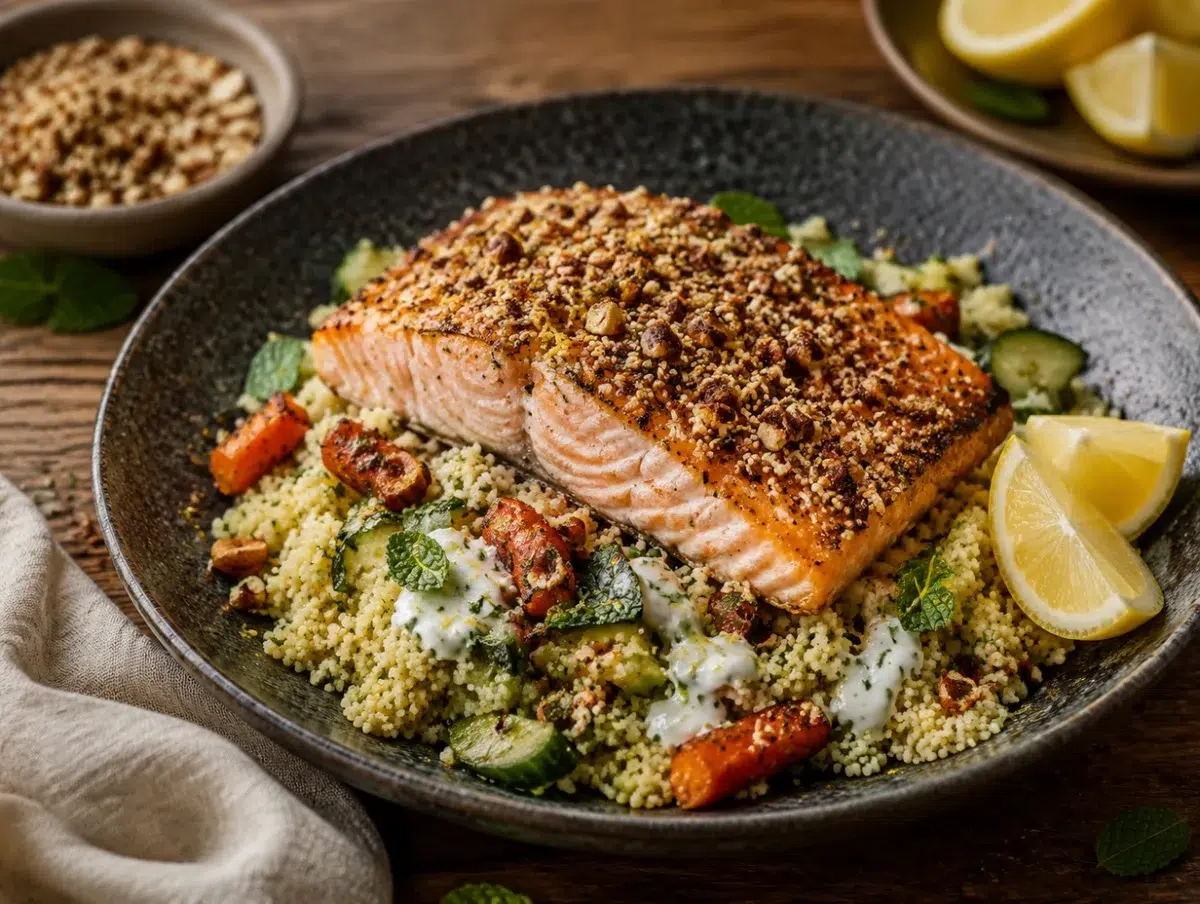
I’ll just say it: the first time I made a dukkah-crusted salmon & herbed couscous bowl, I burned the dukkah so badly that my smoke alarm went off and my neighbor Greg (lovely man, questionable taste in lawn ornaments) knocked on my door to check if I was alive. That was October 2023.
Seventeen batches later — including one truly unhinged attempt where I tried torching the crust with a crème brûlée torch, don’t ask — I’ve nailed a method that gives you a shatteringly crispy, golden dukkah crust on buttery salmon every. single. time. And the herbed couscous underneath? It takes maybe 10 minutes and it’s, like, embarassingly good for how little effort it requires. Here’s everything I learned.
Table of Contents
Dukkah-Crusted Salmon Herbed Couscous Bowl
Ingredients
Method
- 1. Preheat oven to 400°F (200°C). Line a baking sheet with parchment paper.
- 2. Bring vegetable broth to a boil. Pour over couscous in a heatproof bowl, cover tightly, and let sit 10 minutes (or simmer Israeli couscous for 12 minutes). Fluff with a fork.
- 3. Pat salmon fillets very dry with paper towels. Season both sides with salt and pepper.
- 4. In a small bowl, mix Dijon mustard with 1 tsp olive oil. Brush mixture over the top of each fillet.
- 5. Spoon 1½ tablespoons dukkah onto each fillet, pressing gently to adhere.
- 6. Place fillets skin-side down on prepared baking sheet. Bake 12-15 minutes until internal temp reaches 130°F (medium-rare) to 140°F (medium).
- 7. Optional: Broil on low for 60-90 seconds for extra crust crunch. Watch closely to prevent burning.
- 8. While salmon bakes, toss couscous with olive oil, lemon zest, lemon juice, herbs, scallions, and pine nuts. Season to taste.
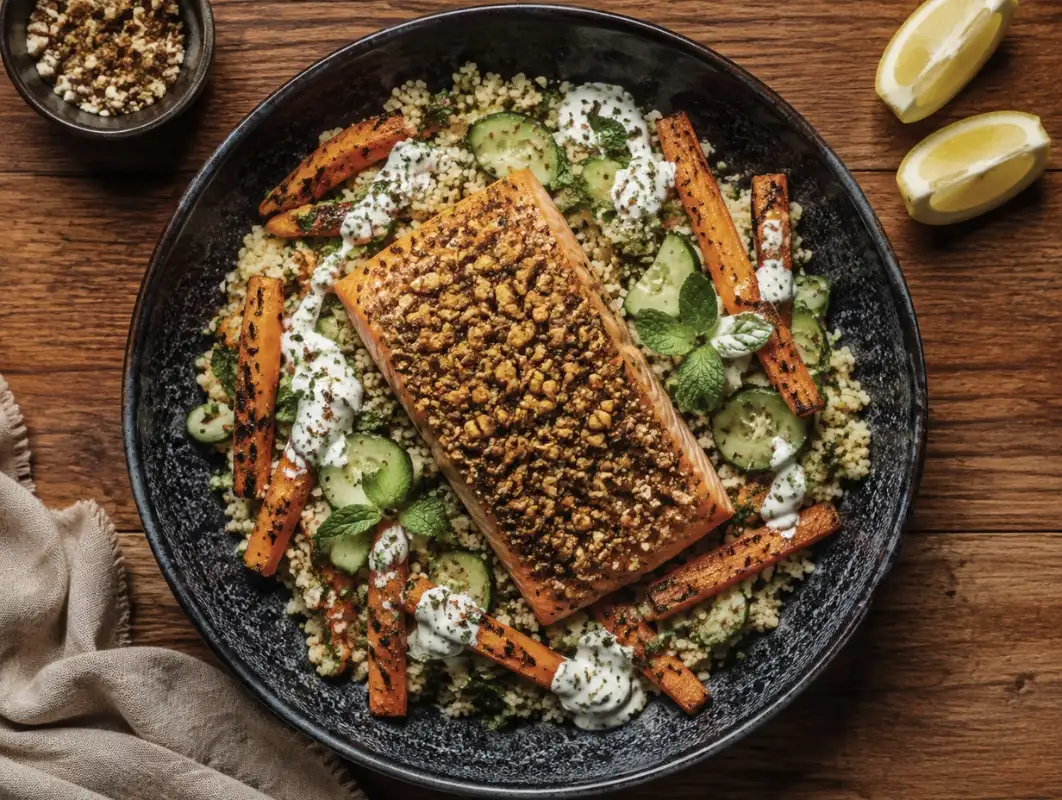
- 9. Divide couscous among bowls. Top with arugula, tomatoes, feta, and pickled onion as desired. Place salmon on top, crust side up. Serve with lemon wedges and yogurt sauce.
Notes
Why This Dukkah Salmon Bowl Actually Works
The Science of the Perfect Crust
Here’s what makes dukkah crusted fish different from other spice crusts: dukkah contains both ground nuts AND whole seeds. The nuts (usually hazelnuts or almonds) are rich in oils that undergo a Maillard-adjacent browning reaction at oven temperatures, creating that deep, toasty flavor. The sesame and coriander seeds, meanwhile, provide textural crunch that stays intact even after cooking. Food science writer Harold McGee notes that nut crusts on fish work so well because the fat in the nuts bastes the protein from the outside as it cooks — it’s basically self-basting salmon. Which is, honestly, the laziest kind of genius.
When This Bowl Becomes Your Go-To
This salmon couscous bowl works for basically every scenario. Tuesday night when you need dinner in 25 minutes? Perfect. Date night when you want to impress without stress? Absolutely. That awkward dinner party where your friend’s partner “doesn’t eat chicken” but never specifies what they do eat? This is your safety net. The Egyptian-inspired flavors feel elevated and interesting without being alienating, and the bowl format means everyone can customize their own toppings. It’s a similar vibe to our Mediterranean sheet pan salmon, but with a crunchier, nuttier edge that I’m honestly a little obsessed with.
Essential Ingredients (Quality Matters Here)
Ingredients
For the Salmon:
4 skin-on salmon fillets (6 oz each), preferably wild-caught
¼ cup homemade dukkah or store-bought
1 tablespoon Dijon mustard
1 teaspoon extra-virgin olive oil (for binding)
Kosher salt and freshly ground black pepper
For the Herbed Couscous:
1 cup couscous (regular or pearl)
1½ cups low-sodium vegetable broth
2 tablespoons extra-virgin olive oil
1 lemon (zest and juice)
¼ cup fresh flat-leaf parsley, chopped
2 tablespoons fresh dill, chopped
2 tablespoons fresh mint, chopped
2 scallions, thinly sliced
2 tablespoons toasted pine nuts
Kosher salt and black pepper to taste
For Serving (Optional):
Crumbled feta cheese
Baby arugula or spinach
Cherry tomatoes, halved
Quick-pickled red onion
Lemon wedges
Lemon-herb yogurt sauce (¼ cup Greek yogurt + 1 tbsp lemon juice + 1 tbsp olive oil + pinch salt)
Your Shopping List Breakdown
Let’s talk about what goes into this Egyptian spiced salmon bowl. First up: the dukkah itself. You can absolutely buy pre-made dukkah — Trader Joe’s sells a solid one, and most grocery stores stock it in the spice or international aisle now. But if you make your own (which I strongly, strongly recommend), you get to control the texture and toast level. A homemade batch uses hazelnuts, sesame seeds, coriander seeds, cumin seeds, and a little black pepper. Some folks add fennel seed; I add a pinch of dried mint, which is a hill I will die on because it just works.
For the salmon, go wild-caught if you can afford it — the flavor difference is real. Skin-on fillets are ideal because the skin protects the bottom from overcooking while the crust gets all golden and gorgeous on top. And the couscous — regular (Moroccan) couscous is fastest, but Israeli (pearl) couscous gives you a chewier, more satisfying texture. I’ve been leaning Israeli lately. Either pairs well with a lemon-herb dressing similar to the bright flavors in our Mediterranean shrimp white bean salad. For an incredible starter while the salmon bakes, our whipped feta garlic confit dip with warm pita is basically mandatory at this point.
Dukkah: Store-Bought vs Homemade Comparison
| Factor | Store-Bought Dukkah | Homemade Dukkah |
| Flavor Depth | Good, can taste stale | Exceptional, freshly toasted |
| Texture Control | Pre-ground, often fine | You control coarseness |
| Customization | Fixed blend | Add dried mint, adjust nuts |
| Cost (per cup) | $6-10 | $3-5 (bulk spices) |
| Shelf Life | 6-12 months | 3 months (freezer: 6 months) |
The Binding Agent Secret (This Changes Everything)
Okay, the game changer for getting dukkah to actually stick to salmon — and I cannot stress this enough — is a thin brush of Dijon mustard mixed with a tiny bit of olive oil. I know. I know! It sounds weird. But hear me out: the mustard’s natural stickiness acts like edible glue, and its mild acidity helps the crust caramelize faster.
Plus, it adds this subtle back-of-the-throat warmth that plays beautifully against the nutty dukkah. Some recipes use mayonnaise or even harissa paste, and those work too, but Dijon is my ride-or-die for this nut-crusted salmon. In the US, any good quality Dijon will work — I use Maille, but honestly Grey Poupon is perfectly fine and I refuse to be snobby about mustard brands. (I’m saving my snobbery for olive oil, which is a whole other conversation.)
The Foolproof Method (Tested 17 Times)
Preparation: Set Yourself Up for Success
Get everything prepped before you start — this whole thing moves fast. Pat your salmon fillets very dry with paper towels. This is critical. Wet salmon = steamed dukkah = sad, soggy crust. I usually pat them dry, leave them on a paper towel for 5 minutes, then pat them dry again. Am I paranoid? Maybe. Does it work? Every time.
While the salmon air-dries, make your couscous. For herbed couscous recipe perfection, bring 1½ cups of vegetable broth (not water — broth adds a layer of savory depth that’s non-negotiable) to a boil, pour it over 1 cup of couscous, cover tightly, and let it sit for 10 minutes. That’s it. While you wait, chop a generous handful of fresh parsley, dill, and mint, plus some scallions. The aromatics here work similar to how we build flavor in our Greek chicken gyros — lots of fresh herbs, added at the end to keep everything bright. Mix your dukkah binding by stirring 1 tablespoon Dijon mustard with 1 teaspoon olive oil.
Main Method: Building the Bowl
Step 1 (0-2 min): Preheat your oven to 400°F (200°C). Line a baking sheet with parchment paper. Season salmon fillets with salt and pepper on both sides, then brush the top (non-skin) side with the Dijon-olive oil mixture. Spoon about 1½ tablespoons of dukkah onto each fillet and press gently — gently! — so it adheres. Don’t smash it; you want a craggy, uneven surface for maximum crunch.
Step 2 (2-15 min): Place fillets skin-side down on the baking sheet and bake for 12-15 minutes, depending on thickness. You’re looking for an internal temperature of 130°F for medium-rare (my preference) or 140°F for medium. The dukkah should be deeply golden and aromatic. If the crust looks pale after 12 minutes, hit the broiler on low for 60-90 seconds — but watch it like a hawk, because this is where batch #1 went wrong for me.
Step 3 (While salmon bakes): Fluff your couscous with a fork, then toss with 2 tablespoons of olive oil, the juice of one lemon, all your chopped herbs, and a handful of toasted pine nuts. Season aggressively — couscous absorbs salt, so it needs more than you think. This is where the Mediterranean salmon dinner comes together: pile couscous into bowls, add a handful of arugula or baby spinach, some quick-pickled red onion if you’re feeling fancy, crumbled feta, and maybe some halved cherry tomatoes. The bowl-building approach here is similar to our grilled chicken Mediterranean bowl — customize with whatever’s in your fridge.
Step 4: Nestle the baked salmon with dukkah on top of each bowl, crust side up (obviously). Squeeze a lemon wedge over everything. Drizzle with a quick lemon-herb yogurt sauce if you want to be extra (combine ¼ cup Greek yogurt + 1 tbsp lemon juice + 1 tbsp olive oil + pinch of salt). Serve immediately, because this bowl doesn’t do well sitting around — the crust starts to soften after about 20 minutes, and that would be a tragedy.
Pro tip: Kenji López-Alt’s reverse-sear logic applies here too — starting low and slow (oven) preserves moisture, and you can finish with a quick broil for extra crunch. The two-step approach gives you the best of both worlds. If you’re already meal-prepping this week, the couscous base stores exactly like the grain components in our chicken shawarma crispy rice salad — prep it Sunday, reheat Monday.
Creative Variations (Because Flexibility Is Everything)
Four Ways to Switch It Up
The beauty of this easy salmon bowl is that the dukkah crust concept works on practically anything. I’ve gone a little wild with variations, and here are the ones that actually, you know, worked. (We don’t talk about the tofu version. That was… a learning experience.)
| Variation | Protein Swap | Couscous Twist | Best For |
| Harissa-Dukkah Bowl | Same salmon, add harissa to Dijon mix | Add roasted red peppers + dried apricots | Spice lovers, date night |
| Chicken Thigh Version | Bone-in chicken thighs, dukkah crust | Swap lemon for preserved lemon + olives | Budget-friendly, family dinner |
| Cauliflower Steak Bowl | Thick cauliflower steaks, dukkah crusted | Add chickpeas + tahini drizzle | Vegan, plant-based nights |
| Cod & Pistachio Dukkah | Thick cod fillets, pistachio-heavy dukkah | Add pomegranate seeds + fresh dill | Lighter option, elegant dinner |
Dietary Modifications & Budget Swaps
Gluten-Free: Swap couscous for quinoa or cauliflower rice — couscous is wheat-based, which catches people off guard sometimes. Quinoa actually works brilliantly here because it has a nutty flavor that echoes the dukkah. Our Mediterranean chickpea power bowl uses a similar grain-bowl approach with naturally gluten-free options.
Nut-Free: Make dukkah without the nuts (just seeds — sesame, coriander, cumin, sunflower seeds). It won’t be traditional dukkah, but it’ll still be delicious and crunchy.
Kid-Friendly: Reduce the cumin by half (kids are weirdly sensitive to cumin, I’ve noticed) and use milder almonds instead of hazelnuts. Serve the couscous plain on one side, dukkah salmon on the other — let them explore. Our Mediterranean chicken meatballs use a similar “let kids customize their plate” strategy that works shockingly well.
Budget: Frozen salmon fillets (thawed overnight) work great here. Use regular couscous, not Israeli. Buy whole spices in bulk and make your own dukkah for pennies.
Storage & Meal Prep Strategies
Storing Leftovers (The Honest Truth)
I’m going to level with you: the crispy dukkah crust will not be crispy the next day. The crust absorbs moisture overnight and becomes more of a flavorful coating than a crunchy shell. Is it still good? Yes, genuinely. Is it the same? No. Store leftover salmon and couscous in separate airtight containers in the fridge for up to 3 days. To reheat salmon, place in a 300°F oven for 8-10 minutes (microwaving makes it rubbery — please don’t do that to this fish). The couscous reheats beautifully with a splash of broth or olive oil.
For meal prep, I’d actually suggest a different approach: prep all the components separately. Make the dukkah blend (stores 3 months in freezer), prep the herbed couscous, chop the vegetables, make the yogurt sauce. Then cook the salmon fresh each evening — it takes 12-15 minutes, which is barely longer than reheating anyway. This component-prep approach is the same strategy that works so well for our Greek sheet pan chicken dinner and our kale and sweet potato salad — flexible, fresh, and zero soggy sadness.
What to Serve Alongside
| Side Dish | Why It Pairs Well | Prep Time |
| Cucumber-tomato salad with sumac | Bright acidity cuts through rich salmon | 5 min |
| Roasted broccolini with lemon | Char complements the toasted dukkah | 15 min |
| Quick-pickled red onions | Tangy crunch, zero effort | 5 min + 30 min sit |
| Warm pita with olive oil | Scoops up every last grain of couscous | 2 min |
| Tzatziki or lemon yogurt sauce | Cool creaminess against warm spices | 5 min |
Nutritional Benefits of Dukkah-Crusted Salmon Bowl
Macronutrient Profile (Per Serving)
| Macronutrient | Amount | % Daily Value |
| Calories | 520 kcal | 26% |
| Total Fat | 24 g | 31% |
| Saturated Fat | 4 g | 20% |
| Carbohydrates | 38 g | 14% |
| Dietary Fiber | 4 g | 14% |
| Protein | 38 g | 76% |
| Sugar | 3 g | — |
Key Micronutrients & Health Benefits
| Micronutrient | Amount (per serving) | Health Benefit |
| Omega-3 Fatty Acids (from salmon) | 2.2 g | Heart health, inflammation reduction |
| Vitamin D (from salmon) | 570 IU (71% DV) | Bone health, immune function |
| Selenium (from salmon + sesame) | 48 mcg (87% DV) | Thyroid function, antioxidant defense |
| Vitamin B12 (from salmon) | 4.8 mcg (200% DV) | Nerve function, red blood cell formation |
| Magnesium (from nuts + seeds) | 62 mg (15% DV) | Muscle function, energy production |
| Iron (from couscous + cumin) | 3.1 mg (17% DV) | Oxygen transport, energy metabolism |
This healthy salmon dinner is a nutritional powerhouse. Wild salmon is one of the best natural sources of omega-3 fatty acids and vitamin D — two nutrients that most Americans are deficient in. The dukkah adds healthy monounsaturated fats from nuts and seeds, plus minerals like magnesium and zinc. The couscous provides complex carbohydrates for sustained energy, and the fresh herbs contribute antioxidants that you won’t find on any nutrition label. I’m not a dietitian (just a person who reads a lot of nutrition research while procrastinating on actual cooking), so consult a professional for specific dietary needs. For another omega-3-rich Mediterranean bowl, check out our Mediterranean shrimp white bean salad.
The glycemic index of this bowl is moderate, thanks to the fiber from the dukkah nuts and the protein from the salmon slowing carbohydrate absorption. If you’re watching glycemic load closely, swap couscous for quinoa or cauliflower rice.
Frequently Asked Questions
What is dukkah and where can I buy it?
Dukkah (sometimes spelled duqqah) is an Egyptian spice and nut blend made from toasted hazelnuts or almonds, sesame seeds, coriander, and cumin. It’s traditionally served with bread and olive oil as a dip. You can find pre-made dukkah at Trader Joe’s, Whole Foods, and most grocery stores in the spice or international aisle. Making your own dukkah spice blend at home gives you better flavor and texture control.
How do I get dukkah to stick to salmon without falling off?
The best trick for dukkah crusted fish is to brush the salmon with a thin layer of Dijon mustard mixed with olive oil before pressing on the dukkah. The mustard acts as a natural adhesive and adds subtle flavor. Pat the salmon completely dry first — any moisture will prevent the crust from sticking. Press the dukkah gently but firmly onto the surface.
Can I pan-sear dukkah-crusted salmon instead of baking it?
Yes! Heat a cast iron or non-stick skillet with oil over medium-high heat. Place the salmon dukkah-side down first and sear for 2-3 minutes until golden. Flip carefully and cook another 3-4 minutes on the skin side. Pan-searing gives an even crunchier crust than baking, but requires more attention to avoid burning the nuts.
What kind of couscous is best for a salmon couscous bowl?
Both regular (Moroccan) couscous and Israeli (pearl) couscous work well. Regular couscous is faster — just pour boiling broth over it and wait 10 minutes. Israeli couscous has a chewier, more satisfying texture and takes about 12 minutes to simmer. For a gluten-free herbed couscous recipe alternative, quinoa is an excellent substitute.
How long do you bake dukkah-crusted salmon?
Bake dukkah salmon at 400°F (200°C) for 12-15 minutes, depending on the thickness of your fillets. A 1-inch thick fillet takes about 12 minutes; thicker portions may need 15. The salmon is done when it reaches an internal temperature of 130°F for medium-rare or 140°F for medium, and it flakes easily with a fork.
Can I make this Mediterranean salmon dinner ahead of time?
You can prep all the components ahead — make the dukkah blend, prepare the herbed couscous, and chop vegetables. Store separately in the fridge for up to 3 days. Cook the salmon fresh when ready to serve for the best crust texture. The couscous reheats well with a splash of broth or olive oil, and the dukkah blend stores in the freezer for up to 3 months.
Pairing & Serving Ideas for Every Mood
Complete Meal Combinations
Building a complete meal around this Middle Eastern salmon is almost too easy. The couscous bowl already handles your starch and protein, so you really just need something fresh and crunchy on the side — or nothing at all, honestly. But if you’re entertaining, our lemon chickpea patties with yogurt sauce make an incredible appetizer course that sets the North African flavor theme beautifully. And if you need bread (you need bread), our garlic Parmesan focaccia torn into pieces and dunked in olive oil with extra dukkah is dangerously addictive.
| Meal Scenario | Bowl Components | Beverage Pairing |
| Quick Weeknight | Salmon + couscous + bagged arugula + lemon squeeze | Sparkling water with cucumber |
| Date Night | Salmon + pearl couscous + pickled onion + feta + pomegranate | Fresh mint lemonade |
| Family Dinner | Salmon + couscous + cherry tomatoes + cucumber slices | Hibiscus iced tea |
| Meal Prep Lunch | Cold couscous salad + reheated salmon + yogurt sauce | Chilled chamomile tea |
Refreshing Non-Alcoholic Beverages
The warm spices in dukkah pair incredibly well with citrus-forward drinks. My absolute favorite is homemade mint lemonade — muddle fresh mint leaves, add lemon juice, honey, and sparkling water. It’s bright and herbaceous and cuts right through the richness of the salmon. Hibiscus iced tea is another stunner (its tartness mirrors the lemony couscous), and for something warm, a light chamomile or lemon verbena tea works beautifully. Our gemista Greek stuffed peppers recipe has similar Mediterranean herb notes that pair with the same beverage lineup if you’re building a full themed dinner.
Make It Your Own (Seriously, Experiment)
Your Kitchen, Your Rules
The whole point of this dukkah-crusted salmon & herbed couscous bowl is that it’s a template, not a set of commandments etched in stone. Use pistachios instead of hazelnuts. Add harissa to the yogurt sauce. Throw in some roasted sweet potato chunks because why not? The core technique — dry salmon, Dijon glue, dukkah press, 400°F oven — that’s the part to master. Everything else is your canvas. Our pesto pasta with grilled chicken takes a similar “master the base, freestyle the toppings” approach that I think makes cooking actually fun instead of stressful.
Tell Me How It Goes
I genuinely want to see your versions. Did you nail the crust on the first try? (If so, I’m both impressed and slightly jealous.) Did you add something unexpected that turned out amazing? Leave a comment, tag us, send a smoke signal — whatever works. And if you’re looking to build more Mediterranean bowl nights into your rotation, our creamy chicken orzo is another weeknight hero that takes about the same amount of time. Happy cooking, and remember — even Greg from next door eventually admitted this smelled incredible. Batch #17 was worth it.