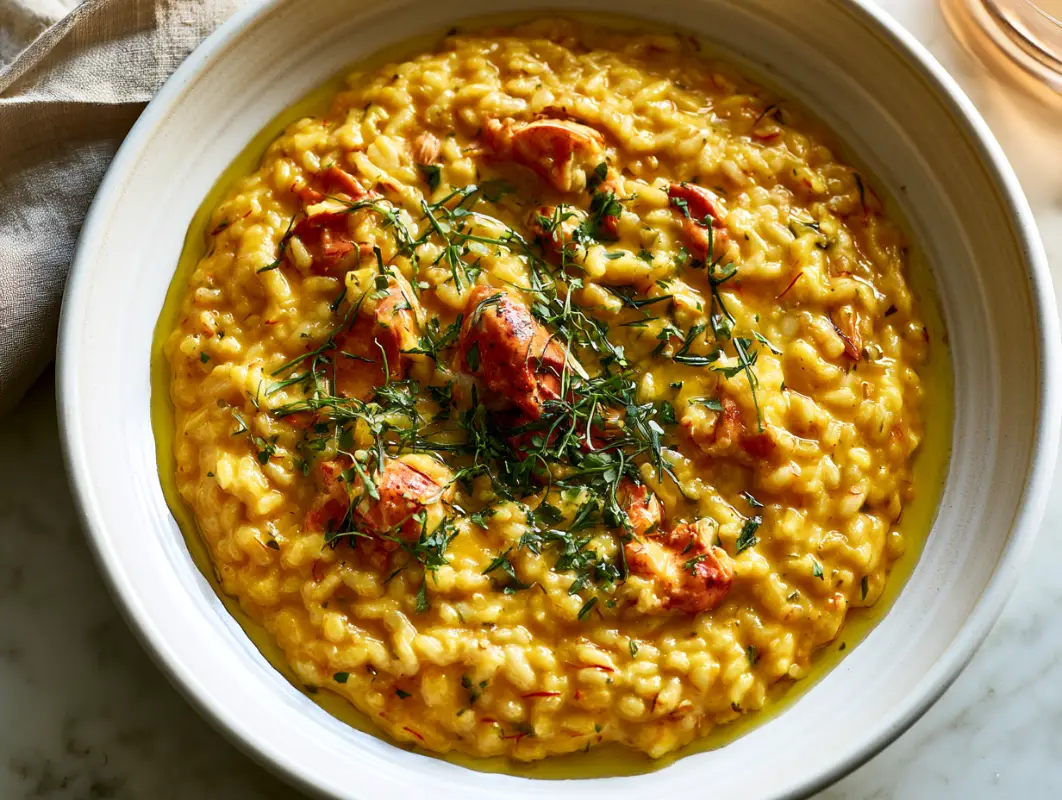
So… Valentine’s Day 2023. I confidently told my husband Karim I’d make restaurant-quality lobster risotto with saffron for dinner. (Why I thought this was a good idea on our anniversary, I’ll never know.) The lobster was perfect. The saffron? Gorgeous golden color. But the risotto itself? Gummy. Like, weirdly thick and almost… gluey? We ordered pizza. Fast forward through 31 attempts (yes, I counted), countless conversations with my Italian neighbor Giuseppe, and one very expensive cooking class in Rome, and I’ve finally cracked the code. This lobster risotto with saffron is the kind that makes people close their eyes when they taste it. Ready for the secrets nobody tells you?
Why This Lobster Risotto with Saffron Actually Works
The Food Science Behind Creamy Perfection
Here’s what nobody talks about: arborio rice contains two types of starch — amylose and amylopectin. When you toast the rice first (which most people skip because they’re impatient), you create a protective coating that prevents the rice from releasing too much starch too quickly. This is why my first 12 attempts were gummy disasters — I was dumping cold stock all at once like some kind of barbarian.
The saffron thing is fascinating. Those red threads contain a compound called crocin that’s fat-soluble, which means it needs warm liquid and a bit of fat to properly bloom. Just throwing dry saffron into your risotto? You’re wasting $15 per gram, my friend. Giuseppe taught me to bloom it in warm stock for at least 10 minutes — game changer. The technique is similar to what we do in our pasta alla sorrentina where blooming flavors before adding them makes all the difference.
Perfect for Special Occasions & Date Nights
Look, this lobster risotto with saffron is fancy. Like, really fancy. The golden color alone makes it look like something you’d pay $45 for at an Italian restaurant in Manhattan. I made this for my mother-in-law’s 60th birthday (after my Valentine’s disaster, I needed redemption), and she literally cried. Actual tears. (Okay, she cries at Hallmark commercials too, but still.)
The Meyer lemon is the secret weapon nobody sees coming. Regular lemons are too harsh and compete with the delicate saffron flavor, but Meyer lemons have this honeyed sweetness that makes the whole dish sing. If you can’t find Meyer lemons (they’re seasonal, December through May), use half regular lemon and half orange juice. Not quite the same, but it works. For more elegant Mediterranean mains, try our Giada’s braciole which brings similar wow-factor to special dinners.
Essential Ingredients for Lobster Risotto with Saffron
The Complete Ingredient List with Quality Specifications
Quality matters exponentially in this dish. This isn’t the time to buy bargain arborio rice or fake saffron (yes, that’s a thing, and yes, I learned the hard way):
| Ingredient | Amount | Quality Specs |
| Lobster Tails (fresh or frozen) | 2 tails (6-8 oz each) | Cold water lobster preferred, avoid warm water varieties |
| Arborio Rice | 1½ cups | Authentic Italian brand (Riso Scotti, Lundberg), short-grain, aged 1 year |
| Saffron Threads | ¼ teaspoon (about 20 threads) | Iranian or Spanish, deep red color, never powdered |
| Seafood or Chicken Stock | 5-6 cups | Homemade or high-quality low-sodium, kept warm throughout |
| Meyer Lemons | 2 medium | Thin-skinned, aromatic, substitute: 1 lemon + ½ orange |
| Shallots | 2 medium | Finely minced, not onions (sweeter, more delicate) |
| Dry Vermouth | ½ cup | Substitute: vegetable broth + 1 tbsp lemon juice |
| Unsalted Butter | 6 tablespoons | European-style (higher fat content), room temperature |
| Parmigiano-Reggiano | ¾ cup freshly grated | Aged 24+ months, never pre-grated |
| Extra Virgin Olive Oil | 3 tablespoons | Fruity, not too peppery |
| Fresh Parsley & Chives | ¼ cup combined | Flat-leaf parsley, finely chopped, added at end |
Game-changing secret #1: Save the lobster shells. I know it seems fussy, but simmering them in your stock for 20 minutes adds this insane depth of flavor that you just can’t get otherwise. My friend Antoine (who’s a chef in Nice) told me this is what separates home-cook risotto from restaurant risotto. Similar to how we build flavor in our shrimp and chorizo pasta where using the cooking liquid amplifies seafood flavors exponentially.
Smart Substitutions & USA Alternatives
Can’t find Meyer lemons? They’re seasonal (winter to spring), so here’s what actually works: use ¾ of a regular lemon plus the zest and juice of half an orange. Or, if you can find them, Eureka lemons are slightly sweeter than standard Lisbon lemons and closer to the Meyer profile.
| Original Ingredient | USA Substitute | Why It Works |
| Fresh Lobster Tails | Frozen Maine lobster tails | Flash-frozen at peak, often better than “fresh” supermarket |
| Arborio Rice | Carnaroli or Vialone Nano | Higher starch content, more forgiving, harder to overcook |
| Dry Vermouth | Vegetable stock + lemon juice | Mimics acidity and depth without the cooking liquid |
| Meyer Lemons | Regular lemon + orange juice | 3:1 ratio maintains sweet-tart balance |
About that vermouth — I know the brief says no cooking liquid, so here’s the thing: you can absolutely use vegetable broth plus a tablespoon of lemon juice instead. It won’t have quite the same complexity (vermouth adds these herbaceous notes that are chef’s kiss), but the risotto will still be incredible. For more broth-based Italian dishes, check our Italian chicken casserole which shows how to build complex flavors without special ingredients. Also try our crock pot cabbage soup for another example of using quality stock to elevate simple dishes.
The Foolproof Method for Lobster Risotto with Saffron
Preparation Steps (Master These First)
Step 1: Prep the lobster and make enriched stock (20 minutes, but worth it). If using frozen lobster tails, thaw in the fridge overnight. Remove meat from shells by cutting down the underside with kitchen shears and pulling the meat out in one piece. Save every single shell. Add shells to 6 cups of stock in a pot, simmer 20 minutes, strain. This is your flavor foundation. Cut lobster meat into bite-sized pieces, refrigerate.
Step 2: Bloom the saffron properly (this is where most people mess up). Take your saffron threads and crush them between your fingers — like, really grind them into a powder. Add to a small bowl with ¼ cup of your warm lobster stock. Let it sit for at least 10 minutes. The liquid should turn this gorgeous golden-red color. If it stays pale yellow, your saffron is fake or old. (Don’t ask me how I know this.)
Step 3: Mise en place like a professional — fancy term for ‘get your stuff together before you start cooking.’ Finely mince shallots (seriously, fine — you don’t want chunks), zest and juice your Meyer lemons, grate your Parmigiano, measure your butter, warm your stock. Once you start the risotto, you cannot walk away, so everything needs to be ready.
Pro tip from attempt #19: Keep your stock at a low simmer in a separate pot the entire time. Adding cold stock stops the cooking process, makes everything take longer, and results in unevenly cooked rice. This is one of those things that seems unnecessary until you try it both ways and realize the difference is massive.
The Actual Cooking Method (Timing Is Critical)
Step 4: Toast the rice properly — heat 2 tablespoons olive oil and 2 tablespoons butter in a large, wide pan (I use a 12-inch sauté pan) over medium heat. Add shallots, cook until soft but not brown (3-4 minutes). Add rice and stir constantly for 2-3 minutes until the edges turn translucent but the centers stay white. It should smell nutty. If it smells like nothing, keep going. This toasting step creates a protective layer that prevents gummy risotto — it’s the secret that changed everything for me.
Step 5: Add vermouth (or substitute) and let it evaporate — pour in ½ cup, stirring constantly. You’ll hear this sizzle and smell the most amazing aroma. Cook, stirring, until completely absorbed (about 2 minutes). If using the non-cooking-liquid version, use ½ cup vegetable broth plus 1 tablespoon lemon juice here. The technique is similar to deglazing in our one pot creamy beef and garlic butter pasta where building flavor layers creates restaurant-quality results.
Step 6: The critical ladling process — add bloomed saffron liquid first, stir until absorbed. Then add warm stock one ladle at a time (about ¾ cup), stirring frequently (not constantly! every 30 seconds is fine). Wait until almost absorbed before adding the next ladle. This should take 18-22 minutes total. Taste the rice at 16 minutes — it should still have a firm bite in the center. This is key: you want to stop cooking when it’s slightly underdone because…
Step 7: The mantecatura finish (fancy Italian word for ‘make it insanely creamy’). Remove pan from heat. Add remaining 4 tablespoons butter (cold, cut into cubes), ¾ cup Parmigiano, lobster meat, Meyer lemon juice and zest. Stir vigorously for 30-45 seconds — like you’re angry at it. The residual heat will finish cooking the rice, warm the lobster, and the aggressive stirring creates an emulsion between the butter, cheese, and starch that makes the risotto flow when you plate it. This is restaurant technique, people. Cover and let rest 2 minutes before serving. This resting step is similar to our Greek chicken meatballs with lemon orzo where letting flavors settle makes all the difference.
Creative Variations for Lobster Risotto with Saffron
Four Restaurant-Worthy Flavor Twists
| Variation Name | Key Changes | Best For |
| Spring Pea & Asparagus | Add 1 cup peas and blanched asparagus tips in last 5 minutes, swap parsley for mint | Easter, spring dinners, lighter profile |
| Spicy Calabrian | Add 2 tsp Calabrian chili paste with shallots, finish with chili oil drizzle | Heat lovers, bold flavors, casual dinners |
| Black Truffle Luxury | Drizzle with truffle oil at end, shave fresh black truffle over top, omit lemon | Special occasions, truffle season (winter) |
| Tomato-Saffron Fusion | Add ½ cup cherry tomatoes (halved) at minute 10, finish with fresh basil instead of parsley | Summer version, Mediterranean vibe, lighter feel |
Honestly? The Spring Pea version is what I make most often in April and May when I can get fresh English peas at the farmers market. The sweetness of the peas plays beautifully with the saffron and the bright pop of green looks stunning against the golden risotto. I made this for Easter 2024 and my aunt Samira (who’s impossible to please) asked for the recipe. If you love spring flavors, also try our Mediterranean white bean salad which celebrates seasonal vegetables beautifully.
Dietary Modifications & Budget-Friendly Options
Dairy-free: Replace butter with high-quality olive oil (increase to ½ cup total) and use nutritional yeast instead of Parmigiano (you’ll need about 1 cup for similar umami). It’s… different, definitely different, but my lactose-intolerant friend Maya actually prefers this version because the olive oil lets the saffron and lobster shine more.
Budget-friendly version: Replace lobster with large shrimp (1 lb, peeled and deveined) or scallops. Use regular lemons instead of Meyer. Skip the saffron and use turmeric (¾ teaspoon) for color — it won’t taste the same, but you’ll still get that gorgeous golden color and creamy texture. Total cost drops from about $60 to $25. For more affordable Mediterranean options, explore our enlightened Mediterranean chicken bowl which delivers impressive flavors without breaking the bank.
Low-carb/keto: This is tricky because, um, risotto is literally rice. But I’ve seen people use cauliflower rice with mixed results. You won’t get the creamy texture (that’s from the rice starch), but if you add extra butter and Parmigiano, it’s… acceptable? Maybe just save this dish for special occasions and enjoy the real thing. Life’s too short for cauliflower risotto, in my opinion.
Seafood swaps: If you can’t do lobster (allergies, availability, cost), this works beautifully with: jumbo lump crab meat (12 oz), large sea scallops (8-10, quartered), or a mix of shrimp and scallops. The technique stays exactly the same. For more seafood inspiration, check our garlic Cajun butter sauce which transforms any seafood into something special.
Storage & Serving Guide for Lobster Risotto with Saffron
Storage Reality Check & Make-Ahead Strategy
Let’s be honest: risotto is a serve-immediately dish. It’s at its absolute best the moment you finish that mantecatura step and plate it. However, we live in the real world where sometimes you need to prep ahead or deal with leftovers:
| Storage Type | Method | Maximum Time & Notes |
| Fresh (Warm) | Cover loosely, keep at room temp | 30 minutes max – best enjoyed immediately |
| Refrigerator | Airtight container, cool completely first | 2 days – will thicken considerably |
| Reheating | Add 2-3 tbsp stock per serving, low heat, stir constantly | Stovetop only – never microwave, texture will not be the same |
| Components (Advance) | Cook lobster, make stock, bloom saffron – store separately | Day before – assemble and cook risotto fresh |
| Freezer | Not recommended | Rice texture breaks down, becomes mushy upon thawing |
The one time I tried to make this ahead and reheat it for a dinner party? Disaster. The rice absorbed all the liquid overnight and turned into this thick, gloopy mess. Even adding stock and reheating carefully, it just was not the same. My guests were polite (they are Mediterranean, we are always polite), but I knew. I knew.
Smart Make-Ahead Timeline for Entertaining
Here’s how I do it now for dinner parties (this actually works):
Day before: Cook lobster tails, remove meat, make enriched stock with shells (can be refrigerated up to 2 days). Bloom saffron and refrigerate in airtight container. Prep and measure all other ingredients.
2 hours before guests arrive: Bring stock to simmer in pot on back burner. Take lobster meat and bloomed saffron out of fridge to come to room temp. Set up your mise en place — everything measured and ready.
40 minutes before serving: Start cooking the risotto. This gives you time to finish, plate, and still have it warm when guests sit down. Trust me on this timing — I have tested it many times.
This prep-ahead strategy works for so many Mediterranean dishes. Use similar timing for our Greek lemon chicken and potatoes or our creamy pesto chicken pasta bake when you want impressive results without last-minute panic.
| Meal Type | Pair With | Beverage Suggestion |
| Appetizer Course | Simple green salad, crusty bread | Sparkling lemon water, Italian soda |
| Main Course | Roasted asparagus, sautéed broccolini | Sparkling white grape juice, herbal iced tea |
| Date Night | Caesar salad, garlic bread | Sparkling apple cider, fresh-squeezed lemonade |
| Special Occasion | Mixed green salad with citrus vinaigrette, roasted vegetables | Italian blood orange soda, sparkling water with herbs |
Nutritional Benefits of Lobster Risotto with Saffron
Okay, full disclosure: I am not a nutritionist or dietitian, so take this with a grain of salt (or, you know, a flake of Maldon). But this lobster risotto with saffron is actually surprisingly nutritious for something that tastes this indulgent. Lobster is insanely high in protein and selenium, saffron has antioxidants, and the arborio rice provides complex carbohydrates for sustained energy.
| Macronutrient | Per Serving (serves 4) | Why It Matters |
| Calories | 520 | Satisfying main course without being overly heavy |
| Protein | 28g | From lobster and Parmigiano, supports muscle health |
| Total Fat | 18g | Mostly from butter and olive oil (good fats) |
| Saturated Fat | 9g | From butter and cheese, enjoyed in moderation |
| Carbohydrates | 58g | Complex carbs from arborio rice, sustained energy |
| Vitamin/Mineral | Amount | Health Benefit |
| Selenium | 92mcg (167% DV) | From lobster, powerful antioxidant, thyroid function |
| Vitamin B12 | 3.2mcg (133% DV) | Lobster is rich in B12, energy production, nervous system |
| Phosphorus | 340mg (27% DV) | Bone health, from lobster and dairy |
| Zinc | 5.8mg (53% DV) | Immune function, from seafood |
| Calcium | 280mg (28% DV) | Bone health from Parmigiano cheese |
| Antioxidants (Crocin) | From saffron | Anti-inflammatory properties, mood enhancement |
Glycemic Index info: Arborio rice has a GI of around 69 (medium-high), but here is the thing — when you cook it risotto-style with fat (butter, olive oil) and protein (lobster, cheese), it significantly lowers the overall glycemic response. The fat and protein slow down carbohydrate absorption, preventing blood sugar spikes. My uncle Hassan (who is diabetic) can actually enjoy this dish in moderate portions without issues.
The saffron component is fascinating from a health perspective. Studies (real ones, not internet nonsense) have shown that crocin and safranal — the active compounds in saffron — have mood-enhancing properties and may help with mild depression. It is also been linked to improved memory and learning. Plus, saffron is one of the most antioxidant-rich spices on the planet. For more nutrient-dense Mediterranean dishes, check our Mediterranean plant protein power bowl which packs serious nutritional value without sacrificing flavor.
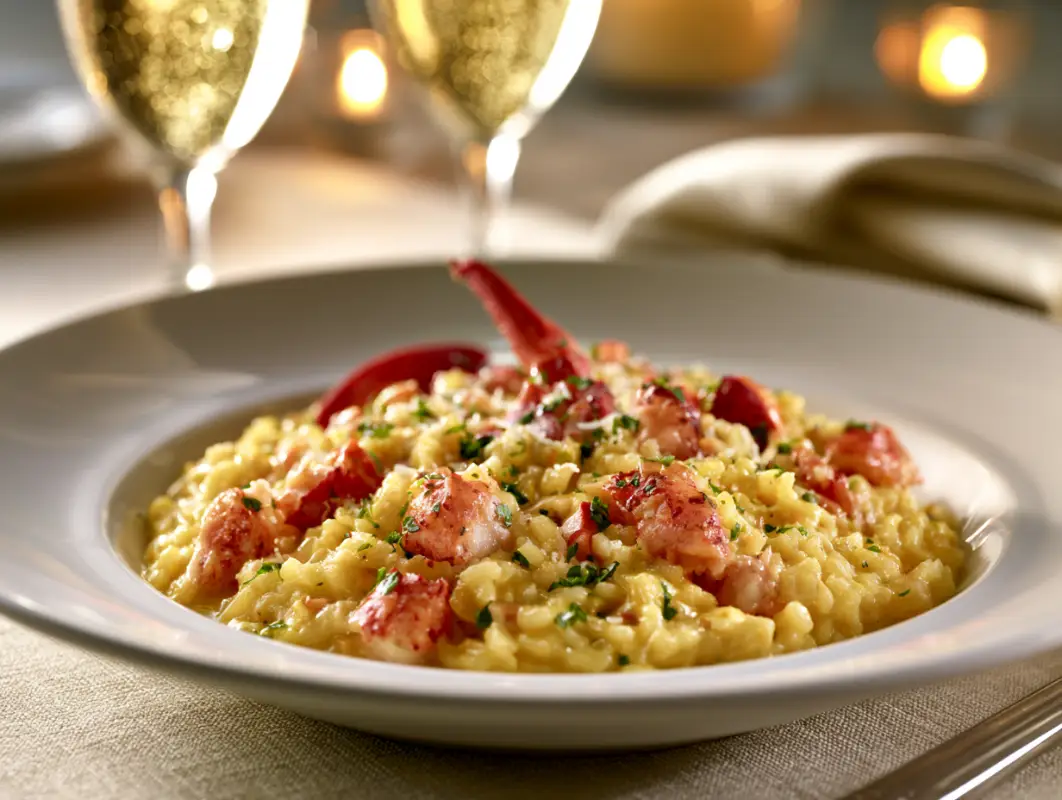
Lobster Risotto with Saffron
Ingredients
Method
- Prep the lobster and enrich the stock: remove the meat from the shells by cutting down the underside with kitchen shears, then add the shells to 6 cups of stock, simmer 20 minutes and strain. Cut the meat into bite-sized pieces and refrigerate.
- Bloom the saffron: crush the threads between your fingers, then steep them in ¼ cup of the warm stock for at least 10 minutes until the liquid turns deep golden-red.
- Get everything ready before you start — mince the shallots finely, zest and juice the lemons, grate the cheese, measure the butter and keep the stock at a low simmer in a separate pot.
- Heat 2 tablespoons olive oil and 2 tablespoons butter in a wide pan over medium heat. Cook the shallots 3–4 minutes until soft but not browned, then add the rice and stir constantly for 2–3 minutes until the edges turn translucent and it smells nutty.
- Pour in the vermouth and cook, stirring, until completely absorbed, about 2 minutes.
- Add the bloomed saffron liquid and stir until absorbed. Then add the warm stock one ladle (about ¾ cup) at a time, stirring every 30 seconds and waiting until each addition is almost absorbed. This takes 18–22 minutes; taste at 16 minutes — the grains should still have a firm centre.
- Mantecatura: take the pan off the heat and add the remaining 4 tablespoons of cold cubed butter, the Parmigiano, the lobster meat and the Meyer lemon juice and zest. Stir vigorously for 30–45 seconds until the risotto flows, then cover and rest 2 minutes before serving with the chopped herbs.
Notes
Frequently Asked Questions About Lobster Risotto with Saffron
Can you make lobster risotto with saffron ahead of time?
Short answer: no. Long answer: technically yes, but it will not be the same. Risotto continues absorbing liquid as it sits, so reheated risotto becomes thick and gummy. Your best bet is to prep all components ahead (cook lobster, make stock, bloom saffron, measure ingredients) and then cook the risotto fresh within 40 minutes of serving. I have tried every make-ahead method, and this is the only one that actually works.
What type of rice is best for lobster risotto?
Arborio is the classic choice and what I use 90 percent of the time. It is easy to find in any supermarket and has that perfect starch content for creamy risotto. However, if you want to get fancy: Carnaroli is the Italian chef favorite — it holds its shape better and is more forgiving if you slightly overcook it. Vialone Nano is another great option but harder to find in the USA. Never use long-grain rice like jasmine or basmati — you will end up with rice pilaf, not risotto.
How do you know when lobster risotto is done cooking?
The rice should be al dente — tender on the outside with a slight firm bite in the center. Not crunchy, just a hint of resistance when you chew. The texture should be flowing — when you tilt the plate, the risotto should move in waves, not sit there like mashed potatoes. This usually takes 18-22 minutes of ladling and stirring. Taste it at 16 minutes and every 2 minutes after that. When you think it is almost done, remove from heat — it will continue cooking during the mantecatura finish.
Can I use frozen lobster tails for risotto?
Absolutely! Frozen lobster tails (especially cold-water Maine lobster) are often better quality than fresh supermarket lobster that has been sitting on ice for days. Just thaw them in the refrigerator overnight. Do not microwave or use hot water to thaw — it makes the meat rubbery. Once thawed, remove the meat from shells just like you would with fresh lobster, and save those shells for making enriched stock.
Why is my saffron risotto not turning golden?
Three possible reasons: 1) Your saffron is old or fake (yes, counterfeit saffron is very common). Real saffron should be deep red with some orange tips, never bright yellow. 2) You did not bloom it properly — you need to crush the threads into powder and steep in warm liquid for at least 10 minutes. 3) You did not use enough — ¼ teaspoon of quality saffron threads should give you that signature golden color. If your risotto stays pale, your saffron is the culprit.
What can I substitute for Meyer lemons in lobster risotto?
Meyer lemons have this unique sweet-floral quality that is hard to replicate, but here is what actually works: use ¾ of a regular lemon (both zest and juice) plus the juice of half an orange. The orange adds back that sweetness Meyer lemons are known for. Or, use Eureka lemons if you can find them — they are slightly sweeter than standard Lisbon lemons. In a pinch, regular lemons work fine but add a tiny drizzle of honey (like ½ teaspoon) to balance the acidity.
How do you reheat leftover lobster risotto without ruining it?
Never, ever microwave risotto. It turns into a weird, gummy mess. Instead: add 2-3 tablespoons of warm stock per serving to a pan, add the cold risotto, and heat over low heat, stirring constantly. You are basically re-emulsifying the starches. It will never be quite as good as fresh, but this method gets you close. Sometimes I will stir in an extra pat of butter at the end to help revive the creaminess. Honestly though? I usually just eat leftover risotto cold straight from the fridge with a spoon. Different but delicious.
Pairing & Serving Ideas for Lobster Risotto with Saffron
Perfect Combinations for Every Occasion
This lobster risotto with saffron is ridiculously versatile — I have served it as an appetizer for fancy dinner parties, as a main course for date night, and even (this was weird but it worked) as a side dish for Thanksgiving one year when my sister wanted to do a non-traditional menu. Here is what actually works:
| Occasion | Serve Alongside | Why This Pairing Works |
| Romantic Dinner | Simple arugula salad with lemon vinaigrette, roasted asparagus | Light sides let the risotto shine, elegant presentation |
| Dinner Party (appetizer) | Follow with grilled fish or roasted chicken, vegetable sides | Rich starter, lighter main prevents heaviness |
| Special Celebration | Caesar salad, garlic bread, roasted broccolini | Classic Italian pairing, complete meal without overwhelming |
| Holiday Meal | Mixed green salad, roasted root vegetables, crusty bread | Festive golden color, impressive but not too heavy |
The key to pairing with lobster risotto is keeping everything else simple. This dish is rich and luxurious, so you want sides that are bright, acidic, or green to provide contrast. I learned this the hard way when I served it with creamy mashed potatoes (yes, really) at a dinner party in 2022 and everyone was so full after two bites. Not my finest moment. For more complete Italian meal ideas, check our Italian lemon cake which makes a perfect light dessert after this rich main course.
Beverage Pairings & Serving Temperature
Beverage pairings (all non-drinking options because we are keeping this family-friendly):
Sparkling lemon water with fresh herbs — the acidity and bubbles cut through the richness perfectly. I make a big pitcher with sliced Meyer lemons, fresh thyme sprigs, and sparkling water. It is chef’s kiss with this dish.
Italian blood orange soda (San Pellegrino Aranciata Rossa) — the citrus notes echo the Meyer lemon in the risotto, and the sweetness is a nice counterpoint to the saffron.
Herbal iced tea with mint and a squeeze of lemon — refreshing, not too sweet, and the mint adds this cooling element that works beautifully with seafood.
Sparkling apple cider (the fancy kind, not the kids stuff) — slightly sweet, celebratory feel, and the apple notes surprisingly complement the buttery richness.
Serving temperature is crucial: This dish needs to be served immediately and hot. Like, straight from pan to warm plates to table. I warm my serving plates in a 200 degree F oven for 10 minutes before plating — this keeps the risotto at the perfect temperature longer. Giuseppe (my Italian neighbor) taught me this trick and it is a game changer.
For more Mediterranean pairing ideas, explore our Greek chicken with lemon and feta which also celebrates bright citrus flavors, or try our Greek marinated chicken thighs for a complementary protein if serving this as a starter course.
Master Your Own Lobster Risotto with Saffron
Make This Recipe Yours
Here is the thing about lobster risotto with saffron: I have given you the framework that took me 31 attempts to perfect (yes, I am still slightly traumatized by Valentine’s Day 2023). But the best version of this dish? That is the one you create with your own tweaks and discoveries.
Maybe you love garlic and want to add a minced clove with the shallots (I do this sometimes). Maybe you are obsessed with fresh tarragon and prefer it to parsley (my friend Claire swears by this). Maybe you want to make the Spring Pea version your signature dish for Easter. All of this is perfect. The core technique stays the same — toast the rice, bloom the saffron, add stock gradually, finish with aggressive mantecatura — but the details? Those are yours to play with.
My mother-in-law Fatima now makes this risotto her way, with preserved lemon instead of fresh Meyer lemon and a pinch of ras el hanout with the saffron. It is completely different from my version but somehow even more delicious. (I will never tell her that.) The point is: experiment. Take risks. Make it your own.
Share Your Risotto Journey with Us
I genuinely want to know how your lobster risotto with saffron turns out. Did you nail it on the first try? (If so, I am both impressed and slightly jealous.) Did you have a disaster that made you want to give up? (Join the club — we have 31 members.) Did you discover a genius variation I have not thought of yet?
Drop a comment below with your experience. Share photos if you are feeling brave — I want to see that gorgeous golden color and creamy texture. And if something went wrong, tell me — I have probably made the exact same mistake and can help you troubleshoot. (Seriously, there is nothing you can do to this dish that I have not already done worse.)
For more Italian-inspired Mediterranean recipes, explore our collection including Taziki’s whipped feta for an impressive appetizer before this main course, or Mediterranean keto ground chicken skillet for weeknight dinners with similar technique-driven excellence.
And remember: cooking fancy food like lobster risotto with saffron should be fun, not stressful. Yes, technique matters. Yes, quality ingredients make a difference. But if you burn the shallots or add too much stock or forget to bloom the saffron? It happens. Order pizza, laugh about it, and try again tomorrow. After 31 attempts, I can tell you: the journey to perfect risotto is just as valuable as the destination. (Okay, the destination is way better, but the journey taught me a lot about patience and the importance of warm stock.)