 Written by Ines Zahraoui — Tunisian home cook and co-founder of The Mediterranean Recipe, developing and testing recipes in her own kitchen since 2020. More about Ines →
You do not decorate these. That is the whole thing, and it took me three failed batches to believe it.
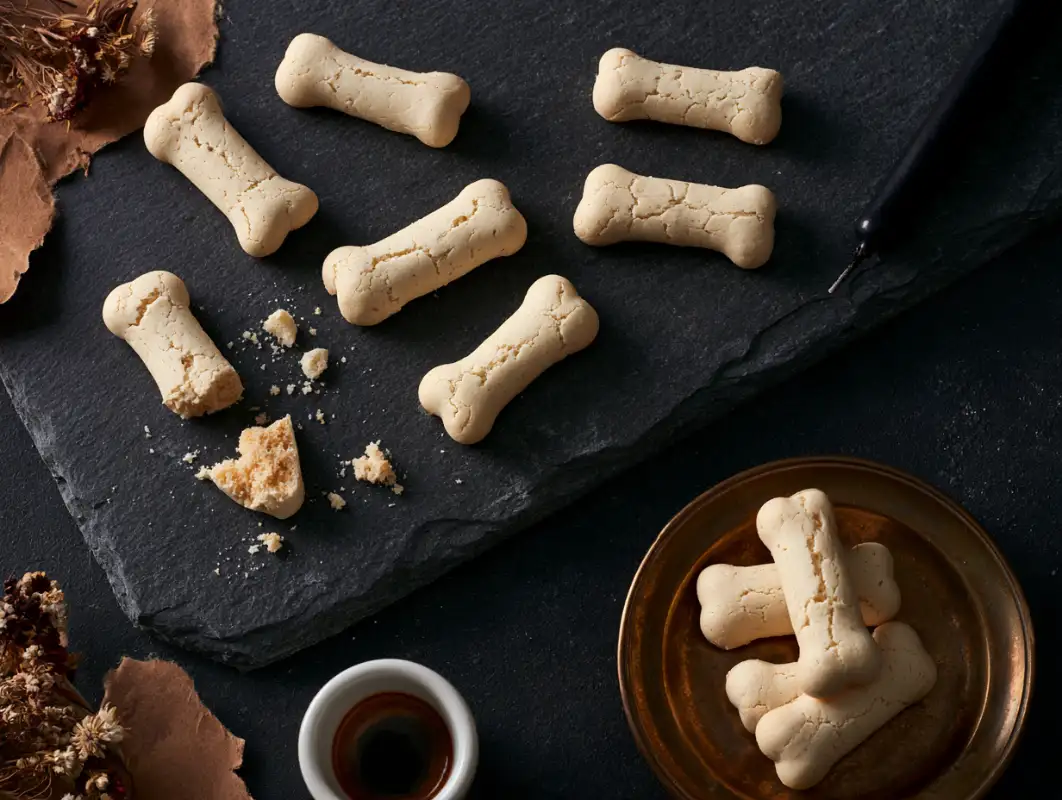
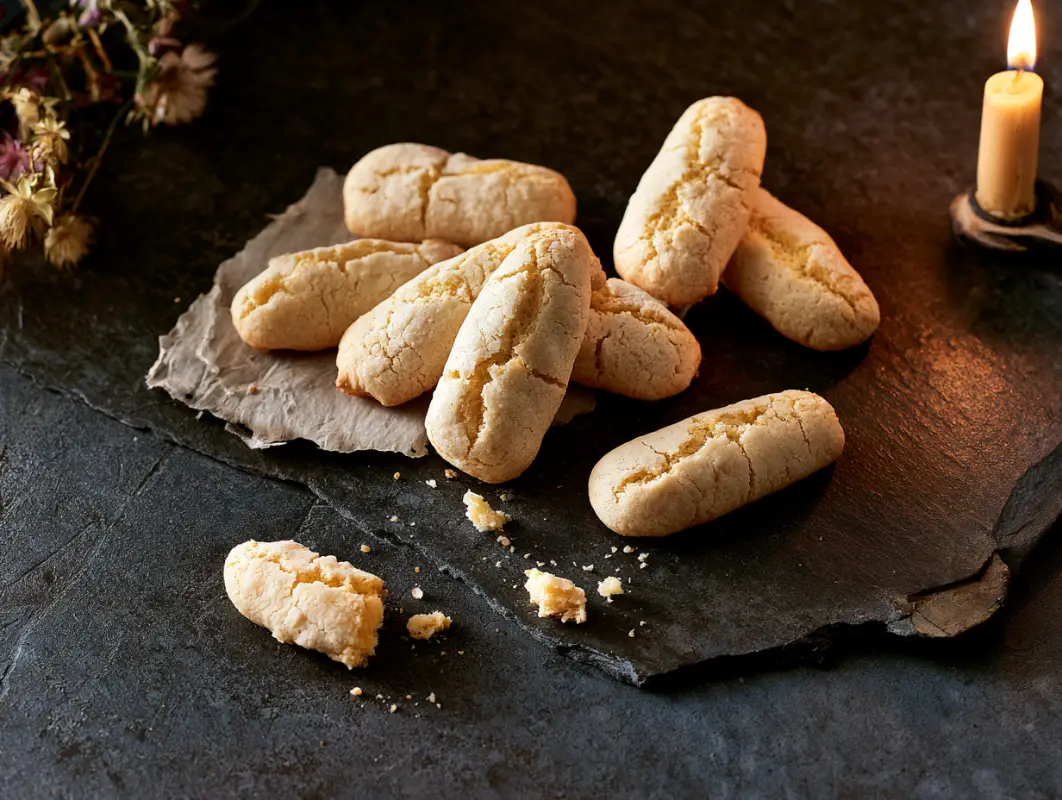
Ossi dei morti — bones of the dead — are a traditional Italian cookie baked for Ognissanti on 1 November and Il Giorno dei Morti on 2 November. They are four ingredients. You shape them into rough little logs, and then you leave them out overnight and go to bed. In the oven the next day the dried surface splits and craters and goes bone-white while the inside puffs slightly underneath, and what comes out looks unmistakably, uncomfortably skeletal. No fondant. No piping. No black gel in a tube.
They snap. That is the other thing nobody mentions. Bite one and it goes with a dry, brittle crack, then softens into something chewy in the middle — the texture is doing half the work of the effect.
I make these every year now, and I make them in the third week of October, because they keep for a fortnight in a tin and because the tradition they belong to happens the day after everyone else’s Halloween content stops working.
Table of Contents
Ossi dei Morti Recipe Card
Ossi dei Morti (Italian Bones of the Dead Cookies)
Ingredients
Method
- If using whole almonds, pulse them with 1/4 cup of the sugar in a food processor until they are the texture of coarse sand with some larger fragments left. Do not run to a powder — the fragments matter to the crack.
- Whisk the egg whites by hand until frothy and loose, about 30 seconds. You are not making meringue. Stiff peaks will give you a cookie that puffs smooth instead of splitting.
- Combine the ground almonds, remaining sugar, flour, lemon zest and salt in a bowl. Add the egg whites and work with a spatula, then your hands, into a stiff, slightly tacky paste. It will look too dry for about a minute, then come together.
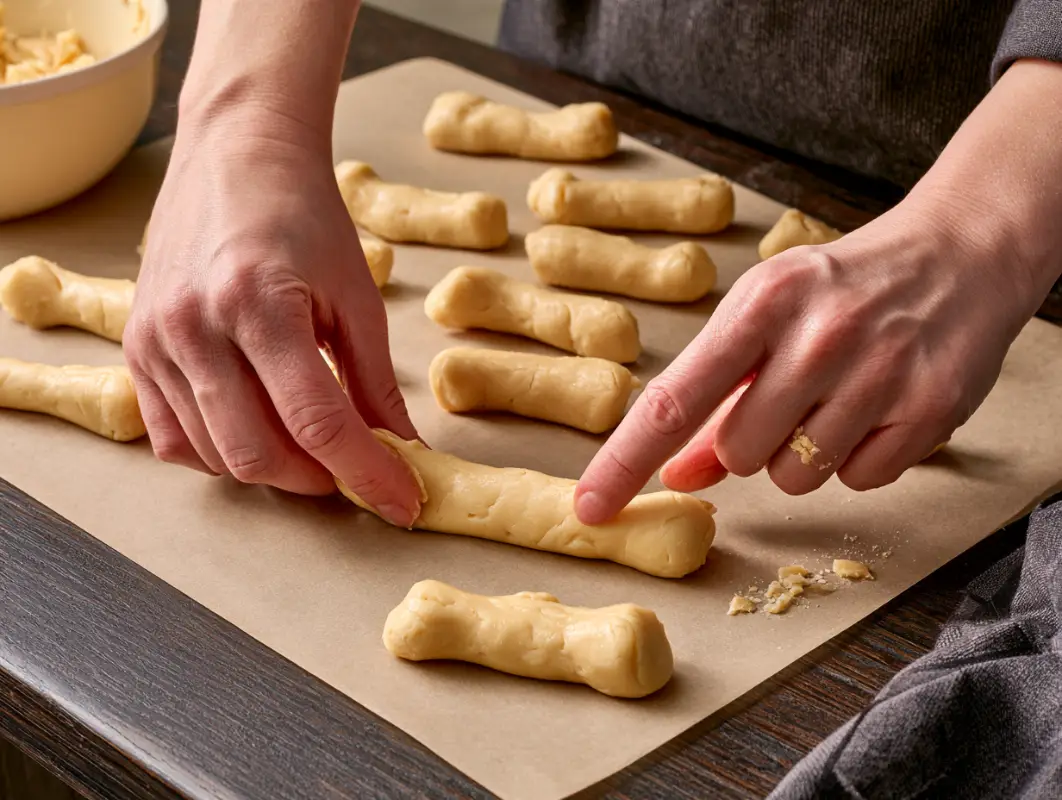
- Roll walnut-sized pieces into rough logs about 2 1/2 inches long, slightly thicker at each end. Irregular is correct. Neat is wrong.
- Space them 2 inches apart on parchment-lined trays. They spread.
- Leave the trays out, uncovered, at room temperature for 8 to 12 hours or overnight. The surface must dry to the touch and lose its shine. This is the recipe.
- Bake at 300°F (150°C) for 30 to 35 minutes, until the tops have split and gone pale bone-white and the bases are just golden. They will still feel slightly soft.
- Cool completely on the tray. They firm as they cool. Moving them warm will bend them.
Notes
Why This Ossi dei Morti Recipe Actually Works
- The decoration is structural. The bone effect comes from a physical process, not from your piping hand, which means it works the first time.
- Four ingredients. Almonds, sugar, egg white, flour. Everything else is optional.
- No mixer. A bowl and your hands.
- They keep two weeks, which no other Halloween bake does.
- They carry a real tradition, which is both the honest reason to make them and, practically, the reason this page can outrank a much bigger site.
The Two-Audience Problem, Solved
People arrive at this page from two completely different directions: Italian-American readers looking for the cookie their nonna made for the first of November, and Halloween bakers who are tired of buttercream skeletons. The recipe serves both without compromise, because the traditional version is the spooky version. There is nothing to adapt.
Essential Ingredients
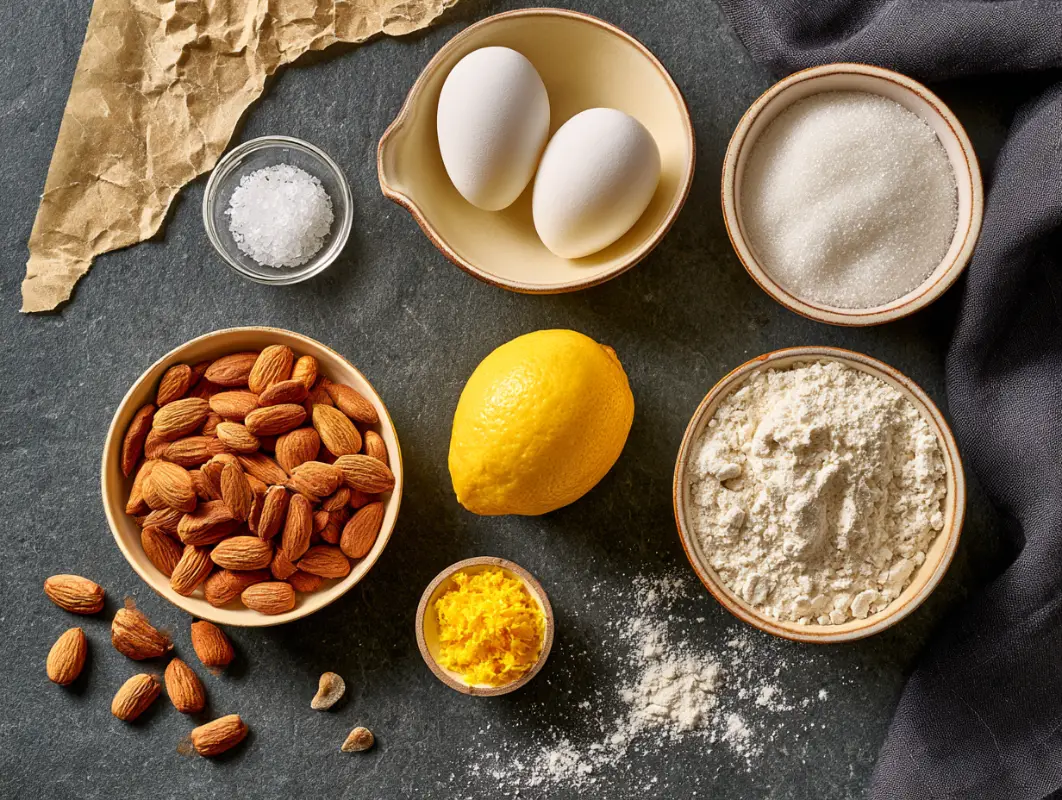
Almonds. Blanched, ground with a little of the sugar so they don’t turn to butter. Leaving some fragments coarser than sand gives the surface irregular weak points, and weak points are where cracks start. Almond flour works and is genuinely convenient; the crack pattern comes out finer and more even, which is slightly less bone-like and still very good. Buy this season’s crop if the shop will tell you. Almonds carry a lot of oil and old ones taste flat and faintly bitter, and in a cookie with four ingredients that has nowhere to hide.
Sugar. A lot of it, and it is not negotiable. The sugar is what forms the brittle, meringue-like crust during the rest — this is closer to a macaroon in mechanism than to a butter cookie. Reducing it gives you a soft, smooth, wrong cookie.
Egg whites. Room temperature, whisked only to frothy. The whites bind and, critically, provide the protein structure that sets the dried skin.
Flour. Just enough to keep it from spreading into a puddle.
Lemon zest. Traditional across most regions and it lifts what is otherwise a very sweet cookie. Do not skip it.
The Foolproof Method
- Grind the almonds with some of the sugar. Coarse sand, not powder.
- Whisk the whites to frothy only. 30 seconds by hand.
- Combine and work to a stiff paste. It comes together slowly. Keep going.
- Roll rough logs, thicker at the ends. Bone-shaped, badly.
- Rest uncovered overnight. 8 to 12 hours. The surface should be matte and dry to a fingertip.
- Bake low and slow. 300°F for 30 to 35 minutes.
- Cool completely on the tray.
The Tradition Behind Ossi dei Morti
Italy has its own days for the dead, and they are not Halloween.
Ognissanti — All Saints’ Day — falls on 1 November and is a public holiday across Italy. Il Giorno dei Morti, the Day of the Dead, follows on 2 November. Together they form a two-day observance that predates the American Halloween most of us grew up with by a very long way, and it is quieter, more domestic and considerably more about food than costume. La Cucina Italiana, the country’s oldest food magazine, files these bakes under the tradition rather than under Halloween — which is the right way round.
The custom the cookies come from is a beautiful one. In many regions, families baked ossi dei morti and left them out overnight on the evening of 1 November, along with a jug of water, for the dead who were understood to return to the house that night. In Sicily, children woke on the morning of 2 November to find sweets and small gifts said to have been left by dead relatives — i morti, arriving in the night with presents, which is functionally Sicily’s Santa Claus and considerably more atmospheric. In parts of Lombardy and Piedmont, the cookies were carried to the cemetery and eaten there.
Bone-shaped sweets recur across the whole peninsula: Sicily has its pupi di zucchero, sugar puppets shaped as paladins and saints; Umbria has stinchetti dei morti, “little shinbones of the dead.” Naming a food after a bone and eating it is not morbid in this context — it is a way of keeping the dead at the table, which is roughly what every culture with a November feast has arrived at independently.
There is also a linguistic curiosity worth knowing: in several regions these are called ossi da mordere, “bones to bite,” which tells you something about the intended texture that no recipe headnote could.
I am not Italian and I am careful about that. What I can say is that almost no US recipe site has written this properly, that it is genuinely interesting, and that it changes what the cookie is — from a novelty into something with several hundred years of people behind it.
Why They Crack Into Bone Shapes (And Why Yours Didn’t)
This is the section to read twice.
During the overnight rest, water evaporates from the surface of each cookie and the sugar and egg-white proteins there concentrate into a thin, brittle, glassy skin. The interior stays soft and full of moisture.
Then you put them in the oven. The interior heats, the moisture inside turns to steam, and the cookie expands — but the dried skin has no give at all. It cannot stretch, so it fractures. The cracks open along the irregular lines where your rolling left the surface uneven, and the pale, matte, slightly porous interior pushes up through them.
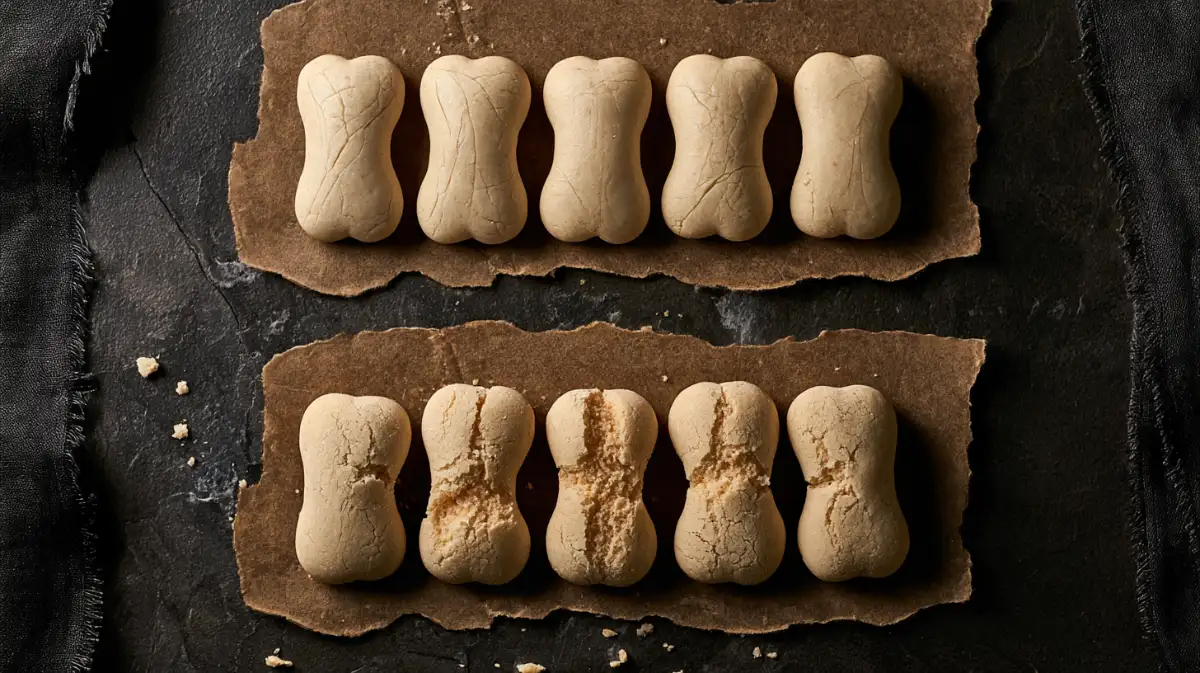
The crack is not a flaw. The crack is the recipe. Everything about the method exists to create a rigid outside over an expanding inside.
Which means every way it goes wrong is a version of the same mistake:
- You skipped or shortened the rest. No dried skin, no fracture. You get smooth, pale, faintly disappointing almond cookies that taste fine and look like nothing. This is the reason 90% of failed batches fail.
- You covered them. Plastic wrap traps humidity and the surface never dries. Leave them naked on the tray.
- Your kitchen is humid. In a damp kitchen, 8 hours may not be enough — go to 12, or leave them in a turned-off oven with the light on, which gives you a slightly warmer, drier box. A domestic oven with the light on and the door shut sits roughly 10 to 15°F above room temperature, and that is enough to drop the relative humidity around the tray without warming the sugar.
- You whipped the whites to peaks. A meringue-like batter rises evenly and gently rather than pushing hard against the crust. Frothy only.
- Your oven was too hot. At 350°F the outside sets before the inside has finished expanding, and you get a shallow crack or none. Low and slow.
My first batch, years ago, came out looking like small smooth stones. I had covered them overnight because covering things overnight is what you do. Marc ate about nine of them and said they were nice, which is what he says when something has gone wrong and he does not want to discuss it.
The Five Rules for a Cookie That Cracks
- Grind the almonds coarse. Sand with fragments in it, not powder. The fragments are the weak points cracks start from.
- Whisk the whites to frothy only. Thirty seconds by hand. Peaks give you a smooth cookie.
- Leave them uncovered. Plastic wrap traps humidity and no skin ever forms.
- Eight hours minimum, twelve in a damp kitchen. This is the step with no shortcut.
- Bake low. 300°F for 30 to 35 minutes. At 350°F the outside sets before the inside has finished expanding.
Getting the Texture: Crisp Outside, Chewy Center
The finished cookie should snap when you break it and then give slightly at the center. That contrast is the point — it is why they are called bones to bite.
Bake low. 300°F for 30 to 35 minutes. The tops should be bone-pale, not golden; only the bases take color.
Pull them while they still feel slightly soft. They firm dramatically as they cool. A cookie that feels crisp in the oven will be a tooth hazard on the plate.
Cool completely on the tray, not a rack. The residual heat finishes the base and stops them bending.
Give them two days. Genuinely. The interior equilibrates and the chew improves. This is a cookie that is better on Thursday than it was on Tuesday.
Regional Variations Across Italy
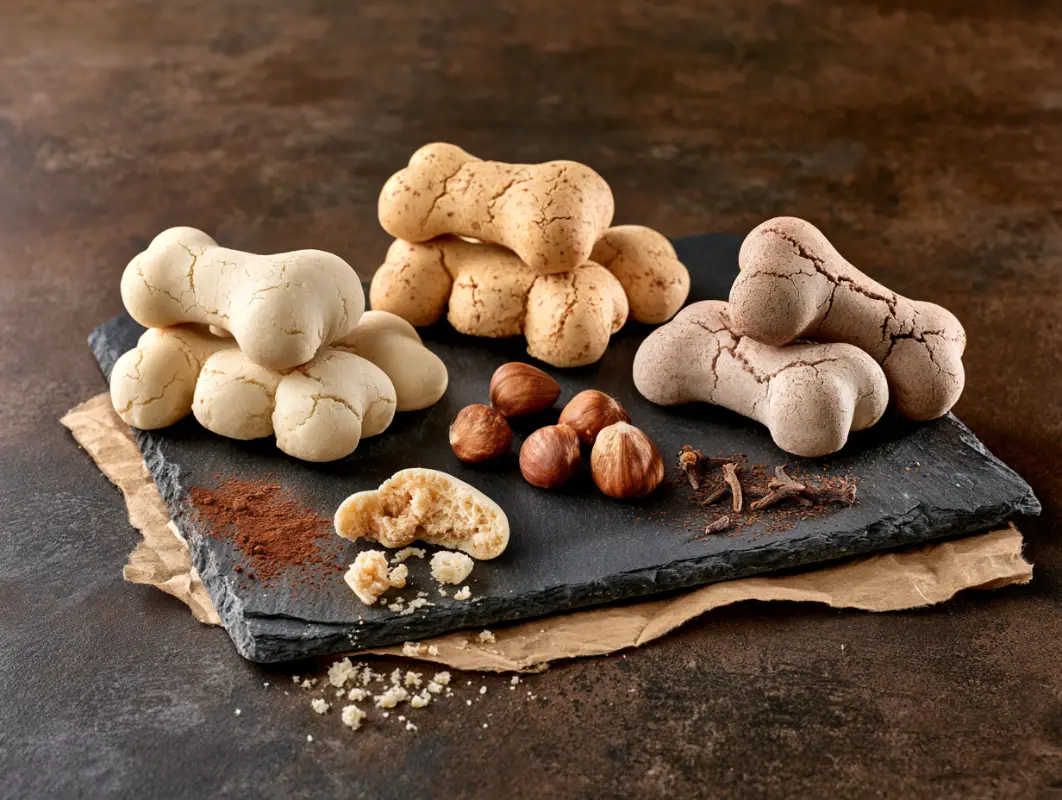
Sicilian, with cloves. A quarter teaspoon of ground cloves in the dry mix. Warm, faintly medicinal, very old-tasting. My favorite of the three.
Piedmontese, with hazelnut. Swap half the almonds for toasted skinned hazelnuts. Rounder, sweeter, more fragrant, and it cracks just as well.
Lombard, with cocoa. A teaspoon of cocoa in the dry mix takes them from bone-white to a greyish ivory that reads even more like something excavated. Less traditional in this specific cookie but common in the wider family.
Ossi da mordere with a hard glaze. Some Piedmontese versions are essentially two-textured, with a firmer meringue base. Worth knowing exists; not worth the extra step for a first bake.
Storage and Gifting
Tin, room temperature, 2 weeks. Airtight, with a sheet of parchment between layers. Do not refrigerate — the fridge softens the crust and you lose the snap.
They post well, which very few cookies do. Layer them in a rigid tin with parchment, and they arrive intact.
Bake mid-October. For a Saturday 31 October party or for 1 November, make them between the 15th and 20th. This is the only recipe in this cluster where making it early is actively better than making it fresh.
Freezing: the raw shaped logs freeze for 6 weeks. Thaw on the tray, then do the overnight rest before baking. Do not freeze baked.
Nutritional Benefits
Almonds carry vitamin E, magnesium and monounsaturated fat, and a full two cups of them go into thirty cookies. The NIH Office of Dietary Supplements ranks almonds among the best food sources of vitamin E, and nuts are a standard entry on its magnesium food list as well. There is no butter and no dairy at all. They are still, unambiguously, a sugar cookie — 350 g of sugar is 350 g of sugar — but at roughly 78 calories each and with almond as the bulk ingredient, they sit better than most things on a Halloween dessert table.
Frequently Asked Questions
What are ossi dei morti?
Traditional Italian almond cookies baked for All Saints’ Day (1 November) and All Souls’ Day (2 November). The name means “bones of the dead,” and they are shaped as rough bones and left to dry overnight so that they crack open in the oven into a convincingly skeletal texture. They are made across Italy with regional variations in spice, nut and shape.
Why did my cookies not crack?
Almost always the overnight rest. The surface has to dry to a matte, touch-dry skin before baking — that rigid skin is what fractures when the inside expands. If you covered them, shortened the rest, or your kitchen is very humid, the skin never forms. Whipping the egg whites too stiff and baking too hot are the other two causes.
Do I really have to rest the dough overnight?
Yes. This is the one step in the recipe with no shortcut. Eight hours is the minimum, twelve is better, and in a humid kitchen you may need the full twelve plus a turned-off oven with the light on. Without it you have a perfectly pleasant almond cookie that looks nothing like a bone.
How long do ossi dei morti keep?
Two weeks in an airtight tin at room temperature, and they improve for the first two or three days. Do not refrigerate.
Can I make them without almonds?
Not really — the almond is the body of the cookie, not a flavoring. Hazelnuts work as a full substitution and are traditional in Piedmont. For a nut-free table this is the wrong recipe.
What is the difference between ossi dei morti and fave dei morti?
Both are Italian All Souls’ Day cookies. Ossi dei morti are bone-shaped, crisp, cracked and made with egg white. Fave dei morti are small, soft, chewy and shaped like broad beans, referencing an old Roman association between beans and the dead. Many households make both.
Is it safe to leave raw egg white out overnight?
Yes, and this is worth saying plainly because it is a fair question. The surface dries rather than spoils. Dissolved sugar binds free water and lowers a food’s water activity — the measure UC Agriculture and Natural Resources describes as the controlling factor in whether microbes can grow at all — and this dough is roughly half sugar by weight. Drying is the entire mechanism the recipe depends on, and the cookies then bake for 30 to 35 minutes afterwards. This is how the cookie has been made for a very long time.
Pairing and Serving Ideas
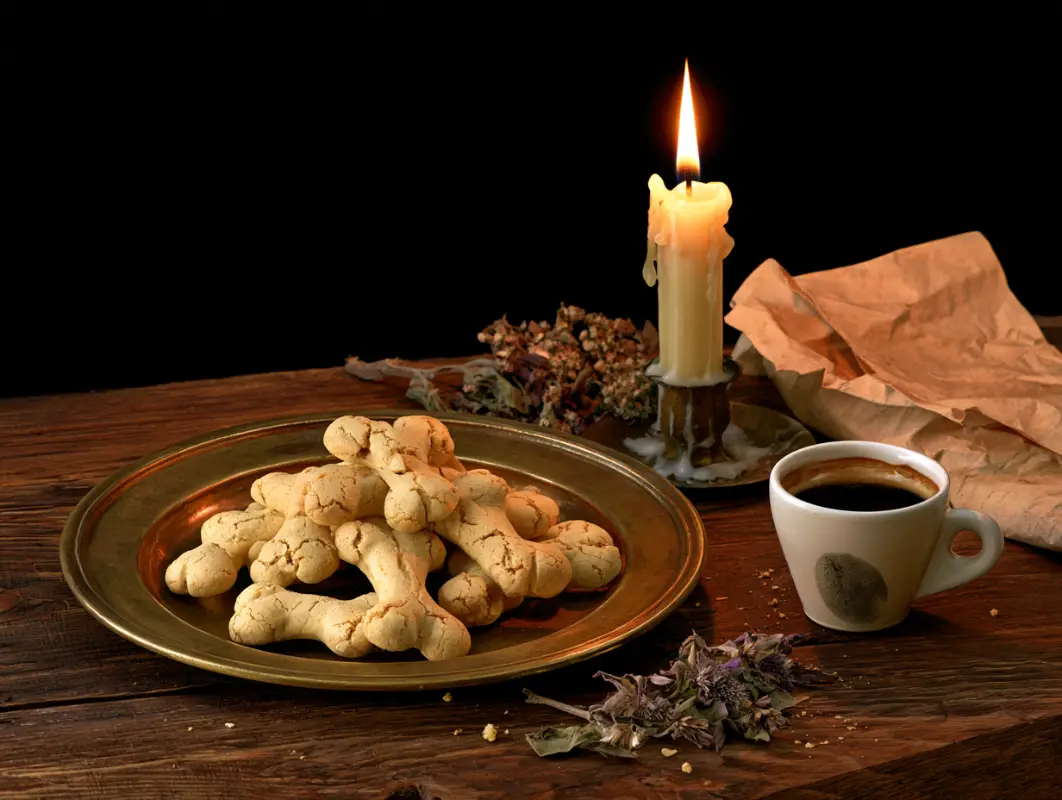
These want something to dunk into. Across Italy that is most often a small cup of strong black coffee — the crisp shell softens just enough at the edge and the bitterness cuts the sugar.
For a 1 November table, a small glass of chilled mosto cotto stirred into sparkling water, or Sicilian almond milk over ice, does the sweet-and-dark job without a bottle. Mosto cotto — also sold as saba — is grape must cooked down to a syrup before it can ferment, so it is not a wine and carries no alcohol; most Italian grocers stock it, as does every Middle Eastern grocer that carries pomegranate molasses. Latte di mandorla is Sicilian, which puts it in the same region as the cookie, and it photographs pale against a dark table.
If you are building a full 1 November table, serve them alongside the two sibling bakes for a plate of three shapes and three colors:
- Fave dei morti — soft, bean-shaped, pale
- Pan dei morti — dark, spiced, fruited
For a Halloween party rather than a November table, they work best on a dessert board with something rich to offset the dryness — halva bark, or a bowl of dark chocolate.
Style them on dark slate with dried flowers and a single candle. They are one of very few Halloween bakes that need no props at all.
Watch: The Overnight Rest, Start to Crack
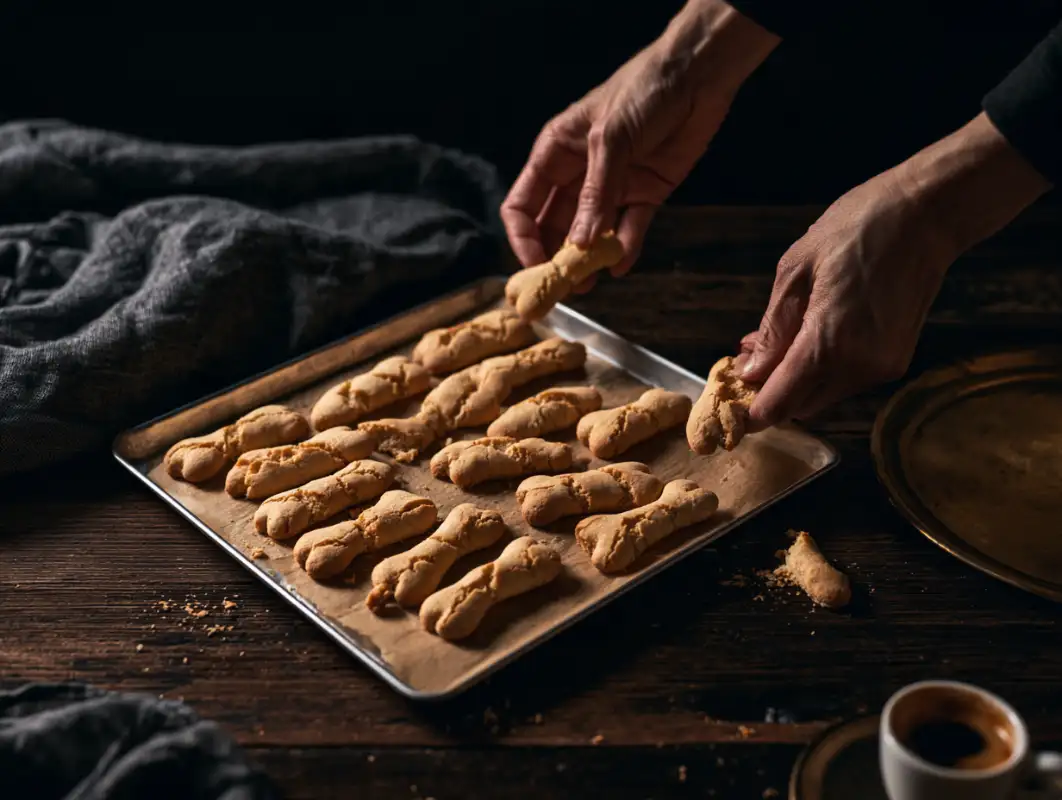
Rolling the rough logs, the trays going out on the counter at night, a hard cut to the same trays in the morning with the surfaces matte and dry, then the split cookies coming out of the oven.
Ready to Bake Something With Actual Meaning Behind It?
Four ingredients, one night of doing nothing, and a cookie that decorates itself into something genuinely eerie. Make them the week of 20 October, keep them in a tin, and you are covered for both 31 October and the first of November.
Leave a couple out overnight on the first. It costs nothing and it is a nice thing to do.