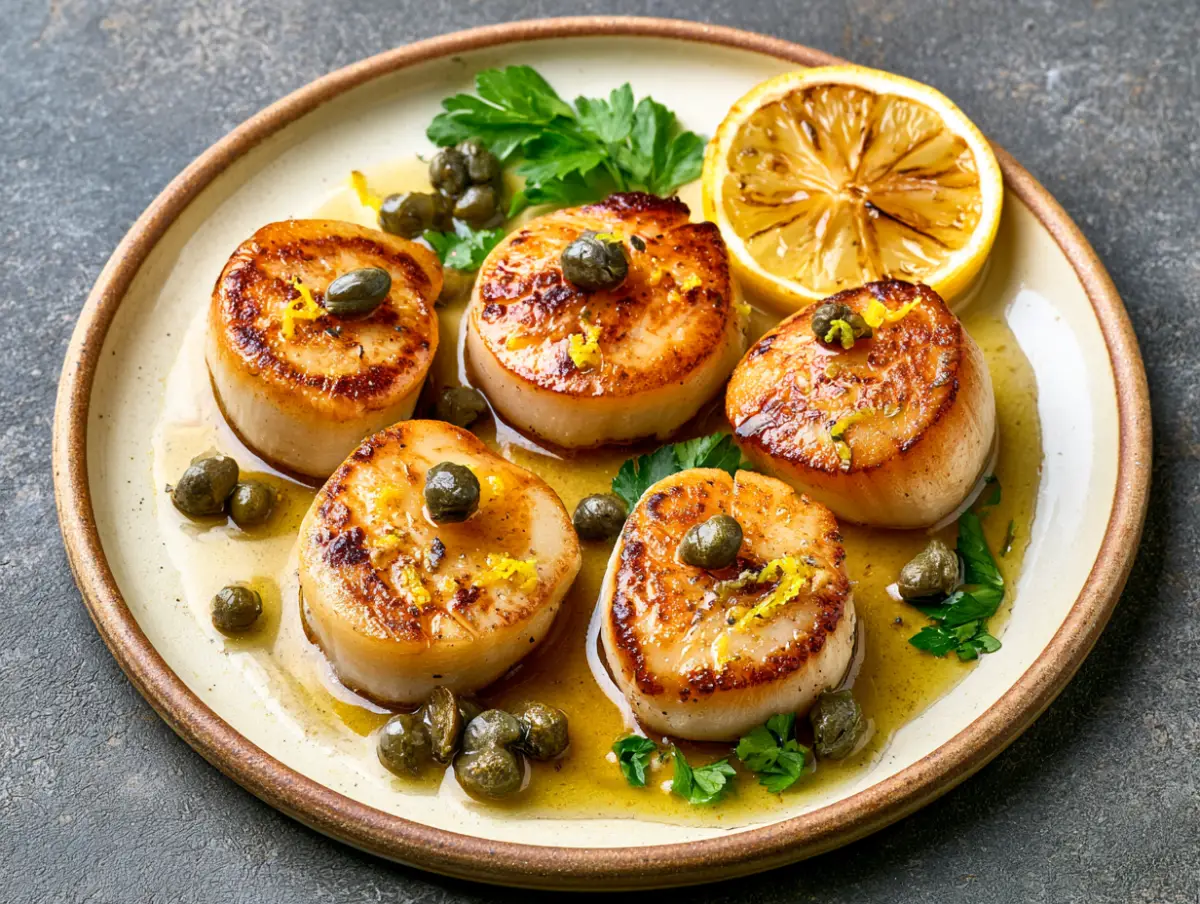
I can still hear the sound of my father’s boots on the dock in Chania. It was early — maybe 5:30 in the morning — and the Cretan sun was just beginning to paint the harbor that impossible shade of gold that photographers spend their whole careers chasing. He’d come back from a night on the water with a crate of whatever the sea offered, and some mornings — the best mornings — that crate held scallops. Beautiful, ivory-colored, still smelling like clean salt water.
My yiayia would take those scallops into her kitchen (which, honestly, was barely more than a stone room with a gas burner and an ancient cast iron pan that probably belonged to her mother before her) and within minutes — minutes — she’d have them sizzling in olive oil and butter, the lemon juice hitting the hot pan with that sharp, fragrant hiss. The capers came from a jar she kept on the windowsill, brined in sea salt, their pungent little bursts cutting through the richness of the butter. Golden. Crispy. Perfect.
This lemon butter scallops with capers recipe is that memory, translated for your kitchen. It’s the dish I’ve made more than any other — probably 200 times over the last six years — and I’ve refined every single step until it’s as close to what my yiayia made as I can possibly get without actually being on that Chania dock at dawn. In my yiayia’s kitchen, seafood was never complicated. It was fast, it was bright, and it let the sea do the talking. Let me show you.
Table of Contents
Lemon Butter Scallops with Capers
Ingredients
Method
- 1. Remove side muscles from scallops. Pat very dry with paper towels. Season with salt and pepper.
- 2. Heat a 12-inch cast iron skillet over high heat, 2–3 minutes. Add olive oil and 1 tbsp butter.
- 3. When butter foam subsides and wisps of smoke appear, add scallops. Sear 2 minutes without moving.
- 4. Flip. Sear 90 seconds–2 minutes until golden. Transfer to warm plate.
- 5. Lower heat to medium. Add remaining 2 tbsp butter. Swirl until golden-brown and nutty.
- 6. Add garlic, stir 30 seconds. Add capers, cook 30 seconds until slightly crispy.
- 7. Pour in lemon juice. Scrape up fond. Swirl to emulsify.
- 8. Return scallops to pan. Baste with sauce 20 seconds.
- 9. Remove from heat. Add lemon zest and parsley. Serve immediately.
Notes
Why This Lemon Butter Scallops Recipe Is Special
The Technique That Makes the Difference
Here’s something most pan seared scallops recipes get wrong: they’re too gentle. I know that sounds counterintuitive — scallops are delicate, right? But as J. Kenji López-Alt explains in The Food Lab, the Maillard reaction (that gorgeous golden crust) only happens when surface proteins hit extremely high heat with minimal moisture.
That’s why the single most important step in this entire recipe is drying your scallops until they’re practically squeaky. My yiayia didn’t know the science, but she knew the principle: “If the pan doesn’t scream, the scallop won’t sing.” The lemon butter caper sauce in this seared scallops lemon caper sauce recipe builds directly in the pan, using the fond (those caramelized bits) as the foundation. That’s where all the flavor lives.
When Golden Butter Meets Briny Capers
The flavor profile of these browned butter scallops is what I call “Mediterranean umami” — sweet from the scallop, nutty from the browned butter, sharp from the lemon, and that punchy salinity from the capers that ties everything together. It’s an easy scallop recipe that genuinely tastes like you spent an hour on it. Trust me on this. I serve these for date nights, dinner parties, Tuesday nights when I’m feeling fancy, and lazy Sundays when I want something special but refuse to stand at the stove for more than 15 minutes. My mother used to say, “The best Mediterranean scallops are the ones you can make before the bread gets cold.” She wasn’t wrong.
The Story Behind Lemon Butter Scallops
A Dish with Deep Mediterranean Roots
Scallops with lemon and capers aren’t exclusively Greek — the Italians have their beautiful scallop piccata, the French do a version with beurre noisette — but the Cretan approach has always been simpler, more direct. In Crete, we don’t dress things up for the sake of dressing them up. Good olive oil from Kolymvari, lemons from the garden, capers from the rocky hillsides near Sitia. The sea provides, the land provides, and the cook’s job is to stay out of the way. This Greek-style seafood tradition has been part of coastal Cretan cooking for generations.
My Family’s Version
My grandfather — Papou Yannis, who ran a seaside taverna in Chania for 40 years — had a saying: “Three ingredients, five minutes, one happy table.” His scallop dish was famous among the fishermen who’d trade their morning catch for a plate of whatever he was cooking. The version I’m sharing today is his, filtered through my mother’s hands and then my own, with a few adjustments learned during my years at Varoulko. The spirit is unchanged: respect the scallop, don’t overthink it.
Essential Ingredients for Lemon Butter Scallops with Capers
Core Ingredients: What You Need and Why
Let me walk you through every ingredient, because in a dish this simple, each one pulls serious weight. When I was training at Varoulko, our chef used to say, “Six ingredients means six chances to ruin dinner.” Dramatic? Yes. Accurate? Also yes.
For the scallops: you want dry, untreated sea scallops (U10 or U15 if you can find them). “Dry” means they haven’t been soaked in sodium tripolyphosphate, which forces water retention and makes them impossible to sear properly. If your scallops are bright white and sitting in milky liquid, they’re “wet” — look for ones with a natural ivory or pale coral hue instead. As Harold McGee notes in On Food and Cooking, untreated scallops caramelize far more effectively because their surface proteins aren’t diluted by retained water. This matters for getting those restaurant quality scallops at home.
For the capers: I prefer salt-packed over brined. They have a more intense, floral flavor that reminds me of the wild capers my mother used to pick near Sitia (she’d come home with scratched hands and a bucket of tiny green treasures). Rinse them well before using. If you can only find brined, drain and pat dry — the extra moisture is the enemy of our hot pan.
| Ingredient | Amount | Why It Matters | Authentic Pick | Substitution |
| Sea Scallops | 1 lb / 450g (8-10 large) | The star — sweet, briny, tender | Dry U10/U15 sea scallops | Bay scallops (reduce cook time to 30 sec/side) |
| Unsalted Butter | 3 tbsp / 45g | Creates the nutty browned base | European-style (82%+ fat) | Ghee or olive oil for dairy-free |
| Extra-Virgin Olive Oil | 1 tbsp / 15ml | High smoke point blend for searing | Kolymvari or Sitia EVOO | Avocado oil |
| Fresh Lemons | 2 medium (zest + juice) | Brightness, acidity, aroma | Thin-skinned Greek lemons | Meyer lemons (sweeter, less sharp) |
| Capers | 2 tbsp / 20g | Briny, pungent flavor bombs | Salt-packed from Pantelleria or Crete | Brined capers, drained and patted dry |
| Garlic | 3 cloves, minced | Aromatic backbone | Fresh, firm, tight skin | 1/2 tsp garlic powder (emergency only) |
| Flat-Leaf Parsley | 2 tbsp, chopped | Freshness, color, peppery finish | Fresh Italian flat-leaf | Fresh dill or chives |
| Flaky Sea Salt | To taste | Finishes and brightens | Cretan sea salt flakes | Maldon or any flaky finishing salt |
Dietary Substitutions & Pro Tips
I’ve tested every substitution below at least three times (my neighbors in Athens have eaten more experimental scallops than they probably wanted). Here’s what actually works for this sea scallops recipe:
| Dietary Need | Replace | With | Notes |
| Dairy-Free | Butter | Equal amount ghee or quality olive oil | Ghee still gives nutty flavor; EVOO works but different character |
| Low-Sodium | Capers + salt | Rinsed capers only, skip added salt | Capers provide enough salinity on their own |
| Keto/Low-Carb | No changes needed | — | Recipe is naturally keto-friendly as written |
| Pescatarian | No changes needed | — | This is already a pescatarian dish |
| AIP Protocol | Butter + pepper | Coconut oil, omit pepper | Keep capers, lemon, and garlic |
Yiayia’s Tip: Always bring your scallops to room temperature for 15 minutes before cooking. Cold scallops hitting a hot pan is a betrayal. The temperature shock causes them to seize, and you’ll never get that golden crust. My yiayia would set hers on the counter the moment she started squeezing the lemons. Trust me on this.
If you enjoy working with quality Mediterranean ingredients, the olive oil technique here is similar to what we use in our Mediterranean shrimp white bean salad and our roasted vegetables salmon — both excellent companions if you’re planning a seafood-focused dinner.
Equipment & Technique
Tools of the Trade
My grandfather seared scallops in a cast iron pan that was older than my father. You don’t need anything fancy — but the right pan makes a real difference for this one pan scallops dinner.
| Traditional Tool | Modern Alternative | Why It Matters |
| Cast iron skillet (12-inch / 30cm) | Heavy stainless steel skillet | Retains heat for perfect sear — non-stick won’t work here |
| Mortar and pestle (for garlic) | Microplane or sharp knife | Crushing garlic releases more allicin than slicing |
| Wooden spatula | Fish spatula (thin, flexible) | Slides under scallops without tearing the crust |
| Ceramic lemon juicer | Fork + bowl | Catches seeds, extracts maximum juice |
Mise en Place: Your Setup Checklist
Before you even think about turning on the stove, get everything prepped and within arm’s reach. Scallops cook in under 4 minutes total. There is no time to search for the lemon or realize you forgot to mince the garlic. (I speak from painful experience. Batch #3 of my Varoulko apprenticeship days? Burned scallops. Chef’s disappointment? Legendary.) Here’s your setup: scallops patted dry and on a plate, garlic minced, lemon juiced with zest set aside separately, capers drained, parsley chopped, butter measured. Pan on the stove, warming. You ready? Good. Let’s cook.
Step-by-Step: How to Make Lemon Butter Scallops with Capers
Preparation (Steps 1–4)
Step 1: Prepare the Scallops. Remove the small side muscle from each scallop — it’s that little rectangular tab on the side. Give it a gentle pinch and pull; it tears right off. Rinse scallops briefly under cold water, then pat them extremely dry with paper towels. I mean it — press firmly, flip, press again. Use fresh towels if the first ones are soaked. This is the step that separates golden, crusty pan seared scallops from sad, steamed, gray disappointments. As Kenji López-Alt has demonstrated, surface moisture is the number-one enemy of the Maillard reaction.
Step 2: Season Simply. Season both sides with a pinch of flaky sea salt and freshly cracked black pepper. Don’t go overboard — the capers and butter will bring their own seasoning. My yiayia never used more than salt on the scallops themselves. “Let the sea speak,” she’d say. Good advice.
Step 3: Prep the Sauce Components. Juice your lemons into a small bowl (you’ll need about 3 tablespoons). Zest one lemon — set the zest aside separately; it goes in at the end. Mince your garlic. Drain and pat dry the capers. Chop the parsley. Everything within arm’s reach. This is your mise en place — and in a 15-minute dish, it’s everything.
Step 4: Heat the Pan. Place your 12-inch cast iron or stainless steel skillet over high heat for 2–3 minutes. You want it screaming hot. Add 1 tablespoon olive oil and 1 tablespoon butter. When the butter foam subsides and you see the first wisps of smoke, you’re ready. Don’t rush this. A properly heated pan is the difference between a seared scallop and a boiled one. (How can you tell? Hold your hand 3 inches above the surface — if it’s uncomfortably hot within 2 seconds, go.)
Yiayia’s Tip: If your kitchen has a weak vent, open a window before you start. A properly seared scallop WILL produce smoke. That’s not a problem — that’s the Maillard reaction doing its beautiful work. The smoke means flavor.
Cooking & Assembly (Steps 5–10)
Step 5: Sear the First Side. Gently place scallops in the pan, leaving at least 1 inch between each one. Do not overcrowd — work in two batches if needed. Now: do not touch them. Not a nudge, not a peek, nothing. Set a timer for 2 minutes. You’ll hear a fierce sizzle that gradually quiets. That’s moisture evaporating. When the sizzle returns stronger, the crust is forming. After 2 minutes, gently peek at the bottom with your fish spatula. You should see a deep golden-brown crust. If it’s pale, give it another 30 seconds.
Step 6: Flip and Finish. Flip each scallop. They should release easily — if they’re sticking, they’re not ready. (The crust releases on its own. Patience.) Sear the second side for 90 seconds to 2 minutes. The scallop should feel like the fleshy part of your palm when you touch your thumb to your index finger — firm but with give. Internal temperature: 130°F / 54°C for medium-rare (my preference), 140°F / 60°C for fully cooked. Transfer to a warm plate immediately. Don’t leave them in the pan. Residual heat is real.
Step 7: Build the Sauce. Lower heat to medium. Add the remaining 2 tablespoons butter to the same pan. It will foam and begin to turn golden — these are the milk solids browning, releasing that intoxicating nutty aroma. As soon as the butter smells like toasted hazelnuts (about 60 seconds), add the minced garlic. Stir constantly for 30 seconds — garlic goes from golden to burnt in the blink of an eye. The garlic butter scallops flavor base is now building on all that beautiful fond left from the searing.
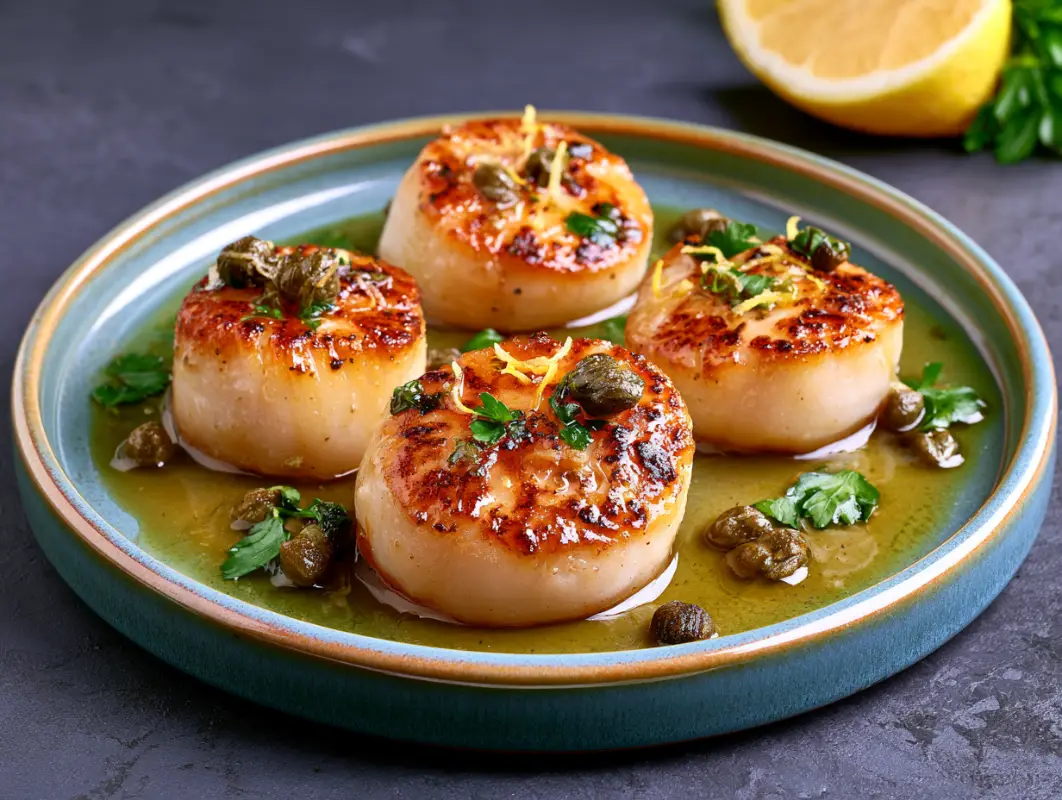
Step 8: Add the Stars. Toss in the capers — they’ll sizzle and pop dramatically (I love this moment). Cook for 30 seconds until they’re slightly crispy on the edges. Then pour in the lemon juice. It will bubble and steam as it deglazes the pan, lifting all those caramelized bits. Swirl the pan to emulsify the butter and lemon into a glossy, cohesive sauce. This is your seared scallops lemon caper sauce — and it should look like liquid gold.
Step 9: Reunite & Finish. Return the scallops to the pan. Spoon the lemon butter caper sauce over each one, basting gently for about 20 seconds. Remove from heat. Add the fresh lemon zest and chopped parsley now — off the heat, so the volatile oils and fresh flavors stay vibrant. Taste the sauce. Adjust with a squeeze more lemon if needed.
Step 10: Plate & Serve Immediately. Transfer scallops to warm plates. Spoon the remaining sauce over them. Serve right now. Scallops wait for no one. They’re best within 60 seconds of leaving the pan. Crust’s still crackling, butter’s still glistening, aroma’s filling the room. This is the moment. Enjoy it. This healthy scallop dinner is ready before your guests have finished their first sip of sparkling water.
Pro Tip: If you’re serving these lemon butter scallops with capers over pasta or alongside grains, plate the base first, then the scallops on top, then the sauce last. Gravity is your friend for presentation. The technique is similar to how we plate our Mediterranean sheet pan salmon — components layered, sauce finishing.
The Secret Touches
Insider Techniques from My Family’s Kitchen
1. The Paper Towel Sandwich: After patting scallops dry, place them between two layers of paper towels and press with a flat plate for 5 minutes. This removes deep-set moisture that regular patting misses. My mother invented this trick when she was tired of my father’s scallops coming out pale. It works.
2. The Cold Butter Finish: After building the sauce (Step 8), remove the pan from heat and swirl in one small cube of cold butter. This is called monter au beurre — a classical technique I learned at Varoulko — and it emulsifies the sauce into something silky and glossy. The temperature difference is key: Harold McGee explains that cold fat disrupts the liquid’s surface tension, creating a stable emulsion.
3. The Caper Crisp: Before making the sauce, toss a few extra capers into the hot butter and let them fry for 45 seconds until they open like tiny flowers and become crispy. Use these as a garnish. The texture contrast is — and I don’t use this word lightly — extraordinary. This takes your scallops with caper sauce to another level.
Common Mistakes (and How to Fix Them)
| Mistake | What Happens | How to Fix It | Prevention |
| Not drying scallops | No crust — they steam instead of sear | Pat dry + paper towel sandwich method | Dry 10+ minutes, press with plate |
| Pan not hot enough | Pale, soft surface — no Maillard reaction | Remove scallops, reheat pan, start over | Wait for first wisps of smoke |
| Overcrowding the pan | Temperature drops, scallops release water | Cook in 2 batches max | Leave 1-inch gaps between each |
| Overcooking (>2 min/side) | Rubbery, tough texture | Pull earlier next time — they cook fast | Set a timer. 90 sec to 2 min per side |
| Burning the garlic | Bitter, acrid sauce | Fish out burnt bits, add fresh garlic | Add garlic to browned butter, stir constantly |
Variations & Serving Ideas
Regional Twists & Modern Adaptations
In Crete, we keep it simple: scallops, lemon, butter, capers, done. But travel across Greece and the Mediterranean, and you’ll find gorgeous variations. On the islands, they add a pinch of dried oregano and a scattering of cherry tomatoes that burst in the hot butter. In Athens (where I live now), the more modern tavernas finish with a drizzle of ladolemono — that classic olive oil and lemon emulsion — and a shower of fresh dill. One of my favorite modern takes adds a spoonful of sun-dried tomato paste to the sauce for depth and sweetness.
For a weeknight shortcut: skip the fresh lemon zest garnish and use a premade ladolemono. The result is 90% as good in half the effort. And honestly? On a Wednesday at 8pm? That’s a win. You can also turn this quick seafood dinner into a full Mediterranean spread by serving it alongside our classic Greek lemon rice pilafi — the citrus notes echo beautifully.
What to Serve Alongside
These Mediterranean scallops pair brilliantly with simple, bright sides. I love them over our pasta primavera for a complete meal, or alongside a bowl of our Mediterranean white bean salad when I want something lighter. For a grain option, try our classic Greek lemon rice pilafi — the lemon in the rice plays off the lemon in the scallop sauce in a way that makes me unreasonably happy.
Non-Alcoholic Beverage Pairings: Sparkling water with a sprig of fresh rosemary and a squeeze of grapefruit. Fresh mint lemonade — the classic. Chilled tsai tou vounou (Greek mountain tea) — herbal, subtle, gorgeous with seafood. Cold hibiscus tea with a touch of honey. Or simply: very cold water with thick lemon slices. Let the food do the talking.
Storage & Reheating
How to Store Lemon Butter Scallops with Capers
I’ll be honest: these are best eaten immediately. But life happens, and leftovers deserve respect.
| Method | Container | Duration | Notes |
| Refrigerator | Airtight glass container, sauce separate | 2–3 days | Don’t stack scallops — they’ll lose their crust |
| Freezer | NOT recommended | — | Frozen scallops become rubbery; freeze raw instead |
| Room Temp | Covered plate | Up to 2 hours | Food safety limit — don’t exceed this |
Reheating Without Ruining the Crust
The stove is your best friend here. Heat a dry skillet over medium-high, add a tiny amount of butter, and sear the scallops for 30 seconds per side — just enough to warm through and re-crisp the outside. Microwave? Only if you want rubber. (I tried it once out of curiosity. Once.) Alternatively, you can warm them in a 300°F / 150°C oven for 4–5 minutes on a rack. Refresh with a squeeze of fresh lemon juice and a few new capers before serving. You can use leftover scallops in a cold salad situation too — sliced over arugula with a quick vinaigrette. Our Mediterranean chickpea power bowl is a great template for building a bowl around leftover protein.
Frequently Asked Questions
Substitution & Technique Questions
What’s the difference between dry and wet scallops, and which should I buy?
Dry scallops haven’t been treated with preservatives, so they sear beautifully — golden crust, natural sweetness. Wet scallops have been soaked in sodium tripolyphosphate, which makes them heavier (you’re paying for water weight) and nearly impossible to brown. Always buy dry. If your fishmonger doesn’t know, look for a natural ivory or pale coral color rather than bright white.
Can I use bay scallops instead of sea scallops for this lemon butter scallops with capers recipe?
You can, but the technique changes significantly. Bay scallops are tiny and cook in about 30 seconds per side. You won’t get the same dramatic golden crust, but the lemon butter caper sauce will still be incredible. Sauté them quickly in a single layer, then build the sauce as written.
How do I know when pan seared scallops are done?
Two cues: the sides of the scallop should be opaque about halfway up (the center stays slightly translucent for medium-rare), and they should feel like pressing the base of your thumb. Internal temp: 130°F / 54°C for medium-rare, 140°F / 60°C for fully cooked. When in doubt, pull them early — you can always cook more, but you can’t un-cook rubber.
My scallops aren’t getting a golden crust — what am I doing wrong?
Three likely culprits: moisture (pat them drier), pan temperature (wait for wisps of smoke), or crowding (leave gaps). Also check if you’re using wet scallops — the STPP treatment makes browning nearly impossible. Switch to dry scallops and follow the paper towel sandwich technique in Section 6.
Can I substitute the butter with olive oil for a dairy-free version?
Yes — use good quality extra-virgin olive oil or ghee. You’ll lose the nutty browned-butter notes, but the lemon and capers carry enough flavor to compensate. I’ve made this dairy-free version probably 15 times, and it’s still a restaurant quality scallop dinner.
Dietary, Make-Ahead & Authenticity Questions
Is this recipe gluten-free?
Yes, completely. There’s no flour, no breadcrumbs, no hidden gluten. This healthy scallop dinner is naturally gluten-free, keto-friendly, and Whole30-compliant as written. One of the reasons I love it so much.
Can I make the sauce ahead of time?
You can prep all components in advance (juice lemons, mince garlic, drain capers, chop parsley), but the actual cooking should happen fresh. The sauce takes 90 seconds to build, so the time savings of making it ahead are minimal. The lemon loses its brightness when it sits.
What makes this recipe authentically Mediterranean rather than just ‘fancy scallops’?
The philosophy: simplicity, restraint, and respect for the ingredient. We’re not masking the scallop with 12 flavors — we’re amplifying it with three (lemon, butter, capers). This is how we cook in Crete. The technique of building the sauce in the same pan, using the fond, is classical Mediterranean taverna cooking.
How many scallops per person?
For a main course: 4–5 large sea scallops per person (about 5–6 oz). For an appetizer or as part of a larger spread: 2–3 per person. I usually buy 1 pound for two generous main-course servings. Our grilled chicken Mediterranean bowl is a great option if you’re building a multi-dish dinner alongside the scallops.
Bringing Greece to Your Kitchen
From Chania to Your Table
Every time I make these lemon butter scallops with capers, I’m standing in two kitchens at once — mine in Athens, and my yiayia’s in Chania. The sizzle of the pan, the sharp perfume of lemon hitting hot butter, the little pop of capers frying… these are sounds and smells that connect me to my family, my island, my inheritance. If my yiayia wouldn’t recognize it, it doesn’t belong in the recipe. And she’d recognize every bite of this.
I’d love to see your version. Drop a comment below, tag us in your photos, tell me what you served alongside. Cooking is better when it’s shared.
More Mediterranean Seafood to Explore
If these scallops have you craving more quick seafood dinners, you’ll love our Mediterranean sheet pan salmon which uses a similar one-pan philosophy, or our Mediterranean shrimp white bean salad for something lighter and refreshing. For a cozy night in, our creamy tomato basil chicken brings the same warm Mediterranean flavors in a different direction. And don’t miss our Greek yogurt panna cotta for dessert — it’s the perfect light finish after seafood.