There is a sound that takes me straight back to my grandfather’s taverna in Chania — the quiet scrape of a wooden spoon against a clay tapsi, pulling thick tomato sauce over pale, swollen beans as the whole pan slides back into the wood-fired oven. I was six, perched on a stool that wobbled on the uneven stone floor, and my yiayia was teaching me the single most important dish in our family’s repertoire.
Not lamb. Not fish. Beans. She pressed one between her thumb and finger. “When it gives like butter,” she said, “it’s ready.” The kitchen smelled of oregano, caramelized onion, and the sweet earthiness of slow-baked tomatoes, and through the open doorway I could hear the fishing boats rocking in the harbor.
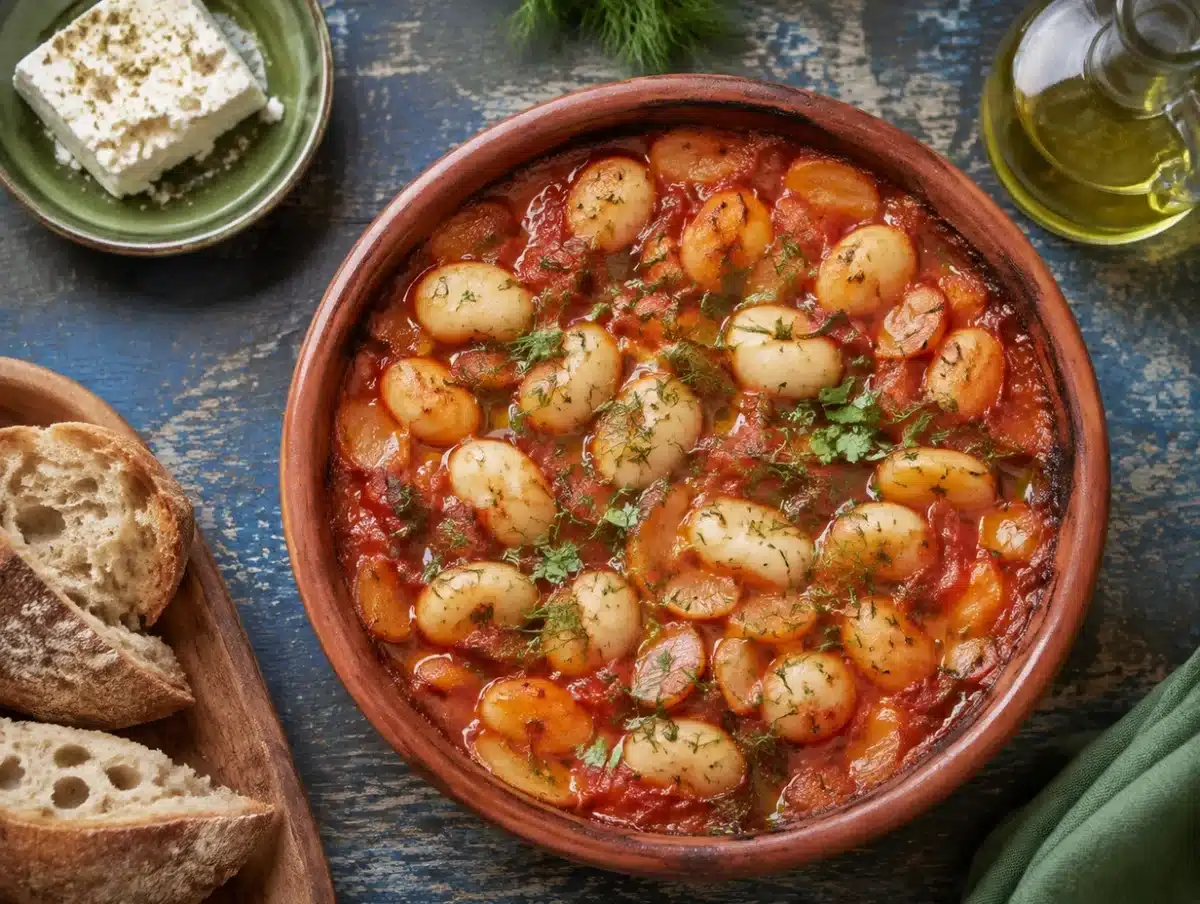
That dish was Greek gigantes plaki (Baked Giant Beans) — giant white beans slow-baked in a fragrant tomato sauce with generous amounts of extra virgin olive oil, fresh herbs, and the kind of patience that modern cooking has nearly forgotten. Every taverna in Greece serves its own version, but this is ours: the Papadopoulos family recipe from Crete, refined over three generations and tested in my own Athens kitchen more times than I can count (though I’d estimate somewhere north of 80). It’s a vegan Greek beans dish that is naturally gluten-free, deeply satisfying, and so simple that the real challenge is keeping your hands off the pan while it bakes. Let me show you how my family makes it.
Table of Contents
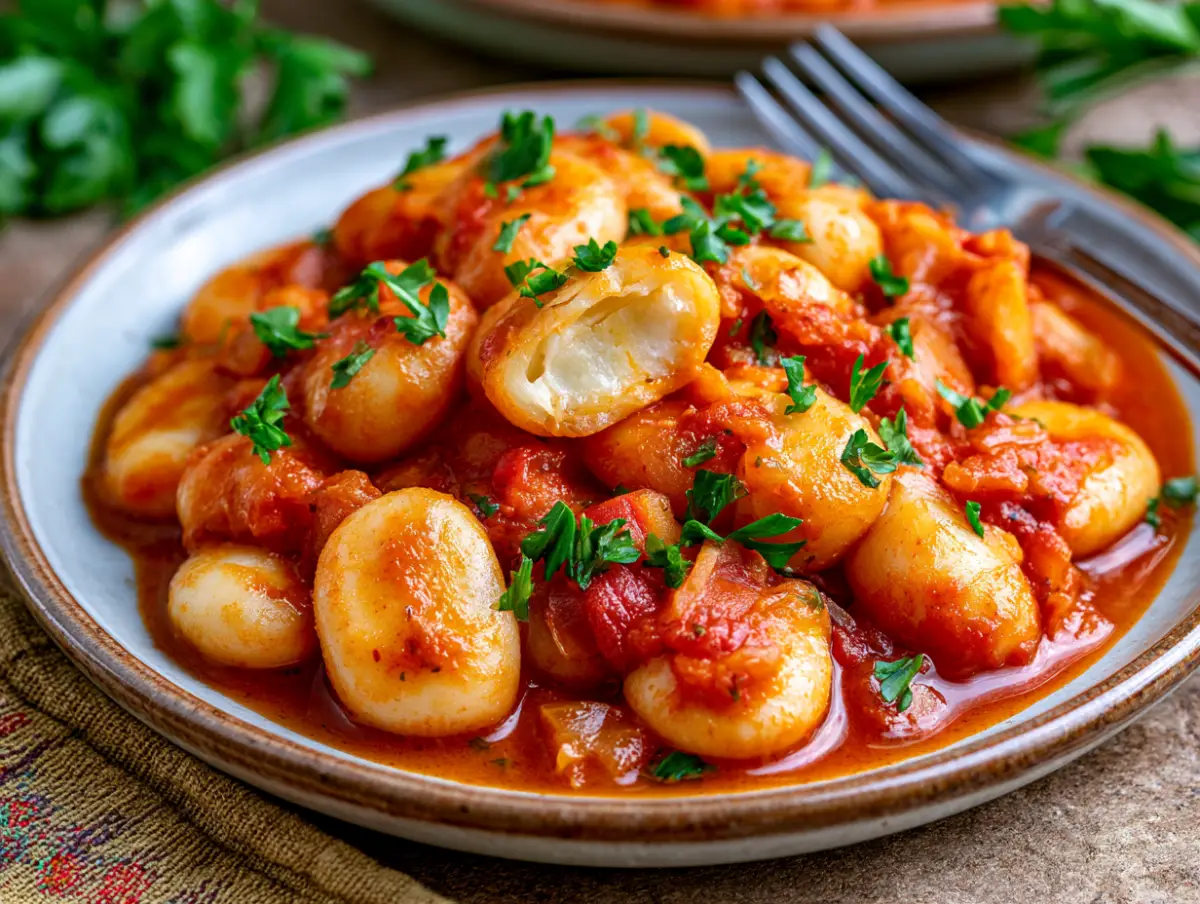
Greek Gigantes Plaki (Baked Giant Beans)
Ingredients
Method
- 1. Soak gigantes in cold water with 1/2 tsp baking soda for 8–12 hours or overnight. Drain and rinse.
- 2. Place beans in a large pot, cover with fresh water by 2 inches, bring to a boil. Skim foam. Reduce heat and simmer 35–45 minutes until al dente. Drain, reserving 1 cup cooking liquid.
- 3. Preheat oven to 375°F (190°C).
- 4. Heat 1/4 cup olive oil in a skillet over medium heat. Sauté onions 5–6 min. Add garlic, carrot, celery; cook 3 min. Add tomatoes, tomato paste, oregano, salt, pepper, sugar, and bay leaf. Simmer 8–10 min. Stir in half the parsley.
- 5. Spread beans in a shallow baking dish. Pour sauce and reserved cooking liquid over beans. Drizzle remaining 1/4 cup olive oil on top. Stir gently.
- 6. Cover tightly with foil. Bake 45 minutes.
- 7. Remove foil. Stir gently once. Bake uncovered 25–35 minutes until sauce is thick and bean tops are caramelized.
- 8. Rest 15–20 minutes. Remove bay leaf. Drizzle with finishing EVOO, scatter remaining parsley and oregano. Serve with crusty bread.
Notes
Why This Greek gigantes plaki (Baked Giant Beans) Recipe Is Special
The Technique That Makes All the Difference
Here’s what separates truly great gigantes plaki from a mediocre pan of baked beans: the two-stage soak-and-simmer before the oven ever gets involved. Most people boil their beans until soft and toss them in sauce. But if you pull them from the pot when they’re still slightly firm — what Italians would call al dente — and then let the oven finish the job, something magical happens.
The beans absorb the tomato sauce and olive oil as they complete their cooking, meaning the flavor penetrates to the very center of each bean. Harold McGee explains this in On Food and Cooking: starch granules in legumes fully gelatinize between 180°F and 200°F (82–93°C), and when that process happens inside the sauce rather than in plain water, you get beans that taste like they were born in that sauce. Don’t skip this.
Flavor Profile and Best Occasions
The flavor of properly made baked giant beans is sweet, earthy, and deeply savory all at once. The tomatoes caramelize around the edges of the pan. The olive oil emulsifies into the sauce, giving it a silky richness that doesn’t feel heavy. Fresh herbs — flat-leaf parsley, a touch of oregano, and dill if you’re feeling Cretan — brighten everything. This is Greek comfort food at its purest. I serve it on Lenten Fridays (my mother’s tradition), as a weeknight Mediterranean diet legumes dinner with crusty bread, or at room temperature as part of a mezze spread when friends come over. Trust me on this: a humble pan of gigantes will disappear faster than any fancy entrée you put beside it.
The Story Behind the Dish
Origins of the Plaki Tradition
The word plaki comes from Greek and roughly means “laid flat” — referring to food spread in a shallow baking pan and cooked slowly in the oven with tomatoes, onions, and olive oil. It’s one of the oldest cooking methods in the Greek repertoire, applied to everything from fish (psari plaki) to green beans (fasolakia plaki). Gigantes plaki became a cornerstone of Greek cooking during the long Orthodox Lenten fasting periods, when meat, dairy, and often fish are off the table. Beans provided the protein, olive oil the fat, and the oven-baked tomato sauce the soul.
How My Family Made It in Crete
In my yiayia’s kitchen, gigantes day was always a Sunday production. She’d soak the beans Saturday night in a big clay bowl, and by Sunday morning the kitchen counter looked like a science experiment — the beans had doubled in size overnight. My grandfather brought the gigantes back from northern Greece on his supply trips (Crete doesn’t grow many giant beans, though the mainland regions of Kastoria and Prespa are famous for them). He treated those bags like treasure. My yiayia baked them in her wood-fired oven in a tapsi so old the glaze had worn smooth, and the whole house smelled like Sunday.
Essential Ingredients for Greek Gigantes Plaki
Core Ingredients
Finding real Greek gigantes beans is the single most important step in this traditional Greek gigantes recipe. These are not the same as regular lima beans, despite what the internet will tell you. True gigantes (from northern Greece) are creamier, meatier, and hold their shape far better during the long bake. I order mine from a Greek importer, and I buy 5-kilo bags at a time — that’s how often I make this. My father used to joke that our family spent more money on beans than on lamb, and he wasn’t wrong.
| Ingredient | Amount | Why It Matters | Authentic Pick | Substitution |
| Dried gigantes beans | 500g (1.1 lb / ~2.5 cups) | Large, creamy texture; absorbs sauce beautifully | Greek PDO gigantes from Kastoria or Prespa | Large dried lima beans or butter beans |
| Extra virgin olive oil | 1/2 cup (120 ml) | Emulsifies with tomatoes; rich mouthfeel; heart-healthy fat | Kolymvari or Sitia Cretan EVOO | Any high-quality EVOO |
| Crushed/grated tomatoes | 1 can (400g / 14 oz) + 2 tbsp tomato paste | Sweet acidity; creates the signature sauce | San Marzano or Greek vine tomatoes | 3 large fresh ripe tomatoes, grated |
| Yellow onion | 2 large, finely diced | Sweetness base; caramelizes in the oven | Any sweet onion | 1 large sweet Vidalia onion |
| Garlic cloves | 4 large, minced | Aromatic foundation; mellows during long bake | Fresh, firm heads | 1 tsp garlic paste per clove |
| Carrot | 1 medium, finely diced | Natural sweetness; traditional Cretan addition | Fresh, firm | Omit for a more classic mainland version |
| Celery stalk | 1 medium, finely diced | Herbal backbone; aromatic depth | Fresh with leaves attached | 1/2 tsp celery seed |
| Fresh flat-leaf parsley | 1/2 cup (30g), chopped | Brightness; added before and after baking | Greek or Italian flat-leaf | Fresh dill (Cretan variation) |
The olive oil here isn’t optional and it isn’t garnish — it’s structural. A traditional Greek bean casserole uses what seems like a lot of oil, but it emulsifies with the tomato sauce during the bake, creating a silky, rich coating on every bean. My yiayia would say, “If you’re scared of the oil, you’ll never understand Greek food.” (She had a point.)
Dietary Substitutions and Pro Tips
| Dietary Need | Replace | With | Notes |
| Lower Fat | 1/2 cup olive oil | 1/4 cup olive oil + 2 tbsp bean cooking liquid | Sauce will be thinner; add 1 tbsp tomato paste for body |
| Instant Pot / Time Saver | Overnight soak + 45-min simmer | 1-hr pressure cook (no pre-soak) | Beans won’t absorb sauce as deeply |
| Canned Bean Shortcut | Dried gigantes | 2 cans (800g) large butter beans, drained | Reduce oven time to 35–40 min; sauce needs less liquid |
| Nut-Free | Already nut-free | N/A | Recipe is naturally nut-free |
| Soy-Free | Already soy-free | N/A | Recipe is naturally soy-free |
Pro Tip: Add a pinch of baking soda to your soaking water — about 1/2 teaspoon per liter. It raises the pH, which softens the bean skins and cuts cooking time by roughly 25%. Just rinse the beans thoroughly before cooking to remove any soapy taste. I’ve done this for 20 years.
Equipment and Technique
Tools You Will Need
| Traditional Tool | Modern Alternative | Why It Matters |
| Clay tapsi (shallow baking pan) | Large oven-safe casserole or 10×15″ glass baking dish | Shallow pan = maximum surface for caramelization |
| Wood-fired oven | Standard oven at 375°F (190°C) | Low-moderate heat for slow, even cooking |
| Large clay soaking bowl | Any large bowl or stockpot | Beans need room to double in size overnight |
| Olive wood spoon | Any large spoon or silicone spatula | For gentle stirring without breaking beans |
Mise en Place and Workspace Setup
The beauty of oven-baked gigantes is that most of the work happens the night before, when you soak the beans. The next day, your mise en place is simple: dice your onion, carrot, and celery (what the French call a mirepoix and what my yiayia just called “the stuff that goes in first”). Mince the garlic, chop the parsley, and open your canned tomatoes. Preheat your oven to 375°F (190°C). Set a large pot on the stove for simmering the beans. Once the beans are par-cooked, everything comes together in the baking dish in about 5 minutes. Then the oven does the rest.
Step-by-Step Instructions
Preparation (Steps 1–4)
Step 1: Soak the Beans Overnight. Place 500g dried gigantes in a large bowl, cover with cold water by at least 3 inches, and add 1/2 teaspoon baking soda. The beans will double in size (sometimes more — don’t underestimate them). Soak for 8–12 hours or overnight. This step hydrates the starch and breaks down oligosaccharides — the compounds responsible for, well, the gassiness that gives beans a bad reputation. Can you skip it? Technically yes, with a pressure cooker. Should you? No. Soaked beans bake better.
Yiayia’s Tip: My yiayia always soaked her beans in the coolest corner of the kitchen — never in the fridge, never in warm water. Room temperature, she insisted. “The bean needs to wake up slowly,” she’d say, “like a person.”
Step 2: Par-Cook the Beans. Drain and rinse the soaked beans thoroughly. Place them in a large pot, cover with fresh cold water by 2 inches, and bring to a boil. You’ll see foam rising to the surface — skim it off and discard it. (This foam contains saponins and impurities. It won’t hurt you, but removing it gives a cleaner-tasting broth.) Reduce heat and simmer for 35–45 minutes until the beans are tender but still have a slight firmness when you bite into them. They should yield but not be mushy. Drain the beans, reserving 1 cup of the cooking liquid. This starchy liquid is gold — it helps thicken the sauce during baking.
Step 3: Build the Sauce. While the beans simmer, heat 1/4 cup of the olive oil in a large skillet over medium heat. Add the diced onion and cook for 5–6 minutes until soft and translucent — you want sweetness, not color. Add the minced garlic, diced carrot, and celery. Cook another 3 minutes until fragrant. Pour in the crushed tomatoes and tomato paste, stir well, season with 1 teaspoon salt, 1/2 teaspoon black pepper, 1 teaspoon dried oregano, and a pinch of sugar (this tempers the tomato acidity, a trick every Greek cook knows). Simmer for 8–10 minutes until the sauce thickens slightly. Remove from heat and stir in half the chopped parsley.
Step 4: Combine and Arrange. Preheat your oven to 375°F (190°C). Spread the drained beans in your baking dish. Pour the tomato sauce over the beans and add the reserved cup of cooking liquid. Drizzle the remaining 1/4 cup of olive oil over the top — yes, all of it. Stir gently to combine, making sure the beans are in a single layer and just barely covered by liquid. If they’re poking above the surface, that’s actually ideal — those exposed tops will caramelize.
Pro Tip: If you can find a 1-inch-deep baking dish rather than a deep casserole, use it. The shallow profile means more surface area, which means more of those gorgeous caramelized edges. This is exactly what plaki means — flat, spread out, baked to perfection.
Cooking and Assembly (Steps 5–10)
Step 5: First Bake (Covered). Cover the baking dish tightly with aluminum foil. Bake at 375°F (190°C) for 45 minutes. The beans will finish cooking inside the sauce, absorbing flavor as they go. This is the step that makes Greek gigantes plaki fundamentally different from beans that are just boiled and sauced.
Step 6: Uncover and Continue Baking. Remove the foil. The sauce should be bubbling gently and the beans should look plump and happy. Stir once, very gently (you don’t want to break them), and return to the oven uncovered for another 25–35 minutes. You’re looking for the sauce to reduce and thicken, and for the tops of the beans and the edges of the pan to develop golden-brown, slightly caramelized spots. Golden. Thick. Saucy. That’s your target.
Step 7: Check Doneness. Press a bean between your fingers. It should yield like soft butter with absolutely no chalkiness or grit. The sauce should coat the back of a spoon but not be watery. If the sauce has reduced too much but the beans aren’t soft, add a splash of hot water (never cold — cold water shocks the beans and toughens them, as J. Kenji López-Alt notes in The Food Lab) and bake another 10–15 minutes.
Step 8: Rest. This step is crucial and almost everyone skips it. Remove the pan from the oven and let it sit for 15–20 minutes. The sauce will continue to thicken as it cools slightly, and the flavors will meld together. My mother would drape a clean kitchen towel over the pan and tell us “ten more minutes” at least three times. She was right every time.
Step 9: Finish. Drizzle with your best raw EVOO — the finishing oil, not the cooking oil. Scatter the remaining fresh parsley and a generous pinch of dried oregano. A crack of black pepper. If you’re not keeping this vegan, a few crumbles of good feta on top is transcendent (but entirely optional — the traditional Lenten version is completely plant-based Greek dish without any dairy).
Step 10: Serve. Bring the baked giant beans to the table in the baking dish. Serve with thick-cut crusty bread for scooping (this is mandatory, not optional), lemon wedges, and Kalamata olives on the side. These are also magnificent at room temperature the next day — arguably even better, as the flavors have had time to deepen overnight.
Yiayia’s Tip: My yiayia always said the gigantes taste best the day after baking, eaten cold from the pan with a piece of bread and a glass of mountain tea. “The bean rests and thinks about what it has become,” she’d say. I never argued with her, because she was always right.
The Secret Touches
Insider Techniques from Three Generations
The Two-Oil Method. I use olive oil twice: a moderate-quality oil goes into the sauce for cooking, and my best Kolymvari EVOO gets drizzled on top raw at the end. The cooking oil provides body and richness. The finishing oil provides aroma — that grassy, peppery, almost spicy character of great Cretan olive oil that heat would destroy.
The Sugar Pinch. One teaspoon of sugar in the tomato sauce. I know, it sounds wrong. But here’s the food science: sugar doesn’t make the sauce sweet. It neutralizes the harsh acidity of canned tomatoes, letting the natural fruit sweetness come through. San Marzano DOP tomatoes don’t need this; regular canned tomatoes do. My yiayia used a pinch of honey from her neighbor’s hives. I’ve tested both — sugar is more neutral, honey adds floral notes. Either works.
The Al Dente Transfer. Pull the beans from the simmer at 80% done. This is the hardest part for beginners because instinct says to cook the beans fully first. Resist. Those last 20% of cooking should happen inside the sauce in the oven, and this is where the Maillard reaction and starch absorption create the characteristic creamy-yet-intact texture of great gigantes plaki. As McGee explains, the pectin in bean cell walls softens gradually, and slow oven heat does this more gently than a rapid boil.
The Overnight Rest. I’ve served these fresh from the oven and I’ve served them the next day at room temperature. The next-day version wins every time. The sauce tightens, the olive oil distributes evenly, and the herb flavors mature. If you’re cooking for a dinner party, make them the day before. I’ve made this mistake in reverse — rushing gigantes for a gathering in my early blogging days and serving them straight from the oven. They were good. The leftovers the next morning were spectacular. Lesson learned.
Common Mistakes to Avoid
| Mistake | What Happens | How to Fix It |
| Skipping the overnight soak | Beans take 2-3x longer to cook; uneven texture | Always soak 8–12 hours. Add a pinch of baking soda to speed softening |
| Boiling beans until fully soft before baking | Beans turn mushy in the oven; no sauce absorption | Par-cook to al dente (35–45 min), then let the oven finish |
| Using too little olive oil | Sauce is thin and acidic; beans taste dry | Use the full 1/2 cup — it emulsifies into the sauce and is key to authenticity |
| Adding cold liquid during baking | Thermal shock toughens bean skins | Always add hot water or warm broth if the pan is drying out |
| Deep baking dish instead of shallow | Less caramelization; steamed rather than baked | Use a wide, shallow pan for maximum surface area (this is what plaki means) |
| Stirring too aggressively | Broken beans; starchy, gluey sauce | Stir gently once or twice maximum during the uncovered bake |
Variations and Serving Suggestions
Regional Variations and Modern Twists
In northern Greece (Kastoria, Florina), where the beans actually grow, gigantes plaki tends to be simpler — just beans, tomato, olive oil, parsley, and nothing else. In Crete, we add carrot and celery for sweetness. Some island versions incorporate a pinch of cinnamon in the sauce (borrowed from the Venetian-influenced Ionian islands), which sounds unusual but adds a warm, subtle depth. I love it.
For a modern weeknight shortcut, use two cans of large butter beans (drained and rinsed) and skip the soaking and simmering entirely. You lose some of the deep flavor absorption, but the dish still comes together beautifully in about 40 minutes. You can also toss in a handful of baby spinach during the last 10 minutes of baking for extra greens — it wilts right into the sauce. And if you’re feeding a crowd, crumble some good feta over the top just before serving (non-Lenten version). The salty tang against the sweet tomato sauce is absolutely addictive.
Accompaniments and Pairing Ideas
The single best partner for this Mediterranean bean recipe is crusty bread. Full stop. You need something to soak up that sauce, and a thick slice of artisan bread is perfect. Beyond that, a sharp Greek salad or our Mediterranean white bean salad provides a lighter counterpoint. For a heartier meal, serve alongside our grilled chicken Mediterranean bowl or pair with the classic Greek lemon rice pilafi which our family serves during Lent.
For drinks, keep it non-alcoholic and Greek: tsai tou vounou (mountain tea) brewed strong and served warm is the classic pairing in Crete. For warmer days, try sparkling water with fresh mint and a squeeze of lemon, or a tall glass of homemade lemonade sweetened with Cretan thyme honey. Hibiscus tea, chilled, is another gorgeous option — its tartness plays beautifully against the sweet tomato sauce.
Storage and Reheating
How to Store Gigantes Plaki
| Method | Container | Duration | Notes |
| Refrigerator | Airtight container or covered baking dish | Up to 4–5 days | Flavor improves over the first 24 hours |
| Freezer (fully cooked) | Freezer-safe container or bag | Up to 3 months | Texture may soften slightly upon thawing |
| Freezer (par-cooked beans only) | Freezer bag, drained | Up to 6 months | Thaw and add to fresh sauce for faster weeknight version |
| Room temperature (for serving) | Covered plate or dish | Up to 2 hours | Often served at room temp as mezze; don’t leave out longer |
Reheating Methods and Next-Day Ideas
To reheat Greek gigantes plaki, the stovetop is best: add 2–3 tablespoons of water to a saucepan, add the beans, cover, and warm over medium-low heat for 8–10 minutes, stirring gently once. Oven reheating works too — 350°F (175°C) for 15 minutes, covered with foil. Microwave in a pinch: 90 seconds at 70% power, but the texture suffers slightly.
Honestly? The best way to eat leftover gigantes is cold or at room temperature, straight from the fridge, on toast. Add a drizzle of your best EVOO, a squeeze of lemon, and maybe a scatter of fresh dill. Leftover beans also make an incredible base for a quick soup: thin them with vegetable broth, add spinach, and simmer for 10 minutes. My mother called this “the lazy cook’s second dinner,” and I have adopted her philosophy entirely.
Frequently Asked Questions
Substitution and Technique Questions
Can I use canned beans instead of dried? Yes — use 2 cans (800g total) of large butter beans or lima beans, drained and rinsed. Skip the soaking and simmering steps entirely and reduce the covered bake time to 30–35 minutes. The texture won’t be quite as creamy and the beans won’t absorb the sauce as deeply, but for a weeknight giant butter beans recipe shortcut, it’s very good.
Why are my beans still hard after cooking? Almost always, this means old beans. Dried beans lose internal moisture over time, and after about a year on the shelf they become nearly impossible to fully soften. Buy from a store with good turnover, check for wrinkled or yellowed beans (a sign of age), and always soak for a full 8–12 hours. Adding baking soda to the soak helps significantly.
Can I make this in a slow cooker? I’d recommend against it for this recipe. Part of what defines gigantes plaki is the oven-baked caramelization — the sauce reducing around the beans, the exposed tops getting golden. A slow cooker produces something closer to bean soup. If time is the issue, use the canned bean shortcut above instead.
Do I need to remove the skins from the beans? No. The skins stay on and become silky-soft during the long bake. Removing them would cause the beans to fall apart completely. The skins are also where much of the fiber and nutrients are. Leave them alone and they’ll reward you.
What’s the best baking dish to use? A wide, shallow, oven-safe dish — ideally ceramic or glass — about 10×15 inches (25×38 cm). The shallow profile is key: it maximizes surface area for caramelization. A deep casserole traps steam and steams the beans instead of baking them. My parents use a glass tapsi they’ve had for 30 years.
Dietary, Make-Ahead, and Authenticity Questions
Is gigantes plaki vegan? In its traditional Lenten form, yes — completely vegan and gluten-free. No dairy, no eggs, no animal products whatsoever. The feta that many people add on top is a non-Lenten addition. For a fully vegan Greek beans dish, simply omit the feta or use a plant-based alternative.
Can I make gigantes plaki the day before? Not only can you — you should. The flavors develop beautifully overnight in the fridge. Just bring to room temperature or reheat gently before serving. I make mine on Saturday for Sunday lunch at least half the time.
What’s the difference between gigantes and butter beans? True Greek gigantes (from Kastoria or Prespa) are a specific variety of runner bean — larger, creamier, and meatier than standard butter beans or lima beans. If you can’t find real gigantes, large butter beans are the closest substitution, but the texture and flavor won’t be identical. It’s like the difference between San Marzano and regular canned tomatoes: similar but not the same.
How many servings does this make? Starting from 500g dried beans, you’ll get 6–8 generous servings as a main course with bread, or 10–12 as a side or mezze. Greeks tend to serve this family-style from the baking dish, and it always disappears faster than you’d expect.
Is this part of the Mediterranean diet? Absolutely. Gigantes plaki is a textbook Mediterranean diet legumes dish: plant-based protein, extra virgin olive oil, tomatoes, fresh herbs, and whole foods. It’s exactly the kind of meal that research links to heart health, longevity, and lower rates of chronic disease. I’m not a dietitian, but I can tell you my yiayia ate these beans every week and lived to 94.
Cultural Closing
Bringing Greece to Your Table
There’s a Greek word — filoxenia — that means “love of strangers.” It’s the idea that anyone who comes to your table should be fed generously, without question. A pan of Greek gigantes plaki is filoxenia made edible. It’s humble, it costs almost nothing, and it feeds a crowd with grace. When my father passed away in 2017, the neighbors brought three pans of gigantes to our house in the days that followed. Nobody asked. They just came. That’s what this dish means in Greece — it’s love, served in a tapsi.
Make this recipe. Share it. Put it on the table with bread and olive oil and let your family tear into it. And when you do, tell me about it in the comments or tag me on social media. I want to see your version of my yiayia’s beans.
More Mediterranean Recipes to Explore
If you loved these baked beans, try our gemista (Greek stuffed peppers and tomatoes) — another slow-baked Lenten classic from the same culinary tradition. For a protein-packed lunch bowl, the Mediterranean chickpea power bowl shares the same wholesome philosophy. Start your morning the Mediterranean way with our Mediterranean hummus breakfast bowl, and for a fresh side salad to serve alongside, our Mediterranean shrimp white bean salad is outstanding.