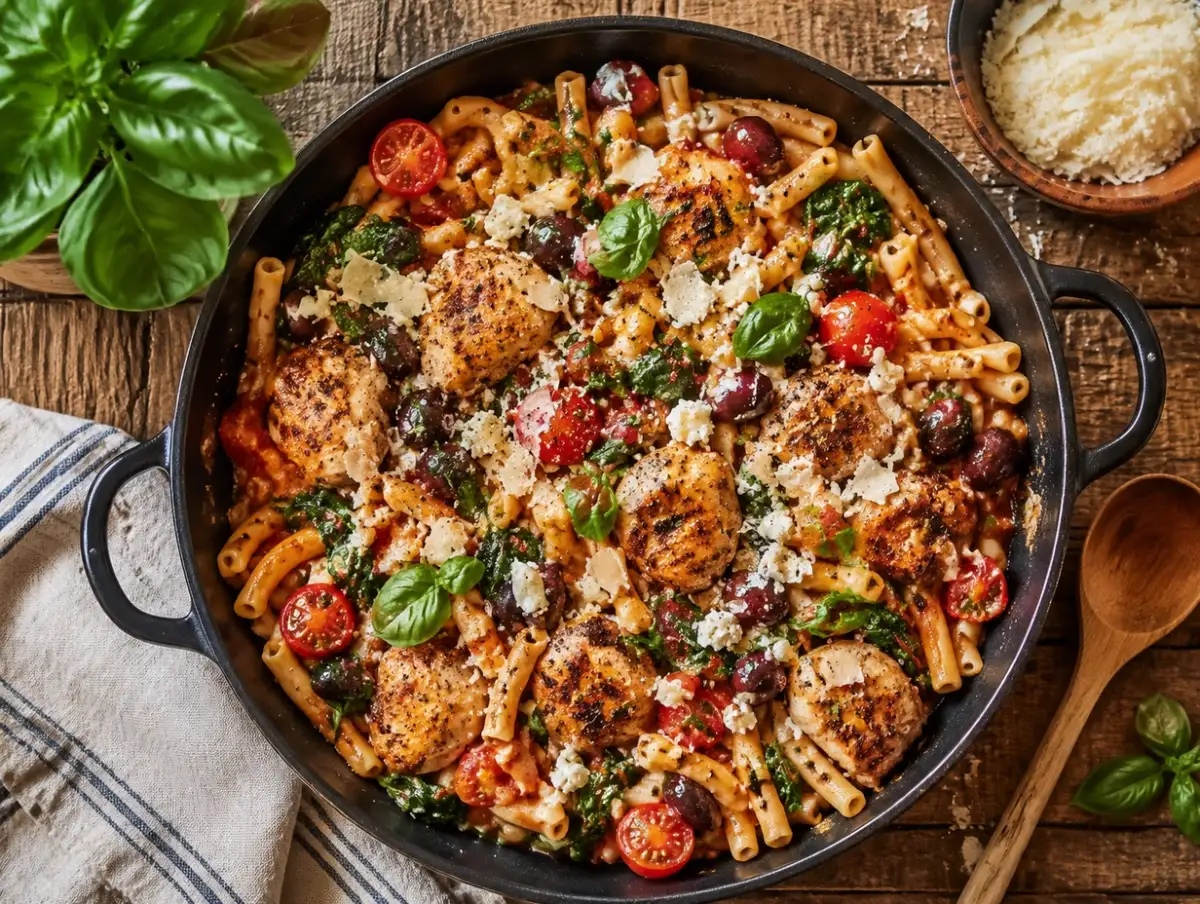
Right, so. There’s a specific type of Tuesday that happens to everyone — it’s 6:45pm, you haven’t thought about dinner since approximately 11am when you had good intentions, and the only thing you genuinely have energy for is standing in front of an open fridge making very poor decisions.
This recipe was born from one of those Tuesdays in March 2023, when I grabbed chicken breasts, half a can of diced tomatoes, and whatever pasta shape was left in the back of the pantry (penne, as it turns out) and just — started cooking. The result was chaotic and needed eight more test versions to become the one-pan Mediterranean Chicken Pasta & Fresh Basil you’re reading about now.
My neighbor Farouk — who has eaten more of my test versions than any human should have to endure — called Version 9 “the one” and then ate a second portion while standing at my kitchen counter, which I’m choosing to interpret as a five-star review. Seven secrets. Let’s go.
Table of Contents
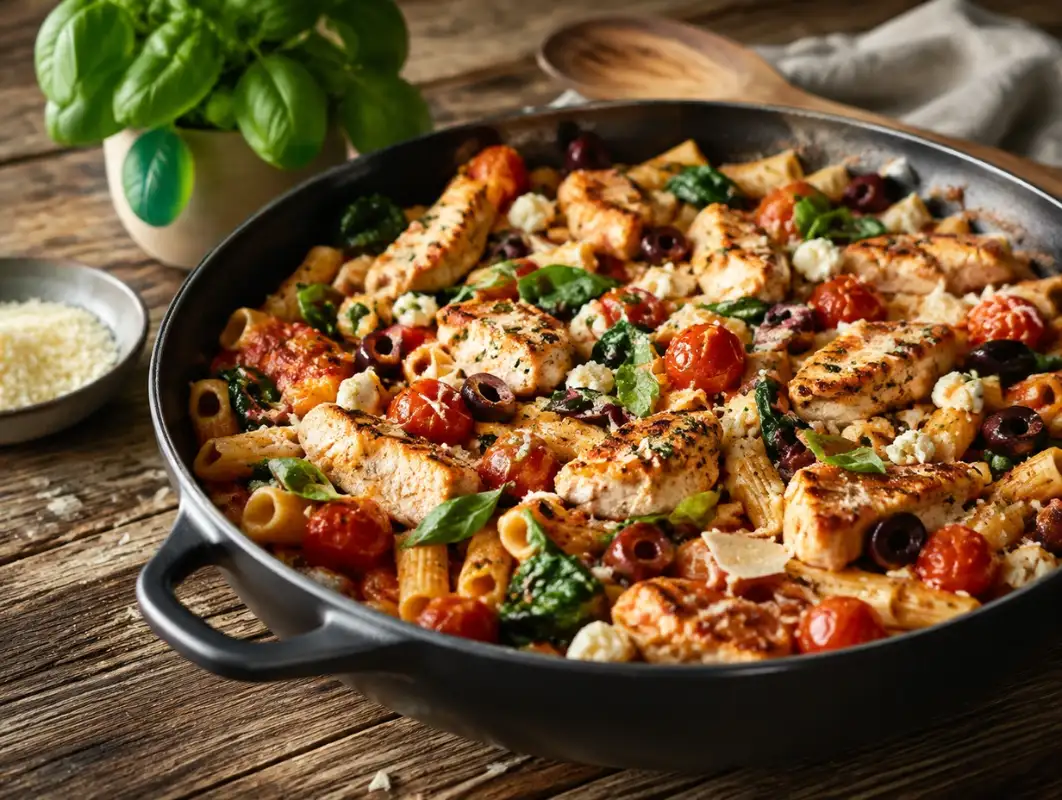
One-Pan Mediterranean Chicken Pasta with Basil
Ingredients
Method
- 1. Pat chicken completely dry. Season both sides with paprika, salt, pepper, oregano, garlic powder. Heat 2 tbsp olive oil in a 12-inch deep-sided skillet over medium-high until shimmering.
- 2. Sear chicken 6–7 min per side without moving, until golden crust forms and internal temp reaches 160°F/71°C. Transfer to plate; rest 5 min. Do not wipe the pan.
- 3. Reduce heat to medium. Add 1 tbsp olive oil to the pan. Add minced garlic, cook 60 sec stirring constantly. Add Italian herbs and red pepper flakes, stir 30 sec. The fond will lift and incorporate.
- 4. Add sun-dried tomatoes (and reserved 1 tbsp oil) and kalamata olives. Cook 2 min, stirring to coat in the garlic oil.
- 5. Add chicken broth, cherry tomatoes, lemon zest, lemon juice, sugar, and salt. Bring to a boil over medium-high. Add dry pasta; stir to submerge. Reduce to a vigorous simmer.
- 6. Cook pasta 12–14 min, stirring every 2 minutes, until al dente and sauce has thickened to a creamy coating consistency. Add broth ¼ cup at a time if pan looks dry before pasta is done.
- 7. Slice rested chicken against the grain. Add back to pan for final 2 min of pasta cooking to warm through.
- 8. REMOVE PAN FROM HEAT. Add torn fresh basil and 1 tbsp sun-dried tomato oil. Toss thoroughly — basil wilts from residual heat only.
- 9. Divide into bowls immediately. Top with cold crumbled feta, drizzle of olive oil, additional basil, and black pepper. Serve at once.
Notes
Why One-Pan Mediterranean Chicken Pasta & Fresh Basil Actually Works
The Science of One-Pan Pasta (It’s More Than Just Fewer Dishes)
The one-pan pasta technique — cooking pasta directly in a flavored liquid rather than in separate plain boiling water — was popularized widely around 2013 but the underlying food science is genuinely interesting. When pasta cooks in a reduced, flavorful liquid (here: chicken broth, crushed tomatoes, garlic, herbs), it releases starch into that liquid as it cooks. Harold McGee explains that pasta starch gelatinizes progressively as it hydrates and heats — and when it gelatinizes directly into a sauce rather than plain water, that starch becomes part of the sauce, thickening it into a silky, cohesive coating that clings to every piece of pasta rather than sitting under it.
The contrast with separately-boiled pasta is meaningful. When you boil pasta in a large pot of salted water, you’re actually washing away a significant amount of surface starch down the drain. (This is why Italian chefs always reserve pasta water — it’s liquid starch and it’s valuable.) The one-pan method keeps all of that starch in the sauce. The result is a sauce that is naturally thicker, richer, and more integrated with the pasta without any cream, butter, or thickeners. One pan, 35 minutes, significantly less cleanup. The technique is doing real flavor work, not just saving you from washing a colander.
The Occasion and Why This Isn’t Just a “Lazy” Recipe
I want to gently push back on the idea that one-pan pasta is somehow a lesser version of a proper dish. This one-pan Mediterranean chicken pasta is a complete protein + complex carbohydrate + vegetable meal with the flavor depth of something that took much longer — the lemon, fresh basil, kalamata olives, and sun-dried tomatoes are doing serious flavor lifting and the technique produces a sauce that genuinely tastes like you reduced it for 30 minutes. It’s also, yes, very fast and leaves you with one pan to wash. Both things can be true. For a compare-and-contrast Mediterranean pasta that’s cold-served and a bit more elaborate, our Mediterranean orzo salad is worth knowing about as the cold cousin of this dish.
The Ingredients That Make This Mediterranean, Not Just Pasta
Complete Ingredients List
Chicken
1½ lb (680g) boneless skinless chicken breasts, pounded to even thickness
1 tsp smoked paprika
1 tsp kosher salt + ½ tsp black pepper
½ tsp dried oregano + ¼ tsp garlic powder
2 tbsp (30ml) extra-virgin olive oil, for searing
Sauce + Pasta
1 tbsp (15ml) extra-virgin olive oil
5 garlic cloves, minced
1 tsp dried Italian herbs
½ tsp red pepper flakes (adjust to taste)
⅓ cup (55g) oil-packed sun-dried tomatoes, drained and roughly chopped (reserve 1 tbsp of the oil)
⅓ cup (55g) pitted kalamata olives, halved
2½ cups (600ml) low-sodium chicken broth
1 cup (150g) cherry tomatoes, halved
Zest + juice of 1 lemon
½ tsp sugar
12oz (340g) dried short pasta — penne or rigatoni
Off-Heat Finish
Large handful fresh basil (~½ cup packed), roughly torn — added OFF heat
1 tbsp reserved sun-dried tomato oil
To Serve
3oz (85g) feta cheese, crumbled cold from block in brine
Extra-virgin olive oil, for drizzle
Additional fresh basil leaves and black pepper
The Flavor Markers You Need and Why
I’ve made a lot of pasta — um, probably more than is strictly justifiable for one person who also writes about Mediterranean food professionally — and the thing that separates a genuinely Mediterranean pasta from pasta with herbs is the layering of bold, specific flavor markers: the sun-dried tomatoes’ concentrated umami, the kalamata olive brine threading through the sauce, the brightness of lemon zest, and fresh basil added entirely off-heat at the end so its aromatic volatile compounds don’t cook off. Remove the basil timing and you just get green flecks. Add it off-heat and you get actual basil flavor throughout. That distinction matters.
| Ingredient | Quality Spec | Why It Matters | US Substitution |
| Chicken breasts (1.5 lb / 680g) | Even thickness — pound if needed | Even thickness = even cooking; no dry ends with raw centers | Boneless chicken thighs (more forgiving, richer flavor) |
| Short pasta — penne or rigatoni (12oz / 340g) | Bronze-die cut (rough surface texture) | Rough texture holds sauce dramatically better than smooth | Any short pasta: ziti, farfalle, fusilli |
| Sun-dried tomatoes (⅓ cup / 55g) | Oil-packed, not dry | Oil-packed are plumper; richer concentrated tomato flavor | Roasted red peppers for milder profile |
| Kalamata olives (⅓ cup / 55g) | Pitted, in brine | Brine adds salt + acid to sauce naturally | Castelvetrano for milder; omit for olive-averse |
| Chicken broth (2½ cups / 600ml) | Low-sodium, good quality | This IS the pasta cooking liquid — quality shows in the sauce | Vegetable broth works equally well |
| Cherry tomatoes (1 cup / 150g) | Ripe; halved | Burst and contribute fresh acidity during cooking | Diced canned tomatoes (½ cup) for off-season |
| Fresh basil (large handful, ~½ cup packed) | Added completely OFF HEAT | Volatile aromatic compounds evaporate above 140°F — add cold to hot pasta off burner | Fresh parsley or fresh oregano as secondary option |
| Feta cheese (3oz / 85g) | Block feta in brine, crumbled at serving | Creamy salt contrast; do not cook into sauce or it melts completely | Shaved parmesan for non-Greek profile |
The Two Game-Changers Nobody Warns You About
First: liquid ratio is everything in one-pan pasta. Too little and the pasta scorches on the bottom before it’s cooked. Too much and you get a watery, under-reduced sauce. The ratio in this recipe — 2½ cups broth for 12oz pasta — was arrived at through seven test versions of adding and subtracting in 2-tablespoon increments. Your pan size affects this: a wider pan means faster liquid evaporation. A deeper, narrower pan holds liquid longer. Check at the 10-minute mark and add a splash of broth if the pan is looking dry before the pasta is done.
Second: never add feta to the hot sauce. Feta in brine is a soft cheese with roughly 55% moisture — add it to a hot sauce and it melts into an unappetizing grainy mess. Crumble it cold over the finished bowl right before serving and it stays creamy and intact. I discovered this in Version 3 and then apparently forgot it and re-discovered it in Version 5 and then wrote it down. Our Greek shakshuka bowl has the same feta-off-heat principle at work — the lesson applies everywhere.
The Foolproof Method — Layering Flavor in One Pan
Prep: Season, Sear, Set Aside (8 Minutes That Change Everything)
The biggest mistake I see in one-pan pasta recipes is dumping everything in raw from the start. The chicken needs to sear first, separately, to develop the Maillard reaction crust that creates hundreds of flavor compounds on the meat surface — compounds that then stay in the pan as fond (the sticky brown bits left after searing) and dissolve into the sauce when liquid is added. Skip the sear and the chicken will be technically cooked but bland. The fond is free flavor. Use it.
- Season the chicken (5 min): Pat 1.5 lb (680g) chicken breasts completely dry with paper towels — moisture is the enemy of browning, and a damp surface steams instead of sears. If breasts are uneven thickness, place in a zip-lock bag and pound gently to even thickness (~¾ inch). Season both sides generously with 1 tsp salt, ½ tsp black pepper, 1 tsp smoked paprika, ½ tsp dried oregano, ¼ tsp garlic powder.
- Sear the chicken (6–7 min per side): Heat 2 tbsp extra-virgin olive oil in a large (12-inch) deep-sided skillet or sauté pan over medium-high heat until shimmering. Add chicken breasts in a single layer without touching. Press gently to ensure full contact with the pan surface — this maximizes the sear area. Cook 6–7 minutes without moving. You’ll know it’s ready to flip when it releases naturally from the pan (it’ll stick if it’s not ready — don’t force it). Flip, cook 5–6 more minutes. Internal temp should reach 160°F/71°C. Transfer to a plate and rest while you build the sauce. Don’t wipe the pan.
- Build the aromatics in the fond: Reduce heat to medium. Add 1 tbsp olive oil to the same pan (don’t clean it — the fond is the point). Add 5 minced garlic cloves and cook 60 seconds, stirring constantly so garlic doesn’t burn. The fond will start to lift and incorporate into the garlic oil. Add 1 tsp dried Italian herbs, ½ tsp red pepper flakes (adjust to taste), stir 30 seconds. You should smell the garlic shift from sharp to sweet and nutty — that’s the signal to move on.
Pro Tip: If the fond (brown bits) looks like it’s burning rather than lifting, add 2 tbsp of broth immediately and scrape with a wooden spoon. This ‘deglazes’ the pan and incorporates the fond into the sauce before it chars. A little dark fond = flavor; actual burned bits = bitter. There’s a narrow window and this is how you stay on the right side of it.
Main Method: The One-Pan Pasta Cook (This Is Where the Magic Happens)
Now the actual one-pan pasta technique — everything goes in together and you manage the cook from here.
- Add sun-dried tomatoes + olives (2 min): Add ⅓ cup oil-packed sun-dried tomatoes (drained and roughly chopped) and ⅓ cup pitted halved kalamata olives directly to the garlic oil. Stir and cook 2 minutes. The sun-dried tomato oil is deeply flavorful — don’t let it drain away; scrape everything from the jar into the pan.
- Add liquid, tomatoes, pasta (1 min assembly): Pour in 2½ cups (600ml) low-sodium chicken broth. Add 1 cup (150g) halved cherry tomatoes, zest and juice of 1 lemon, 1 tsp sugar (balances tomato acidity), salt to taste. Bring to a boil over medium-high. Add 12oz (340g) dried short pasta — penne or rigatoni — stir to submerge, and reduce heat to maintain a vigorous simmer (not a full boil, not a gentle simmer — you want active bubbles breaking the surface throughout).
- Cook pasta in sauce (12–14 min, stirring frequently): Cook according to your pasta package’s al dente time minus 1 minute — the pasta will continue cooking from residual heat after you pull it from the burner. Stir every 2 minutes to prevent sticking. Watch the liquid level: at the 10-minute mark, the sauce should be visibly reduced and thickened from the pasta starch, with liquid just coating the pasta rather than pooling. If it looks dry before pasta is al dente, add broth ¼ cup at a time. If it looks soupy at the 12-minute mark, increase heat for the last 2 minutes.
- Slice and return chicken (1 min): While pasta finishes cooking, slice rested chicken against the grain into ½-inch pieces. Add chicken back to the pan for the last 2 minutes of pasta cooking to warm through.
- Off-heat finish — this is mandatory: Remove pan completely from heat. Add the handful of fresh basil (roughly torn, not chopped — tearing releases the oils without the oxidation that comes from a metal knife). Toss everything together. The residual heat wilts the basil just enough without cooking out its aromatics. The sauce will thicken further over the next 60 seconds as the starch stabilizes.
- Serve immediately: Divide into bowls. Crumble cold feta generously over the top. Drizzle with good extra-virgin olive oil. Additional fresh basil leaves for garnish. A final crack of black pepper and, if you have it, a pinch of za’atar or dried chili flakes on the feta. This is not a meal that waits — one-pan pasta is at its best in the first 10 minutes.
Maya’s Tip: For an extra layer of Mediterranean depth: add 1 tbsp of the sun-dried tomato oil from the jar directly into the finished pasta with the basil. It’s concentrated tomato and herb-infused oil and it makes the sauce taste like it’s been simmering for an hour. It takes two seconds and the flavor difference is noticeable.
On the pasta shape question — I’ve gotten this question so many times I need to address it directly. Short pasta (penne, rigatoni, ziti) works significantly better than long pasta (spaghetti, linguine) in the one-pan method because short pasta can be completely submerged in the liquid from the start and stirred easily without breaking. Long pasta requires more liquid and tends to stick together at the ends as it cooks down. Use short pasta. I know you love spaghetti. Not here. For the full deep-dive on Mediterranean pasta techniques, our Mediterranean orzo salad covers the orzo side of Mediterranean pasta cooking in equal detail.
Variations — The One-Pan Mediterranean Pasta Formula Is Flexible
Flavor Direction Variations
The base technique stays identical across all of these — sear protein, build aromatics in fond, cook pasta in flavored liquid, finish off heat. What changes is the Mediterranean flavor direction. I’ve tested all four variations and they’re all legitimately good:
| Variation | Protein Swap | Flavor Direction | Dietary Notes | Key Difference |
| Classic (this recipe) | Chicken breast | Lemon-tomato-basil-olive | GF-adaptable / Halal | The baseline; bright and balanced |
| Shrimp Mediterranean Pasta | Large shrimp (add last 3 min only) | Garlic-lemon-herb | GF-adaptable / Halal / quick | Reduce overall cook time; don’t over-cook shrimp |
| Vegetarian Mediterranean Pasta | Skip chicken; add white beans + eggplant | Richer, earthier profile | Vegetarian / Vegan without feta | Eggplant sears in same pan first as protein substitute |
| Spicy Arrabbiata Variation | Chicken breast | Double red pepper flakes + harissa | GF-adaptable / Halal | Heat-forward; serve with labneh to cool |
| Sun-Dried Tomato Cream Variation | Chicken thigh (more forgiving) | Creamy sun-dried tomato; add ¼ cup Greek yogurt off-heat | Vegetarian with swap | Richer; works for entertaining |
Dietary Modifications and the Budget Approach
Gluten-free: Use a good GF short pasta (chickpea or lentil pasta hold up well in one-pan cooking; rice pasta gets mushy). Reduce liquid by 2 tbsp and check doneness 2–3 minutes earlier as GF pasta often cooks faster.
Vegan: Skip chicken and feta; use vegetable broth; add a can of white beans or roasted eggplant as the protein component and finish with tahini drizzle instead of feta.
Budget play: Replace chicken breasts with chicken thighs (significantly cheaper), use regular black olives instead of kalamata, and swap cherry tomatoes for a half can of diced tomatoes. The technique and flavor structure are unchanged — the premium ingredients are a nice-to-have, not a requirement.
For a companion Mediterranean one-pan situation that costs even less per serving, our Mediterranean chickpea stew is the budget hero of our recipe collection.
Storage & Serving — Making This Work Beyond Night One
The Honest Storage Situation
I want to give you a real answer here rather than the usual “stores great for 5 days!” One-pan pasta is at its absolute best immediately after cooking, when the sauce is still loose and clinging and the basil is fragrant. By Day 2, the pasta absorbs most of the remaining sauce and you effectively have cold pasta salad with Mediterranean flavors. Which is, honestly, also good — but it’s a different eating experience. Plan to serve this fresh; make-ahead the components if you need to.
| Component/State | Storage | Duration | Reheat / Use |
| Fully assembled (pasta + chicken + sauce) | Airtight fridge | 3 days | Add 2–3 tbsp broth when reheating in pan; stir over low heat 3–4 min |
| Cooked chicken only (unsauced) | Airtight fridge | 4 days / freeze 2 months | Reheat in dry skillet or slice cold into pasta |
| Sauce without pasta | Airtight fridge | 5 days / freeze 3 months | Excellent make-ahead; cook fresh pasta directly in reheated sauce |
| Pre-assembled dry pasta + sauce (uncooked) | N/A — cook fresh | — | The one-pan method requires cooking; don’t par-cook and hold |
| Day 2 cold pasta | Fridge in container | 3 days | Outstanding cold as Mediterranean pasta salad; add drizzle olive oil + fresh basil |
The Smart Make-Ahead Move
The best make-ahead approach is to cook the sauce without pasta — everything through step 4 — and refrigerate. The sauce alone keeps 5 days and freezes beautifully. When you’re ready to eat, bring the sauce to a simmer, add fresh broth to bring it back to the right liquid level (about 1½ cups), add fresh dry pasta, and cook through. The entire from-sauce-to-table time is 15 minutes flat.
This is the professional catering approach to pasta service and it works just as well at home. For a similar make-ahead sauce strategy applied to a different protein entirely, our Greek shakshuka bowl sauce follows the same logic — make ahead, finish to order — and the principle is transferable to almost any Mediterranean sauce in this collection.
Nutritional Benefits — What This Pasta Bowl Is Delivering
Obligatory disclaimer: I’m not a dietitian. These are estimates from standard nutrition databases and will vary significantly based on pasta brand, broth sodium content, olive quantity, and whether you use the sun-dried tomato oil or not. For medical nutrition guidance, please speak with a registered dietitian. Now — here’s what you’re working with per serving:
Macronutrient Profile (per serving, ¼ of full recipe):
| Macronutrient | Per Serving | % Daily Value | Primary Source |
| Calories | ~520 kcal | 26% | Pasta + chicken + olive oil + feta |
| Protein | 42g | 84% | Chicken breast (35g) + feta (5g) + chickpea pasta if used |
| Total Carbohydrates | 52g | 19% | Penne pasta + cherry tomatoes + sun-dried tomatoes |
| Dietary Fiber | 4g | 14% | Pasta + tomatoes + olives |
| Total Fat | 16g | 21% | Olive oil + feta + olives + sun-dried tomato oil |
| Saturated Fat | 4g | 20% | Feta cheese |
| Unsaturated Fat | 12g | — | Extra-virgin olive oil + kalamata olives |
| Trans Fat | 0g | — | — |
| Sugar | 5g | — | Cherry tomatoes (natural) + sun-dried tomatoes |
| Sodium | 590mg | 26% | Feta + broth + olives — use low-sodium broth to reduce |
| Cholesterol | 95mg | 32% | Chicken breast + feta |
Micronutrient Highlights:
| Nutrient | Why It Matters | Key Sources in This Pasta |
| Lycopene | Antioxidant; cardiovascular protection — increases with cooking/heat | Cooked cherry tomatoes + sun-dried tomatoes |
| Vitamin B3 (Niacin) | Energy metabolism; DNA repair | Chicken breast — one of the highest dietary sources |
| Vitamin C | Immune function; enhances iron absorption from chicken | Cherry tomatoes + lemon juice |
| Polyphenols (hydroxytyrosol) | Strong antioxidant; anti-inflammatory; brain health | Extra-virgin olive oil — primary Mediterranean health compound |
| Potassium | Blood pressure regulation, muscle function | Tomatoes + pasta + chicken |
| Oleic Acid | Heart-healthy monounsaturated fat; supports HDL cholesterol | Olive oil + kalamata olives |
| Allicin | Cardiovascular protection; antimicrobial properties | 5 fresh garlic cloves — significant source per serving |
A note on the pasta-and-Mediterranean-diet tension: pasta is often unfairly maligned in weight-loss contexts, but the Mediterranean diet research — including the PREDIMED study — consistently includes pasta as part of the dietary pattern associated with cardiovascular benefit. The key is portion context, olive oil as the primary fat, and abundant vegetables alongside. This recipe hits all three criteria. For another Mediterranean dish that balances protein and carbohydrate in a similar way, the Greek souvlaki bowl with lemon potatoes is a natural companion in any weekly Mediterranean rotation.
FAQ — The Questions That Come Up Every Time I Make This
Can I use dried basil instead of fresh?
Technically yes, practically no. Dried basil is what’s left after the aromatic volatile compounds (linalool, eugenol, estragole) that make fresh basil smell and taste the way it does have largely evaporated during the drying process. What remains is a faint herby background note — fine in long-cooked sauces where you want depth, completely wrong for the bright, fragrant finish role that fresh basil plays here. If you truly cannot get fresh basil, use fresh flat-leaf parsley (a different flavor but similarly bright and fresh-tasting). Fresh oregano works too. Dried basil: use elsewhere.
My pasta absorbed all the sauce. How do I fix it?
Two options. For a fix while still cooking: add broth ¼ cup at a time, stir over medium-low heat, and let the pasta absorb just enough to return the sauce to a creamy coating consistency. For reheating next day: same approach — add 2–3 tbsp broth or even water per serving in a pan over low heat. The starch in the pasta will re-emulsify with the added liquid as it heats. Don’t add too much or you’ll water down the flavor; add in small increments.
What pasta shapes work best for one-pan pasta?
Short, sturdy shapes: penne, rigatoni, ziti, casarecce, gemelli, mezze maniche. The criteria are: (1) completely submersible in the liquid volume, (2) a hollow or tubular structure that fills with sauce, and (3) a rough texture if possible — bronze-die extruded pasta has a textured surface that holds sauce much better than smooth Teflon-extruded pasta. Long pasta like spaghetti doesn’t submerge evenly and tends to clump at the point where it bends. Genuinely, please use short pasta for this. I will know.
The chicken is cooked through but I’m worried about the one-pan timing. Any tips?
The sear-then-remove method in this recipe specifically addresses timing anxiety. You sear the chicken fully first (internal temp 160°F / 71°C — it carries over to 165°F while resting), remove it, cook the pasta completely in the sauce, then add the chicken back for the last 2 minutes just to warm through. There’s zero risk of underdone chicken if you verify the temp during the initial sear, and zero risk of overcooked chicken because it’s not sitting in the liquid during the full pasta cook time.
Can I make one-pan Mediterranean chicken pasta in advance for a dinner party?
Yes, using the make-ahead sauce strategy. Cook everything through step 4 (sun-dried tomatoes, olives, garlic, initial liquid) but stop before adding pasta. Refrigerate the sauce up to 5 days. Sear the chicken separately up to 2 days ahead and refrigerate sliced. The night of the party: bring sauce to simmer, add 1½ cups fresh broth, add dry pasta, cook 12–14 minutes. Stir in pre-cooked sliced chicken last 2 minutes. Off-heat finish with fresh basil and feta to order. This makes feeding 8 people from one recipe completely manageable.
Is this recipe gluten-free?
Not by default — regular pasta contains wheat gluten. Easily made GF by substituting a good short gluten-free pasta. Chickpea pasta (Banza is the most available US brand) holds up particularly well in one-pan cooking and adds around 13g extra protein per serving. Lentil pasta also works well. Rice-based GF pasta tends to get soft quickly — reduce liquid by 2 tbsp and check doneness 2–3 minutes earlier than the package directs.
What do I do if the sauce tastes flat?
In order: (1) More salt — under-salted pasta sauce always tastes flat, even if you’ve salted throughout. Taste and add kosher salt ¼ tsp at a time. (2) More acid — a squeeze of lemon juice brightens the entire flavor profile almost instantly. (3) More fat — a drizzle of good olive oil off-heat adds richness and carries the fat-soluble flavor compounds. (4) More herb intensity — tear a few more fresh basil leaves over the top. Flat Mediterranean pasta sauce is almost always an under-seasoning issue, not an ingredient quality issue.
Pairing & Serving Ideas — Completing the Mediterranean Table
What Goes Alongside One-Pan Mediterranean Chicken Pasta
| Occasion | Serving Style | Best Side | Drink Pairing |
| Quick weeknight dinner | Bowls from the pan | Simple arugula salad with lemon | Sparkling water with lemon + mint |
| Dinner party (4–6 guests) | Large serving bowl; feta + basil on top | Greek salad + warm pita for scooping extra sauce | Pomegranate juice or hibiscus iced tea |
| Meal prep week | Individual containers; basil + feta added daily | Cucumber-tomato side | Mint iced tea or lemon water |
| Family with kids | Mild version (less pepper flakes); tzatziki as dip | Pita triangles + cucumber sticks | Sparkling water with fruit slices |
| Romantic dinner for two | Pasta + halved recipe; elegant bowl presentation | Light arugula-cherry tomato salad | Fresh lemonade with herbs |
The Complete Mediterranean Table Around This Pasta
When this is the centerpiece of a dinner party, here’s the table I build around it: our classic hummus goes out as soon as guests arrive with warm pita — buys 20 minutes of cooking time while everyone grazes and nobody panics about being hungry. A simple arugula salad with lemon dressing and shaved parmesan on the side cuts through the pasta’s richness. For dessert — which I never know how to handle, honestly — a simple bowl of fresh fruit with honey and a sprinkle of crushed pistachios requires zero cooking and looks elegant. The one-pan pasta is the thing you spent the most energy on; let the surrounding elements be easy.
The One-Pan Formula Is Yours Now
Seven Secrets, One More Time
Fast summary before you go: (1) Dry the chicken before searing — moisture = steam = no crust. (2) Don’t clean the pan after searing; the fond is free flavor. (3) Liquid ratio is 2½ cups per 12oz pasta — adjust by pan size. (4) Stir every 2 minutes during the pasta cook; this isn’t a set-and-forget situation. (5) Sun-dried tomato oil from the jar goes in with the sauce. (6) Fresh basil is added completely off heat — no exceptions. (7) Feta is crumbled cold over the finished bowl, never cooked in. Seven things. All of them matter. All of them are fast.
Farouk’s “the one” verdict, the nine test versions, the March 2023 Tuesday chaos that started all of this — all of it landed here, in a 35-minute skillet pasta that tastes significantly more invested than the time it takes. That’s the whole point of this collection, honestly. Good flavor doesn’t have to be slow.
Community: Tell Me Your Variation
Drop a comment below with which variation you made — the shrimp version? The vegan eggplant-white-bean version? Did you use chickpea pasta? (I want to hear about the chickpea pasta situations specifically.) Tag your bowl and I will look at every single one. And if this has you in a Mediterranean weeknight dinner mood, the Greek souvlaki bowl with lemon potatoes and our Mediterranean nourish bowl are the natural next moves — same flavor family, different formats, same 30–40 minute weeknight promise.