My father came home from the sea at different hours depending on what the Aegean had decided to give him that day. Sometimes it was a single species — silvery lavraki, or a net of squid still changing colour. But on the lucky days, the days I remember most, he’d walk through the door carrying a bucket with five or six different creatures in it, and my yiayia would look at that bucket the way a painter looks at a full palette.
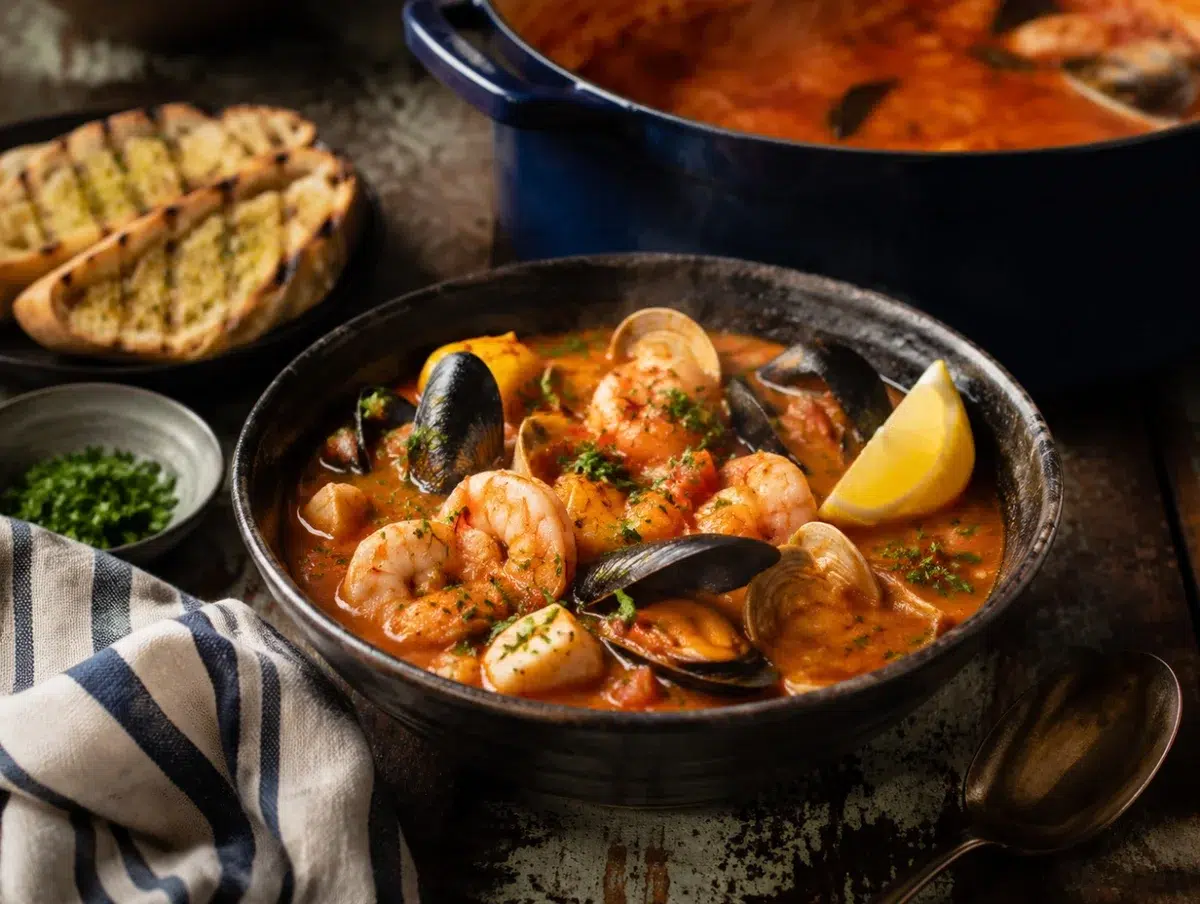
Those were the nights she made what we simply called the fisherman’s pot: everything into a wide, shallow tapsi with tomatoes, saffron, garlic, and enough olive oil to make the broth shine like the harbour at sunset. What I’m sharing with you today is my version of that pot — a Mediterranean Seafood Stew (Cioppino) that draws on both the Ligurian-Italian tradition the name comes from and the Cretan fisherman’s cooking I grew up watching.
The name cioppino likely derives from the Genoese word ciuppin — to chop, or to stir together — which perfectly describes the philosophy: you use what the sea gives you, you build a fierce tomato broth, and you cook every piece of seafood with precision. I’ve made this Mediterranean seafood stew at least 35 times since I started teaching it in my Athens workshops, and the version I’ve landed on is something I’m genuinely proud of: deeply flavoured, surprisingly simple, and the kind of dish that makes people lean over the pot before it even reaches the table.
What follows is everything I know about getting this right — the science behind timing each seafood correctly, the single ingredient that separates a good cioppino from a transcendent one, and the four mistakes that ruin most home versions. You’ll want to make this on a Friday night when you have an hour and a crowd worth impressing.
Table of Contents
Mediterranean Seafood Stew Cioppino
Ingredients
Method
- 1. Steep ¼ tsp saffron in 3 tbsp warm (not boiling) broth for 5+ minutes.
- 2. Heat olive oil over medium in a wide pot. Cook onion and fennel 10–12 min until deeply golden. Add garlic 1 min. Add anchovy paste, stir 60 sec until dissolved. Add chilli flakes and oregano, stir 30 sec.
- 3. Add crushed tomatoes, sun-dried tomato paste, remaining broth, saffron liquid, and salt. Bring to simmer. Cook uncovered 15 min until broth has reduced and deepened. Taste — it must be extraordinary before seafood goes in.
- 4. Pat fish dry, season with salt and pepper. Nestle fish into simmering broth. Cover, cook 4 min.
- 5. Add scrubbed mussels over the fish. Cover, cook 4–5 min until mussels open. Discard any still closed after 6 min.
- 6. Add shrimp, stir gently once. Cover, cook 2–3 min until pink and C-shaped. Do not overcook.
- 7. Remove from heat. Add squid rings and tentacles. Cover, leave 2 min (residual heat cooks squid perfectly).
- 8. Taste. Add lemon juice, adjust salt. Scatter fennel fronds and parsley. Drizzle olive oil.
- 9. Place bread in warmed bowl bases. Ladle stew generously over. Serve immediately.
Notes
Why This Mediterranean Seafood Stew Is Genuinely Different
The Technique That Sets This Cioppino Apart
Most cioppino recipes add all the seafood at the same time and cross their fingers. The result is shrimp like rubber bands sitting next to raw mussels, or — just as bad — perfectly cooked shrimp floating in a pot of still-firm clams. The technique that changed everything for me is staggered seafood addition: you add each type of seafood based on its cooking time, working from longest to shortest.
Mussels and clams need 6–8 minutes; firm fish chunks need 8–10 minutes; shrimp and squid need only 2–3 minutes at the end. According to J. Kenji López-Alt in The Food Lab, shrimp proteins begin to tighten above 50°C / 122°F and are fully overcooked by the time they hit 60°C / 140°F — a window of barely 3 minutes in a simmering broth. Build the timing right and every element in your seafood soup is cooked perfectly, not just some of it.
A Flavour Profile That Earns Its Place at Any Table
This easy cioppino is layered in a way that feels genuinely coastal Mediterranean: the base is slow-cooked sweet fennel and onion in good olive oil, then a hit of anchovy paste that melts invisibly into the sauce and contributes a deep, savoury backbone.
San Marzano tomatoes, a generous pinch of saffron steeped in warm fish broth, a spoonful of sun-dried tomato paste for concentrated sweetness. The seafood — shrimp, white fish, mussels, and squid — cooks in this broth and gives back everything it has. The result is somewhere between a healthy seafood stew and a restaurant-worthy Italian seafood stew: bold, complex, and deeply, completely satisfying. Serve it with enough good bread to address the broth seriously. You will need a lot of bread.
The Story Behind This Cioppino Recipe
From Ligurian Docks to the Mediterranean Table
The classic cioppino is famously associated with San Francisco, where Ligurian fishermen who had emigrated to the city’s wharf district in the late 19th century created it from the scraps of the daily catch. The dish they made was essentially the same stew their grandmothers had cooked on the Ligurian coast — a mixed seafood stew in a tomato and broth base, the name echoing the Genoese verb ciuppin (‘to chop’ or ‘to crush tomatoes’).
What links the Italian version to what I grew up eating in Crete is the philosophy, not the recipe: you use whatever the sea gives you that day, you build a sauce that could stand alone, and you cook everything with respect for its texture. The Mediterranean fish soup and the cioppino recipe are cousins separated by an ocean, united by the same instinct.
My Father’s Bucket and My Yiayia’s Tapsi
My father was not a sentimental man about cooking. He caught the fish; he expected someone else to know what to do with it. But he had an opinion about the mixed catch pot: it had to contain at least three different species, it had to cook in olive oil first before the tomatoes came in, and the broth had to be ‘thick enough to hold a spoon upright.
‘ My yiayia’s version met all three criteria, and also included a practice I’ve kept ever since: she put a piece of stale bread at the bottom of each bowl before ladling the stew over it. It absorbed the broth from underneath and created this extraordinary, almost panade-like layer at the base. I still do this. If you try it once you will never serve cioppino any other way.
Essential Ingredients for Mediterranean Seafood Stew (Cioppino)
Complete Ingredients List
Seafood:
400 g / 14 oz firm white fish fillets (cod, halibut, or hake), cut into 4–5 cm chunks
300 g / 10 oz raw large shrimp / prawns, shell-on, deveined
400 g / 14 oz fresh live mussels, scrubbed and debearded
200 g / 7 oz squid, cleaned, tubes cut into 1.5 cm rings, tentacles whole
Aromatics & Broth:
3 tablespoons extra virgin olive oil (Sitia PDO preferred)
1 medium onion, finely diced
1 small fennel bulb, diced (fronds reserved for garnish)
4 garlic cloves, minced
1 tsp anchovy paste (or 2 anchovy fillets in olive oil)
1 tsp dried red chilli flakes (adjust to taste)
1 tsp dried oregano
1 × 400 g tin San Marzano crushed tomatoes
2 tbsp sun-dried tomato paste
500 ml / 2 cups fish or seafood broth (no alcohol)
¼ tsp saffron threads, steeped in 3 tbsp warm broth
½ tsp fine sea salt
To Finish:
1 tbsp fresh lemon juice
Reserved fennel fronds
Large handful flat-leaf parsley, roughly chopped
1 tbsp extra virgin olive oil, for drizzling
Good bread (toasted or day-old), for serving in bowl base
Core Ingredients — Why Each One Earns Its Place
Over 35 batches, I’ve changed this ingredient list significantly. What you see below is what stayed — and why:
| Ingredient | Amount | Why It Matters | Authentic Pick | Substitution |
| Firm white fish fillets | 400 g / 14 oz | Adds meaty body; soaks up broth flavour during the final simmer | Cod, halibut, or hake | Monkfish (meatier), sea bass (sweeter) |
| Raw large shrimp / prawns | 300 g / 10 oz, shell-on | Shell-on shrimp release collagen into the broth; adds depth and body | Shell-on fresh or frozen, deveined | Peeled shrimp (add 1 tbsp extra fish broth to compensate) |
| Fresh mussels | 400 g / 14 oz, scrubbed and debearded | Open as they cook; release natural brine that seasons the entire broth | Fresh live mussels | Clams (cockles or littleneck); adjust time to 8 min |
| Squid / calamari tubes and tentacles | 200 g / 7 oz, cleaned | Adds silkiness and umami; cooks in 2–3 min or needs 40 min — nothing between | Pre-cleaned fresh squid | Leave out if unavailable; add extra shrimp |
| San Marzano crushed tomatoes | 1 × 400 g tin | Lower acid, fleshier, sweeter than standard tinned tomatoes — critical for broth quality | San Marzano DOP (tinned) | Passata + ½ tsp sugar to compensate sweetness |
| Anchovy paste or fillets | 1 tsp paste or 2 fillets | Melts completely; adds invisible savouriness (glutamate) without fishy taste | Italian anchovy fillets in olive oil | ½ tsp fish sauce (same glutamate effect) |
| Saffron threads | ¼ tsp steeped in warm fish broth | Signature golden colour and honeyed aroma; distinguishes Mediterranean version from standard cioppino | Spanish or Iranian saffron | ½ tsp turmeric (colour only, different flavour) |
| Fish or seafood broth (no alcohol) | 500 ml / 2 cups | Broth base; use quality here — it becomes the stew | Homemade fish stock or good-quality low-sodium broth | Chicken broth + 1 tbsp lemon juice (lighter body) |
I want to say something about anchovy paste. I was — embarrassingly — afraid of it for the first 10 years I cooked seriously. Too fishy, I thought. Too aggressive. Then I watched the chef at Varoulko work a teaspoon of anchovy fillets into an oil base for a fish dish, watched them dissolve in 90 seconds into something completely invisible, and tasted the result: depth I couldn’t otherwise explain. Harold McGee in On Food and Cooking explains why: anchovies are extraordinarily rich in glutamates — the same compounds responsible for umami — which dissolve into fat and become a flavour foundation that the brain registers as ‘more savoury’ without identifying the source. One teaspoon. That’s all it takes. Trust me on this.
And the saffron — I know I keep coming back to it in every Mediterranean seafood recipe, but there is no substitute for that honeyed, slightly metallic, deeply floral quality. A quarter teaspoon steeped for 5 minutes in warm broth turns a tomato fish stew into something that tastes ancient. It costs almost nothing per dish. Do not leave it out.
Dietary Substitutions and Flexibility
| Dietary Need | Replace | With | Notes |
| Gluten-free | Bread garnish only | Certified GF bread or polenta | All other ingredients are naturally GF; verify anchovy paste label |
| Shellfish allergy | Mussels + shrimp + squid | Double the white fish + add 200 g firm tofu or extra chickpeas | Broth loses some natural brine; add ½ tsp fish sauce and extra lemon |
| Lower sodium | Anchovy paste + fish broth | Omit anchovy; use low-sodium homemade broth | Compensate with 1 tbsp lemon juice and more garlic for depth |
| Pescatarian (already is) | No change needed | — | Recipe is naturally pescatarian as written |
| Dairy-free (already is) | No change needed | — | No dairy in the recipe at any point |
🌊 Pro Tip: Save your shrimp shells. If you’re peeling them ahead of time, simmer the shells in 600 ml water with a halved onion and a bay leaf for 15 minutes, then strain. That is your homemade shrimp broth. It costs nothing and makes this Mediterranean seafood stew dramatically more flavourful than store-bought broth ever will.
Equipment and Mise en Place
The Right Pot and Why It Matters
| Traditional Tool | Modern Alternative | Why It Matters |
| Wide, shallow terracotta tapsi | 12-inch / 30 cm wide Dutch oven or straight-sided braiser | Width matters: more seafood surface contact with broth; shallower depth means more even steam distribution |
| Wooden pestle for crushing tomatoes | Hands or potato masher | Partially crushing San Marzano tomatoes gives irregular texture — some smooth, some chunky — that makes the broth more interesting |
| Long-handled ladle | Any deep ladle | Essential for serving without disturbing the seafood arrangement at the bottom |
| Sharp kitchen scissors | Sharp chef’s knife | For cutting squid tubes into rings; scissors are actually faster and neater for this task |
| Wide, deep serving bowls (prewarmed) | Any large bowl, rinsed with boiling water | Cold bowls drop the broth temperature 10–15 degrees in 90 seconds; always prewarm your serving vessels |
Mise en Place — The Non-Negotiable Pre-Cook Checklist
This dish moves quickly once the broth is built — the entire seafood-cooking window is roughly 12 minutes. If you are scrambling to scrub mussels while shrimp overcooks in the pot, the whole thing falls apart. Before you turn on a single burner: steep saffron. Scrub and debeard mussels (tap any open ones — if they don’t close, discard). Pat fish dry, cut into 4–5 cm / 1.5–2 inch chunks. Devein shrimp. Cut squid tubes into 1.5 cm rings, tentacles left whole. Dice onion, fennel, and garlic. Open and partially crush tomatoes with your hand. Have the broth measured and warm. Once the broth is built and simmering, you have a clear, sequential 12-minute window. Know the sequence before you begin.
How to Make Mediterranean Seafood Stew (Cioppino): Step-by-Step
Preparation Steps 1–4
Step 1 — Steep the Saffron
Warm 3 tablespoons of your fish broth in a small cup to about 80°C / 176°F — hot but not boiling. Drop in ¼ teaspoon saffron threads. Leave for at least 5 minutes. The liquid will turn amber-gold. Saffron’s principal colourant, crocin, is water-soluble and releases best in warm (not boiling) water — a fact confirmed by McGee’s research on spice chemistry. Boiling water actually degrades the aromatic compounds. Warm is the word.
🌊 Yiayia’s Tip: My grandmother always steeped saffron while she did everything else. She said a rushed saffron is a wasted saffron. Five minutes minimum. Ten is even better.
Step 2 — Build the Aromatics Base
Heat 3 tablespoons extra virgin olive oil in your widest, deepest pot over medium heat until shimmering. Add 1 medium onion (diced), 1 small fennel bulb (diced, fronds reserved), and 4 garlic cloves (minced). Cook, stirring occasionally, for 10–12 minutes until the onion is deeply golden and the fennel has softened and sweetened — you’ll smell a faint anise note as the fennel breaks down. Add 1 teaspoon anchovy paste (or 2 fillets) and cook, stirring, for 60 seconds until fully dissolved. Add 1 teaspoon red chilli flakes (adjust to your preference) and 1 teaspoon dried oregano. Stir 30 seconds.
Step 3 — Build the Tomato Broth Base
Add 400 g San Marzano crushed tomatoes (or whole tomatoes partially crushed by hand), 2 tablespoons sun-dried tomato paste, the saffron-steeped broth, and the remaining 470 ml / 2 cups of fish broth. Add ½ teaspoon sea salt. Stir everything together. Bring to a simmer over medium-high heat, then reduce to medium. Cook uncovered for 15 minutes, stirring occasionally, until the broth has reduced slightly and deepened to a rich rust-red-gold. Taste it at this point. It should be intensely savoury, slightly sweet from the fennel, and faintly spiced. If it tastes flat, add a pinch more salt and another small squeeze of sun-dried tomato paste. This is your foundation — make it extraordinary before any seafood touches it.
🌊 Yiayia’s Tip: My yiayia always tasted the broth three times during the 15-minute simmer. ‘The broth will tell you what it needs,’ she said. She was not wrong. Taste yours and listen.
Step 4 — Final Prep While Broth Simmers
While the broth builds, do your final seafood prep. Pat fish chunks completely dry — this matters even in a stew, because water on the fish surface dilutes the broth locally and prevents the fish from taking on any flavour from the initial contact with the liquid. Season fish pieces with ¼ teaspoon salt and ¼ teaspoon black pepper. Have your mussels scrubbed and ready, shrimp deveined and in a bowl, squid rings cut. Prewarm your serving bowls by filling them with hot water for 2 minutes. When the broth is ready, drain the bowls.
Cooking Steps 5–10: The Staggered Seafood Method
Step 5 — Add the Fish First
With the broth at a steady simmer (medium heat, small bubbles — not a rolling boil), nestle fish chunks into the liquid. They should be half-submerged. Do not stir. Cover and cook for 4 minutes. At this point the fish is almost, but not quite, done — it will finish during the next additions. This partial-cook approach from J. Kenji López-Alt’s carry-over cooking principles means the fish doesn’t overcook in the extended window of the following steps.
Step 6 — Add the Mussels
Add mussels directly over the fish and broth. Cover and cook 4–5 minutes until mussels have opened. Discard any that remain closed after 6 minutes — they were dead before cooking and are not safe to eat. As the mussels open, they release their natural brine into the broth, adding another layer of oceanic depth to the entire Mediterranean seafood stew. The broth will visibly deepen in colour and intensity.
Step 7 — Add the Shrimp
Add shrimp directly into the broth around the mussels. Stir very gently once to distribute. Replace the lid and cook 2–3 minutes until shrimp are opaque, pink, and just curled into a C shape. An overcooked shrimp curls into an O — tight and bouncy and rubbery. C-shaped is perfectly cooked. Take the pot off the heat the moment you see C shapes throughout.
Step 8 — Add the Squid
With the pot off the heat (residual temperature is 85–90°C / 185–195°F), add squid rings and tentacles, stir very gently, and cover for 2 minutes. The residual heat cooks squid in this window perfectly — tender, not chewy. Squid has a notoriously narrow cooking window: it is either tender (under 3 minutes) or needs 40+ minutes of braising to become tender again. Two minutes in residual heat is the exact sweet spot.
Step 9 — Taste and Final Seasoning
Gently ladle some broth into a spoon and taste it. The mussel brine will have raised the salt level; you may need no additional salt at all. Add a small squeeze of lemon juice (about 1 tablespoon) to brighten everything. Scatter the reserved fennel fronds and a generous handful of flat-leaf parsley over the top. A final drizzle — 1 tablespoon of your best Sitia EVOO — over the surface. This is ladolemono thinking: olive oil and lemon together on seafood is as old as the Mediterranean itself.
Step 10 — Serve Immediately
Place a piece of good bread (or a slice of toasted day-old sourdough) in the bottom of each prewarmed bowl. Ladle the Mediterranean Seafood Stew (Cioppino) generously over it — fish, shrimp, mussels, squid, and that glowing, saffron-bronze broth. Serve alongside our garlic Parmesan focaccia for the full experience of tearing warm bread into hot broth. Serve immediately — this is not a dish that waits.
The Secret Touches That Make This Cioppino Extraordinary
Four Techniques That Separate Good from Transcendent
The Anchovy Foundation: One teaspoon of anchovy paste dissolved into the oil base before the tomatoes go in. You will not taste anchovy. You will taste umami — a depth of savouriness that your guests will not be able to identify but will keep reaching for. McGee explains this as glutamate synergy: anchovies and tomatoes both contain high glutamate levels, and together they create an umami effect significantly greater than either alone.
The Bread-in-Bowl Technique: My yiayia’s trick — a piece of stale bread at the bottom of the serving bowl, ladle the stew over. The bread becomes a kind of rough crouton panade, absorbing broth from underneath while staying slightly firm on top. It turns an already extraordinary bowl into something almost architectural. Do not use fresh bread — it disintegrates. Day-old or toasted is what you need.
The Shell-On Shrimp Rule: Cook shrimp shell-on even if you plan to eat them without the shell. The shells contain collagen that dissolves into the broth during cooking, adding body and a subtle crustacean sweetness you simply cannot get any other way. I peel them at the table — it adds two minutes and enormous flavour.
The Fennel Frond Garnish: Reserve the fennel fronds from the beginning and scatter them over the finished stew. Their fresh, grassy anise note contrasts with the deep cooked-fennel flavour in the broth and makes the dish smell extraordinary from a metre away. Never throw fennel fronds away. They are garnish, they are flavour, and they are free.
Common Mistakes and How to Fix Them
| Mistake | What Happens | How to Fix It |
| Adding all seafood at once | Shrimp overcooked and rubbery before mussels open; fish falls apart | Use strict staggered addition: fish first (4 min), mussels (4–5 min), shrimp (2–3 min), squid last off heat (2 min) |
| Not building the broth long enough | Thin, raw-tasting broth that seafood can’t salvage | Simmer the tomato-broth base uncovered for 15 full minutes before any seafood goes in; it must taste great alone |
| Using frozen mussels or clams pre-cooked | No brine release; broth stays flat; mussels are rubbery | Only use live fresh mussels; tap any open ones before cooking — close = fresh |
| Boiling (not simmering) the seafood | Shrimp seizes and toughens; fish breaks apart; squid becomes rubber | Keep at a steady, gentle simmer (small bubbles visible at edges only); reduce heat if needed |
| Skipping the bread in the bowl | Good stew, not great stew | Day-old or toasted bread in bowl bottom — trust this completely |
Variations, Serving Ideas & Pairings
Regional Variations and Modern Adaptations
The San Francisco classic cioppino uses dungeness crab as its centrepiece; my Mediterranean version uses mussels and squid as the shellfish backbone. In Crete, this type of one-pot seafood dinner would include octopus (cut small and braised in first before the tomatoes to tenderise it — add it with the onion and give it 20 minutes of braising before you build the sauce).
On the Greek islands, horta — wild greens — are sometimes wilted into the broth at the end, a practice that adds iron, colour, and a pleasant bitterness. A weeknight shortcut: use a 600 g bag of frozen mixed seafood (defrosted completely and patted dry), skip the mussel step, and simply add all seafood in a single batch for 4–5 minutes. You lose some of the magic but still get a genuinely excellent easy cioppino in 30 minutes. You could also build the broth using our Mediterranean keto skillet spice approach for a land-and-sea fusion version.
Accompaniments and Non-Alcoholic Pairings
The only accompaniment this Mediterranean seafood stew truly needs is bread — and lots of it. Our garlic Parmesan focaccia is spectacular torn into the broth. Alternatively, the classic Greek lemon rice pilafi makes a beautiful base instead of bread. If you want a lighter starter before this stew, the Mediterranean hummus breakfast bowl components — good olive oil, vegetables, chickpeas — won’t compete with the seafood that follows.
For drinks: the broth itself is so intensely flavoured that it needs something clean alongside it. Sparkling water with a thin slice of lemon and a sprig of fresh fennel frond is elegant and thematic. Tsai tou vounou — Greek mountain tea served cold — cuts through the richness beautifully. Homemade lemonade with a little fresh basil works wonderfully; the lemon note echoes what’s already in the stew. Hibiscus iced tea provides a tartness that matches the tomato acidity without fighting it. Whatever you choose, keep it simple and cold.
Storage and Reheating
How to Store Leftover Seafood Stew
| Component | Container | Duration | Notes |
| Full stew (all seafood in broth) | Airtight glass container | Fridge: 1 day maximum | Seafood quality degrades fast; best eaten day-of |
| Broth only (seafood removed) | Airtight glass container | Fridge: 3–4 days / Freeze: 3 months | Excellent base for another batch of seafood the next day |
| Cooked fish chunks only | Airtight glass container | Fridge: 2 days | Can be flaked into the reheated broth with fresh shrimp added |
| Cooked mussels | In their shells in broth | Fridge: 1 day maximum | Discard any that smell even slightly off |
| Broth only (frozen) | Freezer bag, remove air | 3 months | Freeze the broth when it’s excellent and you can have cioppino in 20 minutes any night |
Reheating Without Ruining the Seafood
The honest answer: reheating fully assembled cioppino is imperfect at best. The best approach is to reheat only the broth (gently, on medium-low until just simmering), then add fresh raw shrimp and fish to cook in it for the final 4–5 minutes before serving. This gives you the flavour of yesterday’s fully developed broth with the texture of freshly cooked seafood. Stovetop only — microwave reheating of seafood stew creates an unappealing, steamed-fish smell and uneven textures. What to add fresh before serving: a squeeze of lemon, fresh parsley, a drizzle of olive oil, and if possible a handful of fresh mussels for visual drama.
Frequently Asked Questions
Substitutions & Technique Q&A
Can I make Mediterranean Seafood Stew (Cioppino) without mussels?
Absolutely — and I’ve made it this way plenty of times when mussels weren’t available at the market. Replace the mussels with 400 g littleneck or Manila clams (same timing: 6–8 minutes until opened), or simply skip the shellfish entirely and increase the white fish to 600 g. The broth loses some natural brine — compensate with ½ teaspoon more fish sauce or anchovy paste. The cioppino recipe remains excellent, just a slightly different character.
What is the best broth for this seafood broth base?
Homemade shrimp-shell broth is unbeatable (simmer shells in water 15 minutes — recipe above). Second choice: good-quality low-sodium fish or seafood broth from a reliable brand. Third: chicken broth with a tablespoon of lemon juice. What I strongly advise against is using plain water — the broth needs body and savoury depth that water simply cannot provide, even with all the other flavours in the pot. The seafood broth is the carrier of everything you’ve built.
Can I use frozen seafood for this easy cioppino?
Yes — with one critical rule: thaw overnight in the fridge, then pat every piece completely dry before cooking. Frozen seafood holds more water than fresh; if you don’t dry it, that water steams off into the broth and dilutes your beautiful sauce. Frozen shrimp and squid work very well. For mussels, use only fresh live ones — frozen pre-cooked mussels don’t release brine, the single most important contribution they make to the broth.
How do I know when the shrimp are perfectly cooked?
Shape is your best cue. Raw shrimp is a loose S or straight. Perfectly cooked shrimp forms a gentle C — opaque, pink, with a slight bounce when you press it. Overcooked shrimp curls into a tight O, turns firmer, and loses moisture. Pull the pot off heat the moment you see consistent C shapes — there is residual heat in the broth that will continue cooking them for another 60–90 seconds. When in doubt, slightly undercook: the carry-over finishes them perfectly.
Dietary, Make-Ahead & Authenticity Q&A
Is this Mediterranean seafood soup naturally gluten-free?
The stew itself is completely gluten-free: fish, shellfish, tomatoes, broth, olive oil, aromatics — all naturally GF. The bread served in the bowl is the only potential issue; simply use certified gluten-free bread or skip it entirely (serve with polenta or GF rice instead). Always check your anchovy paste or fish sauce label, as some brands add wheat flour as a thickener. Beyond that, no modifications needed.
How far ahead can I prepare this dish?
The tomato broth base — everything up to and including the 15-minute simmer, before any seafood — can be made up to 48 hours ahead and refrigerated. In fact the flavour improves: the saffron deepens, the fennel sweetens, the anchovy integrates completely. Reheat to a simmer, then run the staggered seafood additions in the same sequence. This is exactly how I prep it for my Athens cooking workshops — all the slow work done in advance, the seafood stage takes 12 minutes in front of my students.
Is cioppino actually Italian or Italian-American?
Technically Italian-American — specifically Ligurian-American, born in San Francisco’s fishing community in the late 1800s. But its roots are squarely in Italian seafood stew tradition, and before that in a broader Mediterranean fisherman’s stew philosophy shared across Italy, Greece, Spain, and France. My version is Mediterranean in the wider sense: it shares DNA with the French bouillabaisse, the Greek kakavia, and the Italian ciuppin, all of which are variations on the same ancient instinct — cook what the sea gives you in olive oil, tomatoes, and broth.
What’s the nutritional profile of this healthy seafood stew?
I’m not a dietitian, so treat these figures as estimates and consult a registered dietitian for precise needs. Broadly, this one-pot seafood dinner is high in protein (from three seafood varieties), rich in omega-3 fatty acids (particularly from the white fish and shrimp), low in saturated fat, and loaded with micronutrients including zinc, selenium, and iron from the shellfish. At around 320 kcal per serving (without bread), it’s one of the most nutritious-per-calorie dinners in my entire repertoire.
Bringing the Mediterranean Sea to Your Kitchen
A Bowl That Carries a Whole Coastline
There is a reason this kind of dish exists in every coastal Mediterranean culture. It is not coincidence; it is logic — the logic of people who live beside the sea and cook what it gives them with whatever grows on their hillsides. This Mediterranean Seafood Stew (Cioppino) is my version of that logic: my father’s catch, my yiayia’s tapsi, the Ligurian dockworkers’ instinct, and everything I’ve learned from fifteen years of cooking professionally. It sits in a bowl in front of you, and if you let it, it tells you all of that.
Make it. Invite people. Put the pot in the middle of the table. Leave enough bread. Then come back here and tell me which seafood combination you used — I read every comment. Tag me on Instagram @NikosCooks with #MediterraneanSeafoodStew. Show me your bowl.
More Mediterranean One-Pot Seafood Recipes
If this stew captivated you, our Mediterranean shrimp and white bean salad uses similar flavours in a completely different register — perfect for the following night.
For another spectacular fish dinner, Mediterranean sheet pan salmon is the easiest impressive weeknight meal I know — 25 minutes, one pan.
If you want to explore the same North African-Mediterranean spice register in a different format, the gemista Greek stuffed peppers and tomatoes uses a similarly aromatic tomato base and is a household favourite in my Athens kitchen.