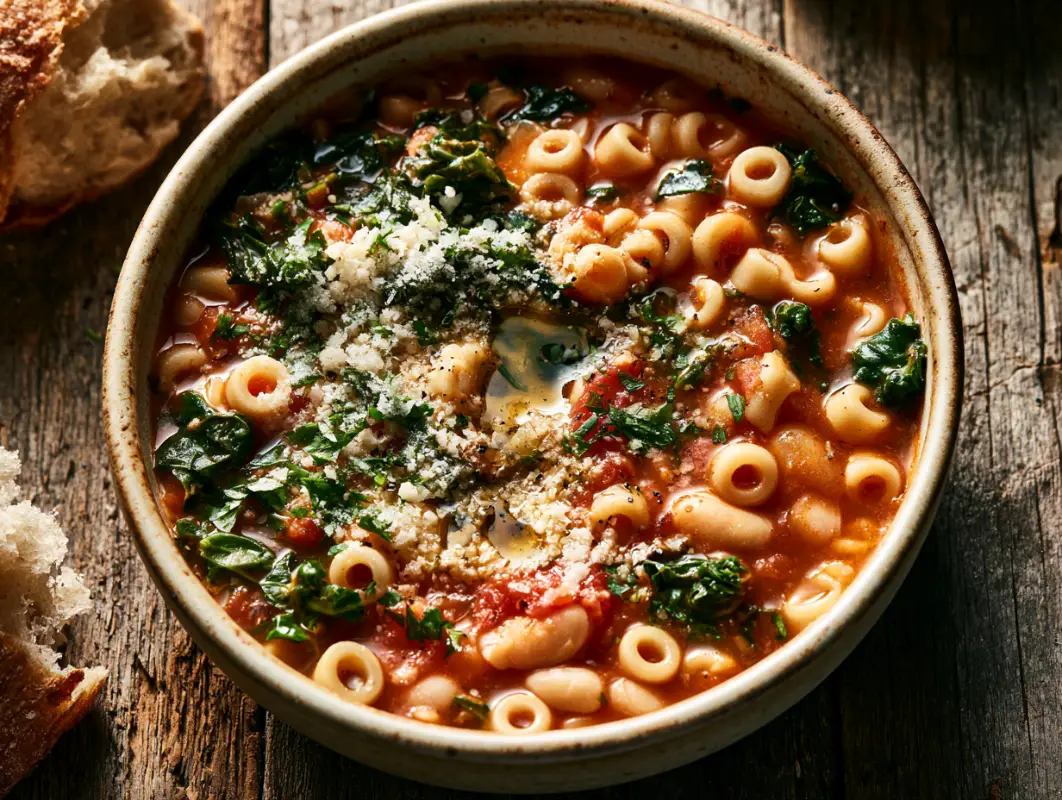
So there I was, January 2022, standing in my kitchen at 9pm on a Tuesday with a pot of what was supposed to be one-pot pasta e fagioli but looked more like… beige cement. My friend Gina—who is aggressively Italian about food (her words)—had talked me into attempting her grandmother’s recipe, and I had somehow turned a peasant dish into a construction material. That was batch one.
There were fourteen more. Fourteen batches over two years of tweaking, burning, oversalting, and once accidentally adding cinnamon instead of oregano (don’t ask). But here’s the thing: batch fifteen was perfect. Actually perfect. Like, Gina ate it and didn’t have a single criticism, which if you knew Gina, you’d understand is basically a Michelin star. Every secret, every mistake—it’s all here.
Table of Contents
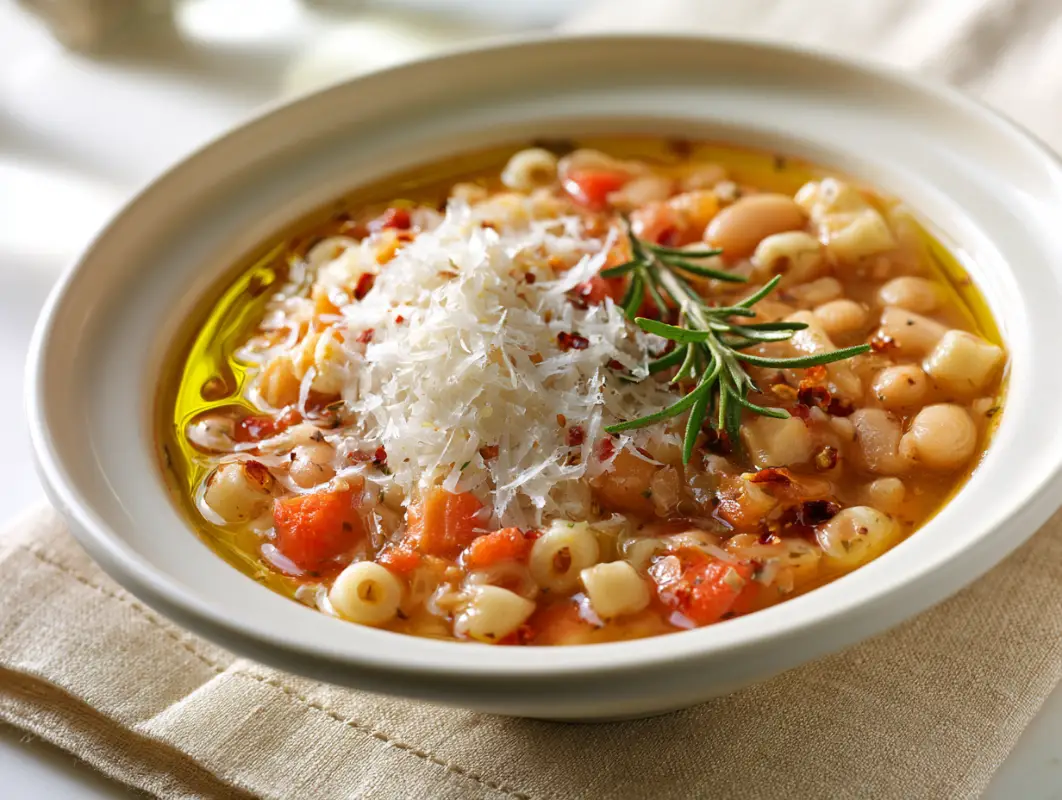
One-Pot Pasta e Fagioli
Ingredients
Method
- 1. Heat olive oil in a large Dutch oven or heavy pot over medium heat. Add onion, carrots, celery, and a pinch of salt. Cook 8–10 minutes, stirring occasionally, until softened and lightly golden.
- 2. Add garlic and tomato paste. Stir constantly for 60–90 seconds until the paste darkens and becomes fragrant. Add rosemary and red pepper flakes.
- 3. Pour in crushed tomatoes and stir well, scraping up any browned bits from the bottom of the pot. Cook for 1 minute.
- 4. Add broth, Parmesan rind, and 1 can of whole drained beans. Take half the second can of beans and mash roughly with a fork (or pulse in a blender). Add both mashed and remaining whole beans.
- 5. Bring to a boil, then reduce heat to medium-low. Add ditalini pasta directly to the pot.
- 6. Simmer 10–12 minutes, stirring occasionally to prevent pasta from sticking, until pasta is al dente.
- 7. Remove Parmesan rind. Stir in kale and lemon juice. Cook 2–3 minutes until kale wilts.
- 8. Season with salt and pepper. Ladle into bowls, drizzle with EVOO, and top with freshly grated Parmesan and parsley.
Notes
Why This One-Pot Pasta e Fagioli Actually Works
The Science Behind the Creaminess
Here’s what took me embarrassingly long to figure out: the best pasta fagioli recipe isn’t really about the pasta or the beans. It’s about the starch. When you cook ditalini directly in the broth (instead of boiling separately like some recipes insist), the pasta releases starch into the liquid, creating that thick, velvety consistency that makes Italian bean soup so impossibly comforting. Harold McGee calls this “starch gelation”—basically, the starch granules swell with hot liquid and burst, thickening everything around them.
And then there’s the bean-mashing trick: puréeing a portion of the cannellini beans and stirring them back in gives the broth body without adding cream or flour. The puréed beans act as a natural emulsifier, creating that silky mouthfeel that separates a truly great pasta e fagioli soup from a watery one.
When to Make This (Spoiler: Always)
Look, pasta e fagioli literally translates to “pasta and beans.” It’s a peasant dish from rural Italy, meaning it was designed to be cheap, filling, and absolutely delicious when made with pantry staples. That makes it the ultimate Tuesday night dinner, the perfect sick-day food, the thing you make when the fridge is looking sad and you’ve got canned beans and half a box of pasta. It’s also somehow impressive enough for company? I’ve served this one-pot Italian soup to guests who thought I’d been cooking for hours. I just smiled. The warming flavors remind me of our creamy tomato basil chicken—simple ingredients, big payoff.
Essential Ingredients for the Best Pasta Fagioli
The Building Blocks
The beauty of a good pasta fagioli recipe is that you probably have 80% of it in your kitchen right now. But ingredient quality does matter here because there’s nowhere to hide. You need cannellini beans (two cans, or cook your own if you’re feeling ambitious—I usually am not), ditalini pasta (the tiny tube-shaped ones that look like they’re wearing little hats), crushed tomatoes, a good vegetable or chicken broth, the classic soffritto trio of onion, carrot, and celery, garlic, rosemary, and tomato paste.
For the Mediterranean twist, I add a generous drizzle of quality extra virgin olive oil at the end and a Parmesan rind simmered in the broth. Speaking of which, our Mediterranean white bean salad uses these same cannellini beans in a completely different (and equally addictive) way, and our pasta primavera recipe brings the same pantry-staple energy to a lighter dish.
Ingredient Quality Comparison:
| Ingredient | Budget Option | Premium Option | Difference |
| Beans | Standard canned cannellini | Dried beans soaked overnight or Rancho Gordo | Creamier texture, earthier flavor |
| Pasta | Any small pasta (elbow, shells) | Ditalini or tubetti from De Cecco/Barilla | Better sauce absorption, authentic shape |
| Tomatoes | Regular canned crushed | San Marzano DOP crushed tomatoes | Sweeter, less acidic, richer body |
| Broth | Store-bought vegetable broth | Homemade bone broth or Kettle & Fire | Deeper, more complex savory base |
| Olive Oil | Regular olive oil for cooking | Cold-pressed EVOO for finishing drizzle | Peppery, fruity finish elevates everything |
The Game-Changing Secret: Parmesan Rind
If you take one thing from this entire article, let it be this: save your Parmesan rinds. When you simmer a rind of Parmigiano-Reggiano in the broth, it slowly melts and releases glutamic acid—the amino acid responsible for umami flavor. It’s the same compound found in soy sauce and aged cheeses, and it transforms this Italian comfort food recipe from “good soup” to “I need to sit down and think about my life choices because this is so good.” Just toss it in whole, fish it out before serving. Free flavor bomb.
USA substitutions: if you can’t find Parmigiano-Reggiano, Pecorino Romano works similarly. No rind? A tablespoon of nutritional yeast stirred in at the end gets you partway there.
Complete Ingredients List
For the Soup Base:
3 tbsp extra virgin olive oil, plus more for drizzling
1 medium yellow onion, finely diced
2 medium carrots, finely diced
2 celery stalks, finely diced
4 cloves garlic, minced
1 tbsp tomato paste
1 tbsp fresh rosemary, chopped (or 1 tsp dried)
½ tsp red pepper flakes (adjust to taste)
1 can (14 oz) crushed tomatoes
6 cups vegetable or chicken broth
2 cans (15 oz each) cannellini beans, drained and rinsed
1 Parmesan rind (optional but highly recommended)
1 tsp salt (adjust to taste)
½ tsp black pepper
For the Finish:
1½ cups ditalini pasta (or other small pasta)
2 cups chopped kale or Swiss chard (ribs removed)
1 tbsp lemon juice
Freshly grated Parmesan cheese for serving
Extra virgin olive oil for drizzling
Fresh parsley for garnish
The Foolproof Method for One-Pot Pasta e Fagioli
Preparation: The Soffritto Foundation
The Italian soffritto—that’s the trio of diced onion, carrot, and celery cooked slowly in olive oil—is the backbone of this entire dish. And I do mean slowly. This isn’t a “throw everything in and crank the heat” situation. I learned this the painful way when batch three tasted like raw onion soup. Here’s the timeline:
Step 1 (3 min prep): Finely dice 1 medium onion, 2 carrots, and 2 celery stalks. And when I say finely dice, I mean smaller than you think. You want them roughly the same size as the ditalini pasta so every spoonful is a balanced bite. My knife skills are, um, developing, so I just go slow.
Step 2 (10 min): Heat 3 tablespoons olive oil in a large Dutch oven or heavy pot over medium heat. Add the soffritto and a generous pinch of salt. Cook, stirring occasionally, for 8–10 minutes until the vegetables are soft and just starting to turn golden. The salt draws moisture out of the vegetables, helping them soften without browning too quickly. This is the same gentle approach we use for our lahanorizo (Greek cabbage rice), and for good reason—patience here equals flavor later.
Step 3 (2 min): Add 4 minced garlic cloves and 1 tablespoon tomato paste. Stir constantly for 60–90 seconds. The tomato paste should darken from bright red to a deep brick-ish color—that’s the Maillard reaction doing its thing, creating caramelized flavor compounds that’ll permeate the entire broth. Add 1 tablespoon fresh chopped rosemary (or 1 tsp dried) and ½ teaspoon red pepper flakes. The rosemary is key—as Kenji Lopez-Alt notes, woody herbs release their oils better when bloomed in fat. The spice base here echoes what we do in our pasta amatriciana with its deeply built tomato foundation.
Main Method: One Pot, Zero Stress
Step 4 (1 min): Pour in 1 can (14 oz) of crushed tomatoes and stir well, scraping up any bits stuck to the bottom of the pot. Let it bubble for about a minute—cooking the raw edge off the tomatoes.
Step 5 (1 min): Add 6 cups vegetable or chicken broth, the Parmesan rind (if using), and 1 can of drained cannellini beans (whole). Take the second can of beans, drain them, and purée roughly half of them with a fork or quick blender pulse. Add both the puréed and remaining whole beans. This is the move that gives you that thick, restaurant-quality broth without any cream or thickener.
Step 6 (20 min): Bring everything to a boil, then reduce heat to medium-low and add 1½ cups ditalini pasta directly into the pot. Yes, directly into the broth. I know, I know—every Italian grandmother is shaking her head. But cooking the pasta in the soup is what makes this a true one-pot pasta e fagioli and it releases the starch that thickens everything beautifully. Simmer, stirring occasionally (important—the pasta sticks to the bottom if you forget), for 10–12 minutes until the pasta is al dente.
Step 7 (3 min): Remove the Parmesan rind. Stir in 2 big handfuls of chopped kale or Swiss chard (it wilts in about 2 minutes), a squeeze of lemon juice, and season aggressively with salt and pepper. Ladle into bowls, drizzle with your best olive oil, and top with freshly grated Parmesan. Honestly, the finishing olive oil drizzle is not optional—it’s the difference between good and exceptional. Serve immediately with crusty bread. (The pasta continues absorbing broth as it sits, which is either a feature or a bug depending on how thick you like it.)
Creative Variations for Your Pasta Fagioli
Flavor Variations Table
| Variation | Key Changes | Best For | Difficulty |
| Classic Italian-American | Add browned ground beef, use kidney + Great Northern beans | Olive Garden fans, hearty eaters | Easy |
| Tuscan White Bean | Skip tomatoes, add sage + lemon, white broth only | Lighter palates, spring/summer | Easy |
| Spicy Sausage | Add browned turkey Italian sausage, extra red pepper flakes | Heat seekers, game day crowds | Easy |
| Mediterranean Veggie | Add zucchini, bell pepper, artichoke hearts, olives | Plant-based diners, Mediterranean diet | Easy |
| Budget Pantry | All canned ingredients, dried herbs, skip Parmesan | Students, tight budgets | Very Easy |
| Kid-Friendly | Skip the greens, use elbow pasta, add mild cheese on top | Picky eaters, toddler-friendly | Very Easy |
For gluten-free, swap the ditalini for your favorite GF small pasta (Banza chickpea pasta is great here—ironic but delicious). For vegan, skip the Parmesan rind and use a generous splash of nutritional yeast plus miso paste for umami depth. The Mediterranean veggie version pairs wonderfully with our gemista (Greek stuffed peppers and tomatoes) for a full rustic Italian-meets-Greek dinner spread.
Dietary Modifications
This hearty Italian soup is naturally pretty adaptable. It’s already dairy-free if you skip the Parmesan (though honestly you’d be missing out). For low-sodium, use no-salt-added broth and beans and season carefully with herbs instead. For paleo—okay, paleo and pasta don’t typically coexist, but you could replace the ditalini with diced sweet potato or cauliflower florets for something that’s still thick and comforting. The bean stew base works beautifully either way. Check out our Mediterranean chickpea power bowl for another legume-based meal that adapts to multiple dietary needs.
Storage & Serving Your Pasta e Fagioli
Storage Techniques with Timeframes
Here’s the thing about one-pot pasta e fagioli: it’s one of those dishes that genuinely tastes better the next day as the flavors meld together overnight. The one caveat? The pasta keeps absorbing broth. By day two, it’s more of a thick stew than a soup, which I personally love but some people find alarming. Store in an airtight container in the fridge for up to 5 days.
When reheating, add a splash of broth or water to thin it back out. For freezing, here’s my pro tip: freeze the soup base WITHOUT the pasta. Cook fresh pasta when you reheat. Frozen for up to 3 months. The beans and broth freeze beautifully; the pasta turns to mush. Trust me, I learned this when I froze four containers of batch eight and they all came out as bean paste. Our pesto pasta with grilled chicken follows the same freeze-the-sauce-not-the-pasta principle.
Meal Prep & Pairing Strategies
This Italian comfort food recipe is meal prep gold. Here’s my weekly system:
| Meal Prep Style | Accompaniment | Prep Time | Reheat Method |
| Work Lunch | Crusty bread + side salad | 5 min assembly | Microwave 3–4 min, stir halfway |
| Quick Dinner | Garlic bread + Parmesan shavings | 10 min total | Stovetop 5 min, add splash of broth |
| Freezer Batch | Soup base only (cook pasta fresh) | Cool + portion | Thaw overnight, stovetop 10 min |
| Big Batch Sunday | Full spread: bread, salad, olives | 45 min active cook | Serve immediately, store extras |
For an Italian-Mediterranean dinner spread, pair a big pot of pasta fagioli with our garlic Parmesan focaccia and a simple arugula salad dressed with lemon and olive oil. Your guests will think you’re running a trattoria.
Nutritional Benefits of One-Pot Pasta e Fagioli
Macronutrient Profile
Standard disclaimer: I’m not a dietitian and I don’t play one on the internet. But pasta e fagioli is legitimately one of the most nutritionally balanced comfort foods you can make. The combination of pasta (carbohydrates) and beans (protein + fiber) creates a complete amino acid profile, meaning you’re getting proper plant-based protein even without any meat. That’s why this has been a staple in Italian diets for literally centuries.
| Nutrient | Per Serving (~1.5 cups) | % Daily Value | Notes |
| Calories | 320 kcal | 16% | Based on 2,000 cal diet |
| Protein | 15g | 30% | Complete protein from bean + pasta combo |
| Total Fat | 8g | 10% | Primarily olive oil (monounsaturated) |
| Saturated Fat | 2g | 10% | Minimal; from Parmesan |
| Carbohydrates | 48g | 17% | Complex carbs from beans + pasta |
| Fiber | 9g | 32% | Excellent source from cannellini beans |
| Sugar | 5g | 6% | Natural sugars from tomatoes and carrots |
Micronutrients and Health Benefits
| Micronutrient | Amount Per Serving | Health Benefit |
| Iron | 3.8mg (21% DV) | Oxygen transport; plant-based iron enhanced by tomato’s vitamin C |
| Folate | 145mcg (36% DV) | Cell growth, essential for prenatal health |
| Potassium | 620mg (13% DV) | Blood pressure regulation, heart health |
| Manganese | 1.2mg (52% DV) | Bone health, metabolism support |
| Vitamin A | 3200 IU (36% DV) | Vision and immune function from carrots |
| Vitamin C | 18mg (20% DV) | Immune support, enhances iron absorption |
The glycemic index of this dish sits at a moderate 45–50, lower than plain pasta alone thanks to the fiber from cannellini beans slowing glucose absorption. The Mediterranean-style olive oil drizzle adds heart-healthy monounsaturated fats—the same ones that make the Mediterranean diet consistently rank as one of the healthiest eating patterns worldwide. For another fiber-packed Mediterranean meal, try our grilled chicken Mediterranean bowl.
Frequently Asked Questions About Pasta e Fagioli
What does pasta e fagioli mean and how do you pronounce it?
Pasta e fagioli (pronounced “PAH-stah eh fah-JOH-lee”) literally translates to “pasta and beans” in Italian. In Italian-American communities, especially in New York, you’ll hear it shortened to “pasta fazool” or “pasta fasul.” It’s one of the most beloved Italian comfort food recipes—a humble one-pot soup that’s been feeding families in Italy for centuries.
What is the best pasta shape for pasta fagioli soup?
Ditalini (tiny tubes) is the most traditional choice for pasta e fagioli soup because the small shape fits neatly on a spoon alongside the beans. Small shells, elbow macaroni, tubetti, or even broken spaghetti all work well. The key rule for this one-pot Italian soup: use small pasta that cooks in 8–12 minutes so it doesn’t overcook in the broth.
Can you make pasta e fagioli ahead of time?
Yes! This hearty Italian soup actually tastes better the next day. However, the pasta will continue absorbing broth as it sits. For make-ahead homemade pasta e fagioli, either accept the thicker consistency (many people prefer it) or cook and store the soup base and pasta separately, combining when you reheat.
How do you thicken pasta e fagioli?
The best way to thicken pasta fagioli is to purée a portion of the beans before adding them back. Mashing half the beans creates a naturally creamy, thick broth without flour or cream. You can also let the soup simmer uncovered for 5–10 minutes, or add more puréed beans until you reach your desired consistency.
Is pasta e fagioli healthy?
This Italian bean soup is genuinely one of the healthier comfort foods. A serving provides 15g of plant-based protein, 9g of fiber, and is rich in iron, folate, and potassium. It’s naturally low in saturated fat (especially the vegetarian version) and provides complete amino acids from the bean-pasta combination. Using whole wheat pasta boosts the fiber content further.
What’s the difference between pasta e fagioli and minestrone?
While both are Italian one-pot soups, pasta e fagioli is specifically centered on beans and pasta in a tomato-based broth, with a thicker, creamier consistency. Minestrone is more of a vegetable soup that may or may not include beans and pasta. Pasta fagioli is typically heartier and more substantial—more stew than soup.
Can I make this pasta e fagioli in a slow cooker or Instant Pot?
For a slow cooker, add everything except the pasta and cook on low for 6–8 hours, then stir in the ditalini and cook on high for 15 minutes until al dente. For the Instant Pot, sauté the soffritto, add broth, beans, and tomatoes, cook on high pressure for 5 minutes, release, then stir in pasta and simmer on sauté mode until cooked.
Pairing & Serving Ideas for Pasta e Fagioli
Perfect Combinations Table
| Category | Pairing | Why It Works |
| Bread | Crusty sourdough, ciabatta, or focaccia | Essential for sopping up every last drop of broth |
| Salad | Arugula with lemon vinaigrette | Peppery freshness cuts through the richness |
| Topping | Fresh Parmesan, EVOO drizzle, red pepper flakes | Layers of umami, fat, and heat on top |
| Vegetable | Roasted broccolini or grilled zucchini | Light veggie contrast to the hearty soup |
| Appetizer | Marinated olives or white bean bruschetta | Sets the Italian tone before the main event |
For beverages (and honestly I have very strong opinions about this), sparkling water with a lemon wedge is the move. It cuts through the richness. Hot mint tea is wonderful in cold weather—the mint brightness pairs unexpectedly well with rosemary. Fresh-squeezed lemonade in summer. And nothing beats a big pot of this with our garlic Parmesan focaccia torn right off the pan.
Occasion-Based Serving
Weeknight? Straight into bowls with whatever bread you have. Dinner party? Ladle it into those wide, shallow bowls, give it the olive oil drizzle, a shower of Parmesan, and a sprig of rosemary. Watch people’s eyes light up. Meal prep Sunday? Make a double batch and portion into containers—you’ll feel smug all week. Leftover transformation? Stir in a handful of spinach and an egg for a riff on Italian egg-drop soup. Our Italian chicken casserole makes an excellent companion dish when you’re feeding a crowd.
Make This One-Pot Pasta e Fagioli Your Own
Embrace the Mess
Here’s what I’ve learned after fifteen batches of this one-pot pasta e fagioli: the best version is the one you make yours. Swap the kale for spinach. Use chickpeas instead of cannellini. Add a splash of lemon at the end or don’t. My friend Gina—the aggressively Italian one—adds a bay leaf and a whole dried chili, and her version is incredible even though it’s nothing like her grandmother’s original. The Italian cooking tradition has always been about working with what you’ve got, and this easy pasta fagioli is the purest expression of that philosophy. For more Italian-Mediterranean inspiration, explore our Mediterranean hummus breakfast bowl or our Mediterranean sheet pan salmon for weeknight simplicity.
Share Your Fazool
If you make this Italian pasta and bean soup (and you definately should), drop a comment and tell me about it. Rate the recipe—it genuinely helps other people find it. Tell me if you went rogue with the beans, if your Parmesan rind was the game-changer, or if your version turned out more soup or more stew. I’m still genuinely confused about where the line between soup and stew actually is. Like, at what exact thickness does soup become stew? At what point does it become—I don’t know—a porridge? Someone please explain this to me. Anyway. Go make pasta fazool. Your kitchen deserves to smell this good.