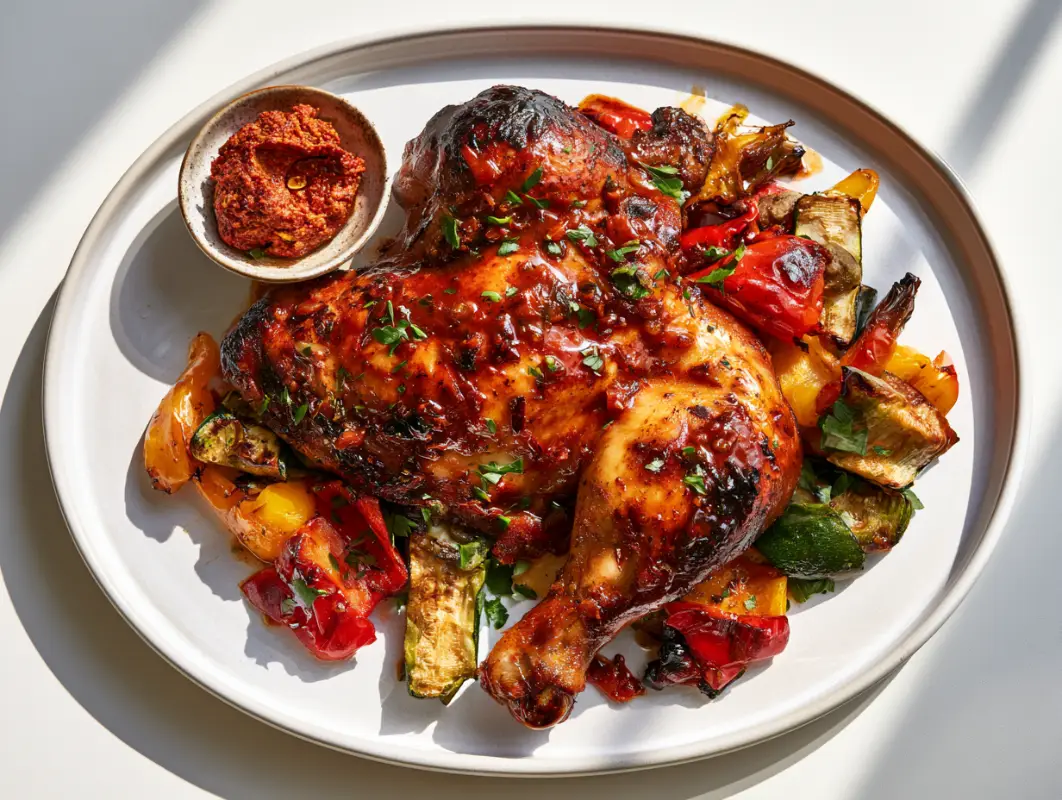
The smell hits you before you even open the oven door. That intoxicating wave of smoky harissa, caramelized honey, and sweet charred peppers — it’s the kind of aroma that brings everyone to the kitchen doorway, spoon already in hand, asking: “How long?” I still remember the first time something like this came out of my yiayia‘s oven in Chania.
She didn’t call it harissa honey chicken with roasted vegetables, of course. She called it “to kotopoulo me ta kokkina” — the chicken with the reds. Every Saturday she’d return from the market with deep-crimson peppers, heavy and fragrant, and by Sunday the whole neighbourhood knew what was cooking in her tapsi — that weathered baking pan that had survived thirty years of family dinners.
Growing up in Crete, I learned early that the best chicken dishes are always about layers. You don’t just season and throw something in the oven. You marinate. You score the skin. You let the spice paste sink in overnight. You drizzle the honey at exactly the right moment so it caramelizes instead of burns. These are the lessons my mother passed down, gently updated over the years to include harissa — that magnificent North African chile paste that pairs so beautifully with the olive oil, lemon, and herb traditions of Greek cooking.
This harissa honey chicken with roasted vegetables has become one of the most-requested dishes at my Athens cooking workshops, and one of the first ten recipes I published when I started this blog back in 2018. It is weeknight-easy but dinner-party-worthy. Trust me — once you make it, you’ll understand exactly why it’s never left the rotation.
Table of Contents
Why This Recipe Is Special
The Authentic Technique That Makes All the Difference
The secret to this harissa honey chicken isn’t simply the harissa paste — it’s the two-stage cooking approach I perfected during my apprenticeship at Michelin-starred Varoulko in Athens. You begin with the chicken skin-side down in a hot cast iron skillet to render the fat and trigger what Harold McGee, in On Food and Cooking, calls the Maillard reaction — that beautiful browning that creates hundreds of new flavor compounds no amount of seasoning can replicate. Then you flip, arrange on the vegetable pan, glaze, and finish in a 425°F (220°C) oven.
That sear creates a fond on the pan bottom that, as the chicken roasts, gets absorbed by the vegetables below it, transforming humble zucchini and bell peppers into something deeply savory. I’ve made this dish over 60 times in my kitchen, and every single time I take the lazy shortcut of skipping the sear, I regret it. Don’t skip it. Golden. Crispy. Non-negotiable.
🌿 Yiayia’s Tip: In my yiayia’s kitchen, every technique had a reason. ‘Don’t rush the heat,’ she’d say. She was describing the Maillard reaction without knowing the science — she just knew the result.
Flavor Profile and Best Occasions
What you get with this dish is a masterclass in sweet-heat balance that I find genuinely thrilling every single time. The harissa paste delivers smoky depth and a building warmth — not a face-numbing heat, but one that lingers pleasantly on the back of the palate. The honey tempers it, adding a floral sweetness that caramelizes in the oven into a glossy, almost lacquered glaze. The Mediterranean roasted vegetables — red bell peppers, zucchini, red onion, and burst cherry tomatoes — become tender and jammy, soaking up every drop of those spiced drippings.
Serve this for a weeknight family dinner or a relaxed dinner party. It pairs naturally with our Moroccan-spiced couscous salad and it’s equally spectacular eaten straight from the pan standing at the stove, which I fully endorse.
The Story Behind the Dish
Cultural and Historical Context
Harissa is a Tunisian chile paste with roots stretching back to the Ottoman era, when chiles arrived in North Africa via the Iberian Peninsula in the 16th century. In Greece, we have always been open to flavor influence from across the Mediterranean — it’s precisely why Greek cuisine shares so much DNA with Turkish, Lebanese, and North African cooking. The pairing of harissa with honey appears across Moroccan and Tunisian kitchens, where the interplay of heat and sweetness is a foundational culinary principle, much like our own ladolemono — the olive oil and lemon dressing we use for everything from fish to vegetables.
My Family’s Version
My grandfather’s seaside taverna in Chania never served anything with harissa — it was a proudly traditional Cretan kitchen. But my mother, always curious, always with a new cookbook under her arm, began experimenting with North African spice pastes in the early 1990s after a trip to Tunis. “Niko,” she’d tell me, standing over her pot, “good food has no borders.” When my father passed away in 2017, I realized those afternoons watching her cook were my real culinary education — more than any kitchen in Athens. She still calls this dish “to kokkino kotopoulo” — the red chicken. She expects it every time she visits.
Essential Ingredients for Harissa Honey Chicken
Core Ingredients — What You’ll Need and Why
I’m particularly passionate about the honey in this easy weeknight dinner. My grandmother’s village of Sitia in eastern Crete is famous for its thyme honey — dark, intensely floral, with a sweetness that doesn’t cloy. When I was young, my father would come back from his fishing trips along that coastline with jars of it. I keep one on my counter always. If you can find Cretan thyme honey at a specialty shop, buy it immediately. The difference between it and a generic supermarket honey in this recipe is extraordinary.
| Ingredient | Amount | Why It Matters | Authentic Pick | Substitution |
| Chicken thighs (bone-in, skin-on) | 8 pieces (~1 kg / 2.2 lbs) | Fat = juicy meat + crispy skin | Free-range organic | Drumsticks; boneless thighs (reduce time) |
| Harissa paste | 3 tbsp (45 g) | Smoky, spiced heat; marinade base | Tunisian rose harissa | 1 tbsp tomato paste + 1 tsp smoked paprika + ½ tsp cayenne |
| Raw honey | 2 tbsp (40 g) | Caramelizes in oven; balances heat | Cretan thyme honey (Sitia) | Maple syrup or date syrup |
| Extra-virgin olive oil | 3 tbsp (45 ml) | Conducts heat; carries spice compounds | Kolymvari Cretan EVOO | Any quality extra-virgin olive oil |
| Garlic | 6 cloves | Aromatic depth; sweetens when roasted | Fresh — never jarred | ½ tsp garlic powder per clove (not ideal) |
| Red bell peppers | 2 large | Natural sweetness; jammy when roasted | Deep red, heavy peppers | Orange or yellow peppers |
| Zucchini | 2 medium | Absorbs cooking juices; mild balance | Small, firm zucchini | Eggplant (add 5 min cook time) |
| Cherry tomatoes | 250 g / 1 cup | Burst to create sauce; natural acidity | Vine-ripened | Regular tomatoes, quartered |
A note on the harissa paste: brands vary enormously in heat level. Tunisian rose harissa tends to be milder and more fragrant; Moroccan-style is often hotter and more intense. I recommend rose harissa for this harissa chicken recipe — you want warmth and complexity, not a heat that drowns the honey’s sweetness. Our dedicated homemade harissa paste recipe takes 20 minutes and is well worth it.
🌿 Pro Tip: For a smoky depth without extra heat, add ½ teaspoon of smoked paprika to the marinade. My mother called this ‘the flavor shadow.’ I’ve never stopped using it.
Dietary Substitutions
| Dietary Need | Replace | With | Notes |
| Gluten-free | — | Already GF | Check harissa label for additives |
| Dairy-free | — | Already dairy-free | No changes needed |
| Lower heat | 3 tbsp harissa | 1 tbsp harissa + 2 tbsp tomato paste | Mild but still flavorful |
| Vegan | Chicken thighs | 1 cauliflower head + 2 cans chickpeas | Reduce cook time to 30–35 min |
| Lower sugar | 2 tbsp honey | 1 tbsp honey + 1 tbsp pomegranate juice | Less caramelization |
| Halal | — | Already fully halal | Verify harissa brand |
Equipment & Technique
Tools of the Trade
Every Greek kitchen I grew up in had a tapsi — a large, often battered baking pan that was the workhorse of Sunday cooking. In my yiayia‘s kitchen, the tapsi was essentially irreplaceable. The modern equivalent is a heavy rimmed sheet pan, and for this one-pan dinner it performs beautifully.
| Traditional Tool | Modern Alternative | Why It Matters |
| Tapsi (Greek baking pan) | Heavy rimmed sheet pan or roasting pan | Even heat distribution; collects flavorful drippings |
| Mortar & pestle | Food processor or pre-made harissa | Grinding whole spices releases aromatic oils |
| Cast iron skillet | Any heavy oven-safe skillet | Heat retention for an even, powerful sear |
| Pastry brush | Spoon (applied carefully) | Even honey glaze without disturbing the crust |
Mise en Place — Set Up for Success
Before you begin: take the chicken out of the fridge 20 minutes before cooking — cold chicken goes into a hot pan unevenly. Mix your marinade components in a glass bowl (not metal — acid reacts with aluminum). Chop vegetables into equal 2.5 cm / 1-inch pieces for even roasting. Have your tapsi brushed with olive oil and ready. Preheat oven to 425°F / 220°C — fully preheated before the chicken goes in. This mise en place takes 10 minutes and makes everything that follows effortless.
Step-by-Step Instructions
Preparation — Steps 1 Through 4
Step 1: Make the Marinade
In a small glass bowl, whisk together: 3 tablespoons harissa paste, 2 tablespoons honey, 2 tablespoons olive oil, 4 cloves minced garlic, 1 teaspoon ground cumin, ½ teaspoon coriander, ½ teaspoon smoked paprika, and generous salt and pepper. The mixture should be deep terracotta-red and slightly thick. If it feels stiff, add 1 tablespoon of lemon juice — the acid also helps the flavors penetrate the chicken. This marinade is the foundation of your harissa honey chicken with roasted vegetables. Taste it before it touches the chicken. If it doesn’t make your eyes widen slightly, add a pinch more salt.
🌿 Yiayia’s Tip: Always taste your marinade before it meets the chicken. Yiayia tasted everything — three times. She said food made with attention always tastes better. I think she was right.
Step 2: Marinate the Chicken
Score each chicken thigh 2–3 times with a sharp knife, about 1 cm deep. Rub the marinade all over — and I mean all over — getting under the skin and into every slit. If you have time, refrigerate for at least 1 hour, ideally overnight. After 60+ tests of this recipe, I can tell you: overnight marinating adds roughly 30% more depth of flavor. It’s worth planning ahead.
Step 3: Prep the Vegetables
Toss the bell peppers, zucchini, red onion, and cherry tomatoes with 1 tablespoon olive oil, salt, and pepper. Add 2 crushed garlic cloves and a pinch of dried oregano. Spread on your oiled sheet pan in a single layer — crowding causes steaming, not roasting. The goal is golden, caramelized edges. If your pan feels crowded, use two pans. Always.
Step 4: Sear the Chicken
Heat a cast iron or heavy oven-safe skillet over medium-high heat — no oil needed. Place chicken thighs skin-side down. You should hear an immediate, strong sizzle. If you don’t, the pan isn’t hot enough. Cook for 5–6 minutes until the skin is deep golden and releases easily from the pan. This is the Maillard reaction that J. Kenji López-Alt describes in The Food Lab — the same principle behind a perfect steak crust. Don’t touch, don’t move, don’t peek. Let it work.
Cooking & Assembly — Steps 5 Through 10
Step 5: Arrange the Pan
Nestle the seared chicken thighs, skin-side up, among the vegetables on your sheet pan. Pour any accumulated pan drippings — those golden, harissa-scented bits — over the vegetables. Every drop of that fond is flavor.
Step 6: First Roast — 20 Minutes at 425°F / 220°C
Roast for 20 minutes. The vegetables should be softening and beginning to char at the edges. The chicken should be golden and fragrant. Your kitchen should smell absolutely remarkable. If it doesn’t, something has gone wrong.
Step 7: The Honey Glaze — The Moment That Changes Everything
Pull the pan from the oven. Using a pastry brush or spoon, apply a thin, even coat of honey over each chicken piece — about ½ teaspoon per thigh. You’ll see the glaze bubble and begin to set almost immediately against the hot surface. This is exactly what you want. A thin, even coat — not a drowning. Then wait 30 seconds before returning to the oven. The glaze needs a moment to adhere properly.
🌿 Yiayia’s Tip: She’d whisper ‘υπομονή’ — patience — every time she glazed anything. Don’t rush back to the oven. That 30 seconds matters more than you think.
Step 8: Final Roast — 15–20 More Minutes
Return to the oven for another 15–20 minutes. Internal temperature should reach 165°F / 74°C at the thickest point. The skin should be deep mahogany, glistening, and impossibly crispy. The vegetables should be jammy and beginning to caramelize at the edges. Your oven roasted chicken thighs are almost done.
Step 9: Rest — 5 Minutes, Non-Negotiable
Remove from the oven. Let rest for 5 minutes before serving. This allows the juices to redistribute through the meat. I know how hard this is. Do it anyway.
Step 10: Plate and Serve
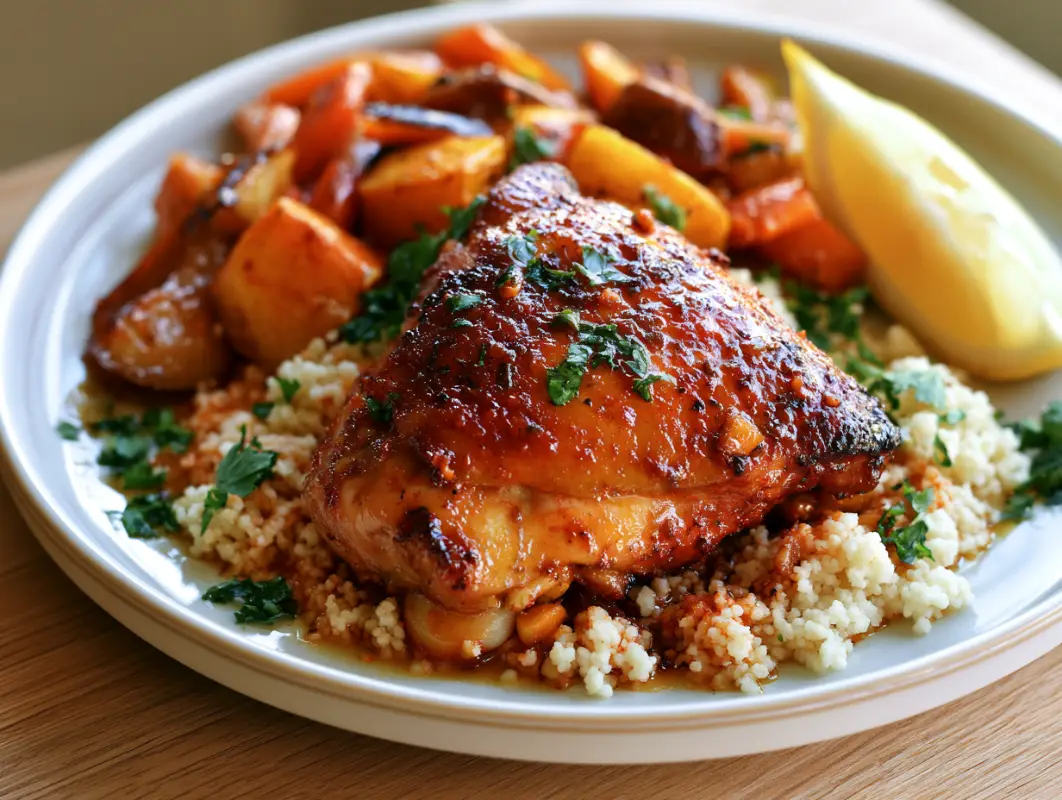
Spoon the jammy roasted vegetables onto a serving platter. Arrange the chicken pieces on top. Drizzle with any pan juices and a final squeeze of fresh lemon. Scatter fresh chopped flat-leaf parsley or mint. Serve your harissa honey chicken with roasted vegetables immediately, with warm pita or couscous alongside. This is how we eat in Crete — generously, together, without hurry.
The Secret Touches
Three Techniques That Change Everything
1. The Two-Stage Honey. Never add all your honey to the marinade. I learned this the hard way during my first test of this recipe — the skin blackened within 15 minutes and I had to eat charred, bitter honey glazed chicken for dinner. (Self-deprecating, but true.) Reserve half the honey for a glaze applied in the final 15–20 minutes. Early honey burns; late honey caramelizes. This is the difference between bitterness and magic.
2. Score the Thighs. Those slits in the chicken skin aren’t just for marinade penetration — they also allow the skin to lie flat during cooking rather than contracting and bunching up. My mother described this as the chicken ‘breathing better.’ She was actually describing collagen contraction at high heat, and she was completely right. The result is more evenly rendered, crispier skin across the entire surface.
3. Transfer the Dripping Gold. Always pour your sear drippings onto the vegetable pan before roasting. That golden fond contains concentrated flavor compounds — the same principle as deglazing a pan in classic French technique. It turns ordinary zucchini into something that tastes like it’s been slow-cooked for hours.
Common Mistakes and How to Avoid Them
| Mistake | What Happens | How to Fix It |
| Adding ALL honey to marinade | Honey burns at 330°F / 165°C — skin blackens before meat cooks | Reserve half honey for glaze in final 15–20 min |
| Crowding the vegetables | They steam instead of roast; pale, soggy result | Single layer always; two pans if needed |
| Skipping the sear | Soft, pale skin; no fond for flavor base on vegetables | Even 5 min sear makes a meaningful difference |
| Cold chicken straight from fridge | Uneven cooking: dry exterior, undercooked center | Rest at room temperature 20 min before cooking |
| Under-seasoning the marinade | Flat, one-dimensional flavor despite beautiful color | Taste marinade before applying; salt generously |
Variations & Serving Suggestions
Regional Variations and Weeknight Shortcuts
In Morocco, this Moroccan chicken style would classically include preserved lemon and olives — both brilliant additions if you have them. I often add 2 tablespoons of chopped preserved lemon to the vegetable mix for a brightness that cuts through the richness beautifully. On the Greek islands, eggplant replaces zucchini and absorbs the harissa drippings even more luxuriously.
For a genuine weeknight shortcut: use boneless skinless chicken thighs (skip the sear, reduce total cook time to 28–30 minutes), and substitute a frozen Mediterranean vegetable mix for fresh. It won’t be quite as magnificent — but it’ll still be very, very good. For a fully plant-based version, substitute one large cauliflower broken into florets plus 2 cans of drained chickpeas. Our spiced roasted chickpeas use this same harissa-honey combination brilliantly.
What to Serve Alongside
This dish is wonderfully versatile at the table. A bowl of our classic tabbouleh offers cool, herby freshness that counterbalances the spiced richness perfectly. Our Moroccan couscous salad placed underneath the chicken catches all the beautiful juices and becomes something almost transcendent. For a lighter accompaniment, our traditional Greek salad is always welcome — the feta and olives contrast the harissa sweetness beautifully.
For beverages: skip anything alcoholic entirely and reach instead for chilled hibiscus iced tea — its tartness mirrors the harissa’s brightness — sparkling water with fresh mint and cucumber, traditional ayran (cold yogurt drink popular across the Middle East and Turkey that cools the palate after the harissa heat), or fresh-squeezed lemonade with a sprig of tsai tou vounou (mountain tea). Our homemade pita bread is practically mandatory — you’ll need something to wipe the pan clean.
Storage & Reheating
How to Store Harissa Honey Chicken
| Method | Container | Duration | Notes |
| Refrigerator | Airtight container | 3–4 days | Store chicken on top of veg to maintain skin texture |
| Freezer | Freezer-safe bag or container | Up to 3 months | Freeze vegetables separately for best texture on thaw |
| Meal prep | Individual portion containers | 3–4 days | Add splash of broth to revive moisture when reheating |
| Marinated (uncooked) | Glass bowl or zip bag (sealed) | Up to 24 hours | Don’t exceed 24 hrs — acid begins breaking down protein |
Reheating for Best Results
The oven is always the best reheating method for maintaining that crispy skin. Preheat to 375°F / 190°C, place chicken on a wire rack over a baking sheet, and heat for 10–12 minutes. Stovetop reheating works well for the roasted vegetables Mediterranean — warm them in a skillet over medium heat with a splash of water or chicken broth. Microwave works when needed: cover loosely, use 60% power, and go in 90-second intervals. Before serving any leftover version, always add a fresh squeeze of lemon and a drizzle of olive oil — it wakes the entire dish back up as if it just came out of the oven.
Harissa Honey Chicken with Roasted Vegetables
Ingredients
Method
- Make the marinade. Whisk together the harissa paste, 2 tablespoons of the honey, 2 tablespoons of olive oil, 4 cloves of minced garlic, the cumin, coriander, smoked paprika and a generous amount of salt and pepper. It should be deep terracotta-red and slightly thick; loosen with the tablespoon of lemon juice if it feels stiff. Taste it before it touches the chicken and add more salt if it does not make your eyes widen slightly.
- Marinate the chicken. Score each thigh 2–3 times with a sharp knife, about 1 cm deep, then rub the marinade all over, getting under the skin and into every slit. Refrigerate at least 1 hour, ideally overnight — overnight adds roughly 30% more depth of flavour.
- Prep the vegetables. Toss the bell peppers, zucchini, red onion and cherry tomatoes with the remaining tablespoon of olive oil, salt, pepper, the 2 crushed garlic cloves and a pinch of dried oregano. Spread on an oiled sheet pan in a single layer — crowding steams instead of roasting, so use two pans if needed.
- Sear the chicken. Heat a cast iron or heavy oven-safe skillet over medium-high with no oil. Lay the thighs skin-side down; you should hear an immediate strong sizzle. Cook 5–6 minutes without touching them, until the skin is deep golden and releases easily from the pan.
- Nestle the seared thighs skin-side up among the vegetables and pour any accumulated pan drippings over the vegetables — every drop of that fond is flavour.
- Roast at 425°F (220°C) for 20 minutes. The vegetables should be softening and beginning to char at the edges and the chicken golden and fragrant.
- Apply the honey glaze. Pull the pan out and brush a thin, even coat of honey over each piece — about 1/2 teaspoon per thigh. It will bubble and begin to set immediately. Wait 30 seconds before returning it to the oven so the glaze adheres properly.
- Roast another 15–20 minutes, until the internal temperature reads 165°F (74°C) at the thickest point, the skin is deep mahogany and glistening, and the vegetables are jammy and caramelised at the edges.
- Rest for 5 minutes out of the oven so the juices redistribute through the meat.
- Spoon the roasted vegetables onto a platter, arrange the chicken on top, drizzle with the pan juices and a final squeeze of fresh lemon, and scatter with chopped parsley or mint. Serve with warm pita or couscous.
Notes
Frequently Asked Questions
Substitutions & Technique Questions
Q: Can I use chicken breasts instead of thighs?
A: You can, but I genuinely don’t recommend it for this dish. Chicken breasts are leaner and dry out faster at the high heat needed to caramelize the harissa honey glaze. If you insist: pound them to even thickness, reduce total cook time to 20–22 minutes, and monitor the internal temperature carefully at 165°F / 74°C. For the juiciest, most forgiving results, bone-in skin-on thighs are the only way.
Q: My harissa paste isn’t very spicy. Should I add extra chiles?
A: Yes, absolutely. Harissa pastes vary wildly — Tunisian rose harissa tends to be milder and more fragrant. If yours lacks heat, add ½ teaspoon cayenne or a minced fresh red chile to the marinade. Taste as you go. You want a warmth that builds pleasantly, not one that overwhelms the honey’s floral sweetness. Balance is everything in this harissa honey chicken recipe.
Q: Can I make this on the stovetop without an oven?
A: The sear step is fully stovetop. For the rest: after searing, add the vegetables to the pan, cover tightly, and cook over medium-low heat for 25–30 minutes, turning chicken once. Add the honey glaze in the last 5 minutes. You won’t get the same deeply roasted vegetables or crispy skin, but the flavor will still be excellent. A lid-on braise gives a more tender result rather than crispy.
Q: I don’t have harissa paste — what can I substitute?
A: Blend together: 3 tablespoons tomato paste, 1 teaspoon smoked paprika, ½ teaspoon cayenne, ½ teaspoon cumin, ½ teaspoon coriander, 2 minced garlic cloves, and 1 tablespoon olive oil. It won’t have the complexity of real harissa — you’re missing fermented chile depth — but it works surprisingly well. Or better: make our homemade harissa paste. It takes 20 minutes.
Dietary, Make-Ahead & Authenticity Questions
Q: Is this recipe naturally gluten-free?
A: Yes, naturally. Every core ingredient is gluten-free. The one potential exception is commercial harissa paste — a small number of brands use flour as a thickener. Check the label carefully. Most authentic harissa pastes are purely chiles, spices, olive oil, and garlic. When in doubt, use our homemade version or a certified GF brand. Everything else in this healthy chicken dinner is completely safe.
Q: Can I prepare this ahead for a dinner party?
A: Absolutely — this is one of the best dinner-party recipes I know for exactly this reason. Marinate the chicken up to 24 hours ahead (any longer and the acid begins to break down the proteins). Prep the vegetables the morning of. When guests arrive, all you need is 45 minutes of actual cooking. The aroma alone will convince everyone you’ve been in the kitchen all day. I’ve used this strategy for every workshop dinner I’ve hosted.
Q: Is harissa honey chicken authentically Greek?
A: Strictly speaking, harissa is North African — Tunisian in origin. But Mediterranean cooking has always been a living conversation between cultures, and this recipe reflects how Greek cooks have incorporated flavors from across the sea for generations. My mother made similar dishes. I think of it as genuinely Mediterranean: a dish that could exist in a Chania kitchen, a Tunis market, or a Moroccan family table without feeling out of place.
Q: Can I use dried herbs instead of fresh for garnishing?
A: For cooking, yes — use one-third the quantity (1 tablespoon fresh = 1 teaspoon dried). For garnishing the finished dish, I strongly prefer fresh. The bright color and fragrance of fresh flat-leaf parsley or mint at the end of this harissa honey chicken with roasted vegetables is part of what makes it visually stunning. It’s a small thing that makes a noticeable difference.
Bringing the Mediterranean to Your Table
A Dish Worth Gathering For
Every time I serve harissa honey chicken with roasted vegetables at my Athens workshops, someone asks me the same question: “Is this hard to make at home?” I always laugh. This dish is exactly what I believe Mediterranean cooking should be — accessible, vibrant, generous. It asks very little of you technically but rewards you with extraordinary flavor that tastes like hours of effort.
Make it this weekend. Let the kitchen fill with that smoke-and-honey fragrance. Call your people to the table. And if you make it and love it — please drop a comment below, or tag me in your photos. Every version of this recipe that travels out into the world makes me feel like my father and my grandfather are still at the table, feeding people, doing the most important work there is.
Related Recipes to Explore Next
If the spice profile here has you hooked, you must try our Moroccan chicken tagine — it takes the same warming, aromatic character in a completely different direction with preserved lemon and olives. For a brighter, herb-forward take on roasted chicken, our baked lemon chicken is one of the most-visited recipes on this site and a perennial favourite. If you want something plant-based with the same harissa energy, our ultimate Mediterranean roasted vegetables uses a nearly identical spice base. And for a complete mezze spread, our silky homemade hummus and classic tzatziki belong on the same table every single time.