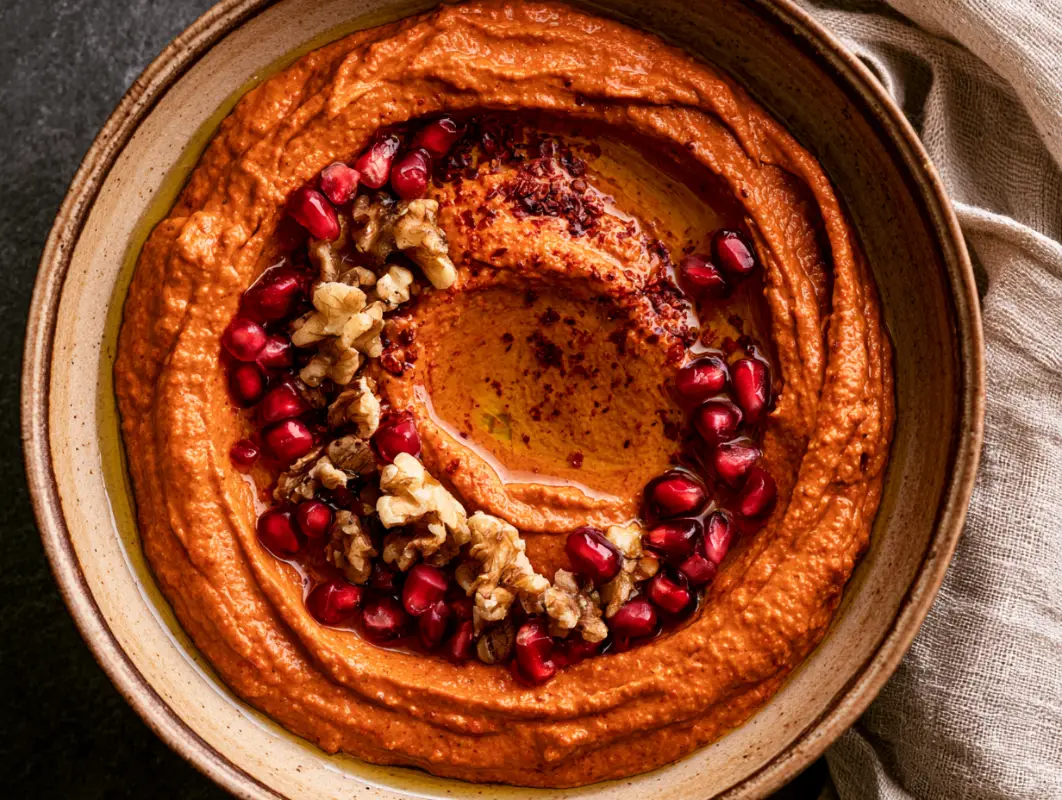
I can still feel the late-afternoon sun warming the stone terrace of my grandfather’s taverna in Chania, where the Cretan Sea stretched out like hammered copper. My mother had just returned from the market with a bag of fire-red peppers, and the kitchen already smelled of toasting walnuts and cumin. “Niko,” she said, pressing a warm pepper into my hands, “in the eastern Mediterranean, they turn these into something magical.” That was my first taste of Muhammara Red Pepper & Walnut Dip so vivid, so deeply savory, that it changed the way I thought about what a simple dip could be.
Muhammara is one of those dishes that proves the Mediterranean table has no borders. Born in Aleppo, Syria, it traveled through Levantine kitchens, across Turkey, and eventually into my yiayia’s Cretan mezze spread, where it sat proudly beside hummus and tzatziki. The combination of charred peppers, toasted walnuts, pomegranate molasses, and a generous pour of extra-virgin olive oil creates a dip that is smoky, tangy, slightly sweet, and impossible to stop eating. (Trust me, I’ve tried.)
In my yiayia’s kitchen, muhammara was never a recipe you measured precisely — it was a feeling, a balance you learned by tasting. Below, I’ll walk you through every step, every secret, every mistake I’ve already made so you don’t have to. Let’s bring the Mediterranean to your table.
Table of Contents
Why This Muhammara Red Pepper & Walnut Dip Recipe Stands Out
The Technique That Makes the Difference
Most muhammara recipes tell you to use jarred roasted peppers. Don’t. The secret is charring fresh red bell peppers over an open flame until the skin blisters and blackens completely. This isn’t just about convenience — it’s chemistry. Direct-flame roasting triggers the Maillard reaction and caramelization simultaneously, producing over 600 new flavor compounds that you simply cannot get from a jar (Harold McGee, On Food and Cooking). The peppers develop a depth — smoky, almost meaty — that becomes the soul of this roasted red pepper dip.
I also dry-toast the walnuts in a cast-iron skillet rather than oven-roasting them. Why? Stovetop toasting lets you control the heat second by second, and walnuts go from golden to burnt in about forty-five seconds. I’ve learned that lesson the hard way — twice.
Flavor Profile & When to Serve It
This walnut dip hits every note: smoky from the charred peppers, tangy from the pomegranate molasses, gently warm from the Aleppo pepper, and rich from the olive oil and toasted walnuts. It’s the kind of Mediterranean dip recipe that makes people lean in and ask, “What is this?”
Serve it as part of a mezze spread alongside authentic hummus and baba ganoush, or smear it on homemade flatbread for a weeknight appetizer. It’s equally at home at a dinner party and a Tuesday lunch. You’ll love it either way.
The Story Behind Muhammara
From Aleppo to the Mediterranean Table
Muhammara — from the Arabic muḥammara, meaning “reddened” — traces its roots to Aleppo, Syria, a city legendary for its culinary heritage. For centuries, Aleppine cooks blended roasted peppers with walnuts, breadcrumbs, and pomegranate molasses to create this mezze dip recipe, traditionally served during celebrations, holidays, and large family gatherings. The dish traveled the spice routes into Turkish, Lebanese, and eventually Greek kitchens.
How Muhammara Found My Family’s Table
My grandfather’s taverna in Chania sat along the harbor, and fishermen from every corner of the eastern Mediterranean would dock there. One summer, a Syrian captain left behind a jar of Aleppo pepper flakes and a handwritten muhammara recipe scribbled on a napkin. My yiayia, never one to let a good ingredient go unused, adapted it using Cretan olive oil from Kolymvari and walnuts from our neighbor’s tree. It became a permanent fixture on our family’s mezze table — Crete’s answer to the Levant.
Essential Muhammara Ingredients
Core Ingredients
Every ingredient in this red pepper walnut spread earns its place. Here’s what you need and, more importantly, why it matters. When I test recipes in my Athens kitchen, I always reach for the best Aleppo pepper I can find — it’s the ingredient that separates a good muhammara from a great one.
| Ingredient | Amount | Why It Matters | Authentic Pick | Substitution |
| Red bell peppers | 4 large (about 800 g / 1.75 lb) | Provide the smoky, sweet base | Fresh, heavy for size | Jarred roasted peppers (drained) |
| Walnuts, toasted | 1 cup (120 g / 4 oz) | Add richness, body, and healthy fats | Fresh halves, not pre-chopped | Almonds or sunflower seeds |
| Pomegranate molasses | 2 Tbsp (30 ml) | The tangy-sweet backbone | Al Wadi or Cortas brand | 1 Tbsp lemon juice + 1 tsp honey |
| Extra-virgin olive oil | 3 Tbsp (45 ml) + more to finish | Emulsifies and rounds the flavor | Kolymvari or Sitia Cretan EVOO | Any quality EVOO |
| Aleppo pepper flakes | 1 Tbsp (5 g) | Fruity warmth without harsh heat | Pul biber / Aleppo-style | 1 tsp sweet paprika + pinch cayenne |
| Breadcrumbs | 1/3 cup (30 g) | Thicken and give body to the dip | Day-old sourdough, dried | Gluten-free breadcrumbs or oat flour |
| Garlic | 2 cloves, minced | Aromatic depth | Fresh cloves, firm and tight | 1/2 tsp garlic powder |
| ground Cumin | 1 tsp (2 g) | Earthy warmth, classic Levantine note | Freshly ground from seeds | Ready-ground cumin |
My mother always said the peppers should feel heavy for their size — that means they’re full of juice. And the walnuts? Buy halves, not pieces. Whole halves stay fresher because less surface area is exposed to air.
Dietary Substitutions & Pro Tips
| Dietary Need | Replace | With | Notes |
| Gluten-free | Breadcrumbs | GF breadcrumbs or 2 Tbsp oat flour | Texture is nearly identical |
| Nut-free | Walnuts | Toasted sunflower seeds (same amount) | Slightly milder, still delicious |
| Lower fat | 3 Tbsp olive oil | 1.5 Tbsp olive oil + 1.5 Tbsp water | Add water gradually for texture |
| Nightshade-free | Red bell peppers | Roasted beets (same weight) | Color is stunning, flavor earthier |
Pro Tip: If your pomegranate molasses is very thick and syrupy, use just 1.5 tablespoons. If it’s thinner and more tart, go the full 2 tablespoons. Taste as you go — my yiayia never measured, and neither should you be afraid to adjust.
Equipment & Kitchen Setup
Tools of the Trade
You don’t need much to make an exceptional muhammara, but the right tools make a real difference. My yiayia used a mortar and pestle the size of a small boulder — you can use a food processor.
| Traditional Tool | Modern Alternative | Why It Matters |
| Stone mortar & pestle | Food processor (7-cup+) | Controls texture — you want chunky, not baby food |
| Open-flame grill / mangal | Gas stovetop or broiler | Direct flame gives the best char on peppers |
| Cast-iron skillet | Any heavy-bottomed pan | Even heat for toasting walnuts without scorching |
| Wooden spoon | Silicone spatula | For folding in olive oil at the end |
Mise en Place Checklist
Before you begin, set up your workspace. This is how we do it in professional kitchens — and it saves you from that panicked scramble mid-recipe. Wash and dry peppers completely (water on a pepper under a flame creates steam, not char). Toast walnuts and let them cool. Measure pomegranate molasses, olive oil, and spices into small bowls. Mince your garlic. Line a bowl with a clean kitchen towel for steaming the peppers. If your oven is doing the roasting, position the rack 4 inches (10 cm) below the broiler element and preheat to 500°F (260°C) for at least 10 minutes.
Step-by-Step Muhammara Instructions
Preparation (Steps 1–4)
Step 1: Char the peppers. Place whole red bell peppers directly on the grate of a gas burner set to high. Rotate with tongs every 2–3 minutes until every surface is blistered and blackened, about 10–12 minutes total. You want aggressive char — don’t be shy. The kitchen will smell incredible, smoky and sweet. If you don’t have a gas stove, use a broiler at 500°F (260°C), turning every 4–5 minutes.
Why it matters: The charring develops deep smoky flavor through pyrolysis and Maillard browning. Raw or under-charred peppers taste flat. Trust me on this.
Yiayia’s Tip: “If the pepper still has patches of red skin, it’s not done. Black everywhere — that’s when the magic happens.”
Step 2: Steam and peel. Transfer charred peppers to a bowl, cover tightly with plastic wrap or a plate, and let them steam for 15 minutes. The steam loosens the skin beautifully. Peel off the blackened skin with your fingers (not under running water — you’ll wash away flavor). Remove stems and seeds. Don’t worry about a few flecks of char. That’s flavor.
Step 3: Toast the walnuts. Place walnuts in a dry cast-iron skillet over medium heat. Stir constantly for 3–4 minutes until fragrant and golden. The moment you smell that warm, nutty aroma, pull them off the heat immediately. Golden. Fragrant. Done. (I’ve burnt more walnuts than I care to admit. They go from perfect to acrid in seconds.)
Step 4: Prep remaining ingredients. Mince garlic, measure pomegranate molasses, Aleppo pepper flakes, cumin, breadcrumbs, olive oil, and a generous pinch of salt. Having everything ready means the final assembly takes under five minutes.
Cooking & Assembly (Steps 5–10)
Step 5: Pulse the walnuts. Add toasted walnuts to the food processor. Pulse 6–8 times until coarsely chopped — you want visible pieces for texture. Don’t over-process; this roasted red pepper dip should have character, not be a smooth paste.
Step 6: Add peppers and blend. Add peeled roasted peppers, garlic, breadcrumbs, pomegranate molasses, Aleppo pepper, cumin, and ½ teaspoon salt. Process for 20–30 seconds until combined but still slightly chunky. Scrape down the sides.
Step 7: Stream in the olive oil. With the processor running on low, drizzle in 3 tablespoons of extra-virgin olive oil through the feed tube. This emulsifies the muhammara and gives it that luscious, silky quality. As J. Kenji López-Alt explains in The Food Lab, slow incorporation of oil into a puree creates a stable emulsion — the same principle behind aioli.
Step 8: Taste and adjust. This is the most important step. Taste. Is it tangy enough? Add another teaspoon of pomegranate molasses. Needs more warmth? Another pinch of Aleppo pepper. Salt? Almost certainly. The flavors should feel balanced — smoky, tangy, rich, warm — with no single note overpowering.
Yiayia’s Tip: “Always taste with bread, not a spoon. A dip lives or dies on how it tastes with what you eat it with.”
Step 9: Rest the muhammara. Transfer to a serving bowl, cover, and refrigerate for at least 30 minutes (ideally 2 hours). The flavors meld and deepen as the dip rests. This is not optional — freshly made muhammara tastes bright and sharp; rested muhammara tastes complex and harmonious.
Step 10: Plate and serve. Spread the muhammara on a shallow plate or wide bowl. Create swooshes with the back of a spoon. Drizzle generously with olive oil, scatter a few whole walnut pieces, and finish with a sprinkle of Aleppo pepper flakes and a few pomegranate seeds if you have them. Serve with warm pita bread or crudités.
The Secret Touches
Insider Techniques from a Greek Kitchen
Here’s where we separate the home cook from the taverna chef. These four techniques aren’t complicated, but they’re what make my muhammara recipe the one friends keep requesting.
1. The Double-Toast Method. Toast walnuts in a dry skillet, then add them to the food processor while still slightly warm. Warm walnuts release their oils more readily, which means a richer, more cohesive dip. Cold walnuts stay stubbornly dry.
2. The Pomegranate Glaze Finish. After plating, I drizzle a thin ribbon of pomegranate molasses directly over the muhammara — not mixed in, just on top. It gives each bite a hit of bright acidity that cuts through the richness.
3. Olive Oil Temperature Matters. Use room-temperature olive oil, never cold from the fridge. Cold oil doesn’t emulsify as smoothly and can make the texture grainy.
4. The Overnight Rest. I’ve made this roasted red pepper dip over 50 times, and it always tastes better the next day. The capsaicin from the Aleppo pepper mellows, the pomegranate molasses integrates, and the garlic loses its sharpness. If you can, make it a day ahead.
Common Mistakes to Avoid
| Mistake | What Happens | How to Fix It |
| Over-processing in food processor | Dip becomes a smooth paste; loses rustic texture | Pulse in short bursts, check after every 3–4 pulses |
| Skipping the pepper steaming step | Skin is hard to peel; you lose flesh | Always steam for a full 15 minutes in a covered bowl |
| Using stale or rancid walnuts | Bitter, musty flavor ruins the whole dip | Taste walnuts raw first; store in freezer for freshness |
| Not enough pomegranate molasses | Dip tastes flat and one-dimensional | Add in small increments, taste after each addition |
| Adding oil too fast | Emulsion breaks; dip looks oily and separated | Drizzle slowly through feed tube with processor running |
Variations & Serving Ideas
Regional Twists & Modern Adaptations
In Aleppo, muhammara is traditionally thicker and heavier on the breadcrumbs. Lebanese versions tend to be smoother and more pomegranate-forward. My Cretan adaptation uses less bread and more olive oil, which makes it lighter and more dip-like — perfect for spreading on homemade flatbread or scooping with raw vegetables.
For a modern weeknight shortcut, use high-quality jarred roasted peppers (drain them well and pat dry). You’ll lose some of that flame-charred depth, but the dip will still be delicious. You can also add a tablespoon of tahini for extra creaminess, or a handful of roasted red lentils for protein — similar to how I boost our Mediterranean lentil soup.
Want a spicier muhammara? Swap in hot Turkish pepper flakes (isot biber) for the Aleppo pepper. It adds a smoky, raisin-like heat that’s addictive.
What to Serve With Muhammara
Muhammara is a mezze dip recipe that plays well with others. Build a full spread with authentic hummus, baba ganoush, a bright fattoush salad, and a bowl of marinated olives. For protein, pair it with homemade falafel or grilled chicken skewers.
For beverages, I love this dip with a glass of fresh pomegranate juice, sparkling water with a sprig of mint, or hot tsai tou vounou (Greek mountain tea). In summer, try chilled hibiscus tea — its tartness mirrors the pomegranate molasses beautifully. A cold glass of homemade lemonade with a pinch of sumac is another winner.
Storage & Make-Ahead Tips
How to Store Muhammara
| Method | Container | Duration | Notes |
| Refrigerator | Airtight glass jar with olive oil layer on top | Up to 5 days | Flavor improves over first 24 hours |
| Freezer | Freezer-safe container, ¾ full | Up to 3 months | Thaw overnight in fridge; stir before serving |
| Room temp (serving) | Covered serving bowl | Up to 2 hours | Bring to room temp 20 min before serving for best flavor |
This muhammara recipe is one of my favorite make-ahead dishes. In fact, it insists on being made ahead. The flavor at hour zero is bright and a little jagged; by day two, it’s smooth, complex, and deeply satisfying.
Reheating & Refreshing
Muhammara is best served at room temperature, so reheating isn’t usually necessary. If it’s been refrigerated, simply take it out 20–30 minutes before serving. Give it a good stir, taste, and adjust: a squeeze of lemon juice brightens cold dips, and a fresh drizzle of olive oil restores that silky finish. If the texture has thickened in the fridge (breadcrumbs absorb moisture over time), stir in a tablespoon of water or olive oil until it loosens up. Scatter fresh pomegranate seeds and a pinch of Aleppo pepper on top just before serving to make it look — and taste — freshly made.
Muhammara (Red Pepper & Walnut Dip)
Ingredients
Method
- Char the peppers. Set the whole red bell peppers directly on the grate of a gas burner over high heat and rotate with tongs every 2–3 minutes until every surface is blistered and blackened, about 10–12 minutes. Be aggressive about it — patches of red skin mean it is not done. Without a gas stove, use a broiler at 500°F (260°C), turning every 4–5 minutes.
- Steam and peel. Transfer the charred peppers to a bowl, cover tightly and let them steam for 15 minutes. Peel off the blackened skin with your fingers — not under running water, which washes away flavour — and remove the stems and seeds. A few flecks of char are flavour, so leave them.
- Toast the walnuts in a dry cast-iron skillet over medium heat, stirring constantly for 3–4 minutes until fragrant and golden. Pull them off the heat the moment you smell that warm nutty aroma; they go from perfect to acrid in seconds.
- Prep everything else — mince the garlic and measure the pomegranate molasses, Aleppo pepper, cumin, breadcrumbs, olive oil and a generous pinch of salt.
- Pulse the still-warm toasted walnuts in a food processor 6–8 times until coarsely chopped. You want visible pieces for texture, not a smooth paste.
- Add the peeled peppers, garlic, breadcrumbs, pomegranate molasses, Aleppo pepper, cumin and 1/2 teaspoon salt. Process 20–30 seconds until combined but still slightly chunky, scraping down the sides.
- With the processor running on low, stream in the olive oil through the feed tube. Slow incorporation creates a stable emulsion and gives the dip its silky quality.
- Taste and adjust — more pomegranate molasses for tang, more Aleppo for warmth, and almost certainly more salt. Nothing should overpower; it should read smoky, tangy, rich and warm all at once. Taste it on bread rather than off a spoon.
- Transfer to a bowl, cover and refrigerate at least 30 minutes and ideally 2 hours. Freshly made muhammara tastes bright and sharp; rested muhammara tastes complex and harmonious.
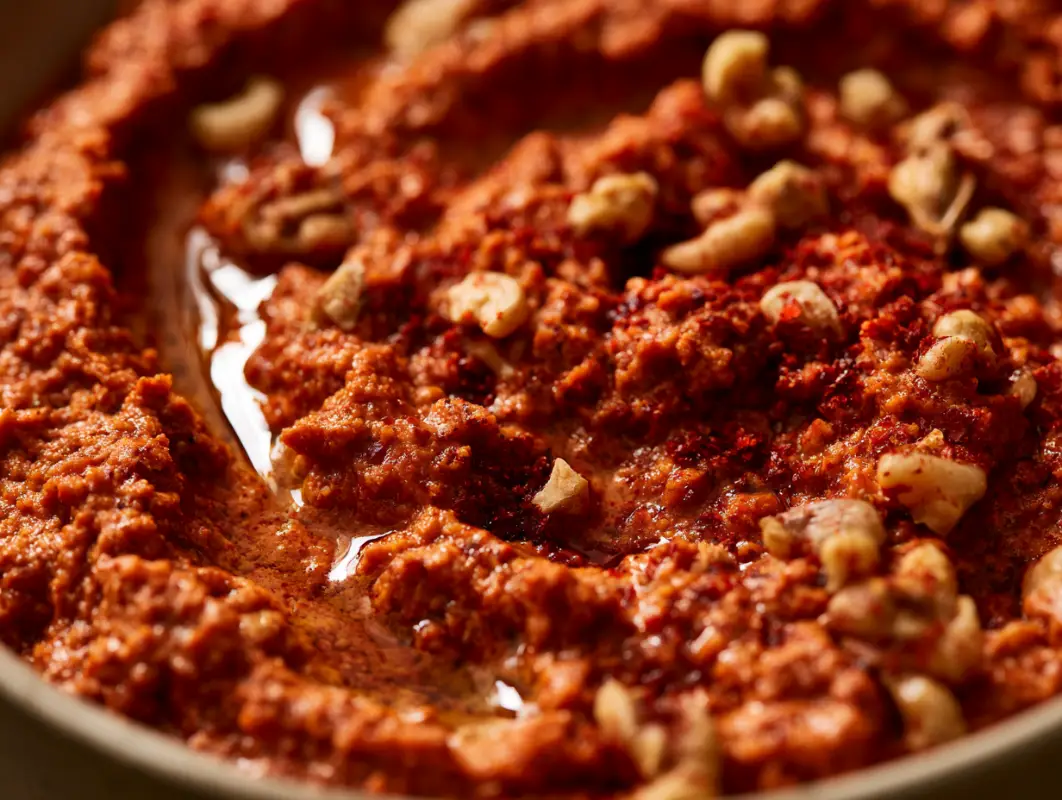
- Spread on a shallow plate, making swooshes with the back of a spoon. Drizzle generously with olive oil and a thin ribbon of pomegranate molasses, scatter whole walnut pieces, and finish with Aleppo pepper flakes and pomegranate seeds. Serve with warm pita or crudités.
Notes
Frequently Asked Questions
Substitutions & Technique
Can I use jarred roasted peppers for muhammara?
You can, and the dip will still taste good. But flame-charred fresh peppers give you a smokiness that jarred peppers simply lack. If you use jarred, drain them thoroughly and pat dry with paper towels. I’d also add a tiny pinch of smoked paprika to compensate for the missing char flavor. The roasted red pepper dip will still work, just with a slightly milder personality.
What can I substitute for pomegranate molasses?
Mix 1 tablespoon of fresh lemon juice with 1 teaspoon of honey or date syrup. It won’t be identical — pomegranate molasses has a unique tangy-sweet complexity — but it provides the acidity and sweetness the dip needs. Tamarind paste (1 teaspoon, thinned with water) also works surprisingly well.
How do I get the right texture?
Pulse, don’t blend. Use the pulse button on your food processor in short bursts and stop when you can still see small walnut pieces throughout. Traditional muhammara has a coarse, rustic texture — it should never be as smooth as hummus. Scrape down the sides between pulses to ensure even processing.
Why does my muhammara taste bitter?
Two likely culprits: burnt walnuts or old walnuts. Walnuts contain tannins that intensify when overcooked or oxidized. Always taste your walnuts raw before using them. They should taste mildly sweet and nutty, never sharp or astringent. Store walnuts in the freezer to maintain freshness.
Dietary, Make-Ahead & Authenticity
Is muhammara naturally vegan and gluten-free?
This muhammara recipe is naturally vegan — no dairy, no eggs, no animal products. For gluten-free, simply swap the breadcrumbs for gluten-free breadcrumbs or a tablespoon of oat flour. The texture difference is minimal. It’s also naturally halal and suitable for most dietary restrictions.
How far ahead can I make muhammara?
Make it up to three days ahead and store in the refrigerator. It genuinely tastes better after resting overnight. I often make a double batch on Sunday to have it ready for the week. Just bring it to room temperature and stir before serving.
Is this recipe authentically Syrian?
The foundation is authentically Aleppine — roasted peppers, walnuts, pomegranate molasses, Aleppo pepper, breadcrumbs, olive oil. My version incorporates a Cretan influence with high-quality Kolymvari olive oil and slightly less bread for a lighter texture. The spirit is authentic; the details are my family’s interpretation.
Can I freeze muhammara?
Absolutely. Freeze in an airtight container for up to three months. Thaw overnight in the fridge, stir well, and refresh with a squeeze of lemon juice and a drizzle of olive oil. The texture may be slightly softer after freezing, but the flavor holds up beautifully.
What bread goes best with this walnut dip?
Warm warm pita bread is the classic choice. I also love it with our homemade flatbread or even toasted sourdough. For a lighter option, serve with cucumber rounds, endive leaves, or carrot sticks. The dip is so flavorful it doesn’t need a fancy vehicle.
A Taste of the Mediterranean at Home
Bringing the Mediterranean to Your Table
Every time I make muhammara, I’m transported back to that Chania terrace — the clinking of glasses, the sound of waves, my mother’s hands moving confidently through the kitchen. That’s what cooking Mediterranean food does: it connects you to a place, a tradition, a feeling. You don’t need to be in Greece or Syria to feel it. You just need good ingredients, a little patience, and the willingness to taste as you go.
I’d love to see your muhammara. Tag me, leave a comment, share a photo — especially if you’ve put your own twist on it. In my yiayia’s kitchen, no two batches were ever exactly the same, and yours shouldn’t be either.
More Recipes to Explore
If this roasted red pepper dip has you craving more Mediterranean flavors, you’ll want to explore our authentic hummus for the ultimate mezze pairing, or try spanakopita for a savory pastry that fills the kitchen with the most incredible aroma. For a complete meal, build a Mediterranean grain bowl topped with muhammara, pickled onions, and fresh herbs. And for something warm and comforting, our shakshuka uses many of the same spices in a completely different way.