The late afternoon sun was beating down on the stone courtyard of my grandfather’s taverna in Chania, turning the air into something you could almost touch. I was maybe fifteen, standing barefoot on the warm tiles, watching my mother work over her tapsi — that heavy clay roasting dish that had been in our family for three generations. She was preparing horta with lemon and olive oil, but what I remember most was the cheese. Not halloumi — that came later — but the way she talked about how cheese should behave when it meets fire. “It should resist,” she said, flipping a piece of aged mizithra. “Then surrender.”
I grew up with the Mediterranean Sea as my backyard and my yiayia’s kitchen as my classroom. Every meal was a celebration, every recipe a story. When my father passed away in 2017, I realized those Saturday mornings grilling fish together, those Sunday dinners around my grandmother’s table — those weren’t just meals. They were my inheritance. I started this blog to preserve what my family taught me.
This Grilled Halloumi & Roasted Vegetable Bowl honors that inheritance while crossing to Cyprus, where my friend Andreas introduced me to halloumi — that miraculous cheese that doesn’t melt, that squeaks when you bite it, that carries the salt of the sea and the warmth of the sun. The roasting technique is my mother’s. The cheese is Cypriot. The result is pure Mediterranean.
Table of Contents
Why This Recipe Is Special
The Authentic Technique: Understanding the Squeak
What makes halloumi extraordinary isn’t just flavor — it’s physics. This Cypriot cheese has a high melting point because of its unique protein structure. When heated, the outside caramelizes and crisps while the interior softens to a squeaky, yielding texture. That “squeak” isn’t a gimmick; it’s the sound of intact protein networks rubbing against your teeth.
The real secret? Patience with the grill. Halloumi needs dry heat and time to develop its golden crust. When I first tried this in my Athens kitchen, I rushed it — flipped too early, used too little oil. The cheese stuck, tore, refused to brown. My yiayia would have shaken her head. “Food knows when you’re impatient,” she’d say.
The science is simple: halloumi’s curds are heated and poached in whey before brining, creating a protein matrix that holds shape under heat.This is why it can go where other cheeses cannot — directly onto the grill, into the roasting pan, seared in a hot skillet. It becomes crispy outside, creamy inside, salty and complex.
Flavor Profile & Occasions
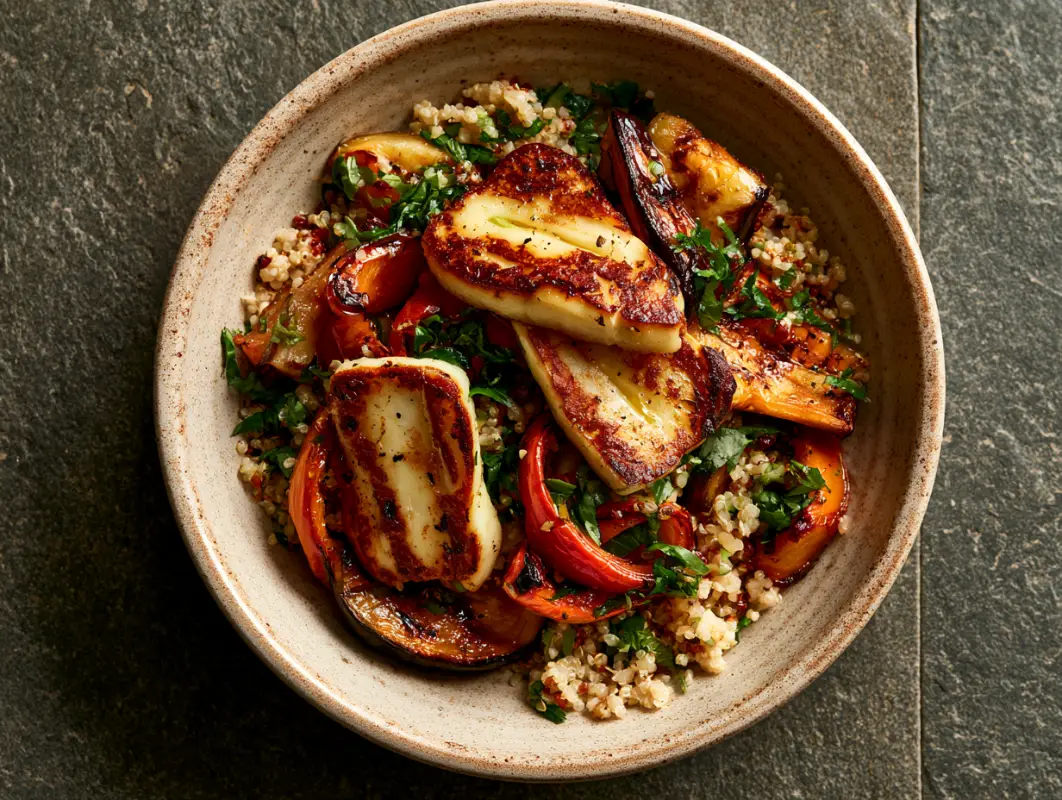
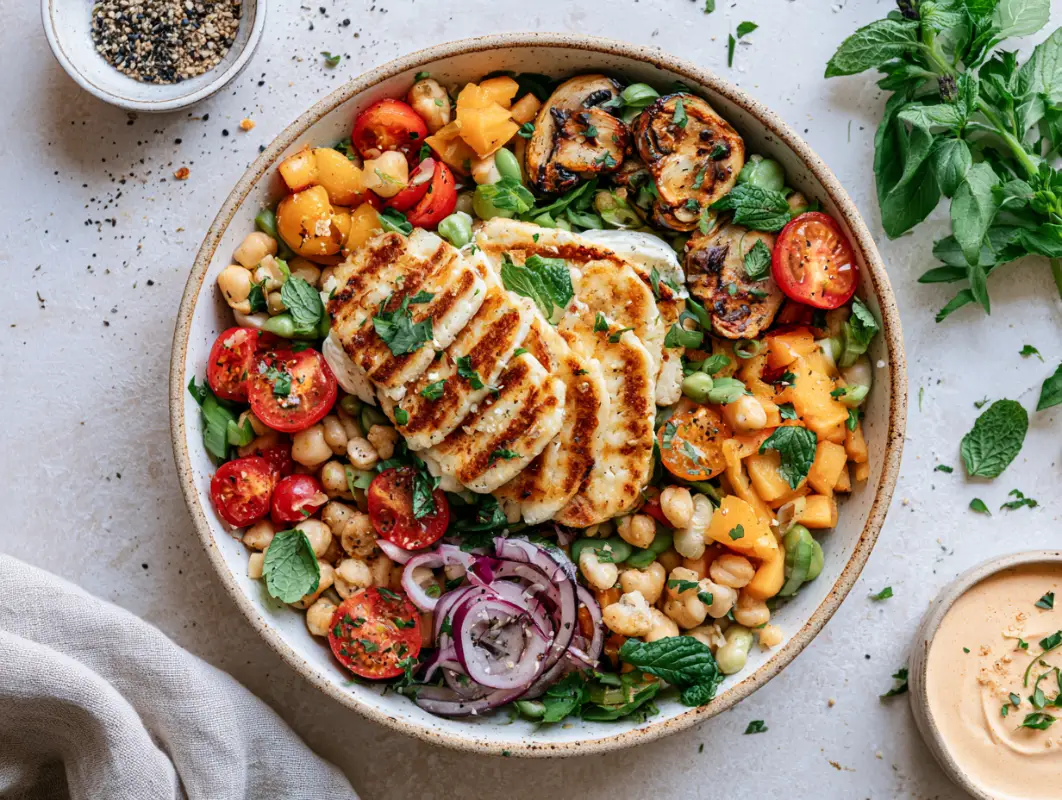
Imagine this: the halloumi is golden and crisp, squeaking between your teeth, releasing bursts of salty, tangy flavor. The vegetables — zucchini, peppers, red onion — are roasted until their edges char and their centers soften, concentrating their sweetness. The quinoa is fluffy and nutty, dressed with lemon and olive oil, providing a neutral canvas that lets the cheese and vegetables star.
It’s craveable. It’s the kind of bowl you want at 8 PM on a Tuesday when you need something real, or at a Saturday gathering where vegetarians and meat-eaters alike demand satisfaction. The protein content rivals chicken — 6.6 grams per 30g serving of cheese alone, plus the quinoa’s complete protein.
This is how we make it in Crete… or rather, how I’ve woven my mother’s roasting techniques with Cypriot cheese mastery. My family has been making vegetables with cheese for generations. The spirit is the same, even if the cheese travels further east.
The Story Behind the Grilled Halloumi & Roasted Vegetable Bowl
Cultural & Historical Context
Halloumi’s history is Cyprus itself — a cheese made for centuries from the milk of goats and sheep that graze on the island’s rugged terrain. Traditionally, it was a preservation method: curds heated in whey, packed in brine, stored for winter when fresh milk was scarce. The high salt content was survival; the unique texture was serendipity .
The roasting of vegetables is older — universal, really. But in the Mediterranean, it became art. My mother taught me that every vegetable has a “surrender point” where it stops fighting the heat and begins to caramelize, releasing sugars, developing complexity. Zucchini becomes sweet and yielding; peppers develop smoky depth; onions turn jammy and rich.
The combination — Cypriot cheese, Cretan technique, modern grain bowl — reflects what the Mediterranean diet truly is: not a rigid set of rules, but a conversation between coastlines, a sharing of wisdom across waters.
Family Tradition: A Cypriot Connection
I met Andreas in 2015, during a culinary exchange in Limassol. He was a third-generation halloumi maker, his hands rough from handling curds, his knowledge inherited like mine. “You Greeks,” he laughed, watching me grill his cheese, “you always want to add oregano.” I did add oregano — dried from my mother’s garden in Crete. He approved.
That night, eating halloumi with roasted vegetables and bulgur in his family’s courtyard, I thought of my father’s fishing boat, my yiayia’s kitchen, the continuity of coastal life. We ate silently for a moment, the cheese squeaking, the vegetables sweet, the sea air mixing with wood smoke. “This,” Andreas said, “is why we do what we do.”
When I returned to Athens, I spent months perfecting this bowl — testing oven temperatures, cheese thicknesses, vegetable cuts. My mother tasted the final version. “The cheese is good,” she said. “But the vegetables are better than mine.” High praise. That was all I needed to hear.
Essential Ingredients
Core Ingredients Table
| Ingredient | Amount | Why It Matters | Authentic Pick | Substitution |
| Halloumi cheese | 8 oz (225g) | 6.6g protein per 30g, high calcium, unique non-melting texture for grilling | Authentic Cypriot, sheep/goat milk blend | Paneer or extra-firm tofu (different, but functional) |
| Quinoa | 1 cup (180g) dry | Complete protein (all 9 essential amino acids), fluffy texture, nutty flavor | Organic, rinsed well | Bulgur, couscous, or farro |
| Zucchini | 2 medium (400g) | High water content roasts to sweet concentration; fiber, vitamin C | Firm, small to medium | Yellow summer squash |
| Red bell pepper | 2 large (300g) | Vitamin C powerhouse, sweetens dramatically when roasted | Thick-walled, heavy for size | Orange or yellow peppers |
| Red onion | 1 large (200g) | Natural sugars caramelize; sharpness mellows to sweetness | Firm, papery skin intact | Yellow onion or shallots |
| Cherry tomatoes | 1 cup (150g) | Burst with heat, creating sauce; acidity balances rich cheese | On the vine, deeply colored | Grape tomatoes or diced Roma |
| Extra virgin olive oil | 1/3 cup | Heart-healthy fats; carries fat-soluble flavors; prevents sticking | Cold-pressed, Cypriot or Cretan | High-quality avocado oil |
| Dried oregano | 2 tsp | Antioxidant, antimicrobial; essential Mediterranean flavor | Greek or Cypriot, hand-rubbed | Dried thyme or marjoram |
Yiayia’s Memory: My mother never measured oregano. She’d take dried stalks in her palms and rub them together, the leaves falling like green snow. “The aroma tells you,” she’d say. When the kitchen filled with that peppery, pine scent, you knew it was enough. I tried to measure once — 2 teaspoons for this recipe — but honestly? I still use her method. Trust your nose.
Dietary Substitutions Table
| Need | Replace | With | Notes |
| Vegan | Halloumi | Extra-firm tofu, pressed and marinated | Use same grilling technique; won’t squeak |
| Dairy-Free | Halloumi | Grilled portobello mushrooms | Different flavor, similar meaty texture |
| Gluten-Free | Quinoa | Certified GF quinoa (verify) | Naturally gluten-free; check processing |
| Lower Sodium | Halloumi | Soak in water 30 min, pat dry | Reduces salt content significantly |
| Nightshade-Free | Bell peppers | Cubed eggplant or more zucchini | Roast separately; different timing |
| Keto/Low-Carb | Quinoa | Cauliflower rice (roasted) | Reduce roasting time to 15 minutes |
Pro Tip: Halloumi’s salt content is high — 0.9g per 30g serving, which is 15% of daily recommended intake . If you’re sensitive to salt, soak the slices in lukewarm water for 30 minutes before grilling, then pat very dry. This removes excess brine while preserving the cheese’s structure. I learned this from Andreas after complaining about a too-salty batch.
Equipment & Technique
Equipment Table
| Traditional Tool | Modern Alternative | Why It Matters |
| Tapsi (clay roasting dish) | Heavy sheet pan or roasting pan | Even heat distribution; vegetables roast, don’t steam |
| Hovoli (charcoal grill) | Cast iron grill pan or outdoor grill | High, dry heat creates halloumi’s signature crust |
| Skara (grill grate) | Non-stick skillet (if no grill) | Direct contact with hot surface essential |
| Kofini (colander) | Fine-mesh sieve | Rinsing quinoa removes bitter saponins |
| Xyalo (wooden spatula) | Thin metal spatula | Slides under cheese without tearing |
Mise en Place Checklist
In my yiayia’s kitchen, everything was ready before the fire was lit. That’s mise en place — the French term every chef lives by, though Greek grandmothers just called it “being prepared.”
Wash & Prep Vegetables (15 minutes):
- Cut zucchini into 1-inch half-moons (exposes more surface area)
- Core and slice peppers into 1-inch strips (uniform size = even roasting)
- Cut onion into thick wedges (root intact holds layers together)
- Halve cherry tomatoes (they’ll burst and create sauce)
Prep Quinoa (during roasting):
- Rinse quinoa thoroughly under cold water (removes bitter coating)
- Cook in 2:1 water to grain ratio, 15 minutes, covered
- Fluff with fork, dress with lemon and olive oil while warm
Halloumi Prep (5 minutes):
- Slice into 1/2-inch thick slabs (thicker than you think — shrinks 30%)
- Pat absolutely dry with paper towels (water prevents browning)
- Brush lightly with olive oil (prevents sticking, aids caramelization)
Step-by-Step Instructions
Preparation Steps: Building the Foundation
Step 1: Roast the Vegetables (25 minutes) Preheat oven to 425°F (220°C). Toss zucchini, peppers, and onion with 3 tablespoons olive oil, dried oregano, salt, and pepper. Spread on heavy sheet pan in single layer — crowding steams, roasting requires space. Roast 20 minutes, then add cherry tomatoes. Continue 5 minutes until vegetables are charred at edges and tender.
Yiayia’s Tip: Don’t stir too often. Let them develop color. The caramelization is flavor. I check at 15 minutes, rotate the pan if oven has hot spots, but otherwise leave them be. My first attempt, I fussed constantly — the result was pale and soggy. Patience.
Step 2: Cook the Quinoa (15 minutes) While vegetables roast, bring 2 cups water to boil. Add rinsed quinoa, reduce to low, cover. Simmer 15 minutes until liquid absorbed and germ rings visible. Remove from heat, let stand 5 minutes, then fluff with fork. Dress immediately with 1 tablespoon olive oil and 1 tablespoon lemon juice — warm grains absorb flavor better.
Step 3: Prep the Halloumi (5 minutes) Slice halloumi into 1/2-inch thick slabs. Pat completely dry — this is crucial. Water on the surface creates steam, preventing that golden crust. Brush lightly with remaining olive oil.
Step 4: Preheat Your Grill Pan (3 minutes) Heat cast iron grill pan over medium-high until smoking. The pan must be hot before cheese touches it — this is what creates the sear and prevents sticking. If using outdoor grill, ensure grates are clean and oiled.
Cooking & Assembly: Bringing It Together
Step 5: Grill the Halloumi (6 minutes total) Place halloumi slices on hot grill pan. Don’t move them for 2-3 minutes. They will release naturally when crust forms — forcing them tears the cheese. Flip when golden with defined grill marks. Cook 2-3 minutes more until second side is browned. The cheese should squeak when pressed.
Temperature Note: Surface temperature should be around 400°F (200°C). If too cool, cheese softens without crusting; too hot, it burns before center warms.
Step 6: Rest the Cheese (2 minutes) Transfer grilled halloumi to plate. Let rest briefly — this allows interior to soften fully while crust remains crisp. Cut into bite-sized pieces or leave in slabs for dramatic presentation.
Step 7: Combine Vegetables & Quinoa (2 minutes) In large bowl, toss roasted vegetables with cooked quinoa. The tomatoes will have burst, creating a light sauce. Add any accumulated juices from the roasting pan — that’s liquid gold.
Step 8: Dress & Season (2 minutes) Add remaining lemon juice, 2 tablespoons olive oil, fresh cracked pepper, and more oregano if desired. Toss gently. Taste for salt — halloumi is salty, so you may need less than you think.
Step 9: Assemble the Bowls (3 minutes) Divide quinoa-vegetable mixture among four bowls. Top with grilled halloumi pieces. Drizzle with your best olive oil. Garnish with fresh herbs if available — parsley, mint, or dill all work.
Step 10: Serve Immediately (1 minute) This doesn’t wait. Halloumi is best hot, when the contrast between crisp crust and yielding center is most dramatic. Serve with lemon wedges and crusty bread. Golden. Squeaky. Perfect.
The Secret Touches
Insider Techniques with Food Science
The Dry Heat Principle: Halloumi’s unique behavior comes from its preparation — curds heated in whey, then brined. This creates a protein matrix that can withstand temperatures up to 400°F (200°C) without melting . When you grill it, you’re not just cooking; you’re creating a Maillard reaction on the surface — hundreds of flavor compounds developing in that golden crust.
The Saponin Rinse: Quinoa is coated in saponins, natural compounds that taste bitter and can irritate digestion. Rinsing under cold water for 30 seconds removes these. Some pre-packaged quinoa is pre-rinsed, but I do it anyway. The difference is subtle but real — cleaner flavor, better digestion. My mother’s technique, confirmed by food science.
The Burst Tomato Effect: Adding cherry tomatoes in the final 5 minutes of roasting means they heat just enough to burst, releasing their acidic juices into the pan. This creates a light sauce that coats the other vegetables. If you add them too early, they dissolve into mush; too late, they remain firm and separate. Timing is everything.
Yiayia’s Wisdom: My mother always said, “Vegetables should be tired before they leave the oven.” Meaning: roasted until they’ve given up their water, concentrated their flavor, surrendered to the heat. That 25-minute roast isn’t arbitrary — it’s the point where zucchini transitions from watery to sweet, where peppers develop their smoky depth.
Common Mistakes Table
| Mistake | What Happens | How to Fix It |
| Slicing halloumi too thin | Cheese dries out, becomes rubbery, loses creamy center | Cut 1/2-inch thick; it shrinks 30% during cooking |
| Wet halloumi on grill | Sticks, tears, refuses to brown; steam instead of sear | Pat absolutely dry; brush lightly with oil |
| Overcrowding vegetables | Steam instead of roast; soggy, pale vegetables | Single layer with space between pieces |
| Flipping halloumi too early | Cheese tears, sticks to pan, loses crust | Wait 2-3 minutes until it releases naturally |
| Under-seasoning quinoa | Bland base that drags down flavorful toppings | Dress warm quinoa with lemon, oil, salt immediately |
Variations & Serving
Regional Variations & Modern Adaptations
The Cypriot Original: Serve with pittas — Cypriot flatbread — and a simple cucumber-mint salad. Andreas would add a drizzle of tahini thinned with lemon juice. The cheese is the star; everything else supports.
The Cretan Adaptation: Add 1 teaspoon dried mint with the oregano. Substitute half the quinoa with cooked horta (wild greens) if available. Finish with a sprinkle of anthotyro cheese alongside the halloumi. My mother’s touch — herbs from the mountains, cheese from the coast.
The Weeknight Shortcut: Use pre-cooked quinoa packets (warm in microwave). Roast vegetables on Sunday, refrigerate, reheat in hot skillet while grilling halloumi. The entire meal comes together in 15 minutes. Quality suffers slightly, but not enough for a Tuesday night.
The Summer Version: Grill everything outdoors — vegetables on the barbecue alongside the halloumi. The smoke adds dimension. Serve with tzatziki instead of lemon dressing. This is how we eat in Chania in August, when the kitchen is too hot and the sea calls.
Accompaniments
This bowl stands alone, but if you’re building a Mediterranean spread:
For a protein-rich companion using similar grilling techniques, try our Mediterranean Salmon Bowl — the principles of high-heat cooking apply beautifully to fish as well as cheese.
If you’re meal prepping multiple bowls for the week, pair this with our BJ’s Mediterranean Chicken Bowl for variety — the quinoa base and vegetable preparation are similar, keeping your workflow efficient.
For a lighter grain option that complements this hearty bowl, our Couscous and Quinoa Salad offers a refreshing counterpoint with similar Mediterranean flavors.
Non-Alcoholic Beverage Pairings:
- Ayran: Turkish yogurt drink, thinned with water, salted — cools the palate
- Fresh mint lemonade: The brightness cuts through the cheese’s richness
- Tsai tou vounou (Greek mountain tea): Earthy, herbal, aids digestion
- Sparkling water with cucumber: Simple, palate-cleansing, refreshing
- Chilled watermelon juice: Sweet, hydrating, classic Cypriot pairing
Storage & Reheating
Storage Table
| Method | Container | Duration | Notes |
| Refrigerator (components) | Airtight glass containers | 4-5 days | Store halloumi, vegetables, quinoa separately for best texture |
| Refrigerator (assembled) | Airtight container | 2 days | Halloumi softens; texture compromised but flavor good |
| Freezer (not recommended) | — | — | Halloumi becomes rubbery; vegetables lose integrity |
| Make-ahead vegetables | Container | 5 days | Roast ahead; reheat in hot skillet to restore |
Reheating Methods
Skillet (Best for Halloumi): Heat dry skillet over medium-high. Add halloumi slices, cook 1 minute per side until re-crisped. The microwave makes it rubbery — avoid if possible.
Oven (Best for Vegetables): Spread on sheet pan, 375°F (190°C) for 10-12 minutes until warmed and edges re-crisp. The oven restores what the microwave destroys.
Microwave (Quinoa Only): Acceptable for quinoa-vegetable base. 1-2 minutes, covered. Add fresh halloumi after reheating — day-old grilled halloumi is disappointing; fresh-grilled is divine.
What to Add Fresh: Always add fresh lemon juice, a drizzle of uncooked olive oil, and fresh herbs after reheating. This revives flavors dulled by refrigeration. The halloumi should ideally be grilled fresh, but if you must use leftovers, re-crisp in a hot skillet.
Grilled Halloumi & Roasted Vegetable Bowl
Ingredients
Method
- Preheat the oven to 425°F (220°C). Toss the zucchini, peppers and onion with 3 tablespoons olive oil, the dried oregano, salt and pepper and spread on a heavy sheet pan in a single layer — crowding steams, roasting needs space. Roast 20 minutes, then add the cherry tomatoes and continue 5 minutes more, until the vegetables are charred at the edges and tender.
- While the vegetables roast, bring 2 cups water to a boil. Add the rinsed quinoa, reduce to low and cover. Simmer 15 minutes until the liquid is absorbed and the germ rings are visible. Off the heat, let it stand 5 minutes, fluff with a fork, and dress immediately with 1 tablespoon olive oil and 1 tablespoon lemon juice — warm grains absorb flavour best.
- Slice the halloumi into 1/2-inch slabs and pat them completely dry. Surface water creates steam and steam prevents a golden crust. Brush lightly with olive oil.
- Heat a cast-iron grill pan over medium-high until smoking, about 3 minutes. The pan has to be hot before the cheese touches it, or the halloumi sticks instead of searing.
- Grill the halloumi 2–3 minutes per side without moving it. It will release naturally once the crust forms — forcing it tears the cheese. Flip when golden with defined grill marks and cook until the second side is browned. It should squeak when pressed.
- Transfer the halloumi to a plate and rest 2 minutes so the interior softens fully while the crust stays crisp. Cut into bite-sized pieces or leave in slabs.
- Toss the roasted vegetables with the cooked quinoa in a large bowl, scraping in every bit of the burst tomato juices from the roasting pan.
- Add the remaining lemon juice, 2 tablespoons olive oil, cracked pepper and more oregano if you like. Toss gently and taste for salt — you will need less than you think.
- Divide the quinoa and vegetables between four bowls, top with the grilled halloumi, drizzle with your best olive oil and garnish with the chopped fresh herbs.
- Serve immediately with lemon wedges and crusty bread — halloumi is at its best hot, when the crisp crust contrasts with the yielding centre.
Notes
FAQ
Substitution & Technique Q&As
Can I use a different cheese if I can’t find halloumi? A: You can try paneer or extra-firm tofu, but understand you’re changing the dish’s soul. Paneer has similar heat resistance but lacks halloumi’s saltiness and squeak. Tofu absorbs flavors well but won’t develop that golden crust or protein-rich bite. If you must substitute, marinate either in lemon, olive oil, and oregano before grilling. But honestly? Seek out halloumi. It’s worth the hunt.
Why did my halloumi stick to the pan? A: Three possibilities: not dry enough, pan not hot enough, or flipped too early. Water creates steam, which prevents browning and causes sticking. The pan must be smoking before cheese enters. And patience — if it resists when you try to flip, it’s not ready. Wait until it releases naturally. I tore many slices learning this.
Can I roast the halloumi instead of grilling? A: Yes, but the texture differs. Roasted halloumi (400°F/200°C, 10-15 minutes) softens more uniformly, losing some of the grilled contrast. It’s still delicious — creamier, less dramatic. If roasting, add it to the vegetable pan for the final 10 minutes. You’ll lose the squeak but gain ease.
Do I really need to rinse quinoa? A: If you enjoy bitter, soapy flavors, skip it. Otherwise, yes — 30 seconds under cold water removes saponins, natural compounds that protect the plant but irritate human digestion. Most modern quinoa is pre-rinsed, but I do it anyway. My mother’s habit, and habits become tradition for a reason.
Why is my halloumi rubbery instead of creamy? A: Overcooking or too-thin slices. Halloumi needs thickness to maintain interior creaminess while developing exterior crust. Cut 1/2-inch minimum. And don’t walk away — 2-3 minutes per side over high heat is the window. Beyond that, it tightens, squeezing out moisture, becoming tough.
Dietary, Make-Ahead & Authenticity Q&As
Is this actually healthy, given the cheese’s fat content? A: Halloumi is rich — 7.4g fat per 30g serving, 5.1g saturated. But it’s also protein-dense (6.6g per 30g) and calcium-rich (238mg per 30g)
Combined with fiber-rich vegetables and complete-protein quinoa, this bowl offers balanced nutrition. I’m not a dietitian, but I am a chef who understands that “healthy” isn’t about single ingredients — it’s about the whole plate. Moderation matters; quality matters more.
Can I prep this for a week’s lunches? A: With strategy. Roast vegetables and cook quinoa on Sunday; store separately. Grill halloumi fresh each day — it takes 6 minutes and makes the difference between good and exceptional. If you must use pre-grilled halloumi, re-crisp in a hot skillet. Day-old squeaky cheese is an oxymoron.
Is this authentic Cypriot or your interpretation? A: Respectful adaptation. Grilled halloumi with vegetables is authentically Cypriot; the grain bowl format is modern global. I’ve kept the core — the cheese treatment, the roasting technique, the lemon-oregano dressing — while adapting for contemporary bowls. Andreas in Cyprus approves; my Cretan mother would recognize the spirit. If the technique honors the ingredient, the presentation is flexible.
Can I make this vegan? A: Yes, with significant changes. Substitute extra-firm tofu, pressed and marinated in lemon, olive oil, and oregano. Grill using same technique — it won’t squeak or develop the same crust, but carries flavor well. The bowl becomes different but still satisfying. Some Cypriot producers now make vegan “halloumi” using coconut oil and starches; quality varies widely.
Why does halloumi squeak when I eat it? A: That sound is the hallmark of authentic halloumi — the protein structure rubbing against your teeth. It indicates proper curd formation and heating technique. No squeak often means lower quality or improper cooking. Embrace it. It’s the sound of tradition
Cultural Closing
Bringing Greece to Your Table
Cooking is inheritance. When I make this Grilled Halloumi & Roasted Vegetable Bowl, I’m channeling my mother’s patience with vegetables, Andreas’s pride in his cheese, my father’s understanding that the best food is often the simplest. Every time you grill halloumi until it squeaks, you’re participating in a tradition that stretches from Cyprus to Crete to your own kitchen.
Don’t be intimidated by the cheese if you’ve never used it. Trust me on this — if you can grill a sandwich, you can grill halloumi. The key is patience: dry cheese, hot pan, don’t flip early. The squeak will tell you when you’ve succeeded.
Make this for someone you love. Make it for yourself on a night when you need nourishment that satisfies without heaviness. Make it to understand that Cypriot and Cretan traditions aren’t competitors — they’re cousins who share the same sea, the same sun, the same understanding that good cheese and good vegetables need only respect to become extraordinary.
I’d love to see your versions. Tag me on Instagram with your halloumi — show me your grill marks, your vegetable char, your own grandmother’s serving bowl. Share this recipe with someone who thinks “vegetarian” means compromise. And tell me in the comments: what’s your inherited food memory? What dish carries your family’s history?
Kali orexi. Afiyet olsun. Good eating.
Related Recipes
If this bowl speaks to you, explore these other Mediterranean creations:
For another protein-rich Mediterranean bowl using similar grain techniques, try our Mediterranean Salmon Bowl — the quinoa preparation and vegetable roasting methods translate beautifully to seafood.
If you’re looking for a restaurant-style bowl with comparable Mediterranean flavors, our BJ’s Mediterranean Chicken Bowl offers a masterclass in layering techniques that complement this vegetarian dish.
And for a lighter grain-based option that pairs well with this hearty bowl, don’t miss our Couscous and Quinoa Salad — it’s refreshing, versatile, and shares the same Mediterranean DNA.