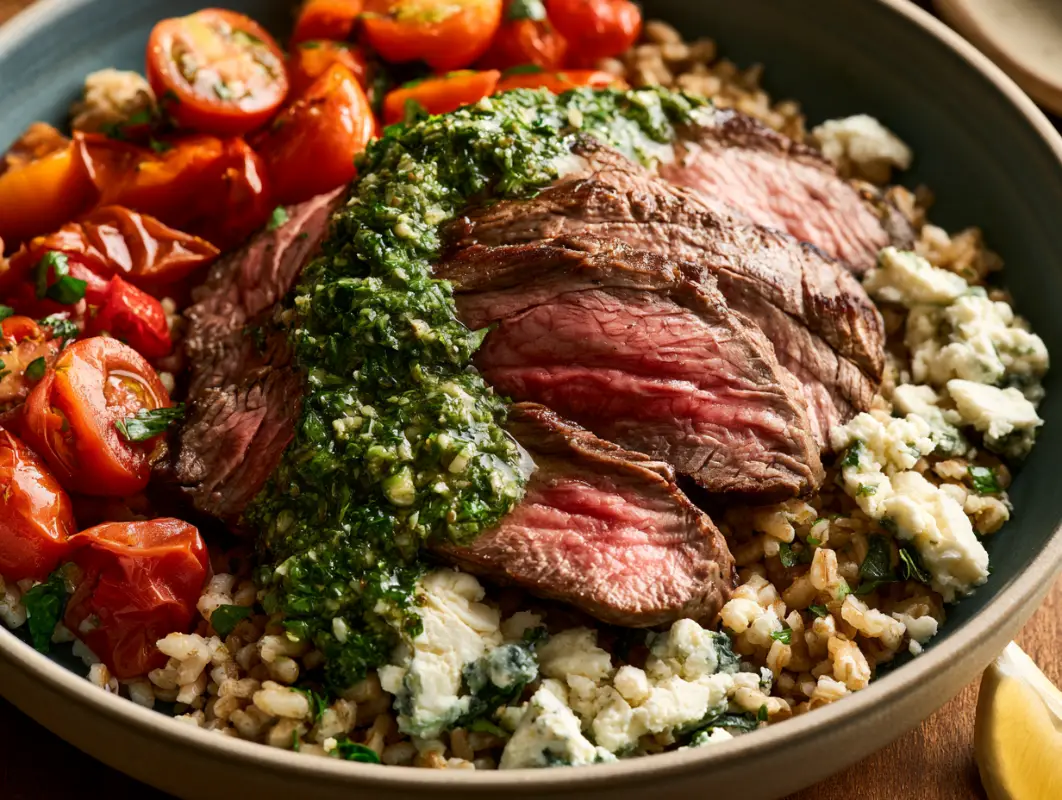
There is a particular kind of morning light in Chania that I will never stop chasing — golden, angled, the kind that turns ordinary harbour stones into amber. It was on one such morning, maybe twenty years ago now, that I stood in my yiayia’s kitchen watching her drag a bunch of flat-leaf parsley from a bucket of water, shake it with authority, and begin chopping it so fine it became almost a paste. She was making ladolemono — the ancient Cretan emulsion of olive oil and lemon — for a dish of grilled fish my father had brought in before dawn. The smell was extraordinary: green, peppery, alive.
I thought about that morning the first time I tried chimichurri at a restaurant in Athens. Here was the same fundamental idea — olive oil, acid, bright herbs, garlic — translated through an entirely different culinary tradition. That dish sparked an obsession. Over the next eighteen months, I tested more than 30 versions of a Chimichurri Steak & Ancient Grain Bowl, tweaking the herb ratios, the acid balance, and — crucially — the ancient grain base, until I arrived at the recipe you have in front of you now.
What makes this chimichurri steak bowl different from anything you will find in a restaurant? The farro. A grain my grandmother called zea and added to winter soups — nutty, chewy, deeply satisfying — it absorbs the herby green sauce in a way that no other grain can match. Plus it is genuinely good for you: high in fibre, magnesium, and slow-release energy. Whether you are cooking Sunday dinner for the family or meal-prepping for the week ahead, this recipe delivers every time. Let me show you how.
Table of Contents
Why This Chimichurri Steak & Ancient Grain Bowl Is Special
The Technique and Ingredient Difference
Most grilled steak bowl recipes tell you to throw your herbs in a blender and call it a day. That approach kills flavour. When you pulse parsley in a high-speed blender, you shear the cell walls so aggressively that chlorophyll degrades within minutes — a phenomenon food scientist Harold McGee describes as enzymatic browning, the same process that turns a cut apple brown. Instead, I use a marble mortar to crush the garlic and dried oregano first, then fold in hand-chopped parsley. The result is a chimichurri sauce with vivid green colour and a flavour that lasts for days in the fridge, not hours.
The second difference is the ancient grain. I specifically call for whole-grain farro (or freekeh, if you want a smokier note), because it holds its bite even after several days in the fridge, making this genuinely the best ancient grain bowl recipe for meal prep. Its nutty flavour is a natural echo of the peppery Cretan olive oil in the herb sauce steak marinade. Trust me — once you have tried it with farro, plain rice will feel like a step backwards.
🫒 Food Science: Maillard reaction (Maillard, 1912; popularised for cooks by J. Kenji López-Alt in The Food Lab) requires a dry surface at above 140 °C / 285 °F. Pat your steak completely dry before searing. Water on the surface causes steaming, not browning.
Flavour Profile and Best Occasions
In a single bowl you get five distinct flavour registers: the savoury, iron-rich depth of the grilled steak bowl, the sharp herbal punch of chimichurri, the nutty chew of farro, the sweet acidity of cherry tomatoes, and the cool crunch of cucumber. It is a complete, balanced meal. I serve it for Sunday family lunches, for guests I want to impress without spending three hours in the kitchen, and for meal prep on Sunday afternoons when I need five healthy lunches lined up for the working week.
This is equally good in summer as in winter. In summer, serve it at room temperature with extra lemon squeezed over the bowl; in winter, warm the farro gently and serve the chimichurri at room temperature. The Mediterranean grain bowl concept is endlessly adaptable — I have made it for dinner parties of twelve and for a solo Tuesday night when the fridge was nearly empty. It never fails.
The Story Behind the Chimichurri Steak Bowl
Cultural and Historical Roots
Chimichurri is Argentina’s gift to the world: a herb condiment of debated origin (some historians trace it to Basque immigrants, others to 19th-century British settlers who mispronounced their names as Jimmy McCurry). What fascinates me — a chef trained in Crete — is how immediately familiar it felt. At its core, chimichurri is an herb sauce steak condiment built on the same ratio of oil-to-acid-to-aromatic that my grandmother understood intuitively: olive oil carries the flavour, acid brightens it, garlic anchors it, and fresh herbs lift everything.
Ancient grains, meanwhile, have been cultivated in the Eastern Mediterranean for over 10,000 years. Farro (emmer wheat) was the grain of the Roman legions; freekeh — young durum wheat fire-roasted in the field — has been prepared in the Arab world and Levant for centuries. Pairing these grains with a New World herb sauce felt, when I first conceived this recipe, like the kind of accidental fusion that happens when two honest traditions meet at a kitchen table.
A Family Tradition — Cretan Herbs and the Taverna
My grandfather’s taverna in Chania had exactly two herb pots on the windowsill at all times: rigani (Greek oregano) and parsley. These were not decorative. Every fish, every grilled lamb chop, every bowl of horta — wild greens boiled and dressed with lemon — passed through those two herbs before it reached the table. When I developed this chimichurri recipe for a Mediterranean audience, I knew immediately that Cretan dried oregano — more pungent and more phenol-rich than its Italian or Spanish cousins — would be the bridge between South America and the Aegean. My yiayia, if she were here, would not know what ‘chimichurri’ was. But she would recognise the smell the moment you opened the jar.
Essential Ingredients for Your Ancient Grain Bowl
★ Core Ingredients Table
Let me walk you through each ingredient — what to buy, why it matters, and what to do if you cannot find the ideal version. (I have made this with everything from Greek village oregano to a dusty jar from a Greek corner shop in Berlin. Both worked, once I knew what to look for.)
| Ingredient | Amount | Why It Matters | Authentic Pick | Substitution |
| Flank steak or sirloin steak | 500 g / 1.1 lb | Tender grain-fed beef absorbs herb marinade beautifully | Grass-fed sirloin | Lamb leg steak or chicken thighs |
| Farro (whole-grain) | 200 g / 1 cup | Nutty chew balances the sharp chimichurri | Emmer farro (farro grande) | Freekeh, bulgur or quinoa |
| Fresh flat-leaf parsley | 40 g / 1½ cups packed | Backbone of chimichurri; bright grassy flavour | Italian flat-leaf only | Fresh coriander (milder) |
| Dried Greek oregano | 1 tsp | Earthy, assertive note — Cretan oregano is superior in oil concentration | Cretan mountain oregano | Marjoram (lighter flavour) |
| Extra-virgin olive oil | 80 ml / ⅓ cup | Carries fat-soluble aromatics; Cretan EVOO adds peppery finish | Kolymvari PDO Cretan olive oil | Avocado oil (neutral) |
| Lemon juice + apple cider vinegar | 2 tbsp + 1 tbsp | Acid brightens and preserves; replaces wine vinegar cleanly | Freshly squeezed Cretan lemon | White wine vinegar (if tolerated) |
| Garlic cloves | 4 cloves | Allicin-forward punch; mellow when finely minced | Fresh Greek garlic (smaller, sweeter) | ½ tsp garlic powder (mild) |
| Cherry tomatoes + cucumber | 200 g + ½, diced | Fresh crunch and acidity to balance rich steak | Greek Santorini cherry tomatoes | Roasted peppers or sun-dried tomatoes |
Two personal notes before we move on. First: the olive oil matters more than you think. I use Kolymvari PDO olive oil from western Crete — intensely grassy, with a long peppery finish. If you cannot find it, any high-quality Greek EVOO will do, but please, please, do not use light or refined olive oil here. The oil is doing structural work in the chimichurri sauce, carrying fat-soluble aromatics from the garlic and oregano deep into every bite. Use a good one.
Second note: the farro. I once, in a moment of foolishness, tried to make this recipe with couscous to save ten minutes. My mother, on a video call, gave me a look that could have curdled milk. She was right. The chew of whole-grain farro in a farro bowl is non-negotiable. It is what makes the chimichurri steak bowl satisfying rather than merely edible. If you are short on time, use the soaking trick in Step 2.
🫒 Yiayia’s Tip: Buy farro from a shop with high turnover — old farro takes forever to cook and goes gummy. The packet should have a ‘best before’ date at least 12 months away.
★ Dietary Substitutions Table
| Dietary Need | Replace | With | Notes |
| Vegan / Plant-based | Beef steak | Portobello mushroom steaks or pressed tofu | Marinate 30 min; grill 4 min/side |
| Gluten-free | Farro | Certified GF quinoa or millet | Cook quinoa 15 min; texture is lighter |
| Lower-carb | Farro (whole cup) | 50 g farro + 150 g cauliflower rice | Stir cauli in at the end; don’t overcook |
| Nut/seed allergy | Toasted pine nuts (garnish) | Toasted pumpkin seeds or omit | No flavour loss — the chimichurri shines |
| Lower sodium | Added salt | Squeeze of extra lemon + smoked paprika | Adds brightness without the sodium hit |
A note on the vegan substitution: portobello mushrooms need to be patted bone-dry before they hit the hot pan, otherwise they steam and go rubbery. Press them with kitchen paper for two minutes. Once seared, they develop their own version of Maillard-reaction crust — deep, umami-rich, and almost meaty. You will not miss the beef if you treat the mushrooms with the same respect.
Equipment and Mise en Place
★ Equipment Table
| Traditional Tool | Modern Alternative | Why It Matters |
| Heavy cast-iron skillet (σκεύος) | Stainless-steel frying pan | Retains high, even heat — essential for sear; thin pans create steam not crust |
| Marble pestle & mortar | Mini food processor | Mortar crushes garlic cells for fuller allicin release; processor over-emulsifies |
| Earthenware pot (tapsi) | Medium saucepan with lid | Steady, even heat keeps farro grains plump without mushing |
| Sharp boning knife | Chef’s knife (20 cm / 8 in) | Clean, confident cuts prevent tearing muscle fibres and losing precious juices |
| Wire cooling rack | Upturned oven rack over plate | Elevates resting steak so juices don’t pool and soften the crust |
Mise en Place — Setting Up for Success
My Varoulko apprenticeship taught me one thing above all else: a disorganised kitchen produces disorganised food. Before you heat a single pan, spend ten minutes on mise en place. Measure your farro and set it soaking. Mince your garlic — all four cloves, right now. Pull the parsley and oregano from the fridge so they come to room temperature; cold herbs bruise unevenly. Set out two boards: one for raw meat, one for everything else. And please, sharpen your knife first. A blunt knife on a flank steak is a small personal catastrophe.
Set your cast-iron (or heaviest pan) over medium-high heat at least three minutes before you add the steak. This is not optional. The Maillard reaction, as J. Kenji López-Alt exhaustively demonstrates in The Food Lab, requires both high temperature and a dry surface. A pan that isn’t hot enough just steams the meat. I check mine by holding my palm 10 cm / 4 inches above the surface — if I can feel serious heat radiating, it’s ready.
Step-by-Step: How to Make a Chimichurri Steak & Ancient Grain Bowl
Preparation Steps 1–4
Step 1 — Soak the farro (10 min active, 30 min passive)
Rinse 200 g / 1 cup whole-grain farro under cold water until the water runs clear — about 45 seconds. Cover with cold water by 5 cm / 2 inches and leave to soak for 30 minutes. This ancient grains cooking step is your secret weapon: soaking softens the outer bran, cutting cook time from 40 minutes to 22 and producing a grain with gentle bite, not mush. While it soaks, prep everything else.
🫒 Yiayia’s Tip: My yiayia soaked her emmer wheat overnight. You do not have to go that far — 30 minutes is enough — but the longer soak produces a creamier grain that holds its texture for days.
Step 2 — Make the chimichurri (8 min)
In a mortar, combine 4 minced garlic cloves, 1 tsp dried Cretan oregano, ½ tsp red chilli flakes, and ½ tsp sea salt. Pound to a rough paste — about 30 seconds. Add 40 g / 1½ cups of very finely hand-chopped flat-leaf parsley (chopped as fine as you can — think 3 mm pieces, not a rough chop). Stir in 80 ml / ⅓ cup extra-virgin olive oil, 2 tbsp lemon juice, and 1 tbsp apple cider vinegar. Taste — it should be punchy, bright, and deeply herby. Adjust acid or salt. Cover and set aside at room temperature. Do NOT refrigerate yet; cold dulls the flavour.
Step 3 — Season and dry the steak (5 min)
Pat your 500 g / 1.1 lb flank or sirloin steak completely dry with kitchen paper. Completely dry — this is the single most important step for a proper sear. Season generously on both sides with fine sea salt and black pepper. I use approximately ¾ tsp salt per side on a 500 g steak. Let it sit on a wire rack for 10 minutes at room temperature while your pan heats. You should see the salt beginning to draw out tiny beads of moisture, which then re-absorb into the surface of the meat — this is osmotic seasoning and it works.
Step 4 — Cook the farro (22–25 min)
Drain the soaked farro. In a medium saucepan, bring 600 ml / 2½ cups lightly salted water (or unsalted chicken stock for extra flavour) to a boil. Add the farro, reduce to a steady simmer, cover, and cook 22–25 minutes. Taste at 20 minutes — you want a gentle, nutty bite, not crunch and not mush. Drain any excess water. Stir in a drizzle of olive oil and a pinch of salt while still warm. This farro bowl base will hold beautifully for 5 days in the fridge.
Cooking and Assembly Steps 5–10
Step 5 — Sear the steak (6–8 min total)
Add 1 tbsp olive oil to your screaming-hot cast-iron pan. The oil should shimmer and barely smoke. Lay the steak away from you into the pan — you should hear an immediate, aggressive sizzle. If you don’t hear that sizzle, the pan wasn’t hot enough. Do not move it for 3 full minutes. Walk away. Set a timer. The crust forms through prolonged direct contact; every time you lift and move the steak, you interrupt the Maillard reaction and cool the pan. For medium-rare, sear 3–4 minutes per side until the internal temperature reads 55 °C / 130 °F on an instant-read thermometer. For medium: 60 °C / 140 °F.
Step 6 — Rest the steak (8–10 min)
Transfer the steak immediately to a wire rack set over a plate. Tent loosely with foil — not tightly, or the steam softens your crust. Rest for a minimum of 8 minutes. This is non-negotiable. As Harold McGee explains, resting allows muscle fibres to relax and reabsorb the juices that the high heat forced to the centre. Slice too early and those juices flood your board, not your mouth. Walk away from the steak. Have a glass of ayran. Come back in 8 minutes.
🫒 Yiayia’s Tip: My yiayia always said ‘a rested piece of meat is a generous piece of meat.’ She was talking about lamb, but the principle is identical. Let the heat do its quiet work.
Step 7 — Prepare the fresh vegetables (5 min)
Halve 200 g cherry tomatoes. Dice ½ a cucumber into 1 cm / ½ inch pieces. Thinly slice a quarter of a red onion — if you find raw onion too assertive, soak the slices in cold water for 5 minutes. This draws out the harsh sulfur compounds while leaving the sweet crunch. Crumble 60 g / 2 oz good Greek feta over everything, or toss it gently into the bowl at the end.
Step 8 — Slice the steak
Slice the rested steak against the grain — this means perpendicular to the direction of the long muscle fibres. Hold up a piece of flank steak to the light and you will see the fibres running diagonally. Cut across them in slices about 5 mm / ¼ inch thick. Cutting with the grain produces long, tough, stringy pieces. Against the grain: tender, buttery ribbons. This single technique has more impact on perceived tenderness than the quality of the cut itself.
Step 9 — Assemble the chimichurri steak bowl
Divide the warm farro between four bowls. Arrange steak slices over one side. Add the tomatoes, cucumber, and red onion. Spoon 2–3 generous tablespoons of chimichurri directly over the steak — don’t be shy, the grain absorbs it beautifully. Crumble feta over the top. Finish with a squeeze of fresh lemon and an optional pinch of flaky sea salt. Golden. Herby. Perfect.
Step 10 — Taste and serve
Before you carry the bowls to the table, taste one. Seriously, taste it. This healthy steak bowl should have layers: the richness of the beef, the sharp green punch of chimichurri, the nutty warmth of farro, the cool acidity of tomato. If it feels flat, add lemon. If it feels sharp, drizzle a touch more olive oil. Cooking is a conversation, not a formula. Trust your palate.
The Secret Touches That Make This Recipe Unforgettable
Three Insider Techniques from My Kitchen
After making this chimichurri steak bowl more than 50 times (I counted), I have identified three specific things that separate a very good version from an extraordinary one.
1. The Cold-Start Chimichurri Rest. Make your chimichurri at least 30 minutes before you plan to eat. Parsley-based sauces need time for the flavours to marry — the garlic mellows, the acid rounds out, and the dried oregano rehydrates and blooms in the oil. I once served it immediately out of the mortar because I was running late for a dinner party. It tasted harsh and disconnected. Thirty minutes of patience produces an entirely different sauce.
2. The Farro Toasting Option. Before soaking, toast the dry farro in a dry pan for 3 minutes until it smells nutty and a few grains turn lightly golden. This is an optional step, but it adds a layer of toasted cereal flavour — almost like roasted hazelnuts — that makes the ancient grain bowl recipe feel genuinely special rather than simply wholesome. My mother does this instinctively when making barley soups. It takes three extra minutes and is worth every one of them.
3. The Two-Zone Chimichurri Technique. Use half your chimichurri as a sauce (drizzled over the assembled bowl at the table) and half as a finishing marinade applied to the resting steak immediately after it comes off the heat. The residual heat opens the meat’s pores and the hot fat in the crust draws the herb oil in at a molecular level. This is my single favourite trick in the recipe and the one I almost left out because it felt almost too simple. Don’t skip it.
★ Common Mistakes to Avoid
| Mistake | What Happens | How to Fix It |
| Skipping the rest after searing | Juices flood out the moment you slice — dry, chewy steak | Rest on a wire rack, tented loosely with foil, 8–10 min minimum |
| Adding oil-based chimichurri to a cold steak | Fat congeals; herbs taste muted; sauce separates | Drizzle at room temperature or warm the sauce briefly to 35 °C / 95 °F |
| Overcooking farro (no pre-soak) | Gummy, blown-out grains that soak up sauce like a sponge | Soak 30 min, then cook 22–25 min — taste at 20 min; it should have gentle bite |
| Crowding the pan during sear | Temperature drops; moisture escapes; you get a grey boil instead of a crust | Cook in one layer; use two pans if needed. Never touch the steak for 3 min |
| Blending chimichurri too long | Parsley oxidises and turns brown within 20 minutes | Pulse in food processor max 5 times — or use the mortar for a rustic sauce |
Variations, Serving Ideas, and Accompaniments
Regional Variations and Modern Adaptations
The beauty of a grain bowl is its infinite adaptability. Here are the three variations I return to most often in my own kitchen:
Cretan Version: Replace half the farro with freekeh (young smoked wheat — a freekeh recipe variant that’s become popular in Athenian restaurants) and add a handful of capers and sun-dried Cretan tomatoes. Drizzle with our classic lemon herb dressing instead of chimichurri for a fully Cretan bowl experience.
Mainland Greek Version: Swap the steak for grilled lamb leg slices marinated in Cretan herb sauce — rosemary, garlic, lemon. The chimichurri works beautifully with lamb, especially when you add a spoonful of our spiced lamb bowl spice blend.
Weeknight Shortcut: Use pre-cooked farro from a supermarket pouch (most large supermarkets carry it), skip the soak and cook steps, and heat the farro in a pan with a touch of olive oil for 2 minutes. Total active cooking time drops to under 20 minutes. Still an outstanding easy steak dinner.
Serving Suggestions and Non-Alcoholic Pairings
Serve this bowl alongside a simple Greek horiatiki salad for a full mezze-inspired spread. The briny olives and sharp feta in the horiatiki play off the richness of the steak beautifully. For extra vegetables, a tray of our Mediterranean roasted vegetables — aubergine, courgette, pepper — rounds the meal out perfectly.
For non-alcoholic beverages, this bowl is wonderful with a glass of cold sparkling water with a squeeze of lemon and a sprig of fresh mint. Alternatively, tsai tou vounou — Greek mountain tea brewed and chilled over ice — offers an aromatic, lightly herbal backdrop. Freshly squeezed pomegranate juice cuts through the fat of the steak with satisfying acidity, and a chilled glass of ayran (yoghurt drink) provides a cooling counterpoint to the chimichurri’s heat. All of these options pair beautifully with the Mediterranean bowl recipe without dominating the herbs.
Storage and Reheating
★ Storage Guide by Component
| Component | Container | Duration | Notes |
| Cooked farro | Airtight glass container | Fridge 5 days / Freezer 3 months | Freeze in single-portion bags; reheat from frozen in a steamer |
| Sliced steak | Airtight container, juices included | Fridge 3 days only | Do not freeze — texture suffers; reheat gently |
| Chimichurri sauce | Small glass jar, oil layer on top | Fridge 5 days | The oil cap prevents oxidation; stir before use. Do not freeze — herbs blacken |
| Assembled bowl | Separate components — never combined | Fridge 2 days max | Tomatoes go watery after 24 h; store separately and add fresh at serving |
Reheating Methods
The oven is your best friend for reheating farro: spread it in a baking dish, add a splash of water (2 tbsp / 30 ml), cover with foil, and warm at 160 °C / 320 °F for 10 minutes. The steam regenerates the grain’s moisture without making it sticky. For stovetop: medium heat in a non-stick pan with olive oil and a splash of water, lid on, 4–5 minutes. Microwave (last resort): 90 seconds on 70% power, covered, with a damp paper towel over the bowl.
For the steak: reheat gently in a pan over low heat — no more than 60 °C / 140 °F — or serve it cold, sliced over room-temperature farro. Cold steak and grains dressed with fresh chimichurri is genuinely one of the best lunch-box meals I know. Add a new handful of fresh cherry tomatoes when serving (the stored ones will have gone a little soft) and the assembled chimichurri steak bowl tastes almost as good as day one.
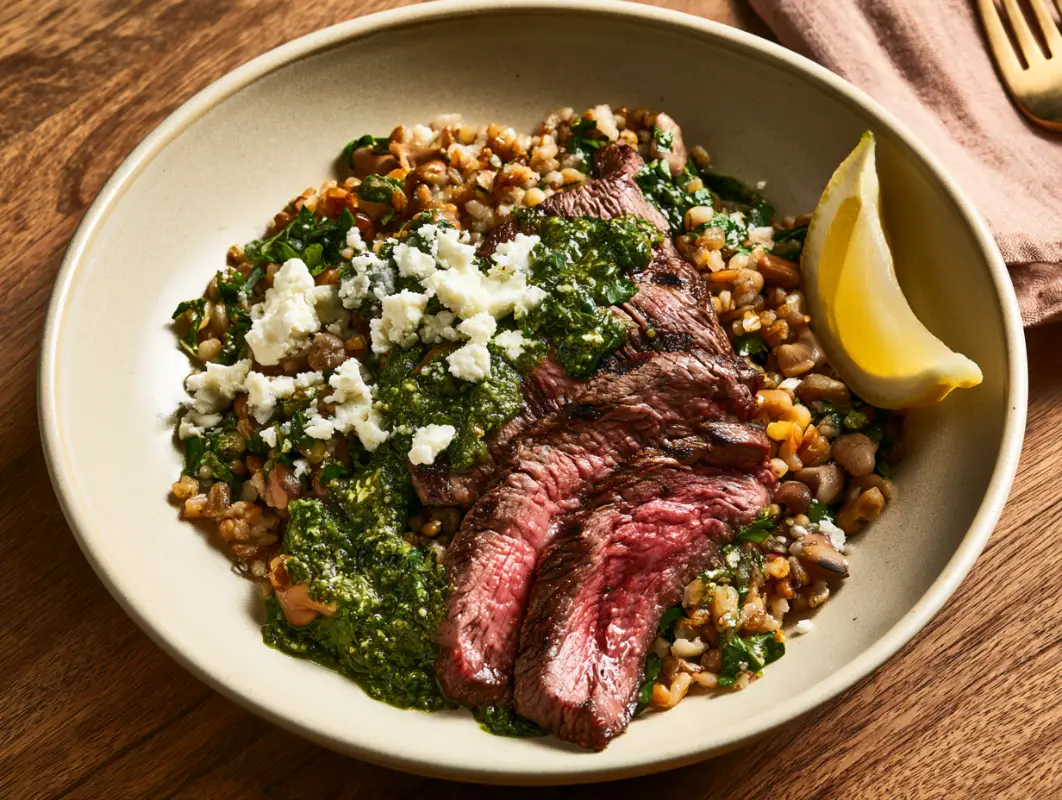
Chimichurri Steak & Ancient Grain Bowl
Ingredients
Method
- Rinse the farro under cold water for about 45 seconds until the water runs clear, then cover with cold water by 2 inches and soak for 30 minutes. Soaking softens the bran and cuts the cook time from about 40 minutes to 22. Prep everything else while it soaks.
- Make the chimichurri: pound the minced garlic, oregano, chilli flakes and ½ teaspoon sea salt to a rough paste in a mortar, about 30 seconds. Stir in the very finely chopped parsley, then the 80 ml olive oil, lemon juice and apple cider vinegar. Taste and adjust the acid and salt. Cover and leave at room temperature — do not refrigerate it yet, as cold dulls the flavour.
- Pat the steak completely dry with kitchen paper and season generously on both sides with the fine sea salt and black pepper. Let it sit on a wire rack for 10 minutes at room temperature while the pan heats.
- Drain the soaked farro. Bring the 600 ml salted water or stock to a boil, add the farro, reduce to a steady simmer, cover and cook 22–25 minutes. Taste at 20 minutes — you want a gentle nutty bite. Drain off any excess water and stir in a drizzle of olive oil and a pinch of salt while still warm.
- Sear the steak: add 1 tablespoon olive oil to a screaming-hot cast-iron pan so it shimmers and barely smokes. Lay the steak in away from you — you should hear an immediate aggressive sizzle — and do not move it for 3 full minutes. Sear 3–4 minutes per side, to 130°F (55°C) for medium-rare or 140°F (60°C) for medium.
- Transfer the steak to a wire rack set over a plate and tent loosely with foil (tight foil steams the crust). Rest a minimum of 8 minutes so the fibres relax and reabsorb their juices.
- While the steak rests, halve the cherry tomatoes, dice half a cucumber and thinly slice a quarter of a red onion. If raw onion is too assertive for you, soak the slices in cold water for 5 minutes. Crumble the feta.
- Slice the rested steak against the grain — perpendicular to the long muscle fibres — into slices about 1/4 inch thick. This does more for tenderness than the cut of meat itself.
- Divide the warm farro between four bowls, arrange the steak slices over one side and add the tomatoes, cucumber and red onion. Spoon 2–3 generous tablespoons of chimichurri over the steak, crumble the feta on top and finish with a squeeze of lemon and a pinch of flaky salt.
- Taste a bowl before you serve. It should have layers — rich beef, sharp green chimichurri, nutty farro, cool acidic tomato. If it tastes flat add lemon; if it tastes sharp add a little more olive oil.
Notes
Frequently Asked Questions
Substitutions and Technique Questions
Q: Can I use skirt steak instead of flank or sirloin?
Absolutely. Skirt steak is thinner and more intensely flavoured, which actually works beautifully in this ancient grain bowl recipe. Cook it for just 2 minutes per side over very high heat — it goes from raw to overdone quickly. Rest for 6 minutes, slice very thin against the grain, and the result is extraordinary. I actually prefer skirt steak for weeknight versions because it’s typically cheaper and faster.
Q: My chimichurri turned brown — what went wrong?
Oxidation. The parsley was either over-processed (blender on high speed) or the sauce was left uncovered in the fridge without an oil cap. Fix it: always cover the chimichurri with a thin layer of olive oil before refrigerating, and keep it in a glass jar, not a plastic container. Make it fresh for best results — it keeps its vivid colour for about 48 hours if stored correctly.
Q: Can I use bulgur instead of farro?
Yes — bulgur is a classic Mediterranean choice and cooks in just 15 minutes with boiling water (no stove needed — just cover and steep). The texture is softer and the flavour is milder, which lets the chimichurri sauce take centre stage. I’d call it a lighter, more Levantine take on the grain bowl. For a similar nutty experience to farro, try our freekeh pilaf as your grain base.
Q: How do I know when the pan is hot enough to sear?
Drop a single drop of water into the pan. If it evaporates immediately with a sharp hiss, the pan is ready. If it dances and rolls (the Leidenfrost effect), it is actually too hot — pull it briefly off heat for 20 seconds, then return it. A moderately aggressive sizzle the moment the steak hits the pan is what you’re after. No sizzle means no Maillard reaction.
Dietary, Make-Ahead, and Authenticity Questions
Q: Is this recipe gluten-free?
Farro contains gluten as it is a form of wheat. For a gluten-free chimichurri steak bowl, substitute certified GF quinoa or millet (see the Substitutions Table above). The quinoa version is actually higher in complete protein than the farro version and still produces a great textural contrast to the steak.
Q: Can I make this ahead for meal prep?
Yes — this is one of my top healthy steak bowl meal-prep recipes. Cook the farro on Sunday and refrigerate. Make the chimichurri (it improves after 24 hours). Sear the steak and slice it — store it cold. Prep the veg but keep the tomatoes and cucumber separately. Assemble at the last minute, adding fresh tomatoes and a spoonful of chimichurri. Four lunches in 45 minutes of Sunday cooking.
Q: Is chimichurri authentic to Greek cooking?
Not at all — and that is precisely what I love about this recipe. Chimichurri is proudly Argentine. But the underlying technique — building a herb sauce on a base of olive oil, acid, and garlic — is deeply Mediterranean in logic, even if it comes from the other side of the world. Think of it as a conversation between two ancient culinary traditions who happen to agree on the fundamentals.
Q: Is this recipe Halal?
Yes, this recipe is fully Halal-compliant as written. No pork, no alcohol (the recipe uses lemon juice and apple cider vinegar instead of wine vinegar). All other ingredients are plant-based or sourced from beef. Simply ensure your steak is sourced from a certified Halal butcher.
Bringing Greece — and Argentina — to Your Table
A Final Reflection
When my father passed away in 2017, I realised that the recipes I had taken for granted — the grilled fish at dawn, the bowls of horta dressed with ladolemono, the endless bread-and-olive-oil that accompanied every meal — were not just habits. They were the language my family spoke to each other. This Chimichurri Steak & Ancient Grain Bowl is a new sentence in that language. It would have confused my yiayia, I think, but it honours everything she taught me: use the best olive oil you can afford, let the herbs speak for themselves, and always, always rest the meat.
If you make this recipe, I would love to see it. Tag me, leave a comment, tell me how your farro turned out. Did you try the toasting step? Did you substitute freekeh? Every version of this recipe that lands on a real table in a real home is, to me, a small success. Καλή όρεξη.
Explore More Mediterranean Bowl Recipes
If you loved this bowl, you will want to try our Mediterranean grain bowl, which uses a lemony tahini dressing in place of chimichurri for a creamier, Levantine-inspired result. For a vegetarian showstopper, our grilled halloumi bowl uses the same farro base with charred halloumi and herb oil. And if you want to go deeper into ancient grains cooking, our quinoa tabbouleh is the most popular recipe on this site for good reason — it is fast, fresh, and utterly Cretan in spirit. Finally, if you want a deep dive into the chimichurri sauce on its own — ratios, variations, storage — our dedicated chimichurri sauce recipe covers every variation I have ever tested.