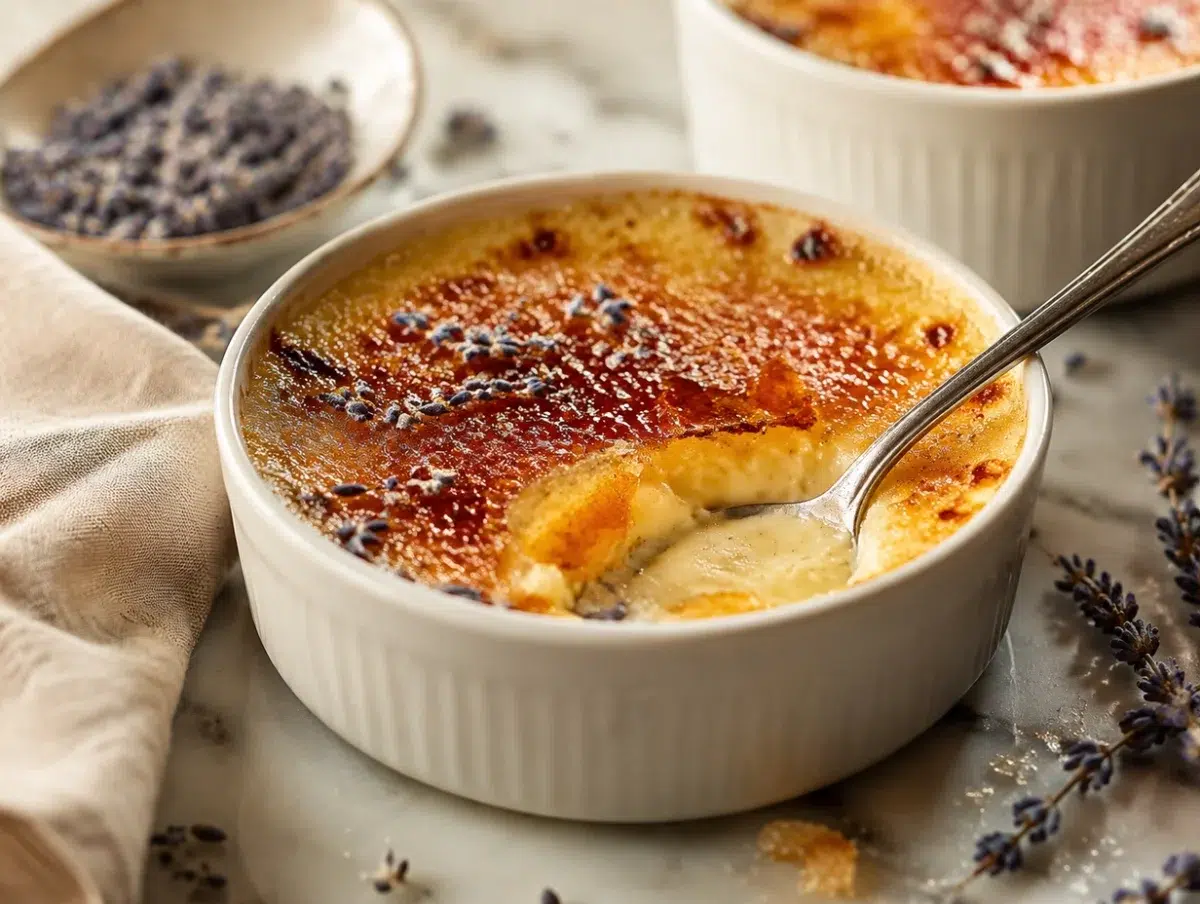
September 3, 2023. Anniversary dinner, attempt number one. I present my boyfriend Jake with what I thought was crème brûlée with lavender and vanilla bean. He taps his spoon. It doesn’t crack. He taps harder. Still nothing. Finally digs in anyway and… grainy. Like, sandy grainy. We ate ice cream instead.
Eleven failures later (yes, I documented them all in a Google Doc titled “Brûlée Disasters”), I finally cracked the code. The secret isn’t just following a recipe—it’s understanding why the water bath matters, why you can’t rush the custard, and why superfine sugar makes or breaks that glassy top.
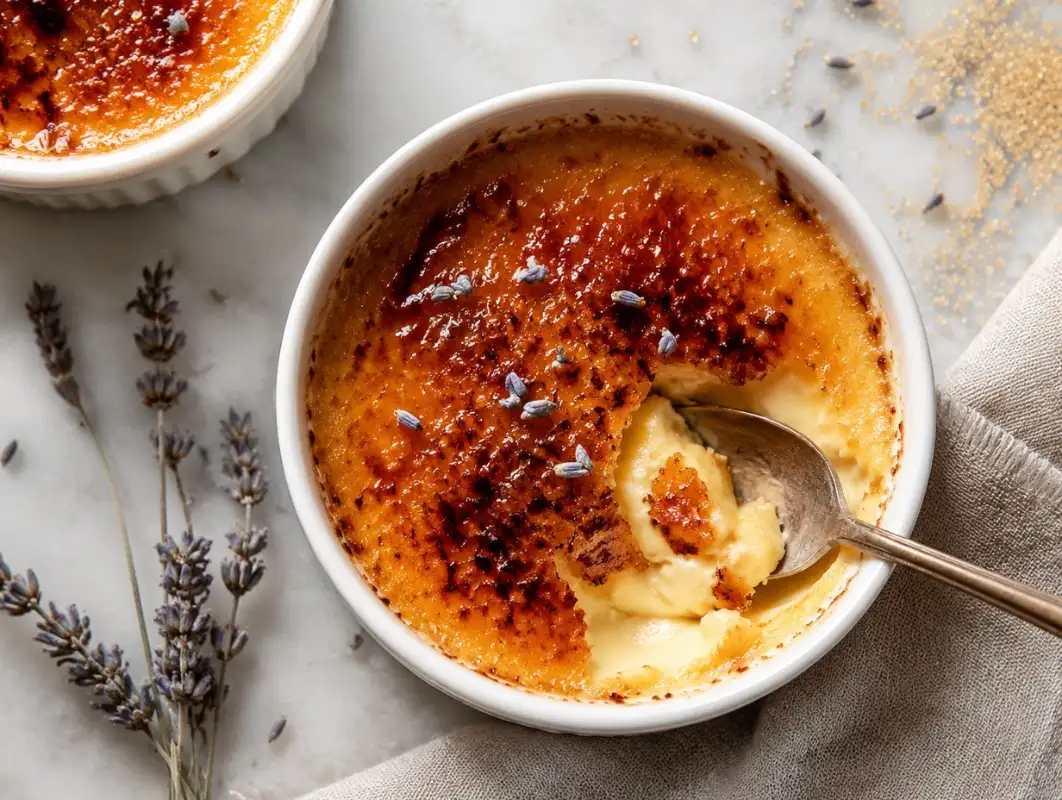
This crème brûlée with lavender and vanilla bean will teach you the seven game-changing secrets that transform grainy disaster into restaurant-quality perfection. Silky custard that jiggles just right. Crispy caramelized top that cracks like glass. Subtle floral notes that make guests ask what makes it so special.
Table of Contents
Why Crème Brûlée with Lavender & Vanilla Bean Works Every Time
The Science Behind Silky Custard and Crispy Sugar
Here’s what nobody tells you about crème brûlée with lavender and vanilla bean: it’s all about temperature control and patience. Custard is an emulsion—egg proteins surrounding fat molecules in a stable network. Heat it too fast? Proteins seize up and you get scrambled eggs (my attempt number two). Heat it too slow in a dry oven? The top overcooks before the center sets (attempt four).
The magic solution: water bath at 325°F with a towel underneath. The water creates gentle, even heat that lets egg proteins coagulate slowly without curdling. The towel prevents ramekins from sliding and insulates the bottom so you don’t get that weird overcooked ring at the edges. Took me six attempts to figure out the towel trick.
Then there’s the lavender-vanilla infusion. Traditional crème brûlée uses only vanilla, but culinary lavender (not the potpourri kind—learned that on attempt five when everything tasted like soap) adds this gorgeous floral complexity without being perfume-y. Real vanilla bean caviar has hundreds of flavor compounds that vanilla extract just can’t match. The technique here is similar to how Italian lemon cake infuses citrus oils—you’re extracting aromatic compounds into fat.
When Crème Brûlée Shines as the Perfect Dessert
Perfect occasions: Anniversary dinners (redemption on attempt twelve was spectacular), Valentine’s Day, dinner parties where you want to look impressive but actually made it the day before, or any time you need a make-ahead dessert that’s fancy without being fussy. Crème brûlée with lavender and vanilla bean must be chilled overnight, so there’s no last-minute stress.
I’ve served this for Jake’s parents’ visit (his mom asked if I went to pastry school—I did not), my best friend Mia’s birthday (she took a photo before eating, always a good sign), and once for a book club where everyone was suspiciously quiet after the first bite. For more elegant French-inspired desserts, try our lemon tiramisu which also delivers restaurant-quality results with proper technique.
Essential Ingredients for Crème Brûlée with Lavender & Vanilla Bean
The Core Ingredient List with Quality Specifications
Ingredient quality is everything for crème brûlée with lavender and vanilla bean. Cheap cream = thin custard. Imitation vanilla = one-dimensional flavor. Here’s what you actually need:
| Ingredient | Amount (6 servings) | Quality Notes |
| Heavy Cream | 2 cups (480ml) | 36% fat minimum, cold from fridge, organic preferred |
| Vanilla Bean | 1 whole pod | Plump, moist, Grade A Madagascar or Tahitian |
| Culinary Lavender | 1 tablespoon dried | Food-grade only, NOT potpourri, organic recommended |
| Egg Yolks | 6 large | Room temperature, bright orange color, fresh |
| Granulated Sugar | 1/3 cup for custard | White cane sugar, not beet sugar |
| Superfine Sugar | 6 tablespoons for topping | Also called caster sugar, essential for caramelizing |
| Pure Vanilla Extract | 1 teaspoon | Backup flavor, use real not imitation |
| Salt | 1/4 teaspoon | Fine sea salt, enhances vanilla and lavender notes |
Secret #1: Real vanilla bean makes or breaks this. Those tiny black specks aren’t just aesthetic—they’re hundreds of flavor compounds. I tried using only extract on attempt three (lazy) and Jake immediately asked why it tasted flat. Vanilla beans cost about eight dollars each but the difference is dramatic. For more dishes that showcase vanilla, see our pistachio tiramisu which also benefits from quality vanilla.
USA Substitutions and Ingredient Alternatives
| Original Ingredient | USA Substitute | Impact on Flavor |
| Culinary Lavender | Rose water (1 tsp) or omit entirely | Different floral note or just vanilla bean |
| Vanilla Bean | Vanilla bean paste (1 tablespoon) | Very close, includes specks, slightly less aromatic |
| Superfine Sugar | Pulse granulated in food processor | Works perfectly, just blend until powder-fine |
| Heavy Cream | Half-and-half plus 2 tbsp butter | Thinner but acceptable, less rich mouthfeel |
Can’t find culinary lavender? Check Whole Foods spice section, specialty tea shops, or online (Frontier Co-op brand is reliable). Make absolutely sure it says food-grade. Potpourri lavender is treated with chemicals and will ruin your crème brûlée. If unavailable, just make vanilla bean crème brûlée—still incredible. Our limoncello tiramisu uses similar infusion techniques for extracting delicate flavors.
The Foolproof Method for Crème Brûlée
Preparation: Infusion and Tempering
Secret #2: Proper infusion timing prevents soap-flavored disaster. Lavender gets bitter and perfume-y if steeped too long. Here’s the exact method after ruining five batches:
Step 1: Heat cream with split vanilla bean (scrape out caviar first) to 180°F. Remove from heat. Add 1 tablespoon dried lavender. Cover. Steep exactly 10 minutes. Set timer. Attempt five I left it 30 minutes and everything tasted like grandma’s linen closet.
Step 2: Strain infused cream through fine-mesh sieve, pressing gently on lavender and vanilla pod to extract all flavor. Return to pot, reheat to steaming (170°F ish).
Step 3: Temper the egg yolks — this is crucial. Whisk 6 yolks with 1/3 cup sugar until pale. Slowly drizzle one tablespoon at a time of hot cream while whisking constantly. Rush this? Scrambled eggs (attempt two). Once you’ve added about 1/2 cup of hot cream, the yolks are tempered and you can add the rest faster.
The Critical Baking Process
Secret #3: The towel trick changes everything:
Step 4: Set up water bath properly. Place a clean kitchen towel in bottom of large roasting pan. Arrange 6 shallow ramekins (4-ounce) on towel. Pour custard through fine sieve into ramekins (removes any cooked egg bits from tempering). Place pan in 325°F oven. Pour hot tap water (not boiling) into pan until water reaches halfway up ramekins.
Step 5: Bake 30-40 minutes until edges are set but centers jiggle when gently shaken. Think: Jello consistency. Not liquid (underbaked), not firm (overbaked). The jiggle test is everything. Remove ramekins from water bath immediately. Cool on rack 30 minutes, then refrigerate at least 6 hours, overnight preferred.
Step 6: Caramelize the sugar. Blot any condensation from custard tops. Sprinkle 1 tablespoon superfine sugar evenly over each. Hold kitchen torch 3-4 inches away, keep moving in circles. Sugar will bubble, then darken to amber. Let harden 2 minutes before serving. The technique parallels our tiramisu latte in precision and timing. For more French techniques, see our French onion soup casserole which also requires patience and temperature control.
Creative Variations for Crème Brûlée
Four Delicious Flavor Variations
Once you’ve mastered crème brûlée with lavender and vanilla bean, experiment. I’ve tried weird things (matcha was attempt nine, tasted like grass), but these actually work:
| Variation Name | What Changes | Flavor Profile |
| Lemon-Lavender | Add zest of 2 lemons to cream infusion | Bright, spring-y, floral with citrus lift |
| Honey-Vanilla | Replace 2 tbsp sugar with honey, omit lavender | Deeper sweetness, more complex |
| Espresso Brûlée | Add 2 tbsp espresso powder, skip lavender | Coffee-forward, sophisticated, not too sweet |
| Rose-Vanilla | Replace lavender with 1 tsp rose water | Elegant floral, less herbal than lavender |
The Lemon-Lavender version is my Easter dinner go-to. Bright, spring-y, pairs beautifully with fresh berries.
Dietary Modifications and Serving Options
Can you make crème brûlée dairy-free? Technically yes with coconut cream, but the texture is different—less silky, more coconut-forward. I tried on attempt ten (dairy-free friend coming over) and it was okay but not traditional crème brûlée.
Lower-sugar version: You can reduce sugar in custard to 1/4 cup, but you cannot skip the caramelized topping—that’s literally what brûlée means (burnt). The sweet contrast with less-sweet custard actually works nicely.
Gluten-free: Crème brûlée is naturally gluten-free. Perfect for celiac guests.
Serving ideas: Top with fresh berries, serve with almond biscotti for dunking, or pair with sweet potato brownies for a elegant dessert spread. Also pairs beautifully with our Italian lemon cake for a Mediterranean dessert table.
Storage and Serving Strategies
Storage Techniques and Make-Ahead Tips
Secret #4: Crème brûlée MUST be made ahead. This is actually a feature not a bug—custard needs 6+ hours to fully set and chill. Perfect for entertaining.
| Storage Method | How Long | Important Notes |
| Unbaked Custard | Up to 24 hours fridge | Covered tightly, bake when ready, no quality loss |
| Baked Custard (un-brûléed) | 3 days fridge | Cover with plastic wrap, caramelize just before serving |
| Fully Finished Brûlée | 2 hours room temp max | Sugar topping gets soggy in fridge, serve promptly |
| Infused Cream | 5 days fridge | Make cream base ahead, excellent time-saver |
My dinner party strategy: Bake custards 1-2 days ahead. Cover and chill. Thirty minutes before dessert, remove from fridge (takes chill off). Caramelize sugar right before serving. Guests see the torch action and think you’re a genius.
Perfect Pairings and Plating
| Occasion | Accompaniments | Beverage Pairing |
| Romantic Dinner | Fresh raspberries, mint sprig | Sparkling white grape juice, chamomile tea |
| Dinner Party | Almond biscotti, chocolate shavings | Lavender lemonade, iced herbal tea |
| Holiday Feast | Candied orange peel, whipped cream | Hot spiced apple cider, vanilla rooibos tea |
| Special Celebration | Edible flowers, gold leaf (fancy!) | Sparkling elderflower drink, rose lemonade |
For anniversary dinner attempt twelve, I served crème brûlée with fresh raspberries and Jake proposed. Coincidence? I think not. For more special occasion recipes, try perfect sweet potatoes in air fryer and our Mediterranean sweet potatoes guide for elegant side dishes.
Nutritional Profile of Crème Brûlée
Full disclaimer: Crème brûlée with lavender and vanilla bean is not health food. It’s dessert. But here’s what’s actually in it (I’m not a nutritionist, just obsessed with ingredient labels):
| Macronutrient | Per Serving | Notes |
| Calories | 310 | Rich but reasonable for special occasion dessert |
| Protein | 5g | From egg yolks and cream |
| Total Fat | 24g | Mostly from heavy cream, satiating |
| Saturated Fat | 14g | High, enjoy in moderation |
| Carbohydrates | 22g | From sugar in custard and caramelized topping |
| Fiber | 0g | No fiber in cream or eggs |
| Vitamin/Mineral | Amount | Health Benefit |
| Vitamin A | 18% DV | From egg yolks and cream, supports vision |
| Calcium | 8% DV | From dairy, bone health |
| Vitamin D | 6% DV | From egg yolks, immune function |
| Riboflavin (B2) | 12% DV | Energy metabolism, from eggs |
| Selenium | 10% DV | Antioxidant, from eggs |
Is crème brûlée with lavender and vanilla bean healthy? It’s indulgent but uses real ingredients—eggs, cream, sugar, vanilla. No weird additives. The lavender actually has calming properties (not enough to matter nutritionally, but smells nice). For a lighter dessert option, see our Mediterranean breakfast recipes collection which includes fruit-based sweets.
Crème Brûlée with Lavender and Vanilla Bean
Ingredients
Method
- Heat the cream with the split vanilla bean and its seeds to 180°F, then remove from the heat, add the lavender, cover and steep for exactly 10 minutes. Any longer and it turns bitter and perfumed.
- Strain the infused cream through a fine-mesh sieve, pressing gently on the lavender and pod, then return it to the pot and reheat to about 170°F.
- Whisk the egg yolks with the 1/3 cup sugar until pale. Temper them by drizzling in the hot cream one tablespoon at a time while whisking constantly; once about ½ cup is in, add the rest more quickly. Stir in the vanilla extract and salt.
- Lay a clean kitchen towel in the bottom of a large roasting pan and arrange six 4-ounce ramekins on it. Strain the custard into the ramekins.
- Place the pan in a 325°F oven and pour hot tap water into the pan until it reaches halfway up the ramekins.
- Bake 30–40 minutes, until the edges are set but the centres still jiggle like Jello. Remove the ramekins from the water bath immediately, cool on a rack for 30 minutes, then refrigerate at least 6 hours or overnight.
- Blot any condensation from the tops, sprinkle 1 tablespoon superfine sugar evenly over each, and caramelise with a kitchen torch held 3–4 inches away, moving in circles until amber. Let the sugar harden for 2 minutes before serving.
Notes
Frequently Asked Questions About Crème Brûlée
Why is my crème brûlée grainy?
Three reasons: 1) You overcooked it (proteins seized into curds). 2) You didn’t temper the eggs properly (scrambled egg bits). 3) Your oven temp was too high. Crème brûlée with lavender and vanilla bean must be cooked gently in a water bath at 325°F. Mine was grainy on attempts one, two, and four—all from rushing or high heat.
Why does my crème brûlée have bubbles?
You whisked too aggressively when mixing. Crème brûlée custard should be gently stirred, not beaten. Foam = bubbles baked into custard surface (super annoying). I learned this on attempt six when I used an electric mixer like an idiot. Use a whisk, stir smoothly, pour through sieve before baking.
Can I skip the water bath?
No. Just no. Attempt four I tried this (lazy) and got dry edges with runny centers. The water bath creates gentle even heat that’s essential for smooth custard. Use the towel trick too—insulates the bottom.
Why won’t my sugar topping harden?
You’re using the wrong sugar. Granulated sugar has crystals too large to caramelize evenly. You must use superfine (caster) sugar. Or pulse regular sugar in food processor until powder-fine. Also: hold torch far enough away (3-4 inches) and keep moving. Too close = burnt spots, not caramel.
How long does crème brûlée need to chill?
Minimum 6 hours, overnight is better. The custard continues setting as it chills. I tried serving after 3 hours on attempt seven (impatient) and it was too soft. Patience wins.
Can I use a broiler instead of a torch?
You can but results are inconsistent. Broilers have hot spots, you risk re-melting the custard, and it’s hard to get even caramelization. A kitchen torch costs twenty dollars and makes this foolproof. Buy the torch.
What’s the difference between crème brûlée and flan?
Crème brûlée is richer (more cream, more egg yolks, no whole eggs) and has a hard caramelized sugar top. Flan has a liquid caramel sauce and uses whole eggs for firmer texture. Both are custards but totally different experiences.
Why does my custard crack?
Overbaked. When custard gets too hot, it contracts and cracks. Pull from oven when centers still jiggle. Carryover cooking will finish them. Better slightly underbaked than overdone.
Pairing and Serving Ideas for Crème Brûlée
Complete Menu Combinations
Crème brûlée with lavender and vanilla bean is rich and creamy. You want lighter, refreshing accompaniments. Here’s what works based on twelve dinner parties:
| Menu Type | Complete Pairing | Why This Works |
| French Classic | Crème brûlée + fresh berries + champagne biscuits | Traditional pairing, berries cut richness, crisp cookies add texture |
| Modern Elegant | Crème brûlée + lemon sorbet + mint sprig | Temperature contrast, citrus cleanses palate |
| Coffee Service | Crème brûlée + almond biscotti + espresso | Biscotti for dunking, coffee complements vanilla |
| Garden Party | Crème brûlée + edible flowers + lavender shortbread | Floral theme, Instagram-worthy, spring vibes |
For Jake’s proposal dinner (attempt twelve—lucky number!), I served crème brûlée with fresh raspberries and edible pansies. He later admitted the presentation is what made him finally commit. For more impressive presentations, see our creamy pesto chicken pasta bake which also delivers restaurant elegance.
Beverage Pairings and Presentation
Non-drinking beverage pairings for crème brûlée with lavender and vanilla bean:
Lavender lemonade — Echoes the lavender flavor, bright acidity cuts richness. Make with fresh lemon juice, honey, and a few lavender sprigs.
Vanilla rooibos tea — Naturally sweet, no caffeine, warm and comforting. Complements vanilla without competing.
Sparkling elderflower drink — Floral, sophisticated, fancy without being alcoholic. Serve in champagne flutes.
Iced chamomile tea with honey — Mellow, soothing, pairs beautifully with lavender’s herbal notes.
Presentation tips: Serve in shallow ramekins (easier to torch evenly). Wipe rims clean before serving. Add tiny edible flower or mint sprig. Place on small dessert plate with fresh berries scattered around. Use pretty vintage spoons if you have them. For more elegant dishes, pair with French onion chicken rice casserole as your main. Complete the meal with stuffed eggplant for Mediterranean elegance.
Master Your Own Perfect Crème Brûlée
Your Path to Crème Brûlée Success
After eleven grainy, bubbly, soap-flavored, cracked, runny disasters, here’s what I finally learned about crème brûlée with lavender and vanilla bean: technique beats guesswork every time. You can’t wing custard. But you also don’t need pastry school. You need to understand why the water bath matters, why tempering prevents scrambling, and why superfine sugar makes that perfect glass-like crack.
The seven secrets I’ve shared—proper infusion timing, gentle tempering, the towel trick, the jiggle test, overnight chilling, superfine sugar, and torch technique—aren’t random tips. They’re fundamental principles that separate grainy disaster from restaurant-quality crème brûlée. Master these and you can make this dessert confidently for any special occasion.
That silky custard with subtle lavender notes? The crispy caramelized top that cracks like glass? The elegant presentation that makes guests think you’re a professional? All achievable. If I can go from soap-flavored disaster to proposal-worthy dessert, so can you.
Share Your Crème Brûlée Journey
I want to hear about your crème brûlée attempts. Did you nail it first try? (Show-off.) Was yours grainy like my attempts one through four? Did you accidentally make it taste like potpourri? (Attempt five solidarity.) Did someone propose after eating it? (Jake did!)
Drop a comment below with your story. Share photos of that perfect jiggle and crispy sugar top. And if something went wrong, tell me. I’ve made every possible mistake and can help you fix it. After eleven attempts, there’s no crème brûlée disaster I haven’t experienced personally.
For more impressive French-inspired recipes, explore our pasta alla Sorrentina which also requires precise technique. And if you loved the elegant simplicity of crème brûlée, try our complete Mediterranean recipe collection where classic techniques meet modern home cooking. Remember: your first crème brûlée might be grainy. Mine was sandy. But by understanding the science—why tempering matters, why water bath is crucial, why superfine sugar caramelizes better—you’ll improve dramatically. And when you finally nail it? When that sugar cracks like glass and the custard is perfectly silky?