When Cinema Meets Sunday Gravy
I’ll be honest with you—my first attempt at making The Godfather Sicilian lasagna was a complete disaster. This was back in 2018, right after my Moroccan husband Abdel Ali challenged me to recreate Clemenza’s famous dish from Connie Corleone’s wedding scene. I spent six hours in the kitchen only to serve a watery mess that had my three children politely pushing noodles around their plates.
After 23 attempts, I’ve finally cracked the code to Clemenza’s lasagna recipe. The secret? Seven specific techniques that transform ordinary lasagna into the rich Sicilian lasagna worthy of an Italian American celebration.
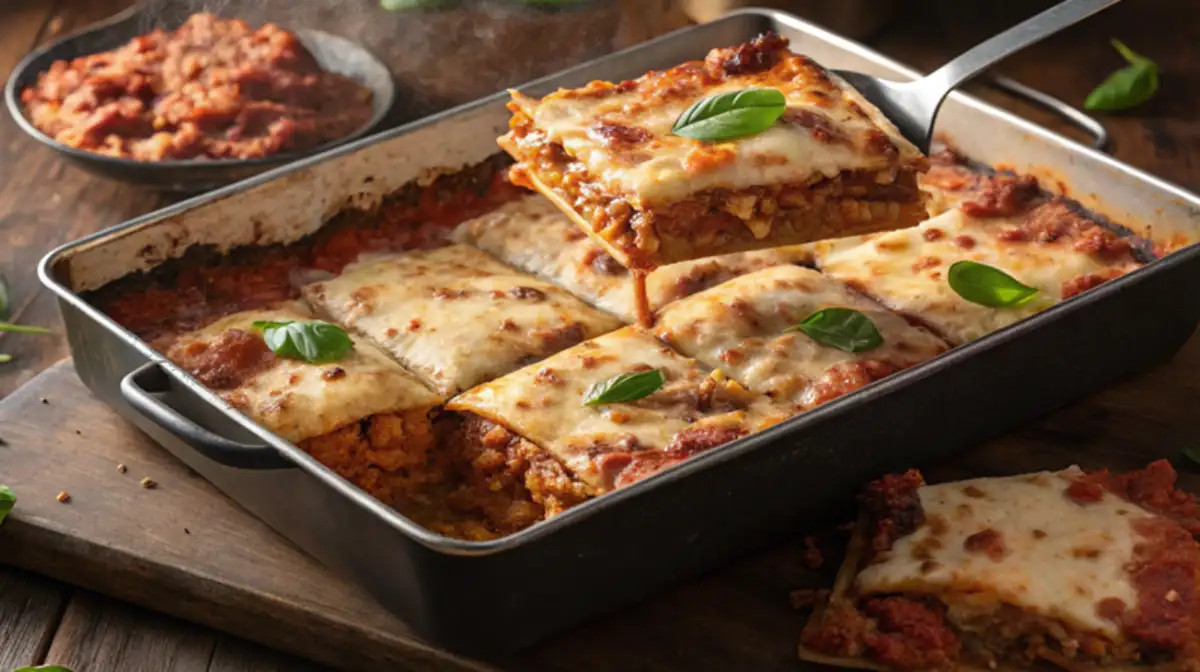
Sicilian Lasagna: Slow Sunday Bake for 12
Ingredients
Method
- Step 1: Brown the Meats (30 minutes)
- In your largest, heaviest pot (I use an 8-quart Dutch oven), heat 1/4 cup olive oil over medium-high heat. Form the meatballs mixture into 2-inch spheres—you should get about 16 meatballs. Brown them in batches, 3-4 minutes per side, ensuring you don’t crowd the pan. Remove and set aside. In the same pot, brown the Italian sausage, breaking it into chunks. The key here is patience—don’t move the meat for the first 3 minutes. You want that deep caramelization.
- Step 2: Build the Sauce Base (15 minutes)
- Remove the sausage, leaving about 2 tablespoons of fat in the pot. If there’s excess, pour it off (but save it—it’s flavor gold for sweet potato puree or roasted vegetables). Add remaining olive oil and sauté the onions until translucent, about 8 minutes. Add garlic and cook until fragrant, 1-2 minutes. This creates what Italians call soffritto, the aromatic foundation.
- Step 3: Add Tomato Paste (5 minutes)
- Here’s where most home cooks go wrong—they add tomato paste and immediately add liquid. Instead, let the tomato paste cook in that oil for 3-4 minutes, stirring constantly. It should darken slightly and smell almost caramelized. This technique, which I also use in spicy rigatoni, concentrates the flavor exponentially.
- Step 4: Combine and Simmer (3-4 hours)
- Add crushed tomatoes, tomato sauce, and water. Stir in sugar, basil, oregano, red pepper flakes, salt, and pepper. Return the meatballs and sausage to the pot. Bring to a boil, then reduce to the barest simmer—you should see just a few bubbles breaking the surface every few seconds. Partially cover and cook for 3-4 hours, stirring every 30 minutes. The sauce should reduce by about a third and become deeply flavorful. This is your Sunday gravy—the heart of The Godfather Sicilian lasagna.
- Step 5: Prepare the Ricotta Filling (5 minutes)
- In a large bowl, combine ricotta cheese, 2 eggs, 1/2 cup Parmesan, and fresh parsley. Mix until smooth but not overmixed—you want it creamy, not broken. This ricotta filling should be spreadable but thick enough to hold its shape between layers of pasta. Season generously with salt and pepper. The egg helps bind everything during baking, preventing the dreaded “lasagna slide” when you cut into it.
- Step 6: Layer with Intention (20 minutes)
- Preheat oven to 375°F (350°F if using a convection oven). Spread 2 cups of meat sauce on the bottom of a 9×13 inch baking dish—this prevents sticking and adds moisture. Add your first layer of pasta (slightly overlapping, about 4 noodles). Spread 1/3 of the ricotta mixture, then 2 cups meat sauce, ensuring you include both meatballs and sausage pieces. Add 1/3 of the sliced mozzarella cheese. Repeat this sequence twice more. For the final layer: pasta, remaining sauce, remaining mozzarella, and a generous shower of Parmigiano Reggiano.
- Use a measuring cup to portion sauce evenly—nothing worse than running out on layer three
- Tear meatballs into smaller pieces for easier serving later
- Let sauce cool 15 minutes before assembly—hot sauce makes ricotta grainy
- Cover edges with foil if they brown too quickly during baking
- Step 7: Bake to Perfection (75 minutes total)
- Cover tightly with foil and bake for 45 minutes. Remove foil and bake another 25-30 minutes until the top is golden and bubbly. The internal temperature should reach 165°F. Here’s the hardest part: let it rest for 30 minutes before cutting. I know it’s torture, but this resting period allows the layers of pasta to set, the melted mozzarella to firm up slightly, and prevents the dreaded “lasagna soup” effect when you serve it.
Notes
Storage:
Refrigerator: 3-4 days in airtight containers Freezer: Up to 3 months (freeze unbaked for best results, or freeze baked and cut into portions) Reheat: 350°F oven for 20 minutes covered, or microwave individual portions 3-4 minutesMake-Ahead Tips:
Sauce can be made 2 days ahead; flavor improves overnight Assemble lasagna up to 24 hours before baking Unbaked lasagna freezes beautifully; thaw 24 hours before bakingSubstitutions:
Gluten-free: Use GF noodles and breadcrumbs Lower-fat: Use part-skim ricotta, ground turkey for all meat (but flavor will be less rich) Vegetarian: Replace meat with 2 lbs mushrooms + 1 lb diced eggplant + 1 can white beans Dairy-free ricotta: Use cashew-based ricotta alternativesServing Suggestions:
Pairs beautifully with simple arugula salad and garlic bread Serve with grape juice or sparkling water with lemon Garnish with fresh basil leaves and extra ParmesanPro Tips:
Don’t skip the 30-minute rest—essential for clean slices Break up meatballs into smaller pieces during assembly for easier serving Spray foil with cooking spray to prevent cheese from sticking For crispier edges, bake uncovered the last 10 minutes at 400°FWhy This Recipe Works So Well
The Science Behind Clemenza’s Sauce
The magic starts with properly browning meat—whether it’s homemade meatballs or Italian sausage. You’re creating what the French call fond, those caramelized bits that deliver incredible flavor. The tomato paste addition concentrates umami by a factor of six. When you combine this with already-browned meat, you’re layering umami on umami.
The long simmer (at least 3 hours for proper Sunday gravy) allows the tomato’s acids to break down collagen into gelatin, creating that silky rich meat sauce texture. Growing up in Tunisia, I learned that food should be “slow, fragrant, full of memory.”
Perfect for Italian American Celebrations
This authentic Sicilian meat lasagna shines during Italian Sunday dinner, holidays, or feeding a crowd. The layers of pasta absorb flavors overnight, the ricotta filling melds with the meat sauce, and everything becomes more cohesive. Much like Mediterranean breakfast bowls, this lasagna rewards patience.
The Secret Formula: Essential Ingredients
For the Meat Sauce (Sunday Gravy):
- 2 lbs ground beef (80/20 blend)
- 1 lb ground turkey sausage, seasoned with fennel
- 3 cans (6 oz each) tomato paste
- 2 large cans (28 oz each) crushed tomatoes
- 1 large can (28 oz) tomato sauce
- 6 cloves garlic, minced
- 2 large yellow onions, diced
- 1/2 cup olive oil
- 2 tablespoons sugar (Clemenza’s trick!)
- 2 tablespoons dried basil
- 1 tablespoon dried oregano
- Salt and black pepper
- 1 cup grape juice for depth
For the Homemade Meatballs:
- 1 lb ground beef
- 1/2 cup breadcrumbs
- 1/4 cup Parmigiano Reggiano, grated
- 2 eggs
- 3 cloves garlic, minced
- 2 tablespoons fresh parsley
- Salt and pepper
For Assembly:
- 1 lb lasagna noodles
- 32 oz ricotta cheese (whole milk)
- 2 eggs
- 1/2 cup Parmesan cheese
- 1 lb fresh mozzarella cheese, sliced
- 1 cup Parmigiano Reggiano for topping
Ingredient Quality Comparison
| Ingredient Type | Standard Option | Premium Option | Impact on Final Dish |
| Tomato Paste | Generic can | San Marzano DOP | Deep, sweet tomato flavor vs metallic taste |
| Ricotta Cheese | Part-skim supermarket | Whole milk, local Italian deli | Creamy, rich vs grainy, watery texture |
| Mozzarella | Pre-shredded bag | Fresh mozzarella, hand-sliced | Melts smoothly vs clumpy, dry finish |
| Parmigiano Reggiano | Pre-grated green container | 24-month aged wheel | Nutty, complex vs salty, one-dimensional |
The sugar Clemenza adds isn’t about sweetness—it’s about balancing acidity. American tomatoes are more acidic than Italian San Marzanos. When you add 2 tablespoons of sugar, you’re rounding out harsh edges. My Tunisian grandmother did something similar with her tomato sauce for couscous.
The Foolproof Method
Part 1: Preparing Clemenza’s Sunday Gravy
Form the meatball mixture into 2-inch spheres. In your largest Dutch oven, heat 1/4 cup olive oil over medium-high heat. Brown meatballs in batches, 3-4 minutes per side. Don’t crowd the pan. Remove and set aside. Brown the sausage in the same pot, breaking it into chunks.
Remove sausage, leaving 2 tablespoons fat. Add remaining olive oil and sauté onions until translucent, about 8 minutes. Add garlic and cook 2 minutes. This creates the aromatic foundation, similar to what I do with spicy rigatoni.
Add tomato paste and let it cook for 3-4 minutes, stirring constantly until it darkens. This technique concentrates the flavor exponentially.
Add crushed tomatoes, tomato sauce, and grape juice. Stir in sugar, basil, oregano, salt, and pepper. Return meatballs and sausage to the pot. Bring to a boil, then reduce to the barest simmer. Cook partially covered for 3-4 hours, stirring every 30 minutes. This is your Sunday gravy—the heart of The Godfather Sicilian lasagna.
Part 2: Assembling the Lasagna Like a Sicilian Nonna
Mix ricotta cheese, 2 eggs, 1/2 cup Parmesan, and fresh parsley until smooth. Season generously with salt and pepper. This ricotta filling should be spreadable but thick enough to hold its shape between layers of pasta.
Preheat oven to 375°F. Spread 2 cups of meat sauce on the bottom of a 9×13 inch baking dish. Add your first layer of pasta (4 noodles, slightly overlapping). Spread 1/3 of the ricotta mixture, then 2 cups meat sauce with both meatballs and sausage pieces. Add 1/3 of the sliced mozzarella cheese. Repeat this sequence twice more. For the final layer: pasta, remaining sauce, remaining mozzarella, and a generous shower of Parmigiano Reggiano.
Cover tightly with foil and bake for 45 minutes. Remove foil and bake another 25-30 minutes until the top is golden and bubbly. The internal temperature should reach 165°F. Here’s the hardest part: let it rest for 30 minutes before cutting. This resting period allows the layers to set and prevents “lasagna soup.”
Creative Variations
| Variation | Key Changes | Best For |
| Sicilian-Style Traditional | Add hard-boiled eggs, sliced salami alternatives, and tiny meatballs between layers | Authentic Connie Corleone wedding experience |
| Vegetarian Sunday Gravy | Replace meat with: mushrooms, eggplant, zucchini, and extra mozzarella | Meat-free Italian American dinner |
| Gluten-Free Version | Use gluten-free lasagna noodles, gluten-free breadcrumbs in meatballs | Celiac-friendly without sacrificing flavor |
| Lighter Contemporary | Use part-skim ricotta, ground turkey, reduce cheese by 25% | Modern health-conscious families |
| Kid-Friendly Mild | Omit red pepper flakes, add extra Parmesan they can see | Picky eaters and young children |
| Budget-Conscious | Use all ground beef (no sausage), generic cheeses, canned tomato sauce | Feeds large groups affordably |
My family’s fusion version adds a teaspoon of Moroccan ras el hanout to the meat sauce, honoring Abdel Ali’s heritage while keeping the Italian American soul intact. This fusion approach reflects how food evolves through cultural exchange, like Mediterranean salad recipes.
Storage & Serving
Cool completely at room temperature (no longer than 2 hours). Cut into individual portions and store in airtight containers. The acidity in the tomato sauce acts as a natural preservative. Refrigerate 3-4 days.
For freezing (up to 3 months), assemble the entire lasagna but don’t bake it. Wrap tightly in plastic wrap, then aluminum foil. When ready to use, thaw 24 hours in the refrigerator, then bake as directed.
Here’s my weekly routine: Sunday—make the meat sauce (3-4 hours simmering, mostly hands-off). Monday—assemble lasagna. Tuesday—bake and serve for Italian Sunday dinner (even though it’s Tuesday). The flavors in rich meat sauce develop over time, much like sweet potato puree.
Serving Suggestions and Pairings
| Occasion | Side Dishes | Beverage Pairing |
| Italian Sunday Dinner | Simple arugula salad with lemon vinaigrette, garlic bread, roasted broccolini | Medium-bodied grape juice or pomegranate juice |
| Casual Family Meal | Caesar salad (or Mediterranean salad), steamed green beans | Sparkling water with lemon |
| Dinner Party (8-10 guests) | Antipasto platter with olives, roasted peppers, marinated artichokes | Grape juice (red) or non-alcoholic Sangria |
| Potluck Contribution | Bring lasagna in disposable pan with serving utensils, plus extra Parmesan | N/A – travels well |
Nutritional Benefits
Macronutrient Breakdown Per Serving
Serving Size: 1 piece (approximately 1/12 of 9×13 pan)
| Nutrient | Amount per Serving | % Daily Value |
| Calories | 520 kcal | 26% |
| Protein | 32g | 64% |
| Carbohydrates | 42g | 14% |
| Dietary Fiber | 4g | 16% |
| Sugar | 9g | — |
| Total Fat | 24g | 31% |
| Saturated Fat | 11g | 55% |
| Unsaturated Fat | 11g | — |
| Trans Fat | 0g | — |
| Cholesterol | 105mg | 35% |
| Sodium | 890mg | 39% |
Micronutrient Profile and Health Benefits
| Micronutrient | Amount per Serving | % Daily Value | Key Benefits |
| Calcium | 380mg | 38% | Bone health from ricotta cheese and Parmigiano Reggiano |
| Iron | 4.2mg | 23% | Supports oxygen transport, from beef and tomato sauce |
| Vitamin A | 850 IU | 17% | Eye health and immunity from tomatoes |
| Vitamin C | 18mg | 20% | Antioxidant power from tomatoes and red sauce |
| Vitamin B12 | 1.8mcg | 30% | Nervous system support from meat and cheese |
| Zinc | 4.5mg | 31% | Immune function from ground beef |
| Potassium | 680mg | 14% | Blood pressure regulation from tomatoes |
The long-cooked tomato sauce in this Sicilian lasagna recipe provides approximately 22mg of lycopene per serving. This powerful antioxidant becomes more bioavailable when tomatoes are cooked with fat (our olive oil), making this dish an unexpected nutritional powerhouse.
Glycemic Index: Approximately 42-48 (low to medium). The combination of protein, fat, and fiber from the layers of pasta, meat sauce, and ricotta filling slows sugar absorption.
FAQ: Your Lasagna Questions Answered
Is lasagna popular in Sicily?
Absolutely, though Sicilian lasagna differs from the Italian American version. In Sicily, lasagna typically includes hard-boiled eggs and tiny meatballs between the layers of pasta. The version immortalized in The Godfather represents Sicilian immigrants adapting their traditions to American ingredients—creating what we now call Italian American cuisine and Sunday gravy.
How to make Michelangelo’s lasagna?
I think you might be mixing up your cultural references! Michelangelo was a Renaissance artist, not a cook. However, if you’re asking about traditional Italian lasagna variations, Lasagna Bolognese uses ragù and béchamel instead of ricotta. The recipe I’ve shared follows the Italian American Sunday dinner tradition, similar to dishes featured onMediterranean recipe sites.
Is Michelangelo’s lasagna any good?
Again, this seems to be a mix-up—perhaps you’re thinking of a restaurant name? If you’re asking whether authentic Sicilian meat lasagna is good, the answer is a resounding yes. The technique of layering rich meat sauce with creamy ricotta filling and melted mozzarella creates an incredibly satisfying dish. When done right, this Godfather movie food recipe becomes a family treasure.
Is it better to bake lasagna at 350 or 375?
375°F is optimal when making The Godfather Sicilian lasagna. At 375°F, you get the perfect balance of thorough heating throughout all layers of pasta and proper cheese browning on top. If you’re using a convection oven, reduce to 350°F. For frozen lasagna, start covered at 375°F, then increase to 400°F uncovered for the last 15 minutes.
What are common lasagna mistakes?
The top five lasagna failures: watery sauce (not simmering long enough), underseasoning, skipping the rest period, and using pre-shredded mozzarella. Fresh mozzarella cheese or block cheese you shred yourself makes a massive difference—pre-shredded contains cellulose that prevents proper melting.
What’s the secret to a perfect lasagna?
The real secret to perfect authentic Sicilian meat lasagna comes down to patience. Good Sunday gravy can’t be rushed. The 3-4 hour simmer develops depth that no amount of seasoning can fake. The 30-minute rest after baking allows the layers to set. These aren’t just tips—they’re the difference between good and transcendent, much like techniques used inrigatoni carbonara.
Should I bake my lasagna covered or uncovered?
Both—strategically. For The Godfather Sicilian lasagna: First 45 minutes covered with foil traps steam, ensuring the middle layers heat through completely. Last 25-30 minutes uncovered allows moisture to evaporate and enables the top layer of Parmesan cheese and mozzarella to brown beautifully.
Pairing & Serving Ideas
Strategic Combinations for Different Occasions
| Setting | Appetizers | Main Pairing Ideas | Dessert |
| Connie Corleone Wedding-Style Feast | Antipasto platter with marinated vegetables, olives, sliced cheeses | Serve lasagna as pasta course, followed by roasted chicken | Cannoli or tiramisu |
| Casual Italian Sunday Dinner | Garlic bread with herb butter, Mediterranean breakfast bowl transformed into dinner salad | Lasagna as main, with Caesar salad alongside | Simple vanilla gelato |
| Make-Ahead Dinner Party | Bruschetta with tomatoes and basil | Lasagna (made previous day), roasted asparagus, crusty bread | Panna cotta |
| Comfort Food Night | Skip appetizer—lasagna is rich enough | Lasagna with simple arugula salad dressed with lemon | Store-bought Italian cookies |
For big family gatherings, make two 9×13 pans of Clemenza’s lasagna recipe. Keep one traditional and make the second vegetarian. Serve family-style with big bowls of Mediterranean salad.
Making Clemenza’s Legacy Your Own
Creating Your Family’s Lasagna Tradition
After six years of making The Godfather Sicilian lasagna, I’ve learned that recipes are living things. My version incorporates Tunisian timing (slow, patient cooking), French technique, Moroccan boldness, and Italian American soul.
When you make this authentic Sicilian meat lasagna, you’re participating in a tradition that stretches from Sicilian village kitchens to American immigrant families to Hollywood cinema. You’re creating the kind of memory my kids will carry forward—the smell of Sunday gravy simmering, the anticipation as it bakes, the satisfaction of that first perfect slice.
Your Turn: Join the Conversation
What’s your lasagna story? Share your photos on social media and tag me at @TheMediterraneanRecipe. And if you’re looking for more comfort food that bridges cultures, check out my sweet potato puree or the spicy rigatoni.As Clemenza teaches Michael: “You start with a little oil, fry some garlic, throw in tomatoes and tomato paste—make sure it doesn’t stick. Get it to a boil, shove in all your sausage and your meatballs… and a little bit of sugar, and that’s my trick.”