
I can still hear the cicadas. It was late July in Chania, and the sun was setting over the harbor, painting everything in shades of amber and rose. My yiayia stood at her outdoor kitchen — really just a stone counter under a grapevine canopy — slicing eggplant with the kind of quiet confidence that comes from doing something ten thousand times. The air smelled like warm olive oil, charred peppers, and the wild thyme that grew between the rocks near my grandfather’s taverna. She was making her version of Mediterranean ratatouille, though she never called it that. To her, it was simply tourlou-tourlou — a jumble of summer vegetables slow-cooked until they practically melted into each other.
That evening, we ate it straight from the tapsi with thick slices of crusty bread and a wedge of sharp graviera cheese. My father had come in from his fishing boat with a sunburned nose and calloused hands, and he told us the stew tasted like the sea breeze felt — warm, salty, alive. I was maybe twelve, and I didn’t understand what he meant then. Now I do.
This Mediterranean ratatouille is my tribute to those evenings. It’s a French vegetable stew at its core, yes, but filtered through three generations of Cretan cooking — generous olive oil, unhurried technique, and the belief that vegetables deserve the same respect as any cut of meat. Whether you serve it as a healthy vegetarian meal or alongside grilled lamb, this dish will transport you to the Mediterranean coast. Let me show you exactly how my family makes it.
Table of Contents
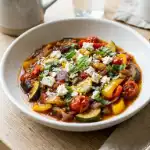
Mediterranean Ratatouille Recipe – 3 Insane Tips
- Total Time: 1 hour 50 minutes
- Yield: 6 (as a side) or 4 (as a main) 1x
Description
A vibrant French vegetable stew with a Cretan twist — sautéed summer vegetables slow-baked in a herbaceous tomato sauce with generous olive oil. Vegan, gluten-free, and incredibly flavorful.
Ingredients
For the Vegetables:
2 medium eggplants (about 1 lb / 450g), cut into 1-inch cubes
2 medium zucchini (about 12 oz / 340g), cut into 1-inch half-moons
2 large bell peppers (1 red, 1 yellow), seeded and cut into 1-inch pieces
1 large yellow onion, diced
6 cloves garlic, minced
1 teaspoon fine sea salt (for salting eggplant)
For the Sauce:
4 large ripe tomatoes, roughly chopped (or one 28 oz / 794g can crushed tomatoes)
2 tablespoons tomato paste
1 teaspoon sweet paprika
½ teaspoon dried oregano
1 teaspoon sugar (only if using out-of-season tomatoes)
Olive Oil & Herbs:
⅓ cup (80 ml) extra virgin olive oil, divided, plus more for drizzling
4 sprigs fresh thyme (or ½ teaspoon dried)
½ cup (15g) fresh basil leaves, torn
Salt and freshly ground black pepper, to taste
Fresh lemon juice, for finishing
Optional Toppings:
Crumbled feta cheese
Flaky sea salt (such as Maldon)
Crusty bread for serving
Instructions
1. Salt eggplant cubes and drain in a colander for 20–25 minutes. Pat dry.
2. Prep all remaining vegetables (zucchini, peppers, onion, garlic, tomatoes).
3. Heat 2 tbsp olive oil over medium-high heat. Sauté eggplant until golden, 6–8 minutes total. Set aside.
4. Add 1 tbsp oil. Sauté zucchini 3–4 minutes until lightly golden. Set aside.
5. Add 1 tbsp oil. Sauté peppers 4–5 minutes until edges char slightly. Set aside.
6. Sauté onion 5–6 minutes. Add garlic (1 minute), then paprika (30 seconds).
7. Add tomatoes, tomato paste, thyme, oregano, salt, and pepper. Simmer 8–10 minutes.
8. Gently fold sautéed vegetables back into the sauce. Transfer to baking dish.
9. Cover and bake at 350°F (175°C) for 25 minutes. Uncover and bake 15–20 minutes more.
10. Rest 30 minutes. Finish with torn basil, finishing olive oil, and lemon juice.
Notes
Storage: Refrigerate in an airtight container for up to 5 days. Freeze for up to 3 months.
Make-ahead: Ratatouille tastes even better the next day. Prepare fully, cool, and refrigerate.
Substitutions: Replace eggplant with mushrooms (1:1 ratio). Use dried thyme (½ tsp) if fresh is unavailable. For nightshade-free, see the substitution table above.
Dietary modifications: Already vegan and gluten-free. Skip feta for dairy-free. Add chickpeas or white beans for extra protein.
Serving suggestions: Wonderful alongside our Mediterranean sheet pan salmon, our pesto pasta with grilled chicken, or our Italian chicken casserole. Also pairs beautifully with our Mediterranean shrimp white bean salad for a lighter meal.
- Prep Time: 25 minutes
- Rest Time: 30 minutes
- Cook Time: 55 minutes
- Method: Stovetop
- Cuisine: Mediterranean, French
Nutrition
- Serving Size: 1 serving
- Calories: 185 kcal
- Sugar: 11g
- Sodium: 420mg
- Fat: 12g
- Saturated Fat: 1.8g
- Unsaturated Fat: 10g
- Trans Fat: 0g
- Carbohydrates: 19g
- Fiber: 6g
- Protein: 4g
- Cholesterol: 0mg
Why This Mediterranean Ratatouille Is Special
The Authentic Technique That Changes Everything
Here’s what separates a truly great Mediterranean ratatouille from a mushy pot of stewed vegetables: you cook each vegetable separately before combining them. I know — more dishes, more time. But trust me on this. When you sauté the eggplant on its own first, you trigger the Maillard reaction (that beautiful browning that food scientist Harold McGee describes as the foundation of savory flavor). The sugars and amino acids in the eggplant transform into hundreds of complex flavor compounds that you simply cannot achieve by dumping everything into one pot. The same goes for the zucchini and bell peppers. Each vegetable gets its moment in the pan, developing its own character before joining the ensemble.
This is how my mother taught me, and how her mother taught her. In Crete, we don’t rush vegetables. We let the olive oil do its work — slowly, patiently, until each piece is golden and caramelized. It takes an extra twenty minutes, but the difference in flavor? Night and day.
A Flavor Profile Worth Every Minute
The finished dish is a symphony of roasted vegetables bound together by a rich, herbaceous tomato sauce. You get sweetness from the peppers and caramelized onions, earthiness from the eggplant, a gentle freshness from the zucchini, and a backbone of garlic and herbs de Provence that ties everything together. It’s the kind of easy ratatouille that tastes like you spent all day in the kitchen — even though the active cooking time is barely forty-five minutes. I make this summer vegetable stew at least twice a month from June through October, and I’ve served it at everything from casual Tuesday dinners to my cousin Eleni’s wedding.
The Story Behind Mediterranean Ratatouille
From Peasant Stew to Provençal Icon
Ratatouille comes from the Occitan word ratatolha, which roughly translates to a rough stew. Originally a humble peasant dish from Nice and the broader Provence region of southern France, it was born from the practical need to use up an abundance of summer garden vegetables — eggplant, tomatoes, zucchini, peppers — before they spoiled. Over centuries, this simple Provençal cuisine staple evolved from frugal necessity into one of the most celebrated dishes in all of Mediterranean cooking. Today, ratatouille represents the very essence of the Mediterranean diet recipe philosophy: fresh, seasonal, plant-forward, and deeply satisfying.
My Family’s Greek Twist on a French Classic
Now, my yiayia would never have called her dish ratatouille. In Crete, we have our own tradition of slow-cooked summer vegetable stews — tourlou-tourlou, briam, tava. The principles are identical: peak-season vegetables, good olive oil from Kolymvari or Sitia, fresh herbs, and time. When I trained at Varoulko in Athens under a Michelin-starred chef, I learned the French technique of cooking each vegetable separately, and I realized my grandmother had been doing a version of this all along — she just didn’t call it mise en place. She called it common sense. This recipe is where those two traditions meet.
Essential Ingredients for Mediterranean Ratatouille
Core Ingredients You’ll Need
The beauty of this eggplant zucchini recipe is in its simplicity — there’s nowhere to hide behind fancy sauces or heavy seasonings. Every ingredient matters. When I shop for this dish, I go to my local farmers’ market and pick vegetables that feel heavy for their size, smell like the earth they came from, and haven’t been sitting in a cold warehouse for weeks. My yiayia used to say you should be able to smell a tomato from across the room. If you can’t? Keep walking.
| Ingredient | Amount | Why It Matters | Authentic Pick | Substitution |
| Eggplant | 2 medium (about 1 lb / 450g) | Provides meaty texture and absorbs surrounding flavors beautifully | Italian globe or Tsakoniki (Greek heirloom) | Japanese eggplant (thinner skin, cooks faster) |
| Zucchini | 2 medium (about 12 oz / 340g) | Adds gentle freshness and holds shape when properly sautéed | Dark green, firm, no larger than 8 inches | Yellow summer squash or pattypan squash |
| Bell Peppers | 2 large (1 red, 1 yellow) | Natural sweetness deepens with caramelization | Mixed colors for visual appeal — Florina peppers if available | Orange pepper or roasted jarred peppers (drained) |
| Ripe Tomatoes | 4 large or 1 can (28 oz) crushed | Forms the sauce base; acidity balances the sweetness of other vegetables | San Marzano or vine-ripened in summer | Canned whole peeled tomatoes, hand-crushed |
| Yellow Onion | 1 large, diced | Builds the aromatic foundation when slowly softened | Sweet yellow variety | White onion or 2 large shallots |
| Garlic | 6 cloves, minced | Essential aromatic; mellows and sweetens during cooking | Fresh whole heads, never pre-minced jarred garlic | 5 cloves roasted garlic for a milder, nuttier flavor |
| Extra Virgin Olive Oil | ⅓ cup (80 ml) + more for drizzling | The soul of Mediterranean cooking — carries flavor and aids caramelization | Kolymvari or Sitia Cretan EVOO | Any quality early-harvest EVOO with a fruity, peppery character |
| Fresh Herbs (thyme, basil) | 4 sprigs thyme + ½ cup basil leaves | Thyme adds earthiness during cooking; basil brightens the finish | Fresh always — dried thyme acceptable; never dried basil | 1 tsp dried thyme + fresh parsley for finish |
A quick note on olive oil: I know ⅓ cup sounds like a lot, but this is a Mediterranean diet recipe — olive oil isn’t just a cooking fat, it’s a flavor ingredient. My yiayia used to say the olive oil in a dish should have a seat at the table, not just lurk in the background. At Varoulko, we used Cretan Kolymvari oil for nearly everything. If you can find it, you’ll understand why.
Dietary Substitutions & Pro Tips
| Dietary Need | Replace | With | Notes |
| Nightshade-free | Eggplant + tomatoes + peppers | Mushrooms, fennel, artichoke hearts + lemon juice for acidity | Completely different profile but still delicious as a vegetable braise |
| Low-FODMAP | Onion + garlic | Green tops of spring onions + garlic-infused olive oil | Infused oil gives garlic flavor without the FODMAPs — tested and approved |
| Lower fat | ⅓ cup olive oil | 2 tablespoons olive oil + vegetable broth for sautéing | You’ll lose some caramelization but still get great flavor |
| AIP / Paleo | Tomatoes + peppers | Beets (for color) + butternut squash + extra lemon | Add 1 tbsp apple cider vinegar for brightness |
Pro Tip: If using canned tomatoes in winter, add a teaspoon of tomato paste and a pinch of sugar to mimic the sweetness of peak-summer tomatoes. I’ve tested this at least thirty times — it works beautifully.
Equipment & Technique
Traditional Tools vs. Modern Alternatives
You don’t need a fancy kitchen to make a beautiful baked ratatouille, but the right tools make a real difference. My yiayia made her version in a heavy clay tapsi that had been in the family since before I was born — the kind that retains heat so evenly that everything cooks at the same gentle pace.
| Traditional Tool | Modern Alternative | Why It Matters |
| Clay tapsi (baking dish) | Enameled cast iron skillet (12-inch / 30 cm) | Even heat distribution prevents hot spots; retains heat for gentle braising |
| Large copper sauté pan | Heavy-bottomed stainless steel skillet | Needed for sautéing vegetables individually — must be wide enough for single-layer cooking |
| Wooden mortar & pestle | Chef’s knife + cutting board | Crushing garlic releases more allicin than slicing — mortar gives the best results |
| Olive wood spoon | Any heat-resistant wooden spoon or silicone spatula | Won’t scratch cookware; gentle on tender vegetables during folding |
Setting Up Your Workspace (Mise en Place)
Before you touch a single vegetable, get organized. This is the one lesson from my culinary training at Le Monde Institute that changed my home cooking forever. Cut all your vegetables to roughly the same size — about 1-inch (2.5 cm) cubes — and arrange them in separate bowls. Mince your garlic, measure your olive oil, and pick your herb leaves from the stems. Set a plate lined with paper towels near the stove for resting sautéed vegetables. Preheat your oven to 350°F (175°C) if you’re finishing the dish in the oven (my preferred method). Trust me — when the cooking starts moving fast, you’ll be glad everything is ready to go.
Step-by-Step Mediterranean Ratatouille Instructions
Preparation Steps (1–4)
Step 1: Salt and drain the eggplant. Cut eggplant into 1-inch cubes and toss with 1 teaspoon of fine sea salt in a colander set over a bowl. Let it sit for 20–25 minutes. You’ll see beads of moisture forming on the surface — that’s the excess water releasing. Pat dry with paper towels. Why this matters: Salting draws out moisture, which prevents the eggplant from becoming a soggy, oil-soaked sponge. As J. Kenji López-Alt explains in The Food Lab, pre-salted eggplant absorbs up to 50% less oil during frying. I’ve tested this side by side at least a dozen times, and the difference is dramatic.
Yiayia’s Tip: My grandmother never salted her eggplant — she said Cretan eggplants weren’t bitter. She was probably right about the old heirloom varieties, but with modern supermarket eggplant, salting is essential. Don’t skip this.
Step 2: Prepare the remaining vegetables. While the eggplant drains, cut your zucchini into 1-inch half-moons (or cubes if you prefer a rustic look). Seed and dice the bell peppers into 1-inch pieces. Dice the onion. Mince the garlic. If using fresh tomatoes, score an X on the bottom, blanch for 30 seconds, peel, and roughly chop. (Using canned? Just crush them with your hands — therapeutic and effective.)
Step 3: Sauté the eggplant until golden. Heat 2 tablespoons of extra virgin olive oil in your large skillet over medium-high heat until the oil shimmers (about 375°F / 190°C). Add the dried eggplant cubes in a single layer — don’t crowd the pan or they’ll steam instead of brown. Cook undisturbed for 3–4 minutes per side until deep golden brown. The sound should be a steady sizzle, not a violent spatter. Transfer to your paper towel–lined plate. Sensory cue: The eggplant is ready when it’s golden on the outside and creamy on the inside, with caramelized edges that smell nutty and sweet.
Step 4: Build the aromatics. In the same pan (no need to clean it — that fond on the bottom is liquid gold), add another tablespoon of olive oil. Sauté the diced onion over medium heat for 5–6 minutes until softened and translucent. Add the minced garlic and cook for exactly 60 seconds — you want it fragrant, not browned. Burned garlic is bitter garlic, and there’s no coming back from that. Stir in 1 teaspoon of sweet paprika and cook for 30 seconds to bloom the spice.
Cooking & Assembly Steps (5–10)
Step 5: Sauté the zucchini and peppers. Remove the aromatics and set aside. Add 1 tablespoon of oil and sauté the zucchini for 3–4 minutes until lightly golden but still firm — they’ll continue cooking in the oven. Set aside. Add the bell pepper eggplant’s companion and sauté 4–5 minutes until the edges begin to char slightly. Set aside with the zucchini.
Step 6: Build the tomato base. Return the aromatic onion mixture to the pan. Add the crushed tomatoes, 2 tablespoons of tomato paste, the thyme sprigs, ½ teaspoon dried oregano, and a generous pinch of salt and black pepper. Stir well and let the sauce simmer for 8–10 minutes until it thickens slightly and the raw tomato taste cooks out. The kitchen will start smelling incredible at this point.
Step 7: Combine and transfer. Gently fold all the sautéed olive oil vegetables back into the tomato sauce — eggplant, zucchini, peppers. Be gentle here; you want distinct vegetable pieces, not mush. Transfer everything to your baking dish or tapsi if you’ve been working on the stovetop.
Step 8: Bake low and slow. Cover with foil or a lid and bake at 350°F (175°C) for 25 minutes. Then remove the cover and bake another 15–20 minutes until the top develops a light golden crust and the sauce has reduced to a thick, glossy consistency. The internal temperature of the stew should be bubbling gently at 200°F (93°C).
Yiayia’s Tip: My grandmother always let her vegetable casserole rest for at least 30 minutes after coming out of the oven. She said the flavors needed time to ‘talk to each other.’ She was right — the dish tastes better at warm rather than piping hot. The flavors meld and deepen considerably as it cools slightly.
Step 9: Finish with fresh herbs. Tear the fresh basil leaves (never chop basil with a knife — it bruises the leaves and turns them black) and scatter them generously over the top. Drizzle with your best extra virgin olive oil — this is a finishing oil, so use something fruity and peppery. A squeeze of fresh lemon juice brightens everything.
Step 10: Plate and serve. Ladle the Mediterranean ratatouille into shallow bowls or serve it family-style straight from the tapsi. A few cracks of black pepper, a sprinkle of flaky sea salt, and maybe — if you’re feeling indulgent — a crumble of good feta on top. Gorgeous. This is the kind of dish that makes people close their eyes when they take the first bite. Serve it alongside our classic Greek lemon rice pilafi for a complete meal.
The Secret Touches
Insider Techniques from Three Generations
1. The Olive Oil Bath. In my yiayia’s kitchen in Chania, vegetables were always started in what she called a ladolemono bath — a warm pool of olive oil and lemon. For this ratatouille, I warm the olive oil gently before adding each batch of vegetables. Warm oil sears the exterior faster, creating a thin crust that locks in moisture rather than letting the vegetable absorb the oil like a sponge. Harold McGee confirms this in On Food and Cooking — hotter oil means less absorption.
2. The Rest Period. Every great stew improves with rest. I let my Mediterranean ratatouille sit for at least 30 minutes after baking, but honestly? It’s even better the next day. The cell walls of the vegetables continue to break down slowly, releasing more pectin and natural sugars that thicken and sweeten the sauce overnight.
3. The Double-Tomato Technique. I use both crushed tomatoes for body AND tomato paste for concentrated umami. The paste caramelizes in the pan, adding a depth of flavor that crushed tomatoes alone can’t achieve. This is something I picked up during my apprenticeship at Varoulko — the chef there called it building layers.
4. Finishing Oil. A drizzle of raw, uncooked extra virgin olive oil right before serving adds a fruity, peppery punch that cooked oil loses. It’s the difference between good and spectacular. My father always said the first pour of oil is for cooking, the last pour is for your soul.
Common Mistakes (And How to Fix Them)
| Mistake | What Happens | How to Fix It |
| Cooking all vegetables together | Uneven cooking — some mushy, some raw. Flavors muddle. | Sauté each vegetable separately. Yes, it takes more time. Yes, it’s worth it. |
| Skipping the eggplant salting step | Soggy, bitter eggplant that absorbs too much oil. | Salt cubes 20-25 minutes before cooking. Pat dry thoroughly with paper towels. |
| Crowding the pan | Vegetables steam instead of searing — no Maillard reaction, no flavor. | Work in batches. Single layer only. Wait for the sizzle before adding more. |
| Using low-quality olive oil | Flat, one-dimensional flavor that no amount of seasoning can save. | Use a mid-range extra virgin olive oil for cooking and your best EVOO for finishing. |
| Serving immediately from the oven | Flavors haven’t melded; sauce is too thin and watery. | Rest 30 minutes minimum. Even better: make a day ahead and gently rewarm. |
(I’ll confess — the first time I made this solo in my Chania apartment after culinary school, I committed mistake number one AND number three simultaneously. The result was a pot of beige mush that my neighbor’s cat wouldn’t touch. We’ve all been there.)
Variations & Serving Ideas
Regional Takes and Modern Adaptations
In Crete, we often add potatoes to our vegetable stews — thick slabs of Yukon Gold that absorb the tomato sauce beautifully. On the mainland, particularly in northern Greece, you might find kalamata olives and capers stirred in at the end. The islands sometimes add a handful of chickpeas or white beans for protein, turning it into a complete vegan Mediterranean recipe. For a modern twist, try layering thinly sliced vegetables in a spiral pattern (yes, like the movie) in a baked ratatouille format — it’s stunning for dinner parties.
For a weeknight shortcut, skip the individual sautéing and roast all the vegetables together on a sheet pan at 425°F (220°C) for 30 minutes, then fold them into the prepared tomato sauce. You lose some nuance, but it cuts the hands-on time in half. Our pasta primavera recipe uses a similar roasting approach that works wonderfully here too.
Perfect Accompaniments
Mediterranean ratatouille is incredibly versatile. Serve it as a main course over fluffy couscous, creamy polenta, or alongside our classic Greek lemon rice pilafi. For a protein-rich meal, pair it with our Mediterranean sheet pan salmon or grilled chicken Mediterranean bowl. It also makes a beautiful topping for our Mediterranean hummus breakfast bowl with a poached egg on top.
For beverages, I love serving this with sparkling water infused with fresh mint and cucumber slices, or a glass of cold tsai tou vounou (Greek mountain tea) — it has a gentle, floral flavor that complements the herbs in the stew beautifully. Fresh-squeezed lemonade with a sprig of rosemary is another favorite at our family table.
Storage & Reheating
How to Store Mediterranean Ratatouille
| Method | Container | Duration | Notes |
| Room temperature | Covered baking dish | Up to 2 hours | Ideal serving temperature — flavors are most vibrant at warm, not hot |
| Refrigerator | Airtight glass container | 4–5 days | Tastes even better on day 2! Let it come to room temp for 30 min before serving. |
| Freezer | Freezer-safe container or zip-lock bag | Up to 3 months | Thaw overnight in fridge. Texture will be softer — consider blending into a soup if too soft. |
Best Reheating Methods
The oven method is my favorite: preheat to 325°F (165°C), transfer the Mediterranean ratatouille to an oven-safe dish, cover with foil, and heat for 15–20 minutes. This gentle warmth prevents the vegetables from breaking down further. For stovetop reheating, use medium-low heat and add a splash of water or vegetable broth to loosen the sauce — stir gently every few minutes. The microwave works in a pinch (2–3 minutes on medium power, stirring halfway), but it can make the zucchini a bit rubbery. Whatever method you choose, always finish with a drizzle of fresh olive oil and a scatter of torn basil to restore that just-made brightness.
Frequently Asked Questions
Substitutions & Technique Questions
Can I make Mediterranean ratatouille without eggplant? Absolutely, though eggplant gives the dish its characteristic meaty texture. Replace it with extra zucchini, mushrooms (cremini or portobello work beautifully), or cubed butternut squash. I’ve made an eggplant-free version for my friend Dimitri who’s allergic, and while it’s different, it’s still delicious — especially with mushrooms that you’ve seared hard in olive oil for that same caramelized depth.
Do I really need to cook each vegetable separately? Yes, and I’ll die on this hill. Cooking vegetables separately is the single most important step in this recipe. Each vegetable has a different water content and optimal cooking temperature. When you combine them raw, the zucchini releases water that prevents the eggplant from browning. You end up with a one-dimensional stew instead of a layered, complex dish. Is it more work? A little. Is it worth it? Every single time.
What’s the best olive oil for ratatouille? For sautéing, use a good-quality everyday extra virgin olive oil — something fruity but not too expensive, since heat diminishes delicate flavors. For the finishing drizzle, use the best EVOO you can find. I personally use Kolymvari or Sitia oil from Crete, but any early-harvest, cold-pressed EVOO with a peppery bite works. The finishing oil is where you’ll taste the difference most.
Can I use dried herbs instead of fresh? Dried thyme is actually wonderful in this dish — use about ½ teaspoon in place of the fresh sprigs. Dried oregano (1 teaspoon) is a great addition too, especially in our Greek-style version. However, never use dried basil — it tastes like dusty hay compared to the real thing. Always add fresh basil at the very end, torn by hand. If fresh basil isn’t available, substitute with fresh flat-leaf parsley.
How do I prevent watery ratatouille? Three things: salt your eggplant (draws out excess moisture), sauté each vegetable separately (evaporates surface water), and don’t skip the uncovered baking step at the end (allows steam to escape and the sauce to concentrate). If your ratatouille is still too watery, simply return it to the oven uncovered for another 10–15 minutes. You can also add a tablespoon of tomato paste to thicken the sauce.
Dietary, Make-Ahead & Authenticity Questions
Is Mediterranean ratatouille naturally vegan and gluten-free? Yes! This recipe is 100% vegan, gluten-free, dairy-free, nut-free, and halal. It’s also Whole30-compliant if you skip the optional feta topping. This is one of the many reasons ratatouille is such a beloved healthy vegetarian meal — it accommodates nearly every dietary restriction without any modifications needed. Serve it with our Mediterranean chickpea power bowl for an extra protein boost.
Can I make ratatouille ahead of time? Not only can you, I strongly recommend it. Ratatouille is one of those magical dishes that genuinely tastes better the next day. The flavors deepen, the sauce thickens, and the vegetables absorb more of the herbaceous tomato base. Make it on Sunday afternoon, refrigerate, and enjoy it Monday through Wednesday. It’s the ultimate meal prep recipe.
Is ratatouille French or Greek? Ratatouille is French — specifically from the Provence region near Nice. But every Mediterranean culture has its own version of a slow-cooked summer vegetable stew. In Greece, we have briam and tourlou-tourlou. In Turkey, there’s türlü. In the Levant, there’s musaka’a. They’re all cousins in the great Mediterranean family of olive oil vegetables and sunshine. My recipe draws from both the French technique and my Cretan heritage.
What’s the difference between ratatouille and briam? Great question — I get this one a lot. Traditional ratatouille involves sautéing vegetables separately on the stovetop before combining them, while Greek briam typically layers raw vegetables in a pan and bakes them together with olive oil. Briam also often includes potatoes, which ratatouille traditionally does not. My recipe takes the French sauté-first approach but finishes with a Cretan-style oven bake. The best of both worlds, if you ask me.
How many servings does this make, and can I double it? This recipe serves 6 as a generous side dish or 4 as a main course. Doubling works perfectly — just use a larger baking dish and add 5–10 minutes to the baking time. I’ve made quadruple batches for neighborhood gatherings in Athens, using two large tapsi side by side. It freezes beautifully, so don’t be afraid to make extra.
A Taste of the Mediterranean at Your Table
Bringing Greece to Your Kitchen
There’s something deeply satisfying about transforming a handful of humble vegetables into a dish that can silence a table. That’s the magic of Mediterranean ratatouille — and of Mediterranean cooking in general. It doesn’t hide behind complicated techniques or rare ingredients. It trusts that good produce, good olive oil, and a little patience are enough. Because they are.
My yiayia passed away three years after my father, and I still think about her every time I slice an eggplant. These recipes — her recipes — aren’t just food. They’re memory. They’re connection. And now they’re yours too. I’d love to hear how your version turns out. Drop a comment below, tag me in your photos, and don’t be afraid to make it your own. That’s what Mediterranean cooking is all about.
More Mediterranean Recipes You’ll Love
If this Mediterranean ratatouille has you craving more vegetable-forward dishes, you’ll absolutely love our gemista (Greek stuffed peppers and tomatoes) — it uses many of the same seasonal vegetables but stuffed with a fragrant herb-and-rice filling. For something lighter, try our Mediterranean white bean salad, which makes a wonderful lunch alongside leftover ratatouille. And if you want to turn dinner into a full Mediterranean feast, pair the stew with our creamy tomato basil chicken and a side of our lahanorizo (Greek cabbage rice). Your family will think you’ve been cooking all day.