
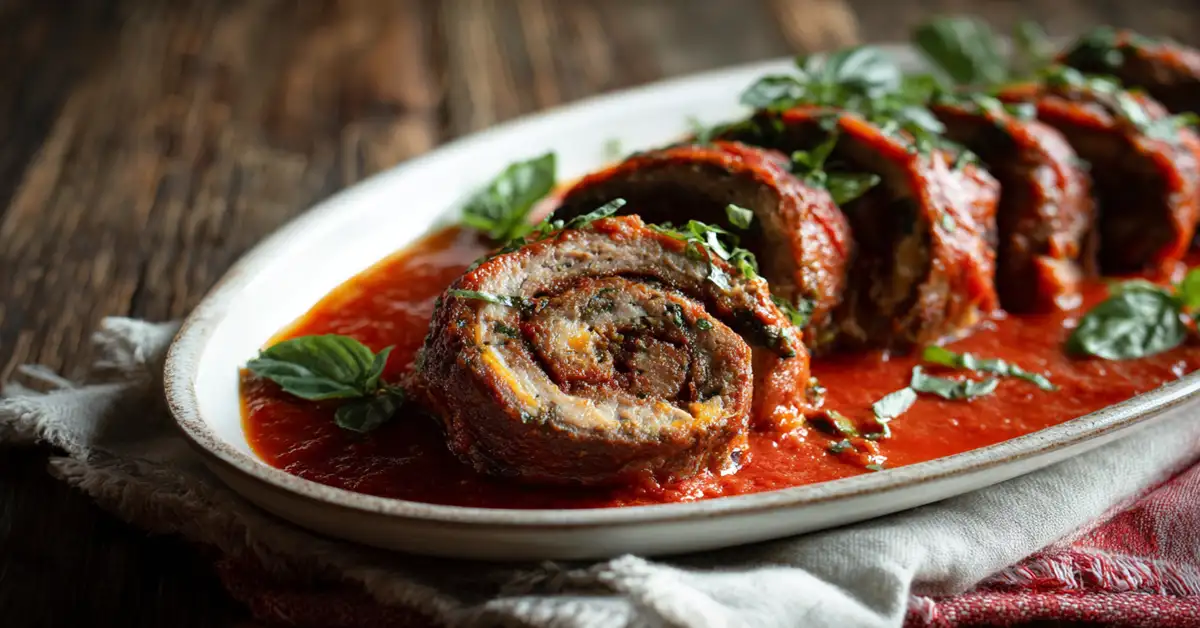
So there I was, Christmas Eve 2021, standing in my kitchen with what was supposed to be Giada’s braciole—except it looked more like a sad, unraveling beef scroll that had given up on life. My mother-in-law Francesca (who grew up in Calabria, so you know she has opinions) took one look and said something in Italian that I’m pretty sure wasn’t a compliment. The butcher’s twine had completely failed, the filling had escaped into the sauce, and honestly? I wanted to cry into my marinara.
But seventeen batches later (yes, seventeen), I’ve finally mastered Giada’s braciole recipe—and I’m sharing every single hard-won secret so you don’t have to suffer through your own Christmas Eve disaster.
Table of Contents

Giada’s Braciole (Stuffed Italian Beef Roll)
- Total Time: 2 hours 15 minutes
- Yield: 6–8 servings 1x
Description
Traditional Italian stuffed beef roll featuring flank steak filled with seasoned breadcrumbs, Parmesan, and fresh herbs, slowly braised in rich tomato sauce until fork-tender. This classic Giada-inspired recipe is perfect for Sunday dinners and special occasions.
Ingredients
For the Beef Roll:
1.5–2 lb flank steak (pounded to 1/4 inch thickness)
1 cup Italian-style breadcrumbs
1/2 cup freshly grated Parmesan cheese
1/4 cup freshly grated Pecorino Romano
4 cloves garlic (minced)
2 tablespoons fresh flat-leaf parsley (chopped)
4 tablespoons extra virgin olive oil (divided)
salt and freshly ground black pepper.
For the Sauce:
1/2 cup beef broth (to replace wine)
2 cups marinara sauce (homemade or quality jarred)
2 tablespoons tomato paste
fresh basil for garnish.
Instructions
Preparation: Don’t Skip These Steps
Step 1: Prep Your Workspace (5 minutes)
Clear a large work surface. You need room to work with this recipe. Get your butcher’s twine cut into 6-8 pieces, about 12 inches each. (I learned to pre-cut my twine after trying to manage raw meat and a ball of string simultaneously. It was not pretty.) Set your oven to preheat at 350°F.
Step 2: Pound the Flank Steak (10 minutes)
Lay your flank steak between two sheets of plastic wrap. Using the flat side of a meat mallet, pound from the center outward until it’s about 1/4 inch thick and roughly rectangular. Be patient here—rushing leads to uneven thickness, which leads to uneven cooking, which leads to sad braciole. Work the whole surface, not just the thick parts.
Step 3: Make the Filling (5 minutes)
In a medium bowl, combine breadcrumbs, both cheeses, minced garlic, parsley, and 2 tablespoons of olive oil. Mix until everything is evenly distributed. The mixture should hold together slightly when pressed. Season with salt and pepper—but go easy on the salt since the cheeses are already salty.
The Main Cooking Method
Step 4: Assemble the Roll (10 minutes)
Lay the pounded steak flat with the short end facing you. Sprinkle the breadcrumb mixture evenly over the surface, leaving about a 1-inch border on all sides (this is important—filling that reaches the edges will fall out). Starting from the short end closest to you, roll the steak up tightly like a jelly roll. Don’t worry if it’s not perfect—you’ll secure it with twine.
Step 5: Tie It Like You Mean It (5 minutes)
This is where I failed spectacularly for years. Tie the braciole at 4-5 intervals along its length, pulling the twine snug but not so tight you squeeze out filling. Also tie around both ends. The roll should feel secure but not strangled. Season the outside with salt and pepper.
Step 6: Sear for Color and Flavor (8-10 minutes)
Heat remaining 2 tablespoons olive oil in a large oven-safe skillet (Dutch oven works great) over medium-high heat. When the oil shimmers, carefully add the braciole. Brown on all sides—this takes about 8 minutes total. Don’t rush this step. That brown crust is flavor. That Maillard reaction is what separates good braciole from great braciole.
Step 7: Build the Sauce and Braise (90 minutes)
Remove braciole and set aside. Add beef broth to the hot pan, scraping up all those beautiful brown bits (that’s free flavor). Stir in tomato paste and cook for 1 minute. Add marinara sauce and bring to a simmer. Return the braciole to the pan, spooning some sauce over top.
Cover partially with foil and transfer to your preheated oven. Bake for 1 hour, basting every 30 minutes. Then uncover and bake another 30 minutes until the meat is fork-tender. Total cooking time: about 90 minutes.
Step 8: Rest and Slice (15 minutes)
Let the braciole rest in the sauce for at least 10 minutes. Remove to a cutting board, carefully cut away the twine, and slice crosswise into 1/2-inch rounds. Arrange on a platter, spoon that glorious sauce over top, and garnish with fresh basil. The slices should reveal a beautiful spiral of filling. The techniques here work beautifully with baked rigatoni (https://themediterraneanrecipe.com/easy-baked-rigatoni-recipe/) as a side dish.
Notes
Storage: Room temperature max 2 hours. Refrigerate in sauce 4-5 days. Freeze in sauce up to 3 months.
Make-Ahead: Cook completely up to 2 days ahead. Reheat covered at 325°F for 20-25 minutes. Flavors improve overnight.
Substitutions: Flank steak: top round or sirloin (1:1). Pecorino Romano: additional Parmesan (1:1). Breadcrumbs: almond flour for GF.
Dietary Modifications: Gluten-free: use GF breadcrumbs. Low-carb: omit breadcrumbs, use spinach-cheese filling. Dairy-free: omit cheeses, increase herbs.
Serving Suggestions: Serve over rigatoni or polenta with extra sauce. Crusty bread essential for sopping.
- Prep Time: 30 minutes
- Cook Time: 1 hour 45 minutes
- Category: Mediterranean launch recipe
- Method: Braising, Oven
- Cuisine: Italian/Mediterranean
Nutrition
- Serving Size: 2-3 slices (approximately 4 oz)
- Calories: 350 kcal
- Sugar: 5g
- Sodium: 620mg
- Fat: 20g
- Saturated Fat: 7g
- Unsaturated Fat: 11g
- Trans Fat: 0 g
- Carbohydrates: 14g
- Fiber: 2g
- Protein: 30g
- Cholesterol: 85mg
Why This Giada’s Braciole Recipe Actually Works
The Science of Braising Beef Rolls
Here’s what nobody tells you about braciole: it’s essentially controlled meat transformation. When you braise flank steak low and slow in tomato sauce, you’re breaking down collagen into gelatin—that’s what makes the meat go from chewy shoe leather to fork-tender perfection. Temperature matters here. Keep your oven at 350°F, and the braciole needs about 90 minutes total. Harold McGee (the food science guru) explains that collagen starts converting around 160°F, and you want to hold it there long enough for the magic to happen.
The breadcrumb filling does double duty—it adds flavor and acts as a moisture barrier, keeping the beef from drying out. The Parmesan and Pecorino Romano in Giada’s version create this umami bomb that intensifies as the braciole simmers. It’s basically Italian engineering at its finest.
When This Stuffed Beef Roll Steals the Show
Listen, Giada’s braciole isn’t a Tuesday-night-I’m-exhausted kind of meal (though you can totally make it ahead—more on that later). This is Sunday dinner. This is “the family is coming over and I want them to think I have my life together” food. My neighbor Tony, who’s been making braciole for forty years, once told me: “Braciole is how you show people you love them without having to say it.” (Tony is very dramatic, but he’s not wrong.)
This Italian stuffed beef roll pairs beautifully with rigatoni carbonara or just crusty bread to soak up that incredible sauce. Either way, prepare for compliments.
Essential Ingredients for Authentic Giada’s Braciole
The Complete Ingredient List

For the Beef Roll:
1.5-2 lb flank steak (pounded to 1/4 inch thickness)
1 cup Italian-style breadcrumbs
1/2 cup freshly grated Parmesan cheese
1/4 cup freshly grated Pecorino Romano
4 cloves garlic (minced)
2 tablespoons fresh flat-leaf parsley (chopped)
4 tablespoons extra virgin olive oil (divided)
salt and freshly ground black pepper.
For the Sauce:
1/2 cup beef broth (to replace wine)
2 cups marinara sauce (homemade or quality jarred)
2 tablespoons tomato paste
fresh basil for garnish.
The Game-Changer Everyone Overlooks
Pound that steak THIN. I’m talking 1/4 inch or less. My first several disasters happened because I was lazy about this step. Thick meat doesn’t roll properly, won’t cook evenly, and results in that chewy texture nobody wants. I use a meat mallet and honestly get a little aggressive with it—good stress relief, if nothing else. Cover the steak with plastic wrap first to avoid splashing and to get an even thickness. The meat should be thin enough that you can almost see through it in spots.
Best Meat Cuts for Braciole
| Meat Cut | Best For |
| Flank Steak | Classic choice, great marbling, becomes very tender when braised |
| Top Round | Budget-friendly, lean, needs thorough pounding |
| Sirloin | More marbling, richer flavor, slightly pricier |
| Bottom Round | Traditional in some regions, requires longer braising time |
USA Substitutions: Can’t find good flank steak? Top round works great—just ask your butcher to slice it thin (about 1/2 inch) and then pound it yourself. No Pecorino Romano? Use all Parmesan, though you’ll miss some of that sharp, salty kick. For the marinara, Rao’s is my go-to jarred sauce, but any quality marinara works. Just avoid anything with added sugar—your sauce will taste weird. The filling technique is similar to what makes spicy rigatoni so satisfying—quality ingredients, properly treated.
The Foolproof Method for Perfect Giada’s Braciole
Preparation: Don’t Skip These Steps
Step 1: Prep Your Workspace (5 minutes)
Clear a large work surface. You need room to work with this recipe. Get your butcher’s twine cut into 6-8 pieces, about 12 inches each. (I learned to pre-cut my twine after trying to manage raw meat and a ball of string simultaneously. It was not pretty.) Set your oven to preheat at 350°F.
Step 2: Pound the Flank Steak (10 minutes)
Lay your flank steak between two sheets of plastic wrap. Using the flat side of a meat mallet, pound from the center outward until it’s about 1/4 inch thick and roughly rectangular. Be patient here—rushing leads to uneven thickness, which leads to uneven cooking, which leads to sad braciole. Work the whole surface, not just the thick parts.

Step 3: Make the Filling (5 minutes)
In a medium bowl, combine breadcrumbs, both cheeses, minced garlic, parsley, and 2 tablespoons of olive oil. Mix until everything is evenly distributed. The mixture should hold together slightly when pressed. Season with salt and pepper—but go easy on the salt since the cheeses are already salty.
The Main Cooking Method
Step 4: Assemble the Roll (10 minutes)
Lay the pounded steak flat with the short end facing you. Sprinkle the breadcrumb mixture evenly over the surface, leaving about a 1-inch border on all sides (this is important—filling that reaches the edges will fall out). Starting from the short end closest to you, roll the steak up tightly like a jelly roll. Don’t worry if it’s not perfect—you’ll secure it with twine.
Step 5: Tie It Like You Mean It (5 minutes)
This is where I failed spectacularly for years. Tie the braciole at 4-5 intervals along its length, pulling the twine snug but not so tight you squeeze out filling. Also tie around both ends. The roll should feel secure but not strangled. Season the outside with salt and pepper.

Step 6: Sear for Color and Flavor (8-10 minutes)
Heat remaining 2 tablespoons olive oil in a large oven-safe skillet (Dutch oven works great) over medium-high heat. When the oil shimmers, carefully add the braciole. Brown on all sides—this takes about 8 minutes total. Don’t rush this step. That brown crust is flavor. That Maillard reaction is what separates good braciole from great braciole.

Step 7: Build the Sauce and Braise (90 minutes)
Remove braciole and set aside. Add beef broth to the hot pan, scraping up all those beautiful brown bits (that’s free flavor). Stir in tomato paste and cook for 1 minute. Add marinara sauce and bring to a simmer. Return the braciole to the pan, spooning some sauce over top.
Cover partially with foil and transfer to your preheated oven. Bake for 1 hour, basting every 30 minutes. Then uncover and bake another 30 minutes until the meat is fork-tender. Total cooking time: about 90 minutes.

Step 8: Rest and Slice (15 minutes)
Let the braciole rest in the sauce for at least 10 minutes. Remove to a cutting board, carefully cut away the twine, and slice crosswise into 1/2-inch rounds. Arrange on a platter, spoon that glorious sauce over top, and garnish with fresh basil. The slices should reveal a beautiful spiral of filling. The techniques here work beautifully with baked rigatoni as a side dish.

Creative Variations of Giada’s Braciole
Traditional Regional Twists
Braciole varies wildly across Italian regions, and honestly? They’re all delicious. My grandmother’s Sicilian version included raisins and pine nuts (sounds weird, tastes incredible—that sweet-savory thing really works). Some families add hard-boiled eggs to the center for a dramatic presentation when sliced.
| Variation | How to Make It |
| Sicilian Style | Add 2 tbsp golden raisins + 2 tbsp pine nuts to filling. Sweet-savory perfection |
| Egg-Stuffed | Place halved hard-boiled eggs along center before rolling. Beautiful presentation |
| Individual Rolls | Cut pounded steak into 4×6 inch pieces, make mini braciole. Easier for portion control |
| Slow Cooker Version | Brown as usual, then cook on low 6-8 hours in slow cooker. Hands-off but tender |
| Provolone Addition | Layer thin slices of provolone over breadcrumb filling before rolling. Extra cheesy |
Dietary Modifications
Gluten-Free: Use gluten-free breadcrumbs (almond flour works surprisingly well too). Everything else is naturally GF.
Low-Carb/Keto: Skip breadcrumbs entirely. Use a mixture of Parmesan, chopped spinach, and garlic as filling. Still delicious, way fewer carbs.
Dairy-Free: Omit cheeses from filling, add extra herbs and garlic. The meat and sauce carry plenty of flavor.
Budget-Friendly: Use top round instead of flank (about 30% cheaper), make individual rolls to stretch the meat further. Still impressive, easier on the wallet.
Kid-Friendly: Add shredded mozzarella to filling—kids love the cheese pull when sliced. Serve sauce on the side for dipping. Works great alongside crispy zucchini fritters for the veggie-resistant crowd.
Storage and Serving Tips for Giada’s Braciole
Proper Storage Techniques
Good news: braciole is actually better the next day. The flavors meld and deepen overnight. This makes it perfect for make-ahead entertaining.
Room Temperature: Maximum 2 hours (standard food safety applies).
Refrigerator: 4-5 days in an airtight container, stored in the sauce. The sauce keeps the meat moist.
Freezer: Up to 3 months! Freeze whole or sliced, covered in sauce. Thaw overnight in fridge, reheat gently covered at 300°F.
Meal Prep Strategies
Make Completely Ahead: Cook braciole 2 days before serving. Cool completely, slice, store covered in sauce. Reheat at 325°F for 20-25 minutes. Flavors are actually enhanced this way.
Partial Prep: Make the sauce up to 5 days ahead. Assemble and tie braciole (uncooked) up to 24 hours ahead—refrigerate tightly wrapped. Brown and braise day-of.
Reheating: Always reheat in the sauce, covered, at 325°F. Sliced braciole reheats in about 15 minutes, whole in about 25-30. Never microwave—it ruins the texture.
Perfect Pairings for Giada’s Braciole
| Pairing Type | Suggestions |
| Pasta Sides | Rigatoni, penne, or fresh fettuccine tossed with extra sauce |
| Bread | Crusty Italian bread, focaccia, or garlic bread for sauce-sopping |
| Vegetables | Roasted broccoli rabe, sauteed spinach, or simple green salad |
| Starch Alternatives | Creamy polenta, mashed potatoes, or roasted potatoes |
Nutritional Benefits of Giada’s Braciole
Full disclosure: I’m not a dietitian. But I’ve researched this because, well, I make braciole a lot and wanted to know what I was eating. The good news? Flank steak is actually one of the leaner beef cuts, and the portion sizes are reasonable since it’s so filling.
Macronutrient Breakdown (per serving, approximately)
| Nutrient | Amount |
| Calories | 320-380 kcal |
| Total Carbohydrates | 12-15g |
| Protein | 28-32g |
| Total Fat | 18-22g |
| Saturated Fat | 6-8g |
| Fiber | 2g |
| Sugar | 4-5g |
Key Micronutrients
| Micronutrient | Benefit |
| Iron (beef) | Supports oxygen transport, energy levels. Flank steak provides 15% DV |
| Zinc (beef) | Immune function, wound healing, about 35% DV per serving |
| B12 (beef) | Nerve function, red blood cell formation, over 100% DV |
| Lycopene (tomatoes) | Antioxidant, heart health, increases with cooking |
| Calcium (cheese) | Bone health, about 15% DV from cheese filling |
Glycemic Index: The dish is relatively low-GI due to the high protein and fat content. The breadcrumbs add some carbs, but in context of the whole meal, blood sugar impact is minimal. Compare this to pasta alone (GI ~55-60).
Health considerations: Beef braciole provides complete protein with all essential amino acids. The tomato sauce adds antioxidants, and the olive oil provides heart-healthy monounsaturated fats. It’s definitely comfort food, but it’s also genuinely nutritious. For lighter Mediterranean options, check out our Mediterranean salads .
Frequently Asked Questions About Giada’s Braciole
What is braciole and how do you pronounce it?
Braciole (pronounced brah-ZHOL-eh in Italian, or brah-ZHOL in Italian-American households) is a traditional Southern Italian dish of thin beef slices stuffed with a savory filling, rolled, tied, and braised in tomato sauce until tender. The name comes from the Italian word “brace” meaning “embers,” referring to the original cooking method over coals.
What’s the best cut of meat for making braciole?
Flank steak is the classic choice for Giada’s braciole because it’s flavorful, becomes tender when braised, and pounds out evenly. Top round and sirloin also work well. The key is pounding the meat thin (about 1/4 inch) regardless of which cut you choose. Some butchers will even pound it for you if you ask nicely.
How long does braciole need to cook to become tender?
Plan for about 90 minutes total braising time at 350°F. The first hour is covered (to trap moisture), then 30 minutes uncovered (to reduce the sauce). The meat should be fork-tender—if it’s still chewy, it needs more time. Some thicker rolls may need up to 2 hours.
Can I make braciole ahead of time for a dinner party?
Absolutely—in fact, braciole is BETTER when made ahead! The flavors deepen overnight. Cook completely, let cool, slice, and store in the sauce. Reheat gently (covered, 325°F, about 20 minutes) when ready to serve. It’s the perfect make-ahead dinner party main course.
Why does my filling fall out when I cook braciole?
This is the most common braciole problem! Three fixes: 1) Leave a 1-inch border when spreading filling—don’t go edge to edge. 2) Roll tightly and tie securely at 4-5 points along the length PLUS both ends. 3) Sear the seam-side first to help seal it. Some filling escape is normal; just push it back in or let it flavor the sauce.
Can I make Giada’s braciole in a slow cooker?
Yes! Brown the braciole first (this step is non-negotiable for flavor), then transfer to slow cooker with the sauce. Cook on low for 6-8 hours or high for 3-4 hours. The meat will be incredibly tender. Just note that the sauce won’t reduce as much, so you may want to simmer it separately before serving. For similar braised comfort food, try our mezzi rigatoni .
What do you serve with braciole?
Traditionally, braciole is served over pasta (the sauce does double duty) with crusty bread. Rigatoni, penne, or fresh fettuccine are perfect. For a lighter option, serve over creamy polenta or with roasted vegetables. Always have extra bread for sopping up that sauce—it’s basically required.
Pairing and Serving Ideas for Giada’s Braciole
This stuffed beef roll is rich and satisfying, so I balance it with something fresh and bright. The tomato sauce already brings acidity, but a good salad or simply-prepared vegetable really rounds out the meal.
Serving Ideas
| Occasion | Suggested Menu |
| Sunday Family Dinner | Antipasto platter to start + braciole over rigatoni + crusty bread + tiramisu |
| Holiday Feast | Minestrone soup + braciole with polenta + roasted vegetables + cannoli |
| Casual Dinner Party | Bruschetta + braciole + arugula salad + lemon olive oil cake |
| Make-Ahead Comfort | Braciole reheated in sauce + mashed potatoes + steamed broccoli |
Beverage Pairings (Non-Alcoholic)
Sparkling water with a squeeze of lemon cuts through the richness beautifully. Italian sodas (blood orange or lemon) work great. Strong espresso after dinner is traditional. For something different, try hibiscus iced tea—the tartness complements the tomato sauce surprisingly well. Pomegranate juice is another unexpected winner.
For dessert, go light after this substantial main course. Fresh fruit, a simple Mediterranean breakfast bowl repurposed as a parfait, or just espresso and biscotti. Save the heavy desserts for another night.
Final Thoughts on Mastering Giada’s Braciole
Make It Your Own
After all those batches (and one extremely memorable Christmas Eve disaster), here’s what I’ve learned: Giada’s braciole is more forgiving than it seems. The filling ratios can vary. The cooking time has some flexibility. The exact cheese blend? Not critical. What is critical: thin meat, tight rolling, good browning, and patient braising. Get those right, and you’re golden.
Join the Conversation
I’d genuinely love to hear how your braciole turns out. Did you nail it on the first try? (Lucky you.) Did your filling escape like mine did for, um, several years? Made any variation I should try? Drop a comment below—I read every one and love hearing about your kitchen wins (and disasters, honestly, those are more relatable).
And if you’re looking to expand your Italian comfort food repertoire, definitely check out our spinach and feta recipes (https://themediterraneanrecipe.com/spinach-and-feta/) for another crowd-pleaser. Happy cooking, and remember: even Francesca was eventually impressed. It only took me seventeen tries.