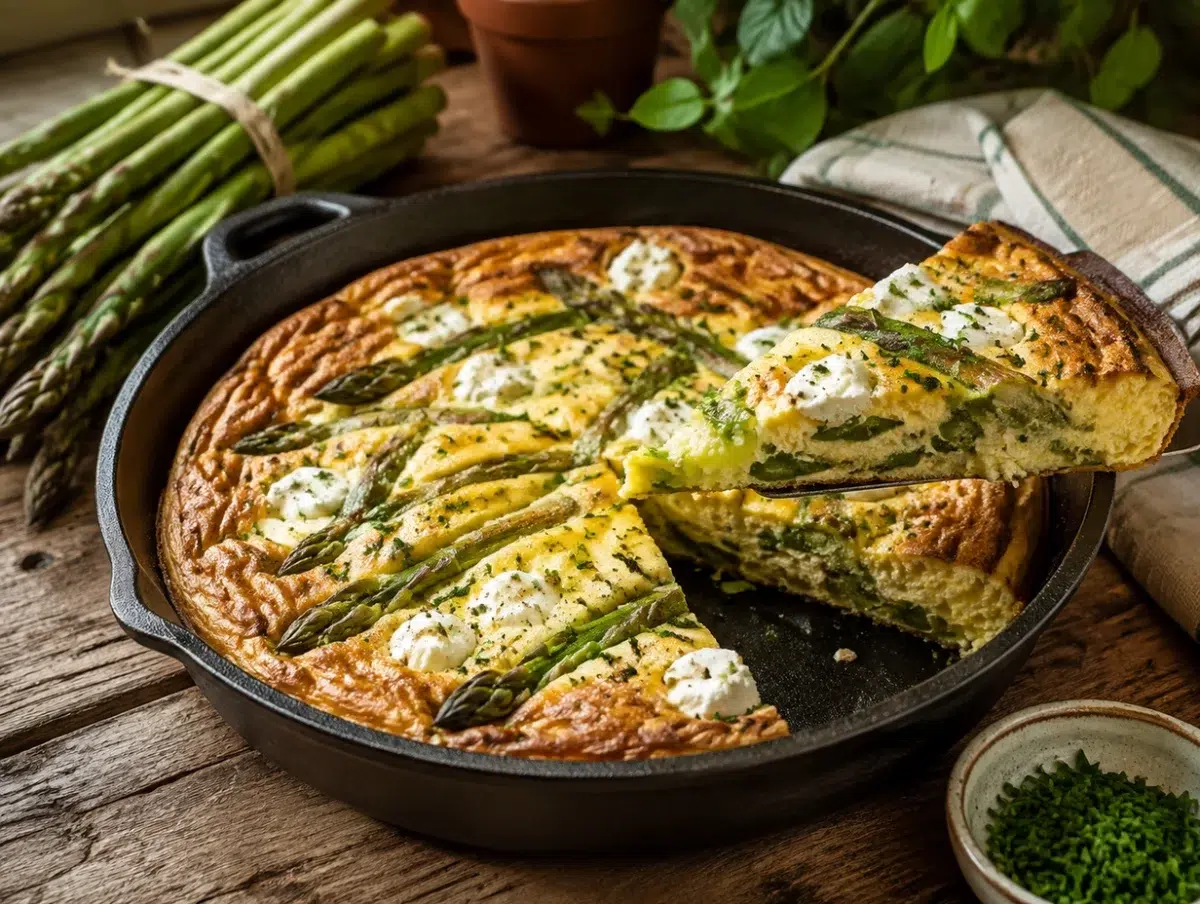
The asparagus appeared on a Tuesday. I remember because the laiki agora — the open-air market near my grandfather’s taverna in Chania — only set up on Tuesdays and Fridays. I was maybe nine years old, and my yiayia grabbed a fat bundle of wild asparagus so green it almost glowed, still damp from the morning dew on the hillside. “Today we make sfougato,” she announced — the Cretan word for frittata. The kitchen smelled of warm olive oil and fresh dill, and I can still hear the gentle hiss as she poured those golden, beaten eggs over the sizzling vegetables in her old tapsi.
That memory is the foundation of this spring asparagus & goat cheese frittata. It’s a dish that celebrates the season the way my family always has — with whatever the earth is offering at its peak, a generous hand with good olive oil, and eggs from our neighbor’s hens. Asparagus and eggs are a partnership that spans every corner of the Mediterranean, from Italian frittatas to Spanish tortillas to the Cretan sfougato I grew up eating.
This easy frittata recipe takes 30 minutes, uses one pan (a properly seasoned cast iron skillet is all you need), and produces something so golden, fluffy, and deeply satisfying that your guests will think you spent all morning cooking. You didn’t. That’s the beauty of it. Whether you’re feeding a crowd for a spring brunch recipe or making yourself a healthy Mediterranean egg dish on a Wednesday night — trust me, this one delivers.
Table of Contents
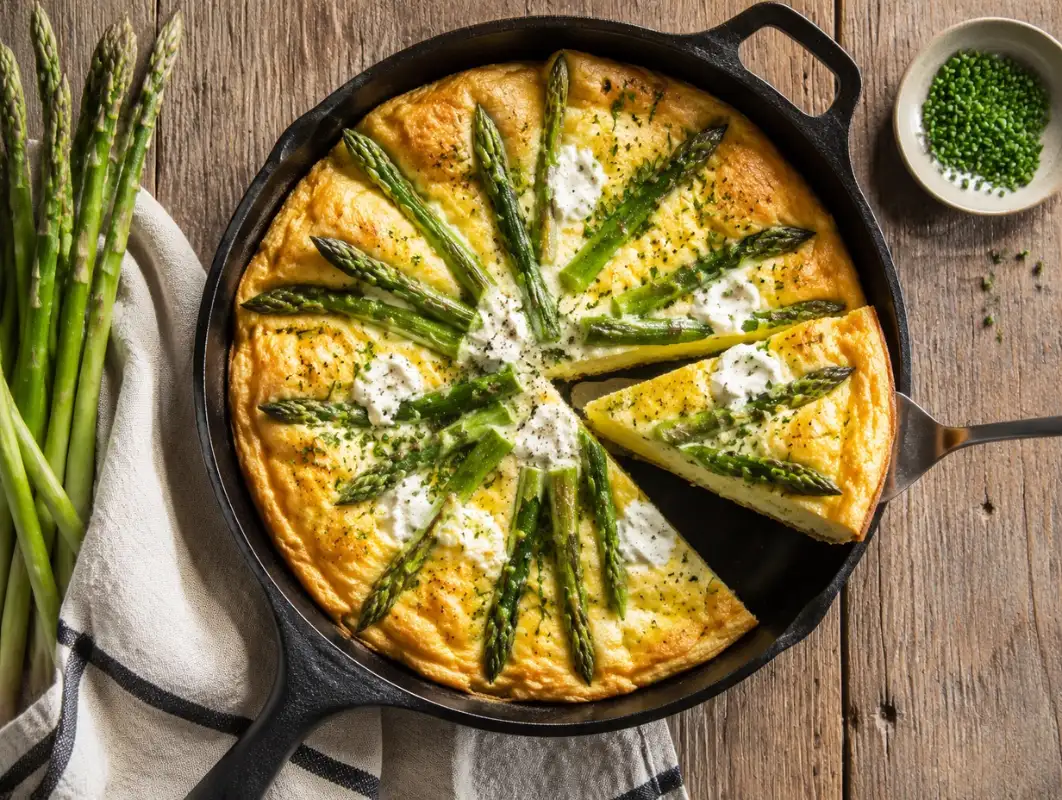
Spring Asparagus and Goat Cheese Frittata
Ingredients
Method
- 1. Preheat your oven broiler to high with a rack positioned 6 inches (15 cm) below the element.
- 2. Whisk eggs, milk, salt, pepper, dill, and lemon zest in a large bowl until frothy.
- 3. Heat olive oil in a 10-inch cast-iron skillet over medium heat. Sauté shallots for 3 minutes until translucent.
- 4. Add asparagus pieces (not tips) and sauté 2–3 minutes until bright green and crisp-tender.
- 5. Spread vegetables evenly. Reduce heat to medium-low. Pour egg mixture over vegetables.
- 6. Dot goat cheese over the surface and arrange asparagus tips on top.
- 7. Cook undisturbed 5–6 minutes until edges are set but center is still liquid.
- 8. Transfer skillet to oven. Broil 3–4 minutes until puffed and golden brown on top.
- 9. Rest in skillet 5 minutes. Slide onto cutting board or serve from pan.
- 10. Garnish with fresh dill, olive oil drizzle, lemon squeeze, and pepper. Cut into 6 wedges. Serve.
Notes
Storage:
Refrigerate in an airtight container for up to 4 days. Freeze individual slices wrapped in parchment and foil for up to 2 months.Make-Ahead:
Bake fully and refrigerate overnight. Serve cold, at room temperature, or reheat at 325°F (163°C) for 8–10 minutes. Alternatively, prep the egg mixture and sautéed veggies separately the night before.Key Substitutions:
Feta for goat cheese (use 80g, reduce salt). Broccolini or snap peas for asparagus. Tarragon or chives for dill. Oat milk for whole milk (dairy-free).Dietary Modifications:
Keto — already compliant. Dairy-free — use vegan cheese + oat milk. Higher protein — add 170g shredded chicken.Serving Suggestions:
Pair with a green salad, crusty bread, and Greek mountain tea or fresh orange juice. Excellent alongside our classic Greek lemon rice pilafi for a heartier meal.Related Recipes:
This frittata pairs beautifully with our Mediterranean chickpea power bowl for meal-prep lunches. For another egg-based showstopper, try our Greek feta egg bake. And when asparagus season ends, transition to our crispy zucchini fritters recipe for summer.Why This Spring Asparagus & Goat Cheese Frittata Is Special
The Technique That Changes Everything
Most frittata recipes tell you to dump everything in a pan and bake it. That works, but it won’t give you the golden, slightly crispy bottom and the creamy, custard-like center that separates a good frittata from a great one.
The secret is a two-stage approach: you start on the stovetop over medium-low heat to set the base and build that golden crust (Maillard reaction — the same browning that gives bread its toast flavor, as Harold McGee explains in On Food and Cooking), then you finish under the broiler for a puffed, golden top. This gives you contrast in every bite — crisp meeting creamy. My yiayia did this instinctively with her tapsi on the stovetop, then slid the whole thing into the wood-burning oven. Same principle, three generations later.
A Flavor Profile Built for Spring
What I love about this asparagus and cheese frittata is the interplay of flavors. The asparagus brings a grassy, almost sweet earthiness (it’s at its peak between March and June — don’t bother the rest of the year). The goat cheese adds a tangy creaminess that melts into soft, rich pockets throughout the eggs. Fresh dill and lemon zest brighten everything.
And beneath it all, a base of slowly caramelized shallots in good olive oil gives the whole dish a savory depth that reminds me of spring mornings in Crete. This vegetarian frittata is elegant enough for Easter brunch, simple enough for a Tuesday dinner, and satisfying enough that you won’t miss the meat. I’ve made it well over a hundred times, and it still makes me happy every single time. You’ll love this.
The Story Behind the Dish
Frittata: A Mediterranean Tradition by Many Names
The word “frittata” comes from the Italian friggere (to fry), but this style of baked egg dish exists across the Mediterranean under different names. In Greece, it’s sfougato or kagianas depending on the region. In Spain, the tortilla. In Tunisia, the tagine-style makhouda. The idea is universal: take seasonal vegetables, combine them with eggs, and turn something humble into something beautiful. Frittatas have always been peasant food in the best sense — nourishing, waste-nothing dishes made with what the garden and the hens provide.
My Yiayia’s Sfougato and the First Asparagus of Spring
In Crete, the arrival of wild asparagus in late March was a genuine event. My father and I would forage the thin, wispy stalks on the hillsides above Chania before dawn — he knew every hidden patch. My yiayia would blanch them briefly, then fold them into her egg mixture with fresh mint and a crumble of the soft myzithra cheese she made herself. This spring asparagus & goat cheese frittata is my modern tribute to her sfougato: same spirit, same reverence for seasonal ingredients, but with goat cheese standing in for the myzithra (they’re cousins, really — both tangy, fresh, and wonderful with eggs). She’d recognize this recipe in a heartbeat.
Essential Ingredients for Spring Asparagus & Goat Cheese Frittata
Core Ingredients
Every ingredient here pulls its weight. No filler, no afterthoughts — this is Mediterranean cooking at its most honest.
| Ingredient | Amount | Why It Matters | Authentic Pick | Substitution |
| Large eggs | 8 large | The custard base — protein structure and richness | Farm-fresh, free-range with deep golden yolks | 10 medium eggs (same total volume) |
| Fresh asparagus | 340 g (¾ lb / 1 bunch) | The star: grassy sweetness and vibrant color define this spring dish | Thin or medium spears, locally grown in season | Broccolini, snap peas, or young zucchini |
| Goat cheese (chèvre) | 115 g (4 oz / ½ cup crumbled) | Tangy, creamy pockets that melt beautifully in the egg custard | Fresh soft goat cheese log (no rind) | Feta, ricotta, or vegan cream cheese |
| Shallots | 2 medium, thinly sliced | Milder and sweeter than onions; caramelizes into a silky base | French shallots | ½ medium yellow onion or 3 green onions |
| Fresh dill | 2 tbsp chopped | Aromatic herb that’s a classic match for eggs and spring vegetables | Fresh Greek dill (anithos) | Fresh tarragon or chives |
| Extra virgin olive oil | 2 tbsp | Sautés the vegetables and prevents sticking; adds fruity depth | Cold-pressed Cretan EVOO from Kolymvari | Ghee or avocado oil |
| Whole milk | 3 tbsp | Loosens the egg mixture for a more tender, fluffy custard | Full-fat milk | Heavy cream for richer, or oat milk for dairy-light |
| Lemon zest | 1 tsp (from ½ lemon) | Bright aromatic finish that lifts all the other flavors | Fresh Cretan lemon | Meyer lemon zest or a pinch of sumac |
A word about the asparagus: my father taught me to choose spears that snap cleanly when you bend them — that sharp crack means freshness. Limp, bendy asparagus has lost its sugar and will taste flat. And the goat cheese? I buy the soft, rindless logs you find in the cheese section. It crumbles easily and melts into these impossibly creamy pockets. After testing this recipe with at least 8 different cheeses, the goat cheese version wins every time.
Dietary Substitutions & Pro Tips
| Dietary Need | Replace | With | Notes |
| Dairy-Free | Goat cheese + milk | Vegan cream cheese crumbles + oat milk | Add 1 tbsp nutritional yeast for extra savory depth |
| Vegan | Eggs + dairy | Chickpea flour batter (150g flour + 350ml water) + vegan cheese | Creates a firm, sliceable result; add ½ tsp black salt for eggy flavor |
| Keto / Low-Carb | No changes needed | Already low-carb as written | Only 4g net carbs per slice — add extra cheese if desired |
| Gluten-Free | No changes needed | Naturally gluten-free | Just ensure cross-contamination-free cheese if celiac |
| Nut-Free | No nuts in base recipe | Already nut-free | Safe as written; avoid pesto variations with pine nuts |
| Higher Protein | Standard recipe | Add 225 g (8 oz) shredded rotisserie chicken | Fold cooked chicken into the egg mixture before pouring |
Pro Tip: Always bring your eggs to room temperature before whisking — cold eggs produce a denser custard. I leave mine on the counter for 20 minutes while I prep everything else. It makes a genuine difference in how fluffy your frittata rises.
Equipment & Technique
What You’ll Need
| Traditional Tool | Modern Alternative | Why It Matters |
| Cretan copper tapsi | 10-inch (25 cm) cast-iron skillet | Cast iron retains heat evenly and goes from stovetop to oven — essential for the two-stage technique |
| Wood-fired oven | Oven broiler (high setting) | The broiler puffs and browns the top in 3–4 minutes, mimicking the radiant heat of a traditional oven |
| Stone mortar (for herbs) | Sharp knife and cutting board | Finely chopping dill and zest by hand releases the oils gently without bruising |
| Clay mixing bowl | Large glass or stainless steel bowl | Glass and steel won’t react with the lemon zest acids — avoid aluminum |
| Olive wood spatula | Silicone spatula (heat-resistant) | Flexible edge lets you lift and check the frittata bottom without tearing |
Mise en Place & Workspace Setup
This Mediterranean frittata comes together fast — about 30 minutes total — so having your mise en place ready is essential. Before you turn on the stove: trim and cut the asparagus, slice the shallots, crumble the goat cheese, chop the dill, zest the lemon, and whisk the eggs with milk, salt, and pepper in a large bowl. Position your oven rack about 6 inches (15 cm) below the broiler element and preheat it to high. Have a trivet or heat-safe surface ready for the hot skillet. One pan, zero stress. This is how we do it in a professional kitchen.
Step-by-Step Instructions for Spring Asparagus & Goat Cheese Frittata
Preparation (Steps 1–4)
Step 1: Trim the asparagus. Hold each spear near the bottom and bend it gently — it will snap naturally at the point where the tender part meets the woody base. Discard the tough ends (or save them for stock). Cut the top two-thirds of each spear into 1-inch (2.5 cm) pieces. Set aside 6–8 whole tips for decorating the top. If your spears are pencil-thin, cut them into 1.5-inch pieces instead — they cook faster.
Yiayia’s Tip: My yiayia always said the asparagus tells you where to cut. “Don’t fight it, Niko — let it break where it wants.” She was talking about asparagus. She was also talking about life.
Step 2: Whisk the eggs. Crack 8 large eggs into a bowl and add 3 tablespoons of whole milk, ½ teaspoon kosher salt, ¼ teaspoon black pepper, the chopped dill, and the lemon zest. Whisk vigorously for about 30 seconds until the mixture is uniform and slightly frothy. You want tiny bubbles — that’s air that will make your cast iron frittata fluffy. As J. Kenji López-Alt notes in The Food Lab, the milk proteins help stabilize those air bubbles during cooking, giving you a more tender result.
Step 3: Sauté the aromatics and asparagus. Heat 2 tablespoons of olive oil in a 10-inch cast-iron skillet over medium heat until it shimmers (not smoking — about 325°F / 163°C). Add the sliced shallots and cook, stirring occasionally, for 3 minutes until they’re translucent and fragrant. Add the asparagus pieces (not the reserved tips) and a pinch of salt. Sauté for 2–3 more minutes until the asparagus turns bright vivid green and is crisp-tender when you pierce it with a knife. Don’t overcook it here — it will cook more in the oven.
Step 4: Even out the vegetables. Using your spatula, spread the sautéed vegetables into an even, single layer across the bottom of the skillet. This matters — clumps of vegetables mean uneven cooking and soggy patches. Every bite should have asparagus in it.
Cooking & Assembly (Steps 5–10)
Step 5: Pour in the eggs. Reduce heat to medium-low (about 275°F / 135°C on the burner). Give your egg mixture one final whisk and pour it slowly and evenly over the vegetables. Tilt the skillet gently to make sure the eggs settle into all the gaps. Don’t stir from this point forward.
Step 6: Add the goat cheese and asparagus tips. Crumble the goat cheese in generous pieces over the surface — press them gently into the egg so they’re partially submerged. Arrange the reserved asparagus tips on top in a decorative pattern (or just scatter them — beauty is optional, flavor is mandatory). This is when your spring asparagus & goat cheese frittata starts to look really stunning.
Step 7: Cook undisturbed on the stovetop. Let the frittata cook without touching it for 5–6 minutes. The edges will begin to set and pull slightly away from the pan. The center will still look liquid — that’s fine and exactly what you want. Resist the urge to poke it. I used to shake the pan every 30 seconds out of anxiety and ended up with broken, scrambled-egg frittatas. Learn from my mistakes.
Yiayia’s Tip: “Don’t rush the eggs, Niko.” My yiayia said this to me every single time we cooked together. Low and slow on the bottom. Fast and hot on top. That’s the rhythm of a perfect baked egg dish.
Step 8: Finish under the broiler. Transfer the skillet to the oven, positioning it about 6 inches (15 cm) below the broiler. Broil on high for 3–4 minutes, watching closely — the top should puff dramatically and turn golden brown in spots. The goat cheese will soften and develop beautiful caramelized edges. The frittata is done when the center is just set (a slight jiggle is fine — it firms up as it rests) and a knife inserted in the center comes out clean.
Step 9: Rest, then release. Let the frittata rest in the skillet for 5 minutes. This rest period allows the residual heat to finish setting the center gently, and the eggs contract slightly, making it easier to release from the pan. Run a spatula around the edges and slide the frittata onto a cutting board or serving plate. If your skillet is well-seasoned, it should slide right out. If it resists (it happens — even to a Varoulko-trained chef), cut and serve directly from the pan.
Step 10: Garnish and serve. Scatter extra fresh dill over the top, add a final drizzle of your best olive oil, and finish with a crack of black pepper and a squeeze of lemon. Cut into 6 generous wedges. Serve warm, at room temperature, or even cold from the fridge the next day. Golden. Fluffy. Perfect.
The Secret Touches
Insider Techniques That Make the Difference
1. The Two-Stage Cook (“Tapsi Method”). Starting on the stovetop and finishing under the broiler gives you two different textures in one dish — a golden, slightly crispy base and a puffy, soufflé-like top. My yiayia’s tapsi sat directly on the coals for the base, then she’d shovel coals onto the lid for the top. Same idea, modern execution. The Maillard reaction on the bottom creates hundreds of new flavor compounds, while the broiler’s radiant heat gently puffs the top through steam expansion.
2. The Shallot Caramelization Base. Cooking the shallots slowly before adding the asparagus creates a sweet, savory foundation. Shallots contain more natural sugars than regular onions (about 6% vs 4%), which caramelize beautifully at medium heat. My mother always said the onions should “sing, not scream” — meaning a gentle sizzle, never a hard sear.
3. The Room-Temperature Egg Rule. Cold eggs straight from the fridge tighten when they hit the hot pan, creating a denser, less fluffy result. Room-temperature eggs (20 minutes on the counter) incorporate more air when whisked and set more gently, producing that coveted tender, custard-like texture. After testing 30+ frittatas in my Athens kitchen, I can tell you: this is the single biggest variable.
4. The Post-Oven Rest. Those 5 minutes of resting aren’t optional. The carryover heat finishes cooking the center without drying the edges, and the proteins relax slightly, making each slice hold together beautifully when you cut it. Skip it and you’ll get a runny center or a messy slice. Trust me on this one.
Common Mistakes to Avoid
| Mistake | What Happens | How to Fix It |
| Cooking on too-high heat | Bottom burns before center sets; bitter, rubbery texture | Keep stovetop at medium-low — the frittata should barely whisper, not sizzle aggressively |
| Overcooking the asparagus before adding eggs | Asparagus turns army-green and mushy in the oven | Sauté only 2–3 minutes until bright green and still slightly firm — it continues cooking in the egg |
| Opening the oven door during broiling | Temperature drops; frittata deflates and won’t puff properly | Use the oven light to monitor — open only to check doneness in the last minute |
| Skipping the rest period | Center is still liquid when sliced; frittata falls apart on the plate | Always rest 5 full minutes in the skillet before slicing or unmolding |
| Using a skillet that’s too large | Thin frittata that’s dry and rubbery with no custardy center | Use a 10-inch (25 cm) skillet for 8 eggs — you want the frittata about 1.5 inches thick |
Variations & Serving Ideas
Regional Twists and Modern Adaptations
In Crete, you’d see this with wild asparagus, fresh mint, and soft myzithra cheese — incredibly delicate. On the Greek islands, they might add capers and sun-dried tomatoes for a punchy, salty contrast. Mainland Greek cooks often fold in spinach and feta for a spanakopita-inspired version, much like our spinach and feta combination that works beautifully in egg dishes.
For a heartier spring frittata, add roasted baby potatoes (thinly sliced) to the sauté stage — they turn golden and crispy on the bottom. Want to make this a weeknight dinner in 20 minutes? Use frozen asparagus (thawed and patted dry) and pre-crumbled goat cheese. Not as romantic as the farmers’ market version, but still delicious. For a Mediterranean frittata with even more vegetables, fold in a handful of peas, artichoke hearts, or roasted red peppers. The technique stays the same — only the filling changes, similar to how we build our versatile gemista Greek stuffed peppers and tomatoes.
What to Serve Alongside
A simple green salad dressed with lemon and olive oil is the classic partner — the acidity cuts through the egg richness perfectly. For a full brunch spread, add our Mediterranean hummus breakfast bowl and a basket of warm crusty bread (our garlic Parmesan focaccia is stunning here). A bowl of cherry tomatoes, some Kalamata olives, and a few slices of cucumber complete the table.
For beverages — always non-alcoholic at my table for these recipes — Greek mountain tea (tsai tou vounou) with a drizzle of honey is my first choice. Fresh-squeezed orange juice, iced chamomile tea with lemon, or sparkling water with cucumber and mint all work beautifully. For a special brunch, try hibiscus iced tea with a splash of pomegranate juice — the tartness is gorgeous alongside the rich, creamy frittata.
Storage & Reheating for Spring Asparagus & Goat Cheese Frittata
How to Store Your Frittata
Good news: this baked egg dish stores and reheats beautifully. It’s one of the few egg recipes I’d call meal-prep friendly.
| Method | Container | Duration | Notes |
| Refrigerator (whole or sliced) | Airtight container or wrapped tightly in plastic wrap | Up to 4 days | Keeps well; flavors actually deepen overnight in the fridge |
| Freezer (individual slices) | Wrap each slice in parchment then foil; store in freezer bag | Up to 2 months | Thaw overnight in fridge or microwave from frozen at 50% power |
| Room temperature (for serving) | Covered plate or under a clean tea towel | Up to 2 hours | Perfect for brunch buffets — frittata is delicious at room temp |
| Meal prep portions | Individual airtight containers | 3–4 days in fridge | Pack with a small side salad for grab-and-go lunches all week |
Reheating Methods & Freshness Tips
Oven method (best results): Preheat to 325°F (163°C), place slices on a baking sheet, and warm for 8–10 minutes. This restores some of the puffiness and re-crisps the bottom. Stovetop: Warm slices in a lightly oiled skillet over medium-low heat, covered, for 3–4 minutes. Microwave: 60–90 seconds at 50% power (higher power makes eggs rubbery). Whichever method you choose, add fresh toppings after reheating: a crack of pepper, fresh dill, a squeeze of lemon, and a drizzle of olive oil. It brings the frittata right back to life — almost as good as fresh from the oven.
Frequently Asked Questions
Substitution & Technique Questions
Can I use thick asparagus instead of thin spears?
Absolutely — just slice them in half lengthwise first, then cut into pieces. Thick spears have a slightly more robust flavor that holds up beautifully in this asparagus frittata recipe. Add an extra minute to the sauté time so they cook through. I actually prefer them for this dish — they give you more satisfying, toothsome bites.
What if I don’t have a cast-iron skillet?
Any oven-safe 10-inch skillet works — stainless steel or an oven-safe nonstick pan. The key is that it must go safely under the broiler. Avoid anything with plastic handles. If using nonstick, reduce the oil slightly and watch the broiler carefully, as some nonstick coatings have lower heat tolerances. A cast iron frittata has the best golden crust, but you’ll still get great results with alternatives.
Can I substitute feta for the goat cheese?
Yes! Feta is a fantastic swap — it’s saltier and firmer, so use about 80g instead of 115g, and reduce your added salt by half. Crumble it into larger chunks for the best pockets of flavor. In fact, our Greek feta egg bake uses this exact approach with beautiful results. Ricotta is another lovely option for a milder, creamier frittata.
How do I know when the frittata is done?
The edges should be set and slightly golden. The center should jiggle very gently — like a barely-set custard — when you shake the pan. Insert a thin knife or toothpick into the center; it should come out clean or with just a tiny smear of moist egg. Remember, it continues cooking for 5 minutes during the rest, so pull it slightly early rather than late. Overcooked frittata is dry frittata, and life’s too short for dry eggs.
Why did my frittata stick to the pan?
This usually means the skillet wasn’t properly preheated or seasoned. Always heat your oil until it shimmers before adding ingredients. If using cast iron, make sure it’s well-seasoned. Adding a thin layer of oil and swirling it around the sides before pouring the eggs also helps. If it does stick, don’t panic — just cut and serve from the pan. (I’ve done this at dinner parties and nobody cared.)
Dietary, Make-Ahead & Authenticity Questions
Is this spring frittata keto-friendly?
Yes! With only about 4g of net carbs per serving, this is a naturally keto and low-carb recipe. The asparagus contributes most of the carbs, and it’s offset by 18g of protein and 15g of healthy fats per slice. If you want to make it even richer for keto, substitute heavy cream for the milk and add an extra ounce of goat cheese. No modifications needed — it’s one of my favorite healthy brunch ideas for keto eaters.
Can I make this frittata ahead of time?
This is one of the best make-ahead recipes I know. Bake the frittata completely, let it cool to room temperature, then refrigerate overnight. Serve cold or at room temperature the next day (it’s genuinely delicious cold), or reheat gently in a 325°F oven for 10 minutes. You can also prep the egg mixture and sautéed vegetables separately the night before — just combine and cook fresh in the morning for a brunch that’s done in 15 minutes.
Is asparagus frittata traditionally Greek?
Egg dishes with seasonal vegetables — including wild asparagus — are deeply traditional in Cretan and broader Greek cuisine. The Greek sfougato is the direct ancestor of what we now call frittata. While the Italian name is more widely known, the tradition belongs to the entire Mediterranean. My family’s version uses olive oil rather than butter, and Greek herbs like dill instead of Italian basil, keeping it firmly rooted in our Cretan heritage.
Can I add meat to this vegetarian frittata?
Of course! Shredded cooked chicken, smoked turkey, or crumbled beef sausage all work wonderfully — just fold them into the egg mixture before pouring. About 170g (6 oz) of cooked protein is the right amount for 8 eggs. For a beautifully complementary protein, try shredded chicken similar to what we use in our chicken shawarma crispy rice salad.
What other vegetables work in a frittata?
Almost anything! Spinach, mushrooms, roasted red peppers, zucchini, peas, artichoke hearts, sun-dried tomatoes, and caramelized onions are all brilliant. The rule is: cook watery vegetables first and squeeze out excess moisture. Our kolokithokeftedes zucchini fritters recipe uses the same moisture-removal technique that applies here if you’re using zucchini as a swap.
From My Greek Kitchen to Yours
Bringing Greece to Your Table
Every spring, when I see the first asparagus at the Athens farmer’s market, I’m right back on that hillside in Chania with my father, filling a canvas bag with wild spears before the sun was fully up. This spring asparagus & goat cheese frittata carries that memory forward — simple ingredients handled with care, cooked in one pan, shared with people I love.
That’s the heart of Mediterranean cooking: not fussy techniques or expensive ingredients, but intention. Attention to what’s in season. Generosity with good olive oil. The patience to let a frittata cook slowly on the bottom before blasting it with heat on top. You don’t need to be Greek to cook like this. You just need to care.
When you make this — and I really hope you do — tell me about it. Leave a comment, tag me with a photo, argue with me about whether dill or tarragon is better (it’s dill, but I’ll listen). Kali orexi! — bon appétit, from my kitchen to yours.
More Mediterranean Recipes You’ll Love
If this frittata has you craving more Mediterranean egg dishes, our Greek feta egg bake is a gorgeous oven-baked cousin that’s perfect for feeding a crowd. For a lighter spring lunch, the Mediterranean white bean salad pairs beautifully with a warm frittata slice. And when you’re ready for dinner, our Greek chicken with lemon and feta uses the same tangy, bright flavor profile in a heartier main. Explore, cook, and eat well — the Mediterranean way.